
Quick Answer
Yes. Patreon can be predictable income for global professionals when you run it as business operations, not creator side cash. Reconcile each withdrawal in the Payouts dashboard against earnings and tax CSVs before posting revenue, and pause automation when amounts or dates do not match. Price from net payout instead of gross pledges, because standard fees, processing, payout costs, and currency conversion can all reduce margin. Keep continuity by exporting consented contacts and maintaining a backup communication channel.
Make the go/no-go decision through four lenses at once#
Make this decision through four lenses at once: strategic fit, compliance load, platform dependency, and operational overhead. If the offer only works when you ignore one of those, it is not a healthy product line yet. A sampled creator page from Decameron Project shows separate Membership and Posts navigation labels, which is the right mental model here. It is an ongoing offer tied to publishing, not a casual side button.
Your setup work falls into three risk domains. For tax complexity, decide who will verify how this revenue is treated in your jurisdiction and where the supporting records will live. For platform risk, define what must stay under your control outside the platform: core offer copy, customer communications, and the broader audience relationship where consent allows. For business integration, assign ownership for monthly reconciliation, member support, and delivery checks. If nobody owns those jobs, you get the failure mode the sample story hints at: "Too much work, too few hands."
One early warning matters. On the sampled Patreon post dated Mar 28, 2020, the visible body is narrative text, not policy or compliance guidance. Do not treat a creator page as your source of truth for fees, tax treatment, or legal handling.
Minimum controls before launch#
| Control | Requirement |
|---|---|
| Public page check | Verify your public page as a visitor: "Membership" and "Posts" are visible, and the offer is easy to understand |
| Evidence pack | Create an evidence pack: launch copy, benefit descriptions, member communications, and revenue records |
| Named owners | Name one owner for support and one for record review, even if both are you |
| Backup channel | Set a backup channel for audience communication outside the platform |
This is only your go/no-go lens. It does not cover fee math, jurisdiction-specific tax handling, or day-to-day operations. Related: How to monetize a 'YouTube Channel'.
Is a Membership Model the Right Strategic Asset for Your Business?#
A membership is a strategic asset only if it strengthens your core business without adding operational drag you cannot sustain. If it requires constant extra content, support, and admin that your current system cannot absorb, it will usually become a burden before it becomes reliable revenue.
Treat this as a fit decision, not a revenue fantasy: does membership match your audience behavior, your delivery cadence, and the path into your primary offer?
Qualify the model before you price it#
Start with audience quality, not follower count. Focus on people already showing repeat intent: opening emails, replying, attending sessions, buying smaller offers, or returning without heavy prompting. If that group is weak, a paid layer usually exposes the gap instead of fixing it.
| Fit area | What supports it | What weakens it |
|---|---|---|
| Audience quality | People already showing repeat intent: opening emails, replying, attending sessions, buying smaller offers, or returning without heavy prompting | If that group is weak, a paid layer usually exposes the gap instead of fixing it |
| Delivery cadence | Deliver repeat value on schedule; map 90 days of member benefits before launch | Delivery depends on custom one-off replies, ad hoc coaching, or last-minute posts |
| Retention logic | Ongoing analysis, regular office hours, a useful archive, or consistent community access can support retention | One-time novelty usually cannot |
Next, pressure-test delivery cadence. Membership works when you can deliver repeat value on schedule. A practical check is to map 90 days of member benefits before launch. If delivery depends on custom one-off replies, ad hoc coaching, or last-minute posts, you are likely setting up the same failure mode: too much work, too few hands.
Then test retention logic. Ask what keeps someone subscribed after month one. Ongoing analysis, regular office hours, a useful archive, or consistent community access can support retention. One-time novelty usually cannot. For consulting or project-led businesses, the strongest fit is when membership warms leads, builds trust, or creates a lower-risk entry into your pipeline.
Build a forecast with verified assumptions#
Use a planning template, then keep each assumption unresolved until source records or your own cohort data verify it:
Formula input to verify: confirm your current conversion benchmark from your own audience data before using it. Then calculate engaged audience size × verified conversion benchmark × average monthly tier price = starting gross monthly membership revenue.
Stress-test it with retention:
Formula input to verify: confirm your current retention assumption from your own cohort data before using it. Then calculate starting paid members × verified month-3 retention assumption = likely ongoing member base.
Keep these assumptions in your evidence pack with launch copy, tier promises, and support plan so you can audit the decision later.
Choose the platform by operating model#
| Decision lens | Patreon | OnlyFans | What you need to verify |
|---|---|---|---|
| Offer shape | Membership with perks and community tools, including tiered rewards | Subscriptions, tips, pay-per-view, and direct messaging | Which model matches how you sell and how much support load you can run |
| Cash timing | Comparison article claims payouts on the first of each month | Comparison article claims fan billing tied to sign-up date | Whether fixed monthly timing or rolling cash-in fits your cashflow |
| Brand and policy fit | Comparison article says explicit content is banned | Comparison article says explicit content is allowed alongside other content | Whether platform policy aligns with your brand, audience, and content risk profile |
| Operations and exit readiness | Evidence here does not establish ownership, portability, payout flexibility, compliance burden, or integration differences | Same limitation | Verify payout routes, records access, export options, and accounting handoff before committing |
Go / no-go checkpoint#
Go if you can clearly define the member outcome, deliver it consistently for 90 days, and show how it supports your primary offer pipeline.
No-go, for now, if your plan depends on vague community momentum, unverified conversion assumptions, or platform convenience masking real operational work.
If this is a strategic yes, move next to fee math, compliance handling, and platform-risk controls. Related: How to Calculate Your Billable Rate as a Freelancer.
The Financial Deep Dive: Calculating Your True Net Profit from Patreon#
Your real margin is what settles in your account after every fee layer and timing delay, not the headline plan fee. Model the path from gross payments to available balance to final settled cash each month.
Audit every deduction#
Use this as an operator checklist:
- Start with gross member payments for the period.
- Subtract the platform fee: confirm the current platform fee with the provider before relying on it.
- Subtract payment processing fees: confirm the current processing rule with the provider by payment method, location, and currency.
- Subtract currency conversion fees when payment and payout currencies differ: confirm the current conversion fee with the provider using the Patreon pricing docs.
- Subtract the payout fee at withdrawal: confirm the current payout fee with the provider by payout method, currency, and country.
- Flag timing effects separately from fee effects: iOS purchases can follow Apple's 30% service-fee path and may stay pending for 75 days before becoming withdrawable.
Reusable net-payout model template#
Patreon states your balance already reflects platform, processing, and conversion deductions before payout. So reconcile in two steps: expected available balance first, then payout-fee impact.
| Line item | Model formula | Your input |
|---|---|---|
| Gross member payments | Total successful payments in period | Confirm the gross payment total from your own records |
| Platform fee | Gross x verified platform fee | Confirm the current platform fee with the provider |
| Processing fees | Tax-inclusive payment base x verified processing rule | Confirm the current processing rule with the provider |
| FX conversion impact | Non-payout-currency payments x verified conversion fee | Confirm the current conversion fee with the provider |
| Expected available balance | Gross - platform - processing - FX | Expected available balance pending reconciliation |
| Payout method impact | Verified payout fee for selected rail, currency, and country | Confirm the current payout fee with the provider |
| Final settled cash | Expected available balance - payout fee | Final settled cash pending reconciliation |
| Final margin | Final settled cash / Gross | Final margin pending reconciliation |
Run this against Patreon's monthly payouts CSV and your ledger each month. If results drift, check tax-inclusive processing basis, currency mix, and payout method assumptions first.
If you also sell one-time purchases, verify current Patreon docs before fixing your assumptions: help-center pages currently describe this fee in different ways, so treat exact values as verification-required.
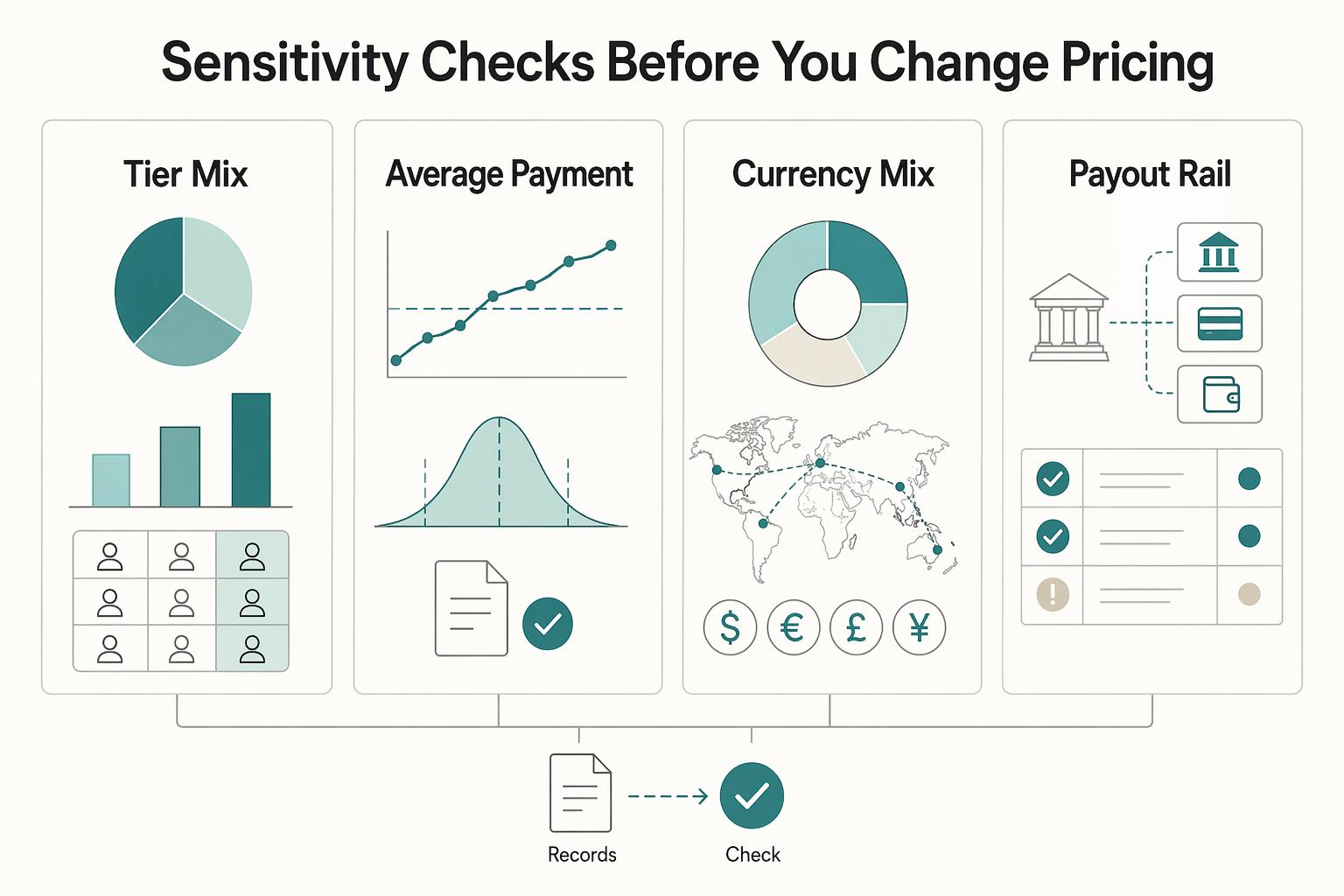
Sensitivity checks before you change pricing#
Before you change tiers or offers, run scenarios on these inputs in your own sheet:
| Scenario input | What to test |
|---|---|
| Tier mix | Shift member counts across tiers and compare margin and cash timing outcomes |
| Average payment size | Test smaller vs larger payment patterns against processing assumptions |
| Currency mix | Increase/decrease non-payout-currency share and measure FX impact |
| Payout rail | Compare withdrawal fee impact by payout method/currency/country setup |
Use this multi-currency decision path:
- Pick a payout currency that matches your most stable paid-member currency mix.
- Route payouts to an account setup that can hold that currency cleanly.
- Reconcile monthly in one base reporting currency using Patreon CSV data plus payout receipts.
- Revisit the setup when member geography or payment-currency patterns shift for multiple cycles.
Do not switch payout currency casually: Patreon documents a 31-day limit between switches and requires $0 available balance before initiating a change. Also plan around payout-method edits, which can trigger a 5-day payout hold.
For a step-by-step walkthrough, see YouTube Sponsorships for Creators Who Want to Get Paid on Time.
The Compliance Engine: Managing the Tax & Legal Realities of Your Patreon Income#
Treat Patreon as operating revenue, not side money. Your compliance workflow should run in this order: entity context, dedicated accounts, bookkeeping flow, then tax reserve.
Set your baseline workflow first#
Start by confirming your operating context. If you have not formed a separate entity, you generally still report this as your own business income. Patreon states that, in many jurisdictions, money you receive from members and customers is taxable income, and IRS guidance for U.S. self-employed filers generally expects both income-tax and self-employment-tax handling.
Then lock in clean money movement and books:
- Route payouts to a dedicated business checking account.
- Record gross income first, then track fees/deductions separately.
- Reconcile Patreon exports to bank deposits each month.
- Store support files with each close (payout CSV, bank record, tax docs).
This matters because your records need to show gross income plus deductions/credits, not only net cash.
Finally, make tax reserve automatic. For U.S. self-employed workflows, IRS guidance generally assumes annual filing plus estimated-tax payments during the year, and estimated tax can cover both income tax and self-employment tax. Verify current estimated-tax and self-employment rules against official IRS records before setting reserves, then sweep a fixed reserve from each payout into a separate tax account on reconciliation day. If you underpay during the year, penalties can apply.
For platform tax-document workflows, do not wait for year-end surprises. Verify the current Patreon tax-form trigger against platform records, then complete required onboarding forms as soon as your account approaches it.
Run compliance as three separate jobs#
Use this split so nothing gets missed:
| Job | What you own | Operational control |
|---|---|---|
| Income reporting | Report taxable business income regardless of whether a platform form arrives | Confirm the current reporting trigger from the official source; do not treat form thresholds as the source of taxability |
| Indirect tax handling | Map where Patreon handles collection/remittance vs where your own obligations may still exist | Re-check tax settings whenever you change benefits, tiers, or bundles |
| Documentation controls | Keep an audit-ready trail by period and country | Archive payout CSVs, country tax breakdown downloads, bank records, and classification evidence |
For indirect tax specifically, Patreon uses "VAT" as an umbrella label that includes VAT/GST/HST. Patreon also states tax applied depends on member location and what you offer. In many cases, Patreon processes and remits VAT it collects and adds it on top of membership price, but Patreon also says creators may still have obligations in some jurisdictions, including cases where VAT obligations are shared through a withhold VAT mechanism.
Your highest-leverage control is benefit classification. Patreon warns that tax settings can change outcomes and poor setup can increase tax applied. Any time you edit perks or tier structure, review classification settings before publishing.
For record retention, keep records long enough for every jurisdiction you touch. IRS guidance commonly suggests three years, but use the longer local rule where required.
If you live abroad, add a residency checkpoint before filing decisions#
If you are a U.S. citizen or resident abroad, you generally still have U.S. filing obligations. Before you assume foreign-earned treatment applies, run a checkpoint in order:
- Confirm your current tax residency position.
- Confirm whether your tax home is in a foreign country for the period.
- Verify current physical-presence or bona-fide-residence criteria against official IRS records before relying on foreign-earned treatment.
- Confirm local registration and social-tax exposure where you are living/working.
Keep one rule explicit: FEIE can reduce regular income tax, but IRS guidance says it does not reduce self-employment tax on net profit. If you are moving across countries or banking jurisdictions, get advisor confirmation before assuming your setup is compliant.
This pairs well with our guide on Canadian Robo-Advisors for Global Professionals: Compliance, FX, and Account Fit.
The Risk Mitigation Framework: De-Risking Your Membership Revenue#
Your main risk is concentration: if one Patreon account fails, revenue, member communication, and support can all fail at once. Treat risk control as a system, not a one-time setup.
Use this practical risk register:
- Policy risk: Patreon says it may terminate accounts for terms or policy violations, and Trust & Safety can suspend creator accounts for frequent or severe Community Guidelines violations. During suspension, existing members are not billed, new members cannot join, and you may lose actions like DMs, comments, and chats.
- Payment-rail risk: Payout timing can slip. Patreon documents a 5-day hold when you add or update a payout method, pending windows of up to 7 days for Commerce on web/Android, and up to 75 days for iOS in-app purchase funds.
- Account-access risk: Login failure is an avoidable outage. Patreon 2FA uses a 6-digit code at login, so enable it and make sure recovery access is not tied to one person.
- Concentration risk: If membership is your only recurring revenue stream, any lock, review, or policy dispute can hit cash flow immediately.
Build portability before you need it#
Audience ownership only helps if you have already tested it. Patreon provides export workflows through Relationship Manager, and Patreon says fan emails can be exported at any time, but portability is only real after you export, validate, and sync into channels you control.
Move contact data carefully. Patreon's creator privacy materials describe Patreon as a data controller and the creator as a data processor for Patron Data, so only use exported contact data where you have consent or another valid legal basis in your jurisdiction.
Keep the execution plan simple:
- Capture consented contact data.
- Sync to your owned email channel.
- Keep one backup broadcast path outside the platform.
- Validate field mapping after export/import, not just integration setup.
- If you run custom ops, use Patreon webhooks so pledge-status events also land in your own systems.
Keep a continuity response ready#
When access or billing breaks, speed matters more than polish. Run this sequence:
- Identify the event type: login/access issue, payout hold, or Trust & Safety enforcement.
- Preserve evidence immediately: account state, payout status, relevant notices, and export files.
- If Patreon contacted you, reply to the Trust & Safety or removal email with supplemental evidence for appeal.
- Communicate through owned channels first, then secondary channels, so members know where updates will appear.
Avoid the common failure mode: waiting for support before communicating. Suspension can limit on-platform communication, so your fallback path must already be live.
| Channel | Dependency risk | Recovery speed after disruption | Operational control |
|---|---|---|---|
| Patreon membership | High: billing, access, and much member interaction sit on one platform. | Medium if you already export contacts, keep records, and have backup communication paths; low if you do not. | Medium: exports and webhooks help, but platform policy and payout timing still govern key operations. |
| Substack | Medium: still platform-dependent, but subscriber CSV export exists and published content is stated as yours to own. | Medium to fast when subscriber exports and content archives are current. | Medium to high because portability is clearer than in closed community-only setups. |
| Ghost | Lower: member exports can be imported to another Ghost site or reformatted for other platforms. | Fast when exports are current and your import path is documented. | High relative to hosted membership platforms due to export/import flexibility. |
| Buy Me a Coffee | Medium to high: payouts run through Stripe Standard Connect, and first payout enters review. | Slower at start: first payout may take 7-14 days; unresolved appeal/verification beyond 30 days can trigger refunds and deactivation. | Medium to low: useful as an additional channel, but review/enforcement still affects access to funds. |
Your de-risking minimum standard:
- Enable 2FA; document login ownership and recovery access.
- Export contacts from Relationship Manager and confirm successful import into an owned channel.
- Keep one non-platform broadcast path active and test it on a recurring cadence you define.
- Maintain a ready evidence pack for support, payout, and appeal workflows.
- Verify the current platform policy checkpoint against official platform records.
- Review revenue concentration on a fixed schedule and reduce single-channel exposure when needed.
You might also find this useful: Affiliate Marketing for Creators Who Need Predictable Payouts. Want a quick next step if you're setting this up as a creator? Try the free invoice generator.
The Professional Operations Stack: Integrating Patreon Into Your Workflow#
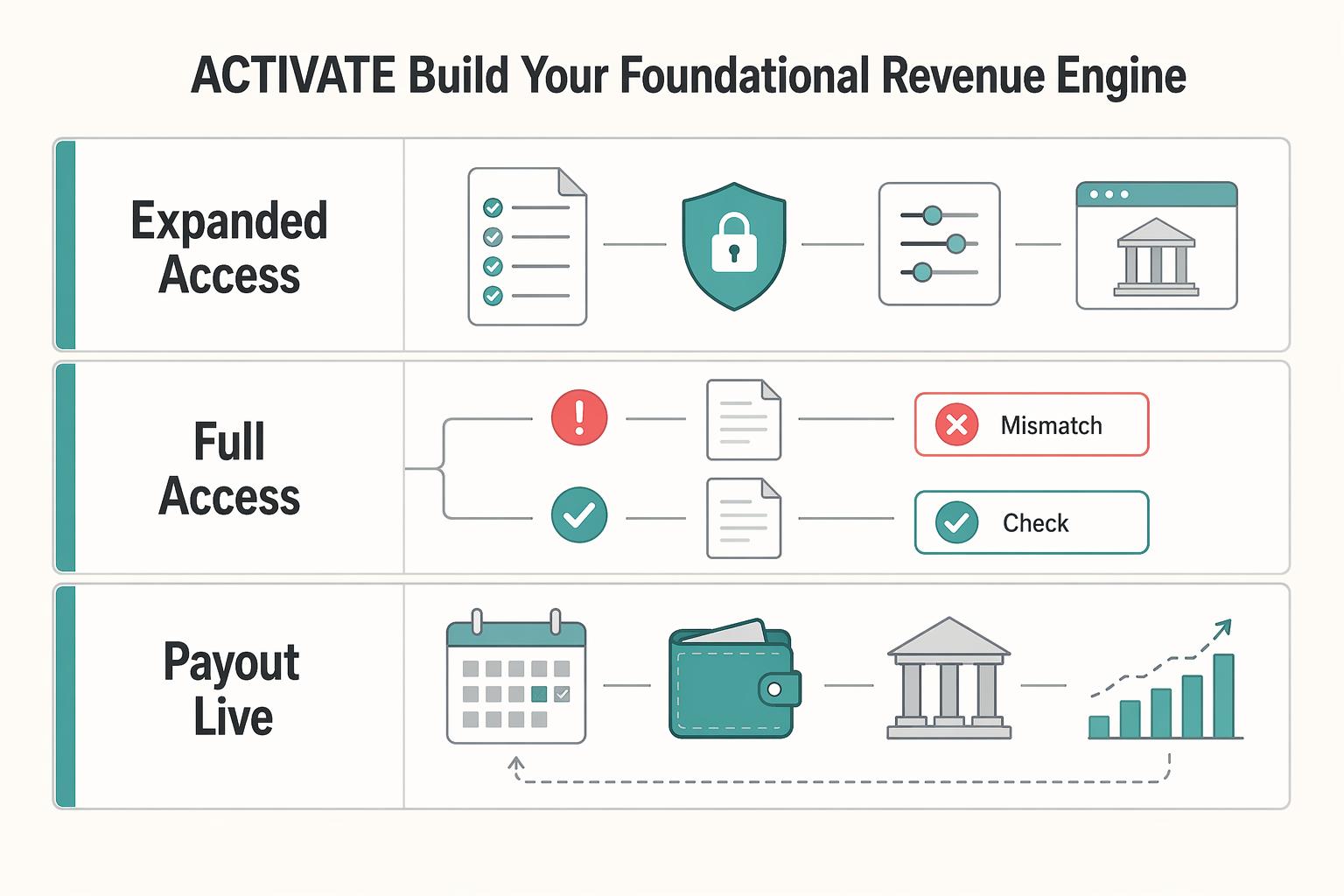
Treat Patreon as a controlled payout source: only post revenue after each payout matches Patreon records, and pause automation when that match fails.
Your monthly money sequence#
Start in Patreon's Payouts dashboard. It is the record for withdrawals, payout history, and earnings/tax CSV exports. If you use automatic transfers, timing matters: enabling them on or after the 5th of the month pushes the first automatic payout to the following 5th. After initiation, payouts can take 3 to 5 business days, and you can only pay out once every 24 hours.
Run this sequence every month:
- Payout intake
Route payouts to your business account and check timing blockers before close: a 5-day payout hold after payout-method changes, web/Android funds pending for up to 7 days, and iOS in-app funds pending for up to 75 days.
- Transaction tagging and sync
Tag each bank credit by source, month, and revenue line before final posting. If you automate, use Patreon API/webhooks or middleware to pass pledge and payout data into your accounting flow. If you run webhook ingestion, verify Patreon's signature header before trusting events.
- Reconciliation check
Match each deposit to Patreon withdrawal history, then confirm against monthly earnings/payout CSVs in the Documents tab. Require all three to match: amount, date window, and one posted entry per payout. If they do not, stop automation and post from CSV to avoid duplicates.
| Option | Best when | Key risk | Control tradeoff |
|---|---|---|---|
| Native import path | Bank/accounting imports already land cleanly | Deposit-only data can miss Patreon context | Lowest effort, less detail |
| Middleware automation | You need richer triggers or near-real-time pledge updates | Permission/mapping drift can misclassify entries | Better detail, more moving parts |
| Manual fallback | Volume is low or automation is unstable | Slower process, easy to defer | Highest control, highest effort |
If a third-party app causes issues, revoke access in Patreon settings. But treat that as partial containment: Patreon notes the app may still retain data already shared.
Records-only receipts for business patrons#
For business patrons, use the simplest valid records path first: Patreon says members can download their own receipts, including VAT breakdown where applicable. If they still ask for your document, issue a paid receipt or records-only invoice with no balance due.
Include: your business name, patron legal entity name, tier/coverage period, amount paid, payment date, and a note like "Paid via Patreon. No balance due."
Do not post it as new revenue if that payout is already recognized. Link the document to the existing entry as support only. Also keep tax scope explicit: Patreon says VAT it collects is added on top of membership price and does not reduce your earnings, and it also says some jurisdictions may still leave tax obligations with you.
Privacy handling you can actually maintain#
Keep this operational, not theoretical. Patreon's DPA states Patreon is a data controller and the creator is a data processor for Patron Data, so your downstream handling needs clear controls:
| Privacy task | What to keep or do | Timing / scope |
|---|---|---|
| Consent capture | Capture wording, timestamp, and source | Consent must be freely given, specific, informed, and unambiguous |
| Privacy notice | State what you collect, why, which tools receive it, and any retention/transfer details required in [your jurisdiction] | Keep it concise, clear, and plain language |
| Data subject requests | Assign one inbox and one owner | Answer within 1 month, with up to two further months for complex cases if you notify in time |
| Processor agreements | Keep current DPA/processor terms for email, CRM, and automation vendors | Verify each vendor's deletion path separately |
We covered this in detail in Best Merch Platforms for Creators Who Want Control and Compliance.
Conclusion: Manage the Tool, Don't Let the Tool Manage You#
The FAQs cover the moving parts. The closing point is simpler: keep control. If you use Patreon, judge it on what you can actually manage: your operating rhythm, your records, and your ability to make decisions when a hard moment hits.
That means focusing on repeatable check-ins, not snap reactions. When something starts to derail the day, pause and run a quick self-check before you make changes.
A steady operating rhythm helps more than big one-time cleanups. Review these points regularly:
- define the immediate problem in plain words before you act
- write down, or say out loud, the prompts you use in your check-in so decisions stay explicit
- treat emotions as information, but keep the operating decision tied to what you can verify
One practical check is worth keeping: when something threatens to take over the day, say out loud what the real problem is. That simple step keeps emotion useful instead of expensive.
Final takeaway: use Patreon as a channel, but keep your decision process in your hands. A simple, repeatable check can keep a difficult moment from running the day.
Need the full breakdown? Read How to Write a Pitch Email to a Brand for a Sponsorship.
Frequently Asked Questions
How do you handle taxes for Patreon income?
Treat it as business income and report it even if you never receive a Form 1099-K. Keep your earnings records, payout records, fee breakdown from Insights, and member receipts together, then set aside a jurisdiction-checked tax reserve instead of using a generic percentage. If your patrons are cross-border, remember Patreon says sales tax is based on the member’s location, and some jurisdictions may still leave you with your own tax obligations.
What is the actual fee Patreon takes?
If you are on Patreon’s current standard pricing, the stated platform fee is 10%. Creators published on or before August 4, 2025 do not get a fee increase, and the full fee stack can also include payment processing, payout fees, and possible 2.5% currency conversion. Price your tiers from net revenue after you verify the fee breakdown in Insights.
Is Patreon a reliable source of income?
It is reliable only if you treat it as one channel, not your whole business. Reconcile each payout to the dashboard and keep a direct audience list you control, so a platform issue does not cut off revenue and communication at the same time.
What are the best alternatives to Patreon for professionals?
Choose based on ownership versus convenience, not brand familiarity alone. | Platform | Control | Setup burden | Fee structure framing | | --- | --- | --- | --- | | Patreon | Lower platform control | Light | Platform fee plus processing, payout, and possible FX costs | | Ghost | High data and brand control | Medium to high | No platform transaction fee; other operating costs still apply | | Memberful | High site-level control | Medium | Membership software pricing plus Stripe-dependent payment costs |
Can you use Patreon if you live outside the US?
Yes, but verify key items first: your payout country, your W-8BEN or W-8BEN-E, and your record-keeping for local tax rules and DAC7 if relevant. One common failure is a country mismatch, because your bank, PayPal, or Payoneer country information must match the payout details you submit.
How do you get paid from Patreon?
Choose the payout method available for your payout country, which can include PayPal, Payoneer, bank transfer, or wire where available. Automatic payout runs on the 5th of the month if enabled, deposits typically arrive within 10 days, and changing payout details triggers a 5-day payout lock. If you have FX exposure, note that payout currency changes are limited to once every 31 days.
Do I need a business license to use Patreon?
That depends on your jurisdiction, but you should treat ongoing membership income as business activity from day one. Check whether you need local registration, a tax ID, or entity paperwork before you scale it, and keep that approval with your payout and tax records.
Try a related tool
Researched and edited by the Gruv editorial team. Gruv builds cross-border billing, payouts, and finance-operations software for global businesses.
Sources
Includes 6 external sources outside the trusted-domain allowlist.
- irs.gov/businesses/small-businesses-self-employed/es...trusted
- irs.gov/businesses/gig-economy-tax-centertrusted
- docs.ghost.org/membersexternal
- docs.ghost.org/hostingexternal
- ghost.org/help/exportsexternal
- ghost.org/help/import-membersexternal
- leadiax.com/patreon-vs-onlyfansexternal
- support.patreon.com/hc/en-us/articles/208656246-How-payouts-workexternal
Educational content only. Not legal, tax, or financial advice.
Related Posts
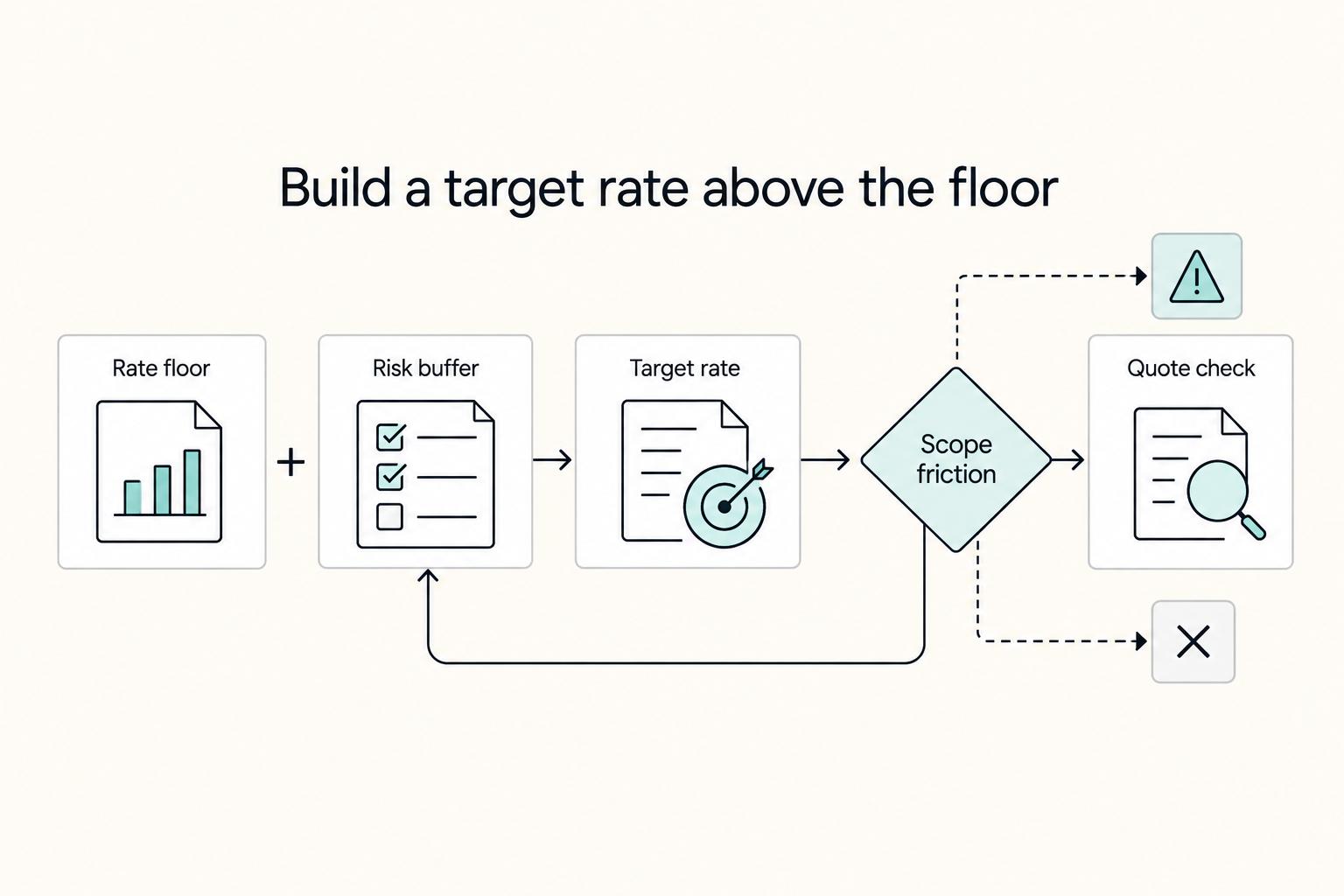
How to Calculate a Freelance Rate You Can Actually Get Paid On
A workable rate is not the neat number a calculator produces. It is the number that still works after you account for real billable capacity, non-client time, scope drift, and the gap between sending an invoice and receiving cleared cash. Start with hourly math even if you do not plan to bill hourly, then turn that number into a quote with clear `payment terms`.
How to Monetize a YouTube Channel for Reliable Cashflow
You are not just a content creator. You are running a business of one. That shift matters because most guides stop at feature checklists. They show you how to switch revenue on, but not how to build something resilient, compliant, and easier to manage over time.

The Freelance Payment Penalty: A Modeled Audit of Platform Fees, FX Spreads, and Payout Delays
The money rarely disappears through a single, easy-to-spot fee. The real loss is stacked. A marketplace takes its commission, a processor adds a charge for international cards, a bank or payment company converts the currency at a spread, a platform holds the funds before release, and a wire sheds a little to intermediaries on the way in. Each layer looks defensible on its own, but the worker feels the combined result as a smaller deposit and a later payday.