
Quick Answer
A strong branding mood board is a decision tool built from business goals, chosen brand attributes, and clear anti-goals, not just visual references. Define outcomes first, map attributes to visual cues and audience signals, annotate each asset, present distinct directions, get written approval on one version, and use that approved board to judge later feedback and reduce rework.
Stop Designing, Start De-Risking: The Strategic Mood Board Framework#
Step 1. Treat misalignment as a rework risk. If you and the client are not aligned on what the brand should communicate, design execution turns into guesswork. Scope and feedback drift, and teams end up revisiting the same decisions. In many branding projects, the problem is not a lack of ideas. It is weak agreement on which ideas actually fit the brief.
Step 2. Use a mood board for branding as a decision tool. A board should do more than collect references you both happen to like. Branding creates a consistent visual expression across physical and digital spaces, and it can also include cues such as tone of voice. A useful model here is the Brand Identity Canvas, which separates the managerial part, the brand's characteristics and influences, from the expressive part, the visuals explored through a mood board. That distinction matters because a board works best when it reflects documented choices, not loose taste.
| Criteria | Inspiration-only mood board | Strategy-led mood board |
|---|---|---|
| Approval quality | Subjective "looks good" response | Decision discussed against documented brand characteristics and intended signal |
| Revision risk | Feedback can drift without a shared reference | Feedback can stay anchored to a stated reference point |
| Change-order readiness | Limited basis for boundary-setting | Clearer basis to flag off-direction requests for review |
Step 3. Lock the pre-design checkpoint before execution starts. Before you move into logo concepts, layouts, or broader identity work, document the board version, the agreed brand characteristics, key influences, tone-of-voice cues, and the final approver. The check is simple: can someone outside the meeting explain why each reference belongs there and what it is meant to signal? If not, pause. "We like the vibe" is not enough.
From there, diagnose the inputs, secure a clear sign-off, and use that approved board to assess later requests. For a step-by-step walkthrough, see The best tools for creating 'Mood Boards'.
Phase 1: The Diagnostic - Translate Business Goals into Visual Strategy#
Start by defining business outcomes, then translate them into a visual direction you can defend in review rounds.
Capture business outcomes before you discuss aesthetics#
Run a short worksheet to capture the outcomes this brand work must support. If outcomes are unclear, pause before you build the board.
Use SMART language where possible so goals are specific and testable. "Look more premium" is vague; outcome-based targets are easier to align on and easier to review later.
Confirm stakeholder coverage early: identify the final approver and bring in key stakeholders before aesthetic opinions start fragmenting direction.
Run an attribute sort and convert it into review tools#
Use a simple workshop sort to force decisions before design execution: who we are, who we want to be, and who we are not. This is a practical decision exercise, not a universal standard.
Turn that exercise into three reusable artifacts:
- prioritized attribute set
- explicit anti-goals from
who we are not - short decision log of what was chosen, rejected, and why
If every attribute lands in who we are, keep pushing until real tradeoffs appear.
Build a working visual strategy matrix#
Map each chosen attribute to visual direction, intended audience signal, and likely misuse risk so feedback stays tied to strategy instead of taste.
| Attribute | Visual cues to explore | Audience signal | Misuse risk |
|---|---|---|---|
| Trusted | Structured layouts, restrained palette, formal typography | Stable, credible, dependable | Can become rigid or dated |
| Innovative | Geometric type, contrast, unexpected composition | Forward-looking, active, distinct | Can feel cold or novelty-driven |
| Friendly | Softer shapes, candid imagery, accessible spacing | Human, open, easy to approach | Can read as generic or less expert |
If you cannot explain why a cue supports the attribute, remove it.
Collect strategic evidence, not loose inspiration#
When you add an asset to the board, annotate it with three notes: what it signals, who it is for, and what it should not communicate. This keeps intent visible and reduces subjective feedback loops.
| Artifact | What it documents |
|---|---|
| Business outcomes worksheet | The outcomes this brand work must support |
| Key stakeholders and final approver | Stakeholder coverage and the final approver |
| Prioritized attributes | The chosen attributes from the workshop sort |
| Explicit anti-goals | Anti-goals from who we are not |
| Decision log | What was chosen, rejected, and why |
| Annotated reference set | What each asset signals, who it is for, and what it should not communicate |
Before moving to Phase 2, confirm these are documented:
- business outcomes worksheet
- key stakeholders and final approver
- prioritized attributes
- explicit anti-goals
- decision log
- annotated reference set
If any item is missing, it is too early to present concepts. These artifacts also make your later brand style guide easier to build.
Phase 2: The Alignment - Secure a Defensible Sign-Off#
The goal in this phase is a clear, documented decision. Present distinct options, guide the choice with your Phase 1 lexicon, and capture written approval on one labeled direction before feedback drifts back into personal taste.
At this point, your mood board is a decision tool, not a reference gallery. A direction can look strong in review and still miss the business goal, audience signal, or product experience.
Present distinct directions as business choices#
Show a small set of clearly different directions, not near-duplicates. Clear contrast improves decision quality and reduces subjective back-and-forth because stakeholders are choosing between strategic paths, not reacting to isolated design elements.
Before presenting, make sure the final approver and key stakeholders from Phase 1 attend or review the same version.
| Direction | Strategic intent | Target audience signal | Tradeoffs | Likely revision risk |
|---|---|---|---|---|
| Direction 1 | Build trust and clarity | Stable, credible, established | Can feel less distinctive if pushed too far toward restraint | Higher if stakeholders also want a disruptive signal |
| Direction 2 | Signal innovation and momentum | Modern, active, forward-looking | Can feel cold or trend-led without human cues | Higher if long-term relevance is a concern |
| Direction 3 | Increase warmth and accessibility | Human, open, approachable | Can lose authority if softened too much | Higher if premium positioning is a priority |
You do not need a fixed number of directions. You do need enough contrast for a real strategic choice.
Tie every element back to the lexicon and objective#
Present each direction in a consistent chain: business objective -> prioritized attribute -> visual cue -> intended audience signal -> misuse risk. If you cannot explain that chain for an element, remove it.
Keep the discussion in business language. Ask stakeholders to summarize each direction in one sentence based on objective and audience fit. If feedback collapses to personal preference, pause and restate the strategic rationale.
Also pressure-test brand-product alignment: if the direction promises something the actual experience cannot support, treat that as a risk before approval.
Record the decision before taste-based drift restarts#
Right after the meeting, document the decision while the group is still aligned:
| Record | Required details | Reference point |
|---|---|---|
| Decision summary | Project name; board version; selected direction label; selection rationale; key anti-goals avoided; final approver; date | Selected direction label |
| Written approval record | Direct confirmation approving the selected direction label on the dated version reviewed | Dated version reviewed |
| SOW attachment reference | State that downstream creative work follows the approved direction attached to the SOW or listed in an appendix; add current clause text after legal review | SOW or appendix |
| Evidence set | Annotated board; comparison table; attendee list; approval message | One evidence set |
Keep one evidence set: annotated board, comparison table, attendee list, and approval message. If you cannot point to one approved direction label and one written confirmation, do not move into development or the later brand style guide.
Phase 3: The Defense - Leverage Your Mood Board as a Scope Shield#
Your priority in this phase is simple: protect delivery quality and margin by checking every decision against what was approved before it reaches the client.
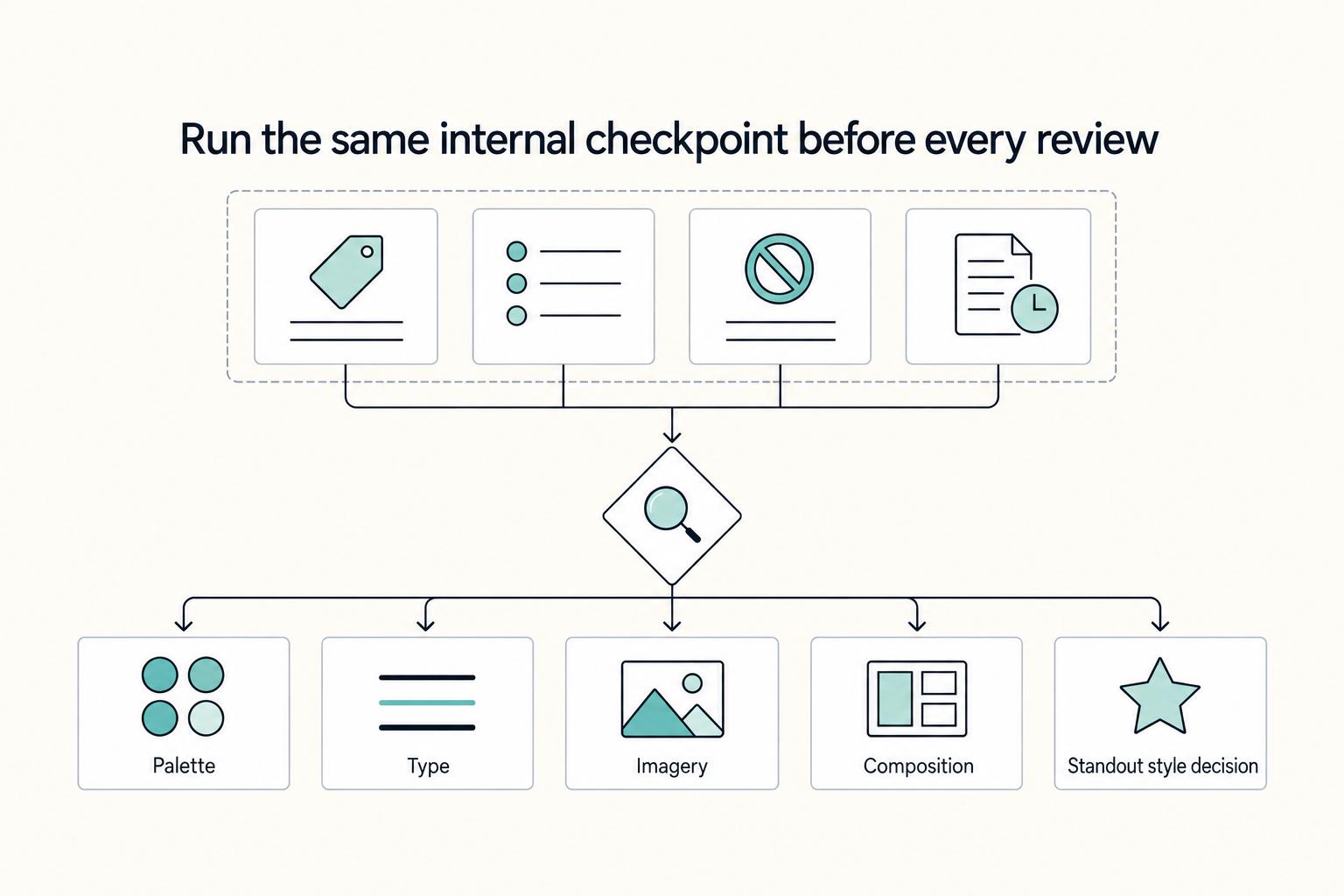
Run the same internal checkpoint before every review#
Before each client review, run the same QA pass against four items: the approved direction label, the reasons it was approved, the anti-goals, and the decision log. Then test each major choice, including palette, type, imagery, composition, and any standout style decision, against that record.
| Major choice | Support to state | Avoidance to state |
|---|---|---|
| Palette | Which approved criterion it supports | Which anti-goal it avoids |
| Type | Which approved criterion it supports | Which anti-goal it avoids |
| Imagery | Which approved criterion it supports | Which anti-goal it avoids |
| Composition | Which approved criterion it supports | Which anti-goal it avoids |
| Standout style decision | Which approved criterion it supports | Which anti-goal it avoids |
For each choice, confirm two things in plain language: which approved criterion it supports, and which anti-goal it avoids. If you cannot state both clearly, hold it back and resolve it before review.
Classify feedback before you act#
Use a short response framework in live reviews: acknowledge the request, map it to the approved strategy, classify it, then confirm next action in writing with the version label and date.
| Feedback type | Response path | Required documentation | Commercial implication |
|---|---|---|---|
| Aligned refinement | Revise within the approved criteria | Update the decision log and send a written summary tied to the reviewed version | Usually remains in current scope |
| Strategic pivot | Treat as a direction change, not a tweak | Written confirmation of the new request, linked to the approved version and SOW reference | Move to a scope/change discussion before doing the work |
If a request conflicts with an anti-goal or changes the agreed audience signal, classify it as a strategic pivot.
Present choices as traced decisions, not personal taste#
In reviews, tie each major design choice back to the approved criteria so the discussion stays objective and defensible. Do not present visuals as isolated preferences; present them as decisions with a clear strategic reason.
After the meeting, keep the record durable and lean: a current approved file, an updated decision log, and written confirmation of what changed and what did not. Treat informal chat threads as weak archives; keep concrete proof in durable written records such as email or signed approval.
You might also find this useful: How to price a 'Branding Package' for a new business.
Conclusion: Your Mood Board is Your Best Insurance Policy#
Used this way, a board stops being a gallery of references and starts acting like an early decision record. You do three things differently: diagnose the visual direction before design starts, get written alignment on the chosen route, and defend that route during execution with versioned notes and clear feedback handling.
That shift matters because it protects the parts of the job that usually get blurred. You can spend less time arguing about taste when the reasoning is documented up front. You can make cleaner scope calls when a request clashes with the approved direction or anti-goals. You also tend to communicate better with clients because the conversation stays anchored to a visible artifact, not memory or scattered chat comments. That is the practical role the board serves here.
Treat the board as a project control document, not just design inspiration. It is the checkpoint you use before detailed design, the record of what was approved, and the reference point for judging change. If the client cannot see the reasoning behind your choices, alignment can weaken quickly.
Consolidate your project record#
Do this today. Keep one approved board, one written rationale, one list of anti-goals, and one change log. Each major design choice should map back to that record in one sentence.
Lock the approval trail#
Save the approved version label, date, and approver in email or your project file. If approval only lives in a call or chat reaction, you do not have a durable checkpoint.
Route new requests through a change decision#
If a request fits the approved direction, log it as refinement. If it changes the direction, pause execution and handle it as a scope conversation before you design further.
Once the direction is approved, the next useful asset is the execution document: the brand style guide.
Frequently Asked Questions
How does a mood board prevent scope creep?
It gives the team a visible reference point for the approved visual direction, so feedback can be judged against the board and project goals instead of personal opinion. New requests can be checked as either refinements or changes in direction. If the board has no shared rationale, interpretation drift can start again.
What is the difference between a mood board and a brand style guide?
A mood board is used early to align on visual direction before detailed design begins. A brand style guide comes later and documents how the approved identity should be applied across real work. The board is a discussion tool, while the guide is broader implementation guidance.
How do you present a board to a client for approval?
Present the board against audience and project goals, not whether someone likes a reference. Review it alongside the communication brief so the direction stays tied to who the work needs to reach and what it needs to do. Then record the chosen direction and any anti-goals in your project notes.
Can a mood board be part of the contract?
By itself, no. The article treats it as a direction-setting document, not a standalone legal agreement. If you want it referenced in project paperwork, use jurisdiction-specific legal advice to decide how to word that reference.
What should a professional board include?
It should show enough range to communicate the intended tone without pretending you are already designing layouts. The core set usually includes palette direction, typography feel, imagery style, and other relevant visual references. Keep it readable and clear enough that another person can understand the direction before you explain it live.
What is the fastest approval and documentation routine to use?
Present the board with the project goals or communication brief visible beside it. Record the chosen direction and a short rationale, capture a short anti-goals list, and align later feedback to that approved direction before doing more design work. If any piece is missing, pause and clean up the record first.
Try a related tool
Researched and edited by the Gruv editorial team. Gruv builds cross-border billing, payouts, and finance-operations software for global businesses.
Sources
Includes 4 external sources outside the trusted-domain allowlist.
- belhaven.edu/pdfs/longview-lasting-strategies-for-rising-...trusted
- buffalo.edu/brand/resources-tools/mood-boards.htmltrusted
- dbb.defense.gov/Portals/35/BCTPV4.pdftrusted
- kenan-flagler.unc.edu/wp-content/uploads/2025/06/KFBS25-005_Brand_...trusted
- bettermarketing.pub/swiping-right-on-brand-product-alignment-9-s...external
- brandcrafter.co.nz/brand-strategy-frameworkexternal
- canvasrebel.com/meet-kristie-hublerexternal
- everything.design/blog/b2b-brand-workshop-playbook-agenda-exer...external
Educational content only. Not legal, tax, or financial advice.
Related Posts

Thailand's Long-Term Resident (LTR) Visa for Professionals
For a long stay in Thailand, the biggest avoidable risk is doing the right steps in the wrong order. Pick the LTR track first, build the evidence pack that matches it second, and verify live official checkpoints right before every submission or payment. That extra day of discipline usually saves far more time than it costs.
How to Create a Brand Style Guide for a Client
If you work alone, your guide does not need to be a full brand book. It should work as a control document. Standardize the few choices that keep coming up so your proposals, reports, invoices, decks, and delegated work look and sound like they come from the same business.
Writing Case Studies for B2B SaaS That Buyers Trust
If you work independently, you do not need another gallery of polished examples. You need a way to produce B2B SaaS case studies that help a buyer trust the result, help a client feel fairly represented, and hold up in review when someone asks, "Where did this number come from?"