
Quick Answer
Yes, build your freelance hire me page as a filter first and a sales asset second. Use one clear CTA, require scope-critical inputs, and show pricing only when you can quote honestly from the details submitted. For variable projects, route leads to a scoped estimate path instead of forcing a fixed number. Pair that with visible payment timing and pause conditions so work starts only after your stated trigger.
Build a hire me page that sells your service and protects your business#
More inquiries are not the goal. You want better inquiries, routed through terms you can actually deliver on. A strong hire me page does two jobs at once: it helps the right buyer raise a hand, and it prevents loose intake, payment confusion, and overpromising once they do. Keep this model in mind:
| Layer | Purpose | Owner | Common failure mode | Success signal |
|---|---|---|---|---|
| Front-end page | Attract and qualify the right prospect | You, in public-facing copy and form design | Too many vague inquiries through an open inbox | Inquiries arrive with scope, timeline, and fit details |
| CTA path | Move one qualified prospect into one next step | You, in your call to action and intake form | Multiple paths create hesitation or side-channel messages | Most serious leads use the same path |
| Back-end rules | Control approval, payment, and delivery boundaries | You, in your proposal, contract, and kickoff terms | Work starts before terms are clear | Work begins only after acceptance points and payment rules are set |
Before you polish any copy, run this mini-checklist:
- Define your client-fit filter. Say who you help, what outcomes you handle, and what you do not take. Checkpoint: every inquiry should tell you project type, timeline, budget range, and decision-maker.
- Choose one primary CTA. One contact path usually beats a scattered contact setup. Upwork uses pre-hire checkpoints like screen, interview, or consult before hiring. Your page can do the same in a simpler form.
- Set payment and milestone rules. Upwork's model is clear: payment release follows approval and can be milestone-based. Mirror that logic in your own terms so scope and approvals have written checkpoints.
- Write within compliance-safe boundaries. Promise process, deliverables, and communication standards, not guaranteed legal, tax, or business outcomes. If a benchmark matters, keep it pending until you can verify the current source.
The rest of this guide turns those four decisions into page structure, channel choice, pricing, and post-launch fixes so you can improve qualified conversion without lowering delivery quality. Related: Build a Freelance FAQ Page That Pre-Qualifies Clients.
What should you prepare before you write a single line?#
Set your operating defaults first, then write copy. If you do this in reverse, your page may attract inquiries you cannot qualify, document, or process cleanly.
Only publish what you can support today. If a requirement depends on jurisdiction or client structure, keep it pending until you can verify it before launch.
| Prep area | Decide now | Ready check | If not ready, do this |
|---|---|---|---|
| Client fit | Who you accept, who you avoid, what work you decline, and your realistic start window | You can describe one good-fit project and one no-fit project in plain language | Write accept/decline rules now and reuse them in your CTA and form |
| Proof pack | Which samples and portfolio items you will send when asked | You can send proof immediately, and every link/file works | Build a small proof set; if needed, create fictional-client samples |
| Business identity and documentation | Your business name, URL, billing identity, and client-type documentation path | Name is usable, URL is available, and you have a checklist for domestic, cross-border, and entity clients | Resolve name/URL first, then draft client-type checklists and leave jurisdiction-specific requirements pending until verified |
| Payment rails | Primary payment path, fallback path, invoice/reconciliation ownership | You know how payment is made, how fallback works, and who confirms receipt before work starts | Reduce options, pick one default route, and document fallback steps |
Client-fit rule: decide your boundaries before positioning. Define the type of clients you want and the type you will avoid. If you cannot state accept/decline criteria up front, your page becomes a catch-all and forces manual filtering later.
Proof rule: have evidence ready before you ask for trust. Most prospects ask for samples before hiring. Keep a usable proof pack ready: writing samples that show you can write, plus portfolio links or snippets from real work where available.
Documentation rule: sort requirements by scenario, not guesswork. For domestic, cross-border, and entity clients, note what information you exchange and where verification is still needed before publication. Use practical language: you may request billing, business, or identity details before contract issue, invoicing, or kickoff when engagement details are incomplete. If required details are missing, pause start until they are provided.
Payment rule: one default route, one fallback, one owner. Set a primary payment path and a fallback path before launch. Assign who sends invoices, who reconciles receipts, and what must be confirmed before work begins.
With these four prep areas set, you can now choose where intake should live: Upwork, your own page, or both. If relevant to your setup, review The 1% Tax Regime for Entrepreneurs in Georgia.
Should you rely on Upwork or build your own hire me page?#
Use both, but give each channel a distinct job. Use marketplaces and profile ecosystems for discovery, then use your own hire me page for qualification, scope clarity, and operating terms.
| Channel | Role | Best-fit project stage | Control level | Common failure mode |
|---|---|---|---|---|
| Competitive marketplace | Demand capture and proposal sending | Early stage, when you need active buyers now | Low to medium | Fee pressure, price competition, and mixed-fit leads |
| Profile network | Credibility and light discovery | Early trust check after someone finds your name | Low | Treating a profile like a full intake process |
| Your own hire me page | Structured qualification and intake | Mid-stage, once interest is real | High | Publishing and waiting, instead of actively driving traffic |
Step 1: Assign one role per channel and avoid overlap#
Assign one role per channel and avoid overlap. On marketplaces, the baseline is practical: complete profile, relevant samples, and consistent pitching on matched projects. Expect ramp time. One freelancer reported sending more than 40 proposals before getting serious interest, so keep refining proposal quality as you go.
Step 2: Make the handoff to your own intake flow explicit#
Make the handoff to your own intake flow explicit. A simple rule is to move the conversation once the prospect asks for exact scope, timeline, deliverables, or a formal next step, then collect those details through your structured form.
If platform policies affect off-platform messaging or payment moves, hold the redirect step until you have verified the current platform rule.
Step 3: Run a weekly cadence with one channel priority#
Run a weekly cadence with one channel priority at a time. If volume is weak, focus on marketplace proposal and profile edits. If quality is weak, tighten your hire me page copy and intake questions. Track lead quality against lead volume so you can decide whether to adjust your profile, proof, or CTA.
For a step-by-step walkthrough, see Build a Freelance Press Page Clients Can Verify.
Build the front-end conversion layer that gets qualified inquiries#
On your own site, your first job is qualification. Help the right buyer recognize fit, trust your claims, and take one clear next step.
Step 1: Build each page block to answer a decision question#
Build each page block to answer a decision question, not just fill space. Use this launch check before you publish.
| Page block | Decision question | What to verify before launch | Common failure mode |
|---|---|---|---|
| Above-the-fold message | Is this for me, and what result can I expect? | A first-time visitor can repeat your fit in one sentence: who you help, the outcome, the delivery context, and a boundary statement | Vague slogan, generic promise, no clear boundary |
| CTA hierarchy | What should I do now if I am ready, and what if I am not? | One primary CTA is clearly dominant, with one lower-commitment fallback that is visibly secondary | Two equal CTAs competing for attention |
| Form readiness | Can you assess fit from one submission? | The form gives enough scope, timing, and fit detail to accept, decline, or clarify quickly | Extra low-value fields, or missing scope-critical questions |
| Mobile usability | Can I read and submit this cleanly on a phone? | Test full mobile completion (labels, tap targets, errors, submit flow), include skip links where useful, and verify any accessibility benchmark before publishing it | Works on desktop but feels heavy or breaks on mobile |
Step 2: Use your opener as a filter#
Use your opener as a filter, not a tagline: I help [who] achieve [outcome] through [delivery context]. Not for [boundary statement].
If you only take projects with a stated budget, specific geography, or defined source channels, say that early. Buyers already filter by budget, country, and category in marketplaces, so your page should keep the same discipline. A quick check: within a few seconds, can someone tell whether they should continue?
Step 3: Pair every claim with proof where doubt appears#
Pair every claim with proof at the point where doubt appears. If you claim complex delivery, place a short case snippet or similar-work example next to that claim. If you promise quality or speed, pair it with concrete checkpoints such as acceptance criteria instead of generic praise.
Keep action paths focused on intent quality. Use one primary CTA for serious inquiries and one secondary fallback for lower commitment. In your form, collect only scope-critical context: project type, desired outcome, timeline, budget range, and any links/examples needed to assess fit.
When this front-end layer is clear, your next control point is back-end rules: scope, payment terms, acceptance criteria, and delivery boundaries. We covered that in Build a Freelance Sales Funnel You Can Run in One Hour a Week.
Set the back-end operating rules behind your CTA#
Your CTA should start a clear operating workflow, not a custom negotiation. If the next steps are vague, you create avoidable exceptions, payment friction, and admin overhead.
Step 1: Make your rules visible before commitment#
Make your rules visible before commitment, not buried in follow-up emails.
| Rule area | What to state | Ready check |
|---|---|---|
| Qualification gates | Minimum fit, what a usable brief must include, and what you do not accept | A lead can self-screen without sending a vague inquiry |
| Documentation path | Which onboarding docs, invoice details, and tax info may be required by payer and jurisdiction | You can send the correct document path without improvising |
| Payment controls | Milestone acceptance criteria, who approves, pause/restart conditions, and dispute-path owner | You can point to one written rule for release, pause, or escalation |
| Compliance caveats | Checks can vary by country, client type, payment provider, or platform | Your language does not imply one universal process |
Step 2: Write your payment governance in plain language#
Write your payment governance in plain language. State what counts as milestone acceptance, who signs off, what happens when feedback is delayed, when work pauses for nonpayment or missing inputs, and who owns the next step in a dispute.
Publish the same rules in your inquiry confirmation, proposal, and contract/SOW. If a milestone is challenged, you should already know which document controls the decision.
Step 3: Keep compliance language clear and honest#
Keep compliance language clear and honest. KYC/KYB checks may be run by your bank, payment provider, or platform, and those checks can delay onboarding. They do not remove your own legal or tax responsibilities.
Where details depend on jurisdiction, keep that explicit and do not name reporting thresholds or filing deadlines until they have been confirmed. Keep organized records from day one (invoices, bills, receipts), and get accounting help early if your setup is getting complex.
Final checkpoint: if a lead cannot self-qualify and explain the next operational steps after reading this section, your rules are still too vague. Need the full breakdown? Read Create a Freelance Lead Magnet That Filters for Ideal Clients.
Should you list pricing on your hire me page?#
Use this rule: publish pricing only when you can give a truthful number from the information a prospect can provide up front. If you still need scope and timeline to quote responsibly, use a guided estimate path instead of hiding everything behind contact friction.
Step 1: Pick the pricing path that matches your real quoting process#
Not posting rates can create a barrier, especially for buyers with a non-negotiable budget. Public pricing can also reduce repetitive rate-only inquiries and pre-filter prospects who are far below your price level.
| Pricing model | When to use it | Primary CTA path | Operational risk if misapplied |
|---|---|---|---|
| Public pricing | You can quote truthfully from the page plus a short intake | Book or apply now | Buyers may assume the posted number includes work that was never defined |
| Guided estimate | You need project scope and timeline before quoting | Request estimate | If intake is vague, you still spend time collecting basics later |
| Rates available upon request | You choose not to show a number publicly | Contact me | Budget-limited buyers may leave before contacting, and you keep handling repeat pricing requests |
Step 2: Publish a short qualification gate before the CTA#
Ask for the minimum details you need to decide whether pricing is possible now. Use a direct prompt such as: "Before requesting an estimate, tell me what the project is and when you need it done by."
Then set scope boundaries before submission. If you publish prices, state what is included. If you use estimates, state that price depends on the scope and deadline provided. If a lead cannot provide those basics, route them to discovery.
Step 3: Add a visible pricing and payment policy next to the form#
Keep this plain and short so expectations are clear before the first reply.
| Policy item | What to say |
|---|---|
| Pricing policy | Published prices apply only to the listed scope. Additional work is quoted after review. |
| Payment timing | Keep this internal until verified; publish the confirmed payment timing rule only. |
| Work pause/reactivation | Keep this internal until verified; publish the confirmed pause and reactivation rule only. |
| Payment processing | State the business name that issues invoices and the payment provider that processes them. |
| Tax handling | Tax treatment depends on client location and business setup; publish only requirements you have verified. |
Related reading: How to Create a Content Flywheel for Your Freelance Business.
What breaks after launch and how do you recover fast?#
After launch, most breakdowns are operational, not copy-related. Diagnose the process before you rewrite the page, or you may fix the wrong layer.
Step 1 Classify inquiries before you edit anything#
Review recent inquiries and tag each one as good fit, unclear, or poor fit. Focus on recurring patterns first.
| Inquiry tag | If this happens | Next move |
|---|---|---|
| good fit | inquiries are good fit but delivery still slips | check scheduling and boundary management before touching page copy |
| unclear | most are unclear | tighten intake prompts so people state the project, deadline, and intended outcome |
| poor fit | most are poor fit or pure price checks | tighten disqualifier prompts or narrow CTA wording so the wrong buyers opt out earlier |
Quick test: you should be able to explain why each inquiry was accepted, paused, or declined within seconds.
Step 2 Keep status changes aligned across records#
Use one simple rule: each trigger should create one automatic update and one manual check so contract, milestone, and client-visible status stay in sync.
| Trigger event | Automatic system action | Manual owner check |
|---|---|---|
| Contract status changes | Update internal and client-facing status labels | Confirm scope, timing, and next action still match |
| Milestone status changes | Update delivery stage or hold state | Confirm contract and client-visible status still agree |
| Required item is missing | Send the standard request and pause the dependent step | Confirm who is responsible, what is paused, and what reactivates work |
If your records say different things, clients experience avoidable confusion.
Step 3 Use one record per payment thread#
In practice, treat payment actions as idempotent: retries and follow-ups should point to the same internal record, not create parallel threads. That keeps your history traceable and reduces duplicate actions.
Verification check: in one place, can you see current state, prior attempt, and latest owner?
Step 4 Send a clear delay message when something is missing#
When work pauses for a compliance or document gap, send a short message that states:
- what is missing
- who must provide it
- what is paused
- what reactivates work
Include only requirement details you have verified. Send this early, not at project-end escalation.
Step 5 Run a weekly recovery loop#
Recover with small operational fixes, one bottleneck at a time.
- Tag new inquiries by fit quality.
- Note one recurring delay or mismatch.
- Make one targeted page or process adjustment.
- Recheck the same pattern next week.
Steady iteration beats redesign cycles.
You might also find this useful: How to Write a Compelling 'About Me' Page for Your Freelance Website.
Launch your page as an operating system not a brochure#
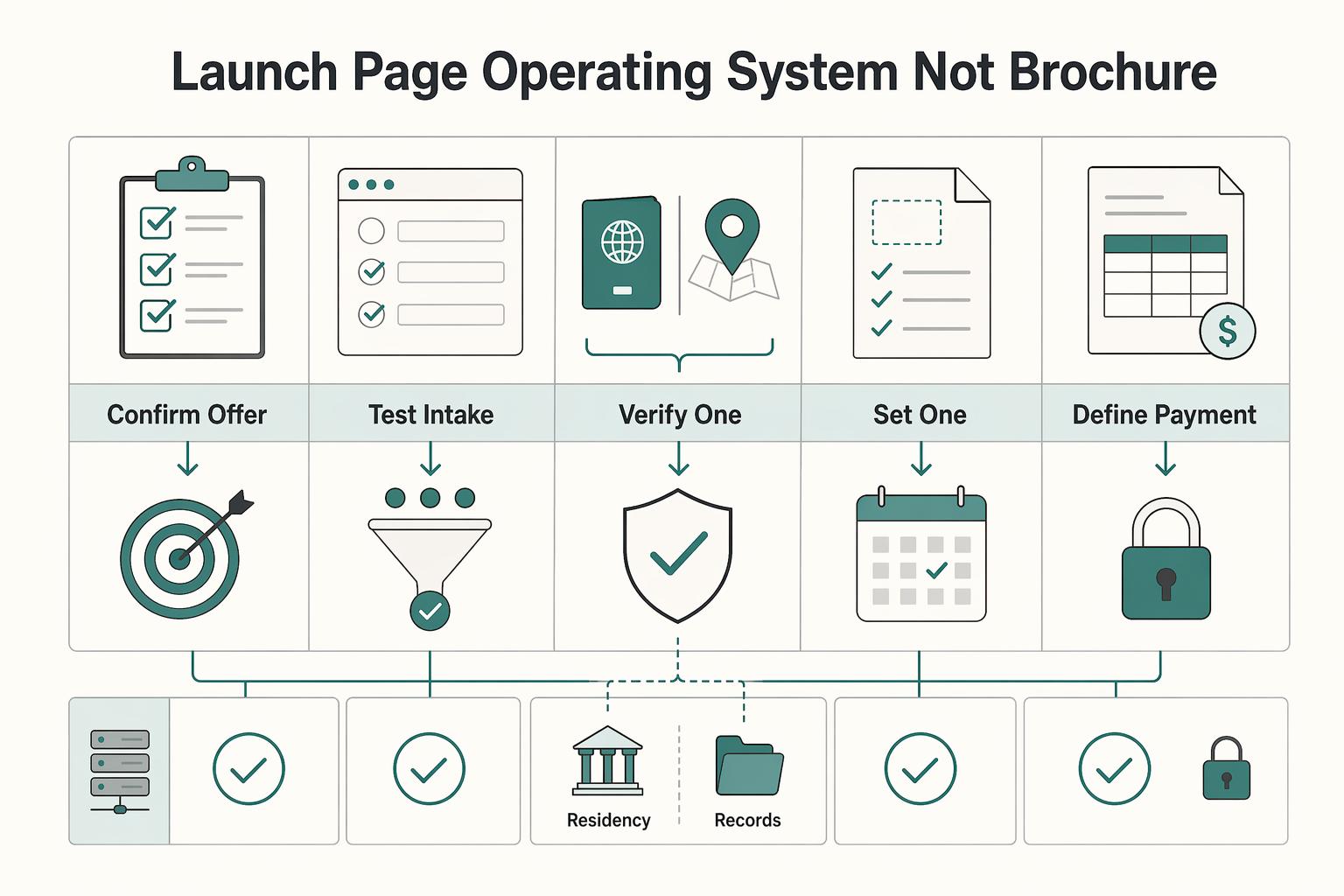
Go live only when your page can enforce your workflow without email improvisation. A brochure page attracts clicks; an operating-system page filters fit, sets scope and payment expectations, and shows exactly what must happen before work starts.
| Pre-launch gate | Owner check |
|---|---|
| Confirm offer boundaries | you can decline poor-fit work using published criteria |
| Test intake behavior | weak briefs are blocked or clarified before a call |
| Verify one primary CTA | next step is obvious and matches your real sales path |
| Set one pricing route per offer | each offer is fixed-scope or estimate-based, not both |
| Define payment start condition | no work begins before the listed trigger |
| Verify compliance notes | jurisdiction-specific items are verified or kept out of public copy |
| Assemble client file structure | inquiry, scope, invoice, and payment proof are in one place |
| Run one urgency simulation | rush leads still cannot bypass qualification |
Keep the same two-layer structure: your front end qualifies the right buyer into one clear next step, and your back end decides whether the project can begin.
| Area | Brochure launch | Operating-system launch |
|---|---|---|
| Intake quality | More inquiries, but mixed fit and curiosity clicks | Fewer, better-fit inquiries because scope, timing, and goal are required |
| Scope control | Scope details surface later in calls and threads | Scope boundaries and estimate path are clear before a call |
| Payment reliability | Payment discussion starts after unpaid effort | Payment trigger, invoice path, and pause rule are defined before kickoff |
| Recovery speed | Problems appear late after missed steps | You can trace failures to intake, scope, invoice, or follow-up quickly |
Step 1. Publish only after qualification rules are explicit. Tell buyers who the offer is for, what is included, what is out of scope, and what they must submit to move forward. If your form still accepts vague requests like "Need help ASAP," you are not launch-ready.
Verification check: submit a test inquiry with missing scope, deadline, or business goal. The flow should force clarification or stop the request from becoming a live lead.
Step 2. Tie your CTA to an enforceable next step. Use one primary action that matches your real intake path: application, project brief, or scoped inquiry. Treat it like an Apply Filter step, not a generic button.
Verification check: give someone 60 seconds on the page, then ask them to explain the offer, the next step, and required submission details. If they cannot, the page is still acting like a brochure.
Step 3. Lock pricing route and payment start condition before launch. Set one pricing route per offer: fixed price for defined deliverables, or scoped estimate for variable work. Then state the start trigger, such as approved proposal plus deposit or signed scope plus first milestone invoice.
Verification check: for every offer, you can point to one visible scope definition, one pricing path, and one start condition.
Step 4. Prepare your client file and compliance notes. Do not publish legal-heavy copy you have not verified. Keep jurisdiction-specific requirements out of public copy until they are confirmed, and confirm required client documents before kickoff. Keep one client record with inquiry, approved scope, invoice, payment confirmation, and compliance notes.
Verification check: open one client file and confirm you can follow the full chain from first message to paid start without searching multiple tools.
Use this decision flow for urgency requests:
- If urgency is high but scope is unclear, send them through intake first.
- If scope is clear but payment or onboarding is incomplete, hold the start date.
- If they push to bypass process, treat that as qualification data.
This pairs well with our guide on How to Write a Professional Bio That Attracts Clients.
Frequently Asked Questions
What should a freelance hire me page include?
It should help the right buyer move forward and push the wrong buyer out early. Put one clear offer, one primary call to action, a short proof block tied to that offer, and a short set of intake questions that expose scope, timing, and business goal. If your page cannot tell you why a lead is a fit or a mismatch before a call, it is creating admin work, not qualified demand.
Should you use a marketplace profile or your own page?
Use a marketplace for discovery and your own page for deal control. On platforms such as Freelancer, clients can post short- or long-term projects and compare bid proposals with rate quotes and time estimates, so it is useful when buyers are already shopping there. On your own page, you decide the questions, boundaries, and next step. If you use Freelancer, complete the profile and email activation first because incomplete profiles cannot bid. If you stop at the platform profile, you are accepting its buying context instead of your intake rules.
Should you list prices on your page?
Yes, if your offer is standardized. Partially, if scope varies. Put fixed package prices on clear deliverables. Or show a starting point with what is included and route custom work into a scoped estimate path using the pricing logic from the section above. When you show price without scope limits, revision boundaries, or payment timing, you invite bad comparisons and messy negotiations.
What call to action usually works best?
The strongest CTA is the one that describes the next real step, not the one that sounds the most inviting. Label the button with the action you actually want, say what information the buyer needs to submit, and keep one primary path visually dominant on the page. A vague button pulls in curiosity clicks, which may look busy in analytics but can weaken qualification.
How do you make the page feel trustworthy fast?
Trust comes from matching claims to evidence and process, not from stacking logos. Put your most relevant sample, result, or testimonial next to the offer it supports, and show the basic project path so the buyer can see how work starts, pauses, and moves forward. For more page-level proof ideas, see How to Create a High-Converting Freelance Services Page. When proof is generic or far from the claim it is supposed to support, buyers fill the gap with doubt.
What legal and payment details should you prepare before taking clients?
Prepare the document path before you publish the page. State which tax or business documents you expect to handle, and note that you will confirm current requirements before kickoff. Tax guidance can change, and IRS Publication 17 does not cover every situation or replace the law. If a threshold belongs on the page, keep the value out of public copy until you can confirm the current source rather than freezing an old number into the page. If you skip that check, you end up making compliance and payment decisions in the middle of client work.
Can you use marketplace proof on your own page?
Yes, if you use it as supporting evidence instead of your main sales argument. Add a platform badge, rating, or profile link near relevant proof, then send serious buyers through your own intake form so your scope and payment rules stay consistent. If outside proof becomes the whole pitch, your page starts acting like a profile mirror instead of a filter.
Try a related tool
Researched and edited by the Gruv editorial team. Gruv builds cross-border billing, payouts, and finance-operations software for global businesses.
Sources
Includes 2 external sources outside the trusted-domain allowlist.
- chc.edu/wp-content/uploads/2024/07/2022-Employee-Man...trusted
- ftc.edu/wp-content/uploads/2025/12/FTC.Catalog.2025-...trusted
- hbs.edu/managing-the-future-of-work/Documents/Buildi...trusted
- irs.gov/pub/irs-pdf/p17.pdftrusted
- plattcollege.edu/wp-content/uploads/2021/07/Platt-2020-21-Pro...trusted
- uprovidence.edu/wp-content/uploads/2025/07/Fall-2024-Catalog...trusted
- askamanager.org/2026/03/ask-the-readers-what-do-i-need-to-kn...external
- behance.net/blog/what-should-i-charge-how-to-justify-you...external
Educational content only. Not legal, tax, or financial advice.
Related Posts

Georgia 1% Tax for Entrepreneurs Without Filing Surprises
Treat Georgia's 1% tax path as a compliance question first and a rate discussion second. The goal is a setup you can defend under review, not a shortcut that fails at filing time.

How to Create a High-Converting Freelance Services Page
If you want fewer renegotiation loops, treat your page as a qualification tool, not a polished brochure. The goal is not more inquiries for their own sake. It is fewer vague inquiries that turn into messy delivery.

The Freelance Payment Penalty: A Modeled Audit of Platform Fees, FX Spreads, and Payout Delays
The money rarely disappears through a single, easy-to-spot fee. The real loss is stacked. A marketplace takes its commission, a processor adds a charge for international cards, a bank or payment company converts the currency at a spread, a platform holds the funds before release, and a wire sheds a little to intermediaries on the way in. Each layer looks defensible on its own, but the worker feels the combined result as a smaller deposit and a later payday.