
Quick Answer
Start by defining your flexible work hours policy as a contractor operating system, not a copy of a client’s internal norms. Put response standards, meeting windows, approval cutoffs, and out-of-scope handling into your SOW so boundaries are verifiable in writing. Then enforce the model through daily practice: keep decisions in one shared record, batch routine communication, and route live calls through a scheduler. This keeps flexibility workable without defaulting to on-call access.
The Unwritten Rules of Engagement: Thriving in the Age of Client Flexibility#
If you are building a flexible work hours policy for client engagements, start here: a client's flexibility language is context, not your operating model. Your job is to translate their terms into clear boundaries in your policy, your SOW, and your day-to-day communication. Do that before ambiguity turns into access, delay, or scope creep.
What works inside a client's employment model can break down in contractor work. The practical job is to separate their internal norms from your service terms, then make those terms easy to follow and easy to verify. That means understanding what the client means when they say flexible, then deciding what that flexibility changes and what it does not change in your delivery process.
Think of it this way: the client's language describes their environment, while your policy describes your service. Their environment may explain why people answer at uneven hours, why approvals disappear on certain days, or why a team rarely meets in person. Your service terms decide how you handle those conditions without slipping into open-ended availability or staff-like expectations.
It matters early. If you wait until friction shows up, you end up negotiating boundaries through individual messages, calendar invites, and one-off exceptions. Those are the hardest places to hold a line because each exception looks small on its own. Set the line before the work starts, then make your operating habits reinforce it.
Step 1 Translate client language into your terms#
Treat every flexibility label as a signal about how the client works, not as permission for open-ended availability. A client's "flexibility" often describes an internal Flexible Work Arrangement, meaning flexibility around where and when work is done. That may work for employees. For an independent professional, the risk is that loose language turns into loose expectations about access.
| Client label | What it signals | Main risk | Boundary to set |
|---|---|---|---|
| Flextime | Staff may work at different hours | Message sprawl and implied on-call service | Define when live collaboration happens, which channels matter, and what counts as a normal response versus an urgent escalation |
| Compressed week | Approvals may disappear on certain days | Missed handoffs followed by blame for slipping dates | Inputs, approvals, and review comments must arrive by an agreed cutoff or the delivery date moves by the same amount |
| Remote or hybrid | Location is flexible for them | Role drift around ownership, approvals, and workflows | State what access is required, which channels and tools govern requests, and who can approve work |
Your first task is to interpret the label, identify the practical risk it creates, and then restate it in terms that fit a contractor relationship. That translation is easier if you listen for what the label is really telling you about workflow. In most cases, it is not telling you what you must do. It is telling you where the engagement will probably get messy if you do not set rules.
When a client says flextime, hear this: their staff may work at different hours. Your risk is message sprawl and implied on-call service. Set a simple boundary: define when live collaboration happens, which channels matter, and what counts as a normal response versus an urgent escalation.
Then make that boundary visible at the start of the engagement. If the team uses several channels, decide which one carries official requests, approvals, and delivery notes. If you leave that open, the client will naturally use whatever is easiest in the moment. That is how a normal engagement turns into messages spread across email, chat, text, and side conversations, with no reliable record of what was asked or approved.
The issue is not just inconvenience. Once requests and approvals scatter, it becomes much harder to verify whether a delay came from your side or theirs.
Flextime also creates a subtle pressure to mirror everyone else's schedule. You do not need to do that. What you need is a predictable collaboration rule. For example, you might work asynchronously for most of the day and reserve live contact for a stated window. The client can still move quickly without assuming you are continuously reachable. The more specific that rule is, the less often you will have to restate it later.
For distributed teams, this translation gets easier when async norms are explicit. A lightweight playbook like How to Create a Culture of Asynchronous Communication helps keep requests traceable across time zones.
When they use a compressed week, hear this: approvals may disappear on certain days. Your risk is missed handoffs followed by blame for slipping dates. Put in writing that inputs, approvals, and review comments must arrive by an agreed cutoff or the delivery date moves by the same amount.
This is one of the places where "flexibility" quietly shifts operational risk onto you. A client team may have a shorter week, rotating off-days, or heavy meeting days that reduce review capacity. None of that is automatically a problem. The problem starts when your deadline remains fixed while their ability to review or approve work changes from week to week.
If the client's schedule creates gaps in the review chain, your policy needs to connect deadlines to the timing of client action, not just to the date on the calendar. In practice, that means you should not leave approvals as an informal expectation. Treat them as inputs with timing consequences. If comments arrive after the agreed point, note the effect in writing and move the next date by the same amount.
That sounds simple, but it only works if you say it early and apply it consistently. If you absorb one late approval without adjusting dates, you teach the client that your timeline is flexible while theirs is not.
Compressed-week situations also make handoffs more fragile. A file can sit untouched for a day or more simply because the approving person is off or unavailable. That does not always show up as a formal delay. More often, it shows up as a chain reaction: the client expected delivery, you expected approval, and both sides feel the other side dropped the ball. A short note in your policy or kickoff recap can prevent that: who reviews, what the cutoff is, and what happens when it is missed.
When they say remote or hybrid, hear this: location is flexible for them, but for you, the bigger issue is role drift. If you start looking and acting like a staff member, boundaries around ownership, approvals, and workflows can blur. State your operating boundaries clearly: what access is required, which channels and tools govern requests, and who can approve work.
Remote or hybrid arrangements can blur lines faster than either side expects. You may be invited into recurring internal meetings, copied on broad internal threads, or asked to use the same systems and routines as employees. Some access may be necessary. The point is not to reject every internal process. The point is to keep your role legible as a service provider rather than letting convenience reshape the relationship.
When multiple countries or offices are involved, role clarity needs stronger written boundaries around approvers and channels. This companion guide on managing a global team of freelancers is useful for mapping communication ownership.
That is why the wording matters. "Works with our team" is fine. "Functions as part of the team" can start pulling in the wrong direction if the rest of the engagement also looks employee-like. Likewise, using client systems when required is different from defaulting to client tools for everything because it feels easier. Your policy should reflect the operating reality without erasing role clarity.
The same goes for authority. Informal environments often blur who can approve, direct, or commit to action. If you are not careful, that can lead to requests that imply decision-making power you did not intend to take on. A simple statement about approval boundaries helps keep the role clear without making the relationship feel rigid.
The goal is not to push back on flexibility. It is to convert flexibility into terms that still protect delivery, recordkeeping, and role clarity. Before kickoff, translate the client's language into a short internal checklist for yourself:
- What does this label tell me about how they communicate?
- Where will approvals slow down?
- Which channel will become the "real" channel unless I define one now?
- What parts of their work pattern could blur role boundaries if I simply copy them?
- What needs to be written into the SOW instead of left as a shared understanding?
Step 2 Put the boundary into the SOW#
That translation work matters most when it shows up in the contract language the client will actually rely on. If a boundary is real, it should survive contact with the SOW. Broad flexibility language rarely does that on its own.
Vague terms create the wrong kind of flexibility. The SOW should turn broad intent into language that can govern the engagement day to day.
| Topic | Vague clause | Enforceable clause |
|---|---|---|
| Response standards | "Contractor will be available during business hours." | "Non-urgent messages sent through approved channels receive a response within the agreed number of business hours. Urgent issues must use the designated escalation channel." |
| Collaboration windows | "Meetings as needed." | "Live meetings are scheduled only within stated collaboration windows in [time zone]. Outside those windows, work proceeds asynchronously." |
| Deliverable basis | "Support provided weekly." | "Fees cover listed deliverables, acceptance criteria, and included revision rounds. Client-side delays in inputs or approvals move dates accordingly." |
| Change control | "Extra requests handled as they come up." | "Any request outside the defined scope requires written approval of updated fee, timing, and impact before work starts." |
Use numeric defaults so expectations are testable#
Many conflicts come from fuzzy language, not bad intent. Numeric defaults make the policy verifiable. For example, teams often set a 24-business-hour non-urgent response target, 48-hour review windows for standard drafts, and a 30-day checkpoint after kickoff to validate whether the rules still match actual workflow.
- Define one response SLA for routine requests (for example, 24 business hours).
- Define one escalation route with a faster SLA (for example, 4 business hours).
- Set review cutoffs 1 business day before dependent delivery milestones.
- Run a first-month audit at day 30 to catch channel drift and hidden scope changes.
The difference between the left and right column is not legal style. It is operational survival. A vague clause sounds cooperative, but it leaves the daily rules open for argument exactly when pressure is highest. An enforceable clause gives both sides a shared reference point when calendars shift, messages pile up, or new requests appear.
Take response standards. "Available during business hours" sounds harmless, but business hours for whom, in which time zone, through which channel, and with what exception? If a client sends a message late in their day and expects a same-day answer, that phrase does not help you. A response standard tied to approved channels is much clearer because it connects timing to a place you can actually monitor and document. It also helps you separate a normal request from an urgent escalation without making every ping feel urgent.
For collaboration windows, the key is to distinguish live work from asynchronous work. Many engagements do not need constant meetings. They need a predictable window for decisions that truly require live interaction. Once that is stated, work outside the window can proceed without the client treating silence as drift or every scheduling issue as a service failure. This is especially useful when the client uses flexible schedules internally, because your stated window becomes the anchor point in an otherwise uneven week.
For the deliverable basis, do not leave the engagement described only in terms of time or general support if the work is really tied to outputs. The more clearly you connect fees to deliverables, acceptance criteria, and included revision rounds, the easier it is to show what is covered and what is not. This is where many "small" disputes begin. A client says they only want minor changes, but no one defined revision rounds or acceptance. Suddenly the work stretches while the original fee stays fixed. Clarity here is not about sounding strict. It is about preventing avoidable confusion.
For change control, the mistake is not just skipping a formal process. The mistake is allowing the sequence to run backward. A client asks for an extra item, you start it to be helpful, and only later do you discuss fee, timing, and impact. By then, your room to negotiate is gone because the work has already started. The clause matters because it locks in the right order: written approval first, then work.
Once you have those baseline terms, pressure-test them against the first month of the engagement. Ask whether someone unfamiliar with your informal conversations could read the SOW and understand:
- when you are expected to respond,
- when you are expected to meet live,
- what the client must provide,
- how delivery is accepted,
- what happens if the client delays,
- and how additional work gets approved.
If the answer is no, the boundary is still living in your head instead of in the contract.
Another useful test is to look for phrases that sound sensible but do not decide anything in practice. "Reasonable availability," "timely feedback," "support as needed," and similar wording often creates more room for conflict, not less. The client reads those words through their internal norms. You read them through your service model. Neither side is necessarily acting in bad faith, but both sides may assume the phrase supports their version of the relationship.
Borrow one more discipline from formal flexible-work agreements: review cycles. Oregon State University's guidance describes arrangements that are reconsidered annually and can be revised or ended if needed. It also encourages teams to review and communicate their strategy annually. That is a useful habit for client work. Attach a short engagement addendum to the SOW, review it at least annually, and review sooner if the first month shows friction.
The annual review matters because flexibility tends to drift, not break all at once. The first month may reveal that approvals are slower than expected, the meeting pattern is heavier than planned, or the escalation channel is being used for routine requests. Those are not always reasons to end the arrangement. They are reasons to adjust the operating terms before those habits harden.
A short addendum works well because it can carry the practical handling rules that are too detailed for a high-level SOW but too important to leave unwritten. Keep it concise and usable. If it starts reading like policy theater, no one will follow it. If it captures only the points people actually need to check during the week, it becomes much easier to use.
When you draft or revise the SOW, move in this order:
- Translate the client's flexibility language into operational risks.
- Decide which risks need contract language and which belong in your policy addendum.
- Write the clause so it can be verified from actual records, not just intention.
- Check whether the clause still works when the client is late, busy, or using several channels at once.
- Confirm that the daily workflow matches the paper terms before the engagement settles into habit.
The contract sets the boundary on paper. Your daily operating habits are what keep that boundary intact.
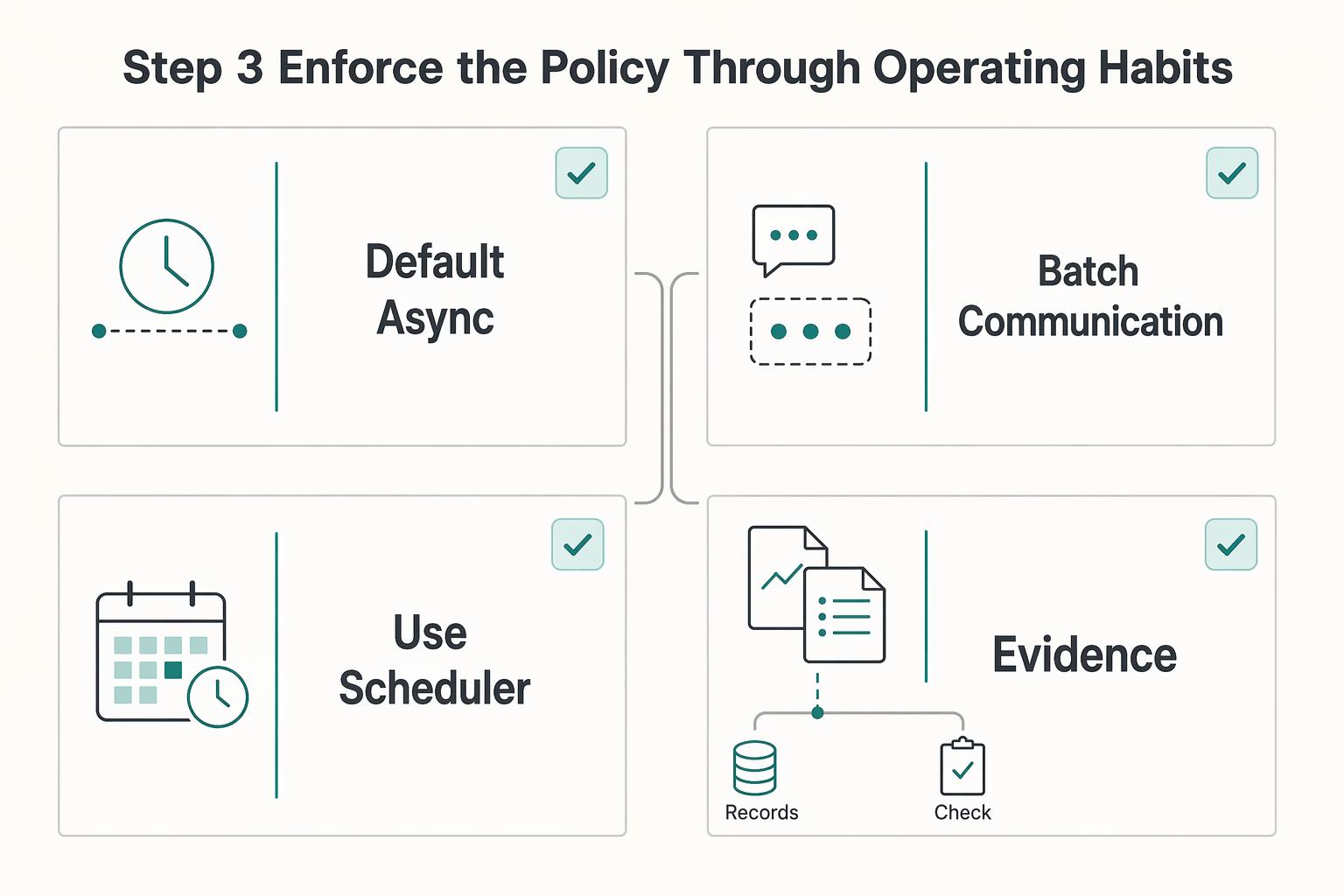
Step 3 Enforce the policy through operating habits#
A workable policy depends less on what you meant than on what your behavior teaches the client to expect. Flexible arrangements can improve productivity, but not automatically. One 2025 article reports 41% better productivity with home or hybrid work, while 16% saw worse results. In practice, the difference is usually clarity.
| Habit | What it does | What to keep visible |
|---|---|---|
| Default to async work | Keeps a reliable trail of requests, answers, and decisions | Keep status updates, routine questions, and feedback in one shared place |
| Batch communication | Keeps you responsive without becoming permanently interruptible | Answer at set points in the day instead of reacting to every message |
| Use a scheduler for all live meetings | Makes your availability, time zone, and buffer rules visible | Book meetings inside the structure you have already defined |
| Check the record weekly | Shows whether your boundary is holding | Confirm what was requested, delivered, approved, and waiting on the client from the shared thread, project tool, or document trail |
| Keep an evidence pack | Keeps the records you would need for scope, timing, payment, or role clarity questions | Include the signed SOW, policy addendum, invoices, and key engagement records |
That is why enforcement in client work rarely looks dramatic. It usually looks like repetition, consistency, and documentation. If your SOW says one thing but your daily behavior teaches another, the behavior will win. A client will rely on the pattern you reward, not the clause you signed.
Use this implementation checklist:
- Default to async work for status, questions, and feedback. Keep updates in one shared place so decisions are visible later.
- Batch communication at set points in the day instead of reacting to every message.
- Use a scheduler for all live meetings so your actual availability, time zone, and buffer rules are visible.
- Check the record weekly. If you cannot reconstruct who approved what from the shared thread or document, your boundary is not holding.
- Keep an evidence pack with the signed SOW, policy addendum, invoices, and key engagement records.
Each of those habits does a specific job.
Default to async work. Async is not just a preference. It is how you keep a reliable trail of requests, answers, and decisions. Status updates, routine questions, and feedback all become easier to verify when they live in one shared place rather than in scattered conversations. This also helps the client. If several people are involved, a visible thread prevents one person's private message from quietly becoming the "real" instruction for the project.
Async only works if you resist the urge to treat every incoming message as a live issue. If a client sends a note in chat, move the decision back to the shared record when needed. That can be as simple as replying in the agreed system with the next step, the decision, or the approval request. The purpose is not bureaucracy. The purpose is to avoid rebuilding the history later from memory.
Batch communication. If you answer everything immediately, you create the expectation of immediate access. That expectation is hard to reverse once the engagement is underway. Batching communication at set points in the day lets you stay responsive without becoming permanently interruptible. It also improves the quality of your replies. Instead of reacting to half-formed requests, you can respond once with a clearer summary of what is needed, what is missing, and what the next step is.
Batching also exposes urgency inflation. Many messages feel urgent because they arrive suddenly, not because they meet your actual escalation criteria. Once you have a routine, true urgent matters stand out more clearly and the client learns which route to use when something genuinely needs immediate attention.
Use a scheduler for all live meetings. This is one of the simplest ways to make your policy visible without repeating it. A scheduler shows when you are available, in which time zone, and with what buffer. That removes a surprising amount of negotiation from the process. It also prevents "quick calls" from becoming the default answer to every issue. If a meeting is necessary, it gets booked inside the structure you have already defined.
Schedulers are especially useful in flexible environments because they externalize your rules. Instead of arguing about availability in real time, the system shows it. That keeps the conversation practical and reduces the pressure to make exceptions just because someone asks in the moment.
Check the record weekly. This is the audit step most people skip until they need it. Once a week, try to reconstruct the status of the engagement from the shared thread, project tool, or document trail. Can you tell what was requested, what was delivered, what was approved, and what is waiting on the client? If not, your boundary is weaker than it looks.
A weekly check catches quiet drift before it becomes a pattern. Maybe approvals are happening in private messages. Maybe revision requests are no longer tied to the agreed rounds. Maybe a stakeholder who was not part of the original scope is now directing work. These are easier to correct when they first appear than after several cycles of the same behavior.
Keep an evidence pack. The evidence pack is your operating file for the engagement. The signed SOW and policy addendum belong there, along with invoices and key engagement records. The point is to keep the records you would actually need if a question comes up about scope, timing, payment, or role clarity.
Do not treat the evidence pack as a static folder that only matters in a dispute. It is more useful as a live reference. If you need to restate a boundary, adjust dates after a client delay, or confirm what was agreed at the start, the evidence pack lets you do that quickly and calmly.
A common failure mode is quiet exception creep: approvals in DMs, "quick" calls outside your window, and out-of-scope asks that never become written changes. Catch that early. If it happens twice, restate the rule in writing and update the engagement addendum.
Quiet exception creep deserves more attention because it rarely feels serious at first. A one-off DM seems harmless. A short call outside your window seems cooperative. A small extra task seems easier to do than to document. The problem is not the single event. The problem is the pattern those events teach. After two or three repetitions, the exception starts functioning as the new rule.
That is why the "if it happens twice" standard is useful. It gives you a practical trigger. You do not need to correct every minor deviation with a formal speech. But once a behavior repeats, treat it as a sign that the client is learning the wrong operating model. Restate the rule in writing, connect it to the engagement terms, and update the addendum if the current wording is not doing enough work.
In practice, that can look like this:
- If approvals keep arriving in chat, move the next approval request back to the shared channel and note that approvals need to remain there.
- If "quick calls" repeatedly land outside your stated window, direct future live discussion into the scheduler and keep substantive follow-up in writing.
- If the client keeps adding small tasks without change approval, group those requests, describe the impact on timing or fee, and ask for written confirmation before continuing.
Notice that each fix is operational, not theatrical. You are not trying to win an argument about flexibility. You are trying to restore the workflow that keeps the engagement understandable and defensible.
Do you need a separate policy if the SOW already covers timing?#
Usually, yes. The SOW sets the commercial terms. Your policy explains the daily handling of messages, meetings, approvals, and escalation.
That difference matters because timing in the SOW often answers only part of the question. It may say when something is due. It often does not say where requests must be sent, how quickly you respond to routine messages, what counts as urgent, or how live meetings are scheduled. Those practical rules are where most friction appears. A separate policy or short addendum keeps them explicit without forcing the SOW to carry every operational detail.
It also gives you something to update when the workflow changes but the commercial core does not. If the engagement is still the same project at the same fee, but the current meeting pattern is causing problems, you may need to adjust the handling rules rather than redraft the whole SOW.
How often should you review it?#
At least annually, and sooner for a new client or after repeated friction. Flexible arrangements hold up better when they are revisited instead of left to drift.
In practice, review sooner whenever the actual behavior no longer matches the written model. That can happen when a new stakeholder joins, the approval path changes, the client adopts a different internal schedule, or the volume of ad hoc requests grows. You do not need to wait for a major conflict to revisit the arrangement. The point of the review is to catch misalignment while it is still easy to correct.
A useful review is brief and concrete. Compare the written terms with the last few weeks of actual work. Are messages staying in the approved channels? Are collaboration windows being respected? Are deadlines moving appropriately when client inputs are late? Are change requests being approved before work starts? If the answer is no, revise the handling terms while the engagement is still healthy enough to absorb the correction.
Flexible work policy FAQ#
Should the policy be separate from the SOW?#
Usually yes. The SOW sets commercial scope, while the policy or addendum defines daily handling rules like channels, response windows, and escalation. Keeping both documents aligned makes boundary enforcement more consistent.
What is a practical non-urgent response target?#
A practical baseline is one business day for non-urgent requests submitted in approved channels. Urgent issues should use a named escalation path with a shorter response target, often 2 to 4 business hours.
How should delay responsibility be documented?#
Tie delivery dates to dependency timing. If client approvals or inputs are 2 business days late, the downstream milestone should move by the same 2 days unless both sides agree otherwise in writing.
How often should a flexible-work policy be reviewed?#
Run a 30-day stabilization review on new engagements, then review at least annually. Additional reviews are useful after role changes, approval-path changes, or repeated exception patterns.
Which records matter most in a dispute?#
Keep five core records together: signed SOW, policy addendum, approval log, change approvals, and invoice milestones. That evidence pack usually resolves scope and timing disputes faster than message-history reconstruction.
A client can offer flexibility without giving you a workable engagement. You create the workable part by translating their language, tightening the SOW, and checking the arrangement on a real cadence. If your policy is easy to verify in writing, it is much easier to defend in practice.
If you want a deeper dive, read Germany Freelance Visa: A Step-by-Step Application Guide.
Frequently Asked Questions
Should a flexible work hours policy live outside the SOW?
Usually yes. The SOW carries commercial scope, while the policy or addendum carries operational rules such as response windows, meeting channels, and escalation handling.
What response-time standard is practical for non-urgent requests?
A common baseline is one business day for non-urgent requests in approved channels, with separate escalation paths for urgent issues. The key is explicit channel and timing language, not informal expectation.
How should late client approvals affect deadlines?
Deadlines should move by the same amount as approval delay when client inputs are contractual dependencies. This makes schedule movement traceable and avoids hidden risk transfer.
How often should the policy be reviewed?
Review at least annually, plus an early checkpoint in the first 30 days of a new engagement to catch drift in channels, approval paths, and scope handling.
What records should be kept to enforce a flexible policy?
Maintain a compact evidence pack with the signed SOW, policy addendum, decision log, approval trail, and invoice milestones so disputes can be resolved from records instead of memory.
Try a related tool
Researched and edited by the Gruv editorial team. Gruv builds cross-border billing, payouts, and finance-operations software for global businesses.
Sources
Includes 3 external sources outside the trusted-domain allowlist.
- dol.gov/agencies/whd/flsatrusted
- hr.oregonstate.edu/flexible-work/resources-supervisors/practica...trusted
- ilo.org/global/topics/non-standard-employment/lang--...trusted
- acas.org.uk/flexible-workingexternal
- emerald.com/pr/article/doi/10.1108/PR-05-2025-0441/13428...external
- infeedo.ai/blog/flexible-work-culture-employee-engageme...external
Educational content only. Not legal, tax, or financial advice.
Related Posts

Germany Freelance Visa Application Path for Freiberufler and Gewerbe
Choose your track before you collect documents. That first decision determines what your file needs to prove and which label should appear everywhere: `Freiberufler` for liberal-profession services, or `Selbständiger/Gewerbetreibender` for business and trade activity.
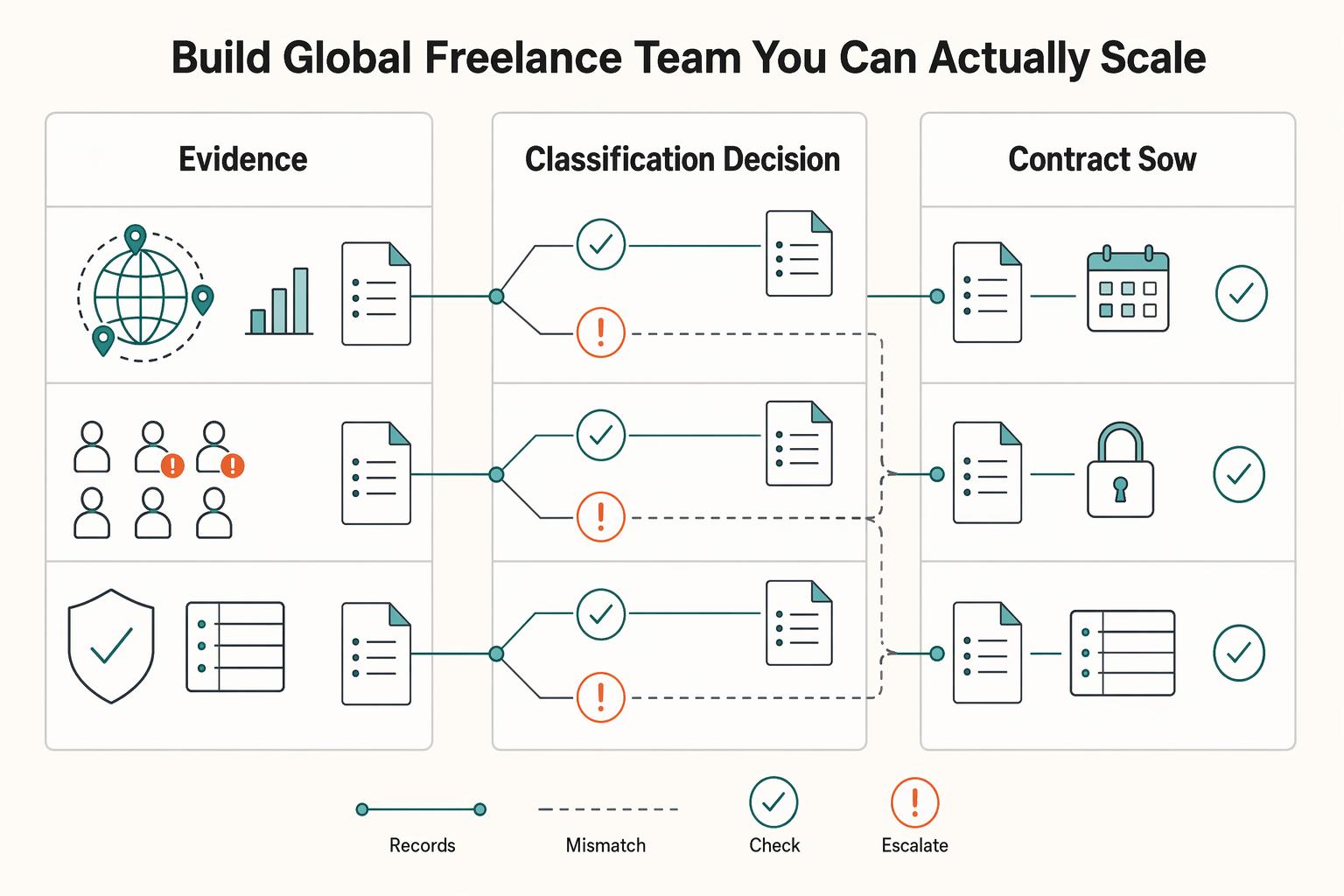
How to Manage a Global Freelance Team Without Compliance Gaps
If you want to manage a global freelance team without constant cleanup, use the same intake-to-payout process for every engagement and save an artifact at each gate. Common failure points are instinct-based classification, vague scope, and payments approved in chat with no audit trail.
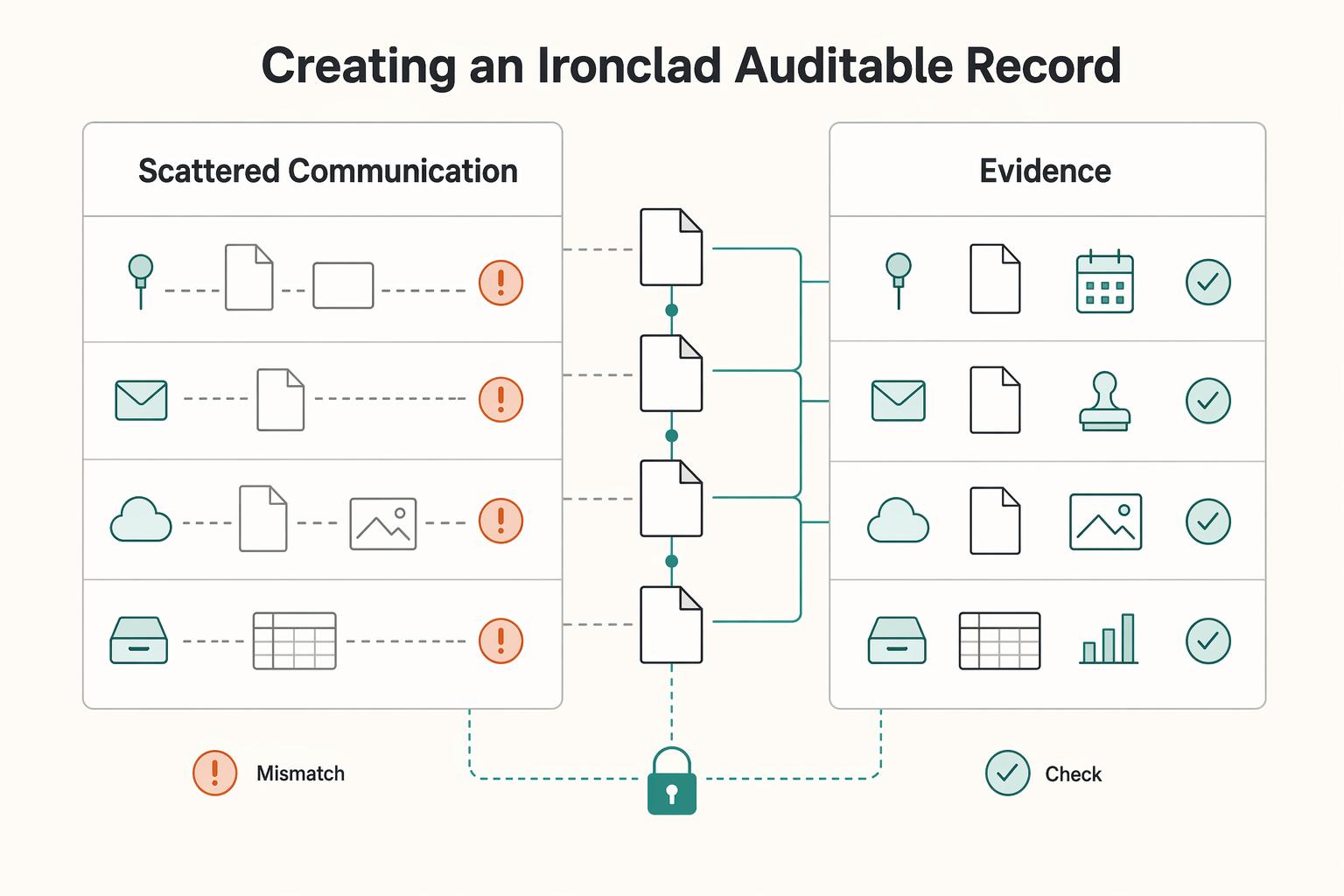
How Solo Professionals Create an Async-First Client Communication System
For a solo professional, async is not just a style preference. It is an operating mode that protects focus by reducing constant interruption and pushing more work into clear written communication.