
Quick Answer
To create a financial plan for sabbatical, build a risk-first cashflow system before you set dates. Define your break mode, calculate runway from core costs plus variable costs and buffers, and subtract only inflows you can defend as guaranteed. Then rehearse the budget, separate emergency and sabbatical funds, and lock a get-paid reliability layer with clear terms, collections rules, and go/no-go gates.
Your Sabbatical Doesn't Need "Inspiration" - It Needs a Cashflow Operating Plan#
Treat your sabbatical like an operating decision you can fund and defend, not a mood you can manifest. As the CEO of a business-of-one, you do not get to outsource coverage, timing, or follow-through. Start from zero assumptions (no "someone will cover me"). Build a plan that survives late payments, uneven income, and real-world friction so the rest stays mechanical, not emotional.
A sabbatical can look like a full stop or a lighter workload. It can also be a micro-sabbatical, which one advisor defines as "a planned, intentional break from work and regular obligations," even if it lasts "a weekend, a week, or a month." The duration matters less than the operating reality: you decide what work continues (if any), what stops, and what bills keep landing while you step away.
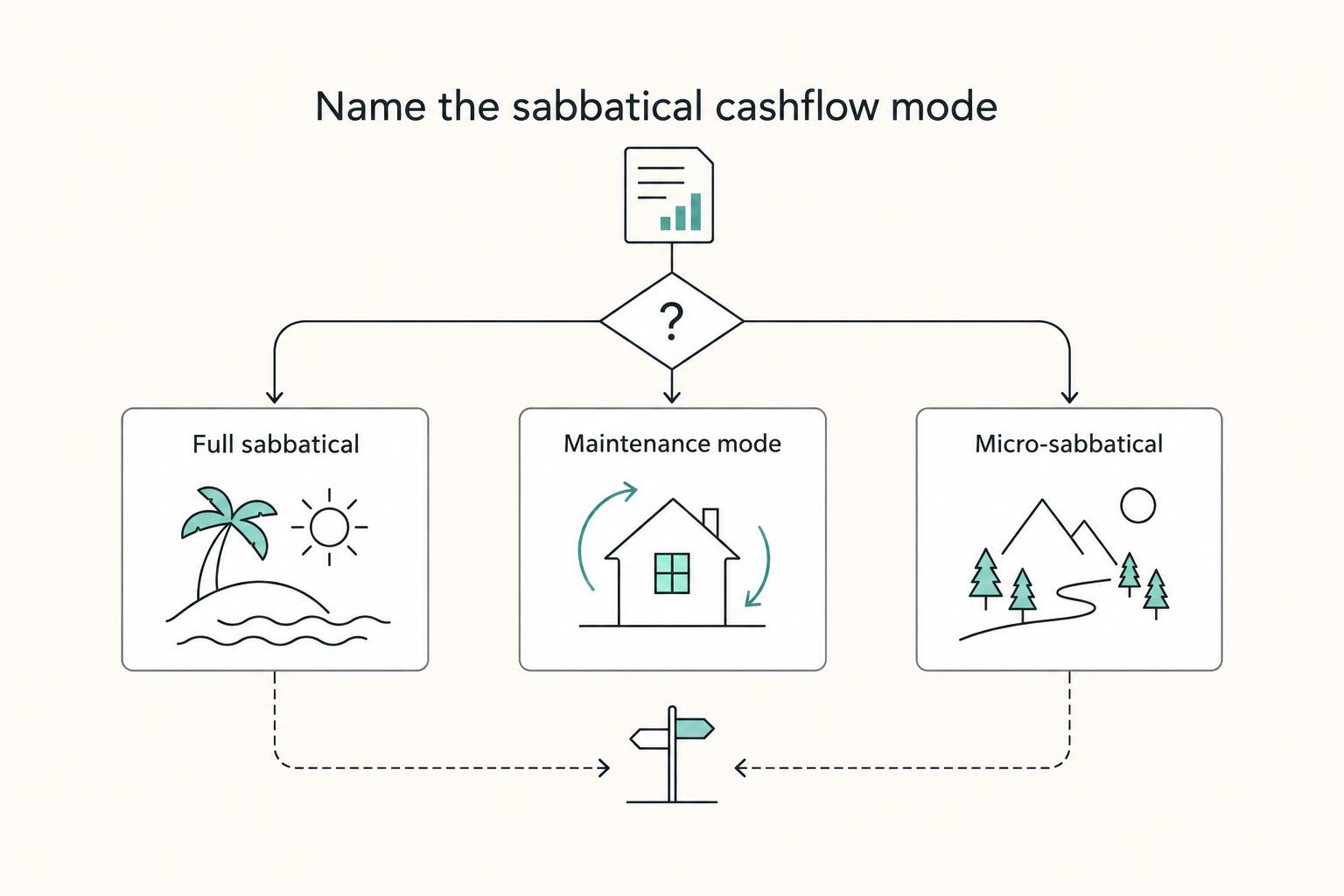
Step 1: Name your cashflow mode (so you stop guessing)#
If you invoice, you manage collections, not just "income." You can do everything right and still wait on approvals, processing windows, or internal pay cycles. If you run a small team, you also carry timing risk across contractors, tools, and commitments.
Here's one simple mode selector you can use:
| Mode | Work during break | What you must fund | Primary risk |
|---|---|---|---|
| Full sabbatical | None (by plan) | All spending from reserves | Underestimating runway |
| Maintenance mode | Minimal, bounded | Spending minus limited inflows | Scope creep from "quick asks" |
| Micro-sabbatical | Short, defined pause | Short burst of spending | Forgetting fixed bills and renewals |
Hypothetical: you plan a month off for travel planning, then a client "just needs" one revision. If you did not define your mode, that revision turns into a week of Slack messages and a delayed departure.
Step 2: Build the risk-first financial plan for a sabbatical (your reusable system)#
This guide is built like an operator playbook. You will leave with a plan you can rerun before every career break:
- Runway math: Calculate the cash you need based on your real outflows and only the inflows you can treat as reliable.
- A rehearsal budget: Practice the sabbatical lifestyle before you leave. You want proof, not confidence.
- A Get-Paid Reliability Layer: Reduce payment risk ahead of time by tightening terms, cleaning up invoicing, and simplifying how money moves.
If you use Gruv, think in terms of a clean money path (invoice to receipt to categorization to buffer) so you can step away with less manual follow-up. The goal is simple: make your sabbatical plan boring enough that you trust it.
Want a quick next step for "financial plan for sabbatical"? Try the free invoice generator.
Step 0 - What to Prepare Before You Touch the Math (Inputs, Files, and "Known Unknowns")#
Prepare clean inputs and document your unknowns first, because every later decision depends on records you can trust. Run this like an operating plan, not a feeling. Demand the same standard you would in a client project: source documents, a single source of truth, and clearly labeled assumptions.
Step 1: Collect source docs (build an audit-ready decision record)#
Treat this as "close the books" lite. Pull:
| Source doc | What to pull | Why it matters |
|---|---|---|
| Invoices | Last 6 to 12 months, including due dates, paid dates, and any credits | Helps you reconcile payment timing and map deposits to invoices |
| Bank statements | Matching statements for the same period | Lets you reconcile deposits to invoices |
| Tax admin basics | Any 1099 summaries you received, plus your W-9 or W-8 status ready for new client onboarding | Helps you avoid stalling on vendor setup right before you leave |
- Last 6 to 12 months of invoices you sent (include due dates, paid dates, and any credits).
- Matching bank statements for the same period (so you can reconcile deposits to invoices).
- Your tax admin basics: any 1099 summaries you received, plus your W-9 or W-8 status ready for new client onboarding (so you do not stall on vendor setup right before you leave).
Outcome check: you can point to any deposit and explain exactly what invoice it maps to (or label it as non-invoice income).
Step 2: Create a "Sabbatical Control Folder" (one source of truth)#
Make one folder you can hand to "future you" without a meeting. Include:
- Signed SOW files for active work
- "Current terms" for each client (payment timing, late fee language, acceptance criteria)
- An export of accounts receivable (invoice list with amount, due date, status)
- Contract clauses you may need during a dispute or wind-down, especially Termination and Governing Law
Use a consistent naming rule like: Client_Project_DocType_Date. Friction kills follow-through.
Step 3: Flag tax and compliance "known unknowns" (especially for travel planning)#
If travel planning includes extended time abroad, mark tax variables early so you do not build a budget on fantasy.
| Area | Grounded detail | Note |
|---|---|---|
| FEIE physical presence test | 330 full days in a foreign country or countries during any period of 12 consecutive months | Days do not have to be consecutive; excluded income still has to be reported on a U.S. tax return to claim the exclusion |
| Foreign housing limitation | Generally 30% of the maximum FEIE, with a stated housing amount limitation of $39,000 for 2025 and $39,870 for 2026 | Can vary by location and qualifying days, so do not treat it as uniform |
| Other reporting risk | Additional U.S. reporting may apply if you keep foreign accounts or otherwise run money through other countries while traveling | Confirm specifics with a tax pro |
- FEIE reality check: If you are looking at the Foreign Earned Income Exclusion (FEIE), IRS guidance says you meet the physical presence test if you are physically present in a foreign country or countries 330 full days during any period of 12 consecutive months (the days do not have to be consecutive). This test applies to U.S. citizens and U.S. residents and is based only on how long you stay abroad. Do not assume you qualify. Build a realistic day-count plan and confirm with a tax pro. Also: excluded income still has to be reported on a U.S. tax return to claim the exclusion.
- Foreign housing limitation: IRS guidance says the limitation on qualified housing expenses is generally 30% of the maximum FEIE, with a stated housing amount limitation of $39,000 for 2025 and $39,870 for 2026 (it can vary by location and qualifying days, so do not treat it as uniform).
- Other reporting risk: if you will keep foreign accounts or otherwise run money through other countries while traveling, flag that additional U.S. reporting may apply and confirm specifics with a tax pro.
Step 4: Choose your baseline (currency + money path)#
Pick one "safe default" currency for the plan. Then map collection vs spend:
| What | Question to answer | Example label |
|---|---|---|
| Collection | Where does money enter first? | Virtual Accounts (inbound) |
| Movement | How do you move money to your spend account? | Payouts (outbound) |
| Spend | Where do bills actually hit? | Home bank card/account |
Practical pass/fail (do this before any savings goal math)#
If you cannot answer, from records, "What is my average monthly net cash after taxes?" stop. Do a 60-minute reconciliation session and compute a defensible average.
Hypothetical: you plan a career break and assume "income covers basics," but your statements show irregular tax set-asides and lumpy client payments. One reconciliation prevents you from underfunding the entire sabbatical planning budget.
How Much Money Do You Need for a Sabbatical? (Runway Math You Can Trust)#
You need a target cash number based on clear monthly costs, explicit sabbatical variables, and a real buffer, minus only inflows you can treat as certain. Add a 10 to 15% buffer for surprises, and keep a separate emergency fund so one problem does not blow up the whole plan. This is sabbatical planning for operators, not a vibe check. As the How to Money team puts it, "they're not just an extended vacation where you're sipping pina coladas on the beach!"
Step 1: Build your editable runway model (with assumptions baked in)#
Create a single sheet where every line has (1) an amount, (2) a start and end month, and (3) an assumption note. Example assumption notes: "rent fixed through lease end" versus "month-to-month, landlord can raise."
Use these buckets:
| Bucket | What it includes | "Operator note" to record |
|---|---|---|
| Monthly Core Costs | Housing, insurance, debt minimums, subscriptions, tax set-asides | What can change while you're away, and who can change it |
| Sabbatical Variable Costs | Travel planning, visas, gear replacement, coworking | One-time vs recurring, and which month it hits |
| Buffers | Unexpected costs | Add a 10 to 15% buffer for surprises |
| Guaranteed Inflows | Only cash you can rely on | Point to the doc and the expected receipt date |
Verification point: you can explain every line item to "future you" without reopening your bank statements.
Also: keep sabbatical and emergency funds separate for cleaner decision-making. Mezzi recommends an emergency fund of 6 to 12 months of living expenses (often kept in a high-yield savings account) and, separately, a risk cushion that covers 6 to 12 months beyond your sabbatical. If liquidity is the priority while you're away, Mezzi also suggests shifting funds into accessible options like money market funds or short-term Treasury bills.
Step 2: List the costs that still hit during a career break#
List the costs that will still hit even during a career break. Keep receipts or notes next to each line so you can trace decisions if you later need to revisit timing in a signed SOW or re-check a subscription you forgot existed.
Minimum safe default categories:
- Housing (rent, utilities, storage if relevant)
- Insurance (health, renters, business policies if you keep them active)
- Debt minimums (do not model optional extra payments as mandatory)
- Subscriptions (software, phone, cloud storage)
- Tax set-asides (treat as core if you expect taxable inflows)
Step 3: Treat inflows as "guaranteed" only when you can point to the money path#
Separate what you already control from what you merely expect. Only count inflows you can map to a written agreement plus a clear collection path (for example, an invoice that's issued or scheduled, and a defined way funds land in your account). If you use multiple accounts, write down where cash lands first and when you can access it.
Hypothetical: you plan to fund the break with "a couple invoices that should clear," but you cannot name the exact payment date or confirm the collection route. That is a hole in the plan. Plug it by removing that inflow from "guaranteed" until it becomes real.
Budget Architecture That Survives Reality (Essentials vs Discretionary + the Practice Budget)#
Build your sabbatical plan around written spending rules tied to cash coverage, then pressure-test those rules before you leave. Runway math gets you the number. Budget architecture keeps you solvent when timing gaps, surprise fees, and "I forgot that renews" moments show up. This is where the break becomes policy, not willpower.
Step 1: Turn your budget into a simple operating policy#
Start by writing down what you already owe, then decide in advance what you would cut first if money gets tight. Do not over-engineer categories. You want something future-you can enforce in five minutes.
At minimum, capture:
- Your recurring commitments you expect to keep paying (the stuff that is hard to change quickly).
- A short list of expenses you can pause, downgrade, or delay if needed.
- A plain-language rule for what happens when coverage tightens.
Write the policy in one paragraph, including a trigger. Example: "If my cash coverage tightens, I reduce optional spending first and reassess before adding anything back."
Keep that policy somewhere you will actually look when uncertainty hits. The point is that you do not renegotiate with yourself mid-sabbatical. You follow the policy.
Verification point: you can explain your rules and trigger to "future-you in 6 months" without opening bank statements.
Step 2: Rehearse the budget (a dry run) and see where it breaks#
Run a rehearsal period before your career break. Treat the result like a system test: if the system fails, adjust the plan, not your discipline story.
Keep the rehearsal simple: know what's coming in, what's going out, and whether your plan still holds when real life happens.
Hypothetical: you rehearse the plan and keep dipping into money you meant to set aside for the sabbatical just to cover normal life. Take the signal. Shorten the sabbatical, reduce the scope, or redesign commitments before you leave.
Practical checks
- If the rehearsal keeps failing, redesign scope. Do not ignore the test.
- If you cannot describe your budget in plain language, simplify it until you can.
What Should Freelancers Do Differently From Employees Before a Sabbatical?#
Freelancers typically need a self-funded plan for a sabbatical, because there may be no employer policy or payroll backstop while you are offline. Employees may be able to lean on employer leave policies. You often cannot.
A career sabbatical is an extended break from work that commonly lasts several months to a year or more, and some companies offer paid sabbaticals while others offer unpaid leave. If you do not have that backstop, as one advisor put it, "your financial plan needs to do the heavy lifting."
Step 1: Name your sabbatical type and what changes operationally#
Employees often start with a policy (paid or unpaid leave). You start with funding reality. Write down, in one sentence, which bucket you sit in: employer-supported leave or a self-funded break.
Then decide what must stay "on" even during the break:
- Cashflow visibility (you still need to know what got paid).
- Access to key client information (so you can answer basic questions without reopening work).
- A response policy (so a "quick question" does not become a project).
Verification point: you can explain who handles money admin and how often you will look at it, in under 60 seconds.
Step 2: Build your freelancer "policy review equivalent" (plan, expectations, access)#
Do not rely on memory. Before you go offline, make sure you have a simple plan for how you will handle essentials while you are away, and communicate expectations clearly.
Keep it practical:
- Know what you are committing to (and what you are not) during the break.
- Make sure you can access the information you may need without turning your sabbatical into a workweek.
- If you will be fully offline, decide who (if anyone) can route urgent admin items to you.
Step 3: Decide how you will handle money admin without being "always on"#
Freelancers do not get automatic paychecks, so your sabbatical plan needs an explicit money plan, including how you will monitor incoming payments (if any) and what you will do if timing shifts.
If you want a deeper dive, read Pricing a SaaS MVP Project as a Freelance Developer.
Plan Time Off as if "Unlimited PTO" Has Real Boundaries#
If your company offers "unlimited PTO," assume it's not truly unlimited in practice and plan your time off like it has real boundaries. The label can hide expectations, norms, and approval dynamics that only show up when you try to take a meaningful break.
Treat "unlimited" as a policy description, not a guarantee. The point is to make time off actually executable without career-limiting ambiguity.
Step 1: Start with the core reality (it's not truly unlimited) "Unlimited PTO" doesn't normally mean it's truly unlimited. So don't plan your break on the most generous interpretation of the words.
- Translate "unlimited" into concrete expectations: What does "reasonable" look like here?
- Get clarity on what needs coverage and what needs advance notice.
- Verification point: you can explain, in plain language, what would make a request likely to be approved or denied.
Step 2: Pressure-test against what people actually take There's research showing employees with "unlimited PTO" actually take fewer vacation days than people with a specific allotment. That's a signal that culture and uncertainty can quietly cap time off.
- Look for the norm: what do peers actually take, and how is it talked about?
- Decide what "enough" time off looks like for you, then plan and communicate accordingly.
- Verification point: you can name the informal baseline you're operating against (even if it's not written anywhere).
Step 3: Borrow confidence from real examples, but don't assume yours matches One commenter reports never having a PTO request denied and taking 25-30 days off per year. That's possible, but it's not universal and it doesn't replace confirming your own environment.
- Treat anecdotes as proof it can work, not proof it will work here.
- Make your request legible: dates, handoffs, coverage, and what "done" looks like before you leave.
- Verification point: you've aligned on the plan in a way that reduces "we'll see" ambiguity.
Practical checks (pass/fail)
- If you can't clearly describe how time off gets approved (and what would make it a "no"), you're not ready to plan a real break.
- If "unlimited PTO" currently makes you take less time off because you feel uncertain, add structure: pick dates, communicate early, and treat it like a real commitment.
How Long Before a Sabbatical Should You Start Planning? (Milestones for 12, 6, and 3 Months Out)#
Start planning as soon as your sabbatical affects your income, and use a few month-based checkpoints (for example: about a year, half-year, and a quarter out) as operational milestones. They are not a magical rule. The goal is a timeline that tells you what to fix when, so the plan does not collapse under last-minute chaos. This is how operators turn "career break" into a controlled shutdown.
Before you start: pick your target departure month and define what "away" means (no sales, no delivery, minimal admin). Then map your work backward.
Step 1: Run a milestone timeline (and ship concrete deliverables)#
Use these checkpoints as a starting point, then adjust earlier if you have messy cashflow or cross-border complexity.
| Milestone (example) | Primary objective | What you complete (deliverables) | Verification point |
|---|---|---|---|
| ~12 months out | Stabilize your baseline | Reduce high-interest debt where you can. Fix pricing. Rebuild inconsistent invoicing. Clean up SOW templates, including Termination language you understand. | You can quote, scope, invoice, and collect without improvising. |
| ~6 months out | Fund and rehearse | Build the sabbatical fund and a rehearsal budget. Run a client concentration audit. Confirm your tax approach if you will travel (FEIE viability, tracking what you need to file/claim). | You ran at least one rehearsal month where your savings goal grows automatically. |
| ~3 months out | Execute collections and constraints | Execute the Get-Paid Reliability Layer. Finalize travel planning and legal constraints (visas, time-in-country realities). If relevant, confirm program requirements for your destination. | No critical sabbatical dollars depend on "they usually pay eventually." |
Hypothetical: you plan to spend part of your sabbatical abroad. At ~6 months out, you build a day-count plan and realize your travel route will not support the FEIE physical presence test requirement of 330 full days in a foreign country or countries during any period of 12 consecutive months. You switch to a simpler plan before you lock flights and commitments.
Step 2: Set go/no-go gates (cash, receivables, and operational readiness)#
Create gates you can enforce:
| Gate | Requirement | Note |
|---|---|---|
| Cash coverage % gate | Sabbatical runway math covers the break with cash on hand plus truly guaranteed inflows | Only greenlight when this is true |
| Unpaid invoices gate | Cap outstanding receivables before departure | If you still hope clients pay on time inside 90 days, delay the sabbatical or shorten it |
| Operational readiness gate | Assign ownership for email triage, invoicing, and disputes | The owner can be scheduled automation plus one weekly review |
Cross-border reality check: If your sabbatical changes where you live or work, confirm implications for invoicing, taxes, and local rules. For taxes, treat FEIE as eligibility-driven, not vibes. The IRS states, "If you meet certain requirements, you may qualify for the foreign earned income exclusion," and you must file a return reporting the income to claim it. Track foreign accounts and related reporting if relevant. Treat VAT as jurisdiction-specific and confirm based on where you supply services.
If part of your plan includes a structured stay abroad, read: the six-month Japan digital nomad visa runbook.
Common Mistakes (and How to Recover Without Cancelling Your Break)#
Treat your sabbatical as a controlled shutdown: isolate the risks that break cashflow, then apply small, reversible fixes instead of scrapping the whole plan. Planning is the point here. With careful planning and a planned budget, it's possible to take extended time off while maintaining financial stability. And as one Canada Life technical specialist put it, "Taking a career break or sabbatical can be a fantastic investment in your wellbeing or career development, but it pays to plan."
A career break feels common for a reason. A Canada Life survey (reported by Yahoo/PA Media) found nearly half (49%) believed they would likely need a sabbatical or career break, and 26% had already taken some type of extended leave. Treat mistakes as normal. Build a correction loop into the plan.
Step 1: Make one change, get one verification signal#
Use this table as your operator script. Make one change, get one verification signal, then move on.
| Mistake you're making | What breaks first | Recovery move you can execute this week | Verification point |
|---|---|---|---|
| Building the plan on money that isn't fully in your control yet | Your runway depends on timing you do not control | Re-run your plan using only cash you already have access to, then decide what to delay, cut, or simplify. | Your break still works on "money in hand," not best-case timing. |
| Skipping a planned budget (or keeping it vague) | You can't see problems early enough to fix them | Write a simple planned budget for the break and update it once, based on reality. | You can explain your monthly baseline in plain language and spot the biggest drivers. |
| Treating "unexpected" costs as a rounding error | Small surprises stack into a big problem | Add a small buffer line item and tighten one discretionary category. Keep it boring and repeatable. | Your budget can absorb a surprise without forcing a full reset. |
| Assuming you'll "figure it out" mid-break | You end up spending your break doing life admin | Decide, in advance, what gets handled and how often (even if it's just a small recurring check-in). | You have a lightweight routine that protects the time off. |
| Making the break all-or-nothing | One wobble turns into panic | Pre-choose two fallback levers (shorten the break, reduce spend, or adjust timing) so you're not improvising under stress. | You can name the first lever you'll pull before you touch the whole plan. |
Step 2: Pressure-test with a quick scenario#
Hypothetical: you plan a career break and expect one last payment to arrive right before departure. It doesn't. You recover by re-running the planned budget on cash you already control, trimming one or two optional expenses, and adjusting the plan instead of abandoning it. You keep the break. You stop "hoping."
Conclusion: Your Sabbatical Plan Wins or Loses on Cashflow Control, Not Motivation#
Your sabbatical works when you control cashflow end to end: what you need, what you spend, and how reliably you collect. With runway math, a practice budget, and a payment reliability layer in place, the finish line is straightforward. Lock the system, set gates, then commit to the calendar. Motivation helps you leave. Cashflow control helps you stay gone.
Step 1: Treat this like a lightweight finance function (not a one-off spreadsheet)#
Run your plan the way a small company runs finance: clear terms, clear rails, clear records, clear go/no-go gates.
- Clear terms: Your signed SOW defines acceptance criteria and payment timing so "approval limbo" cannot quietly eat your runway.
- Clear rails: You map the money path (invoice sent, money received, categorized, moved to the right bucket, held in buffer).
- Clear records: You keep your "Sabbatical Control Folder" current so you can defend every assumption.
- Clear gates: You decide in advance what stops the trip (or forces a shorter career break) without renegotiating with yourself mid-stress.
Hypothetical: you plan a month of travel planning with a low-work posture. One client slips payment. If you already wrote the rule (pause discretionary spend, send the pre-written follow-up, do not start new work), you protect the break without spiraling.
Step 2: Use this copy/paste checklist as your pre-flight standard#
This is your operator-grade "done means done" list. If you cannot check an item, treat it as a blocker, not a "nice to have" for later.
- I calculated Target Cash using: (Core costs × months) + variable costs + buffers − guaranteed inflows
- I ran a 30-60 day practice budget and passed without dipping into savings
- I separated funds: sabbatical runway vs emergency reserve vs tax set-aside
- I audited client concentration and reduced exposure to my top 1-2 clients
- I reviewed contract terms: SOW acceptance criteria, payment timing, Termination, Governing Law/Jurisdiction
- I executed a 90/60/30 Get-Paid Reliability Layer (terms, rails, collections)
- I set go/no-go gates: cash coverage %, unpaid invoices threshold, and an offline collections plan
- I documented tax/compliance considerations and stored records in one folder
If your sabbatical planning includes potential FEIE eligibility, remember the IRS physical presence test requires being physically present in a foreign country or countries for 330 full days during any period of 12 consecutive months (the days do not have to be consecutive), and the IRS still expects you to file a tax return reporting the income. Confirm your specifics with a tax pro, then store your decision notes with the rest of your plan.
If you're rebuilding your "get paid globally" workflow with audit-ready visibility (collection to balance to withdrawal), explore Gruv modules like Virtual Accounts and Payouts (availability varies by market/program) or request access to confirm coverage.
Frequently Asked Questions
How much money do I need for a sabbatical if my income is inconsistent?
Treat your plan like cash coverage, not a vibe. List your fixed costs and variable costs (housing, utilities, food, and any non-negotiables), then decide how long you want to fund without assuming new income. With inconsistent income, only count inflows you’re genuinely confident will arrive. Treat the rest as upside, not runway.
Is an emergency fund enough for a sabbatical, or do I need both an emergency fund and a sabbatical fund?
If you can, keep two separate buckets: an emergency reserve for unplanned problems, and a sabbatical fund for planned time off. A sabbatical can be paid, unpaid, or a combination of paid and unpaid time off, so your funding needs depend on what you actually arranged. Separation keeps your plan honest and prevents you from calling “planned spending” an “emergency.”
How far ahead should I start planning (realistically)?
Start planning early, while you still have room to adjust your budget and commitments. A sabbatical can run from a few weeks to several months (and in some cases up to a year), so the longer the break, the more useful it is to map costs ahead of time. If your plan includes travel or time abroad, add time to confirm logistics and rules since requirements vary by place.
What should I do differently if my income is not steady?
Build around what you can control: your expenses and how much time you want covered without assuming new income. When your cash inflow is less predictable, the planning step that matters most is getting clear on fixed vs. variable costs so the break doesn’t rely on best-case timing.
Should I pay off debt before taking a sabbatical, or keep liquidity?
Keep it simple: make sure your plan covers your non-negotiables first. If you want to accelerate payoff, do it only if you can still take the sabbatical without relying on uncertain income.
Try a related tool
Researched and edited by the Gruv editorial team. Gruv builds cross-border billing, payouts, and finance-operations software for global businesses.
Sources
Educational content only. Not legal, tax, or financial advice.
Related Posts

Japan Digital Nomad Visa 2026: Six-Month Planning Runbook
Treat this as your operating model: identify the right mission first, commit to one route, and keep dated records before you make irreversible plans. That is what keeps the rest of your timeline, paperwork, and decisions coherent.

Pricing a SaaS MVP Project as a Freelance Developer
If you want to protect margin, treat your quote as a risk decision, not a market-average guess. The headline number matters less than the assumptions and scope boundary underneath it.

The Freelance Payment Penalty: A Modeled Audit of Platform Fees, FX Spreads, and Payout Delays
The money rarely disappears through a single, easy-to-spot fee. The real loss is stacked. A marketplace takes its commission, a processor adds a charge for international cards, a bank or payment company converts the currency at a spread, a platform holds the funds before release, and a wire sheds a little to intermediaries on the way in. Each layer looks defensible on its own, but the worker feels the combined result as a smaller deposit and a later payday.