
Quick Answer
Start a financial forecast for funding round planning with a bottom-up model built from controllable operating inputs, then connect those inputs to all three financial statements so cash effects are visible. Turn the raise into milestone-based uses of funds, and pressure-test assumptions through base, bear, and bull cases before sharing the model. Keep unknowns explicit in an assumptions log so updates drive real decisions on hiring pace, spending, and runway.
Stop Pitching Investors. Start Leading Your Business.#
Treat your forecast as a system first and an investor document second. If it does not help you decide hiring pace, spending, and cash runway in the near term, it is not ready yet. Three terms matter here:
- Bottom-up forecast: starts from operating drivers you can inspect, such as customer count, volume, and unit price, and builds up to revenue.
- Decision-grade assumptions: based on evidence you can explain, including historical results, current conditions, and a reasonable forward view, not optimism alone.
- Forecast ownership: your operating team uses the model to run and grow the business, not just to pitch.
Use this screen before any assumption enters the model:
- Use when the assumption is explainable, tied to a real driver, and has a plan for comparing forecast versus actuals.
- Validate when it seems directionally reasonable but evidence is thin. Assign an owner, define the evidence gap, and set the next review point.
- Remove when no one can explain it, no real input supports it, or it only improves the story on paper.
Keep story and math aligned. For cash planning, start from cash reality: cash balance divided by monthly burn, with burn defined as cash in minus cash out.
| Use case | Required inputs | Review cadence | Failure signal |
|---|---|---|---|
| Hiring | Headcount plan, start dates, payroll impact | Monthly or quarterly (year one) | Roles are added without a clear link to expected output |
| Pricing | Unit price, discount logic, conversion/retention assumptions | Monthly or quarterly (year one) | Revenue rises but conversion or retention logic is missing |
| Cash planning | Opening cash, inflows, outflows, burn, capex budget | Monthly or quarterly (year one) | Profit looks acceptable while runway keeps shrinking |
| Fundraising narrative | Milestones, uses of funds, stage-appropriate horizon, projection-to-ask linkage | At each raise, plus regular internal checks | Funding ask is not clearly tied to what the capital will achieve |
Before you build, document three things: an assumption log, a driver map that shows what moves revenue and costs, and risk notes for assumptions that could fail. Build those first so the model becomes a management tool, not a guess. If you want a deeper dive, read Hiring Your First Subcontractor: Legal and Financial Steps.
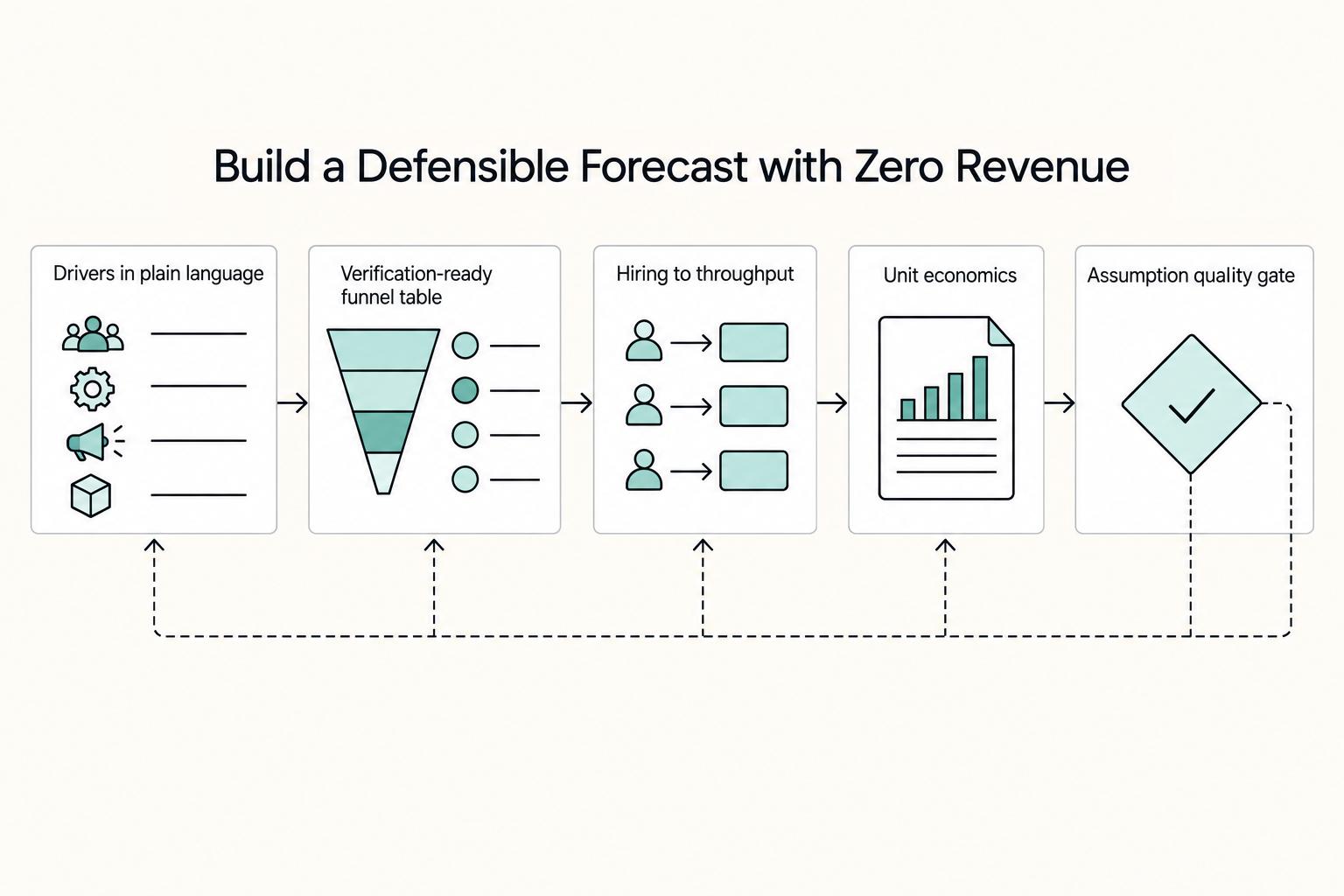
Stage 1: Build a Defensible Forecast with Zero Revenue#
If you have zero revenue, build from drivers you can verify, not from a smooth top-line story. A defensible forecast starts bottom-up and should be usable internally before it is pitch-ready.
Step 1 Define the drivers in plain language#
Start with low-level operating inputs, then roll them up to revenue. At this stage, four drivers matter most:
| Driver | Definition | Grounding |
|---|---|---|
| Demand driver | evidence of real desire for your offer | explicit market research assumptions rather than broad market optimism |
| Conversion driver | a measurable rate from one interaction to the next desired action | one funnel stage to the next |
| Capacity driver | throughput | how many units your team can move through the process per unit time |
| Unit economics driver | whether customer economics are viable | contribution margin and CAC-based measures (including CAC payback and LTV:CAC framing) |
Step 2 Build a verification-ready funnel table#
Do not hardcode conversion rates without a source. A simple source-and-owner table makes weak assumptions visible before they spread through the model.
| Funnel stage | Assumption source | Confidence level | Owner | Verification note |
|---|---|---|---|---|
| Top-of-funnel demand | Benchmark source unresolved | Low / Medium / High | Owner not yet assigned | State what evidence will confirm demand |
| Lead to qualified lead | Benchmark source unresolved | Low / Medium / High | Owner not yet assigned | Define exact qualification rule |
| Qualified lead to proposal or trial | Benchmark source unresolved | Low / Medium / High | Owner not yet assigned | Link to test plan or comparable data |
| Proposal or trial to paid customer | Benchmark source unresolved | Low / Medium / High | Owner not yet assigned | Note the next review date |
Every material assumption should include a source, a confidence label, and a named owner. If the only source is founder belief, mark it low confidence until tested.
Step 3 Tie hiring to throughput, not ambition#
Add headcount when it removes a real operating constraint. Use a driver tree such as: Role hired -> activity capacity -> pipeline throughput -> delivery capacity -> revenue recognized.
For each role, define start date, ramp period (if applicable), and units per time at steady state. Then check capacity utilization so forecasted throughput and delivery capacity stay aligned. If they do not, either delay revenue recognition or add the capacity required to deliver it.
Step 4 Check unit economics before you scale spend#
Make customer economics explicit before you increase acquisition spend or hiring.
- Include full CAC inputs: Customer Acquisition Cost (CAC) = Sum of Sales and Marketing Expenses / Number of New Customers Acquired. Do not limit CAC to ad spend only.
- Build contribution margin from variable costs: Contribution margin is revenue minus variable costs.
- State payback logic exactly: Months to Recover CAC = CAC / (New MRR per Customer x Subscription Gross Margin).
If you reference payback benchmarks, label the segment context. Guidance varies. One view may say under 12 months, while another gives 6-18 months for SMB and 24-36 months for enterprise. Do not treat any single threshold as universal.
If assumptions are still unproven, use ranges, show sensitivity, and state clearly that outputs are conditional on those assumptions holding.
Step 5 Apply the assumption quality gate#
Before you move to Stage 2, sort your assumptions into three buckets:
| Bucket | Criteria |
|---|---|
| Ready | documented source, named owner, method, sensitivity note, and update plan against actuals |
| Needs test | directionally plausible but evidence is thin; define the test, time window, and decision trigger |
| Exclude for now | no source, weak data quality, or outsized model impact without validation |
This gate protects credibility because the model is only as reliable as the assumptions behind it. Related: The Best Bank Accounts for Freelancers in Germany.
Stage 2: Connect Your "Ask" to a Concrete Growth Engine#
Once the drivers hold up, turn them into a financed operating plan. Your ask should read like that plan, not like a round number. In a credible model, each Stage 1 driver flows through the income statement, cash flow statement, and balance sheet so investors can test the logic.
Step 1 Map each driver across the three statements#
Keep the "three statements, one story" framing, but make the links explicit. The income statement shows performance, the balance sheet shows position, and the cash flow statement shows movement. Under IAS 7, cash flow should be clearly classified into operating, investing, and financing activities.
| Operating driver | Income statement effect | Cash flow effect | Balance sheet effect |
|---|---|---|---|
| Demand -> conversions -> customers -> MRR | Revenue recognized | Cash receipts from customers | Cash and receivables move |
| Hiring and ramp | Salary and related expense | Operating cash outflow rises | Cash declines as payroll is paid |
| Funding round close | No direct revenue effect | Financing cash inflow | Cash rises with matching financing balance |
Checkpoint: every material assumption should visibly affect more than one statement. If a driver changes revenue but not cash impact, your model is not linked yet.
Step 2 Translate the ask into milestone funding#
Present use of funds as measurable execution, not "general growth." Your ask should connect capital to milestones and timeline, with outputs you can verify.
| Use case | Spend bucket | Expected operational output | Leading indicator | Verification note |
|---|---|---|---|---|
| Product development | Product / engineering | Deliver agreed feature, workflow, or proof of concept | Release date, active usage, pilot completion | Target not yet verified |
| Market validation | Customer research / testing | Confirm or reject core demand assumption | Qualified interviews, trial starts, win-loss pattern | Target not yet verified |
| Key hiring | Payroll | Increase sales, delivery, or support throughput | Ramp date, capacity per hire, pipeline coverage | Target not yet verified |
| Customer and revenue momentum | Sales / marketing | Increase customer acquisition and revenue pace | New customers, MRR added, stage conversion | Target not yet verified |
If a row does not tie back to demand, conversion, capacity, or unit economics, treat it as an experiment rather than a core milestone.
Step 3 Apply investor-readiness criteria to the ask#
Before you present, run three pass-fail checks:
| Check | Pass condition |
|---|---|
| Driver traceability | Assumptions are traceable to explicit business drivers from Stage 1 |
| Testable milestones | Milestones are testable with observable pass or fail evidence |
| Downside cash modeling | Downside cash impact is modeled explicitly, not parked in a footnote |
A practical test is simple. For each major line item, can you show the source, owner, verification method, and cash impact if it slips?
Step 4 Use a KPI dictionary that drives management decisions#
A KPI list only helps if it changes decisions. Keep the definitions plain and tie each one to an action.
| KPI | Plain-language definition | Decision use |
|---|---|---|
| MRR | Expected monthly customer revenue (commonly for subscription models) | Check whether go-to-market is becoming repeatable |
| Burn | Speed of cash spending; define your sign convention in the model and keep it consistent | Approve or delay hires, campaigns, and discretionary spend |
| Runway | Current Cash Balance / Net Burn Rate | Decide raise timing, spend cuts, or project sequencing |
| DSO / CCC | DSO tracks collection speed; CCC = DIO + DSO - DPO | Act when booked revenue grows but cash collection lags |
Step 5 Model cash-risk controls before you present#
A recurring cash-risk pattern is timing mismatch between payables and receivables. Stress-test these patterns and model the fix first:
- Timing mismatch: supplier payments leave before customer cash arrives. Shift receipts later and model tighter invoicing or payment terms.
- Scenario downside: model downside cases explicitly and confirm the round still covers the low-cash month.
- Delayed collections: revenue is recognized but cash conversion slows. Push DSO out in downside scenarios and confirm the round still covers the low-cash month.
This is a survival check. In CB Insights' March 5, 2026 review of 431 VC-backed shutdowns, "ran out of capital" was the top reason at 70%. Your model should show how you avoid that path.
We covered this in detail in How to Create a Financial Plan for a Sabbatical.
Stage 3: Use Scenarios as Decision Tools Under Plausible Stress#
A model is more credible when it tells you what to do when conditions change. Use scenarios as decision tools, not forecasts, and build them around severe but plausible stress.
Step 1 Define each case by decision purpose#
Keep base, bear, and bull, but give each case a distinct job.
| Case | Purpose | Input assumptions to set explicitly | Expected management action |
|---|---|---|---|
| Base | Run plan | Best current assumptions for demand, hiring ramp, collections timing, and spend | Operate and track plan cadence |
| Bear | Protect cash and extend runway under plausible downside | Lower demand or conversion, slower collections, cost pressure, hiring friction | Execute pre-agreed defensive moves in sequence |
| Bull | Test optionality without breaking resilience | Faster traction plus realistic delivery and cash-conversion assumptions | Accelerate only after evidence checks and downside re-check |
Verification check: each scenario should change named inputs, expected action, and owner accountability. If only revenue changes, your plan is likely under stress-tested.
Step 2 Build a trigger table you can monitor#
Early warning indicators should fit your company profile and be reviewed periodically, with faster reviews when conditions change.
| Trigger event | Impacted driver | Early warning signal | Response lever | Owner |
|---|---|---|---|---|
| Customer cash arrives later than planned | Operating cash flow, runway | DSO rising above baseline; threshold not yet verified | Tighten invoicing follow-up, revisit payment terms, slow discretionary spend | Finance lead |
| Conversion weakens in a core channel | New customer adds, MRR, burn efficiency | Conversion rate below plan for the agreed review period | Cut low-yield campaign spend, reallocate testing budget, revise acquisition pace | GTM lead |
| Hiring ramp slips or productivity lags | Capacity, payroll efficiency | Start dates pushed or output per hire below plan; threshold not yet verified | Freeze backfill, phase future hires, shift work to highest-yield roles | Founder or hiring manager |
| Supplier or tooling costs rise sooner than expected | Gross margin, monthly net burn | Spend variance above plan; threshold not yet verified | Reprioritize scope, renegotiate contracts, defer noncritical tools | Operations lead |
If a row has no signal or no owner, it is likely to fail when you need it.
Step 3 Prioritize risks by controllability#
Separate risks into two buckets so your scenario design stays usable in practice:
- Controllable risks: hiring pace, collections discipline, channel mix, pricing tests, scope decisions.
- External shocks: financing delays, market slowdown, supplier changes.
Then make each scenario include both the external condition you are testing and the internal levers you can pull in response. Keep an assumptions log next to the model with source, owner, last review, and next action. Update it on a regular cadence and faster when conditions change.
Step 4 Use a bear-case decision ladder before runway risk is critical#
Pre-commit the response order so you do not improvise under stress. Measure each move with runway math: Current Cash Balance / Monthly Net Burn Rate.
- Control discretionary spend.
- Slow hiring pace and nonessential backfills.
- Tighten collections discipline and overdue escalation.
- Reprioritize scope toward faster cash conversion.
In the bear case, quantify how much runway each step adds. If a step does not extend runway in a meaningful way, replace it.
Step 5 Treat the bull case as an optionality test#
Do not accelerate spend because results look good for one period. Accelerate only after your evidence gates are met and downside resilience still holds.
Use three checks before you speed up:
- Demand outperformance is repeating, not one-off.
- Collections remain stable, with no hidden cash-conversion drift.
- After added spend, runway still stays above your internal floor in a downside re-check.
That is the point of stress-testing: press the upside when it is earned, without sacrificing survival.
For a step-by-step walkthrough, see Build a Pro Forma Financial Statement for Freelance Cash Decisions. Before finalizing your base, downside, and upside cases, validate your transaction-cost assumptions with the payment fee comparison tool. Then feed those inputs back into your model.
Conclusion: Your Forecast Is Your Story. Tell It with Confidence.#
Your forecast should run the business, not sit in a pitch deck. Treat it as your operating model in numbers, with assumptions, drivers, scenarios, and cash flow tied to real decisions.
- Use the base case as your default operating plan.
The base case is your most likely path, so it should guide routine actions between funding conversations. Keep four elements current: explicit assumptions, a driver-based model, scenario logic, and a cash flow forecast for the coming months.
- Set and follow a decision cadence.
Update monthly or quarterly, keep a rolling one-year forward view instead of a static file, and revisit scenarios more often when conditions are changing quickly. At each review, confirm cash balance, monthly net burn, and runway using: Cash Runway = Current Cash Balance ÷ Monthly Net Burn Rate.
- Let the downside case trigger action.
Scenario planning matters when it changes near-term choices on cash and financing. If the downside case shows pressure on core obligations or near-term funding needs, consider adjusting hiring, spending, or raise timing now rather than waiting for the next cycle.
- Escalate when complexity exceeds internal control.
Consider bringing in finance or tax professionals when financing or tax questions become complex, when statements stop reconciling clearly to cash, or when the team cannot explain model outputs clearly. If an outside preparer handles tax work, your business is still responsible for the information filed. If you keep the forecast current, it becomes a decision tool you can use right after the investor meeting, not a one-time presentation artifact.
You might also find this useful: A Guide to Conditional Green Cards and Removing Conditions (Form I-751).
If you want a second pass on how your collection, conversion, and payout flow impacts forecast reliability, contact Gruv.
Frequently Asked Questions
How do I forecast with no historical data?
Use bottom-up as your operating plan and top-down as a sanity check. A bottom-up forecast starts from low-level company inputs and builds up to revenue. A top-down forecast starts from market-level data and narrows down to your company estimate. In a raise, investors can challenge assumptions that are not tied to controllable drivers, so avoid presenting top-down as your core execution case and log unknowns as unresolved assumptions until you have evidence.
What are the most common mistakes?
A common mistake is treating the model like a pitch artifact instead of a decision tool. In practice, that can show up as growth assumptions disconnected from hiring capacity, collections timing, or cash outflows. When results look unusually strong, do not trust the headline output until demand, delivery, and cash movement reconcile. If key assumptions are still unowned by the next update window, escalate for review.
What is the difference between top-down and bottom-up forecasting?
Top-down is faster and useful for quick screening. Bottom-up is built from controllable operating drivers and is usually more defensible. In a raise, screening logic can frame the opportunity, but operating logic is what supports investor review. Use top-down for range checks and market ceiling context, not as the primary revenue engine in your base case.
How should I think about CAC and LTV in this model?
Treat CAC and LTV as operating tests, not just presentation metrics. CAC (Customer Acquisition Cost) is the cost to acquire one new customer. LTV (Customer Lifetime Value) is the total revenue expected from one customer relationship over its lifetime. Use them to test growth efficiency, but do not present CAC/LTV if cost scope or retention logic is still unresolved. If your team cannot align on component definitions, escalate to a finance advisor before you present them.
How do I calculate runway and net burn?
Keep the convention explicit and the math simple. Net burn rate is the rate at which the business is losing money, and sign conventions differ by source, so define your convention clearly in the model header. Runway is how many months remain before cash runs out, and the basic calculation is cash on hand divided by burn rate when inflows and expenses are stable. Use that formula for a quick check, then move to month-by-month cash forecasting when collections, payroll, or spend patterns shift materially.
How far out should the forecast go?
Match the horizon to what you can actually see and control. There is no single mandatory length for every company or round. Keep monthly views detailed where you can manage directly, then aggregate later periods once assumption quality drops. A common mistake is false precision, not a horizon that is too short.
Should I build the model myself or hire someone?
Keep ownership inside the business even if you bring in help. Your team should still be able to explain the drivers, assumptions, and tradeoffs, because funding questions usually test operating command more than formatting quality. Use outside help for review, cleanup, or reconciliation support, but do not fully outsource the logic. If statements stop reconciling to cash or diligence requests exceed internal capacity, bring in a finance advisor.
What tools should I use?
Use the tool your team can update cleanly and consistently. It is acceptable if it keeps assumptions visible, separates inputs from formulas, and supports repeat updates. That matters more than tool brand because trust comes from traceability back to records and cash activity. Keep the simplest setup that supports regular updates and clean audit trails, and only move to a more structured system when version control or auditability repeatedly breaks.
Try a related tool
Researched and edited by the Gruv editorial team. Gruv builds cross-border billing, payouts, and finance-operations software for global businesses.
Sources
- ecfr.gov/current/title-12/chapter-II/subchapter-A/par...trusted
- fdic.gov/news/financial-institution-letters/2023/fil2...trusted
- gao.gov/products/gao-20-195gtrusted
- hbs.edu/faculty/Pages/item.aspxtrusted
- irs.gov/businesses/small-businesses-self-employed/re...trusted
- irs.gov/newsroom/selecting-a-tax-professional-as-a-s...trusted
- nvlpubs.nist.gov/nistpubs/Legacy/SP/nistspecialpublication800...trusted
- online.hbs.edu/blog/post/pro-forma-financial-statementstrusted
Educational content only. Not legal, tax, or financial advice.
Related Posts

Hiring a Subcontractor for the First Time Without Costly Surprises
**Start with a risk-control sequence, not an ad hoc handoff.** As the Contractor, your goal is simple: deliver cleanly, control scope, and release payment only when the work and file are complete.
The Best Bank Accounts for Freelancers in Germany
Pick the account that protects cashflow and keeps records clean when client behavior gets messy, not the one with the nicest app.
Remove Conditions on a Conditional Green Card With Form I-751
Start with the core rule: file **Form I-751, Petition to Remove Conditions on Residence** in the **90-day period before** your 2-year card expires, and submit evidence that the marriage was entered into in good faith. If you miss the filing rules or send a defective package, this is not a routine renewal issue. USCIS says conditional residents who do not remove conditions can lose permanent resident status and become removable.