
Quick Answer
Prepare revenue, costs, receivables, time records, contracts and pipeline for a protected quarterly review. Check applicable obligations and recovery arrangements, calculate client economics including hidden work, then choose a growth test. Record a decision and dated next action for each priority. Keep legal deadlines and annual or rolling compliance periods separate from the quarterly schedule.
Block One Protected Quarterly Session and Bring the Records#
A quarterly CEO Day is a protected block for business decisions that client delivery keeps displacing. Bring the last quarter’s revenue, costs, time records, receivables, contracts and pipeline. Leave with a short action list and the next review date, rather than a larger collection of unresolved observations.
Step 1 Block a client-free operator review#
Block a client-free session and treat it like an operating review, not a think piece. For it to matter, the inputs are evidence from the last quarter, the decisions are the calls you have delayed, and the outputs are dated next actions, not just observations.
Use three review areas: obligations and business continuity, client economics and delivery processes, then acquisition and next-quarter priorities. A suggested half-day agenda is 45 minutes for risks, 90 minutes for client economics, 45 minutes for growth and 30 minutes to write actions, with breaks between blocks. This is a planning format, not a requirement to spend a full day.
Before You Start#
Bring records, not memory. Pull your calendar, invoices, expense data, active contracts or scopes, and a short list of open questions around compliance, profitability, and growth. One red flag is starting with a blank page and no evidence pack. That can push you back to feelings and recent client noise. Use the checklists in each section to force a decision, then write the next action and date before you move on.
If you want a deeper dive, read How to Use OKRs for Freelance Goal Setting and Performance Tracking.
Pillar 1: Clear the Risk Stack in Order#
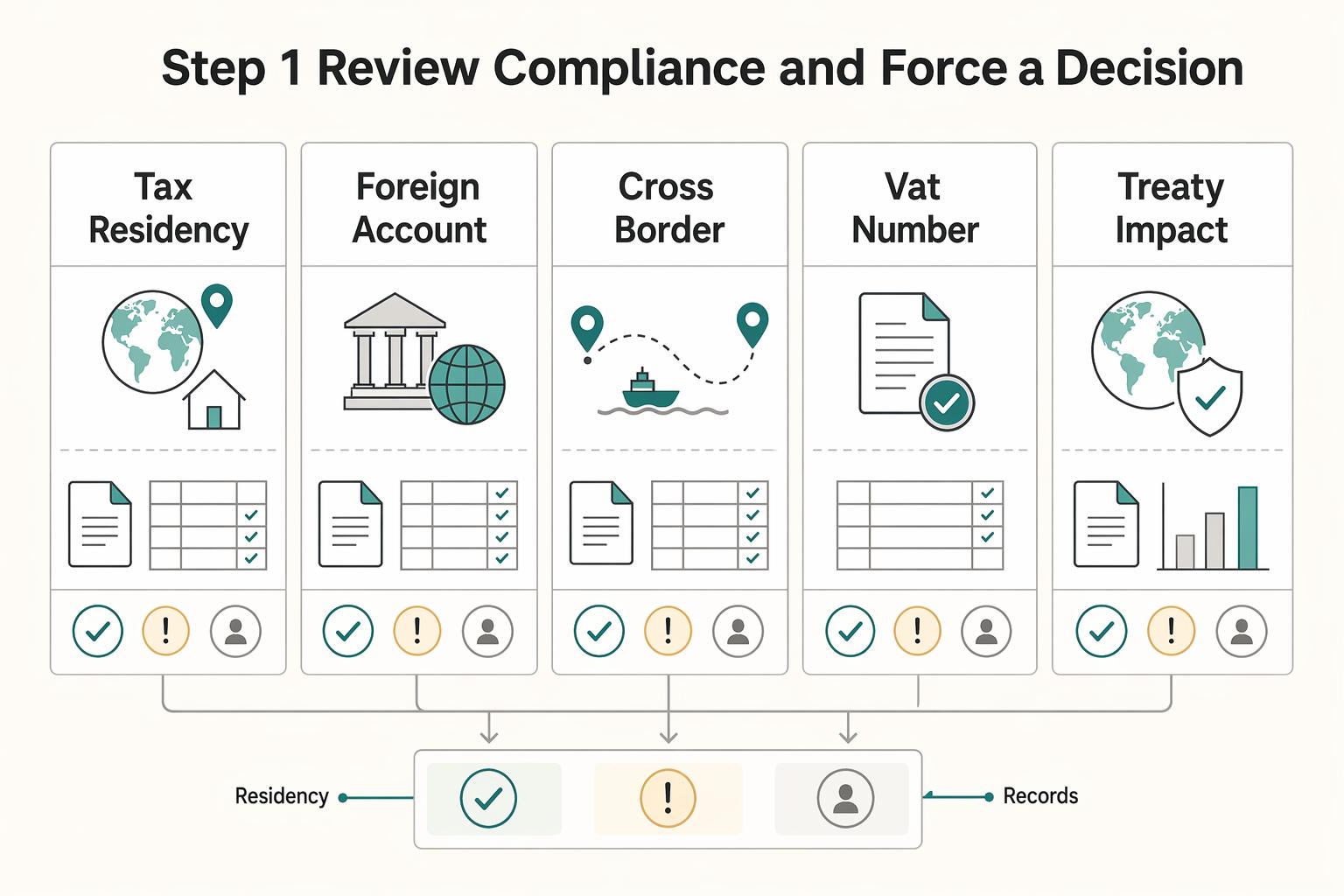
Step 1 Review compliance and force a decision#
| Review now | Verify against | Record in your sheet | Decide before you move on |
|---|---|---|---|
| Tax residency day counters | Travel records and applicable tax-residency or immigration rules; FEIE is a U.S. income-exclusion test, not a tax-residency test | Presence days by jurisdiction, plus a what-if travel plan | Keep current approach, change this quarter, or escalate by date |
| Foreign account reporting exposure | Current official rules or qualified advisor guidance | Account list, institution, country, highest known balance, combined-account risk flag | Keep, change, or escalate |
| Cross-border invoices (last 3-5) | Current rules you operate under for VAT reverse-charge treatment and client status | Which invoices were checked, what matched, what did not | Keep, fix invoice process, or escalate |
| EU VAT number checks (if relevant) | Your VIES validation process | Validation note or screenshot reference for each checked invoice | Keep process, tighten process, or escalate |
| Treaty-impact questions | DTA relevance for income touching two countries | One-line question per country pair | Resolve now only if clear; otherwise batch for advisor |
Before you leave this step, you should have one compliance tracker with statuses: verified, needs update, or needs advisor.
Step 2 Audit contracts for leakage#
This is where margin usually leaks. Scope creep tends to show up as repeated "small" extras, not one big event.
| Review item | Capture |
|---|---|
| Scope boundary | Scope boundary that failed |
| Change-order trigger | Change-order trigger that should have applied |
| Revision pattern | Revision request pattern that kept repeating |
| Extra work billed | Whether extra work was billed |
| SOW language | Exact SOW language to tighten in your standard template |
Review your top three active or recently completed agreements and compare each SOW to what was actually delivered. Use the table above to capture the leakage points for each one.
Update the standard SOW template for future engagements. Existing agreements change only through their agreed amendment process; a template edit does not change a current client’s terms.
Step 3 Check backups and access controls#
Security is only real if you can recover access and data quickly.
- Confirm your latest successful backup date
- Restore one noncritical file to prove recovery works
- Review high-risk accounts first (primary email, banking, accounting, storage, client communication)
- Confirm unique passwords and MFA where available
- Verify account-recovery paths still point to devices and numbers you control
Fix stale recovery settings now, especially after phone changes, SIM swaps, or old-access leftovers.
If you want a lighter cadence between quarterly reviews, How to Conduct a 'Weekly Review' for Your Freelance Business.
Pillar 2: Optimize the Engine#
Step 1 Calculate client profitability with hidden work included#
Use a full-effort view per client. Separate earned revenue from cash received and outstanding invoices so an unpaid balance is visible. Include delivery, meetings, revisions, support, invoicing and collection time, plus direct costs and payment fees.
If your time tracking is imperfect, estimate from evidence and label it as an estimate. Keep delivery effort separate from support and admin load so hidden work is visible.
| Client | Earned revenue | Direct costs and fees | Delivery hours | Support/admin hours | Cash received / open invoices | Contribution per total hour |
|---|---|---|---|---|---|---|
| Illustrative Client A | $6,000 | $600 | 60 | 20 | Record separately from earned revenue | $67.50 before owner labor and other overhead |
In a hypothetical quarter, a client produces $6,000 revenue, incurs $600 of direct costs and fees, and takes 60 delivery hours plus 20 support/admin hours. Revenue per total hour is $75; contribution before your own labor and other overhead is $5,400, or $67.50 per hour. If you value your labor at $50 per hour, $4,000 of labor leaves $1,400 before other overhead and tax. Neither revenue per hour nor contribution per hour is net profit.
Step 2 Force one decision: retain, renegotiate, or offboard#
Pick your lowest-value client or most painful recurring process and choose one path now.
| Path | Use when |
|---|---|
| Retain | Value, workload, and strategic fit are all acceptable |
| Renegotiate | The relationship is worth keeping but scope, revisions, approvals, or payment terms are creating drag |
| Offboard | Time drain or payment friction is chronic enough to disrupt delivery |
- Name the issue in business terms: scope, turnaround, approvals, payment method, or support load.
- Propose the change: revised package/terms, tighter SOW, new invoicing cadence, or end-date notice.
- Set dates: when new terms start, when current work ends, and what handoff you will provide.
Propose amendments through the controlling agreement’s approval process; record the client’s acceptance and effective date before applying new terms. For offboarding, follow notice, termination and handoff obligations and keep the final status record.
Step 3 Map operations from lead to payment, then choose one fix#
Map your workflow in order: lead, discovery, proposal, contract, kickoff, delivery, review, invoice, payout, reconciliation. Then mark tool handoffs and every point where data gets entered twice.
- Tool handoffs that slow transitions
- Duplicate entry across systems
- Payout or currency bottlenecks that add delay or follow-up work
There is no universal blueprint, so adapt the map to your model. For this cycle, pick one prioritized fix with a start date, not a perfect end-state plan.
For each stage, record the responsible person, system and output. A solo operator may own several stages; the point is to expose missing handoffs, not invent a separate person for each one.
Step 4 Rework pricing around value and boundaries#
Adjust pricing only after the offer is structurally clear. Package around outcomes, then define boundaries in writing: included scope, exclusions, turnaround assumptions, revision policy, and change-order process.
Where you need market checks, verify the current benchmark from source records before using it. For each core service, draft three scope tiers, identify the best-fit client type, and attach boundary language to your proposal template.
Target outcome for this step: one repackaged service, one pricing update ready for new clients, and one boundary clause added to your standard terms.
Pillar 3: Chart the Course#
End the day with three decisions for the next cycle: one acquisition channel to prioritize, one offer progression to test, and one founder-risk gap to close.
Step 1 Score acquisition channels#
Choose channels by evidence, not activity. Review your last quarter of leads and projects, then score each channel on source quality, close likelihood, project fit, and delivery burden.
| Channel | Source quality | Close likelihood | Project fit | Delivery burden | Decision |
|---|---|---|---|---|---|
| List each acquisition channel | Score source quality from your records | Score close likelihood from your records | Score project fit from your records | Score delivery burden from your records | Record your keep, test, or drop decision |
Use concrete records for each score: inquiry emails, proposals sent, signed SOWs, and delivered projects. If a channel creates fuzzy scopes, heavy revisions, or procurement friction that later shows up in your SOWs, treat that as delivery burden. Pick one primary channel for focused effort and one supporting channel for lighter maintenance.
Step 2 Map one offer progression#
Build your next offer from work you already deliver well, then tighten it around a clear client outcome and feasible delivery. A practical progression is a path you can explain in plain language, such as: audit -> implementation package -> quarterly review.
| Growth option | Evidence to collect | Risk to test | Next decision |
|---|---|---|---|
| Skill upgrade | Qualified buyers requesting the skill | Training time without billable demand | Choose a small skill project or defer |
| Packaged repeat service | Repeated client requests and recorded delivery effort | Scope exceptions exceeding the planned effort | Test one bounded paid package |
| Fixed-scope productized deliverable | Repeatable inputs, output and acceptance criteria | Support or revisions eroding contribution | Measure actual effort on a pilot before expanding |
For your selected path, define the outcome, required inputs, exclusions, and revision limit before you sell it. If those boundaries are not clear yet, keep refining before launch.
Step 3 Run a founder-risk checklist#
Treat your personal safety net as an operating requirement, not a side note. Save this checklist and your proof in one folder:
| Area | What to confirm |
|---|---|
| Income stability | Compare current reserves against your real monthly personal and business burn |
| Retirement automation | Check actual transfers, eligible plan and current contribution limits for your jurisdiction; record unresolved questions with an adviser date |
| Health coverage portability | Confirm where coverage applies, what changes if you relocate, and which exclusions matter for your movement pattern |
| Business continuity | Arrange authorized emergency access to necessary records; use emergency-access controls and respect bank/client permissions |
Conclusion: Review the Business, Decide, and Keep the Record#
- Gather the inputs. Use comparable operating periods and label estimates. Keep legal annual or rolling test periods separate.
- Make the decisions. Pick one call per pillar. That might be one item to verify, one pricing or scope change, and one growth bet to continue or stop. If a key detail is unclear, do not guess. Mark it as pending verification and assign a date to resolve it.
- Document the outputs. Save the records, write the decision, responsible person and due date, and book the next review.
We covered this in detail in How to use a 'Decision Journal' for your freelance business.
Frequently Asked Questions
What should be on my checklist if I work across borders?
Review the obligations that apply to your citizenship, tax residence, business location and work pattern. List registrations, filing dates, permits, invoice requirements and any foreign-account reporting duties. U.S. FEIE and FBAR checks belong on the list only when applicable; immigration stay limits, tax residency and income exclusions are separate rules.
How do I review FEIE during my quarterly check?
For a relevant U.S. FEIE claim using the physical presence test, reconcile travel records to at least 330 full days in foreign countries during a 12-consecutive-month period. A full day runs midnight to midnight. The day count alone is not enough: foreign-earned income, foreign tax home and other eligibility conditions still matter. The bona fide residence test is a separate possible route for eligible individuals.
What should I verify before I assume FEIE solves my tax problem?
FEIE is an exclusion claimed on a U.S. return, not a general exemption from filing or every tax. Keep the year services were performed and the payment date visible, then use the applicable Form 2555 instructions. For a self-employed person, FEIE does not reduce self-employment tax. Foreign housing deductions or exclusions have separate conditions; do not assume a travel-day count settles the whole calculation.
How should I handle FBAR in this review?
For a U.S. person, review financial interest in or signature authority over reportable foreign accounts and whether their aggregate value exceeded USD 10,000 at any time during the calendar year. FBAR is separate from the income-tax return. The usual deadline is April 15 with an automatic extension to October 15; check exceptions and applicable special relief.
Which reports matter most for the quarterly review?
Start with a client economics sheet, receivables ageing, cash and cost summary, time records, pipeline and active-contract changes for the quarter. Add relevant compliance records using their required period: a rolling FEIE test or annual FBAR check will not necessarily share the quarterly business-review dates.
How often should you do this?
Use a quarterly full review and a shorter monthly check of cash, overdue invoices, pipeline and actions. Calendar legal, tax and renewal deadlines separately; a quarterly meeting should not delay an obligation due sooner.
Try a related tool
Researched and edited by the Gruv editorial team. Gruv builds cross-border billing, payouts, and finance-operations software for global businesses.
Sources
Educational content only. Not legal, tax, or financial advice.
Related Posts

Digital Nomad Health Insurance Comparison for Long-Stay Moves
Use focused time now to avoid expensive mistakes later. Start with a practical `digital nomad health insurance comparison`, then map your route in [Gruv's visa planner](/tools/visa-for-digital-nomads) so we anchor policy checks to your real plan before pricing pages pull you off course.

Use OKRs to Run Your Freelance Business Week to Week
A busy week can produce useful work without improving the business outcome you chose. Objectives and Key Results give you a small set of priorities and measures for a defined cycle. Keep routine tasks and operating checks alongside them, rather than turning every invoice or document into a new goal.

The Best Travel Insurance with Electronics Coverage for Remote Workers
Electronics coverage problems often start before the trip, not only after damage happens. Many trace back to purchase-stage choices: broad labels read as guarantees, eligibility details entered too quickly, or exclusions ignored until a claim is active. If a denied claim would interrupt your income, choose clarity over price from day one.