
Quick Answer
Build your cap table as a legal record first: list each holder, security type, and share count only when a fully executed agreement supports the entry. Run hiring, option-pool, and financing scenarios in a separate working view before you accept terms. Check that every ownership percentage ties to shares and that current, issued, outstanding, and fully diluted views do not get mixed. After each equity event, reconcile the table and document set immediately.
A founder's three-stage guide to building and defending your cap table#
A cap table should do three jobs well: record ownership, help you model decisions, and hold up in diligence. Most founders start by treating it like an administrative file: a spreadsheet, a few signed PDFs, and a hope that everything still ties together when it matters. That view is too narrow, and it gets expensive later.
| Stage | Cap table role | Focus |
|---|---|---|
| Foundation (Control) | Ownership record | Build a source of truth you can defend |
| Foresight (Simulation) | Planning model | Test decisions before you commit to them |
| Fortification (Compliance) | Diligence file | Stand up in fundraising, diligence, and compliance review |
Your cap table is your ownership record, your planning model, and your diligence file. It should tell the story of the company from day one through every hire, grant, financing, and transfer that follows.
The way you manage it should mature in stages. First comes Control, where you build a source of truth you can defend. Then comes Foresight, where you use that record to test decisions before you commit to them. Finally comes Fortification, where the table and its backing documents are strong enough to stand up in fundraising, diligence, and compliance review. This guide walks through each stage so your cap table stays useful as the company gets more complex.
Stage 1: Foundation (Control) - Establish an Unquestionable Source of Truth#
Control starts with a simple choice: treat the cap table as the legal ownership record of the company, not a rough internal tracker. If the first version is sloppy, the damage shows up later in diligence, in founder disagreements, and in the familiar moment when one spreadsheet says one thing and the signed paperwork says another.
Build the minimum source of truth#
Start smaller than most founders expect, but make every field defensible. For each holder, record the full legal name, the security type, and the shares issued, and keep the supporting signed legal document tied to that entry. For founders, the security type is typically Common Stock.
Then add only the details you can defend with signed paperwork. You are not building a complicated tool yet. You are making sure each row can be traced back to a clean document trail without digging through old email threads.
Use one hard rule from the start: no entry belongs in the source-of-truth version unless you can point to a fully executed legal document that supports it. If a row is based on a verbal agreement, a draft PDF, or "we agreed on this in Slack," leave it out until the record is complete.
Keep the records consistent as complexity grows#
Most early cap-table mistakes are not exotic. As complexity increases, spreadsheet-based tracking can create calculation and version-control risk, so keep one source-of-truth version and reconcile it regularly.
| Risk area | What to enforce early | Why it matters | Common founder mistake and prevention |
|---|---|---|---|
| Core holder data | Full legal name, security type, and shares issued for every holder | These are baseline source-of-truth fields | Mistake: incomplete holder rows. Prevent it by refusing partial entries. |
| Supporting documentation | A fully executed legal document for each entry | Diligence depends on a defensible ownership record | Mistake: recording verbal or draft terms as final. Prevent it by entering rows only after execution. |
| Spreadsheet operations | Tight version control and routine reconciliation | Reduces calculation and version-control errors | Mistake: multiple copies drifting apart. Prevent it by maintaining one controlled working version. |
Make reconciliation a habit. Every time equity records change, your holder rows, summary view, and signed documents should tell the same story. If they do not, stop there and fix the mismatch before you move on.
Paper the founder issuance and store the evidence#
For founder shares, the safest sequence is also the least exciting one. Prepare the issuance documentation, complete signatures, record the entry in the table, then store the finalized records so they are easy to retrieve. That order keeps your table from getting ahead of your documents.
Set up the evidence for a future reviewer, not just for your current self. Each founder entry should point to the signed document set that supports the holder name, security type, and shares issued. If you cannot tell which file is final, or signatures are split across inboxes, treat that as a red flag now rather than an annoyance to clean up later.
A spreadsheet is usually fine at this stage, but only if version control is strict and the evidence pack is complete. When founders get this wrong, the problem is rarely just a bad formula. It becomes time spent reconstructing history, chasing signatures, explaining gaps to investors or buyers, and arguing internally about who owns what. Get the foundation right once, and the next stage becomes far easier.
Stage 2: Foresight (Simulation) - Model Your Company's Future#
Use this stage as a pre-signing workflow: run the scenario first, then decide terms. A clean cap table helps with diligence, but the real point here is to test ownership outcomes before you commit.
Lock your baseline, then run scenarios from one consistent view#
Before you model hiring or financing, freeze your starting total share count and reconcile it to the signed records from Stage 1. Then keep two views side by side:
- Current ownership: what is issued and outstanding now.
- Fully diluted working view: potential shares you are modeling (for example, pool reserves or conversion rights), shown separately from current ownership.
Use one simple quality check every time: every percentage must tie to a share count. If you show percentages without counts, your math will be questioned. Also treat scenario inputs as illustrative unless you have deal-specific terms; do not treat template assumptions as market standards.
Common interpretation errors to avoid:
- Mixing current ownership and modeled future ownership in one column.
- Treating an unresolved scenario assumption as a real negotiated term.
- Changing definitions between scenarios, then comparing outputs as if they were equivalent.
Model hiring and option-pool decisions before you promise equity#
Do not negotiate grants from a headline percentage alone. First decide whether the grant comes from an existing pool, a new pool, or a pool expansion tied to financing. Then compare the outcomes in one table.
| Holder or bucket | Current ownership | Post-pool ownership | Negotiation impact |
|---|---|---|---|
| Founder 1 | Enter current shares and percentage from the source record | Enter post-pool shares and percentage from your scenario model | Shows dilution if pool is created before financing |
| Founder 2 or existing holders | Enter current shares and percentage from the source record | Enter post-pool shares and percentage from your scenario model | Shows who absorbs pool expansion |
| Unallocated option pool | Enter current pool shares and percentage from the plan record | Enter new pool shares and percentage from your scenario model | Makes hiring reserve explicit |
| New hire grant | No grant entered until the source record or scenario is verified | Enter the grant share or percentage assumption from your scenario model | Tests whether one grant overuses the pool |
Run this checklist for each hiring scenario:
- Set the pool size assumption.
- Mark timing: pre-financing or post-financing.
- Show grant assumptions in both shares and percentages.
- Reconcile totals after the change.
- Recheck share-price math when pool and financing assumptions interact.
If you need plan-structure guidance, see How to Structure an Employee Stock Option Plan (ESOP) for a US Startup.
Model SAFEs and notes by conversion mechanics, not headline dollars#
For financing, model each instrument as a future ownership claim with its own terms. Keep SAFEs and notes separate, and keep multiple notes on separate lines when caps differ.
| Field | What to model | Article note |
|---|---|---|
| Instrument type | SAFE or convertible note | Keep SAFEs and notes separate |
| Cash amount | Cash amount | Model each instrument as a future ownership claim |
| Valuation cap | Valuation cap, if any | Keep multiple notes on separate lines when caps differ |
| Discount | Discount, if any | Model each instrument with its own terms |
| Conversion trigger | Conversion trigger in that instrument | Model by conversion mechanics, not headline dollars |
| Pro rata assumption | Pro rata assumption for existing investors | Entered manually in this workflow |
Minimum fields to model each time:
- Instrument type (
SAFEorconvertible note) - Cash amount
- Valuation cap (if any)
- Discount (if any)
- Conversion trigger in that instrument
- Pro rata assumption for existing investors (entered manually in this workflow)
Known failure points are predictable: conversion method, share-price calculation, and rounding. Down rounds or recapitalizations usually require model restructuring, including anti-dilution handling, rather than a quick edit to existing assumptions.
Use outputs to make decisions before documents are final:
- If pool sizing leaves too little room for planned hires, change timing or size before grant discussions close.
- If modeled financing terms drive more dilution than expected, renegotiate terms before signing.
- If scenario outputs depend on unclear assumptions, pause and clarify inputs first.
Stage 3: Fortification (Compliance) - Turn Your Cap Table into a Legal Shield#
By this stage, your cap table is evidence, not just a planning file. For every number in the table, you should be able to show the executed record behind it quickly if investors, buyers, or tax authorities ask.
Map every line item to executed records#
Treat the cap table as a summary of legal records, not a substitute for them. Each entry should map to a fully executed agreement, related approvals, and supporting records in a controlled document system so the paper trail is clear during diligence.
Use a simple row-level check for every update:
- Link the line item to its executed document.
- Confirm the key details in the table match the signed record.
- Mark anything unresolved and fix it before the next financing conversation.
Set a maintenance cadence after every equity change#
Keep update ownership explicit and consistent so the record does not drift. After any equity change, run the same reconciliation pass: confirm the table update, confirm document support, and confirm issued, outstanding, and fully diluted figures still tie back to signed records.
When you add an option pool or outside investors, version control and calculation risk usually increase. That is the point where dedicated cap table software can reduce those risks.
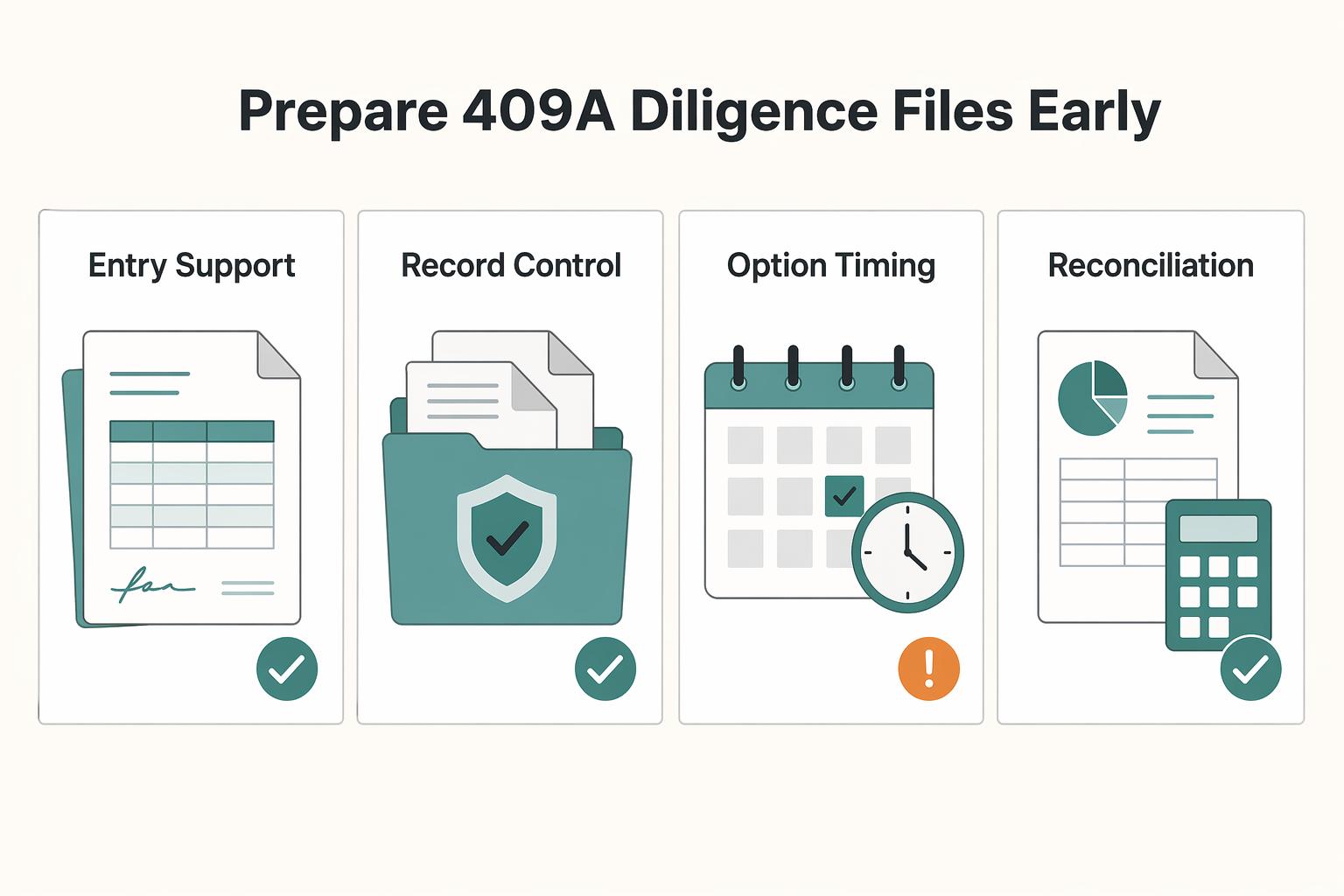
Prepare 409A and diligence files before they are urgent#
If you plan to issue stock options, obtain a formal 409A valuation before the first grant and renew it at least annually. Before relying on the valuation, validate the ownership data feeding it against your current cap table and executed records.
If a requirement is not yet verified, do not guess. Treat the current threshold as pending counsel or valuation-provider verification, and resolve it before you proceed.
| Signal | Clean record | Risky record |
|---|---|---|
| Support for each entry | Each row maps to an executed document and supporting records | Rows exist without clear executed support |
| Record control | Documents are maintained in a controlled system tied to cap table entries | Records are fragmented, and entry-to-document links are unclear |
| Option compliance | 409A is in place before first option issuance, with annual renewal tracked | Option activity and valuation timing are not clearly aligned |
| Reconciliation quality | Issued, outstanding, and fully diluted figures tie back to signed records | Percentages appear plausible, but supporting share math cannot be verified |
If this table exposes gaps, close them before fundraising, financing, or acquisition diligence. You might also find this useful: The Best Software for Cap Table Management.
Spreadsheets vs. Software: When to Migrate and How to Choose#
Upgrade when your current cap table cannot give reliable, audit-ready answers without manual rescue work. If ownership is still simple and one person can reconcile every line item to executed records, a spreadsheet can still work. If your next equity event requires repeated modeling, option tracking, or broader stakeholder access, migrate before that event.
The decision is not about company age or funding stage. It is about whether your record can hold up under investor, diligence, and audit pressure.
Run this three-step readiness check before each equity event#
Use this before a fundraise, option grant cycle, SAFE or note conversion, transfer, or pool change.
| Check | Question | Risk signal |
|---|---|---|
| What-if scenario test | Can you model dilution, new money, pool changes, and conversion outcomes without rebuilding formulas by hand? | Fragile tabs or manual patching mean risk is already rising |
| Prove-it audit test | Can you show grant details, approvals, signed agreements, and current status from a single, controlled record? | Evidence split across files, folders, and inboxes makes diligence friction predictable |
| Go-time test | Can the right people get current answers without editing the master file, and can you identify one authoritative version instantly? | If not, version drift becomes the main operational risk |
Verification point: Pick one recent equity event and answer, from current records only: who owns what now, what fully diluted ownership looks like, and which executed document supports each changed line.
| Decision area | Spreadsheet | Software |
|---|---|---|
| Control | Strong for one careful owner | Better for shared access with managed permissions |
| Error risk | More exposure to manual formula/version mistakes | Less manual handling when workflows are configured well |
| Audit trail quality | Depends on file discipline across separate systems | Stronger when history and document links live with the record |
| Collaboration/version control | Degrades as copies circulate | Stronger with one live source of truth |
| Workflow burden | Light while structure is simple | Better fit when updates, reviews, and reporting are recurring |
Score tools on capabilities, not brand names#
Choose based on capability fit first: document linkage, scenario modeling, permissions, reporting, and compliance workflow support. Tools like Carta, Pulley, or Eqvista are examples to evaluate, not automatic choices.
Set your migration trigger now, and mark any unverified stakeholder threshold as pending until counsel, finance, or provider records confirm it. A defined trigger prevents last-minute, emotion-driven switches.
Make the call#
Stay on a spreadsheet if one owner can keep it current, every row maps to executed records, and your next event is operationally simple. Migrate now if the next event requires scenario-heavy modeling, repeated multi-stakeholder access, or document-heavy proof. For diligence prep, see How to Create a 'Data Room' for a Due Diligence Process.
Conclusion: Your Cap Table Is the Story of Your Business#
The practical answer is simple. First, treat the cap table as your one current ownership record. It should tell you who owns what, who controls the company, and which founders, investors, or team members sit behind each line. If you cannot answer those questions from one source of truth, the record is not ready.
Second, use that record before you make decisions, not after. Before you accept a term sheet, expand an option pool, or issue more equity, model dilution first and review the before-and-after ownership impact. A clean table makes that possible. Without it, you are guessing about founder impact at the exact moment you need precision.
Third, back every entry with documentation and review it on a repeating cadence. After each funding round, update the table and make sure legal documentation for equity grants is complete. Then confirm the record is current and consistent. A common failure mode is not an exotic math problem. It is stale records or missing paperwork.
That is how you create a cap table that keeps working as the company grows. Use one source of truth, model dilution before commitments, and keep a document trail strong enough for investor, counsel, and team questions. That discipline helps avoid headaches down the road and can prevent fundraising delays when diligence starts.
If your next move is hiring with equity, continue with How to Structure an Employee Stock Option Plan (ESOP) for a US Startup. If you are still shaping the company itself, make sure your entity setup is settled before the next equity event.
Frequently Asked Questions
What is the difference between authorized, issued, and outstanding shares?
Use these as separate working counts in your cap table, but do not treat this checklist as a legal definition. This guide does not provide exact legal definitions or fixed trigger rules for how each count changes, so confirm the exact meanings in your company records before negotiations.
How should you calculate fully diluted ownership before a negotiation?
Do not rely on a single universal formula. Build a scenario view from current ownership and every instrument that could become equity, including SAFEs and convertible notes. Check whether preferred-share terms, such as liquidation preferences, change the economics you are discussing, even if the headline percentage looks simple. Before term sheet discussions, verify each included instrument against current legal documentation and share-class labels.
What is the minimum template you should track at the start?
At minimum, track holder name, security type, quantity, current ownership percentage, and any rights or restrictions. Link each line item to the legal documentation that supports it. Once you add convertible instruments, include the key conversion terms and status fields.
How do you keep records audit-ready after each equity action?
Update the record after each funding round and other equity events as they close, not weeks later when diligence starts. Delayed updates can create fundraising delays. For every change, attach the legal documentation, confirm the share class, and make sure totals still reconcile. Missing legal documentation for equity grants and share class errors can damage credibility and delay fundraising.
What is the most common modeling mistake?
A common miss is accepting a term sheet without modeling dilution first. If new money or conversions are on the table, build a before-and-after ownership view and negotiate from that version instead of the last historical snapshot.
Try a related tool
Researched and edited by the Gruv editorial team. Gruv builds cross-border billing, payouts, and finance-operations software for global businesses.
Sources
Includes 1 external source outside the trusted-domain allowlist.
- aamu.edu/about/administrative-offices/purchasing/_doc...trusted
- ftp.txdot.gov/pub/txdot-info/brg/design/bridge-detailing-g...trusted
- occ.treas.gov/publications-and-resources/publications/bank...trusted
- sec.gov/Archives/edgar/data/909759/00009097592400001...trusted
- sec.gov/files/ctf-written-input-private-market-token...trusted
- transit.dot.gov/sites/fta.dot.gov/files/2022-03/A-Guide-to-C...trusted
- uscourts.gov/court-programs/bankruptcy/bankruptcy-basics/...trusted
- breakingintowallstreet.com/kb/venture-capital/capitalization-tableexternal
Educational content only. Not legal, tax, or financial advice.
Related Posts

Sole Proprietorship vs LLC for Global Freelancers in 2026
For most freelancers in 2026, the practical default is still simple: use the simplest structure you can run cleanly, then formalize when risk actually rises. If your work is still in validation mode and the downside is contained, a sole proprietorship is often the practical starting point. When contract exposure, delivery stakes, or dispute risk starts climbing, forming an LLC deserves earlier attention.

Digital Nomad Health Insurance Comparison for Long-Stay Moves
Use focused time now to avoid expensive mistakes later. Start with a practical `digital nomad health insurance comparison`, then map your route in [Gruv's visa planner](/tools/visa-for-digital-nomads) so we anchor policy checks to your real plan before pricing pages pull you off course.
How to Structure an Employee Stock Option Plan (ESOP) for a US Startup
If you searched for **employee stock option plan esop**, stop and sort out the label first. In startup conversations, people often say "ESOP" when they mean a stock option plan or option pool. A formal **Employee Stock Ownership Plan (ESOP)** is different. It is often discussed as a business transition option for owners, while startup stock options are commonly used to give employees a stake in the business.