
Quick Answer
Yes. You can move a personal asset into your LLC, but first confirm tax classification and elections, including whether Form 8832 applies. Then choose one method only (capital contribution or sale and purchase), and keep that same method across documents and bookkeeping. For a car, complete DMV ownership steps before changing insurance and posting entries. Keep a dated memo, basis worksheet, and approval record together so the file supports what you reported.
Start Here and Pick the Right Path#
To move a personal asset into an LLC cleanly, settle the entity decision and the transfer approach before you touch title, payment, or bookkeeping. It sounds basic, but this is where most preventable mistakes start. The SBA's point matters here: your business structure affects operations, taxes, and how much of your personal assets are at risk. Moving an asset into an LLC is not just an admin task.
- Confirm the LLC decision first.
If the LLC is not formed yet, or you are still deciding whether the business should even use an LLC, pause the transfer. The SBA says you should choose your business structure before registering with the state, and changing structure later can bring location-based restrictions, tax consequences, or even unintended dissolution. Verification point: you should be able to say clearly, and in writing, which entity will own the asset and why that entity is the right home for it.
- Choose one transfer approach and stick to it.
Do not blur methods because "moving it into the company" feels close enough. The document you sign, whether money does or does not move, and your bookkeeping entry should all match the same approach. By the end of this step, you should be able to state in one sentence, without hedging, how the transfer is being handled.
- Set local checkpoints before execution.
This is where you avoid getting trapped by facts that do not show up in a template. Restrictions can vary by location, so build verification into your order of operations before you execute documents. A common failure mode is signing internal paperwork first and only later learning the transfer path creates avoidable complications.
- Execute, document, and then protect consistency.
Once you have chosen the path and cleared blockers, move in order: execute the transfer, document the asset move, and post the matching accounting entry. Keep a dated memo with the transfer date, chosen method, asset description, and who approved it. Business-structure decisions can affect taxes and personal-asset risk, so consistency after the transfer matters. If the asset is high value, financed, or central to your business, bring in an accountant or attorney before you finalize the move. Related: Hiring Your First Subcontractor: Legal and Financial Steps.
Gather Prerequisites Before You Transfer Anything#
Lock down your entity and tax facts before you choose a transfer method, because contribution treatment depends on how the LLC is taxed.
- Confirm the LLC record set.
Review your LLC agreement, formation records, and current ownership list so member count and approval authority are clear in writing.
- Confirm federal tax classification now.
If the LLC has only one member, it is generally a disregarded entity for federal income tax unless it elected corporation treatment on Form 8832. If it has at least two members, it generally defaults to partnership tax treatment unless it elected corporation treatment on Form 8832. If a classification election was already made, verify the effective date, since another change is generally restricted for 60 months.
- Assemble the asset tax file.
Gather the purchase record, any depreciation history, and support for current adjusted tax basis before you execute the transfer.
- Prepare internal records for a single story.
Bring your bookkeeping file up to date and draft an internal approval memo with the asset description, proposed date, and chosen transfer method so your legal records and books tell the same story.
Choose the Transfer Method With a Decision Matrix#
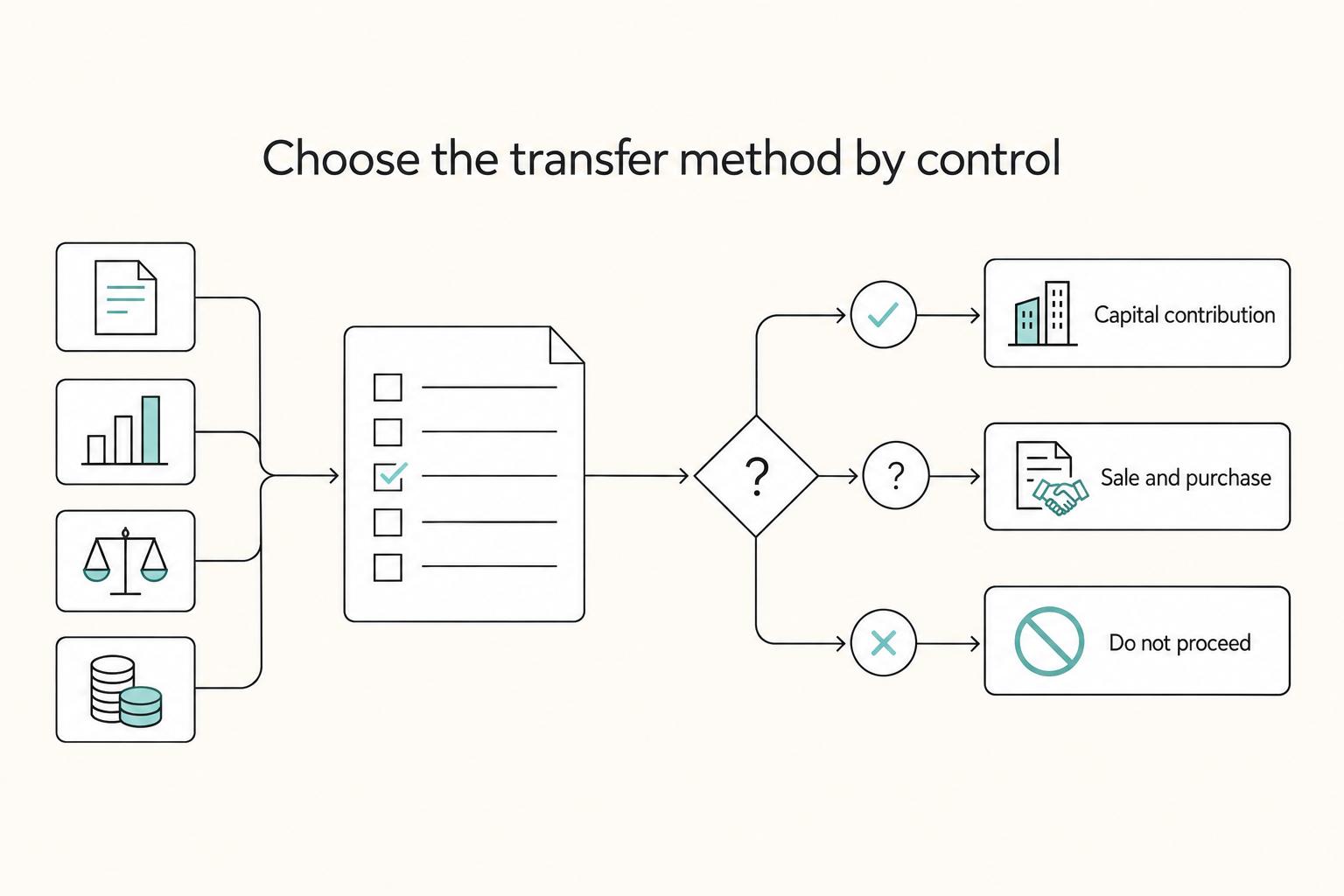
Start with a capital contribution analysis if your goal is cleaner continuity and lower friction. Evaluate a sale and purchase path when you want consideration on record and are prepared for added taxable-gain analysis.
| Method | Taxable-risk posture | Admin burden | Documentation burden | Future depreciation implications |
|---|---|---|---|---|
| Capital contribution | Often the lower-friction starting posture because no purchase price is being documented as consideration | Moderate | You still need a clear transfer record, approval trail, and basis support | Later depreciation support depends on how well you carry basis records into the LLC file |
| Sale and purchase | Higher analysis posture because consideration is part of the legal and bookkeeping story | Higher | You need terms, payment evidence, dates, and records that all match | Later depreciation support depends on consistent purchase and payment records |
| Do not proceed | Risk is not assessable yet | Stop | Missing basis records, unclear ownership chain, or pending approvals block a defensible transfer file | Proceeding now can create records you cannot reliably support later |
Before you proceed, run the same method through a few constraint checks: does your LLC agreement permit this exact transaction, is the asset financed, are title-transfer rules triggered for this asset type, and can insurance be aligned with the post-transfer owner. For real-property context, some guidance describes 2 main deed types (including grant and quitclaim approaches, with and without consideration), but do not assume those deed mechanics apply to vehicle title transfers.
If any blocker is still unresolved, pause and clear it rather than papering over it.
Apply Tax Treatment by LLC Classification#
After you choose the transfer method, confirm the LLC's federal tax classification before you post the asset entry. The IRS treats an LLC as a corporation, a partnership, or part of the owner's return based on member count and elections.
| Condition | General treatment | Key notes |
|---|---|---|
| Domestic LLC with only one member; no corporate election | Disregarded entity for federal income tax | Activity is reported on the owner's return; Schedule C (Form 1040) is listed as a general path for individual owners; for employment tax and certain excise taxes, the LLC is still treated as a separate entity |
| Domestic LLC with at least two members; no corporate election | Partnership for federal income tax | Use partnership status as the starting point, not the final answer on basis or holding period; Sec. 721 and Secs. 1223 and 723 are often part of the analysis |
| LLC that elected corporate treatment on Form 8832 | Corporation-taxed case | Resolve the contribution analysis before posting; do not assume partnership-style or disregarded-entity results |
Step 1 Confirm whether the LLC is disregarded or has elected out#
Start with three checks: member count, the most recent federal return, and whether Form 8832 was filed.
If the LLC has only one member and no corporate election, it is generally a disregarded entity for federal income tax, so the LLC activity is reported on the owner's return. For individual owners, the IRS lists Schedule C (Form 1040) as a general reporting path for business income or loss.
Keep your records consistent with that reporting path. If no real sale occurred, do not book it in a way that creates a purchase story. Also keep the carveout in view: for employment tax and certain excise taxes, a single-member LLC is still treated as a separate entity.
Step 2 Check whether default partnership treatment applies#
If the LLC has at least two members, a domestic LLC is generally classified as a partnership for federal income tax unless it elected corporate treatment.
Use that as the starting point, not the final answer on basis or holding period. Topics such as Sec. 721 and Secs. 1223 and 723 are often part of this analysis, but do not assume outcomes from the LLC label alone. Before you post final entries, make sure your tax file shows the authority and records supporting the treatment you expect.
Step 3 Escalate corporation-taxed cases before posting entries#
If the LLC elected corporate treatment (for example, via Form 8832), treat the contribution analysis as a separate lane and resolve it before you post entries.
Do not assume partnership-style or disregarded-entity results in a corporation-taxed case. The same caution applies to edge issues like nonqualified preferred stock: flag them for tax review before entries are finalized.
Verification checkpoint: your file should clearly state the LLC classification and the basis/holding-period treatment you expect, with support for that position. If your books assume carryover treatment but your tax file does not support it, pause and confirm before posting.
Transfer a Personal Vehicle in the Correct Order#
If you are moving a personal vehicle into the LLC, use this order: complete the legal ownership transfer first, then update insurance, then post bookkeeping entries. That sequence keeps DMV, policy, and books aligned.
| Step | Action | Documents or records |
|---|---|---|
| 1 | Verify ownership and confirm the DMV packet | Current title; LLC formation records such as Articles of Organization; proof of insurance; bill of sale; title transfer form; loan documents if financed or liened |
| 2 | Execute title transfer and handle registration updates | DMV submission or acceptance records; signed transfer documents; bill of sale if used; proof the LLC is owner of record or pending owner of record |
| 3 | Update insurance and then post bookkeeping entries | Insurance records aligned with the transfer; accounting entry using the legal transfer date and the chosen method |
Step 1 Verify ownership and confirm the DMV packet#
Confirm the vehicle is titled in your personal name and that you have the current title record. If the vehicle is financed or has a lien, review your loan documents and confirm what is required before you file transfer paperwork.
Your transfer packet will typically include the current title, LLC formation records (such as Articles of Organization), proof of insurance, and a bill of sale. A title transfer form is also commonly used to move ownership to the LLC. State requirements vary, so verify the exact packet with your local DMV before you sign or submit anything.
Step 2 Execute title transfer, then handle registration updates#
Once the packet is ready, follow the DMV process to transfer ownership. A common sequence is: gather documents, visit the DMV, pay required fees, and wait for the new title.
Treat the transfer as complete only when you have DMV submission or acceptance records and any required registration updates. Keep copies of signed transfer documents, the bill of sale (if used), and proof that the LLC is now the owner of record or pending owner of record.
Step 3 Update insurance and bookkeeping after legal transfer#
Update insurance after the transfer documents are in place so ownership and named insured records do not conflict. Then post your accounting entry using the legal transfer date and the method you chose earlier (for example, contribution or sale).
As a final check, make sure your books, title file, and transfer method all match before month end. If they do not, reconcile the discrepancy before you close.
Build an Evidence Pack That Survives Audit and Disputes#
Your evidence pack should let a third party confirm, in minutes, what moved, when it moved, how it was treated, and who approved it.
Step 1 Create the core file. Include four anchor documents: an internal authorization memo, the transfer instrument, a basis worksheet (including adjusted basis), and journal-entry support. Keep key identifiers consistent across all of them, including asset description, VIN or serial number, transfer date, and owner names.
Step 2 Keep legal, tax, and bookkeeping treatment aligned. Use one method consistently across the memo, transfer documents, ledger entries, and tax-position memo. If one document says capital contribution while another records a sale or owner loan, you create an avoidable dispute. In LLCs taxed as partnerships, owner-level capital accounts are a core part of the accounting record and can affect liquidation or buyout outcomes.
Step 3 Preserve separateness after the transfer. After the transfer, run related expenses through the business bank account. If you pay personally, keep dated reimbursement records with amount, business purpose, and repayment trail so the file does not drift into commingling.
Step 4 Add a one-page control sheet. Put a summary sheet at the front that lists asset ID, transfer date, method, basis used, ledger account, and responsible approver. If basis support is incomplete, pause and fix that before posting depreciation, reimbursements, or owner-equity entries.
Keep Liability Protection Intact After the Transfer#
A correct transfer does not protect you by itself. You still need to operate the LLC as a separate entity after the asset moves over. If business and personal activity are treated as interchangeable, you create facts that can support piercing the corporate veil and expose personal assets to business creditors.
Step 1 Treat the LLC as a separate owner every month#
Use a short monthly control review to reinforce separateness in daily operations:
- Account separation review: check business accounts for personal charges and personal accounts for business expenses.
- Reimbursement policy check: if you paid a business expense personally, make sure you have a dated reimbursement record with amount, business purpose, and repayment through the company account.
- Mixed-use exception log: if the asset has personal use, log when it happened, who used it, why, and how you handled that use in the books.
What you are checking for is consistency: the transfer record, ongoing payments, and ledger treatment should all match.
Step 2 Correct commingling quickly#
One mistake does not automatically remove liability protection everywhere, but repeated commingling can weaken the separateness story. Courts may look at mixing business and personal assets when evaluating personal-liability exposure.
The practical pattern to avoid is informal handling with no paper trail. If this keeps happening, the LLC can look less like an independent entity and more like a personal extension. Recordkeeping here is part of risk control, not admin cleanup.
Step 3 Use a simple decision rule for heavily personal-use assets#
If an asset still has heavy personal use, do not force LLC ownership unless you are ready to enforce strict usage and documentation controls from day one.
If you move it into the LLC anyway, set the controls first, then use the asset under that system. If you cannot maintain those controls yet, keeping it outside the LLC can be the less fragile option until usage changes.
For a step-by-step walkthrough, see How to create an 'accountable plan' for a single-member LLC.
Common Mistakes and Fast Recovery Paths#
When records drift, the fastest recovery is to pause new entries and rebuild one consistent story across tax treatment, ownership records, insurance, and books.
| Mistake | Fast recovery | Records to align |
|---|---|---|
| Posting more entries before the transfer approach is settled | Stop new postings, then restate the file so the transfer memo, ledger treatment, and expected reporting all match | Transfer memo; ledger treatment; expected reporting |
| Using a sale-and-purchase approach without checking gain or loss exposure | Recheck the decision against IRS Publication 544 topics on gain or loss from sales and exchanges and adjusted basis, document the rationale, and align reporting before final filing | Gain or loss analysis; adjusted basis support; reporting |
| Title and books are out of sync | Reconcile vehicle title status, ledger timing, and insurance effective dates until ownership timing is consistent across all three records | Vehicle title status; ledger timing; insurance effective dates |
| Weak or missing file trail | Rebuild a dated evidence pack with approval, transfer method, asset description, and basis support so the ownership record is defensible | Approval; transfer method; asset description; basis support |
In practice, do not try to patch only one record set. Realign the whole file before you close the period or file the return.
Final Checklist You Can Copy and Use#
Use this final pass to make sure your ownership records, federal tax classification, and books line up before you treat the transfer as complete.
- Confirm the LLC's federal tax classification and member count.
Verify current members and classification first. For federal income tax, a domestic LLC with only one member is generally disregarded unless it filed Form 8832; with at least two members, it is generally classified as a partnership unless it filed Form 8832. Keep a short file note stating members, current classification, and whether an election was made.
- Choose one transfer method and use that label consistently.
Use your earlier matrix and choose either capital contribution or sale and purchase. Then use the same method label across approvals, transfer paperwork, bookkeeping, and tax workpapers.
- Clear state and external requirements before finalizing.
LLCs are created under state statute, and state rules vary, so confirm the requirements that apply to your state and asset type before you finalize anything. If a lender, insurer, title office, or registry is involved, keep written requirements or approvals in your file.
- Execute documents and post matching books entries.
Once method and requirements are confirmed, complete the transfer documents and record the related books entry with matching details and dates. Keep the records aligned so later review is straightforward.
- Document support for any recorded tax treatment.
If you record basis or holding-period treatment, keep the worksheet and supporting records in the same file as the transfer memo and books support. If support is incomplete, mark that clearly and resolve it before close.
- Keep one complete evidence pack and maintain clean operating separation.
Store the approval memo, transfer document, classification note, bookkeeping support, and outside approvals in one place, plus a one-page summary. Keep business-side payments and records clean after the transfer to reduce avoidable confusion later. If your finance hygiene still feels loose, fix that next with How LLC Owners Separate Business and Personal Finances.
Frequently Asked Questions
Can I transfer my personal car to my LLC?
Maybe, but only if the transfer is handled correctly. For titled assets like cars, requirements can vary by jurisdiction, and a lien can add extra conditions you need to resolve before retitling.
Is contributing a personal asset to an LLC taxable?
It depends on the LLC’s tax classification and whether you are making a contribution or doing a sale. For an LLC taxed as a partnership, a qualifying contribution of property generally does not trigger income or loss under Sec. 721. A sale is a different transaction and should not be treated as interchangeable with a contribution.
What basis does the LLC get after a contribution?
For a partnership-taxed LLC, the LLC generally takes the contributing member’s adjusted tax basis and holding period continuity. In plain terms, this is typically a carryover-style result rather than a reset to current market value.
Does putting an asset in an LLC automatically protect my personal assets?
No. The liability shield is conditional, not automatic, and it depends on correct execution, ongoing formalities, and the law in your jurisdiction. If those formalities and legal requirements are not maintained, protection can be weakened.
What documents should I keep for an LLC asset contribution?
Keep clear, dated records showing what was transferred, when it was transferred, and how the tax basis was determined. For titled assets, keep the ownership-change records and any related required updates in the same file.
What changes if my LLC is taxed as a partnership vs a disregarded entity vs a corporation?
By default, a domestic LLC with only one member is a disregarded entity for federal income tax unless it files Form 8832. By default, a domestic LLC with at least two members is taxed as a partnership unless it files Form 8832 to elect corporation treatment. If you are considering a classification change just to simplify an asset transfer, remember that after an effective election, another change generally cannot be made for 60 months. For a corporation-taxed LLC, do not assume the partnership rules apply.
What if the asset still has a loan or lien?
Treat that as a live constraint, not a paperwork detail. Loan or lien terms can affect how a transfer is handled, so review the relevant loan and title documents before moving the asset and resolve open requirements before treating the LLC as owner.
Try a related tool
Researched and edited by the Gruv editorial team. Gruv builds cross-border billing, payouts, and finance-operations software for global businesses.
Sources
- ca5.uscourts.gov/opinions/pub/23/23-20450-CV0.pdftrusted
- dos.ny.gov/may-25-2016-rule-making-activitiestrusted
- federalreserve.gov/aboutthefed/files/bstfinaccountingmanual.pdftrusted
- ir.law.fsu.edu/cgi/viewcontent.cgitrusted
- irs.gov/businesses/small-businesses-self-employed/si...trusted
- irs.gov/businesses/small-businesses-self-employed/li...trusted
- law.nyu.edu/sites/default/files/CIV%20PRO%20OUTLINE%202.pdftrusted
- occ.gov/publications-and-resources/publications/comp...trusted
Educational content only. Not legal, tax, or financial advice.
Related Posts

Sole Proprietorship vs LLC for Global Freelancers in 2026
For most freelancers in 2026, the practical default is still simple: use the simplest structure you can run cleanly, then formalize when risk actually rises. If your work is still in validation mode and the downside is contained, a sole proprietorship is often the practical starting point. When contract exposure, delivery stakes, or dispute risk starts climbing, forming an LLC deserves earlier attention.

Hiring a Subcontractor for the First Time Without Costly Surprises
**Start with a risk-control sequence, not an ad hoc handoff.** As the Contractor, your goal is simple: deliver cleanly, control scope, and release payment only when the work and file are complete.
Freelancer Vehicle Expense Deductions: Standard Mileage vs. Actual Expenses
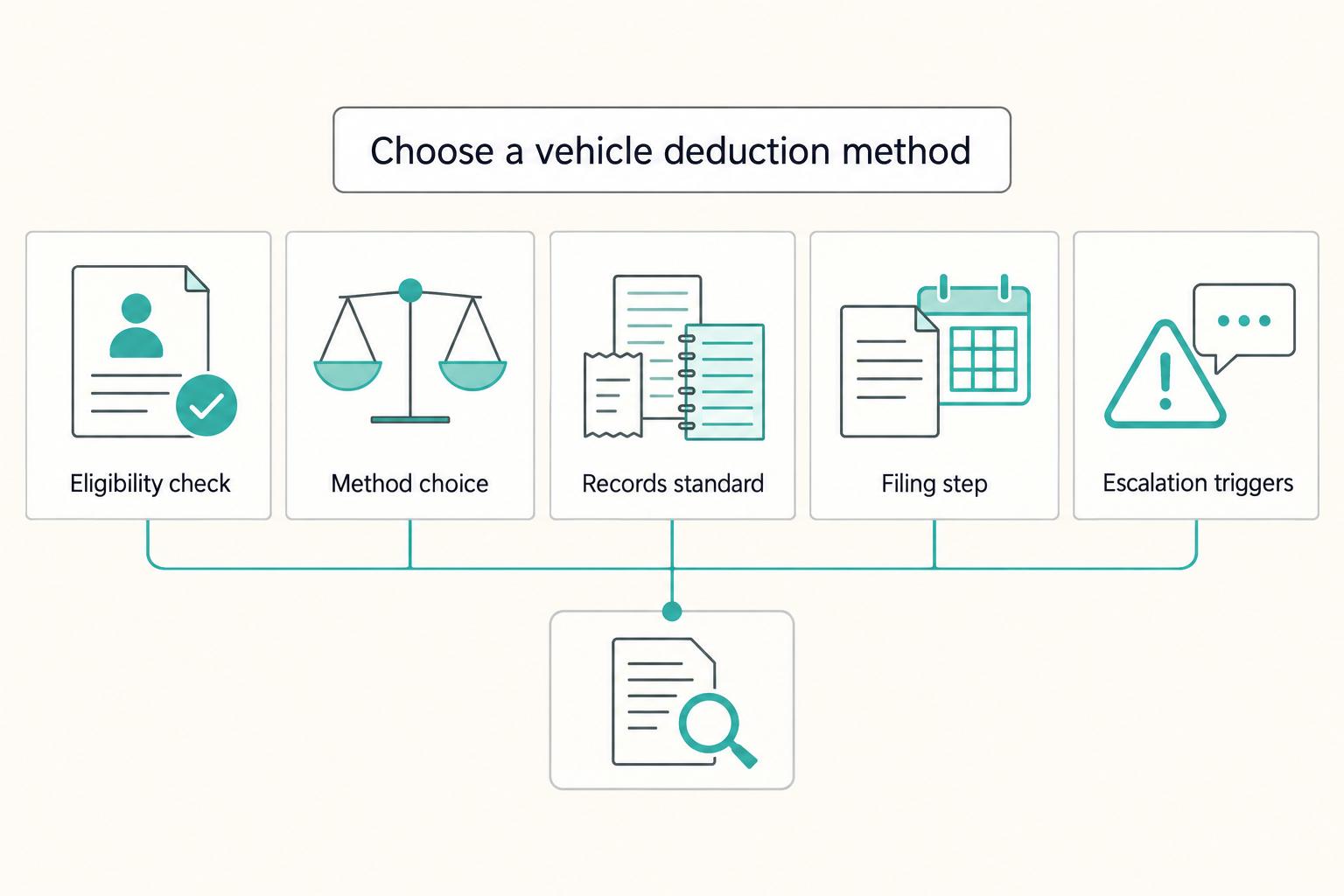
**Handle your vehicle deduction like an operator. Choose one IRS method, document business driving as you go, and escalate before ambiguity turns into risk.**