
Quick Answer
Start by writing one decision sentence, then build legal research for freelancers around evidence you can defend: issue, jurisdiction, source notes, and next action. Read controlling text before commentary, and keep contradictions in a separate log instead of blending them. Convert each conclusion into a contract, onboarding, invoice, or recordkeeping change with saved proof. Escalate if sources conflict, a full text is unavailable, or court or filing deadlines compress your timeline.
Start here and define the legal question before you research#
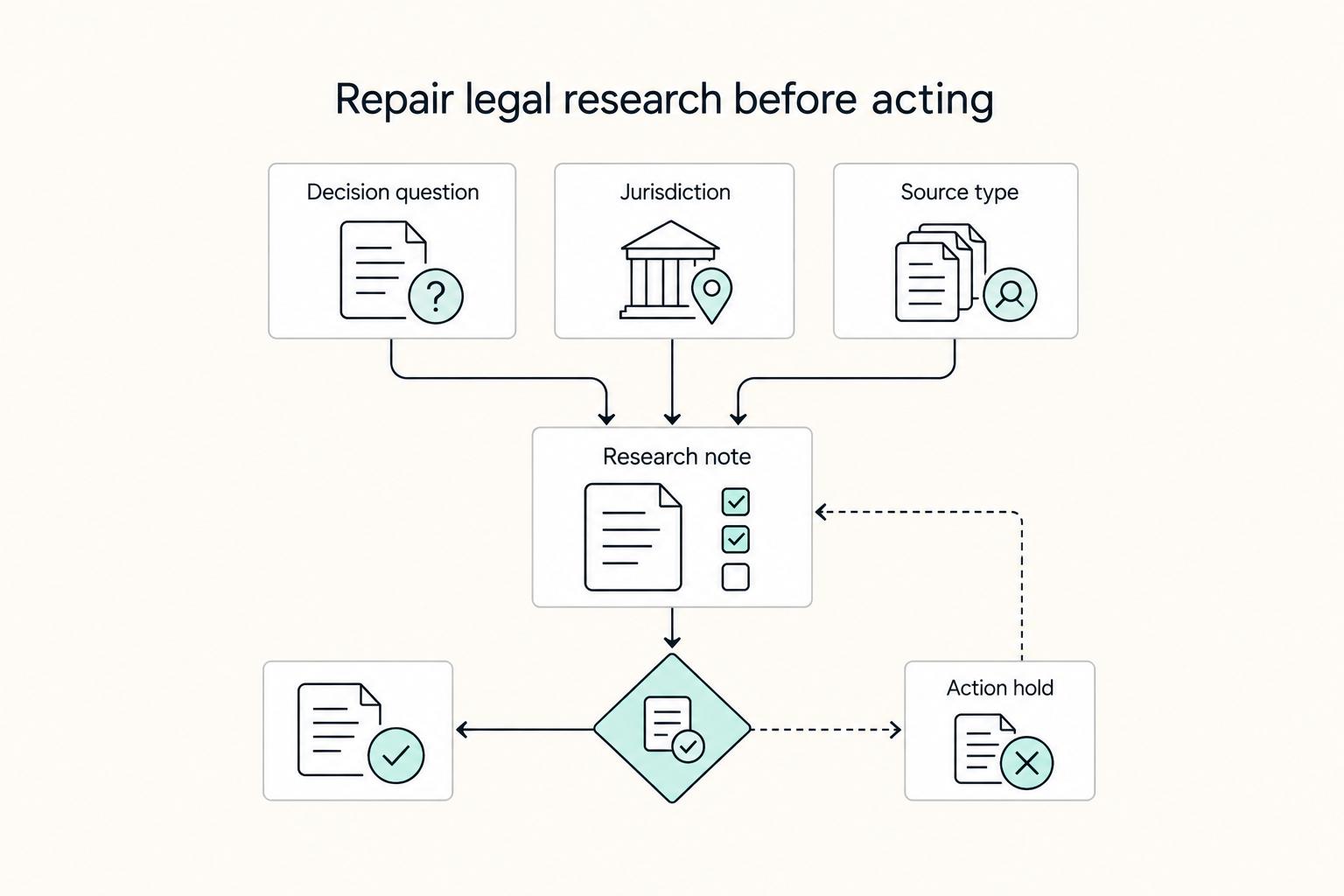
Start narrower than you think. Define one legal risk, decide what you will do about it, and document why. For freelancers, a usable decision file beats endless reading.
Scope the task to your own business#
Focus on your own contracts, compliance questions, and operating risk. Many materials in this area are really about law firms outsourcing legal research to freelance or contract lawyers.
That distinction matters because some of this guidance is about law-firm efficiency, staffing, ethics, and billing. You may see guidance aimed at small firms and solo practitioners that references ABA Formal Opinions 08-451, 00-420, and 88-356. It may also cover client consent and billing outsourced legal work as a fee rather than a disbursement. Use that as background, not as your answer. If a source is mainly about law-firm staffing or billing practices, keep it in the background.
Define the output before you start#
Decide what you need to produce before you start. A simple decision file is often enough:
| What to capture | Why it matters |
|---|---|
| Issue | Keeps the work tied to one real decision |
| Jurisdiction | Helps avoid mixing rules from different places |
| Source notes | Shows what you relied on |
| Next action | Turns research into an actual move |
If you cannot state the decision you need to make, stop and write that first. Research should lead to action, not pile up after the fact.
Set limits and escalation rules up front#
Use this guide to research and organize your thinking, then decide whether to escalate. It does not replace legal advice on high-risk issues.
Escalate sooner when the stakes are high, time is tight, or you are already in a live dispute. Deadline pressure can come from statutes, court rules, or court-imposed deadlines, and urgency changes what good-enough research looks like.
Aim for an explainable decision#
The standard is simple: aim for fewer compliance surprises, cleaner contracts, and decisions you can explain clearly to a client or advisor. Your notes should show what you think applies, what you will do next, and where uncertainty remains.
Pick one legal issue and define your decision#
A narrow decision question makes the rest of the work easier. It keeps the research practical and gives you a clear point to verify, act on, or escalate.
Write the decision question#
Write one sentence that includes the action, jurisdiction, and business context. Example: "Can I use this clause with clients in this jurisdiction as an independent contractor?" Use that level of specificity so the answer changes one real thing, such as a contract clause, onboarding step, invoice term, or compliance task.
Separate risk from curiosity#
Separate risk from curiosity. If getting the answer wrong could force a contract, process, or recordkeeping change, keep it in scope. If it is just good to know, park it for later.
Set a stop condition#
Set a stop condition before you start: "I stop when I can point to accessible legal authority and state my action." If you rely on case law, add a validation check for how that case has been treated before you use it.
Google Scholar can help by letting you filter case law by specific state and federal courts and review the "How cited" signal. Treat free tools as useful but incomplete. They can miss documents and flood you with results.
Record confidence and escalation triggers#
In the same note, record your confidence level and an escalation trigger. Example: "Confidence: yellow. Escalate if I cannot access a full source, if sources conflict, or if I still cannot tie the answer to accessible legal authority."
Prepare your evidence pack before you search#
Good legal research often starts with the right documents. Build your evidence pack first so the answer stays tied to the facts and files that actually drive the decision.
Gather current business facts#
Gather current business facts from documents, not memory. Pull your current contract template, client-specific redlines, and a short note on your business setup. If you operate as a sole proprietorship, note that there is no separation between personal and business assets. If you use a single-member LLC, note that the structure is described as providing personal-asset liability protection.
If the engagement is framed as independent contractor, save that language for later review rather than trying to resolve it yet. Confirm that the contract and related client-facing files are the versions you currently send to clients.
Create a research log#
Create a research log before you open sources. A simple sheet is enough, with fields you can actually maintain, such as issue, source type, contradiction, decision, owner, and review date. Add a source quality column now.
Use that column to separate materials you plan to rely on from commentary, templates, or forum posts. That makes contradictions easier to sort out later.
Separate proof from working notes#
Keep proof artifacts separate from working notes. Use one folder for evidence you relied on and another for drafts, summaries, and tentative conclusions. That separation can make later review easier without mixing final support and scratch work.
Choose tools, then check freshness#
Choose tools that support this process, then check freshness. Some legal research tools include document management, annotation, and citation tracking, which can help keep your pack organized. Start with one or two functions you actually need, then confirm that the source or comparison list is actively maintained.
A list marked current in March 2026 is a stronger recency signal than older app guidance from 2013. By the end, your pack should include current contract terms, business-setup notes, a usable log, and a clear split between evidence and notes.
Map the jurisdictions and authority order first#
Jurisdiction mistakes create bad research faster than almost anything else. Map where each rule might apply before you search, and set the order of authority you will trust.
Build the jurisdiction map#
Build the jurisdiction map first, with separate rows for your home country, the client country, and the country named in the governing-law clause. If one jurisdiction is part of your regular client mix, give it its own row so those issues do not get folded into general cross-border notes.
| Jurisdiction row | What to capture | Verification source |
|---|---|---|
| Home country | Business location and setup context for your work | Current business records |
| Client country | Client legal location used in contract/payment docs | Signed agreement, invoice records |
| Governing-law clause country | Exact country named in the contract clause, or none identified | Current signed contract or active template |
| Recurring jurisdiction (if relevant) | Jurisdiction-linked clients/contracts in your pipeline | Client list and contract set |
Do not assume the client country and governing-law country match. If the clause is missing, log it as a research gap.
Set your authority order#
Set a working authority order as your reading sequence for each row:
- Primary sources, such as statute text or court rules where applicable.
- Official guidance or process materials.
- Secondary commentary, templates, and forms.
Use your source-quality field to enforce that order. A practical example is New York City's Freelance Isn't Free Act. It is city-specific, was passed in October 2016, signed in November 2016, and became effective May 15, 2017. NYC materials also state that freelancers can sue for written-contract, payment, and retaliation violations, and that OLPS administers the law. Keep that in its own jurisdiction row, not under broad "US contract law" notes.
Once the map is built, decide what tool coverage you actually need, such as state, federal, or multistate. That helps you avoid overbuying, especially when paid services require at least a one-year contract.
Add a conflict checkpoint#
Add a conflict checkpoint before you draw conclusions. If two jurisdictions point in different directions, keep each rule attached to its own row and log the contradiction instead of blending them.
You can take the stricter practical path as temporary risk control until counsel confirms otherwise. Treat that as risk control, not as a universal legal rule. If you are working from a lawyer's brief and the framing starts to drift, return to the instructing lawyer to confirm instructions before you keep going.
Track deadlines separately#
Track deadline pressure separately from legal scope. Filing dates, contract deadlines, or court-imposed deadlines in an active dispute change urgency, not jurisdiction.
If a matter is urgent, tag it and save the process documents early. For NYC freelance disputes, the court guide includes "Appendix A: Small Claims Court - Statement of Claim." OLPS also has a Navigation Program with non-attorney navigators who provide information about complaints, the law, and court process. Keep those process supports in your matrix under official guidance or process.
For a step-by-step walkthrough, see The Best Tools for Managing a Company's Legal Documents.
Pull sources in this order so your conclusions stay defensible#
Once the jurisdiction map is done, use this review order: start with the controlling text, then use commentary to interpret it. That keeps your conclusion tied to operative language instead of someone else's summary.
Start with the controlling text#
Open the primary text first and capture the exact language that answers your question. In e-discovery workflows, that includes items like Rule 26(f) requirements and any negotiated ESI protocol.
Keep two note fields:
verbatim rule: the exact languageoperational translation: your plain-language checklist version
That split helps you avoid turning your interpretation into the rule.
Use commentary to interpret, not replace#
Use secondary commentary only after you have the primary text in hand. Commentary can clarify edge cases, definitions, and process, but it should not replace the underlying text.
In fast-moving tech and legal areas, precedent can lag practice. Treat publication dates as a freshness check, and re-verify the current primary text before making a decision.
Flag stale material fast#
Flag potentially stale material early and replace it before you rely on it. A source is higher risk when it has no clear date or predates the contract or process version you are working from.
When you update notes, label the update with date and time instead of overwriting silently. Timestamp metadata can be reviewed, and a clearly labeled late entry is defensible while a backdated one is not.
Keep a contradiction list#
Keep a separate contradiction list. If sources conflict, write down:
- which sources conflict
- the exact language that clashes
- the jurisdiction row each source belongs to
- your interim operating choice
Do not blend conflicting rules into one summary. If the issue is unresolved, record the conflict and confirm the controlling language before finalizing. Also check definitions closely, because omissions or one-sided definitions can change outcomes.
Convert legal text into operating decisions#
Research is only useful once it changes what you do. Each rule should become a concrete action, a saved proof item, and a traceable authority record.
Create a decision card for each rule#
Create one decision card per rule. For each rule, write:
- What must I do
- What must I avoid
- What proof must I keep
Keep the authority on the same card. For U.S. federal regulations in the CFR, log the citation in title-part-section format, for example 16 CFR 0.1, and record the revision date used, for example Revised as of January 1, 2024. Because the CFR is revised at least once each calendar year, undated notes can be harder to defend.
Push the rule into live workflows#
Translate each rule into the places where your business actually runs: contracts, onboarding, invoice wording, and recordkeeping. If a rule affects one of those, update the exact clause, step, wording, or storage task now.
Use this check: can the person handling contracts or invoices apply the decision correctly without extra legal explanation? If not, the note is still too abstract.
Tag confidence before implementation#
Add a confidence tag before implementation. This is a practical control, not a legal requirement.
| Confidence tag | Use it when | Next move |
|---|---|---|
| Green | Current primary text is clear and your facts fit | Implement now |
| Yellow | Text is current but scope, definitions, or facts create interpretation risk | Take the stricter practical option, log the risk, schedule review |
| Red | Ambiguity is material or sources conflict on a high-risk point | Pause and get counsel before relying on it |
Attach a verification checkpoint#
Attach one verification checkpoint to each decision. The checkpoint should prove that the action happened in practice.
| Change | Verification checkpoint |
|---|---|
| contract edit | signed agreement version |
| onboarding change | completed intake or dated consent record |
| invoice change | first issued invoice using approved wording |
| recordkeeping | saved file path plus retained source file |
Store the decision and proof together#
Store the decision card and proof together so you can retrieve both reliably. A vendor article cites research reporting that 71% of businesses could not locate at least 10% of their contracts. That is not a legal standard, but it is a useful warning about recordkeeping.
Use clear file names with issue, client, jurisdiction, and date, preserve prior versions when decisions change, and log why a confidence tag moved. If a legal conclusion does not change a document, a process step, or a saved proof item, it is not yet an operating decision.
When your decision table points to clause updates, use the Freelance Contract Generator to turn research notes into a clean draft for review.
Test your contract terms against real freelance scenarios#
A clause that looks fine in the abstract can still fail in practice. Stress-test it against messy but ordinary project scenarios before you rely on it.
Build one dispute scenario for each high-risk clause#
Start with four short scenarios tied to common risk areas: payment terms, scope boundaries, IP handoff, and non-compete limits. Then check whether each clause tells you what happens next without relying on goodwill.
| Risk area | Scenario |
|---|---|
| payment terms | work is approved, but finance delays payment because of internal processing or transfer timing. |
| scope boundaries | the client asks for "one small extra" outside the original brief. |
| IP handoff | the client requests files, source material, and reuse rights before final payment clears. |
| non-compete limits | a new client opportunity appears while restriction language may still apply. |
If the clause does not clearly state triggers, timing, and partial-work handling, it is still too vague. Save a redlined contract and one short note per clause showing which scenario it passed.
Match the contract to the documents that control delivery#
A common miss is focusing on the master agreement but not the extra documents that define the real work. In the sample Freelancer Services Agreement (effective January 12, 2026), the agreement is binding once accepted, and each engagement can add an Engagement Requirement that sets Services, Deliverables, specifications, and schedule. Some engagements may also require supplemental customer terms.
So do not stop at the master contract. Make sure your scope clause points to the exact artifact that defines Deliverables, then store that final version with the signed agreement.
Check unpaid-work risk early too. The same sample states that Services can include activities that may not be directly compensated. Decide up front which required activities are paid, capped, or excluded.
Compare the contract to how the work is managed#
Mismatch risk shows up when the contract says one thing and day-to-day management says another. If your operating plan expects tightly controlled routines or required activities outside paid deliverables, flag it for review before you proceed.
This is a practical consistency check, not a legal threshold test. Save proof of the actual arrangement, such as onboarding emails, project briefs, communication expectations, and engagement requirement lists.
Decide how outside legal support costs will appear on invoices#
If your terms allow recovery of outside legal support costs, decide the billing treatment before you need it. In your decision file, note how those charges will appear on invoices and what backup records you will keep, then keep that approach aligned with your contract wording.
If you expect frequent outside review, record the cost-speed tradeoff up front. One freelancer-tool comparison article describes attorney review at $200-$500 per contract with a 3-5 day turnaround. Treat that as one planning data point, not a universal benchmark.
Should you do this yourself or hire counsel#
The line is practical, not theoretical. A useful rule of thumb is to handle it yourself when the answer is clear in a current authority and the downside is low if you are wrong. If stakes, complexity, or ambiguity rise, move to review or immediate escalation.
| DIY now | Hire for review | Hire immediately |
|---|---|---|
| A current statute or court rule clearly answers your exact question. | The rule exists, but applying it to your facts is unclear. | The matter is high-stakes and time-sensitive. |
| The impact is low if your interpretation is wrong. | Ambiguity could create meaningful legal or business risk. | Delay could put your position at risk because timing now matters more than perfect research. |
| The task is mostly mechanical, and you can verify completion from the authority itself. | The issue is high-stakes, legally complex, or likely to require substantial research effort. | You need response strategy or filing support right away. |
A good DIY example is a narrow compliance check: when using an EAR License Exception, any required EEI filing must include the correct License Code and ECCN. That is concrete and checkable, especially when you are working from a current text, for example the BIS excerpt dated 03/22/2026.
Move out of DIY when the task shifts from "enter the required field correctly" to interpretation. For the review lane, send a focused brief and expect tighter supervision if you use freelance legal help, since outside support may not know your process by default.
If you hire a lawyer or legal researcher, brief and supervise well#
Outsourcing does not remove your responsibility. Keep the brief tight, write assumptions down, and keep ownership of the final decision.
Write a decision-first brief#
Do not send a vague request. State the issue, relevant jurisdiction or jurisdictions, the exact contract excerpt or clause, your deadline, your required output format, and the decision you need to make.
Use a simple check: if the person you hire cannot restate your decision question in one sentence, the brief is still too loose. Tight scoping matters because legal deadlines can be constant, and unmanaged time pressure can lead to stress and burnout.
Require written assumptions and source hierarchy#
Do not accept conclusions without the assumptions behind them. Ask for a short written note covering assumed facts, what was not reviewed, and the source hierarchy used.
Also ask whether practices like client consent or transparent billing are actually relevant to your situation. Those points come from law-firm ethics context, so have counsel explain applicability instead of assuming they govern every freelance business automatically.
Treat ethics references as context#
If counsel cites ethics materials, require a plain-language relevance check for your matter. References such as ABA Formal Op. 08-451, 00-420, and 88-356 can inform analysis, but they are not automatically binding for every freelancer, matter, or jurisdiction.
Apply the same discipline to Texas Opinion 577 (March 2007): document what actually affects your case, billing, or client communications. If outsourced lawyer work is marked up, confirm in writing whether it is billed as a fee or as a disbursement.
Keep final ownership of execution#
Outside support informs your decision, but it does not replace it. You still approve the timeline, implementation steps, and operational checklist.
Require a final deliverable with the conclusion, limits, and next actions, then convert it into your own implementation plan. The hiring side retains responsibility for competent services, and supervision level should match the freelancer's skill and experience.
Common mistakes that create legal risk and how to recover#
Most of these mistakes are fixable if you catch them before you act. Use this check: if your notes do not clearly show the decision, jurisdiction, and source type, pause and repair the file first.
| Mistake | Recovery |
|---|---|
| Researching broadly without a decision target | Rewrite the issue as one decision sentence, then restart from that sentence only. |
| Mixing jurisdictions casually | Rebuild your jurisdiction map and re-tag each note by jurisdiction before you trust any conclusion. |
| Relying on summaries over primary law | Replace each key summary with the underlying legal text or other official source before you act. |
| No review cadence | Assign one owner and one next review trigger immediately. |
1) Researching broadly without a decision target#
Mistake: starting with a topic instead of a decision question. Recovery: rewrite the issue as one decision sentence, then restart from that sentence only.
A quick test is whether the answer maps to a real business artifact: a written and signed contract for services, an invoice term, or a client onboarding step. If it does not, you are still collecting background, not deciding.
2) Mixing jurisdictions casually#
Mistake: applying one jurisdiction's guidance to a contract governed elsewhere without confirming fit. Recovery: rebuild your jurisdiction map and re-tag each note by jurisdiction before you trust any conclusion.
Keep unsupported items in a "background only" bucket until you can tie them to your actual governing law and contract context.
3) Relying on summaries over primary law#
Mistake: treating marketplace summaries as the rule you will rely on. Recovery: replace each key summary with the underlying legal text or other official source before you act.
Also log source type and version details. For example, if a page is labeled as an impact assessment, treat it as analysis rather than binding law. If a source is sectioned, record the exact section, for example 3.101, along with currency metadata such as Effective Date: 03/13/2026 and FAC Number: 2026-01.
4) No review cadence#
Mistake: leaving research with no owner and no trigger to revisit it. Recovery: assign one owner and one next review trigger immediately.
Use operational triggers: a new client country, a new contract template, a service change, or missed payment under signed terms. If payment becomes overdue, contact the client on the first overdue day. If weeks pass without payment, escalate for legal advice instead of continuing to research. Related reading: How to Prepare for a SOC 2 Audit.
Keep your legal research current as your business changes#
Your legal file should change when your business changes. Treat it as a working record that gets revisited when facts, documents, or markets move.
Set review triggers in the log#
Set review triggers directly in your research log. Use triggers like jurisdiction changes, contract updates, or a website policy update. If your Terms of Service, Privacy Policy, or a recorded "Changes To Privacy Policy" item changes, update the legal file with a new review date, owner, and decision note.
Re-check high-impact items first#
Re-check high-impact items first, starting with classification. Freelancers and contractors need to operate independently to avoid employee-status risk, and classification rules can vary by state. Then review the contract and payment terms you are actually using now, including governing law, jurisdiction, billing, IP, and liability language.
If your service changed, reopen your IP clause. A detailed IP clause helps prevent ownership confusion, and default ownership can stay with the freelancer unless your contract changes it. If AI is now part of delivery, add an output-disclosure checkpoint because AI-created work often cannot be copyrighted.
Update the systems where you work#
Push each updated legal decision into the places where you actually work. Align your contract template, website legal documents, and recordkeeping so they reflect the same rule at the same time. Confirm each decision with one live artifact, such as an updated clause, published policy update, or saved decision log entry.
Schedule refreshes even when nothing looks wrong#
Schedule refreshes even when nothing looks wrong. Use stale source dates as a prompt to re-verify current law or guidance before reusing older conclusions, including notes tied to March 26, 2025, or 31 January 2025. If the answer is unclear, especially on classification, escalate instead of carrying assumptions forward.
Use this copy and paste checklist before every new client or market#
Use the same seven-step checklist before each new client or market so the decision is documented and tied to proof, not verbal agreements or "we'll figure it out later."
- Define one decision question and stop condition.
Write one action-focused question, then define what "done" means, for example a clear decision, noted uncertainty, and recorded next step.
- Map locations and your working source order.
List your location, the client's location, and any contract location terms, then note the order you will review sources. Use this as a consistency tool, not a universal legal ranking.
- Collect sources and log contradictions.
Keep one research log and one evidence folder. For each source, record what it says and where it conflicts with another source.
- Convert findings into actions, proof, and confidence tags.
For each conclusion, capture what you will do, what you will avoid, and what proof you will keep. Tag confidence as green, yellow, or red so uncertainty is visible before work starts.
- Stress-test against contract and delivery reality.
Check whether your contract terms, onboarding flow, payment setup, and delivery process match. Practical proof can include a customized contract, a digital signature step, a deposit invoice (for example, 50% in one documented workflow), and shared workspace setup.
- Apply a clear DIY vs counsel rule.
Handle straightforward, low-impact issues yourself, and escalate when the issue is unclear or high-impact. Free templates can help, but they are not a substitute for legal counsel in complex situations.
- Assign owner, review trigger, and next review date.
Put one owner on the decision and set concrete triggers, such as a new client market, new template, new payment flow, or process changes. The file should show the question, sources, conflicts, decision, proof, and revisit date at a glance.
Related: How to Use AI for Market Research in Your Freelance Business. Explore Gruv's tools library to keep this checklist practical as you grow.
Frequently Asked Questions
What legal topics should freelancers research first before signing new clients?
There is no universal first-topic checklist. Start with questions that would change what you sign or how you deliver, and prioritize jurisdiction-specific issues first. If an answer changes a clause, onboarding step, invoice term, or compliance step, research it before you sign.
How can I tell whether a source is trustworthy for small business legal research?
There is no single scoring test, so use source order. Treat statutes, court rules, and regulator guidance as primary, and use practitioner commentary or provider FAQs as secondary interpretation. In your notes, record jurisdiction and verification date so you do not apply non-binding guidance from the wrong place.
When is DIY legal research enough, and when should I hire a lawyer?
There is no hard universal threshold. DIY can be a reasonable starting point for narrow, low-impact questions where the answer appears clear in one jurisdiction. Consider hiring a lawyer when the issue is ambiguous, cross-border, or could materially affect enforceability, tax, classification, or deadlines. If your sources conflict or your conclusion is still uncertain after checking primary law, escalate.
How do I organize my notes so they are audit-ready and easy to update?
Use one research log and one evidence folder. Track the issue, jurisdiction, source type, decision, owner, and review date in the log, then save the artifact that shows you applied the decision. If you work with outside help, shared file storage and a shared due-date calendar can keep files and timing aligned.
How often should I re-check legal requirements for recurring freelance work?
Re-check on change triggers first, then on a routine cadence. Review again whenever your jurisdiction, service scope, contract template, or payment flow changes, and refresh older conclusions before reuse. If source dates are stale or sources conflict, treat that as an immediate review trigger.
What changes when I work with clients in `Germany` or move under a `Germany Freelance Visa`?
Germany-linked work makes immigration and work authorization part of the legal question, not just contract terms. The cited source says Germany does not have one dedicated digital-nomad visa category, and that visa-free entry or a Schengen visa does not grant the right to work in or from Germany. For remote work from Germany, third-country nationals need a long-term residence permit. The same source says EU/EEA/Swiss nationals do not need a visa or residence permit, but must register with the Bürgeramt if staying longer than three months. The source also uses “Digital Nomad Visa” terminology for a Section 19c/Section 26 pathway for select nationalities, so confirm the exact residence basis before relying on a “Germany Freelance Visa” label, and use Germany Freelance Visa: A Step-by-Step Application Guide.
If I hire outside legal help, what should I include in the brief to get a usable answer?
Give a tight brief with the decision you need, jurisdictions involved, relevant contract text, deadline, and required output format. Ask for explicit assumptions and source hierarchy so you can see what is primary authority versus commentary. If you outsource research or drafting, keep ownership of the final decision, implementation, and review date.
Try a related tool
Researched and edited by the Gruv editorial team. Gruv builds cross-border billing, payouts, and finance-operations software for global businesses.
Sources
- acquisition.gov/far/part-3trusted
- bis.gov/regulations/ear/740trusted
- copyright.gov/comp3/docs/compendium.pdftrusted
- eur-lex.europa.eu/legal-content/EN/TXT/HTMLtrusted
- govinfo.gov/content/pkg/CFR-2024-title16-vol1/xml/CFR-20...trusted
- iicl.law.pace.edu/sites/default/files/cisg/cross-border_contra...trusted
- irlaw.umkc.edu/faculty_bookstrusted
- irs.gov/pub/irs-pdf/p4012.pdftrusted
Educational content only. Not legal, tax, or financial advice.
Related Posts

Germany Freelance Visa Application Path for Freiberufler and Gewerbe
Choose your track before you collect documents. That first decision determines what your file needs to prove and which label should appear everywhere: `Freiberufler` for liberal-profession services, or `Selbständiger/Gewerbetreibender` for business and trade activity.
Taxes in Germany for Freelancers and Expats
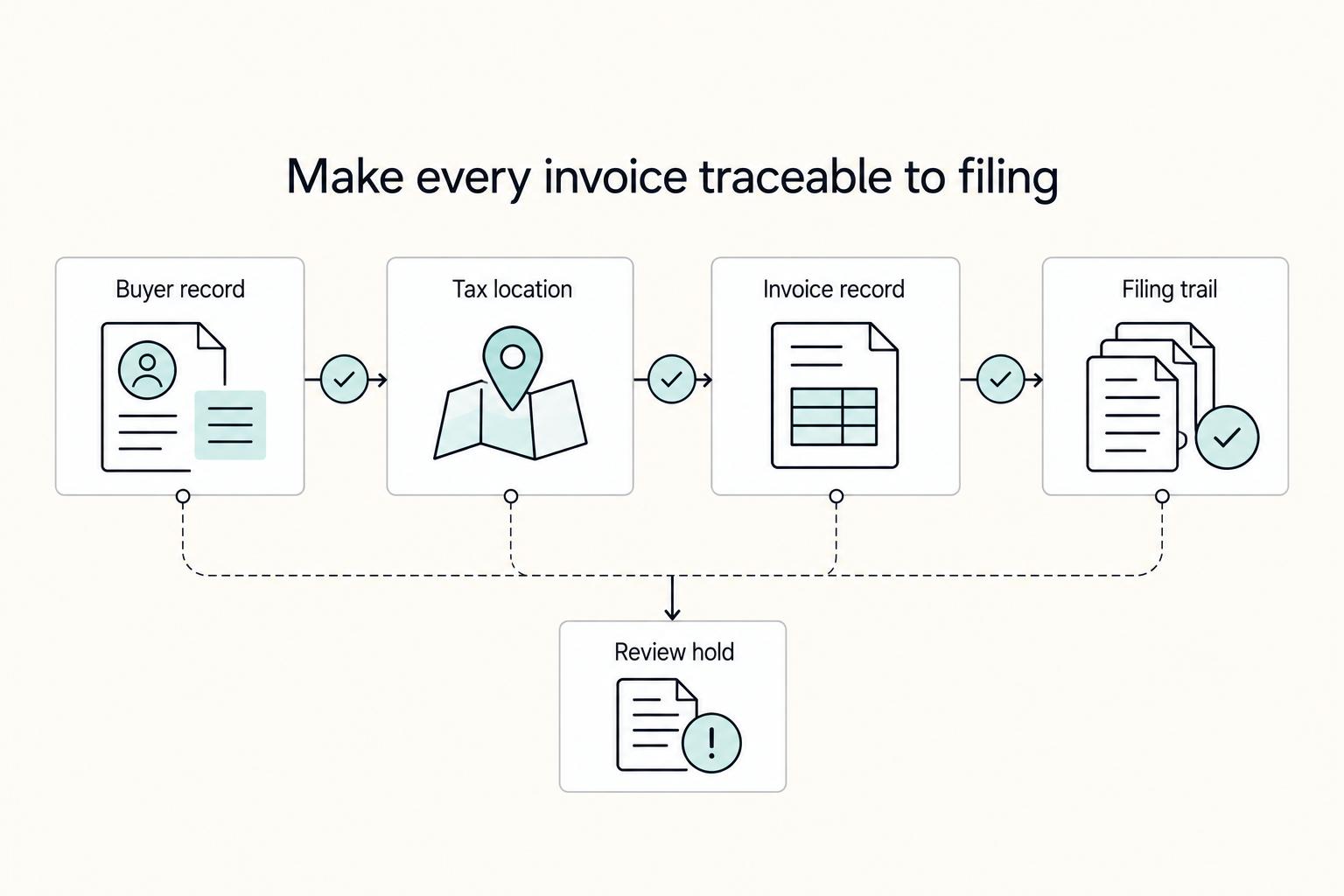
Low-stress compliance in Germany comes from decision order, not tax tricks. Use this sequence: confirm core facts, apply conservative temporary assumptions, verify the few points that can break invoices or filings, and keep one evidence file that explains each decision.

The Freelance Payment Penalty: A Modeled Audit of Platform Fees, FX Spreads, and Payout Delays
The money rarely disappears through a single, easy-to-spot fee. The real loss is stacked. A marketplace takes its commission, a processor adds a charge for international cards, a bank or payment company converts the currency at a spread, a platform holds the funds before release, and a wire sheds a little to intermediaries on the way in. Each layer looks defensible on its own, but the worker feels the combined result as a smaller deposit and a later payday.