
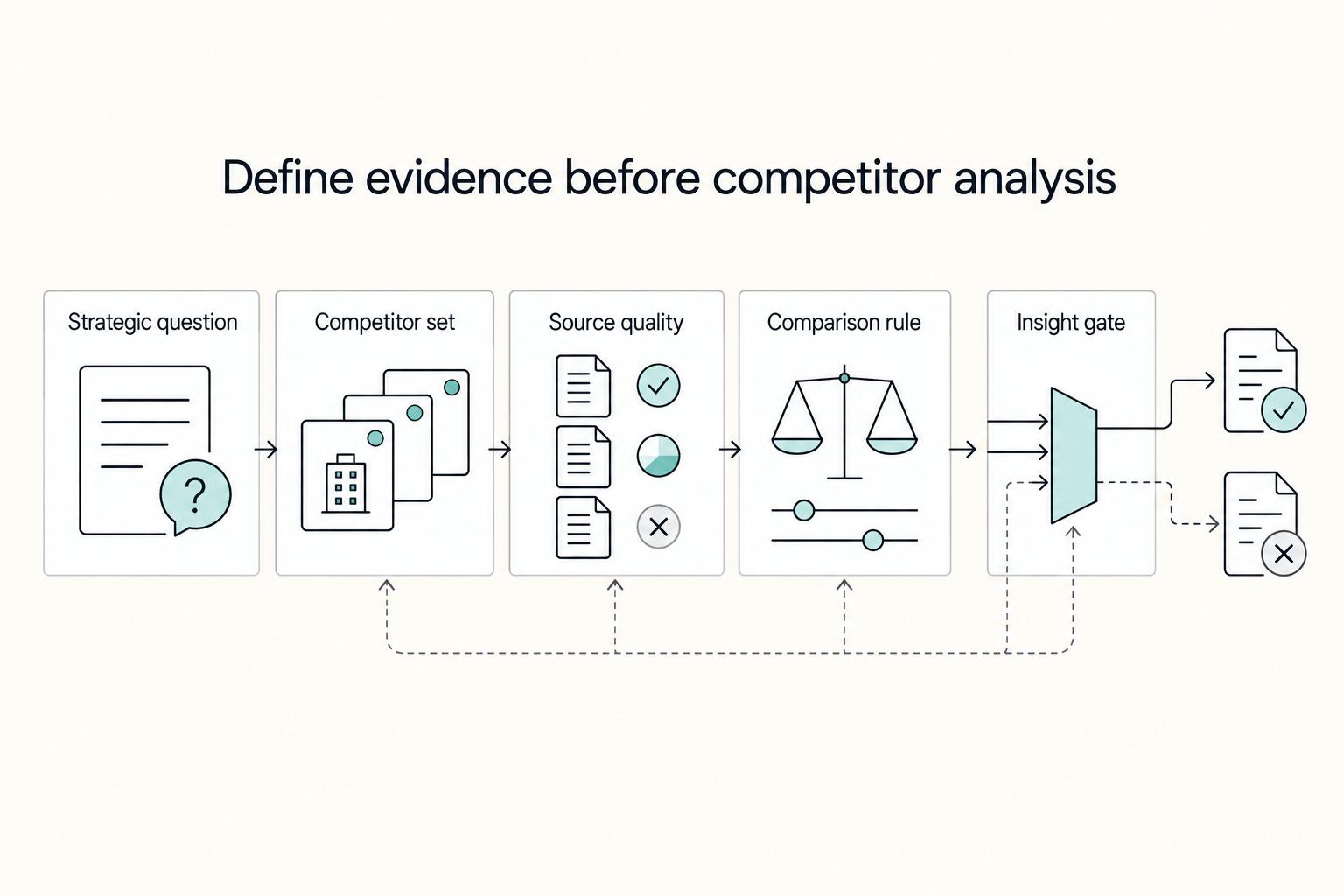
Quick Answer
A useful competitor analysis for an IT agency can be done in one afternoon by focusing on decisions, not documentation. Set three decision targets, compare rivals by service lane, build one-page profiles, score only evidence-backed factors, and keep unknowns visible. The output should be a shortlist of real rivals, a verification list, and a proof backlog you can act on the same day.
Why Do This in One Afternoon#
A useful IT agency competitor analysis can leave you with a short decision list by the end of one afternoon, not a long document no one uses. The goal is simple: decide where to focus, what to stop doing, and what proof to strengthen next.
Competitor analysis is the process of examining similar brands and comparing their strengths and weaknesses in relation to your own offer. Done well, it helps clarify which businesses customers compare you against. It can also sharpen your differentiation when buyers evaluate options side by side. One cited KPMG survey found that 71% of companies used competitive insights in decisions, 52% said those insights shaped positioning, and 47% said those insights created new revenue opportunities.
If you run an IT outsourcing agency, this framework can be applied across lanes such as staff augmentation, project delivery, and managed support. Keep the session tight so you leave with decisions you can apply the same day, not a report that sits untouched.
- Step 1: Set a decision target. Pick three decisions you need today, such as service focus, pricing posture, or proof gaps.
Checkpoint: if a finding does not change a decision, park it.
- Step 2: Separate offer lanes before comparing rivals. Review staff augmentation, project delivery, and managed support separately so buying criteria do not get mixed.
Checkpoint: label every competitor note to one lane first.
- Step 3: Capture evidence, then score. Build one-page competitor profiles and a weighted scorecard, and mark unverified claims as
unknown.
Checkpoint: keep unknowns visible instead of forcing a score.
- Step 4: Filter choices through risk. Treat visibility and reliability as separate signals.
Checkpoint: if a rival gets attention but lacks delivery clarity, do not copy its messaging.
Before you begin, define your output pack. It should include a prioritized rival shortlist, an unknown list that needs verification, and a proof backlog for your own positioning. That output keeps the session practical. Traffic and keyword data matter, but they are inputs, not verdicts.
What to prepare before you start#
Preparation is where weak analysis is either prevented or locked in. Set inputs first so you compare evidence against your strategy while evaluating the competitive market, instead of reacting to loud claims.
| Preparation | Action | Checkpoint |
|---|---|---|
| Gather decision evidence first | Identify competitors and collect comparable notes on their structures, value propositions, marketing efforts, brand identities, and customer journeys | Each key observation should map to a documented note or be marked unknown |
| Build baseline documents | Create one consistent profile per rival and one shared scorecard tab | If a field cannot be supported by public proof, mark it unknown |
| Set your evidence rule up front | Keep verified facts, assumptions, and unknowns separate; unverified claims stay unscored | Every high-impact claim needs a proof pointer or an unknown tag |
| Split comparison lanes before scoring | Keep materially different service types or customer segments separate | Every note gets one lane label before it enters the scorecard |
- Gather decision evidence first. Start by identifying competitors and collecting comparable notes on their structures, value propositions, marketing efforts, brand identities, and customer journeys.
Checkpoint: each key observation should map to a documented note or be marked unknown.
- Build baseline documents. Create one consistent profile per rival and one shared scorecard tab. Keep fields identical so you can compare structures, value propositions, marketing efforts, brand signals, and customer-journey clues instead of headline copy.
Checkpoint: if a field cannot be supported by public proof, mark it unknown.
- Set your evidence rule up front. Put this at the top of your notes: unverified claims stay unscored. Keep verified facts, assumptions, and unknowns separate.
Checkpoint: every high-impact claim needs a proof pointer or an unknown tag.
- Split comparison lanes before scoring. Keep materially different service types or customer segments separate so different risk profiles do not blur together.
Checkpoint: every note gets one lane label before it enters the scorecard.
A practical prep stack can use one file with tabs for decision targets, rival profiles, scoring, and proof gaps. That setup can reduce context switching and make review meetings easier. When someone challenges a score, you can jump from score to evidence quickly.
It helps to tag every evidence note with one extra field: decision_impact. Use simple labels such as high, medium, and low. High-impact notes are anything that could change who you target, what you price, or what you claim. Low-impact notes can wait.
When this prep is done, scoring usually gets easier because everyone can see what is known, what is inferred, and what is still open.
Define your competitor set and cut noise#
Scope control is the first quality filter. The most useful competitor list reflects both search overlap and real service overlap.
Use working labels before scoring: SEO competitors, business competitors, and overlap between the two. These are decision aids for this review, not permanent labels for every market context.
- Build a search-overlap baseline first. Start with 15-20 target keywords tied to your core offers, then track which domains appear repeatedly on page one. Treat domains that appear for five or more of those keywords as meaningful SEO competitors.
Checkpoint: each shortlisted domain has a keyword-overlap count.
- Separate SEO competitors from business competitors. Some domains rank for your terms but do not sell the same services. Some true business rivals may not dominate search. Keep both signals visible so visibility is not mistaken for direct business pressure.
Checkpoint: each name has a short note on keyword overlap and service overlap.
- Classify before scoring. Mark each name as an SEO competitor, a business competitor, or both, then prioritize names with stronger keyword overlap and clear service overlap.
Checkpoint: no high-impact score depends on an unverified assumption.
Add one short rationale line under each classification. Example format: strong service overlap, weak search overlap. That line forces you to state why the name is on the list.
If two rivals look similar, break the tie with evidence depth. Keep the one with clearer overlap evidence in your core set, and move the other to watchlist status until you collect stronger proof.
This is the noise cut. Ranking lookalikes stay visible, but decisions are driven by names that repeatedly appear for your target keywords and overlap with your services.
Build a one-page profile for each real rival#
Use one page per rival so every later score is comparable. Consistency matters more than detail volume.
Treat each profile as a decision document, not a brand recap. Keep fields fixed, evidence standards fixed, and unknowns explicit. If one profile has extra sections and another does not, scoring drift starts immediately.
- Use one fixed template for every rival. Keep the same fields each time: structure, value proposition, marketing approach, brand identity, and customer-journey observations.
Checkpoint: field names stay identical across profiles.
- Capture observable signals from public touchpoints. Note what is clearly stated, what is implied, and what is missing across messaging and customer journey.
Checkpoint: every note is tagged stated, inferred, or unknown.
- Add SEO analysis fields. Track visible keyword themes, content patterns, backlink context, and technical performance notes when visible. SEO rivals and business rivals may not always be the same set.
Checkpoint: each digital note maps to a specific page or touchpoint.
- Mark unknowns and keep timestamps. If public evidence is unclear, record
unknowninstead of guessing. Addcaptured_onandlast_seen_updateso movement over time is visible.
Checkpoint: no high-impact field is filled by assumption alone.
Use brief evidence notes, not long prose. A strong note names the page type or touchpoint, states what was observed, and tags confidence. Example: customer-journey page shows a multi-step path, confidence inferred. Short notes are easier to re-check later.
Keep one row for contradiction checks. If a rival claims a premium position but publishes generic copy, log that mismatch. Contradictions can reveal where your own positioning can be clearer and easier to trust.
If a rival overlaps in search but has limited business evidence, keep it in view with lower confidence until stronger proof appears.
Score rivals with a weighted scorecard that forces tradeoffs#
A weighted scorecard turns profiles into choices. Without explicit priorities, teams can overvalue what is easiest to see.
Define the blocks before you score names. Then apply the same rules to every rival. The goal is comparability and better decisions under uncertainty.
- Set scoring blocks first. Build blocks from external-audit inputs: key external variables, opportunities, and threats. Use a finite list, and organize variables across the five broad categories of external forces.
- Score with competitive intelligence and external-audit signals together. Start with ethical competitive-intelligence gathering, involve broad participation across the team, and score only what you can support with evidence. Keep
unknownwhen evidence is thin. - Write one hard tradeoff rule. Decide in advance how to handle rivals that score high on one variable but raise risk on another, so priorities stay explicit.
- Re-score on a regular rhythm. Treat competitive intelligence as an ongoing ethical practice, and review often enough to keep priorities current.
Add a confidence column next to each score so the team can see where evidence is strong or weak. This helps avoid acting on noisy inputs because a single number looked impressive.
Run a quick sensitivity check before finalizing. Ask one question: if one high-priority variable changed weight, would the top rivals change? If yes, revisit your assumptions before using the scorecard for pricing or positioning calls.
The scorecard should make tradeoffs obvious, not hidden. If a score looks high but confidence is low, treat it as a decision warning, not a win.
Compare service models before you compare marketing#
A clear competitor analysis framework keeps the review structured and helps turn messy data into strategic signals. Many teams still do this work manually, so simple structure matters.
Start by assigning each rival to one primary comparison category for this review cycle. Then compare only like for like. A rival can appear in more than one category over time, but not in the same scoring pass.
- Assign each rival to one primary category at a time.
- Compare each category with the same criteria, and keep
unknownwhere evidence is thin. - Keep visibility signals separate from execution signals so reach does not outweigh what you can verify.
- Turn the category-by-category comparison into a focused summary using only evidence-backed points, plus a short list of unknowns to validate next.
Add category-specific buyer questions while comparing. Ask how the offer is framed, what outcomes are claimed, and what public evidence supports those claims. Use the same questions for each rival in that category.
A simple scenario contrast helps. If a rival looks strong in one category but weak in another, treat those as different competitive positions. Do not average them into one generic score.
If your notes are mostly marketing observations, pause and collect more evidence before making pricing or positioning calls. Related: The Role of the BSA/AML Compliance Officer in a FinTech Company.
Analyze market visibility without vanity traps#
Visibility data is directional, not proof of commercial strength. Use it to frame questions, then verify whether those signals connect to buyer intent and business outcomes.
| Step | Focus | Verification cue |
|---|---|---|
| Step 1 | Directional visibility data by lane | If a note is not tied to a specific page and buyer intent, mark it unknown |
| Step 2 | Depth, not rank position alone | If you can describe rankings but not the buyer problem the page solves, the analysis is still surface-level |
| Step 3 | Paid and organic clues before judging momentum | Check attribution carefully; last-click reporting can hide earlier touches |
| Step 4 | Tool anomalies as verification checkpoints | Confirm whether the shift aligns with a real page change, channel mix change, or tracking change |
- Step 1: Pull directional visibility data by lane. Use your visibility tools to map who is visible in each service lane, then validate at page level with search and social patterns. Keep each review lane-specific. If a note is not tied to a specific page and buyer intent, mark it
unknown. - Step 2: Compare depth, not rank position alone. Review service-page quality, backlink context, and intent match between query and page promise. A top ranking alone is not a business outcome. If you can describe rankings but not the buyer problem the page solves, the analysis is still surface-level.
- Step 3: Combine paid and organic clues before judging momentum. Add paid signals, content cadence, and audience engagement to your organic view, then check attribution carefully. Last-click reporting can hide earlier touches, so full-funnel context can provide a clearer view. Numbers like 50,000 impressions, 2,000 clicks, or traffic up 40% can still miss whether business performance improved.
- Step 4: Treat tool anomalies as verification checkpoints. If a platform shows a sudden spike or drop, pause decisions and verify context. Confirm whether the shift aligns with a real page change, channel mix change, or tracking change before adjusting positioning.
Keep a short validation sequence for anomalies. First, inspect the pages tied to the change. Second, check if intent shifted from one service lane to another. Third, cross-check whether your own pipeline saw similar movement. If those three checks disagree, hold off on strategy changes.
Use visibility trends to prioritize where to inspect deeper, not to declare winners. A rising rival may simply be publishing more frequently. A falling rival may still win deals through strong referrals or delivery reputation. Your scorecard should capture both views before action is taken.
Also separate discovery strength from conversion strength. Some rivals are excellent at attracting early clicks but unclear on scope and commitment language. Others rank less but convert better because service boundaries are clear. Visibility alone cannot tell you which case you are seeing.
If visibility rises while outcomes stay flat, improve intent match on key service pages first, then reassess in the next review cycle.
Turn findings into positioning and pricing decisions#
Research becomes useful when it turns into concrete decisions. Make four calls immediately: who you serve best, what you stop selling, which proof you publish next, and when pricing should be reviewed.
- Decide who you serve best. Review direct competitors by service lane, then choose one primary buyer profile per lane that fits your strengths and market research. Also name one profile to deprioritize. If most rivals could reuse your positioning line, narrow it.
- Decide what you stop selling. If direct competitors cluster around low-price staff augmentation, choose a lane: premium specialization or faster standardized delivery. Do not sit in the middle. Mixed messaging can create pricing friction.
- Decide which proof you publish next. Build a message matrix per core service line with four fields: claim, proof, risk caveat, and fallback offer. This keeps positioning evidence-led and helps discourage copycat claims.
| Service line | Claim | Proof to publish next | Risk caveat | Fallback offer |
|---|---|---|---|---|
| [Core line] | [What you promise] | What you can demonstrate now | Where outcomes can vary | [Lower-risk starting option] |
- Set pricing trigger rules before conditions change. Use competitor moves as decision triggers. For example, if a rival cuts prices by 30% or raises $50 million and expands quickly, run a check before reacting: hold price and strengthen proof, or repackage while protecting margin. Do not default to discounting first.
After you fill the matrix, test each claim with one simple challenge: can sales prove this in the first conversation without stretching language. If not, tighten the claim or move it to backlog.
Your proof backlog should be lane specific. Proof that helps managed support decisions may not help project delivery decisions. Grouping proof requests by lane helps prevent generic collateral work that looks busy but does not help active deals.
For pricing discussions, tie each response option to a clear condition. If a competitor move affects your target segment directly, review packaging and proof first. If the move affects a segment you already deprioritized, document it and hold position.
A strong output is clear: one target segment per lane, one offer you stop pushing, and one proof set you publish next.
Decide where to compete and where to walk away#
Compete-or-walk-away rules can protect deal quality. Without clear gates, teams can chase volume without enough attention to fit and risk.
- Turn your competitive analysis into a practical compete-or-pass screen. Use the same decision document for each deal, and check whether the opportunity fits your offer, your current proof, and your ability to deliver under the buyer's constraints.
- Walk away when a direct competitor has an advantage you cannot credibly close. If the buyer's priorities do not match your current strengths, decline early instead of forcing a weak-fit pursuit.
- Compete harder where direct or indirect competitors leave clear gaps. Use competitor identification to spot likely threats, anticipate moves, and find product or service gaps you can address with stronger execution.
- Use a red-flag list as a gate before proposal drafting. Tie the list to repeated bad-fit patterns and enforce it consistently:
Vague scope requests: require written scope boundaries before estimating.Unrealistic turnaround demands: offer a phased start or decline if risk remains high.Price-first procurement patterns: avoid custom proposals when selection is primarily commodity bidding.Repeated requirement changes during qualification: move to paid discovery or walk away.
Add one practical step between qualification and proposal: a gate review with commercial and delivery input together. The question is direct: can you deliver this scope under the requested constraints without hidden risk? If the answer is unclear, pause before drafting.
Keep walk-away reasons in a visible log. Over time, those patterns can improve targeting and messaging. Consistent gates turn competitor analysis into better pursuit choices instead of extra reporting.
Build a 30 60 90 day execution checklist#
A 30 60 90 plan keeps this work from stalling after the analysis session. Each 30-day block should have one clear focus: learn, implement, improve.
| Period | Focus | What happens |
|---|---|---|
| Days 1-30 | Learning | Define clear goals and expectations, capture key context, and list open questions |
| Days 31-60 | Implementing | Execute priority initiatives and tighten core workflows |
| Days 61-90 | Improving | Review outcomes, improve what is working, and update assumptions only when evidence is verified |
| Days 30, 60, and 90 | Review points | Use formal check-ins to confirm progress and set next-step priorities |
- Days 1-30 (Learning): Define clear goals and expectations for this phase, capture key context, and list open questions. Keep unknowns marked as
unknownuntil verified. - Days 31-60 (Implementing): Turn what you learned into action by executing priority initiatives and tightening core workflows.
- Days 61-90 (Improving): Review outcomes, improve what is working, and update assumptions only when evidence is verified.
- Set review points at each milestone: Use days 30, 60, and 90 as formal check-ins to confirm progress and set next-step priorities.
For days 1-30, define owners for each unknown that can change decisions. For days 31-60, track where your updated approach improves execution and feedback. For days 61-90, compare outcomes against your initial assumptions and retire assumptions that did not hold.
Use the same document across all three phases. Add a short changelog line each time a key assumption, goal, or priority changes. That record helps teams see whether strategy shifts are evidence-led or reactive. If the plan does not change active opportunities, shorten it until every line has an owner and a due date.
Common mistakes and how to recover fast#
Once the plan is active, a common failure is over-focusing on surface metrics instead of context. Treat context-free numbers as a warning, then validate strategic intent before changing offers, pricing, or messaging.
- Mistake: copying polished competitor claims without context.
Recovery: rewrite conclusions around what you can support, and state clearly where your scope ends.
- Mistake: treating digital marketing competitor analysis as the whole job.
Recovery: use SEM and PPC signals as campaign inputs, not as a full business-wide competitor view.
- Mistake: acting on top-line signals without manual context checks.
Recovery: add one required verification step before decisions, and capture the likely strategic intent behind the signal before acting.
- Mistake: letting the analysis scope get too broad.
Recovery: narrow the scope to the decision in front of you, then reprioritize from that tighter set.
If a metric jumps but context and strategic intent do not align, hold position and investigate before changing strategy.
Your next move#
Execution discipline is the next move. Convert what you learned into owned actions with visible checkpoints.
- Create one decision document. Summarize where you can differentiate, where you should hold, and what is still unknown. Keep unknowns explicit so assumptions do not become facts.
- Convert decisions into tracked projects. Assign a clear owner, timeline, and success metric to each action.
- Start with one high-confidence change. Where practical, run a limited test, record a baseline, and compare post-change results in the same tracker before expanding.
- Use competitor moves as review triggers, not copy signals. A price cut, large funding round, or aggressive hiring should trigger an impact check against your strategy, not an automatic reaction.
In your first cycle, publish your current positioning summary and launch one tracked project with a named owner, timeline, and success metric. This creates momentum without waiting for perfect data.
After that, keep the loop simple. Review incoming signals, update only what changes decisions, and keep unknowns visible until verified. Use tools and AI to support judgment, not replace it. Competitive analysis is not about imitation. It is about better timing, clearer choices, and positioning you can defend.
Frequently Asked Questions
What is IT agency competitor analysis, and how is it different from generic competitor research?
IT agency competitor analysis compares similar agencies against your own to support decisions about where to compete and how to differentiate. It is not just a descriptive market scan. The goal is a decision set tied to evidence, not a broad overview.
How is IT outsourcing competitor analysis different from digital marketing competitor analysis?
For IT outsourcing, visibility and channels are only part of the picture. You also compare service structure, value proposition, brand identity, and customer journey so messaging matches what you can actually deliver. Visibility should guide investigation, but delivery evidence should guide positioning and pricing decisions.
What should be included in a weighted scorecard for an IT outsourcing agency?
Build the scorecard around structure, value proposition, marketing approach, brand identity, customer journey, and differentiating factor. Tie every score to observed evidence. Add evidence status and confidence so unknowns stay visible and uncertain high scores do not drive decisions.
How often should I update one-page competitor profiles and scorecards?
There is no fixed cadence in the article. Update profiles and scorecards when assumptions change enough to affect positioning or competitive decisions. If a signal does not change a key decision, log it and review it in the next planned cycle.
What can I do if I have no paid tools like Semrush?
You can still run useful analysis with a structured comparison method. Review structure, value proposition, marketing, brand identity, and customer journey, keep fields consistent, and mark unknowns instead of guessing. Clear note quality and disciplined process often matter more than extra tooling.
What are the most common mistakes that make competitor analysis misleading?
Common mistakes include copying polished claims without context, treating digital marketing analysis as the whole job, acting on top-line signals without manual checks, and letting scope get too broad. These problems usually come from inconsistent inputs and hidden assumptions. Recover by standardizing comparisons, separating unknowns, and verifying context before acting.
How do I decide when to reposition versus when to keep my current offer?
Reposition when your basis for competing is unclear or weak in market communication. Keep your current offer when your differentiating factor is clear, consistent, and supported by analysis. A practical check is proof readiness: if sales can support the claim early, refine it; if not, tighten focus and reposition.
Try a related tool
Researched and edited by the Gruv editorial team. Gruv builds cross-border billing, payouts, and finance-operations software for global businesses.
Sources
Educational content only. Not legal, tax, or financial advice.
Related Posts

Digital Nomad Health Insurance Comparison for Long-Stay Moves
Use focused time now to avoid expensive mistakes later. Start with a practical `digital nomad health insurance comparison`, then map your route in [Gruv's visa planner](/tools/visa-for-digital-nomads) so we anchor policy checks to your real plan before pricing pages pull you off course.

The Role of the BSA/AML Compliance Officer in a U.S. FinTech Company
In a U.S. fintech, this role is often the accountability point for whether BSA/AML controls work under pressure, not just on paper.
A Freelancer's Guide to Donating to Charity (and the Tax Benefits)
The safest move is to **treat charitable giving like a repeatable compliance workflow**, not a "tax optimization" trick. As a globally mobile freelancer, you already juggle moving parts like income timing, residency signals, and multiple accounts.