
Quick Answer
A useful weekly review for a freelance business should end with three decisions: one about money, one about delivery risk, and one about direction. Run it in three passes by acting as CFO, COO, and CEO, using a small evidence pack with cash, open invoices, active client commitments, and admin follow-ups. The goal is to change next week's calendar and reduce near-term risk, not just organize tasks.
What your weekly review should decide: money, delivery risk, direction#
A useful weekly review for freelancers should end with three business decisions: one about money, one about delivery risk, and one about direction. If your review only clears inbox items and rearranges next week's to-dos, you stay stuck working in the business instead of steering it. The pattern is familiar: client work, inbox fires, invoicing, social posts, and "just-a-quick-call" requests. You stay busy, but the business mostly survives.
For a global freelancer, this review is less about tracking tasks and more about deciding where your time goes. Before you start, pull together a small evidence pack: your current cash snapshot, open invoices, active client commitments, and any admin items that need follow-up. If you cannot see those in one place, it is easy to slide back into reactive work.
| Review type | Focus | Decisions | Outcome |
|---|---|---|---|
| Standard Weekly Review | Tasks, inbox, calendar cleanup | What do I need to do next? | Better organization, but often still reactive |
| CEO Sync | Money, operations, direction | What needs attention, what is at risk, and what matters most next week? | Clearer priorities and fewer blind spots across the business |
Use one simple rule: if your review ends with a longer task list but no decision about money, delivery risk, or direction, you stayed in $50/hr tasks.
Step 1 Take a plain-English view of the financial position#
Start with a plain-English view of the business's financial position for the next week. Your job is to know what cash is in, what is late, what is committed, and which admin items could create friction if ignored. This is not a bookkeeping session. It is a check on whether the business can support the work you already promised.
Verification point: by the end of this step, you should be able to say what money is expected, what is uncertain, and what needs follow-up now.
Step 2 Act as the COO#
Once the numbers are clear, check whether you can actually deliver cleanly. Look at active projects, deadlines, client communication, and any handoff or process issue that could slow you down. This is where you catch a common solo-operator failure mode: everything looks manageable until one late invoice, one scope change, or one overloaded week starts affecting delivery.
Your job here is not to perfect your tools. It is to remove the one or two operational issues most likely to create rework, missed commitments, or avoidable stress.
Step 3 Decide whether next week moves the business forward#
Last, decide whether next week moves the business forward or just keeps it moving. This is the point of the whole exercise. Ask, "What deserves my highest-value time?" not "What can I fit in?" The common trap is spending all your time on execution and none on the decisions that shape growth.
The next three sections break down each check-in in order: CFO, then COO, then CEO. Run them in that sequence during one weekly session so you move from facts, to delivery reality, to decisions about where the business goes next.
Related: The Best Personal Productivity Systems for Freelancers (GTD).
Pillar 1: Review compliance signals, profit leakage, and invoice risk#
Run this CFO check-in first each week so you make decisions from evidence, not assumptions. In this review, answer three questions in order: what compliance signal changed, where profit leaked, and which invoice is turning into cash risk. If you skip this pass, you stay reactive.
Open one working note with current balances, unpaid invoices, contract payment terms, and the source used to verify each active rule. If a rule is not verified yet, label the value as Current threshold pending source-record verification instead of guessing.
| Signal to Track | Why It Matters | Weekly Action |
|---|---|---|
| Residency or immigration status | Status changes can affect your compliance workload and required follow-up | Update your day count or renewal timeline, then verify the current rule from a reliable source |
| Account-reporting exposure | Reporting triggers are easy to miss when balances move across accounts | Check combined balances, compare to your verified trigger, and mark if follow-up is needed |
| Profit leakage | Invoiced revenue can look strong while fee friction cuts real margin | Review recent work and subtract conversion costs, transfer costs, platform costs, and withholding exposure |
| Receivables risk | Late payment creates cash instability even when revenue is booked | Bucket each open invoice into monitor, nudge, or terms escalation and act this week |
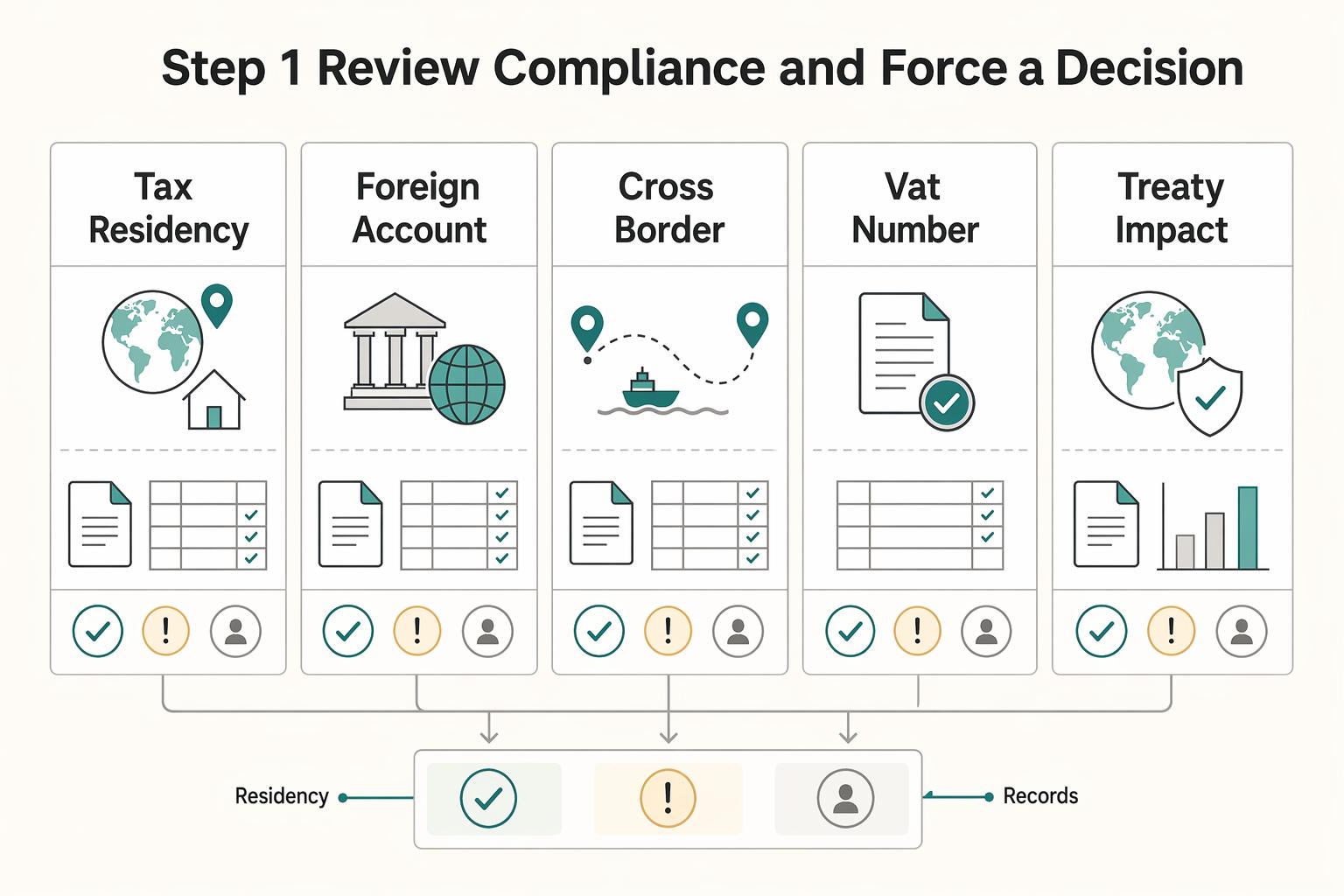
Step 1 Review your compliance dashboard#
Check the items most likely to create risk if ignored: location-based status, renewal/reporting triggers, and any change that needs follow-up. Save the supporting source in your note and keep a short audit trail of what you checked. A recurring review only works if you can show the evidence behind each tracked rule.
| Item | What to save | Status label |
|---|---|---|
| Location-based status | Supporting source and a short audit trail | On track / near trigger / follow-up required |
| Renewal or reporting triggers | Supporting source and a short audit trail | On track / near trigger / follow-up required |
| Changes needing follow-up | Supporting source and a short audit trail | On track / near trigger / follow-up required |
Verification point: you can point to each tracked rule and label it on track, near trigger, or follow-up required.
Step 2 Audit treasury and true profitability#
Use this step to confirm real profit, not just invoiced totals. Review one or two recent invoices with a fee-leakage checklist: conversion costs, transfer costs, platform costs, and withholding exposure. If payment routes or client terms changed, recalculate net before you accept more work under the same setup.
| Cost area | Review in this step | Recalculate net if |
|---|---|---|
| Conversion costs | Check recent invoices for fee leakage | Payment routes or client terms changed |
| Transfer costs | Check recent invoices for fee leakage | Payment routes or client terms changed |
| Platform costs | Check recent invoices for fee leakage | Payment routes or client terms changed |
| Withholding exposure | Check recent invoices for fee leakage | Payment routes or client terms changed |
Use the result to make a decision. If net margins are thinner than expected, adjust terms, reprice, or change how you get paid.
Verification point: you know your current cash position and whether recent work is performing at the margin you expected.
Step 3 Triage accounts receivable risk#
Use a simple escalation flow and close it weekly. First, monitor: sort unpaid invoices by due date, amount, and client history. Next, nudge: send short reminders for due-soon or newly overdue invoices and confirm approval status. Then escalate terms for repeat slow payers: require a deposit, shorten billing cycles, pause new work until payment clears, or tighten milestone-release terms.
| Bucket | Use for | Action |
|---|---|---|
| Monitor | Unpaid invoices | Sort by due date, amount, and client history |
| Nudge | Due-soon or newly overdue invoices | Send short reminders and confirm approval status |
| Terms escalation | Repeat slow payers | Require a deposit, shorten billing cycles, pause new work until payment clears, or tighten milestone-release terms |
Keep the invoice, contract clause, and reminder thread together so the action is documented. Verification point: every open invoice is now in one of three buckets: monitor, nudge, or terms escalation.
If you want a deeper dive, read Digital Nomad Health Insurance: A Comparison of Top Providers.
Pillar 2: Spot friction, name the risk, and schedule one fix#
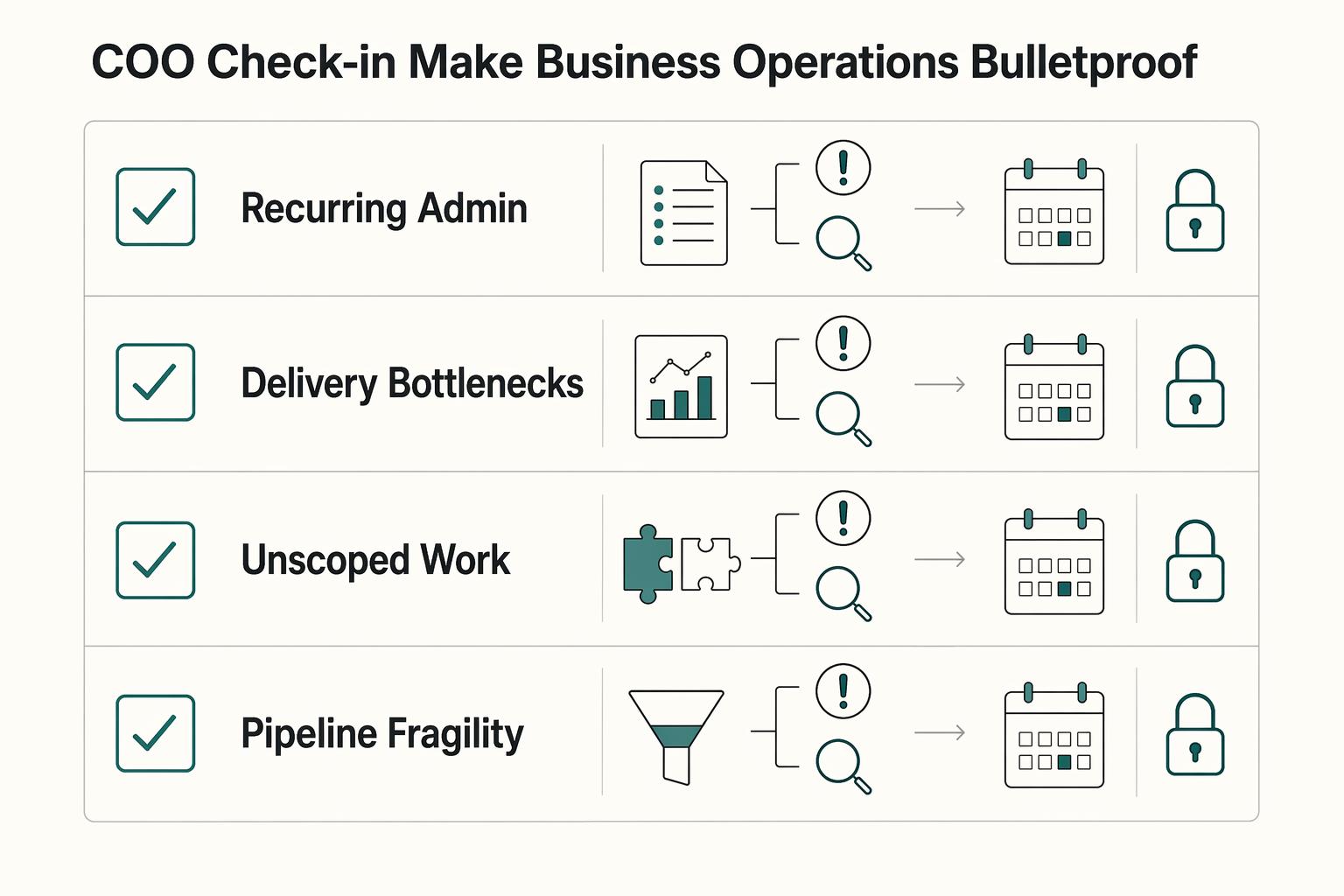
This part is about execution: spot friction, name the risk, choose a response, and schedule one concrete fix before you end the session.
| Operational Signal | What It Reveals | Immediate Fix |
|---|---|---|
| Recurring admin friction | Repeat work is quietly consuming delivery time | Build or update one template, checklist, or intake doc this week |
| Delivery bottlenecks | Progress is blocked in handoff, approval, or scheduling | Identify the block and set one owner, deadline, or client decision to clear it |
| Unscoped work | Boundaries in your proposal or process are too loose | Log the deviation, decide billable vs goodwill, and send a re-scope or boundary note |
| Pipeline fragility | Future revenue depends on too few sources | Compare your next 90 days against forecast and schedule one diversification action |
Step 1. Cut one recurring admin tax. Start with the last seven days. List the repeat tasks that took longer than they should have, then pick one to fix now.
Your decision here is simple: choose one recurring annoyance you will reduce before next Friday. The next action should be specific and small, like creating an invoice template, a client intake form, a kickoff email template, or a closeout checklist.
Verification point: this step is done only when one asset is created or one admin fix is on your calendar.
Step 2. Update your risk ledger with backup actions. Use a simple ledger with five fields: risk, current exposure, early warning sign, backup plan, and evidence link. Review client mix, platform reliance, and jurisdictional exposure every week.
For any hard threshold you have not verified, label the field as Current concentration trigger pending source-record verification. Treat concentration as a warning sign: if about 80% of income comes from one source, that is a critical vulnerability. For each risk, define one fallback now, such as an alternate outreach channel, a direct-contract path, or the advisor/source note you will rely on if exposure changes.
Verification point: each active risk must have a contingency attached.
Step 3. Log delivery drag and scope creep, then choose a side. For each active project, compare the current work to the original brief, proposal, or contract and log any deviation. Then decide: re-scope if the work changed, or enforce boundaries if it did not.
Do not stay in the middle where extra work is absorbed by default. If you keep competing on price alone, you become more fragile when pressure rises. After each decision, schedule one concrete follow-up action for next week: send a change note, update the statement of work, tighten revision language, or book a handoff meeting to clear a bottleneck.
Verification point: every deviation is tagged as absorbed, billed, or blocked, with one follow-up action scheduled.
Step 4. Stress-test pipeline health against the next 90 days. Use a rolling cash flow forecast that looks at least 90 days ahead and refresh it weekly. Compare expected work, proposals, discovery calls, and confirmed revenue to that forward view.
If the next 90 days look thin, match the fix to the weak point: outreach for low lead flow, follow-ups for stalled proposals, or diversification when too much depends on one client, channel, or market. Diversify in ways that build on existing strengths, and use geographic diversification only where you can serve the market well. If forecast gaps appear while reserves are below your target, treat pipeline action as urgent; common reserve targets are 3 to 6 months of operating expenses, and 6 to 12 months in high-volatility periods.
Verification point: you finish with one scheduled revenue action for next week.
You might also find this useful: How to use a 'Decision Journal' for your freelance business.
Pillar 3: Choose the work that serves the business you want#
After you lock next week's cash, risk, and delivery actions, make one CEO decision: keep, cut, or defer work so the week serves the business you want, not just the invoices in front of you.
Step 1. Decide what stays on next week's calendar: keep, cut, or defer#
Start with your calendar, task list, and any pending yes/no decisions. For each item, decide whether it earns time next week based on direction, not urgency alone.
| Category | What it looks like in practice | Recommended action |
|---|---|---|
| Strategic Work | Builds future demand or stronger work quality (for example: key proposals, strong deliverables, outreach to the right clients, improving a service you want to sell more) | Keep it and protect time for it |
| Maintenance Work | Keeps current operations stable (for example: updates, committed revisions, admin follow-through) | Batch it, time-box it, and keep it out of your best focus windows |
| Misaligned Work | Pulls you toward services, clients, or quality standards you do not want to be known for | Cut it, decline it, or defer until you intentionally choose it |
Use a simple revenue-trap check: if work pays now but does not improve proof of work, referral quality, or movement toward your target services, treat it as a likely trap. End this step with every major commitment tagged keep, cut, or defer.
Step 2. Check what your current work is teaching clients to expect#
Your positioning shows up in what you accept and what you deliver each week. Review recent requests, revisions, and outputs, then ask: are clients buying your judgment, or only task execution?
Use three observable signals: the scope of requests you keep accepting, how often clients ask for advisory input, and whether your deliverables match the standard you want associated with your name. If the pattern is drifting low-value, adjust one lever for next week: tighten proposal language, update intake questions, or decline one request that weakens your position.
Step 3. Set next week's workload to match real operating capacity#
Treat capacity as a scheduling decision, not a motivation problem. If the last week pushed you into late-night work and reduced sleep, next week needs load changes before it starts.
Check three items: active deliverable load, scheduled recovery time, and protected focus blocks on the actual calendar. Then make one concrete edit now: move a meeting out of a focus block, add recovery space after a heavy delivery day, or defer a low-value task. The goal is a calendar that shows protected focus time and at least one deliberate load reduction.
We covered this in detail in How to Build a Second Brain for Your Freelance Business.
Conclusion: Leave with clearer decisions and a steadier plan#
The real test after a weekly review for freelancers is simple: do you leave with clearer decisions, lower near-term risk, and a steadier plan for next week? If yes, the hour did its job. If not, you probably collected observations without changing the calendar, the client queue, or the money tasks that actually need action.
- Shift from reactive operator mode to owner-operator mode.
Reactive mode looks like answering whoever pings first, noticing billing gaps late, and mixing admin, delivery, and planning until the week gets fragmented. Owner-operator mode looks different: your CFO pass checks cash due, invoices, and any dates that need verification; your COO pass fixes one bottleneck or protects focused blocks; your CEO pass decides what not to chase next week. Verification point: when you finish, next week's calendar should show real edits, not just a longer note.
- Use each pillar to make one concrete decision.
Your CFO check-in should produce one money or risk outcome, such as sending overdue invoices before Monday or confirming a deadline that needs same-week follow-up. Your COO check-in should produce one operating outcome, such as grouping calls into a themed day so you cut context switching instead of scattering meetings across every afternoon. Your CEO check-in should produce one strategic outcome, such as declining a low-fit project so you can protect one growth block.
- Carry a short agenda into the next review.
Keep it small enough to repeat in under 60 minutes:
- Finance: what is due soon, what is unbilled, what needs verification
- Operations: where time leaked, what caused rework, which blocks need protection
- Strategy: what moved the business forward, what was only maintenance, what should be cut
Consistency matters more than complexity. Missed invoicing, under-billed work, and small deadline slips are exactly the problems that get expensive when you only catch them monthly. Put the same review on your calendar each week, save your decisions in one running note, and use the next review to check whether this one changed your actions.
For a step-by-step walkthrough, see A Guide to 'Deep Work' for Freelancers.
Frequently Asked Questions
How do I include compliance checks in a weekly review?
Use a short checklist you can finish in one sitting. Check your days in each jurisdiction against your verified threshold, confirm any invoice tax treatment or registration deadlines tied to your business structure, and review permit or reporting dates that are getting close. Decide what needs same-week verification and schedule one follow-up task if anything is near a deadline.
What financial metrics should I track every week?
Track the numbers that change next week's decisions. Focus on cash due in the next 30 days, your largest client's share of current revenue, unbilled or overdue work, and protected focus blocks on your calendar. Use them to pull forward invoicing, follow up on receivables, widen your pipeline, or protect better hours for high-value work.
How can I turn this into a strategic planning session instead of a recap?
Turn it into planning by making next week's calendar advance one delivery priority, one money priority, and one growth priority. If the week is full of maintenance work, decide what to cut before Friday ends and schedule one protected block for business-building work. Keep a running record of those tradeoffs so recurring patterns stay visible.
What is a weekly risk audit for a freelance business?
A weekly risk audit is a simple check of client risk, money risk, and compliance risk. Identify which one could hurt you first, such as concentration, a late payer, or a jurisdiction timer getting close to a verified threshold. Then schedule one prevention move for the coming week, like a follow-up, a replacement lead source, or an advisor call.
How long should this take?
There is no fixed minute formula. Give more time to the CFO, COO, or CEO pass depending on whether compliance, delivery, or strategy needs the most attention. The review is done when your calendar shows real edits, at least one risk is reduced, and your decisions are saved in a running record.
Try a related tool
Researched and edited by the Gruv editorial team. Gruv builds cross-border billing, payouts, and finance-operations software for global businesses.
Sources
Includes 6 external sources outside the trusted-domain allowlist.
- academia.edu/8973287/Project_Management_A_Managerial_Appr...trusted
- in.gov/core/business_guide.htmltrusted
- aiaccountant.com/blog/financial-health-monitoring-guideexternal
- aol.com/news/executive-imperatives-2026-saas-founder...external
- asrify.com/blog/weekly-review-ritualexternal
- blog.startupstash.com/the-1-day-ceo-framework-a204a14250d2external
- businessinsider.com/freelance-writer-increase-income-performance...external
- calendar.com/blog/themed-days-structure-your-week-like-a-ceoexternal
Educational content only. Not legal, tax, or financial advice.
Related Posts

Digital Nomad Health Insurance Comparison for Long-Stay Moves
Use focused time now to avoid expensive mistakes later. Start with a practical `digital nomad health insurance comparison`, then map your route in [Gruv's visa planner](/tools/visa-for-digital-nomads) so we anchor policy checks to your real plan before pricing pages pull you off course.

The Best Productivity Systems for Freelancers: GTD, PARA, and Second Brain
**Treat productivity as a system you can run under load, not a vibe you summon on demand.** Client work is messy by default: requests scattered across Gmail and Slack, scope shifting midstream, and the annoying truth that "done" does not always mean "paid."
Create a Quarterly CEO Day for Your Freelance Business
A quarterly CEO Day gives you one protected block to review evidence, make the calls you have been avoiding, and leave with dated next actions. If most of your time goes to client delivery, the business can end up managed in scraps. A rushed pricing change, a half-read compliance note, and a vague plan to market more next month are all signs. A 2024 qualitative study of 10 freelancers found that participants often felt less structure in both work and life, then regained more control through goals, boundaries, and routines. This review can become that routine.