
Quick Answer
Use the new york salary transparency law as a checked market anchor, not a standalone pricing rule. Confirm the listing is in scope, save the posting details, and match the role to your real deliverables before you use its range. Then convert that base-pay reference into your own fee logic with clear notes on scope, operating costs, and delivery risk. This keeps your pricing explanation credible when clients question comparability or remote coverage.
How to Use a Verified New York Posting as Pricing Evidence#
Use the new york salary transparency law as pricing evidence only after you confirm the posting is actually in scope under current state or city guidance. A covered, current posting gives you a credible market anchor. A stale listing, a copied summary, or a misread edge case gives you weak negotiation support and makes the rest of your pricing logic harder to defend.
The goal is not to wave around a law and hope the number speaks for itself. Use a verified, comparable posting as one piece of market evidence, then connect it to how you actually sell your work. That means checking coverage first, matching the role by scope, and keeping enough documentation that you can explain your reasoning without sounding slippery or overconfident.
How do you verify a posting before you use it?#
Do not use a listing as pricing evidence until you know the law actually required the range.
| Check | What to save or note |
|---|---|
| Capture | The listing as it appears on the day you found it |
| URL and date | The URL and visible posting date |
| Pay format | Whether the range is annual salary, hourly compensation, or commission language |
| Location | The location text and any language about where the work is performed |
| Source type | Whether the posting appears to be the employer's own listing or a shortened repost on a job board |
| Job description | Whether a job description appears and, if it does, save it with the range |
| Scope note | A one-line note on why you believe the posting is in scope |
Start with the state rule in Labor Law § 194-B. Since September 17, 2023, private employers with 4 or more employees must include a pay range for covered advertised jobs, promotions, and transfers. For New York State postings, that range is the minimum and maximum annual salary or hourly compensation the employer in good faith believes is accurate at the time of posting. If a job description exists, it must also be disclosed. For commission-only roles, a general statement that pay is based on commission can satisfy the pay disclosure.
| Scenario | Coverage trigger | What you should capture |
|---|---|---|
| NYS advertised role | Private employer with 4+ employees; job, promotion, or transfer ad | Min and max annual salary or hourly pay, posting date, job description if one exists |
| NYC advertisement | Employer with 4+ employees or 1+ domestic workers; ad publicized to a pool of applicants | Good faith min and max base pay, whether work is performed in NYC, worker category shown in ad |
| Remote or out-of-state role touching NY | Verify reporting line, office or worksite connection, and current guidance | Screenshot, URL, location language, reporting language, and a note to verify edge cases before relying on it |
A few details affect how much weight the data deserves. State and city materials treat the posted range as base pay only, not the full benefits package. So do not treat the listed number as salary plus insurance, bonus, equity, or perks.
NYC adds another layer. The city rule started November 1, 2022, covers work performed in NYC, including remote-from-home work in NYC, and city guidance specifically includes postings for interns and independent contractors. NYC materials also note a temporary help firm exception, and Local Law 59 includes first-violation $0 civil-penalty language tied to a cure process, with a 30-day timing window in the text. For any 2026 edge case, add a note such as "[verify current CCHR guidance before relying on archived summary]."
The easiest way to keep yourself honest is to run every posting through the same short verification sequence before you save it as evidence:
- Capture the listing as it appears on the day you found it.
- Save the URL and visible posting date.
- Mark whether the range is annual salary, hourly compensation, or commission language.
- Check the location text and any language about where the work is performed.
- Note whether the posting appears to be the employer's own listing or a shortened repost on a job board.
- Record whether a job description appears and, if it does, save it with the range.
- Add a one-line note on why you believe the posting is in scope.
That sequence does not require legal analysis in every case. It forces you to separate "looks useful" from "is reliable enough to cite." If you skip the capture step and only keep a title and a number, you lose the context that makes the number meaningful. If you skip the location check, you can end up relying on a posting that sounds New York-adjacent but does not give you a clean transparency reference. If you skip the date, you can find yourself using an old screenshot months later with no way to tell whether the employer has already revised the range.
Remote scope is where people most often get sloppy. State guidance says the law can apply to opportunities performed outside New York that report to a supervisor or office in New York. But the NYSDOL FAQ also gives at least one fully remote scenario where a New York based supervisor alone may not be enough. Use a simple checkpoint: if the location or reporting facts are fuzzy, do not call the range "required by law" in a client discussion until you verify the current guidance.
That checkpoint matters because the most common failure here is not a dramatic legal mistake. It is a credibility mistake. You tell a client, "This range had to be posted under New York law," and then they ask one follow-up about remote scope or worksite language that you cannot answer. At that point the benchmark stops helping.
You do not need to be alarmist about edge cases, but you do need to label them accurately. If the posting is strong, say it is a current New York transparency posting. If it is less clear, say it is a relevant market reference and note that remote scope should be verified before treating it as a clean legal disclosure example. For edge cases, treat this as compliance-oriented research and confirm with counsel. A few practical distinctions help when you are deciding whether to keep or discard a posting:
- A current employer-hosted listing is stronger than a stripped-down repost that drops location details or omits the description.
- A posting with clear location and reporting language is stronger than one with vague "remote" text and no other context.
- A full range with a role description is stronger than a bare title and compensation line.
- A posting that matches your work and is easy to explain is stronger than one that only looks impressive because the title sounds senior.
You should also resist the urge to overread the number itself. The law requires a range the employer in good faith believes is accurate at the time of posting. That makes the posting useful as a market anchor, not as proof of what any one person earns, what the client should pay in every situation, or what your fee must be. The posting gives you a bounded starting point. Your job is to make sure that starting point is real.
A simple working habit helps here: keep a "verified" folder and an "interesting but unverified" folder. If the posting is clearly in scope and documented, it goes in the first folder. If the range is attractive but the remote facts are fuzzy, or the listing is missing key context, it goes in the second folder until you confirm it. That keeps you from accidentally mixing persuasive evidence with half-checked material when you are building a proposal on a deadline.
Once you know the posting is solid, the next job is turning employee compensation data into pricing logic that fits your business.
How do you convert employee pay data into a contractor price#
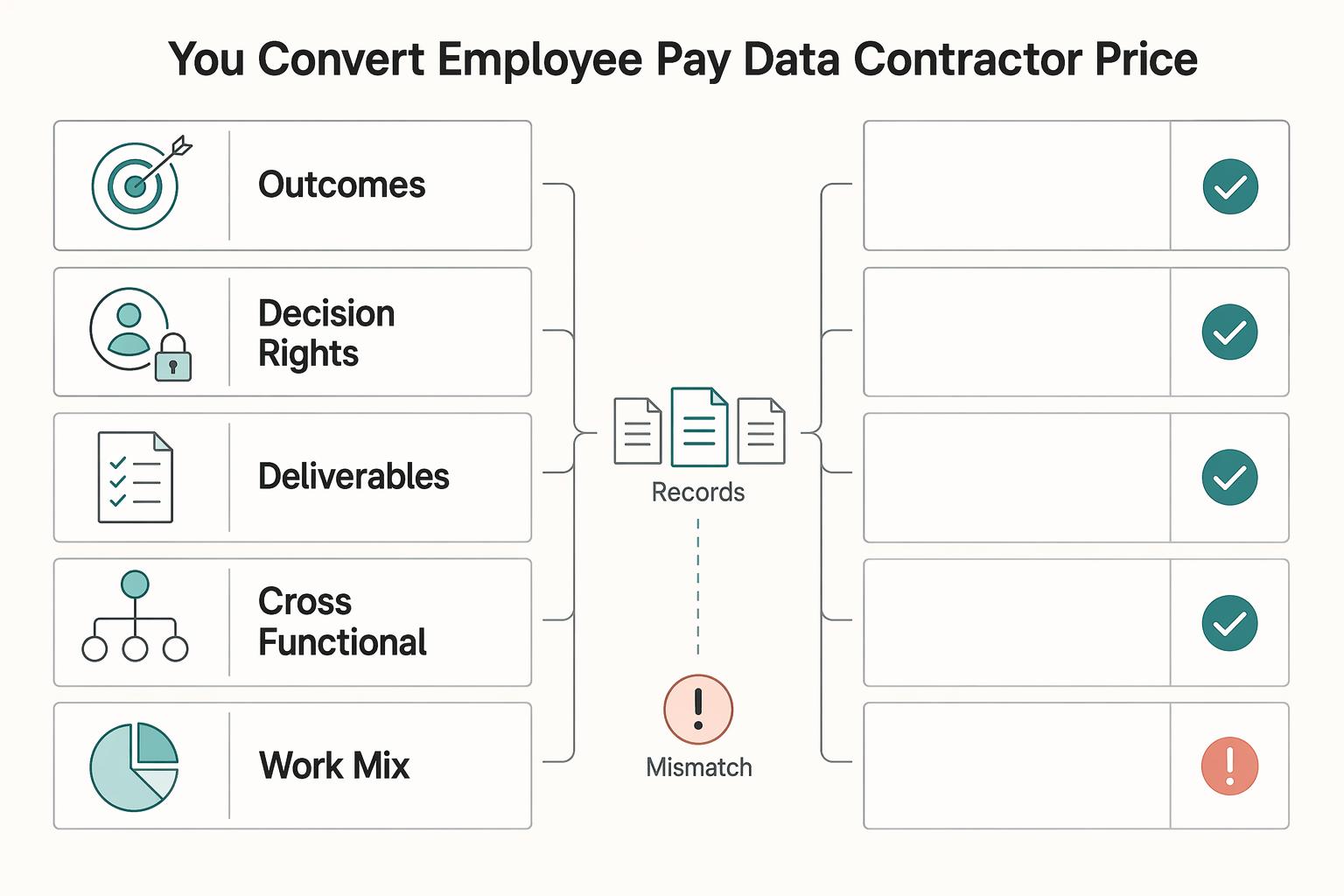
Comparable scope matters more than matching titles. Map roles by scope, not title.
| Factor | What to compare |
|---|---|
| Outcomes | What outcomes is the role expected to produce? |
| Decision rights | What decisions can the person make without extra approval? |
| Deliverables | What deliverables are named or implied? |
| Cross-functional coordination | How much cross-functional coordination does the role carry? |
| Work mix | Is the work strategic, execution-heavy, or both? |
| Industry context | Does the industry context make the work meaningfully different? |
Pull 3 to 5 current postings that match your actual work: level of responsibility, decision rights, deliverables, and industry context. A consultant leading lifecycle email strategy may benchmark against "CRM Manager" or "Growth Marketing Lead," not whatever title sounds senior. If you cannot explain in one sentence why each ad is comparable, drop it.
That one-sentence rule is more useful than it sounds. It forces you to describe the overlap in operational terms instead of relying on title inflation. A good comparability note has a simple structure: this role owns the same function, is accountable for similar outcomes, and makes decisions at a similar level. A weak note sounds like, "the title looks close enough." If you need several sentences to justify a posting, the match is usually not clean.
When you review a posting, compare your work against the role across the same set of factors every time:
- What outcomes is the role expected to produce?
- What decisions can the person make without extra approval?
- What deliverables are named or implied?
- How much cross-functional coordination does the role carry?
- Is the work strategic, execution-heavy, or both?
- Does the industry context make the work meaningfully different?
That last point matters more than people think. A title can be technically similar while the operating environment is very different. If your work involves owning a narrow, specialized function with quick implementation and direct accountability for a result, it may map better to a less glamorous title in the right context. A broader or more senior title can still be a worse match if the internal demands are very different. Scope beats prestige.
Then normalize the compensation format before you do any pricing math. Use the midpoint of each posted base-pay range, then convert it into the unit you need for your model: monthly, weekly, or hourly. Keep one note sheet with your math, time assumptions, and whether the ad is salaried, hourly, or commission-based. A common failure mode is mixing base-pay bands with total comp assumptions and calling the result "market rate."
Normalization is where many otherwise good benchmarks get muddled. If one posting is annual salary, another is hourly, and a third uses commission language, you cannot talk about them together until you put them on a common basis. You also need to label what each one represents. The point is not to make the data look more precise than it is. It is to stop unlike compensation formats from slipping into the same comparison without explanation.
Your note sheet should be boring in a useful way. For each posting, record:
- the role title exactly as posted
- the employer name
- the range exactly as shown
- whether it is annual salary, hourly compensation, or commission language
- the midpoint you are using
- the unit you converted it into for your own pricing model
- your time assumption for that conversion
- your one-line comparability note
- any caveat about location, scope, or verification
This basic discipline keeps a proposal from becoming fragile under questions. If a client asks how you got to your figure, you do not want to recreate the logic from memory. You want to be able to point to a short, consistent record and walk through it calmly.
It also helps to separate benchmark construction from quote construction. First, build the market reference. Then build your fee. If you collapse those into one step, you are more likely to blur the line between what the posting shows and what your business needs. The posting shows employee base pay for comparable work. Your fee reflects the way you deliver that work as an external specialist.
From there, translate the benchmark into contractor logic. Do not present a fixed markup formula as if the law supplies one. Instead, document the categories that change when a client buys your service rather than hiring an employee. Those categories include your unpaid admin time, software and equipment costs, revenue gaps between projects, faster start, narrower specialist expertise, and delivery risk you absorb. If you need help turning that into a project quote, Moving From Hourly to Project-Based Rates is the right next step.
This is the part clients usually understand if you explain it plainly. You are not saying, "The law says my contractor fee must equal employee salary plus a random premium." You are saying, "The employee range is the market reference for comparable base pay. My fee is built for a different buying model." That buying model changes the economics in ways that are easy to describe without sounding defensive.
For example, keep the categories concrete:
- Unpaid admin time: part of your working time is spent on work the client does not see directly, but it is still necessary to run the engagement.
- Software and equipment costs: tools and setup sit with you rather than being fully internalized by the employer.
- Revenue gaps between projects: your earning pattern is not a continuous salary stream.
- Faster start: the client buys speed and reduced ramp time.
- Narrower specialist expertise: they may be hiring you for a focused capability, not a general internal role.
- Delivery risk you absorb: you carry more of the execution risk in how the work gets done.
The key is to keep these as pricing categories, not dramatic justifications. You do not need to turn every proposal into a lecture on why independent work costs more. You only need enough structure to show that your quote did not appear out of nowhere.
A useful internal test is this: could you explain your quote in a few direct sentences without mentioning a formula? If yes, your pricing logic is probably grounded. If no, you may be hiding behind arithmetic that is not actually doing the persuasive work. Clients generally respond better to a transparent chain of reasoning than to a complicated markup story.
A benchmark only helps if you can show how you built it and explain it without overselling what the law proves.
How should you document the benchmark and use it carefully#
If you cannot show your work, the benchmark will not hold up in a proposal. Build a small evidence pack before you put a number in front of a client. Include a screenshot or PDF of each posting, the URL, date captured, employer name, location text, range, job description, and your one-line comparability note. That file is your verification layer when someone asks where the benchmark came from.
| Evidence pack item | Detail |
|---|---|
| Screenshot or PDF | Save the posting as captured |
| URL | Save the listing link |
| Date captured | Note when you saved it |
| Employer name | Record the employer |
| Location text | Save the location and work-location language |
| Range | Record the pay range exactly as shown |
| Job description | Save it if it appears with the listing |
| Comparability note | Add your one-line match note |
Keep the pack simple enough that you will actually maintain it. A messy folder full of unlabeled screenshots is not an evidence pack. A useful pack lets you answer basic questions quickly: what the posting said, when you captured it, why you considered it comparable, and whether there were any scope caveats. If you are working on several proposals at once, use a consistent file name pattern so you can trace each item without reopening everything.
A practical structure looks like this:
- one folder for the opportunity or client
- one subfolder for raw captures of postings
- one short summary sheet listing the key details for each posting
- one place where you note your midpoint and conversion choices
- one section for caution notes, such as remote-scope verification or local-market assumptions
That is enough. You do not need a giant research memo. You need a compact record that makes your pricing feel sourced and deliberate.
Use short, defensible wording:
- Proposal line: "My fee is benchmarked against current New York postings for comparable work. Those ranges reflect base pay only, so my quote separately accounts for scope, delivery speed, and independent operating costs."
- Objection reply: "A posted salary band is an employee base-pay range. My fee covers defined outcomes, shorter ramp time, and the operating costs I carry as an external specialist."
- Risk check: Do not cite one ad, do not treat benefits as included in the posted range, and do not overstate remote coverage where current guidance needs verification.
The discipline here is mostly about tone. Strong wording is specific, limited, and easy to back up. Weak wording overclaims. If you say the law "proves" your rate, you are setting yourself up for pushback because the law does not do that. If you say your fee is benchmarked against current New York postings for comparable work, then adjusted for the realities of independent delivery, you are making a narrower statement. It is easier to defend.
It helps to know what questions you are likely to get and what kind of answer keeps the conversation on solid ground.
If a client says the posted salary looks lower than your quote, do not rush to argue with the posting. Re-anchor the distinction instead: employee base pay is the benchmark reference, while your fee covers a defined engagement, a quicker start, and the operating costs and delivery risk you carry. If they push on the comparison itself, walk them through the scope match first. In many cases, the real issue is not the range but whether they agree the role is comparable.
If a client asks why you used more than one posting, the answer is simple. One ad can be an outlier or a poor fit. So you used several current postings that match the work and documented the logic for each. That shows care without pretending the sample is a scientific market study.
If someone challenges the remote angle on a posting, do not bluff. Say remote scope can require verification, which is why your evidence pack includes location and reporting language and why you do not overstate edge cases. That answer usually builds more trust than pretending every listing sits on perfectly clean legal ground.
If local transparency data is thin, especially in a cross-border consulting sale, use New York postings as an external reference point, not as a claim about the client's local market. Add a plain assumption note such as "[local market adjustment and FX assumption to verify]" so your pricing stays credible instead of overclaimed.
That assumption note does important work. It tells the client you know the difference between a useful external benchmark and a complete local-market argument. It also protects you from your own enthusiasm. When transparency data is sparse, it is tempting to push a strong New York range too hard because it is concrete and easy to quote. A better move is to label it clearly: this is a market reference, not a universal rule.
Another useful habit is to separate what stays internal from what belongs in the client-facing proposal. Internally, keep the full evidence pack and your math notes. Externally, use a short benchmark statement and only the amount of detail needed to support your pricing logic. Most clients do not need every screenshot. They need to hear that the number is grounded in current comparable postings and that you understand the difference between employee base pay and an external specialist fee.
Finally, review your own benchmark language before you send it. Look for three common problems:
- Overstatement: language that makes the law sound broader or cleaner than your evidence supports.
- Compression errors: wording that collapses base pay, benefits, bonuses, and your contractor fee into one number.
- Thin support: a quote that leans heavily on one posting or on a title match without a scope match.
If you remove those problems, the benchmark becomes more useful because it is doing the job it should do: supporting a reasonable pricing conversation with verified market evidence, not substituting for your judgment.
Used that way, salary transparency data can help you negotiate from a firmer position. It does not set your contractor rate for you. It gives you a defensible market anchor, a clearer explanation of your fee, and a cleaner way to talk about the difference between employee compensation and independent pricing.
If you want a deeper dive, read Germany Freelance Visa: A Step-by-Step Application Guide. Want a quick next step? Try the SOW generator.
Related Guides and Official References#
- Use this related guide to align your scope and pricing assumptions before execution.
- Cross-check execution steps with Value-Based Pricing for Freelancers and tighten approval checkpoints.
- Review a contingency pattern in this backup playbook before rollout.
- Benchmark assumptions against this supporting article to avoid planning drift.
- Track legal/compliance edge cases in this linked explainer if your setup is cross-border.
Use official documentation for policy and filing details, including primary guidance, administrative rules, and reference material.
Frequently Asked Questions
How do you verify a posting before you use it?
Do not use a listing as pricing evidence until you know the law actually required the range. Check; What to save or note Check: Capture; What to save or note: The listing as it appears on the day you found it Check: URL and date; What to save or note: The URL and visible posting date Check: Pay format; What to save or note: Whether the range is annual salary, hourly compensation, or commission language Check: Location; What to save or note: The location text and any language about where the work is performed Check: Source type; What to save or note: Whether the posting appears to be the employer's own listing or a shortened repost on a job board Check: Job description; What to save or note: Whether a job description appears and, if it does, save it with the range Check: Scope note; What to save or note: A one-line note on why you believe the posting is in scope Start with the state rule in Labor Law § 194-B. Since September 17, 2023, private employers with 4 or more employees must include a pay range for covered advertised jobs, promotions, and transfers. For New York State postings, that range is the minimum and maximum annual salary or hourly compensation the employer in good faith believes is accurate at the time of posting. If a job description exists, it must also be disclosed. For commission-only roles, a general statement that pay is based on commission can satisfy the pay disclosure. Scenario; Coverage trigger; What you should capture Scenario: NYS advertised role; Coverage trigger: Private employer with 4+ employees; job, promotion, or transfer ad; What you should capture: Min and max annual salary or hourly pay, posting date, job description if one exists Scenario: NYC advertisement; Coverage trigger: Employer with 4+ employees or 1+ domestic workers; ad publicized to a pool of applicants; What you should capture: Good faith min and max base pay, whether work is performed in NYC, worker category shown in ad Scenario: Remote or out-of-state role touching NY; Coverage trigger: Verify reporting line, office or worksite connection, and current guidance; What you should capture: Screenshot, URL, location language, reporting language, and a note to verify edge cases before relying on it A few details affect how much weight the data deserves. State and city materials treat the posted range as base pay only, not the full benefits package. So do not treat the listed number as salary plus insurance, bonus, equity, or perks. NYC adds another layer. The city rule started November 1, 2022, covers work performed in NYC, including remote-from-home work in NYC, and city guidance specifically includes postings for interns and independent contractors. NYC materials also note a temporary help firm exception, and Local Law 59 includes first-violation $0 civil-penalty language tied to a cure process, with a 30-day timing window in the text. For any 2026 edge case, add a note such as "[verify current CCHR guidance before relying on archived summary]." The easiest way to keep yourself honest is to run every posting through the same short verification sequence before you save it as evidence: Capture the listing as it appears on the day you found it. Save the URL and visible posting date. Mark whether the range is annual salary, hourly compensation, or commission language. Check the location text and any language about where the work is performed. Note whether the posting appears to be the employer's own listing or a shortened repost on a job board. Record whether a job description appears and, if it does, save it with the range. Add a one-line note on why you believe the posting is in scope. That sequence does not require legal analysis in every case. It forces you to separate "looks useful" from "is reliable enough to cite." If you skip the capture step and only keep a title and a number, you lose the context that makes the number meaningful. If you skip the location check, you can end up relying on a posting that sounds New York-adjacent but does not give you a clean transparency reference. If you skip the date, you can find yourself using an old screenshot months later with no way to tell whether the employer has already revised the range. Remote scope is where people most often get sloppy. State guidance says the law can apply to opportunities performed outside New York that report to a supervisor or office in New York. But the NYSDOL FAQ also gives at least one fully remote scenario where a New York based supervisor alone may not be enough. Use a simple checkpoint: if the location or reporting facts are fuzzy, do not call the range "required by law" in a client discussion until you verify the current guidance. That checkpoint matters because the most common failure here is not a dramatic legal mistake. It is a credibility mistake. You tell a client, "This range had to be posted under New York law," and then they ask one follow-up about remote scope or worksite language that you cannot answer. At that point the benchmark stops helping. You do not need to be alarmist about edge cases, but you do need to label them accurately. If the posting is strong, say it is a current New York transparency posting. If it is less clear, say it is a relevant market reference and note that remote scope should be verified before treating it as a clean legal disclosure example. For edge cases, treat this as compliance-oriented research and confirm with counsel. A few practical distinctions help when you are deciding whether to keep or discard a posting: A current employer-hosted listing is stronger than a stripped-down repost that drops location details or omits the description. A posting with clear location and reporting language is stronger than one with vague "remote" text and no other context. A full range with a role description is stronger than a bare title and compensation line. A posting that matches your work and is easy to explain is stronger than one that only looks impressive because the title sounds senior. You should also resist the urge to overread the number itself. The law requires a range the employer in good faith believes is accurate at the time of posting. That makes the posting useful as a market anchor, not as proof of what any one person earns, what the client should pay in every situation, or what your fee must be. The posting gives you a bounded starting point. Your job is to make sure that starting point is real. A simple working habit helps here: keep a "verified" folder and an "interesting but unverified" folder. If the posting is clearly in scope and documented, it goes in the first folder. If the range is attractive but the remote facts are fuzzy, or the listing is missing key context, it goes in the second folder until you confirm it. That keeps you from accidentally mixing persuasive evidence with half-checked material when you are building a proposal on a deadline. Once you know the posting is solid, the next job is turning employee compensation data into pricing logic that fits your business.
Try a related tool
Researched and edited by the Gruv editorial team. Gruv builds cross-border billing, payouts, and finance-operations software for global businesses.
Sources
- council.nyc.gov/data/salary-transparencytrusted
- dol.ny.gov/system/files/documents/2023/10/p687-pay-tran...trusted
- dol.ny.gov/pay-transparency-act-frequently-asked-questionstrusted
- eeoc.govtrusted
- forms.labor.ny.gov/WP/LS255.pdftrusted
- nyc.gov/assets/cchr/downloads/pdf/publications/Salar...trusted
- nyc.gov/assets/cchr/downloads/pdf/amendments/Local-L...trusted
- nysenate.gov/legislation/laws/LAB/194-Btrusted
Educational content only. Not legal, tax, or financial advice.
Related Posts

Germany Freelance Visa Application Path for Freiberufler and Gewerbe
Choose your track before you collect documents. That first decision determines what your file needs to prove and which label should appear everywhere: `Freiberufler` for liberal-profession services, or `Selbständiger/Gewerbetreibender` for business and trade activity.
Moving From Hourly to Project Rates Without Hurting Cashflow
The right pricing model matches uncertainty and cashflow risk. It should fit how clearly the work can be defined, approved, and defended, not just what you are used to selling. Hourly billing gives you room to work while requirements are still moving. Fixed project pricing gives the client stronger budget clarity once deliverables are stable enough to pin down.
How to Set Compensation for a Cross-Border Remote Offer
If you work across borders, the offer in front of you is not just a salary discussion. It is a business deal. Review it that way.