
Quick Answer
Indian freelancers exporting services can usually claim a GST refund by using the LUT route, collecting FIRC or BRC, filing GSTR-1 and GSTR-3B, and then submitting Form GST RFD-01 for accumulated ITC. Because exports are zero-rated supplies, you do not charge GST on output, but you can reclaim eligible input tax credit if your invoices, remittance proof, returns, and refund application all match.
GST refunds on export services are not a loophole. They are how the system is meant to work for exports, so Indian service providers do not carry domestic tax into foreign billing. Once you see that clearly, the process feels less like tax admin and more like cash management.
The zero-rated supply principle. Under India's GST regime, the export of services is classified as a "zero-rated supply." That has two practical effects for your business:
- No tax on your output: You do not charge GST on invoices raised to international clients.
- Full credit on your inputs: You can reclaim the GST paid on eligible business expenses through Input Tax Credit, or ITC.
In practice, that changes how you should look at routine spending. The GST you pay on your laptop, software subscriptions, co-working space, or professional services is not always a final cost. If the expense is eligible and your paperwork holds up, that tax becomes recoverable. That is the core idea behind the refund process.
From tax burden to cash flow. Every rupee sitting in accumulated ITC is business cash tied up until you use it or recover it. If you work solo, that matters even more, because blocked credit affects the same pool of money you use to operate, invest, and ride out slower periods.
Seen that way, the GST refund process is not a back-office chore. It is part of working-capital management. Keep the claim clean, reduce the time your money stays blocked, and make sure routine expenses do not quietly become unrecoverable because records were sloppy or timelines slipped.
The two paths to reclaiming your capital. The GST framework gives you two ways to deal with zero-rated supplies, and this is your first real decision point.
- Export under a Letter of Undertaking (LUT): You export services without paying IGST upfront, then claim a refund of the accumulated ITC.
- Export with IGST payment: You pay IGST on the export invoice, usually by using available ITC first, and then claim a refund of the IGST paid.
The difference is not just technical. It affects cash blockage, filing effort, and exposure to refund delays. For most service exporters, one route is usually the cleaner choice. The next section breaks that down so you can choose deliberately, not by habit.
The Strategic Decision: LUT vs. IGST Payment - Which Path Maximizes Your Cash Flow?#
For many service exporters, start with the LUT route. It avoids paying IGST upfront and usually protects working capital better than a pay-first, refund-later approach.
Define the terms before you choose#
| Term | What it means | Key detail |
|---|---|---|
| Zero-rated supply | Exports of goods or services are treated as zero-rated supplies | No tax on output; Section 54(3) allows refund of unutilised ITC in specified cases |
| LUT route | Export without paying IGST upfront | LUT is valid for the whole financial year, and LUT or bond acceptance is instructed within three working days of receipt |
| IGST payment route | Export on payment of integrated tax, then claim a refund of the tax paid | Verify current notified classes and conditions before relying on it in 2026 |
| Accumulated ITC | Unutilised input tax credit in your ledger | Section 54(3) includes zero-rated supplies made without payment of tax |
- Zero-rated supply: Exports of goods or services are treated as zero-rated supplies.
- LUT route: Eligible registered persons furnish a Letter of Undertaking to export without paying IGST upfront. CBIC guidance says LUT is valid for the whole financial year in which it is tendered, and LUT or bond acceptance is instructed within three working days of receipt.
- IGST payment route: You export on payment of integrated tax, then claim a refund of the tax paid. This route appears in guidance, but you should verify current notified classes and conditions before relying on it in 2026.
- Accumulated ITC: Unutilised input tax credit in your ledger. Section 54(3) allows refund of unutilised ITC in specified cases, including zero-rated supplies made without payment of tax.
Use a practical decision matrix#
| Decision criterion | LUT route | IGST payment route | What it means for you |
|---|---|---|---|
| Cash blockage risk | Lower, because no upfront IGST on export invoices | Higher, because tax is paid first and recovered later | If liquidity matters, LUT is usually safer |
| Documentation load | Refund filing for accumulated ITC via Form GST RFD-01 | Export-with-payment refund process plus supporting details | Both need compliance discipline. The IGST route can add moving parts |
| Refund dependency risk | Mainly tied to recovering accumulated ITC | More value depends on successful refund after tax payment | Delays hurt more when you pay first |
| Operational complexity | Lower once LUT is active for the year | Higher due to the pay-then-claim flow | If you run lean, the simpler route reduces errors |
Regardless of route, do two checks up front: confirm your current-year LUT status on the portal, and track limitation yourself, because the portal does not enforce the two-year deadline for you.
When the IGST route can still be rational#
The IGST route can still make sense in specific situations. One example is when your ledger or filing setup makes it cleaner for that period and your advisor confirms it is currently allowed for your exporter class.
Because Notification 27/2023-Central Tax (31-Jul-2023) notified Section 123 of the Finance Act, 2021, verify the latest conditions before choosing this route. If those current conditions are not clear for your case, do not assume eligibility.
Apply the safe default and confirm before filing#
As a default, if you are eligible to furnish LUT, use LUT and claim refund of accumulated ITC through Form GST RFD-01.
| Check | What to confirm | Article note |
|---|---|---|
| LUT eligibility | You are eligible to furnish LUT for this financial year | Verify any applicable compliance or prosecution-related conditions |
| LUT status | Current-year LUT filing and status on the portal | Confirm the portal record before filing |
| IGST route availability | The IGST payment route is currently available for your exact case | Check the latest notified conditions |
| Limitation window | Application is filed within two years from the relevant date | The portal does not enforce the deadline for you |
| Data consistency | Invoices, returns, and refund application data match | A deficiency memo requires rectification and a fresh refund application |
| Acknowledgment timing | Complete applications should receive RFD-02 within 15 days | Do not assume a fixed final sanction timeline without current verification |
Before you file, confirm these points:
- Current LUT eligibility for this financial year, including any applicable compliance or prosecution-related conditions after verification.
- Current-year LUT filing and status on the portal.
- Whether the IGST payment route is currently available for your exact case under the latest notified conditions.
- Your limitation window: application must be filed within two years from the relevant date.
- Consistency across invoices, returns, and refund application data, since a deficiency memo requires rectification and a fresh refund application.
- Processing expectations based on current guidance: complete applications should receive RFD-02 acknowledgment within 15 days. Do not assume a fixed final sanction timeline without current verification.
If you want a deeper dive, read Digital Nomad Taxes in 2026 With a Defensible Filing Plan.
Sequence the LUT route before filing the refund claim#
If you are using the LUT route, sequencing is your main control. File LUT first, issue export invoices second, secure bank remittance proof third, align returns fourth, and file FORM GST RFD-01 only after everything matches.
| Step | What you do | Evidence to keep | Common failure point | Quick prevention |
|---|---|---|---|---|
| 1 | Furnish LUT in FORM GST RFD-11 before export supply | Filed LUT copy, filing date screenshot or PDF | Invoicing before LUT is furnished | File before your first export invoice for the period |
| 2 | Issue export invoice under LUT | Invoice PDF, client contract or SOW, numbering log | Invoice details later do not match returns or remittance proof | Use one numbering series and verify current required invoice fields before issue |
| 3 | Obtain FIRC/BRC from bank and map it to the invoice | FIRC/BRC, bank communication, invoice mapping sheet | Relying on bank statement alone or weak invoice linkage | Request the certificate early and match amount, date, and reference to the invoice |
| 4 | File GSTR-1 and GSTR-3B for all relevant periods | Filed return copies, reconciliation sheet | Export figures disclosed inconsistently across returns | Reconcile invoice-wise before each filing cycle |
| 5 | File refund in FORM GST RFD-01 | Final claim pack, working papers, upload set | Filing with mismatches and assuming you can edit later | Do a final review before submit, because post-filing rectification is not allowed |
Step 1. File your LUT before you export#
File your LUT before you export. A Letter of Undertaking (LUT) lets you make a zero-rated supply without paying IGST upfront. Your task here is to file FORM GST RFD-11 on the GST portal before supply. If you need a walkthrough, use A Step-by-Step Guide to Filing a Letter of Undertaking (LUT) for GST.
You are done when you have a filed LUT record saved in your refund folder before the first export invoice of the period. A common failure is issuing invoices first and trying to backfill LUT later.
Step 2. Issue export invoices that can be matched later#
Issue each export invoice so it can be matched later without guesswork. "Zero-rated supply" is the legal category. Your invoice is the operational proof that the transaction belongs there. Use the current required invoice fields and verified export-under-LUT wording, not text copied from an old template.
You are done when each invoice is uniquely numbered, clearly tied to the foreign client and scope, and stored with contract or SOW support. A frequent break point is a mismatch in client name, invoice number, or amount across the invoice, bank certificate, and returns.
Step 3. Get remittance proof and tie it invoice by invoice#
Get remittance proof from your bank and tie it invoice by invoice. For export of services, the evidence chain expects FIRC/BRC for foreign exchange receipt. A bank statement alone is not enough for this refund flow.
You are done when every invoice in your claim set maps to a corresponding FIRC/BRC with clear amount, receipt date, and reference linkage. If a certificate does not map cleanly, stop and resolve that mismatch before moving forward.
Step 4. File returns that tell the same story#
File returns that tell the same story as your documents. GSTR-1 is your outward-supplies statement. GSTR-3B is your simplified summary return. For export ITC refund filing, the portal flow expects both returns to be filed for the relevant tax periods.
You are done when invoice disclosures in GSTR-1 and the zero-rated or ITC position reflected in GSTR-3B align with your invoice and remittance records. If you are a monthly filer, keep the 20th day of the following month in view for GSTR-3B.
Step 5. Submit the refund only after reconciliation is complete#
Submit refund only after reconciliation is complete. FORM GST RFD-01 is the refund application on the GST portal, not a place to park unresolved data issues. Portal guidance says rectification in the application is not allowed after filing.
| Item | What to check | Evidence to keep |
|---|---|---|
| Filed LUT | Furnished in FORM GST RFD-11 before export supply | Filed LUT copy, filing date screenshot or PDF |
| Export invoices | Details match the client, scope, and numbering used in later records | Invoice PDF, client contract or SOW, numbering log |
| FIRC/BRC | Each invoice maps by amount, date, and reference | FIRC/BRC, bank communication, invoice mapping sheet |
| Return filings | GSTR-1 and GSTR-3B align with the claim set | Filed return copies, reconciliation sheet |
You are done when your claim pack is internally consistent: filed LUT, invoices, FIRC/BRC, and return disclosures all agree. If mismatches still persist after one clean-up pass, escalate to a GST professional before submission. Related: Do I Have to Pay State Taxes While Living Abroad as a Digital Nomad?.
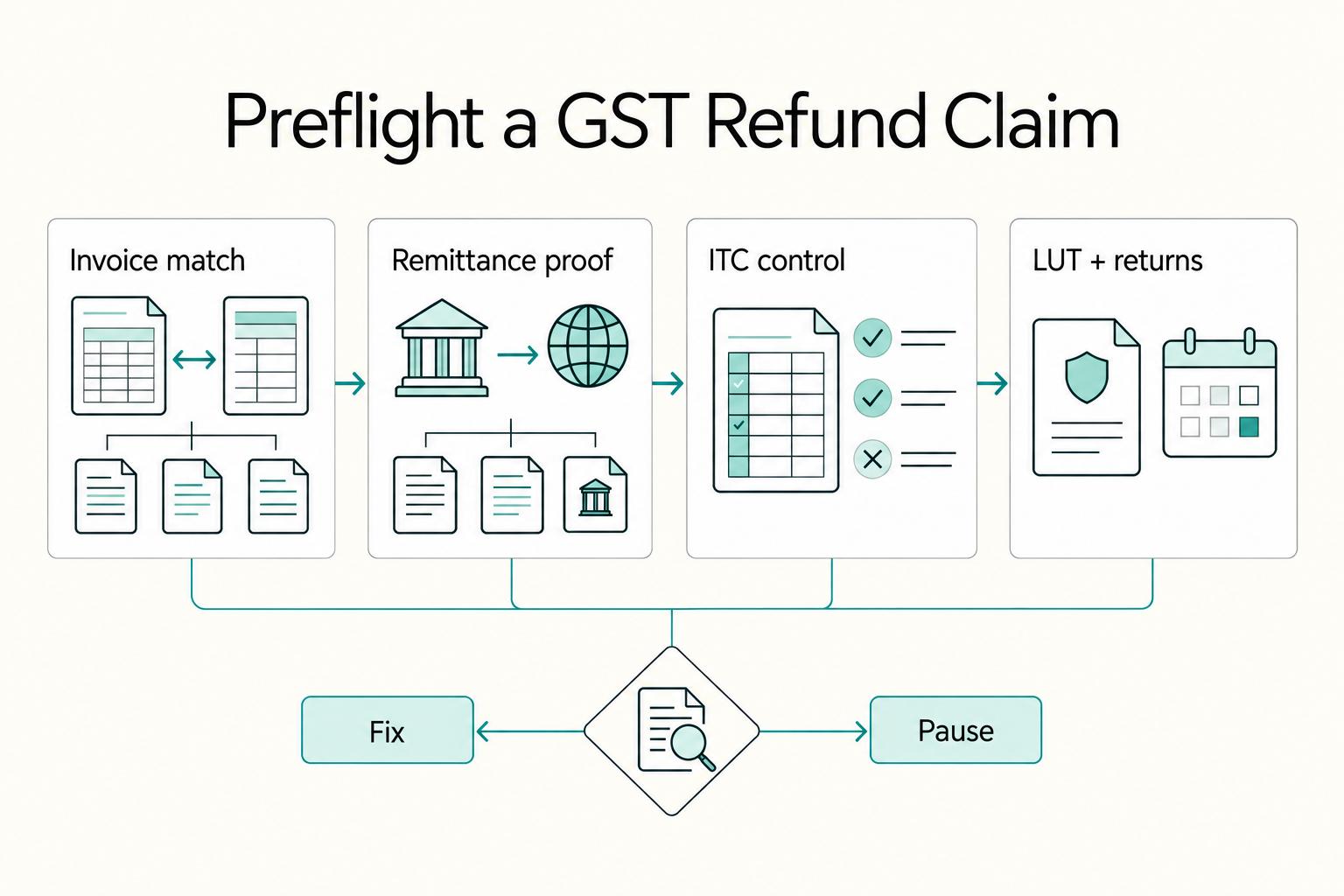
The "Zero-Rejection" Pre-Flight Checklist for Your Refund Claim (Form RFD-01)#
Your best rejection-prevention point is before you submit Form GST RFD-01. Treat this as a strict pass-or-fail review, because portal guidance says no rectification is allowed after filing.
Keep these four guardrails in view:
- Form GST RFD-01 is the GST portal application for this refund claim.
- Relevant date is your Section 54(1) limitation anchor, and the portal will not validate limitation for you.
- Eligible ITC in this route is net ITC for the claim, excluding credits such as those related to capital goods and certain transition ITC entries.
- Confirm the current filing-window rule before you file.
| Check | What to compare | Acceptable evidence | Fix if mismatch |
|---|---|---|---|
| Invoice match | Refund statement vs GSTR-1 Table 6A | Filed GSTR-1 copy, invoice PDFs, refund worksheet | Fix source data before filing |
| Remittance proof | Export-of-services claim data vs FIRC/BRC evidence | FIRC/BRC, bank correspondence, invoice mapping sheet | Get corrected evidence or remove unsupported invoices from claim |
| ITC amount control | Claim amount vs Statement 3A max and electronic credit ledger head-wise balances | Statement 3A, ITC worksheet, credit ledger snapshot | Recompute and reduce claim to permitted amounts |
| LUT and return status | Claim period vs LUT validity, GSTR-1, GSTR-3B filing status | Filed RFD-11, return acknowledgements, filing history | File missing returns or pause until valid |
Match invoice details to GSTR-1 Table 6A#
Compare your refund statement and filed GSTR-1 Table 6A line by line. If any invoice detail does not match, fail this check and fix it before filing.
Pass if every claimed invoice matches Table 6A exactly. Fail if any mismatch appears between the refund statement and filed return data.
Verify FIRC/BRC linkage for each claimed invoice#
For export of services, keep FIRC/BRC evidence from the bank for foreign-exchange receipt and maintain clear mapping to the invoices included in your claim.
Pass if your claimed invoices are supported by clear FIRC/BRC evidence and mapping. Fail if the linkage is unclear or incomplete.
Screen eligible ITC and apply claim caps#
Before filing RFD-01, remove ineligible items for this route, including ITC related to capital goods and certain transition ITC entries. Then confirm your total claim does not exceed the Statement 3A maximum refund amount, and each tax-head claim does not exceed that head's electronic credit ledger balance.
Pass if the eligibility screen is documented and both caps are satisfied. Fail if ineligible credits are included, the total exceeds the Statement 3A max, or any head exceeds ledger balance.
Guidance excerpts also flag uncertainty on GSTR-2A vs GSTR-2B basis in some contexts. Verify current practice before finalising your ITC screen.
Confirm LUT, return filing gates, and limitation responsibility#
Verify your LUT (Form GST RFD-11) was furnished before supply and is valid for the relevant financial-year coverage. Confirm GSTR-1 and GSTR-3B are filed for all relevant periods, including the latest required GSTR-3B, because missing returns can block filing.
Pass if LUT status is valid, required returns are filed, and your limitation check against the relevant date is documented. Fail if there is an LUT validity issue, missing returns, or no defensible limitation record.
If you have mixed invoices, unclear remittance linkage, or disputed ITC eligibility, pause filing and consult a GST professional before submission. You might also find this useful: Place of Supply GST Rules in India for Freelance Service Invoices. Before you file RFD-01, standardize your export invoices so key fields and declarations stay consistent every month: Use the free invoice generator.
What If? Your Troubleshooting Guide for Delayed or Rejected Refunds#
When a refund is delayed or rejected, read each portal status update carefully. Some issues are fixable record-matching problems. If you separate them early, you avoid blind refiling and focus on the next clear action.
Use these checkpoints so you can triage quickly:
- Rejection message: read it carefully before any refile attempt.
- Error report (GST Portal): retrieve it after rejection and compare it with your books and filed returns.
- GSTR-1: outward supply return filed monthly or quarterly; verify export invoices are correctly listed.
- ICEGATE: for export transactions, check status updates using IEC-linked credentials.
| Status you see | What it usually means | What you do now | When to escalate |
|---|---|---|---|
| Rejection message on portal | The portal flagged a mismatch that needs correction | Pause, read the message carefully, retrieve the portal error report, and reconcile against books and filed returns | Escalate if the mismatch is still unclear after reconciliation |
| Pending with no movement | There is no clear correction cue yet | Check for refund status updates, keep dated screenshots, and re-check filing consistency | Escalate if status remains stalled after repeated follow-ups |
| Export invoices not matching GSTR-1 | Export invoice reporting may not align with records | Cross-check invoice details against books and the filed GSTR-1 | Escalate if invoices still do not reconcile after review |
| Unclear portal message | You cannot identify the exact issue from status text alone | Pause and collect exact message text and screenshots before taking any filing action | Escalate if you still cannot isolate the issue from records |
If you receive a rejection message#
- Trigger: The portal shows a rejection/error message.
- Immediate action: Do not resubmit blindly. Read the message carefully, then retrieve the GST portal error report and compare it with your books and filed returns.
- Evidence to gather: Rejection message text or screenshot, GST portal error report, invoice register, filed GSTR-1 extract, and the working papers used for your refund claim. Confirm export invoices are correctly reflected in GSTR-1 whether you file monthly or quarterly.
- Next escalation point: Refile only after the mismatch is clearly identified and corrected. If the issue is still unclear after reconciliation, involve a qualified GST professional.
If status stays pending#
- Trigger: Status remains pending with no clear correction instruction.
- Immediate action: Keep checking for updates in the portal. For export transactions, also review status updates in ICEGATE using IEC-linked credentials.
- Evidence to gather: Dated status screenshots, filed return acknowledgements, invoice list, and your claim working papers so you can quickly show consistency.
- Next escalation point: If there is still no movement after repeated follow-ups, escalate through the official support path or involve a qualified GST professional.
If the claim still shows rejection after corrections#
- Trigger: After reconciliation, the portal still shows a rejected status or unresolved rejection message.
- Immediate action: Treat it as a non-routine case. Map each stated issue in the message or error report to the exact record set.
- Evidence to gather: Rejection message text, GST portal error report, invoice and return records, and your refund working papers.
- Next escalation point: Involve a qualified GST professional before choosing whether to correct and refile or pursue a formal challenge.
For a step-by-step walkthrough, see How to File a GST Return as an Indian Freelancer.
Conclusion: Protect cash and keep records consistent#
Treat this as an operating discipline, not a clean-up exercise. Your role is to protect cash, keep records consistent, and refuse to submit anything that does not reconcile.
-
Make your route decision before invoicing. Treat it as a cash-control choice for that cycle, not an afterthought. Checkpoint: keep your GSTIN identical across invoices, returns, and working papers. It is a 15-digit identifier, so even small format mismatches can create avoidable review friction.
-
Build process discipline into every billing cycle. Issue compliant invoices, capture payment and customer evidence as funds arrive, and keep records current so filing is reconciliation, not reconstruction. If you collect evidence late, it is harder to tie invoices, bank records, and return data together.
-
Run a hard pre-submission check every time. Submit only when invoice data, return data, and your evidence pack tell the same story without manual patchwork. What good looks like: compliant invoicing, evidence captured at receipt, returns reconciled to your books, and a submission-ready file before you hit submit.
-
Pause and escalate when the facts stop being clean. If records are incomplete, treatment is unclear, or portal mismatches persist, get qualified tax help before submission. General guidance is useful, but it is not a substitute for advice tailored to your circumstances. When compliance issues remain unresolved, specialist support is often the safer move.
Keep the routine consistent every cycle. That is how you stay in control of both cash flow and compliance risk, with fewer surprises when it is time to file. We covered this in detail in GST Registration Decisions for Indian Freelancers. If you want help confirming the right payment workflow and controls for your cross-border setup, get a practical coverage check: Talk to Gruv.
Frequently Asked Questions
Which should you choose, LUT or IGST payment?
If you are eligible and want to avoid paying IGST upfront, use the LUT route by filing FORM GST RFD-11 for the financial year. Export of services is zero-rated, so you can either export without IGST and claim refund of unutilized ITC, or export with IGST and claim refund of the tax paid. The article treats LUT as the safer default for cash flow, but says to confirm eligibility and current conditions before filing.
What usually causes refund rejection or delay?
Most delays start with mismatches in invoices, returns, and remittance proof. Common problems are refund statement invoices not matching GSTR-1 Table 6A, missing or weak BRC or FIRC linkage, invalid LUT coverage, missing GSTR-3B, or claim amounts that do not fit Statement 3A or ledger balances. These issues are much easier to fix before filing RFD-01 than after.
How do you actually claim the refund?
If you are exporting without IGST, file LUT in RFD-11 before supply, issue export invoices, collect FIRC or BRC, file GSTR-1 and GSTR-3B, and then submit RFD-01. Only file after the invoice data, remittance proof, and return data all match. The article notes that rectification inside the submitted application is not allowed.
How long does processing take?
Processing time varies by case, so do not rely on a fixed final sanction timeline without current verification. The article notes that a complete application should receive RFD-02 acknowledgment within 15 days. In practice, complete and consistent claims tend to move with fewer interruptions.
What is the deadline for filing?
The refund application must be filed within two years from the relevant date under Section 54(1). Treat that as your responsibility, because the portal does not validate the limitation period for you. Check the timing before you file.
Try a related tool
Researched and edited by the Gruv editorial team. Gruv builds cross-border billing, payouts, and finance-operations software for global businesses.
Sources
Includes 1 external source outside the trusted-domain allowlist.
Educational content only. Not legal, tax, or financial advice.
Related Posts

Digital Nomad Taxes in 2026 With a Defensible Filing Plan
With digital nomad taxes, the first move is not optimization. It is figuring out where you may be taxable, where filings may be required, and what proof supports that position.

Do I Have to Pay State Taxes While Living Abroad as a Digital Nomad?
Living abroad does not end `state income tax` exposure by itself. The first decision is practical: choose a filing position your facts can support, then build records that support the same story all year.
How to File a GST LUT Without Rework
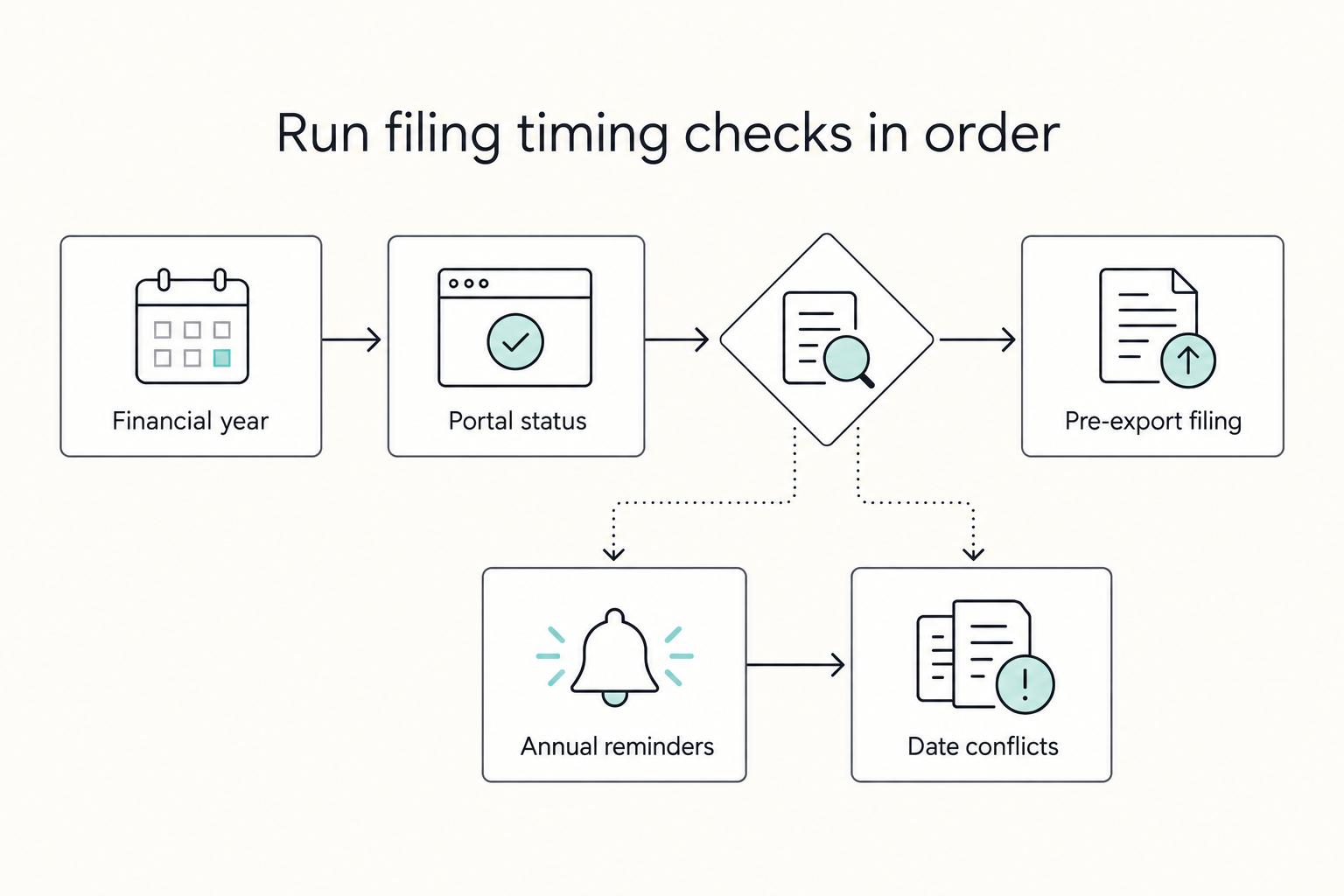
Filing LUT is more straightforward when you lock the sequence before you log in. Set four items first: your tax route, the financial year, who can sign, and where proof will be stored. If any one of those is fuzzy, filing can slow down and invoice treatment can get risky.