
Quick Answer
Choose one niche, test it for 30 days, and keep a backup option ready. For it agency niche selection, start with a three-option shortlist, score each option on client budget quality, sales-cycle friction, retention potential, and delivery repeatability, then run outreach under the same logging rules. Commit only when checkpoint data is mostly verified rather than assumed; if late-stage stalls repeat, switch to the runner-up instead of drifting back to broad positioning.
How to Narrow Your Niche Options#
Start with one focused niche and treat it as a structured test, not a forever identity. This IT agency niche selection guide gives you decision rules and checkpoints for an initial cycle so you can keep or replace your first choice based on evidence.
Broad positioning looks safer, but it usually weakens targeting and pushes you toward price-based comparisons. It also creates proposal-heavy sales work and custom delivery that is harder to repeat. You end up spending time explaining who you are to every prospect instead of proving one clear offer to the right buyers.
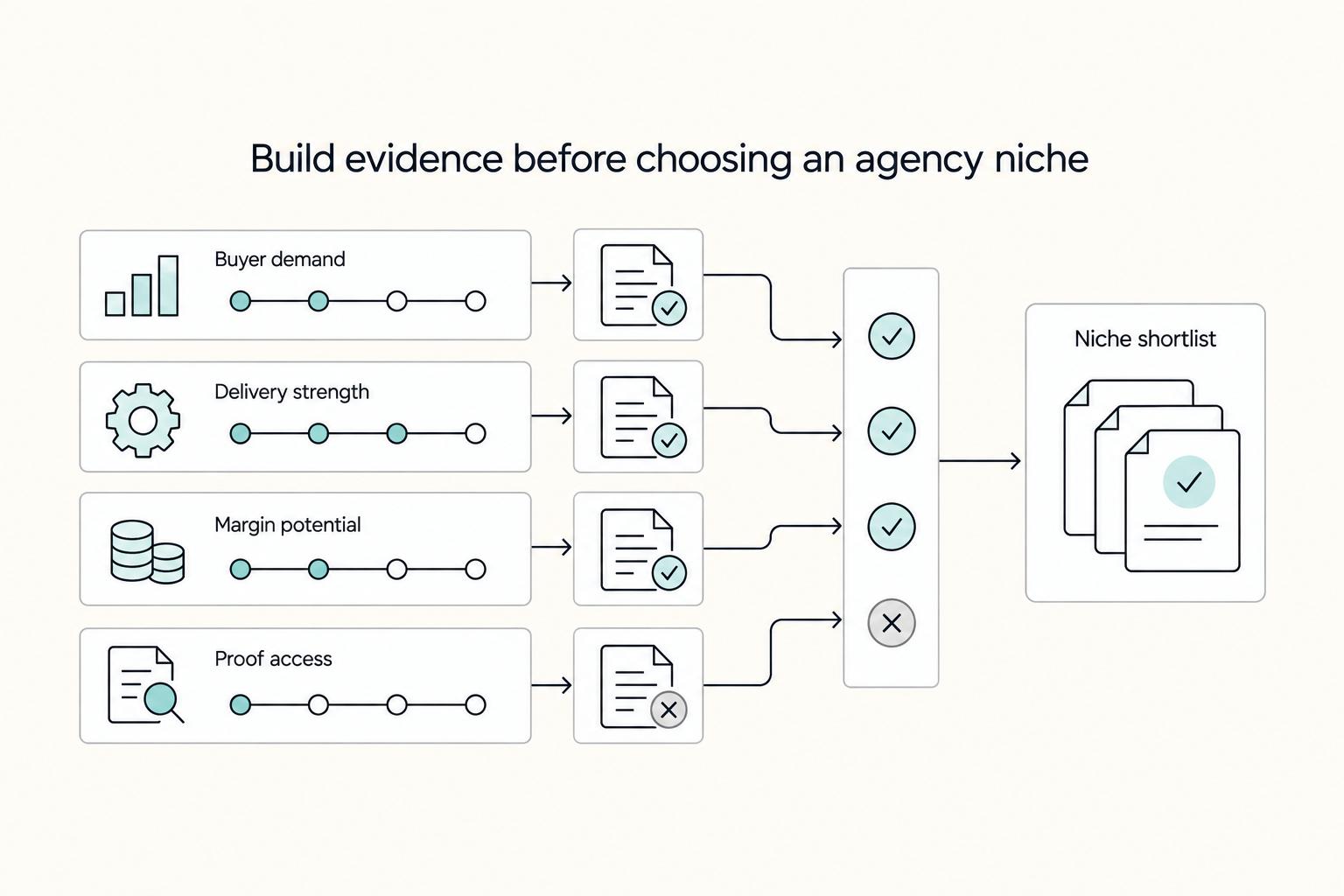
Use this article to build four assets. Keep them in one working document:
- A shortlist method for comparable niche options
- One scoring sheet with consistent criteria
- Clear go/no-go checkpoints before and after outreach
- A copy-paste execution checklist with a fallback option
Read it in order and do the work as you go. The evidence pack supports scoring, scoring supports go/no-go checkpoints, and those checkpoints support your decision point after initial outreach. The target is practical: make a defensible decision you can execute now, then adjust without drifting back to an unfocused generalist position.
What to prepare before you pick a niche#
Build one evidence pack before you compare niche options. Without clear inputs, positioning and outreach can become broad, inefficient, and hard to evaluate.
Create one place for deal evidence from recent work: proposals, call notes, scope drafts, win and loss notes, and any case-study material. If your history is thin, use what you have and label confidence clearly so assumptions do not look like facts. A light data set with clear confidence labels is more useful than a polished sheet that hides uncertainty.
- Compile deal evidence in one sheet. Track outcome status, offer type, buyer segment, budget pattern, and the short reason each deal was lost or stalled.
- Map sales friction. Note where momentum slows, such as first call to scoped follow-up or proposal to sign-off.
- List delivery strengths with proof. Capture repeatable capabilities and implementation steps you can document.
- Set operating constraints before scoring. Define preferred project size, risk tolerance, and near-term cashflow needs.
- Create a baseline KPI view. Use the metrics you already track and mark confidence for each value.
| Input | What to capture now | Confidence |
|---|---|---|
| Segment evidence | Which customer segments respond, buy, or stall | High, Medium, Low |
| Budget pattern | Typical approved ranges by deal type | High, Medium, Low |
| Sales friction | Common blockers in the buying process | High, Medium, Low |
| Delivery proof | Repeatable capabilities and supporting assets | High, Medium, Low |
| KPI baseline | Current trend metrics you already track | High, Medium, Low |
Before you move on, run a quick verification pass on this pack. Check that each row can point to a document, call note, proposal, or post-project note. If you cannot point to evidence, mark that row as assumed and avoid using it as a deciding factor later.
Do this prep before broad outreach, but do not put marketing on hold for long. Delaying too long can cost time and momentum.
Choose between an industry niche and a service niche#
Pick the lane you can prove now. Use an industry niche when your strongest evidence is concentrated in one industry, and use a service niche when your proof is mixed across industries.
An industry lane centers your message on one industry audience. A service lane centers your message on a specific project type or capability across industries. This mirrors the common specialized-versus-broad agency split: who you serve most, and what you specialize in.
| Path | Best starting condition | Main upside | Main risk | Go/no-go checkpoint |
|---|---|---|---|---|
| Industry niche | Proof is concentrated in one industry | Clear relevance for that audience | Opportunity set may be narrower at first | Your strongest examples consistently come from one industry |
| Service niche | Proof is spread across industries | Better fit for targeted projects across different audiences | Positioning can feel generic if scope is too broad | You can define in-scope and out-of-scope work in one sentence |
- Audit proof concentration. Group recent examples by industry and service type, then mark each as strong, partial, or weak.
- Apply one decision rule. If most strong examples cluster in one industry, start industry-first. If proof is mixed, start service-first.
- Check friction in recent deals. If buyers needed heavy education, test a narrower service message first. If shared industry context did more of the work, test the industry path first.
- Run one path for one sprint. Keep positioning stable long enough to compare win and loss signals cleanly.
Use one message line for each path before you choose. If the industry line sounds sharp but your proof rows are mostly assumed, do not force it yet. If the service line sounds broad, tighten the scope sentence until included and excluded work are both clear.
Treat these comparisons as directional rather than universal. The grounding examples come from agency-model discussions, so validate final positioning with evidence from your own market.
Build a shortlist of three niches you can actually win#
Start with a shortlist of up to three options and force head-to-head comparison. This is where focus becomes an operating choice rather than a branding statement.
A tight shortlist helps limit common generalist drift: weak lead quality, lower close rates, higher churn risk, and inconsistent delivery. Specialization only helps when each option is judged on the same criteria with the same evidence window.
| Candidate slot | Why it earns a slot | What must be true before scoring |
|---|---|---|
| Best known | You already understand the buyer and problem | You can show recent proof, not just interest |
| Highest budget | Buyers can fund meaningful scope | Budget fit matches your delivery model |
| Fastest to close | Buying friction is lower | Early conversations move without heavy education |
- Define each candidate in one line. Include buyer type, urgent problem, and specialization.
- Apply hard filters before scoring. Check repeatable demand, realistic client budget, and buyer urgency.
- Set a proof threshold. Keep only options with at least one credible case-study path and a delivery approach you can execute repeatedly.
- Cut execution-risk options early. Remove niches that require capabilities you cannot credibly deliver soon.
- Log every rejection. Record why each option was removed so later pressure does not pull you back to weak-fit choices.
Keep candidate lines structurally identical so your comparison stays fair. A useful format is: buyer type, painful problem, scoped offer, and expected buying friction. If one candidate needs two sentences while the others need one, it is usually underdefined and should be tightened before scoring.
If two candidates tie, keep the one with stronger proof quality. Broad appeal without evidence is harder to validate than a narrower option you can already support.
Score each niche with a weighted decision sheet#
Use one weighted decision sheet across all options so the final choice is auditable, not emotional. For a small team, predictable retention and manageable sales-cycle friction should be weighed alongside market-size narratives.
Build the sheet once, lock weights first, and score all options from the same lookback period. Keep your evidence and your assumptions separate so unknowns do not inflate a niche that only looks good on paper.
- Build one fixed-criteria sheet. Score client budget quality, CAC pressure, expected retention, churn exposure, sales-cycle friction, and delivery repeatability.
- Set weights before scoring. Lock priorities before review so goalposts do not move.
- Add a clear go/no-go line. Write one checkpoint sentence each option must satisfy to remain viable.
- Add confidence for every input. Mark each entry as Verified or Assumed.
| Criterion | What you are scoring | Verification evidence | Confidence | Go/no-go checkpoint |
|---|---|---|---|---|
| Client budget quality | Buyers accept scoped pricing without heavy discount pressure | Proposal outcomes, call budget notes | Verified or Assumed | No-go if budget fit is mostly assumed |
| CAC pressure | Effort and spend to win one client relative to margin | Channel spend logs, pipeline conversion notes | Verified or Assumed | No-go if acquisition effort outweighs margin potential |
| Expected retention | Likelihood of repeat work after first engagement | Renewal history, expansion patterns | Verified or Assumed | No-go if follow-on work remains weak |
| Churn exposure | Risk of early exits or unstable scope | Churn reasons, pause and cancel patterns | Verified or Assumed | No-go if churn risk appears structural |
| Sales-cycle friction | Resistance and delay from first call to signed scope | Stage timestamps, objection logs | Verified or Assumed | No-go if friction repeatedly blocks progress |
| Delivery repeatability | Ability to deliver with consistent scope and outcomes | Delivery checklists, post-project notes | Verified or Assumed | No-go if each deal needs custom reinvention |
Run two hygiene checks before you trust the ranking. First, scan for one criterion that dominates the result only because it has many assumed values. Second, scan for criteria that use different evidence windows across candidates. If either issue is present, clean the sheet and rescore.
When scores are close, rank historical clients by margin and effort, not top-line revenue alone. A high score built on low-confidence inputs is a risk signal, not a winner.
Pressure-test demand, budgets, and sales friction#
Do not commit until one niche proves demand, budget fit, and manageable buying friction under the same test conditions. This step turns your score from a model into real decision evidence.
| Area | How to validate | What to watch |
|---|---|---|
| Demand | Review qualified conversations from SEO intent, outbound response quality, and progression from discovery to scoped follow-up | Separate attention from intent by recording the specific next action each call produced |
| Budgets | Compare quoted scope with what buyers approve, not with verbal interest on calls | Use accepted scope as the budget signal |
| Sales friction | Track where the buying process repeatedly stalls and which objections recur | If two options show similar demand, pick the one with cleaner progression and fewer repeated blockers |
Use one short test window and one shared log template across candidates. Track date, channel, lead-quality note, requested scope, budget response, friction notes, and next action. Keep this log simple enough to update the same day, because delayed notes can lose detail and weaken later decisions.
- Set one value metric and one stop rule per niche. Keep the value metric identical across candidates so one option is not graded on easier criteria.
- Validate demand with three signals. Review qualified conversations from SEO intent, outbound response quality, and progression from discovery to scoped follow-up.
- Validate budgets from accepted scope. Compare quoted scope with what buyers approve, not with verbal interest on calls.
- Document friction and decide. Track where the buying process repeatedly stalls and which objections recur. If two options show similar demand, pick the one with cleaner progression and fewer repeated blockers.
For IT agency niche selection, this section is where many teams overrate activity. A full calendar can hide weak fit if most calls do not convert to scoped next steps. Separate attention from intent by recording the specific next action each call produced.
A common failure mode is activity without movement: many calls, little scoped acceptance. Treat repeated late-stage stalls as decision data, not as a copy problem.
Define a productized service before you scale outreach#
Before you scale outreach, lock one productized service you can deliver the same way each time. Clear boundaries and standardized delivery can make proposals easier to repeat and scope easier to compare.
- Package one core offer with clear boundaries. Define fixed deliverables, explicit exclusions, timeline range, and handoff criteria in one base scope document.
- Set scope guards before proposals go out. State what is included, what is custom, and what triggers a change order after sign-off.
- Standardize delivery checkpoints. Break fulfillment into a short sequence from kickoff to handoff with named owners and verification points.
- Create one proof package per niche. Keep an implementation checklist, relevant case evidence, and expected-outcomes language aligned to the scoped offer.
A quick quality test helps here: hand the scope document to someone not involved in the draft and ask them to mark what is unclear. If they cannot tell where base scope ends and custom work begins, revise before you send another proposal.
Another useful check is proposal variance. If your last few proposals look materially different for the same niche, your offer definition is still loose. Tighten the base package until proposal edits are mostly client context, not core deliverables.
Use How to Create a Productized Service for Your Freelance Business to tighten packaging, pricing logic, and delivery discipline.
Run a 30-day validation sprint with go/no-go checkpoints#
If you want a simple cadence, use a 30-day sprint to test one niche with a measurable plan. A narrow test usually yields clearer evidence than broad outreach across mixed offers.
| Week | Focus | What to do |
|---|---|---|
| Week 1 | Lock the hypothesis and assets | Write one concise hypothesis with customer, outcome, offer, and value metric tied to adoption or willingness to pay; build only the assets needed to test it |
| Week 2 | Run outreach and qualify conversations | Set qualification criteria before launch and apply them consistently |
| Week 3 | Send proposals and log objections | Keep proposal structure stable so results reflect niche fit, not document changes |
| Week 4 | Review outcomes and decide | Compare qualified conversations, proposal progression, and other value-metric signals against your pre-set checkpoints |
Use the same evidence fields each week so trend shifts are easier to read. If your notes become more detailed over time, update older rows too, or week-to-week comparisons can reflect record quality changes instead of market signals.
End the sprint with a short decision memo, even if you are a solo founder: what held up, what failed, and which checkpoint drove the final call. This helps prevent hindsight bias when a future cycle feels uncertain.
Keep one evidence log that combines qualitative and quantitative inputs, including interview notes, analytics, and competitive teardown observations. A single record can make the final go, refine, or pivot decision faster and less subjective.
Set compliance and delivery controls from day one#
Once demand signals look real, lock compliance and delivery controls before scaling. Clear prerequisites can protect scope quality and make your positioning credible from the first proposal.
| Step | Control area | What to record or confirm |
|---|---|---|
| Step 1 | Compliance fit in your ICP | Track industry or NAICS code, company size, geography, and regulatory requirements for each target account; mark unknowns before outreach |
| Step 2 | Proposal prerequisites | State account-level control expectations tied to those requirements, along with ownership and escalation paths |
| Step 3 | Documentation trail at kickoff | Start with a client onboarding checklist, scope acceptance record, and delivery sign-off trail; add a data inventory log |
| Step 4 | Operational ownership | Record who owns invoicing, approvals, and final sign-off; if ownership is unclear, delay the start date |
- Step 1. Define compliance fit in your ICP. Track industry or NAICS code, company size, geography, and regulatory requirements for each target account. Mark unknowns before outreach.
- Step 2. Translate ICP criteria into proposal prerequisites. State account-level control expectations tied to those requirements, along with ownership and escalation paths.
- Step 3. Build a documentation trail at kickoff. Start with a client onboarding checklist, scope acceptance record, and delivery sign-off trail. Add a data inventory log and follow a step-by-step creation workflow so records stay consistent.
- Step 4. Clarify operational ownership before kickoff. Record who owns invoicing, approvals, and final sign-off. If ownership is unclear, delay the start date.
The goal is not paperwork for its own sake. The goal is to reduce avoidable disputes later. When these controls are written early, scope decisions and incident handling can be easier to resolve because ownership and boundaries were set before delivery pressure increased.
Run one pre-kickoff check before work starts. Confirm each required record exists, confirm account-level unknowns are documented, and confirm the proposal language matches onboarding language. Mismatched wording can create rework.
For adjacent planning, point clients or contractors to The Best Tax Software for US Expats. Keep one case study per niche that shows both outcome and control discipline from onboarding to handoff.
How narrow is too narrow for a new IT outsourcing agency?#
Too narrow can mean pipeline fragility. Too broad can create commodity pressure. The right scope is narrow enough to show clear specialization and wide enough to sustain qualified demand.
- Step 1. Run a one-sentence niche test. Name buyer type, primary pain, and productized service in one line.
- Step 2. Check prospecting clarity. Narrowing should make it easier to identify who to approach.
- Step 3. Pressure-test competitive position. If most conversations collapse into comparison with entrenched specialists, refine your angle or adjust scope.
- Step 4. Treat case stories as directional. Use outside wins as ideas to test, not as proof your market will respond the same way.
- Step 5. Keep one adjacent lane ready. Define a nearby expansion option that keeps your core offer intact.
Use your evidence pack to answer one practical question: can this scope support consistent conversations, proposals, and repeatable delivery at the same time? If one of those three stays weak, the scope likely needs adjustment.
A useful contrast is this. If your statement attracts attention but budget approval is unstable, you may be too broad on buyer pain. If your statement is clear but account volume is thin, you may be too narrow for your current stage. Adjust one variable at a time so the next test remains interpretable.
If your current statement cannot survive this test, tighten before scaling outreach.
Common mistakes and recovery moves#
Most misses come from two patterns: repeating outside narratives without proving fit in your own client world, and treating a broad audience like a niche.
-
Mistake: borrowing claims you have not validated in your own context. Treat outside templates and case stories as hypotheses, then test them against what you are actually hearing from prospects and clients.
-
Mistake: ignoring one-and-done work signals. When projects do not repeat and ROI remains hard to show, your niche or offer is still too loose.
-
Mistake: calling a broad market a niche. A niche should be a very specific audience group; otherwise the offer stays diffuse instead of focused.
-
Recovery move: narrow the audience and tighten the offer. Recommit to a specific group and refine the offer so it is easier to deliver consistently.
-
Recovery move: build a point-of-view bank. Capture a few clear opinions, proof points, and memorable lines your team can repeat, then use them consistently over time.
When you run a reset, keep changes specific and trackable. Update your audience definition and core proof points together, then check whether quote quality and client understanding improve over time.
Avoid the opposite failure mode too: endless tinkering without a decision. If evidence still shows one-and-done work and weak ROI clarity, treat that as a signal to refine your niche again.
Your next step and copy-paste checklist#
Lock one decision with evidence, not momentum. Use this checklist to choose a lane, keep uncertainty visible, and avoid drifting back to broad positioning.
- Define your candidate niches with one-line positioning. State buyer type, painful problem, and offer for each option.
- Run viability gates before scoring. Use Keystone and General questions. All Keystone items must pass, and General items need at least a 70% pass rate.
- Fill one weighted score sheet from evidence. Use pain severity, market expansion signals, and financial-model inputs (revenue and cost projections, cash flow analysis, and KPIs) with confidence labels.
- Pick one niche for the next cycle. If scores are close, choose the option with stronger pain-fit evidence and note what is still uncertain.
- Finalize one productized service hypothesis. Document included scope, exclusions, timeline, and change-order triggers, then attach proof assets.
- Run a validation cycle with explicit checkpoints. Track wins, losses, objections, budget acceptance, and delivery friction in one evidence log.
- Carry one clear lane into the next cycle. Keep outreach tied to the same buyer, pain, and offer so learning stays clean.
Treat this checklist as a working document, not a one-time exercise. Update it as evidence improves, then make one explicit decision at the end of each cycle: commit, refine, or pivot.
If you are unsure where to start tomorrow, start with Step 1 and Step 2 on the same day. A clear shortlist plus viability gates can create a faster path to better outreach and cleaner decisions.
Frequently Asked Questions
How do I choose an IT outsourcing niche step by step?
There is no proven universal formula, but a practical start is to pick one sub niche and test fit before expanding. Use three checks: you understand the buyer business model, you can deliver clear value, and demand appears consistent. Then review early calls and proposals to see whether work repeats or stays one-off. Keep the first test narrow and log what is verified versus assumed. If repeat demand still looks weak after that test, move to a backup niche and retest.
What criteria matter most when selecting an IT agency niche?
Prioritize practical fit over hype: business-model understanding, clear client value, and consistent demand. Add a risk check for one-off work where ROI is hard to make tangible after delivery. A specific niche can simplify marketing and fulfillment compared with trying to serve everyone at once. Treat differentiation as the result of these checks, not just a starting claim.
How do I compare two niches objectively without guessing?
Use one shared scorecard with the same criteria for both options: business-model fit, value clarity, demand consistency, and risk of one-off work with unclear ROI. Compare both niches over the same evidence window from your own calls and proposals. If one option is mostly assumptions and the other has stronger verified signals, choose the verified option and keep testing the runner-up.
Industry niche or service niche for IT outsourcing first?
Choose the direction where your current evidence is stronger. If signals are clearer around one buyer type, start with that industry focus. If signals are clearer around one repeatable offer across sectors, start with a service focus. Keep one clear lane during the test. Avoid running both lanes in the same short test when possible; mixed positioning can make win/loss signals harder to interpret.
How do I validate a niche before fully committing?
Set a defined validation window and require evidence before full commitment. Review call notes and proposal outcomes for signs of consistent demand and repeatable work. If scope must be rebuilt each time or demand stays inconsistent, keep testing or pivot. When the window ends, decide based on evidence quality rather than calendar pressure. If key checkpoints are still assumptions, extend testing with a tighter message.
What are the signs I picked the wrong niche?
Recurring one-off projects and weak repeat demand are warning signs. Another is buyers repeatedly struggling to see tangible ROI after delivery. If those patterns continue across multiple deals, your current niche may not be the right fit yet.
What should my first niche checklist include?
Include a clear niche definition (specific buyer type, not a generalist label), your value statement, and a demand-consistency check. Track whether projects look repeatable or one-off and whether ROI is clear to buyers. Add a simple verified-versus-assumed column so reviews stay grounded in real evidence.
Try a related tool
Researched and edited by the Gruv editorial team. Gruv builds cross-border billing, payouts, and finance-operations software for global businesses.
Sources
Includes 2 external sources outside the trusted-domain allowlist.
Educational content only. Not legal, tax, or financial advice.
Related Posts

How to Create a Productized Service for Your Freelance Business
If your recent client work produces similar results from similar inputs, you may be ready to turn it into a defined offer. The shift is operational, not cosmetic. You are deciding what you sell, what the client gets, what it costs, and how delivery happens, instead of rebuilding every job from scratch.
The Best Tax Software for US Expats
Pick by filing complexity, not brand familiarity. For many U.S. citizens living overseas, the right choice is the one that matches your form load, filing history, and tolerance for correction risk with the Internal Revenue Service (IRS).
What is Two-Factor Authentication (2FA) and Why You Need It
Two-Factor Authentication (2FA) is a practical way to reduce avoidable account risk. It adds a second identity check, so a stolen password is less likely to lead to unauthorized access to billing, payouts, or client delivery.