
Quick Answer
Start by drafting a one-page trustee brief, then test candidates against that brief before choosing anyone. For how to choose a trustee, verify who owns filings and beneficiary communication workflows, not just who feels trustworthy. A reliable finalist should explain delegation, supervision, and successor mechanics in writing, including whether Form 1041 timing (April 15 for a Dec. 31 year-end filer) is covered by a clear calendar process.
Choosing Your Trustee: A Strategic Guide for the Global Portfolio#
If you want a practical answer to how to choose a trustee, treat it as a fiduciary hiring decision, not a relationship decision. Start with the job itself, then compare candidates on capability, conflict controls, continuity, and the real administrative load they will carry. The main mistake is choosing a person first and then trying to shape the job around them. In trust administration, that usually reverses the risk analysis and leaves important work unassigned.
Step 1. Define the job before you compare candidates#
Start by writing the role before you look at people or institutions. A trustee role is fiduciary in nature, and a common statutory baseline is to act for beneficiaries' interests and administer the trust with care, skill, and caution. Exact standards are jurisdiction-specific.
| Filing item | What to ask | Timing or trigger |
|---|---|---|
| Form 1041 | Ask candidates to explain Form 1041 timing | 15th day of the fourth month after tax year close |
| FBAR review | Ask when FBAR review may be triggered for a U.S. trust or estate | Foreign accounts over $10,000 aggregate at any point in the year |
| Form 3520 or 3520-A | Ask how they handle potential Form 3520 or 3520-A work where relevant | Do not assume those forms apply without fact-specific tax advice |
Create a one-page brief that lists your asset types, jurisdictions, beneficiary locations, and likely reporting touchpoints. Keep it practical. A useful brief should let a candidate understand what they would actually be taking on. That includes liquid accounts or concentrated holdings, simple periodic distributions or judgment-heavy decisions, one governing law or several places where advisers or beneficiaries sit, and whether regular communications need to be planned rather than improvised.
If U.S. filings may be in scope, ask candidates to explain Form 1041 timing, which is the 15th day of the fourth month after tax year close. Also ask when FBAR review may be triggered for a U.S. trust or estate, which is foreign accounts over $10,000 aggregate at any point in the year, and how they handle potential Form 3520 or 3520-A work where relevant. Do not assume those forms apply without fact-specific tax advice.
A good one-page brief also helps you separate administration from investment and tax work. The trustee may not do every technical task personally, but the trustee still needs a clear process for assigning, supervising, and checking those tasks. That is what you are testing. If a candidate responds to your brief with only broad reassurance, ask them to translate that reassurance into a workflow. Who owns the calendar? Who collects records? Who reviews draft filings? Who communicates with beneficiaries when something slips or changes?
If you cannot produce that one-page brief yet, you are not ready to compare candidates. Without it, you are likely comparing personalities, fee impressions, or brand names instead of actual fit.
Step 2. Compare trustee models against your actual risk#
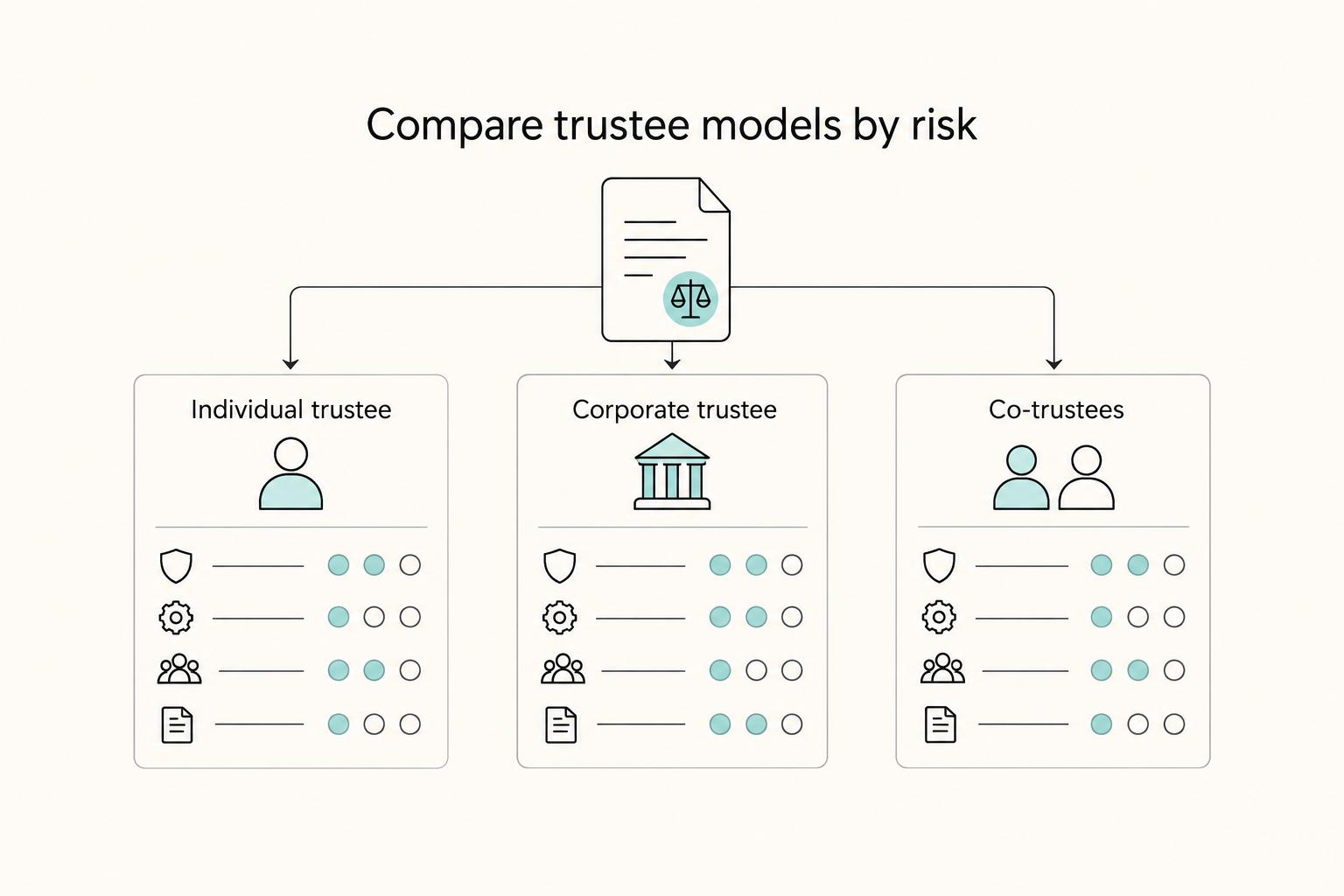
Once the role is clear, compare trustee structures against the risks you actually have. Use this table as a filter, not a ranking. Read across each row and decide which risks you are willing to carry personally and which need professional administration.
| Trustee model | Capability fit | Conflict risk | Continuity risk | Operational burden on you/family | When to choose |
|---|---|---|---|---|---|
| Individual trustee | Can fit better when administration is simpler | Can be higher, especially with overlapping family or beneficiary interests | Can be higher if one person cannot continue | Often lower at first, but can rise if outside experts are added ad hoc | When the trust is straightforward and the person has time, judgment, and willingness to use advisers |
| Corporate trustee | Often a strong fit for formal administration, records, reporting, and controls | Personal conflict risk is often lower, but incentives and vendor relationships still need review | Often lower because the institution can persist through staff turnover | More formal process and fee structure | When you need process discipline, continuity, and documented oversight |
| Co-trustees or split roles | Can be useful when you want personal context plus professional administration | Manageable only if authority lines are explicit | Can be better than single-person dependency, but deadlock design is critical | Highest coordination and drafting burden | When family context matters but compliance and governance still need a professional lane |
When you use the table, focus on the failure mode behind each column. Capability fit is really about whether the trustee can administer this trust without building the process from scratch after appointment. Conflict risk is about whether the person making discretionary decisions is also entangled in family expectations, beneficiary disputes, or personal interests. Continuity risk asks what happens if the acting decision-maker becomes unavailable. Operational burden asks who will be chasing documents, answering beneficiary questions, and coordinating advisers when something urgent comes up.
That last point matters more than many families expect. A structure that looks simpler on paper can push hidden work onto a spouse, adult child, or outside adviser who was never formally given the job. An individual trustee with cross-border assets may seem efficient at first. That can change quickly during the first year-end reporting cycle, the first beneficiary request, or the first time local counsel, tax advisers, and custodians need to be aligned on timing and authority.
Red flag: if your trust has cross-border reporting, multiple advisers, or regular beneficiary communications, choosing only on personal familiarity can push operational risk onto the wrong person.
Step 3. Interview the shortlist like a fiduciary hire#
At this stage, consistency matters more than charm. Use one checklist for every candidate and press for process answers, not general confidence. Your goal is not to hear that they are experienced. Your goal is to understand how they run administration when facts are messy, timing is tight, or two advisers disagree.
| Interview area | What to ask | What to request or confirm |
|---|---|---|
| Jurisdiction handling | Which jurisdictions match my profile; which local counsel, tax, and custody partners do you use there; directed trust availability in my governing-law jurisdiction | Current requirements pending legal/source-record verification |
| Reporting process | How do you keep qualified beneficiaries reasonably informed; who prepares trust accounting, and on what cadence; who owns Form 1041, potential FBAR review, and potential Form 3520 or 3520-A review if relevant | Filing calendar, including April 15 for a Dec. 31 year-end Form 1041 filer |
| Fee transparency | Provide your written fee schedule; if the trust instrument is silent on compensation, how do you determine reasonableness | Redacted sample invoice |
| Delegation policy | Which tasks do you delegate, to whom, and how do you supervise; how do you document agent selection and oversight | If you are a national bank, explain pre-acceptance review (12 CFR 9.6), recordkeeping (12 CFR 9.8), and annual fiduciary audit process (12 CFR 9.9) |
| Succession readiness | What happens if the lead relationship manager leaves; for co-trustees, how are disagreements resolved | Governing-law rule on majority action versus unanimity, pending legal/source-record verification |
-
Jurisdiction handling
-
Which jurisdictions have you administered trusts in that match my profile? - Which local counsel, tax, and custody partners do you use there? - Is a directed trust available in my governing-law jurisdiction, and which current requirements should legal counsel verify from official source records before use?
-
Reporting process
-
How do you keep qualified beneficiaries reasonably informed where governing law requires it? - Who prepares trust accounting, and on what cadence? - If U.S. filings are relevant, who owns Form 1041, potential FBAR review, and potential Form 3520 or 3520-A review? - Walk me through your filing calendar, including April 15 for a Dec. 31 year-end Form 1041 filer.
-
Fee transparency
-
Provide your written fee schedule (acceptance, annual administration, investment-related, special-asset charges). - If the trust instrument is silent on compensation, how do you determine reasonableness? - Show a redacted sample invoice.
-
Delegation policy
-
Which tasks do you delegate, to whom, and how do you supervise? - How do you document agent selection and oversight? - If you are a national bank, explain your pre-acceptance review (12 CFR 9.6), recordkeeping (12 CFR 9.8), and annual fiduciary audit process (12 CFR 9.9).
-
Succession readiness
-
What happens if the lead relationship manager leaves? - For co-trustees, how are disagreements resolved? - Which governing-law rule on majority action versus unanimity should legal counsel verify from official source records before use?
Ask follow-up questions that force specificity. If a candidate says they handle international assets regularly, ask what the first 60 days of acceptance look like. If they say they keep beneficiaries informed, ask what they send, how often they send it, and who answers questions when a beneficiary disputes a valuation or distribution decision. If they say they supervise outside advisers, ask what evidence of that supervision is retained in the file.
The sample invoice request is particularly useful because it reveals how the relationship works after onboarding. Look for billing categories that are understandable and for extraordinary work that is clearly separated from routine work. You also want to see whether the trust is likely to be surprised by charges that were not obvious from the fee schedule alone. A redacted administration calendar can be just as valuable. It shows whether the candidate thinks in deadlines, dependencies, and handoffs rather than broad promises.
Ask for the actual acceptance checklist, not just marketing materials. If a candidate cannot explain conflict screening clearly, treat that as a serious warning. If a candidate cannot tell you who owns the reporting calendar, that is also a warning. Someone will own it in practice. You want to know who before appointment, not after a missed deadline.
Step 4. Put control points in the right document#
Choosing the trustee model is only half the decision. The real control comes from putting authority, replacement mechanics, and intent in the right places. Put binding authority and decision mechanics in the trust document, and put context and preferences in advisory instructions.
| Topic | Trust document | Advisory instructions or letter of wishes |
|---|---|---|
| Legal effect | Binding | Non-binding unless governing law says otherwise |
| Appointment and replacement | Initial trustee appointment, successor priority order, and vacancy-filling mechanics if no trustee remains | Context and preferences, not binding authority |
| Decision mechanics | Co-trustee structure, deadlock mechanics, role-specific powers, and any power-to-direct language where available under governing law | Preference guidance, not binding powers |
| Family and distribution guidance | Authority should be clear on paper | Distribution philosophy, beneficiary context, family sensitivities, education priorities, and preference guidance |
- Trust document (binding): initial trustee appointment, successor priority order, co-trustee structure, deadlock mechanics, role-specific powers, any power-to-direct language where available under governing law, and vacancy-filling mechanics if no trustee remains.
- Advisory instructions or letter of wishes (non-binding unless governing law says otherwise): distribution philosophy, beneficiary context, family sensitivities, education priorities, and preference guidance.
This is where many avoidable administration problems begin or end. If the trust document says too little, the trustee has to reconstruct your intent from emails, conversations, and family pressure. If the advisory instructions try to do the work of the trust instrument, the people administering the trust may have context but no clear authority. That is why the line between binding powers and non-binding guidance matters so much.
Use directed or co-trustee structures carefully. Availability and limits are jurisdiction-specific, and a letter of wishes should not be treated as binding without governing-law confirmation. If you want more setup context before drafting, read A Guide to Setting Up a Trust for Asset Protection.
When reviewing the draft documents, test them from an administration point of view, not just a drafting point of view. For example, if one person controls distributions and another controls investments, ask how information flows between them. Ask what happens if one does not respond, and whether a third party could tell from the document who has final authority on a disputed issue. If there are co-trustees, look for where deadlock is resolved, not just whether deadlock is mentioned. If there is a successor trustee, check whether the path from vacancy to replacement is operationally clear or whether it depends on informal family agreement.
Final test: a neutral third party should be able to read your documents and identify who decides, who reports, who replaces whom, and how deadlocks are resolved. If that is unclear on paper, it will be harder in administration.
If you want a deeper dive, read A Guide to Estate Planning for Digital Nomads.
Before you shortlist trustees, map your country ties and movement patterns so adviser discussions on residency risk start from clean inputs: Use the Tax Residency Tracker.
Conclusion: Appointing Your Trustee Is Your Ultimate Act of Control#
The core point is simple: choose your trustee as a governance decision. Define the role, verify candidate fit, and document the controls before you sign.
Step 1: Define the role. Write a short trustee brief based on this trust, not personal comfort. List the assets, likely distribution decisions, beneficiary communication needs, and reporting workload. If assets, beneficiaries, or trustees cross jurisdictions, confirm governing-law alignment before appointment, because fiduciary and trust powers can vary by jurisdiction. A useful brief should be detailed enough that two candidates reading it would understand the same job.
Step 2: Verify the candidates. Build a real shortlist and review it with your lawyer and tax adviser. Ask each finalist to confirm in writing that they can administer the trust under its terms, act in beneficiaries' interests, and handle required communication and periodic reporting. Treat unclear answers on reporting, availability, or cross-border coordination as a stop sign. The clearest verification tool is consistency: same facts, same questions, same document requests, and then compare how clearly each candidate answers.
Step 3: Document the controls. In the trust document, name the acting trustee, include at least one successor trustee, and set clear replacement, deadlock, and oversight instructions. Set the reporting workflow before acceptance. If U.S.-person foreign-trust or foreign-account reporting could apply, assign who tracks Form 3520, Form 3520-A, and FBAR timing, including the $10,000 FBAR threshold. If you are using co-trustees, make sure the administration path is clear enough that advisers and beneficiaries do not have to guess where authority sits.
Use this final decision prompt before appointment:
- Is the role clearly defined?
- Is the selected trustee actually verified for this trust?
- Are successor and oversight instructions clear enough for a third party to execute?
If any answer is no, pause and fix it. If all are yes, finalize your shortlist, schedule adviser sign-off, and execute the appointment. For related planning context, see A Guide to Superannuation for Australian Freelancers. If your plan needs compliant, traceable cross-border money operations after trust setup, review the implementation surfaces first: Read the Gruv docs.
Frequently Asked Questions
Can a trustee live in a different country than the beneficiaries?
Potentially, but treat a nonresident appointment as a legal and reporting decision, not a convenience choice. Before you appoint, confirm the reporting workflow and adviser coordination for the jurisdictions involved. If California could be in scope, confirm whether nonresident trustees or non-contingent beneficiaries require Schedule G on Form 541 and whether payments of income to a nonresident could trigger withholding handled through Form 592 and Form 592-B.
What are the typical fees for a corporate trustee?
Verify fees line by line, not from memory or marketing summaries. Ask for the written schedule, any minimums, extra-service charges, and a redacted invoice so you can see what is actually billed. Before signing, confirm each component, especially acceptance, annual administration, investment-related charges, and special-asset or extraordinary-service fees. Compare the schedule against the trust you actually have, because separate handling charges or frequent discretionary decisions can move work outside ordinary administration. | Fee item to verify | What you should ask for | | --- | --- | | Acceptance or onboarding fee | Written amount, when charged, and whether waived above certain asset levels | | Annual administration fee | Billing basis, any asset tiers, and account minimum | | Investment-related charges | Whether investment management is included or billed separately | | Special-asset handling | Charges for real estate, private company interests, or closely held assets | | Extraordinary services | Hourly or fixed charges for tax work, litigation support, or unusual distributions |
How do you vet a corporate trustee for international assets?
Use a checklist, but treat detailed service-model standards as verification-required. Confirm in writing who is responsible for administration, tax coordination, and exception handling, and have your legal and tax advisers review that plan before appointment.
What is the difference between a trustee and an executor?
They are different roles with different documents. A trustee manages trust property as a fiduciary under the trust, while an executor administers an estate. Map each asset to its path so you choose trustee capacity for assets staying in trust and executor capacity for assets passing through the estate, especially if the same candidate may act in both roles at different times.
Can you have two trustees for one trust?
It may be possible if the trust document and applicable law allow it. There is nothing to suggest co-trustee structures are required or inherently better. If you use co-trustees, write decision rights, reporting lines, deadlock mechanics, and replacement mechanics clearly enough that advisers, custodians, beneficiaries, and a neutral reader can see who decides what.
Is there a filing checkpoint I should confirm before appointing any trustee?
Yes. If California is relevant, confirm whether the trust hits filing triggers such as over $10,000 gross income or over $100 net income, and whether trustee or beneficiary residency affects the filing path. Ask your tax adviser to confirm whether Form 541 is required, whether Schedule G applies for nonresident trustees or non-contingent beneficiaries, whether payments of income to a nonresident could trigger withholding through Form 592 and Form 592-B, and whether an 18-month prompt-audit request, instead of the normal four years after filing, should be part of your process.
Try a related tool
Researched and edited by the Gruv editorial team. Gruv builds cross-border billing, payouts, and finance-operations software for global businesses.
Sources
- ecfr.gov/current/title-12/chapter-I/part-9trusted
- ecfr.gov/current/title-12/chapter-I/part-9/subject-gr...trusted
- ftb.ca.gov/file/personal/filing-situations/estates-and-...trusted
- ftb.ca.gov/file/personal/filing-situations/estates-and-...trusted
- irs.gov/businesses/small-businesses-self-employed/re...trusted
- irs.gov/forms-pubs/about-form-3520trusted
- legislature.maine.gov/statutes/18-B/title18-Bsec813.htmltrusted
- malegislature.gov/Laws/GeneralLaws/PartII/TitleII/Chapter203E/...trusted
Educational content only. Not legal, tax, or financial advice.
Related Posts
When a Trust for Asset Protection Makes Sense for Your Business
Use a trust only after your core liability setup is solid. A trust for asset protection is an escalation layer, not a substitute for entity separation, insurance, or clean operations.
Estate Planning for Digital Nomads: Legal Intent and Cashflow Continuity
Treat estate planning for digital nomads as a two-part continuity system: legal intent plus operational execution, so your business keeps moving when you cannot. The common trap is thinking, "I have a will, so I'm covered." If you run a business-of-one, cashflow, logins, and process often live in your head until you deliberately externalize them.

A Guide to Superannuation for Australian Freelancers
**Treat superannuation for freelancers australia as a repeatable operating decision, not a guess you make under invoice pressure.** As the CEO of a business-of-one, your job is to turn fuzzy compliance questions into a simple system you can run on demand. Freelance income moves, contract terms shift, and one wrong super call can squeeze cashflow or create a compliance problem you only notice later.