
Quick Answer
Use a four-step sequence for how to choose a freelance niche: shortlist buyer-problem-deliverable options, score them on fit, demand, budget quality, competition pressure, and operational risk, run a seven-day demand log, then execute one reversible 30-day pilot. Set pass/fail criteria before reviewing results so bias stays in check. If a niche draws interest but shows weak scope stability or poor payment follow-through, narrow it or pivot instead of expanding outreach.
How to choose a freelance niche without painting yourself into a corner#
Choosing a freelance niche is a decision about repeatable demand and repeatable delivery, not just personal interest. Passion helps you stay consistent, but durability comes from clear positioning and work you can execute without constant reinvention.
Some freelancers start with uneven income and broad positioning, then report better-fit clients after tightening their offer. Treat that as directional evidence, not a guarantee. Specializing can improve your odds when demand, pricing, and day-to-day execution all hold up.
Use this sequence to move from ideas to a real decision:
- Shortlist options. Write a small set of niche options as clear buyer-problem-deliverable statements so each one is immediately understandable.
- Score before you commit. Use one simple scorecard to compare options, and set pass criteria before you review results.
- Test in the market. Pressure-test your top options through real conversations and proposals, then look for repeatable demand for a specific outcome.
- Commit, then review. Pick one primary direction, run it with discipline, and review against evidence so you can commit, narrow, or pivot intentionally.
This sequence matters because niche decisions often break down when you skip steps. If you start with tactics before positioning, your outreach gets noisy. If you start with identity before proof, your offers drift. If you start with pricing before scope, your margins get squeezed by revisions and hidden effort. A useful niche is not the one that sounds best in theory. It is the one that survives contact with real buyers and real delivery constraints.
Keep this choice grounded in business strategy instead of identity. Focused specialization has been linked to strong outcomes in real cases, including a specialization path tied to an acquisition in 2024. The point is not to copy that result. It is to choose a niche that performs now and still gives you room to adjust as your work matures.
If you want a deeper dive, read How to Create a Productized Service for Your Freelance Business.
What to prepare before you start#
Before you start outreach, build a compact evidence pack. Early on, a common pattern is too many topics, too many tactics, and no clear focus.
Assume your first choice can evolve. You can change direction later, but your initial option still needs a clear throughline. Multiple niches can work when they share a core service. Unrelated offers can weaken positioning and make execution harder.
- Collect raw work evidence in one place. List recent projects, outcomes, industries, and repeat requests. Tag each item by buyer type, problem, and deliverable so recurring patterns are obvious.
- Define your common thread and cut noise. Keep options that connect to the same core service, and flag ideas that feel unrelated. If everything is disconnected, you are still too broad.
- Draft a clear offer shape for each top option. Write a plain-language version of what you deliver, for whom, and what outcome it targets. If useful, pair this with your pricing baseline in How to Calculate Your Billable Rate as a Freelancer.
- Set decision signals before testing. Decide what evidence would make you keep, narrow, or change direction, and track it consistently so you are not deciding by mood.
Build the pack so someone else could audit your logic. Include wins, stalled proposals, client objections, and common scope requests. Keep short notes on where effort expanded unexpectedly. Add a plain sentence for why each candidate niche may work and one sentence for why it may fail. That contrast can clarify your thinking faster than another long brainstorm doc.
This prep work protects you from the do-everything trap. When you test every client-getting tactic at once, execution quality drops and signal gets noisy. Preparation does not need to be heavy, but it does need to be structured enough for you to see what is repeating and what is random.
Define your niche in concrete terms#
A useful niche is a one-sentence offer a client can buy, not just a broad topic label. If a buyer cannot quickly tell what you do, for whom, and why it matters, the niche is probably too vague.
| Positioning path | What it means |
|---|---|
| Horizontal niching | One type of work for many client types |
| Vertical niching | Serving one client type across multiple deliverables |
| Generalist positioning | Broader across project types |
Specificity helps you focus, sharpen your skills, and make it easier for the right client to choose you over a generalist.
- Separate broad labels from client-facing offers. Industry terms provide context, but they are not a complete niche. Your niche statement should describe a specific offer a client can recognize.
- Write each option as one clear sentence. Include buyer type, business problem, and deliverable. If the sentence needs extra explanation, tighten it.
- Choose your positioning path on purpose. Horizontal niching means one type of work for many client types. Vertical niching means serving one client type across multiple deliverables. Generalist positioning stays broader across project types.
- Use a reject rule. If an option cannot be explained in one sentence a client can understand, cut it and move forward with a clearer one.
A practical check is to read your sentence out loud. If it sounds like a resume line, it may be too broad. If it sounds like a result a buyer could request now, it is likely closer. Another check is handoff clarity: if someone else could use your sentence to describe your offer in a referral, your niche language is doing real work.
You can also pressure-test it from the buyer side. Ask: could a client say yes to this without needing several clarifying questions? If not, tighten the sentence. A precise niche statement makes targeting and messaging easier because it helps define your ideal customer.
Build a five-factor scorecard and make the tradeoffs explicit#
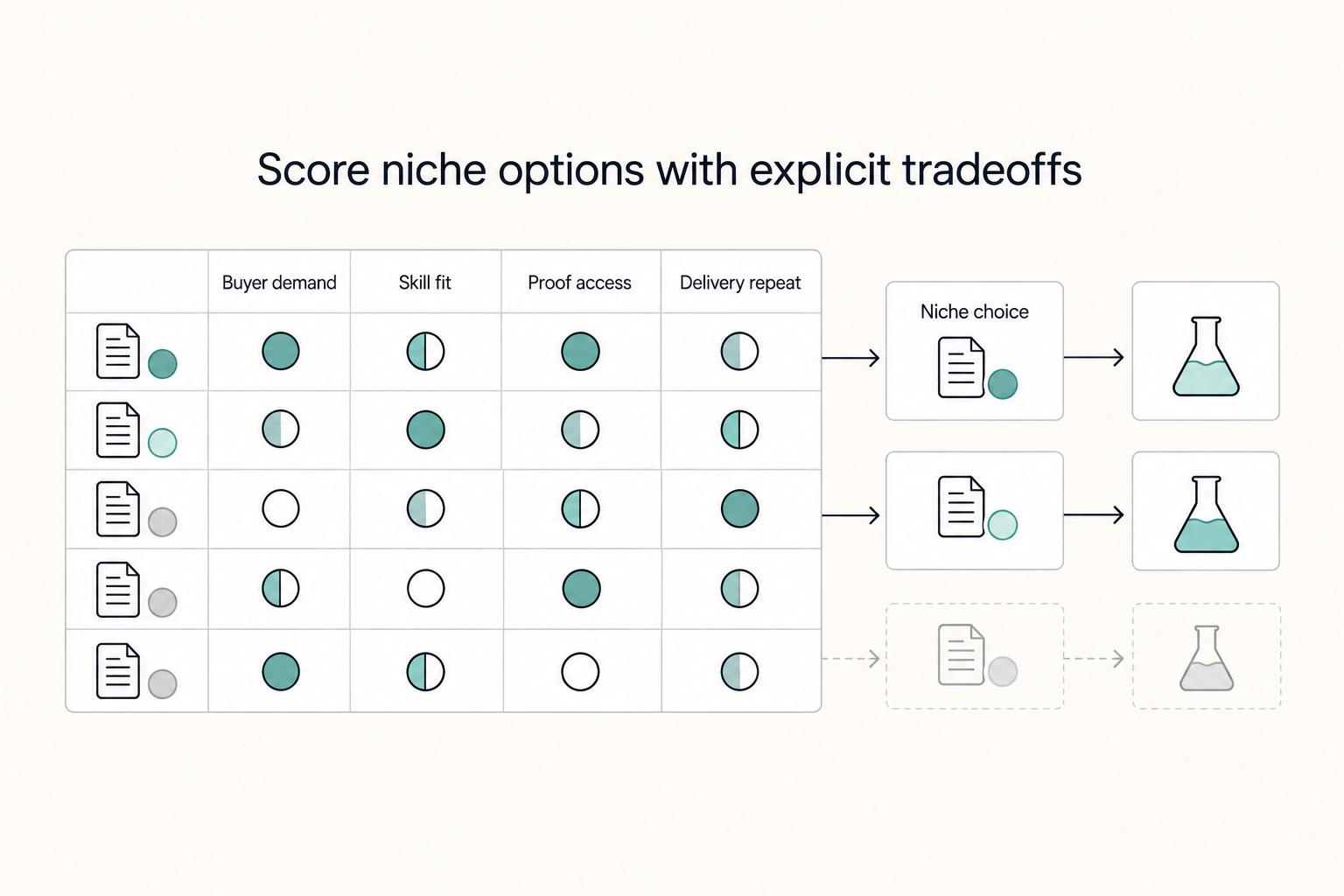
Use a five-factor scorecard before you choose. It makes the tradeoffs visible so you are not deciding on instinct alone.
- Score every option on the same five factors. Use fit, demand, budget quality, competition pressure, and operational risk. Keep one scale across all options, and add a short evidence note for each score. For operational risk, include contract friction and payment process complexity.
- Set decision rules before totaling scores. For example: weak budget quality should not pass on passion alone, and high operational risk should be offset by clear pricing potential.
- Run a passion-led versus budget-led comparison. Compare at least one option you are excited about, such as Health and Wellness, with one option you believe has stronger budgets, such as SaaS. Treat the table below as a hypothesis template, then validate each cell with your own evidence.
| Factor | Health and Wellness (passion-led) | SaaS (budget-led) |
|---|---|---|
| Fit | Often stronger if you already know the audience | Often stronger if you know product-led teams |
| Demand | Can be active, but varies by segment | Can be clearer in teams with ongoing growth goals |
| Budget quality | Can vary widely by client type | Can be stronger, but still needs buyer-level validation |
| Competition pressure | Can be high in broad categories | Can be high in broad tech positioning |
| Operational risk | May include inconsistent process maturity | May include heavier contract and approval cycles |
Use benchmarks as directional, not predictive. One consulting source reports 39% identify as niche specialists. In that same dataset, 52% of specialists reported charging at least $10,000 per project versus 18% of generalists. Do not assume delivery constraints are automatic deal-breakers either. One freelancer case study reports winning work despite an almost 12-hour time difference. Treat these as signals from different contexts, not guaranteed outcomes.
A scorecard is only useful when the notes are specific. For each score, write the evidence in plain language, not labels. Instead of "demand seems good," note what you saw: repeated problem wording, project requests, or proposal movement. Instead of "risk is high," name the friction: delayed approvals, unclear sign-off, or payment uncertainty.
- Set one consistent review rule before looking at totals. Decide in advance what would disqualify an option, such as unresolved contract or payment feasibility after early client conversations.
Keep the rule fixed during review. Changing it after seeing scores usually means you are trying to rescue a preferred option. If two options tie, choose the one with cleaner execution and lower recurring friction. Tie-breakers based on delivery reality are usually stronger than tie-breakers based on preference.
Generate three niche hypotheses from what you already know#
At this point, you need testable options, not more brainstorming. Build three niche hypotheses from what you already know, then move only evidence-backed options into demand testing.
- Start with evidence from your own work. Pull real signals from past projects, client requests, and outcomes. Write each hypothesis as buyer plus problem plus deliverable so it is specific enough to market.
- Create three distinct options. Build one known-strength option, one adjacent-stretch option, and one new-market option. This helps prevent defaulting to comfort while keeping your choices intentional.
- Filter for credibility before you keep an idea. If you can name clear buyer language and a first deliverable, keep it. If the idea is vague, broad, or hard to deliver, revise or cut it.
- Avoid broad positioning. Trying to appeal to everyone can weaken your message and make specialist alternatives more attractive to buyers.
- Capture each option on a simple evidence card. For each hypothesis, note buyer, core problem, deliverable, proof you already have, and one key risk. If a card lacks buyer clarity or deliverable clarity, do not advance it.
The three-hypothesis structure helps with two common errors. One is choosing only what feels safe and never testing a stronger market. The other is chasing novelty without enough skill overlap to deliver well. A known-strength option can support short-term stability. An adjacent-stretch option can support growth. A new-market option checks whether there is upside you are currently missing.
Treat each card like a short decision memo. If you cannot explain why the option may win and why it may fail, it is not ready for market testing. A good card also makes outreach easier because your language is already focused. It also makes review easier, because you can compare what you expected against what happened.
Validate demand with real market signals in seven days#
Validate demand when buyers ask for a specific outcome, not when an idea merely sounds promising. Use a seven-day sprint to filter your niche hypotheses, then move the strongest one into a reversible 30-day test.
| Signal type | How to use it |
|---|---|
| Commentary | Treat as context |
| Job posts | Weight when they request a clear deliverable and timeline |
| Direct inquiries | Weight when they request a clear deliverable and timeline |
| Posted briefs | Weight when they request a clear deliverable and timeline |
| Outreach replies | Weight when they request a clear deliverable and timeline |
- Create one demand log before you test. Track date, channel, buyer type, exact problem language, requested deliverable, and scope notes for every signal.
- Prioritize signals tied to real buying behavior. Treat commentary as context, but weight job posts, direct inquiries, posted briefs, and outreach replies that request a clear deliverable and timeline.
- Score each hypothesis with a simple rubric. Use recurring problem language, active buying behavior, and acceptable project scope, then rate each on a 1-5 scale so weak spots are obvious.
- Apply a strict day-seven checkpoint. If you cannot find repeated buyer pain and clear deliverable demand, the niche fails this demand test.
- Run a reversible 30-day test on one passing niche. Keep one buyer segment, one core problem, and one offer, then watch for risk-reduction signals such as requests for dependable delivery, clear outcomes, and low-friction execution.
The quality of your notes matters as much as the quantity of signals. Log the exact phrasing buyers use when they describe the problem. Those words can become positioning language later. Log scope concerns and timing objections. Those become offer boundaries and proposal language later. Without that detail, you end up deciding from memory, and memory tends to overweight the loudest conversation.
At the checkpoint, use a simple interpretation rule. If you see interest but no movement toward scope and timeline, demand is weak. If you see scope discussion but no budget tolerance, pricing may be the issue rather than positioning. If you see repeated urgency and clear scope fit, you likely have enough signal to proceed to the pilot. Seven days can filter weak options quickly, and thirty days shows whether the strongest option is worth committing to.
Pressure-test pricing and scope before you commit#
A niche is more likely to be viable if pricing still works after full effort is counted and scope pressure is handled. Drafting-time math alone is not enough.
- Build two concrete offers per niche. Create one custom offer and one productized-style offer for the same buyer problem. Price each with a model you can explain, such as hourly, flat fee, or per-word when it fits. Define scope with named tasks, deliverables, and boundaries.
- Test effective earnings against total workload. Estimate total effort: research, interviews, revisions, communication, and project management. Divide your quote by that total to check whether the work remains sustainable. Pressure-test assumptions hard. An estimate can expand from 80 hours to 200 hours, cutting effective rate by about 60%.
- Compare delivery paths before you commit. Use a simple side-by-side check of margin, revision exposure, and fulfillment stability for your custom versus productized-style offer. Pick the path you can deliver consistently without margin erosion.
- Lock assumptions into terms and set a rejection rule. Tie pricing to revision limits, scope-change handling, and invoice timing so profitable-looking projects are less likely to unravel in execution. Keep records tight from day one, since detailed documentation makes expense tracking and 1099 admin easier at tax time. Set a hard rule: if a niche mainly closes low-budget one-offs, consider not making it your primary niche.
This is where a promising niche can break down. Early conversations can make work look simple, but delivery often reveals hidden effort. Revision rounds can expand, approvals can slow down, and communication overhead can climb. If your model ignores that effort, your quoted rate can look healthy while your effective rate quietly drops.
A practical way to pressure-test pricing is to write assumptions next to each quote. Include expected revision load, expected communication time, and expected turnaround pressure. Then ask what happens if each assumption misses. If one missed assumption breaks margin, your offer is fragile. Tighten scope or change pricing before you scale.
Keep a clear rejection rule and follow it. Without one, it is easy to keep accepting projects that feel busy but do not support the business. Busy is not the same as sustainable. If you need to tighten the tax admin side, see The Best Tax Software for US Expats.
Check operational durability and compliance fit#
A niche is more durable when you can deliver it with manageable contracts, invoicing, payments, and tax documentation for your likely client mix.
- Map client mix and paperwork first. Split likely clients into domestic and international, then define the contract template, invoicing process, and tax documentation for each. Note who sends what, when it is due, and where records are stored.
Checkpoint: For each client type, you should be able to answer what is required before work starts, before invoicing, and at tax time.
- Stress-test the payment path before committing. Walk one sample project from signed agreement to paid invoice, including approvals, payment method, and what happens if payment is late or disputed. If you plan to serve international clients, map cross-border payment requirements early.
Failure mode: Proposals can look profitable, but cash collection slows when your process does not match how that client group pays.
- Match contract terms to scope control and dispute handling. Keep deliverables, revision limits, change requests, and payment timing explicit. Clear scope reduces guesswork and helps prevent scope creep, and a simple escalation path can keep disputes from taking over your delivery time.
Checkpoint: If a client can request extra work without a new agreement, tighten terms before making that niche primary.
- Score admin overhead as a go or no-go factor. Add three items to your niche scorecard: documentation burden, payment friction, and dispute effort. Strong demand can still underperform if recurring admin is heavy.
Decision rule: If two niches are similar on demand and pricing, choose the one with lower recurring admin effort and cleaner payment execution.
This is not paperwork for its own sake. It is risk control. A niche with great demand can still underperform if invoicing delays are common, contract terms are unclear, or tax documentation requires repeated cleanup. That friction steals time and adds cash-flow stress even when sales look strong.
Keep your records organized by project and by client type. Store the latest contract version, invoice status, payment notes, and required tax documentation together so review is easy, and so expense tracking and 1099 handling are smoother at tax time. The goal is to make every project boring to administer. If admin stays chaotic after repeated projects in the same niche, that is useful decision evidence.
If operations are the bottleneck, a tighter niche can be the right pivot. One freelancer case described going hyper-niche while keeping existing clients, which is a useful pattern for narrowing without breaking continuity.
Run a 30-day niche pilot and capture decision evidence#
After your initial niche checks, run a 30-day pilot as a practical test. The goal is to see whether one focused offer can close, stay in scope, and get paid reliably.
| Week | Focus | What to track or decide |
|---|---|---|
| Week 1 | Positioning and offer setup | Define one buyer, one problem, and one deliverable; write a one-page offer with clear scope, revision limits, and payment terms |
| Week 2 | Outreach and conversations | Track response rate and close rate; log repeated objections and whether prospects accept your scope boundaries |
| Week 3 | Paid tests | Record scope changes, revision load, and invoice outcomes |
| Week 4 | Review and decision | Evaluate close rate, scope stability, revision load, and payment reliability; decide: commit, pivot narrower, or sunset |
A focused audience is the practical choice here. Customer acquisition costs have risen every year since 2013, and broader outreach can create more wasted effort before fit appears. Tighter targeting can reduce wasted acquisition effort and improve conversion quality.
Use one simple four-week structure:
- Week 1: Positioning and offer setup. Define one buyer, one problem, and one deliverable. Write a one-page offer with clear scope, revision limits, and payment terms.
- Week 2: Outreach and conversations. Talk to prospects in the same buyer profile. Track response rate and close rate, and log repeated objections and whether prospects accept your scope boundaries.
- Week 3: Paid tests. Run small paid engagements using the same offer terms. Record scope changes, revision load, and invoice outcomes so execution quality is measured, not assumed.
- Week 4: Review and decision. Evaluate close rate, scope stability, revision load, and payment reliability using your evidence pack, then decide: commit, pivot narrower, or sunset.
Treat the pilot like a live experiment with one question: does this niche support repeatable, viable delivery? Keep variables stable so your read is clean. Changing buyer type, offer shape, and pricing model at the same time makes weak results hard to diagnose.
Review with strict criteria, not optimism. If close rate is acceptable but scope stability is poor, your positioning may be right while boundaries are weak. If scope is stable but payment reliability is poor, operational fit may be the issue. If all signals are weak, pivot quickly and protect time for the backup niche.
Keep the evidence pack auditable with call notes, proposal outcomes, and objection patterns in one place. If results are mixed, narrow one variable and run another 30-day cycle before scaling.
Decide how narrow to go without killing demand#
Go narrow enough that the right buyer recognizes the offer quickly, but not so narrow that demand disappears.
Use this as a practical check on your current offer:
- One clear buyer
- One specific pain
- One repeatable deliverable
- Enough reachable prospects to keep testing
A quick contrast helps: Tech content is broad. SaaS lifecycle email sequences for seed-stage B2B teams is narrower because the buyer, problem, and deliverable are explicit.
Then pressure-test the niche with two filters: profitability and genuine interest. If either is weak, the niche is harder to sustain.
If demand looks thin, widen one variable at a time, either buyer, problem, or deliverable, and retest. Changing everything at once makes results harder to read.
Use adjacent options as risk management, not as a distraction. Your backup should share meaningful overlap with your core skills so you can pivot without rebuilding every asset.
Keep a connected adjacent niche ready as a backup. You do not need to lock into one super narrow lane forever, and it is okay to change your niche over time.
Common mistakes that cause bad niche choices and how to recover#
Bad niche choices usually come from weak evidence. Recovery starts by improving the proof, then committing.
- Choosing by identity instead of paid demand
Picking a niche only because you like the topic can trigger niche paralysis. Reweight your scorecard toward paid demand, then test whether the problem is a true painkiller problem buyers will pay to solve now.
- Copying generic advice without your own constraints
Public advice can generate ideas, but it often breaks down when it does not match your hours, rates, and client type. Keep only what your own pipeline supports, especially real client problems in front of you.
- Ignoring operations until later
If your goal is income replacement, this rigor matters more than it does for occasional side income. Without systems, multiple income streams can turn into deadline pressure, burnout, and eventual abandonment.
- Staying too broad to be chosen
Broad positioning can make your offer harder to evaluate quickly. Narrow one layer at a time around one buyer problem and one repeatable deliverable so the offer is easier to understand and purchase.
A useful recovery pattern is to fix one failure at a time. If evidence is weak, improve validation before changing everything else. If demand is strong but execution is unstable, tighten delivery boundaries and systems before switching markets. If pricing stays weak across multiple tests, revisit your niche or offer shape rather than chasing more volume at unsustainable rates.
Stop chasing a perfect niche, prioritize paid problems in front of you, and commit only when the niche is both sellable and sustainable.
Make your decision and use this copy-paste checklist#
You likely have enough signal to decide. Make one clear choice, keep one backup, and test both with discipline instead of staying in analysis mode.
Use this final decision script in two passes.
- Pick one primary niche and one adjacent backup niche. Write each as one sentence with buyer, problem, and deliverable.
- Confirm your niche sentence is client-relevant. Check it against real conversations, proposal replies, and discovery notes for repeated pain language and clear buying intent.
- Verify pricing against your target billable rate. Model realistic offers and compare them to your rate floor before you commit.
Then confirm execution details before scaling.
- Confirm practical fit early. Check your workflow, delivery process, and admin requirements before scaling outreach.
- Set your focus level by tradeoff, not ideology. Too broad increases competition and pricing pressure. Too narrow can shrink client volume.
- Run a time-boxed pilot, review evidence, then commit or pivot once. Track outreach, qualified conversations, proposal outcomes, close rate, and realized rate. Then make one decision and move.
If a section of the checklist fails, do not discard the whole niche immediately. Fix the failing layer first, then retest. If demand fails, revisit positioning. If pricing fails, revisit offer design and scope boundaries. If operations fail, simplify execution or choose the adjacent backup. The goal is one clean decision, supported by evidence, followed by consistent execution. If you want to confirm what is supported for your situation, Talk to Gruv.
Frequently Asked Questions
How do I choose a freelance niche in 30 days?
If you use a 30-day window, treat it as focused decision time, not a guaranteed finish line. Use that time to define your focus and ideal client, then make a working choice you can market. If clarity still feels incomplete, that is normal. One freelancer reported it took over two and a half years to settle on a niche.
Should I pick a niche based on passion or profit?
Do not force this into an either-or rule. Start with your skills and strengths, then pressure-test the niche against real client context. Keep the niche focused enough that your positioning is clear.
How narrow should a freelance niche be before demand gets too small?
Go narrow enough that your positioning has clear focus instead of broad topic coverage. If your message sounds generic, you are likely too broad. The goal is not the smallest niche possible, but a focused niche that helps you stand out.
Can beginners choose a niche they do not already know?
Yes. Beginners can choose a niche before they are experts. You do not need expert status to start, but you do need to learn the space deeply as you go. A practical starting point is your current skills and strengths.
When should I pivot to a new niche instead of waiting longer?
Consider a pivot when fear of choosing wrong keeps you from choosing and your marketing momentum stalls. Delaying indefinitely can cost time and ground. Make a clearer focus decision, test it, and adjust based on what you learn.
Is a freelance writing niche easier to validate than a freelance designer niche?
Neither is universally easier. In both cases, clear focus and a defined ideal client can make validation easier to execute. Use the same criteria for both options so you compare them fairly.
What is the fastest way to test niche demand without lowering my billable rate?
A practical route is clear focus and consistent market visibility, rather than waiting for perfect certainty. Keep your positioning specific enough that the right client can recognize it quickly. If you need to tighten your pricing foundation first, use How to Calculate Your Billable Rate as a Freelancer.
Try a related tool
Researched and edited by the Gruv editorial team. Gruv builds cross-border billing, payouts, and finance-operations software for global businesses.
Sources
Includes 3 external sources outside the trusted-domain allowlist.
- boskovic.linguistics.uconn.edu/wp-content/uploads/sites/2801/2020/11/Schiff...trusted
- cs.princeton.edu/courses/archive/spring18/cos226/assignments/...trusted
- interaction-design.org/literature/article/how-to-choose-your-specia...external
- sagehouseeditorial.com/blog/freelance-business-nicheexternal
- unkoa.com/how-to-choose-a-profitable-niche-for-your-fr...external
Educational content only. Not legal, tax, or financial advice.
Related Posts
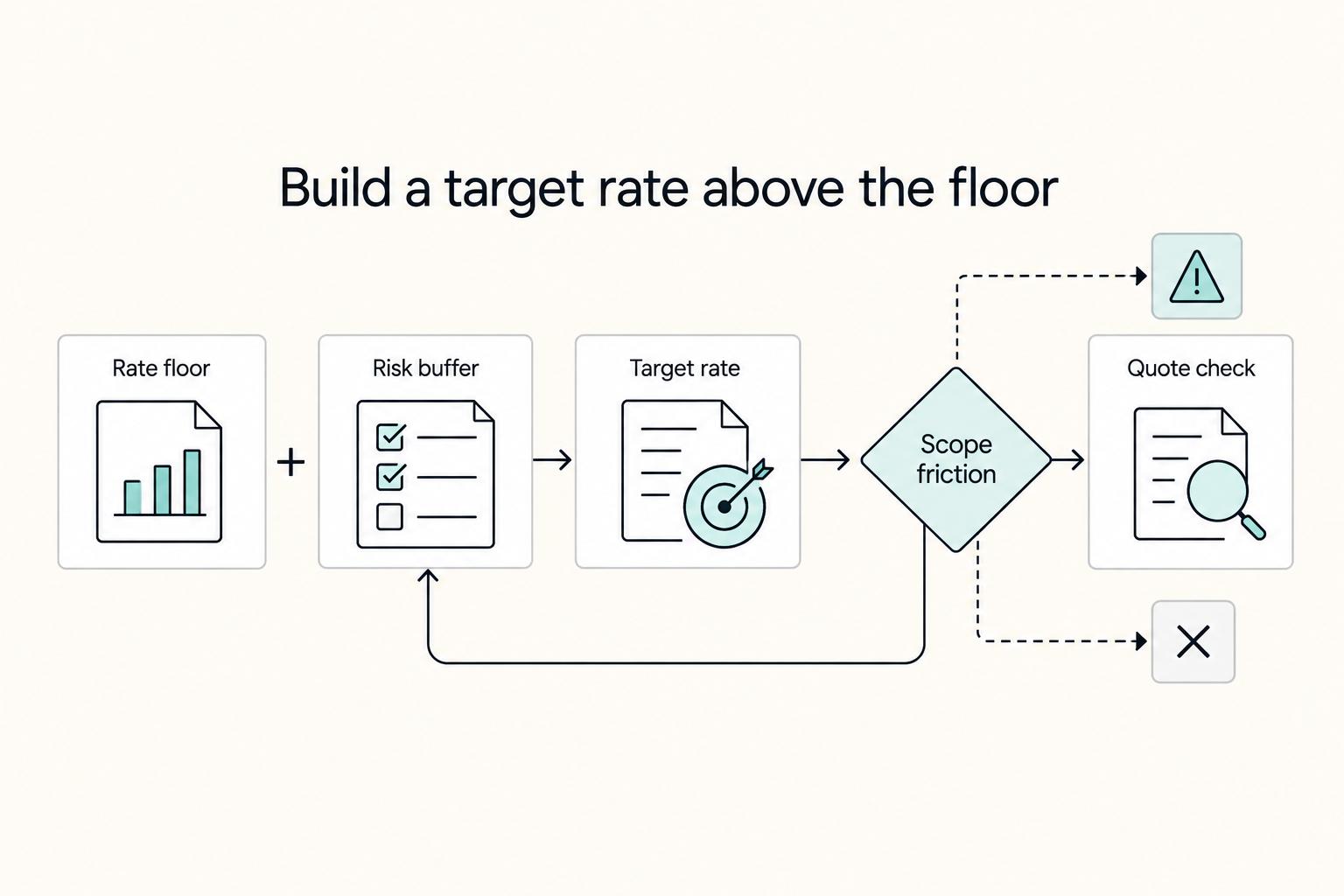
How to Calculate a Freelance Rate You Can Actually Get Paid On
A workable rate is not the neat number a calculator produces. It is the number that still works after you account for real billable capacity, non-client time, scope drift, and the gap between sending an invoice and receiving cleared cash. Start with hourly math even if you do not plan to bill hourly, then turn that number into a quote with clear `payment terms`.

How to Create a Productized Service for Your Freelance Business
If your recent client work produces similar results from similar inputs, you may be ready to turn it into a defined offer. The shift is operational, not cosmetic. You are deciding what you sell, what the client gets, what it costs, and how delivery happens, instead of rebuilding every job from scratch.
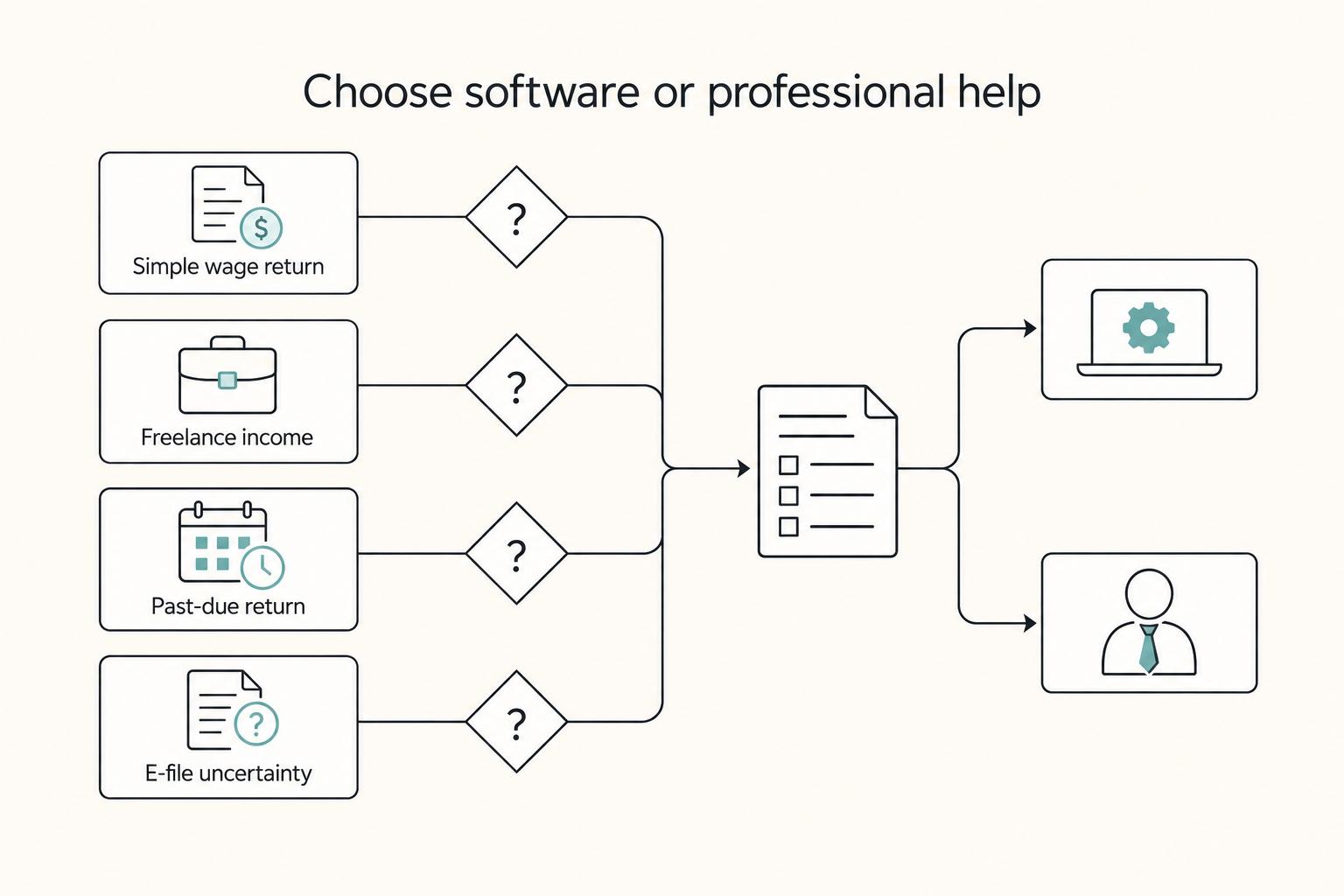
The Best Tax Software for US Expats
Pick by filing complexity, not brand familiarity. For many U.S. citizens living overseas, the right choice is the one that matches your form load, filing history, and tolerance for correction risk with the Internal Revenue Service (IRS).