
Quick Answer
Use a three-stage workflow for how to check references: audit claims before calls, interview references with reusable behavior prompts, and score findings in one matrix. Start from candidate-provided contacts, confirm what each person directly observed, and document conflicts right away. When a third-party consumer report is involved, handle written notice and permission under FCRA before ordering it. This turns references into decision evidence instead of reassurance.
Stop Checking References. Start De-Risking Your Business.#
If you are searching for how to check references, you probably are not trying to complete a hiring formality. You are trying to understand what could go wrong if the hire goes wrong. A good process will not remove all hiring risk. It can reduce selection errors by verifying critical employment information and testing whether past performance fits the work you actually need done.
Name the risk before you contact anyone#
Start by naming the risk before you contact anyone. For a small business, the main buckets are usually financial, reputational, and compliance.
| Risk bucket | Article description | Examples or requirements |
|---|---|---|
| Financial | Shows up in concrete ways | Missed deadlines; weak scope control; poor ownership of deliverables; resume claims that do not match the level of work performed |
| Reputational | Is easier to miss and can become expensive later | Inconsistent client communication; defensiveness when projects slip; poor judgment when representing your business without supervision |
| Compliance | Includes your process as much as the candidate | If you use a third party to obtain a consumer report, FCRA rules apply, including a standalone written notice and written permission before the report is ordered |
Financial risk shows up in concrete ways: missed deadlines, weak scope control, poor ownership of deliverables, or resume claims that do not match the level of work performed. Reputational risk is easier to miss and can become expensive later: inconsistent client communication, defensiveness when projects slip, or poor judgment when representing your business without supervision. Compliance risk includes your process as much as the candidate. If you use a third party to obtain a consumer report, FCRA rules apply, including a standalone written notice and written permission before the report is ordered.
Before any call, write down the exact claims you need to verify, such as job title, employment dates, reporting line, client-facing responsibility, and ownership of key projects.
| Aspect | Old checkbox reference check | Risk-based reference check |
|---|---|---|
| Goal | Confirm the person seems fine | Screen for specific business exposure |
| Questions | Generic and improvised | Standardized and tied to the role |
| Evidence | Vague impressions | Verifiable claims plus examples of past behavior |
| Decision use | Last-minute formality | Direct input into the hiring decision |
Verify what you can before you call#
Expect a tradeoff. Former employers may readily confirm dates and titles but give little detail on performance or conduct. That is why the first stage starts before the call. Narrow to your top candidate or finalists, verify the claims you can verify first, and use live conversations to test the gaps that matter most. That shifts the process from opinion gathering to evidence gathering, which is where Stage 1 should begin.
If you want a deeper dive, read What to Do If You've Been Misclassified as an Independent Contractor.
Stage 1: The Asynchronous Audit - Verify Claims Before the Conversation#
Start here, not with a reference call: verify what you can first, then use live conversations to test what is still unclear. That keeps your process formal, tied to the role, and focused on risk instead of impressions.
Build an audit sheet around the role#
Use your role brief, or your MOC document (missions, outcomes, and competencies), to decide what is worth checking. If a claim does not connect to a required mission, outcome, or competency, treat it as lower priority.
Create a dated audit sheet and capture evidence as you go.
| Claim | Proof found | Risk note | Follow-up question |
|---|---|---|---|
| Candidate claim to verify | What you can confirm from available materials | What is still unclear or risky | What you need to ask in Stage 2 |
Your goal at the end of Stage 1 is simple: a short evidence pack plus a short list of unresolved claims.
Check consistency and portfolio evidence#
Review the same core claims across resume, profile, portfolio, and any submitted materials. Focus on whether role scope, ownership, and outcomes stay consistent.
| Area | Ask for | Should show |
|---|---|---|
| Technical | Examples | Your candidate's contribution to delivered work |
| Content | Examples | Authorship and how work was developed |
| Design | Examples | Problem, approach, and ownership in collaborative work |
| Client-facing | Examples | Communication quality and decision-making in real engagements |
For portfolio review, ask for role-relevant proof, not just polished outputs:
- Technical: examples that show your candidate's contribution to delivered work.
- Content: examples that show authorship and how work was developed.
- Design: examples that show problem, approach, and ownership in collaborative work.
- Client-facing: examples that show communication quality and decision-making in real engagements.
If direct samples are limited, ask for a walkthrough of context, tradeoffs, and personal contribution, then note what remains unverified.
Audit communication and prepare Stage 2 question bank#
Treat communication in this stage as an early operating signal. Note whether responses are clear, specific, and aligned with what you asked.
Document patterns you need to test later, such as repeated vagueness, unresolved contradictions, or unclear ownership. Keep this proportional: one weak signal is not a verdict, and no hiring method guarantees a good hire every time.
Before you move to Stage 2, convert each unresolved item into one practical question a reference could answer: the claim, what is missing, and who is most likely to confirm it.
We covered this in detail in How to Screen Tenants for a Rental Property.
Stage 2: The Risk-Mitigation Interview - Ask the Questions That Truly Matter#
Use this call to test unresolved claims, not collect compliments. A short, structured phone call usually works best because you can probe immediately when an answer is vague, and a consistent core question set makes answers comparable across references.
Past behavior is useful only when the reference directly observed it. If someone only knows the candidate by reputation or limited contact, treat that as weak evidence.
Run a simple call flow: context, behavior, probe, role fit#
Start by anchoring the role and confirming first-hand knowledge.
Opening template: "I'm hiring for a role that owns client delivery, manages changing scope, and gives early project updates. How did you work with them, and what did you directly observe?"
Then keep questions job-related and focused on work performance. Avoid protected-characteristic topics, and do not ask medical questions before a conditional offer.
Use behavior-based prompts you can reuse every time#
Ask for observed examples, then probe for specifics tied to your Stage 1 gaps.
- Accountability prompt: "Tell me about a project that went off track. What did they personally own, and what did they do next?"
Listen for: ownership language, concrete corrective action, and no blame-shifting without specifics.
- Scope control prompt: "Describe a time scope changed. How did they handle expectations, deliverables, and timing or budget impact?"
Listen for: tradeoff thinking, explicit reset of expectations, and clear handling of consequences.
- Communication prompt: "How did they keep stakeholders updated on complex work, and when did they escalate risk?"
Listen for: early updates, clear escalation habits, and evidence of written follow-through.
| Area | Strong signal | Low-value noise |
|---|---|---|
| Accountability | Specific example, clear ownership, corrective action | Generic praise, blame-shifting, no concrete role |
| Scope control | Names the change, explains tradeoffs, reset expectations | "Handled it well" with no project detail |
| Communication | Clear update cadence, escalation timing, documented follow-through | "Great communicator" with no examples |
Close the call and capture risk labels immediately#
Close with role fit, then boundaries of fit.
| Item | Label or status | Handling |
|---|---|---|
| Accountability risk | low / medium / high | Follow up if ownership is unclear |
| Scope-control risk | low / medium / high | Follow up if tradeoffs or expectation resets are vague |
| Communication risk | low / medium / high | Follow up if escalation timing is unclear |
| Evidence quality | first-hand / partial / weak | Discount hearsay |
| Conflict flag | Answers conflict with other references or candidate materials | Resolve with the candidate before final scoring |
- "Would you recommend them for this position? Why or why not?"
- "What kind of role or project would you be most confident hiring them for again?"
Right after the call, record the date, reference name/title, and what they said in each risk area. Then assign a label and action for each item:
- Accountability risk: low/medium/high; follow up if ownership is unclear.
- Scope-control risk: low/medium/high; follow up if tradeoffs or expectation resets are vague.
- Communication risk: low/medium/high; follow up if escalation timing is unclear.
- Evidence quality: first-hand/partial/weak; discount hearsay.
- Conflict flag: if answers conflict with other references or candidate materials, resolve with the candidate before final scoring.
If you use a third-party screening company for background checks, treat that as a separate compliance lane that may trigger FCRA rules. For this stage, your goal is clear: leave with job-relevant, documented evidence ready for Stage 3.
You might also find this useful: How to Write a Job Description That Attracts Top Talent.
Stage 3: The Decision Matrix - Turn Gut Feeling into a Defensible Choice#
After each reference interaction, record findings immediately in a decision matrix so your choice is based on evidence, not memory or debate.
Step 1: Lock criteria and weights before side-by-side comparison#
Keep the matrix to 4 to 8 criteria. For this hiring workflow, use these four risk vectors:
- Ownership
- Scope discipline
- Communication reliability
- Verified capability
Set weight before you compare candidates:
- 3 = role-critical risk
- 2 = important, but not decisive
- 1 = useful context
Apply heavier weight to the vectors that carry the biggest downside in this specific role.
Step 2: Use one rubric for every vector#
Rate each vector with the same labels so your scoring stays consistent:
- Strong evidence: specific first-hand example, clear candidate actions, role-relevant outcome.
- Mixed evidence: partly relevant detail, but incomplete, second-hand, or paired with a concern.
- Insufficient evidence: generic praise, hearsay, or too vague to rely on.
Then rate all four vectors for each candidate using that same rubric.
Step 3: Record method and findings separately#
Keep one part of your sheet for criteria/weights (method), and one part for what each reference actually showed (findings).
| Vector | Weight | Rating | Score (optional) | Evidence note | Confidence level | Unresolved risk |
|---|---|---|---|---|---|---|
| Ownership | 3 | |||||
| Scope discipline | 3 | |||||
| Communication reliability | 2 | |||||
| Verified capability | 2 |
If you want numeric scoring, convert labels only after notes are written (for example, Strong/Mixed/Insufficient to 3/2/1).
Step 4: Resolve close calls with one targeted follow-up#
If two candidates are close, identify the single highest-weight gap and run one focused follow-up check on that point only. Then document a short rationale: which weighted risks mattered most, what evidence supported the decision, what remains unresolved, and why that residual risk is acceptable or not.
This pairs well with our guide on How to Vet a New Client for Financial Stability.
Advanced Due Diligence: Navigating Global and Legal Complexities#
For cross-border hiring, treat reference checks as a compliance workflow, not a routine call. Use authorized outreach by default, verify which rules may apply before contact, and document exceptions. General frameworks are useful, but they are not a substitute for case-specific legal review, and U.S. federal-only discussion does not resolve state or international requirements.
Map the jurisdictions before outreach#
You are not ready to contact anyone until you map jurisdiction scope and current rule sources.
- Record where your business operates.
- Record where the candidate works.
- Record where each reference is located.
- Record where the employing entity is based.
- For each location, log the rule source and version/effective-date checkpoint.
- If the exact requirement is not confirmed yet, mark it as pending and verify it against the official source, counsel, HR policy, or contract records before use.
Escalate before outreach if any applicable jurisdiction or current rule version is unclear, especially when multiple countries or subnational rules may apply.
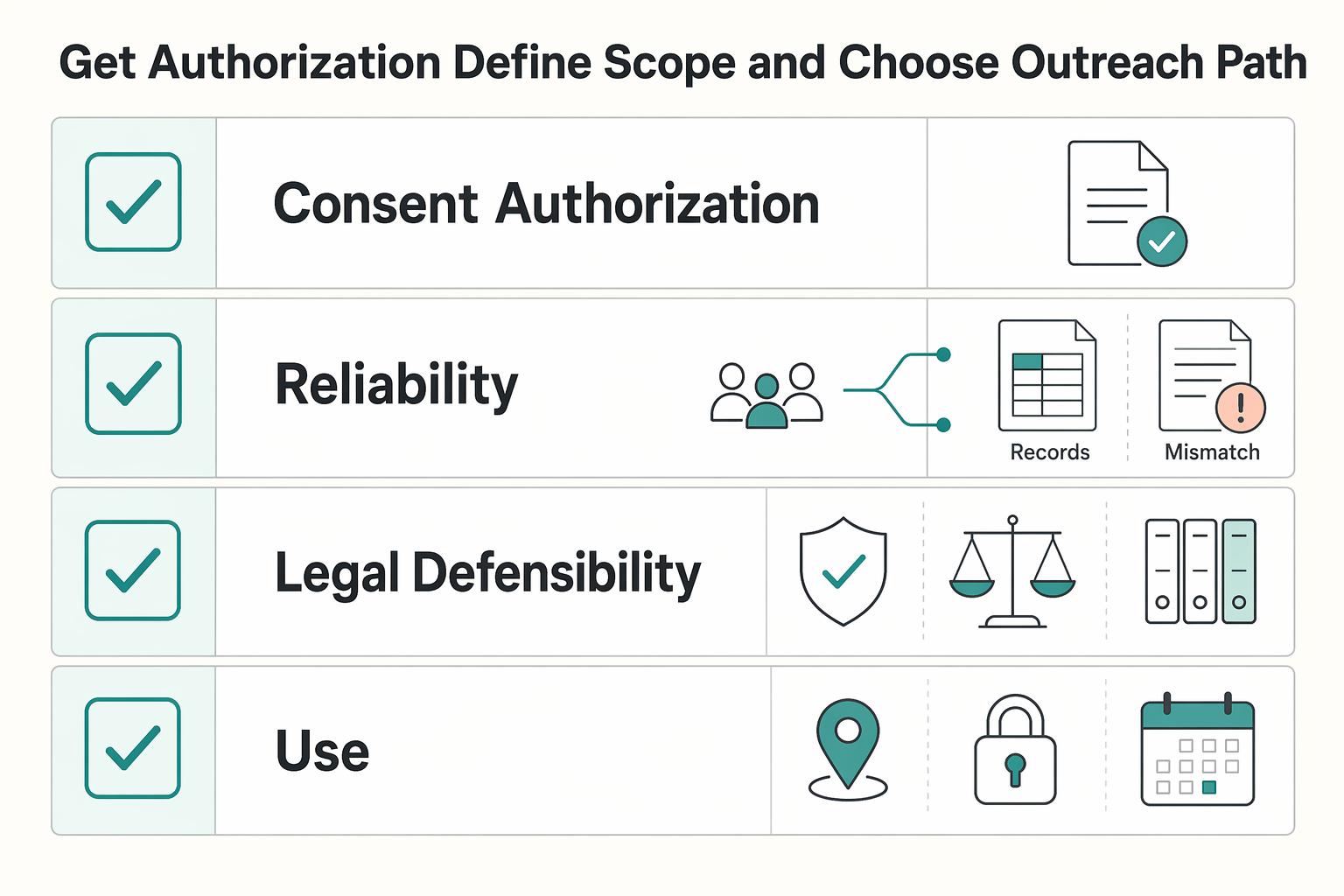
Get authorization, define scope, and choose outreach path#
Run authorized reference checks as your default path, and lock scope before interviews.
- Ask the candidate which contacts are approved and what each relationship is.
- Record approved contacts and any channel/timing limits.
- Keep questions tied to role performance, working style, and verified outcomes.
- If purpose changes, revisit authorization and record that decision.
- If non-role personal information appears, exclude it from the decision note and escalate if needed.
| Checkpoint | Authorized reference check | Backchannel outreach |
|---|---|---|
| Consent or authorization | Candidate-approved path with a recorded contact list | Authorization may be unclear unless separately verified |
| Reliability | Usually stronger when feedback is first-hand and role-specific | Can be variable, second-hand, or bias-prone |
| Legal defensibility | Stronger when approval, scope, and notes are documented | Weaker and more likely to require internal/legal review |
| When to use | Default for most hiring decisions | Consider only when risk is material, authorized evidence is insufficient, and the approach is cleared internally |
Adapt for cross-border context and verify entity details#
Prepare for language and cultural context so feedback is specific and usable.
- Share core questions in advance when language or communication norms may affect live clarity.
- Reframe high-friction prompts in neutral, coaching-style language to improve candor.
- Verify the entity separately from the individual: business name and registration details where available.
- Save verification artifacts (for example, registry search record, screenshot, or PDF).
Treat entity verification as existence evidence, not capability evidence. Do not equate compliance status with delivery capability.
Keep a minimum documentation pack and clear escalation triggers#
Use a minimum file so your process is auditable if challenged. This is not presented as a universal legal requirement.
- Consent or authorization record
- Approved contact list
- Question log (date, method, notes)
- Entity verification artifact
- Decision note (what was learned, what was excluded, unresolved risk)
Escalate when any of these occurs:
- Governing jurisdiction cannot be confirmed
- Backchannel outreach is proposed
- Personal or non-role allegations are raised
- Entity status cannot be verified
- Contradictory facts could change the decision outcome
If the role includes access to sensitive systems or data, expand due diligence beyond references and request operational evidence relevant to that risk (for example, data security or disaster recovery materials).
For a step-by-step walkthrough, see How to Vet Contractors and Global Partners with a Tiered Background Check Process.
Conclusion: Treat References as Proof Points You Can Document#
Your next hire should feel more like an evidence-based decision than a hope-based one. If you want to cut selection errors, reduce operational drag, lower reputational risk, and reduce bias risk in the final call, treat references as proof points, not reassurance.
- Verify claims before you call anyone.
This stage tells you whether the candidate's core story holds up on paper: role history, portfolio claims, and the facts that would change your decision. Confirm the candidate has given permission to contact references. Use it at the finalist stage, not as broad early screening. Your checkpoint is simple: can you match each important claim to a document, work sample, or person with direct knowledge?
- Gather comparable reference evidence.
This stage shows what other people directly observed, not what the candidate or a friendly contact prefers to emphasize. Ask each reference the same job-related questions and keep dated notes, because comparable inputs are what make later scoring defensible. A common failure mode is letting one loose conversation outweigh better-documented evidence from other references.
- Score the decision the same way every time.
This stage shows whether the file meets your hiring standard, not your mood that day. Use one rating scale across candidates, and if you weight any factor differently, document why.
| Practical contrast | Unstructured reference check | Evidence-based de-risking |
|---|---|---|
| Financial decision | Trusts broad praise | Verifies the claims tied to delivery and judgment |
| Operational decision | Collects uneven anecdotes | Uses the same questions and rating standard |
| Reputational decision | Accepts curated impressions | Checks what a reference directly knows and where that knowledge stops |
| Bias control | Relies on gut feeling | Documents notes, scores, and rationale consistently to reduce bias risk |
Keep the file. Save the reference list, outreach log, notes, and scorecard as personnel or employment records, and keep them for at least 1 year. If you use a third-party consumer report, get written permission and follow pre-adverse notice steps before taking adverse employment action. Document findings, score consistently, and proceed only when the evidence meets your predefined criteria. If the threshold is unresolved, mark it pending and verify the exact requirement against the official source, counsel, HR policy, or contract records before use.
Related: How to Hire Your First Salesperson.
Frequently Asked Questions
Do I need the candidate’s permission before I contact references?
Start with the reference list the candidate gave you in the application or resume. That gives you a clear verification input tied to the hiring process. Keep the reference list and your outreach log in the file, and follow your organization’s process for any consent documentation.
How do I keep questions job-relevant without making the call too shallow?
Ask the reference to verify interview claims, employment history, skills, and work behavior they directly observed. Interviews do not tell you everything, so the goal is to fill blind spots, not collect gossip. Keep a dated question list and reference notes that show what was asked, what was confirmed, and what stayed unverified.
What should I do differently for an international reference check?
Use the same core method: confirm who you are contacting, then run reference outreach by phone or email and document what is directly confirmed. For cross-border cases, account for language and business context before interpreting answers. If a policy point is unclear, pause and get internal guidance instead of guessing.
How can I probe for scope-creep handling without turning it into a gotcha interview?
Ask for one real example of how expectations changed and what the candidate did next, then focus on what the reference directly observed. You are listening for communication and follow-through, not polished theory. In your notes, mark whether the input was first-hand or second-hand before weighting it.
How do I validate a portfolio or case study?
Treat portfolio or case-study statements like interview claims: ask references what result they can directly confirm. Record what the candidate owned, what was confirmed, and where the reference’s knowledge stops. Keep those notes next to the portfolio item so claimed and verified results stay separate.
Should I ever use backchannel references?
Use candidate-provided references as your default because they are easier to verify and document. Off-list feedback can be biased, second-hand, or hard to substantiate, so keep it separate from direct reference checks. If you receive it anyway, label it unverified in your decision notes.
Try a related tool
Researched and edited by the Gruv editorial team. Gruv builds cross-border billing, payouts, and finance-operations software for global businesses.
Sources
- consumer.ftc.gov/articles/employer-background-checks-and-your...trusted
- consumerfinance.gov/compliance/circulars/consumer-financial-prot...trusted
- dodcio.defense.gov/Portals/0/Documents/CMMC/AssessmentGuideL2.pdftrusted
- ecfr.gov/current/title-29/subtitle-B/chapter-XIV/part...trusted
- eeoc.gov/laws/guidance/background-checks-what-employe...trusted
- eeoc.gov/employers/small-business/what-shouldnt-i-ask...trusted
- ftc.gov/business-guidance/resources/using-consumer-r...trusted
- ftc.gov/business-guidance/resources/background-check...trusted
Educational content only. Not legal, tax, or financial advice.
Related Posts

What to Do If You've Been Misclassified as an Independent Contractor
Treat this as a protection problem first, not a label debate. If your work was treated as an independent contractor arrangement even though the relationship functioned differently, your first goal is to protect pay, rights, and records while you choose the least risky escalation path. You can do that without making accusations on day one, which often keeps communication open while you document what happened.
How to Hire Your First Salesperson
The decision to bring on your first salesperson begins not with a job description, but with a hard look in the mirror. This hire is an investment that goes far beyond salary; it's a strategic commitment of cash, time, and trust. Get this wrong, and you risk not only a significant financial loss but also damage to your brand and morale. Get it right, and you build the foundation for scalable growth.
How to Write a Job Description That Attracts Top Talent
If you are buying a defined result from an outside professional, start with a project charter, not a hiring document. A charter can make the outcome, boundaries, approval path, and proof of completion clearer before work starts. That clarity is often what keeps projects cleaner than role-based paperwork.