
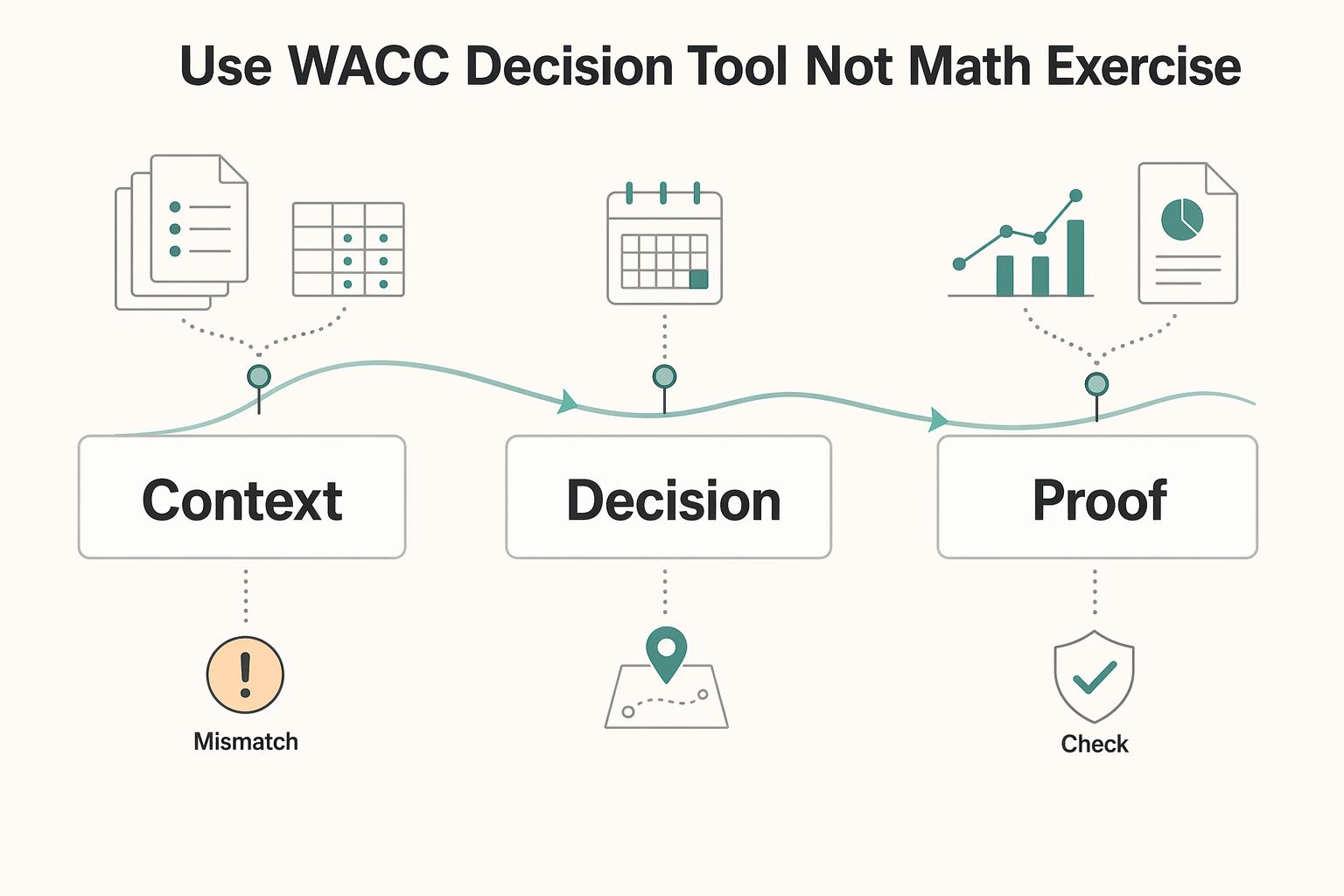
Quick Answer
Calculate WACC by fixing six inputs first: E, D, V, Re, Rd, and tax rate. Then apply `WACC = (E/V * Re) + ((D/V * Rd) * (1 - T))`, using market-value weights and debt adjusted for tax on the same basis as projected cash flows. Run base and stressed scenarios, then use the result in DCF/NPV to decide whether to accept, reprice, or pause the work.
Calculate WACC Without Guesswork#
Use WACC as a decision benchmark, not a theory exercise. Weighted Average Cost of Capital, or WACC, is the blended cost of debt and equity used to finance assets. In financial modeling, it is commonly used as a discount rate in NPV-style valuation work.
For a small business, this is practical finance discipline. Tracking capital and projecting cash flow are part of sound financial management, and capital in the business, owner equity, and borrowing each carry a cost. Revenue alone may not fully show whether a decision is financially strong.
Before you start#
Your goal is a repeatable method, not a perfect number. Build one credible WACC estimate, document each assumption, and refresh it when your financing mix or risk changes so it stays useful in real decisions.
Keep one constraint in view. The result depends on assumptions. Estimating cost of capital requires judgment, and those choices affect the conclusion, so make every assumption explicit before it reaches your model.
Define the decision use first. Define how you will use the number before you calculate it. Start with one base-case WACC for DCF and NPV checks, then add decision-specific adjustments only when risk assumptions are clearly different. That keeps the model usable and reduces ad hoc discount-rate changes.
Lock the input sheet before touching the formula. Set the inputs first, then run the equation. Core fields are market value of equity (E), market value of debt (D), total capital (V = E + D), cost of equity (Re), cost of debt (Rd), and tax rate (T) for after-tax debt treatment:
WACC = (E/V × Re) + ((D/V × Rd) × (1 - T))
Tie each input to a clear source and update date. If an input cannot be traced, mark it as provisional instead of treating it as final.
Choose a repeatable update cadence. Do not rebuild from zero each time. Keep the method stable, and refresh inputs when debt terms, capital mix, or risk profile materially change. Otherwise, do a light review.
This keeps WACC aligned with normal finance hygiene. Maintain current capital assumptions alongside your balance-sheet and cash-flow discipline so the benchmark is ready when a meaningful decision comes up.
Decide if WACC is the right tool for this decision#
Use Weighted Average Cost of Capital (WACC) when you are evaluating a decision in a valuation or Capital Budgeting context. If you need an initial screen and the inputs are still limited, a Hurdle Rate can serve as a minimum-return check.
Classify the decision before you pick the rate. Classify the decision into one of three groups: investment, financing, or payout. WACC is commonly used as a discount rate in valuation and capital budgeting. That first cut matters because rate selection should follow the decision, not the other way around.
Use a hurdle rate as a practical screen. A hurdle rate is the minimum acceptable return. Make the assumption explicit and tie it to the decision's risk and funding mix. This gives you a usable screen without pretending the inputs are stronger than they are.
Avoid a common mistake. Do not treat WACC as a universal cost of capital for every choice. It is a weighted discount rate used in specific decision contexts, and a higher WACC generally signals higher perceived risk and higher required returns.
Gather the inputs before you touch the formula#
WACC errors often come from weak inputs, not bad math. Before you run the formula, make sure the inputs reflect current market reality.
Build a clear capital input sheet. Capture the three core inputs first: Market Value of Equity (E), Market Value of Debt (D), and Total Capital (E + D), often shown as V.
| Input | What it means | What to capture |
|---|---|---|
| Market Value of Equity (E) | Equity measured at market value | Current equity value estimate and how you derived it |
| Market Value of Debt (D) | Debt measured at market value | Current market value of debt obligations |
| Total Capital (E + D) | Capital base used for weighting | The exact E + D total used in the model |
Use current market values for debt and equity when setting weights.
Pull debt evidence from real financing documents. For Cost of Debt (Rd), use what it would cost to refinance now. If debt is traded, use yield to maturity (YTM) rather than an old coupon rate.
Pull debt evidence from the actual financing documents and terms in force. Capture, at minimum, interest rate and maturity by debt type. If you have unused long-term commitments, include commitment fees and withdrawal conditions so the debt-cost picture includes those terms.
Define and justify the equity return assumption. For Cost of Equity (Re), write down the required return assumption and why it fits the business risk. Re should rise with higher systematic risk.
For private companies, equity-cost estimation is usually less precise because beta estimation is harder without price history. If confidence is limited, label the estimate clearly as an assumption and state the uncertainty.
Run a verification check before inputs enter the model. Before inputs go into your Financial Modeling file, run a quick internal control check:
- Each input has a documented source or a clearly labeled assumption.
- Debt terms are current for this decision.
- Inputs are market-value or required-return based, not just historical accounting figures.
Once this sheet is clean, applying the WACC weighting is straightforward.
Step 1 set your capital weights correctly#
Set the weights from current market values first. WACC weights are based on market financing values, not book-value splits from past accounting periods.
Convert market values into weights#
Use the inputs you already prepared: Market Value of Equity (E), Market Value of Debt (D), and total capital from the same market-value set. In a two-component structure, V = E + D.
- Equity weight: E / V
- Debt weight: D / V
These weights show how much of total capital comes from equity versus debt. If preferred stock exists, keep it as its own capital component in the structure. If not, its weight is 0.
Use market-value weights, not book-value weights. Market values move with economic conditions, so refresh the weights to match current financing reality.
Check completeness before the model moves on#
Before moving on, confirm the capital weights cover 100% of financing.
- Two-component structure: E/V + D/V = 100%
- With preferred stock: D% + P% + E% = 100%
Recompute your totals from the same market-value inputs used in the weights so your capital mix stays internally consistent.
Step 2 compute debt cost on an after-tax basis#
Use a current debt cost, then apply the tax adjustment before it enters WACC. A common error is mixing a pre-tax debt input with a post-tax setup, which can distort the result.
Start from current debt pricing#
Estimate Cost of Debt (Rd) from today's required debt return, typically the current yield to maturity on existing debt. If debt is not traded, estimate Rd from current borrowing terms where available instead of relying only on an older blended borrowing average.
Keep this consistent with Step 1. If your capital weights use current market values, your debt-cost input should reflect current financing conditions too.
Apply the debt tax adjustment consistently#
In WACC, debt is used on an after-tax basis:
After-Tax Cost of Debt = Rd x (1 - T)
This reflects that interest expense can reduce taxable income, so after-tax debt cost is lower than pre-tax YTM in this framework. For example, 10% x (1 - 0.25) = 7.5%.
Use an estimated marginal tax rate, and document that choice rather than assuming the average or effective rate is automatically the right input.
Check model-basis alignment before moving on. Use this quick checkpoint:
- Rd is based on current debt pricing, not only historical blended borrowing.
- The debt term is after tax using (1 - T).
- The discount rate and cash flows are defined on the same basis, post-tax with post-tax.
If those definitions are not aligned, fix that before relying on WACC for valuation or capital budgeting.
Run base and stressed Rd scenarios when debt terms are moving. When borrowing conditions are changing quickly, run a base case and a stressed case for Rd. Sensitivity analysis shows whether a reasonable change in debt cost materially shifts your valuation range or decision. Related reading: How to Calculate Cash-on-Cash Return for Real Estate.
Step 3 estimate cost of equity without public market data#
For a private business, false precision is a risk. Set Cost of Equity (Re) as a documented Required Rate of Return (RRR) range, then carry low, base, and high cases until the decision is stable.
Anchor Re to a documented required return#
For a private business, Re can be framed as the return equity investors require for the risk they take. Start by writing an RRR range and a short reason for where your company fits within it: low, middle, or high.
Use a method check before you move on. One DCF path pairs expected equity cash flow with required return to equity, while another pairs free cash flow with WACC. Keep those pairings clean. WACC is not a pure required return to equity, so do not substitute one for the other.
Build a low, base, and high band#
When private-company equity inputs are weak, a scenario band can be more practical than one number.
- Low case: conditions are less risky than your normal operating reality.
- Base case: your current operating reality.
- High case: a realistic stress case where equity risk is higher.
Document why each case exists and what would move you from one case to another.
Use a decision rule when the range stays wide#
If low, base, and high Re cases lead to the same practical decision, proceed. If the decision flips across cases, treat that as unresolved uncertainty rather than averaging it away.
In that situation, use a conservative near-term decision threshold and revisit Re when you have better support. Keep the definitions strict to avoid repeat modeling errors. Re is your equity return requirement. RRR is a benchmark used to assess return expectations. WACC is used with the matching free-cash-flow valuation path.
Step 4 calculate WACC and run a sense check#
Calculate WACC by weighting equity and debt costs at market value, then verify that the result moves in the direction you would expect before you use it.
Combine Re and after-tax debt cost with market-value weights#
Use the standard setup:
WACC = (E/V × Re) + ((D/V × Rd) × (1 - T))
Where V = E + D, E is market value of equity, and D is market value of debt. If your debt input is already after tax, keep the debt term in after-tax form and avoid applying the tax adjustment twice.
Before you interpret the output, confirm the capital mix is complete. With only debt and equity, E/V + D/V = 100%.
Run a compact base/upside/downside table#
| Case | What changes | Expected effect on WACC | What to verify |
|---|---|---|---|
| Upside | Lower Re and/or lower debt cost, with same E/V and D/V | WACC should fall | Weights still sum to total capital |
| Base | Current Re, debt cost, E, and D | Baseline result | Inputs are consistent across the model |
| Downside | Higher Re and/or higher debt cost, with same weights | WACC should rise | Inputs use consistent weights and tax treatment |
Keep each test clean. If you change Re, hold debt inputs constant. If you change debt cost, hold Re constant.
Validate directionality before using WACC in modeling#
Do the movement checks first:
- If Re rises while debt inputs stay fixed, WACC should rise.
- If debt cost rises while equity inputs stay fixed, WACC should rise.
- The weighted impact should track your capital mix.
A simple sensitivity example shows the direction clearly. With debt inputs held constant, increasing Re from 13.4% to 14.24% raises WACC from 11.33% to 11.97%.
Check consistency with required-return assumptions. Now test the result against Step 3. Cost of equity is the required return on equity, while WACC combines equity and debt for capital-investment evaluation.
WACC does not need to equal your RRR, but they should tell a coherent risk story. If you use WACC as the NPV discount rate and a separate hurdle-rate assumption is stricter, document which one governs the decision and why. For a step-by-step walkthrough, see How to Calculate the All-In Cost of an International Payment.
Step 5 turn WACC into real client and investment calls#
A validated WACC only matters if it changes a decision. Use it inside the model, usually as the discount rate in your DCF, then check whether value still holds after timing and risk are priced in.
Discount the projected cash flows#
A DCF projects future cash flows and discounts them to today's value. The discount rate (r) is usually WACC, reflecting required return and opportunity cost.
Build the forecast first, then discount each period using the rate you set in Step 4 (often WACC). If value continues beyond the explicit forecast window, include a Terminal Value (TV) at the end of that period.
Keep the mechanics consistent:
- If you use WACC, derive it from E, D, and V = E + D.
- Align the discounting timeline and terminal value to the same forecast horizon.
Illustrative method only. Cash flows of $400 (Year 1), $500 (Year 2), $600 (Year 3), plus $2,000 TV at end of Year 3, discounted at 10%. The sequence is the point: forecast, discount, sum, then compare to what you must invest or commit.
Read NPV against WACC and your decision standard#
After summing discounted values, assess the result against your decision standard. WACC represents a minimum return requirement for capital providers.
Use this as a decision structure, not an automatic rule:
- If discounted value is strong under reasonable assumptions, you may have a proceed case.
- If results are near the line, treat it as a pricing or terms decision.
- If results are weak under current assumptions, revisit the structure before committing.
Pressure-test the premium but risky client#
A high-revenue client can still look weaker once cash timing and risk are discounted. Run scenario tests in the same model, base versus stressed assumptions, to see how sensitive the result is.
Focus on timing and continuation assumptions:
- Delay cash inflows.
- Push renewals.
- Reduce terminal value where continuation is less certain.
| Outcome | What the model is telling you | What to do next |
|---|---|---|
| Take now | Value remains strong across reasonable assumptions | Proceed and document assumptions |
| Reprice terms | Value is borderline or flips with small timing or risk changes | Renegotiate price, deposit, timing, scope, or terms |
| Pause until financing mix improves | Value is weak under current assumptions | Delay until economics or financing mix improves |
Before you finalize anything, keep the decision trail: the DCF version used, WACC input, scenario assumptions, and financing inputs behind debt cost.
If your result lands in the renegotiate zone, pressure-test your new terms with the pricing calculator before sending a revised quote.
Worked example for a small agency decision#
Use this worked case to answer one question. If project cash flows stay fixed and only the financing mix changes, does the decision still clear the stricter of your financing cost and your hurdle rate?
Set one project, then two capital mixes#
Assume a client program with a $60,000 upfront outflow and expected inflows of $22,000 (Year 1), $28,000 (Year 2), and $38,000 (Year 3).
Test the same project under two capital structures:
| Item | Mix A: Equity financing | Mix B: Debt + equity |
|---|---|---|
| Market value of equity, E | $120,000 | $80,000 |
| Market value of debt, D | $0 | $40,000 |
| Total Capital (E + D) | $120,000 | $120,000 |
| Cost of Equity (Re) | 18% | 18% |
| After-tax Cost of Debt (Rd) | n/a | 8% |
| Resulting WACC | 18.0% | 14.7% |
Checkpoint before discounting: use current market-value weights, confirm E + D = V, and make sure the weights reconcile.
Isolate the financing effect#
The project economics did not change. Only the capital mix changed:
- Mix A: all-equity funding keeps the discount rate tied to equity return expectations.
- Mix B: adding debt lowers the blended cost, here from 18.0% to 14.7%, because debt cost is below equity cost.
A lower discount rate usually lifts NPV in the model.
Run the decision-rate test (WACC vs hurdle)#
Assume a 15% hurdle rate for this type of client risk, and use the stricter rate in each mix.
- Mix A: stricter rate is 18.0%; PV of inflows is about $61,900; NPV is about $1,900.
- Mix B: stricter rate is 15%, not 14.7%; PV of inflows is about $65,300; NPV is about $5,300.
The rule stays simple: NPV = PV inflows - PV outflows. Positive can proceed, negative rejects.
Make the call#
- Mix A: positive but thin. Treat this as a terms or pricing checkpoint, not an automatic go.
- Mix B: stronger buffer. Proceed only if debt terms are verified and model assumptions stay consistent.
If financing certainty drops, reprice, increase upfront payment, or reduce initial outlay before signing.
Related: How to Perform a Business Valuation for a Small Agency.
Common WACC mistakes and how to recover fast#
The formula is rarely the failure point. Input quality and rate selection usually are. In practice, these errors can change an NPV decision.
| Issue | Why it matters | Recovery |
|---|---|---|
| Stale D and Rd inputs | Outdated Market Value of Debt (D) and Cost of Debt (Rd) can distort WACC; weights should reflect market values | Rebuild debt inputs from current borrowing conditions and current market-value weights, date-stamp them, confirm E + D = Total Capital (E + D), and make sure Rd is after tax |
| One company-wide WACC for every project | Using one default rate can overvalue riskier work and undervalue safer work when project risk differs from company risk | Set a project-specific discount rate and add a short note on whether the project is safer, similar, or riskier than the baseline |
| Single-point Re for private firms | Re is often less precise than it looks, and small changes in Re can flip NPV from positive to negative | Use a transparent range and state which assumptions move it |
| No capital budgeting action tied to the model | If the output does not change what you do, the model may be incomplete | End each model with one explicit action: proceed, reprice or restructure, or decline |
Reset debt inputs with current market data. Stale Market Value of Debt (D) and outdated Cost of Debt (Rd) can distort WACC. The weights should reflect market values, and when debt and equity proportions change, WACC changes too.
Recover by rebuilding debt inputs from current borrowing conditions (for example, current debt YTM) and current market-value weights, then date-stamping them in the model. Confirm Market Value of Equity (E) + Market Value of Debt (D) = Total Capital (E + D). Also make sure Rd is after tax before combining it with Cost of Equity (Re).
Match the discount rate to the project, not just the company. A single company-wide WACC is not appropriate for every project. If project risk differs from company risk, using one default rate can overvalue riskier work and undervalue safer work.
Recover by setting a project-specific discount rate when risk is clearly different. Add a short note in the model explaining whether the project is safer, similar, or riskier than your baseline before running the DCF.
Show cost of equity as a range for private firms. For private firms, Re is often less precise than it looks. There is no single right method, and private-company rates often require company-specific adjustments, including expanded CAPM or build-up approaches.
Recover by using a transparent range and stating which assumptions move it. If small changes in Re flip NPV from positive to negative, treat that as a decision signal instead of presenting one exact point estimate as certainty.
Force every model into a capital budgeting action. WACC is used to evaluate capital investments, so the model should drive a Capital Budgeting decision. If the output does not change what you do, the model may be incomplete.
Recover by ending each model with one explicit action tied to the discounted result: proceed, reprice or restructure, or decline. Keep that action tied to verified inputs and the project-appropriate rate.
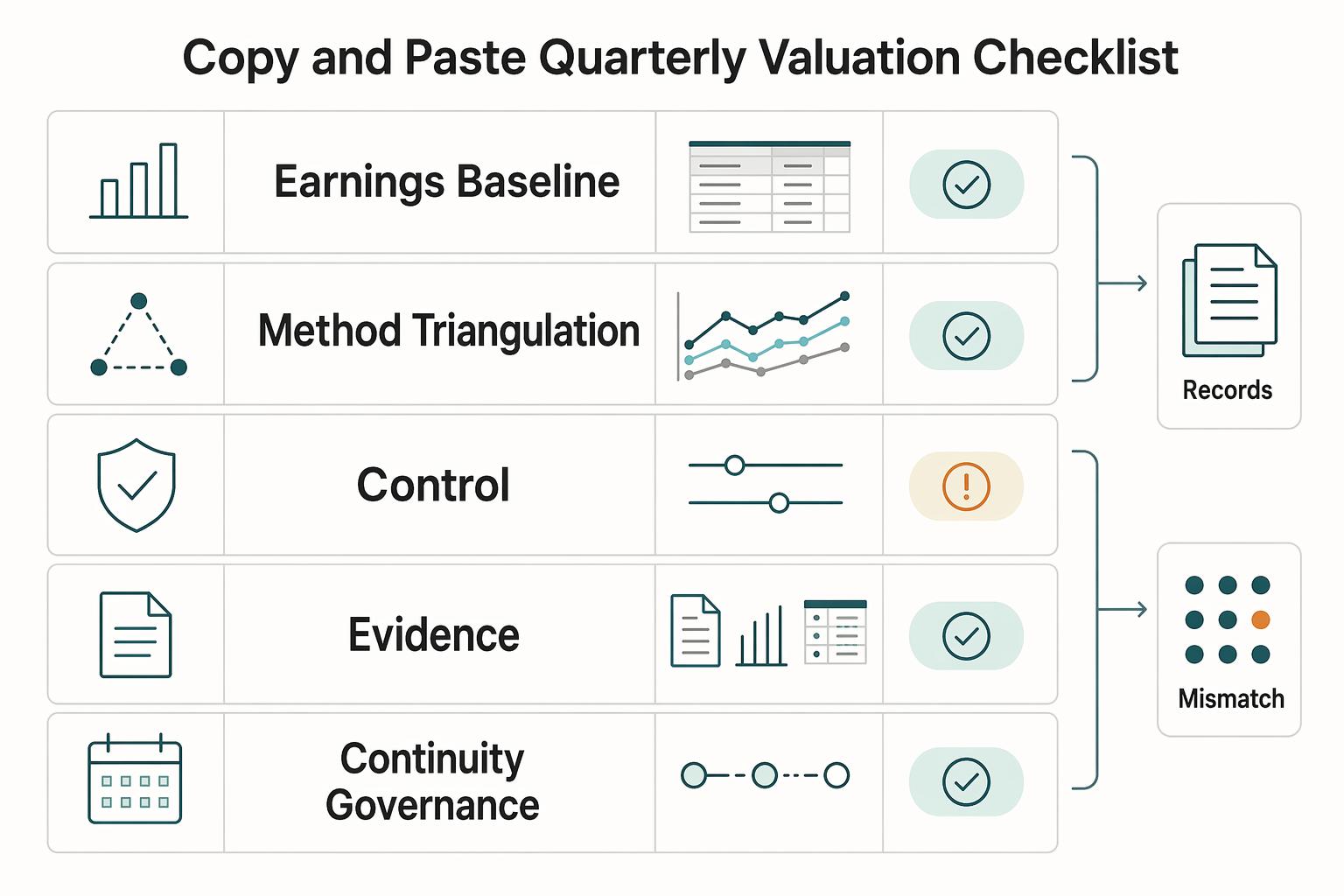
Keep a quarterly evidence pack so your WACC stays defensible#
A quarterly evidence pack keeps your WACC defensible because each update is tied to current inputs and dated support, not memory. Use it so each DCF or Business Valuation decision can be traced to what you knew at that time.
| Item | What to keep | Purpose |
|---|---|---|
| Cost of Debt (Rd) support | Current support for Rd | Tie each update to current inputs and dated support |
| Cost of Equity (Re) support | Current support for Re | Tie each update to current inputs and dated support |
| Market-value capital mix | An updated market-value view of equity and debt (E + D) | Keep weighting aligned with current conditions |
| Source note and as-of date | A source note and an as-of date for every input | Do not carry an input forward as verified if you cannot show where this quarter's number came from |
| Frozen model snapshot | A frozen model snapshot each quarter | Preserve the rate and the key inputs used in that decision |
| Short decision note | What changed, how WACC moved, and which Hurdle Rate calls are affected | Keep the update practical and decision-focused |
| Uncertainty flags | Terminal value assumptions, cyclicality, execution risk, and borderline-call changes | Escalate for review rather than treating the output as automatic |
Gather the key inputs that change over time. Capture current support for Cost of Debt (Rd), Cost of Equity (Re), and your market-value capital mix (E + D). Keep an updated market-value view of equity and debt so weighting reflects current conditions.
Set one rule: every input needs a source note and an as-of date. If you cannot show where this quarter's number came from, do not carry it forward as verified.
Save a model snapshot every time you update. Save a frozen model snapshot each quarter instead of overwriting prior assumptions. The snapshot should preserve the rate and the key inputs used in that decision.
That record lets you explain changes later. Without it, it is harder to clearly separate cash-flow changes from discount-rate changes.
Attach a short decision note. With each update, add a short note covering what changed, how WACC moved, and which Hurdle Rate calls are affected. Keep it practical and decision-focused.
Also flag uncertainty where it matters. NPV outputs can hide terminal value assumptions, cyclicality, and execution risk. If a revised rate changes a borderline call, escalate it for review rather than treating the output as automatic.
Use WACC as a decision tool not a math exercise#
A defensible WACC matters only if it drives a real choice. Use it to make clearer pricing, financing, and project-selection decisions.
Run one real decision through DCF and NPV. Pick one live decision and run it end to end. Use WACC as the discount rate in your DCF, then read the NPV as the first decision signal: positive supports proceeding, negative supports rejecting.
If you want a quick mechanics refresher, pair this step with A Guide to Discounted Cash Flow (DCF) Valuation.
Before you trust the output, verify the build. Confirm each capital component is weighted by its share of total capital, and confirm debt is treated on an after-tax basis consistently across inputs.
Turn the output into an action, not a report. Use WACC as a hurdle rate, then apply judgment with scenarios. One model run is not a permission slip.
A practical decision filter:
- If NPV is positive in base and stressed cases, proceeding is usually defensible.
- If base is positive but stressed is near zero or negative, reprice, tighten payment timing, reduce upfront spend, or stage the commitment.
- If both are negative, decline or pause until assumptions or financing conditions improve.
Build the input sheet and set a review cadence. Your next move is simple: build a one-page input sheet, run one real decision through DCF/NPV, and save the sheet with the model snapshot. Include E, D, Rd, Re, tax treatment, source notes, and last-updated dates so you can update consistently instead of rebuilding from memory.
A quarterly review cadence is a practical default, not a universal rule. Some market-risk inputs update quarterly, while many broader cost-of-capital datasets refresh annually at the start of the year, so update sooner when conditions move.
If you also need tighter payout visibility in the same workflow, explore Gruv options where supported. Confirm fit for your own audit-ready money movement and recordkeeping needs.
When you are ready to pair this decision framework with clearer payment operations and records where supported, review Merchant of Record for freelancers.
Related Guides and Official References#
- Use this related guide to align your scope and pricing assumptions before execution.
- Cross-check execution steps with this workflow and tighten approval checkpoints.
- Review a contingency pattern in Value-Based Pricing for Freelancers before rollout.
- Benchmark assumptions against this supporting article to avoid planning drift.
- Track legal/compliance edge cases in this linked explainer if your setup is cross-border.
Use official documentation for policy and filing details, including primary guidance, administrative rules, and reference material.
Quick Comparison Table#
| Input | Base assumption | Sensitivity check |
|---|---|---|
| Risk-free rate | Current sovereign yield | Model +/- 50 bps |
| Equity risk premium | Market standard range | Test low/base/high case |
| Cost of debt | Blended borrowing rate | Recompute after covenant changes |
Frequently Asked Questions
How do you calculate WACC in five practical steps?
One practical five-step flow is to set Market Value of Equity (E) and Market Value of Debt (D), convert them to weights with V = E + D, estimate Cost of Debt (Rd), estimate Cost of Equity (Re), then apply (E/V × Re) + ((D/V × Rd) × (1 - T)). As a check, your equity and debt weights should add to 100%. Keep tax treatment consistent across inputs before using the result in DCF or Capital Budgeting.
Should freelancers and small agencies use WACC or a simpler Hurdle Rate?
Use WACC when the decision is material and you need a blended cost of capital tied to your funding mix. Use a simpler Hurdle Rate when you need a faster minimum-return screen and more precision would not change the decision. Many teams use WACC as their hurdle rate, but there is no rule that every decision needs a full build.
What is the plain-language difference between Cost of Equity (Re) and Cost of Debt (Rd)?
Cost of Equity (Re) is the return shareholders require for taking equity risk. Cost of Debt (Rd) is the interest rate paid on existing debt. In private firms, debt and equity market values are often not directly observable, so inputs that require traded values are typically estimated.
Why does debt get adjusted as After-Tax Cost of Debt?
Debt is adjusted after tax because interest expense can reduce taxable income, which can lower the effective borrowing cost. That is why WACC commonly uses an after-tax debt term. Use your actual tax situation, since tax treatment is not identical across entities and jurisdictions.
What does a high WACC mean before taking a new client project?
A higher WACC usually signals higher perceived risk and a higher required return. It also reduces the present value of future cash flows when you discount them. It is not an automatic reject signal by itself. Test whether NPV stays positive at the appropriate hurdle rate.
What is usually unknown when a private business estimates Market Value of Equity (E)?
The main unknown is often the market value itself. In private businesses, debt and equity market values are often not directly observable, so inputs that require traded values must be estimated. Treat E as an explicit assumption and document the method or proxy you used.
How often should I update WACC for Capital Budgeting decisions?
There is no universal fixed interval. Reassess when market conditions or key inputs move enough to affect decisions, and keep a regular review cadence. A monthly or periodic refresh can make sense if your market-data inputs move that often.
Try a related tool
Researched and edited by the Gruv editorial team. Gruv builds cross-border billing, payouts, and finance-operations software for global businesses.
Sources
Includes 4 external sources outside the trusted-domain allowlist.
- investor.gov/introduction-investing/investing-basics/glos...trusted
- irs.gov/taxtopics/tc505trusted
- pages.stern.nyu.edu/~adamodar/New_Home_Page/datafile/wacc.htmltrusted
- sec.gov/answers/wacc.htmtrusted
- investopedia.com/terms/w/wacc.aspexternal
- mccrackenalliance.com/blog/what-is-wacc-how-to-calculate-weighted-...external
- openstax.org/books/principles-finance/pages/17-2-the-cost...external
- openstax.org/books/principles-finance/pages/17-3-calculat...external
Educational content only. Not legal, tax, or financial advice.
Related Posts

Hiring a Subcontractor for the First Time Without Costly Surprises
**Start with a risk-control sequence, not an ad hoc handoff.** As the Contractor, your goal is simple: deliver cleanly, control scope, and release payment only when the work and file are complete.
How to Perform a Business Valuation for a Small Agency
**Treat valuation for a small agency as a risk control system, not a headline multiple, and you are more likely to protect agency value before you ever start selling a business.**
Discounted Cash Flow DCF Valuation for Solo Professionals
When you compare client options, do not start with the headline fee. Start with which option gets you more cash sooner, with less risk. That is what **discounted cash flow (DCF)** means in practice.