
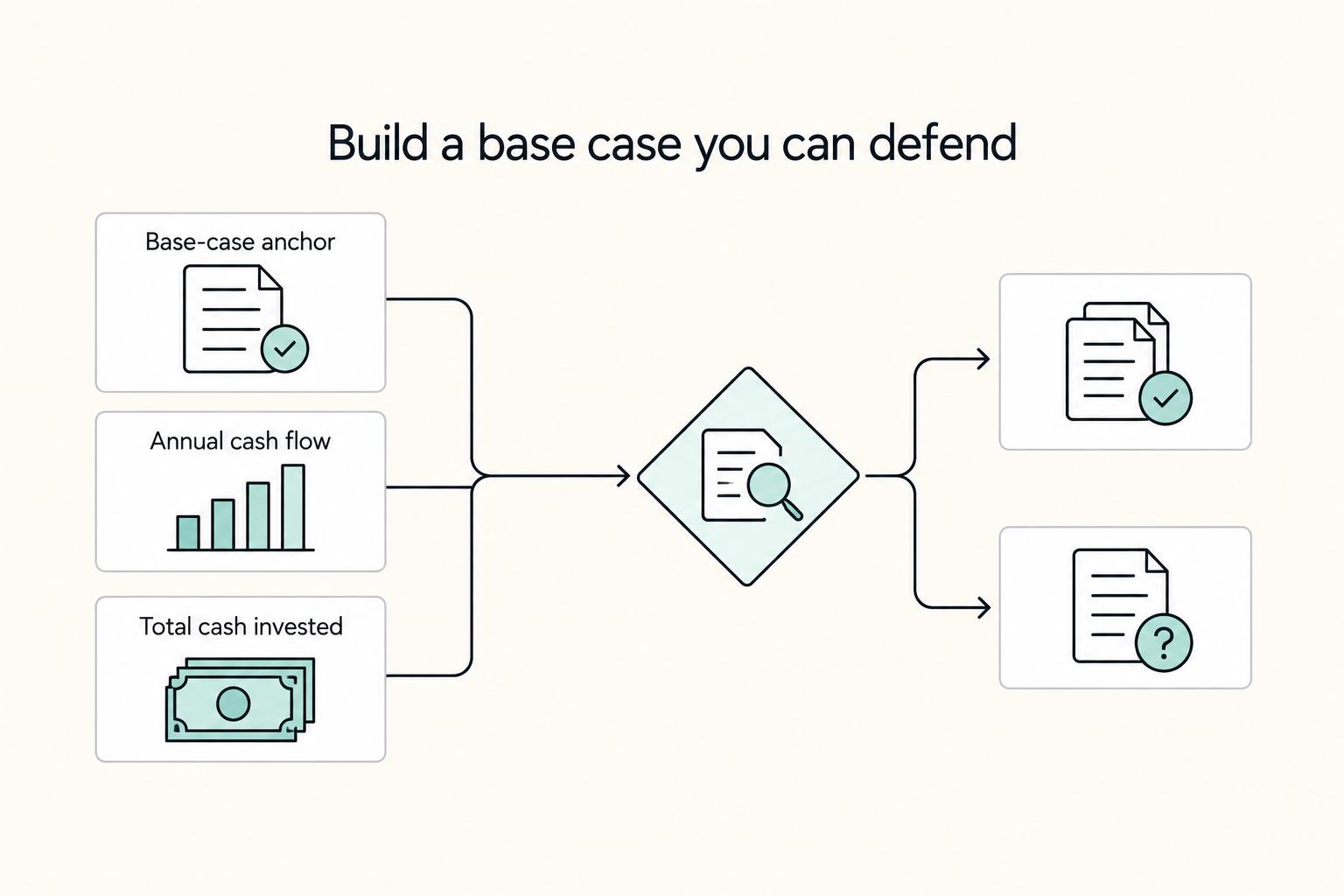
Quick Answer
Calculate cash-on-cash return by dividing annual pre-tax cash flow by total cash invested, then multiplying by one hundred. In practice, the article recommends treating that output as a baseline, not a verdict: verify each input with documented assumptions, run downside and catastrophic cases, and check whether the property still fits your time and operating constraints through the autonomy scorecard before calling the deal attractive.
Stop Calculating, Start Strategizing: A Risk-First Framework for Real Estate Returns#
If your Business-of-One depends on disciplined decisions, real estate should be no exception. Yet a lot of investing advice still reduces the decision to one output: a single return figure. Find the number, compare it to a benchmark, and decide whether the deal is "good."
That is too thin to be useful on its own. Positive earnings or an attractive return can still fail to create value if the present value of future cash flows does not exceed the cost of the investment. Even strong metrics like ROIC can mislead when you ask the wrong question. A more useful checkpoint is the ROIC-WACC spread alongside enterprise value relative to invested capital.
A percentage on its own cannot tell you how a plan will hold up under stress or how you will react in a severe downturn. One documented failure mode is investors selling near market bottoms and never re-entering, permanently damaging outcomes. That is why this guide treats return as a risk-management question, not just a rental metric.
This guide moves past the basic formula and gives you a three-step decision process. You will learn to:
- Build a "Bulletproof" Base Case: Use core investment checks to build a conservative model that holds up under scrutiny.
- Conduct a 3-Scenario Stress Test: Move beyond one projection and model downside and catastrophic cases so you know how much shock the deal can take.
- Score the Asset for Autonomy: Judge the investment against your scarcest resource, your human capital and focus, so it supports your life instead of complicating it.
You are not just learning a formula. You are building a way to test a deal before it tests you.
Related: Accrual vs Cash Basis Accounting for Small Agencies.
Part 1: How to Build a Base Case You Can Defend#
Treat your base case like a business case you may need to defend later, not a quick first-pass screen. If your assumptions are loose at the start, the rest of the analysis usually gets looser with them. That is how rework, overruns, and bad yeses creep in.
Before you begin, gather the inputs you can actually verify: the listing or offer price, lender terms, tax and insurance estimates, any management quote, and a written rehab scope if the property is not already rent-ready.
Step 1. Anchor the deal with one baseline equation#
Start with the core formula, then treat it as a baseline, not a verdict.
Cash-on-Cash Return = (Annual Pre-Tax Cash Flow / Total Cash Invested) x 100%
It tells you the annual return on the cash you personally put into the deal. That makes it useful because it focuses on your capital at risk, not the full asset value. When you also want a property-level view that is less tied to your financing, pair this with cap rate instead of relying on one percentage alone.
The checkpoint here is simple: every number in this formula should tie back to a document, quote, invoice, or written assumption you would be comfortable showing someone else. If you cannot trace an input, it does not belong in the base case yet.
Step 2. Build annual cash flow with zero omissions#
Most weak projections fail for a boring reason: income gets rounded up and expenses get rounded down. Do the opposite. Build annual pre-tax cash flow from gross rent downward and assume the property will occasionally behave like a real asset, not a clean spreadsheet.
| Line item | Include | Note |
|---|---|---|
| Gross Scheduled Income | Monthly rent x 12; other income such as parking, laundry, or storage | Only if it is real and recurring |
| Vacancy Allowance | A conservative assumption | Based on the market, lease-up reality, and the specific unit |
| Operating Expenses | Mortgage principal and interest; property taxes; insurance; property management; HOA fees if applicable; repairs and maintenance; capital expenditure reserves; utilities you cover as landlord; other recurring costs such as landscaping, pest control, legal, and accounting | Separate routine repairs from true capital items before you total expenses |
If you prefer to build it line by line, use this checklist:
- Gross Scheduled Income
- Monthly rent x 12 * Other income such as parking, laundry, or storage if it is real and recurring
- Less: Vacancy Allowance
- Use a conservative assumption based on the market, lease-up reality, and the specific unit * Do not underwrite permanent full occupancy
- Less: Operating Expenses
- Mortgage principal and interest * Property taxes * Insurance * Property management * HOA fees if applicable * Repairs and maintenance * Capital expenditure reserves for larger future replacements * Utilities you cover as landlord * Other recurring costs such as landscaping, pest control, legal, and accounting
A useful checkpoint is to separate routine repairs from true capital items before you total expenses. If you blur those together, cash flow can look cleaner than it will feel in real life.
Step 3. Define total cash invested as every dollar at risk#
Total cash invested should include every dollar required to acquire, stabilize, and operate the asset, not just the down payment.
Include every dollar that is already committed or likely required to get the property operating:
- Down Payment
- Closing Costs
- Initial Rehab Costs
That framing matters because the real comparison is not only "what return does this property produce?" It is also "what else could this cash and attention do for me?" If the deal will eat your weekends, price your own time with the same honesty you would use for client work, just as you would when setting your own rate in How to Calculate Your Billable Rate as a Freelancer.
For location-flexible investors buying from abroad, the same rule applies. If there are setup or oversight costs needed to own the property safely, keep them inside the model, especially if you are using a remote-operator playbook like How to Invest in Real Estate as a Digital Nomad.
The common failure mode here is fuzzy scope. In practice, that usually means vague rehab plans, missing reserves, or soft operating-cost assumptions. The result is familiar: rework, cost overruns, delays, and wasted opportunity cost.
Step 4. Run the numbers and read the answer without flinching
Here is a conservative worked example using one specific deal setup:
| Category | Metric | Calculation | Amount |
|---|---|---|---|
| Acquisition | Purchase Price | $300,000 | |
| Acquisition | Down Payment | 20% of Purchase Price | $60,000 |
| Acquisition | Closing Costs | 3% of Purchase Price | $9,000 |
| Acquisition | Initial Rehab | New flooring & paint | $6,000 |
| Acquisition | Total Cash Invested | $60,000 + $9,000 + $6,000 | $75,000 |
| Income | Gross Monthly Rent | $2,500 | |
| Income | Annual Gross Rent | $2,500 x 12 | $30,000 |
| Income | Vacancy Loss | 5% of Annual Gross Rent | -$1,500 |
| Income | Annual Operating Income | $30,000 - $1,500 | $28,500 |
| Expenses | Annual Mortgage (P&I) | $240k loan @ 6% | -$17,267 |
| Expenses | Property Taxes | -$3,600 | |
| Expenses | Insurance | -$1,200 | |
| Expenses | Repairs & Maintenance | 1% of Purchase Price | -$3,000 |
| Expenses | CapEx Savings | 1% of Purchase Price | -$3,000 |
| Expenses | Total Annual Expenses | -$28,067 | |
| Result | Annual Pre-Tax Cash Flow | $28,500 - $28,067 | $433 |
| Result | Base Case Cash-on-Cash Return | ($433 / $75,000) x 100% | 0.58% |
A 0.58% result is not a reason to panic, and it is not a reason to kill the deal on the spot. It is a reason to get honest. What matters now is that you have a conservative baseline you can test, rather than an optimistic one that falls apart the first time reality shows up.
If you want a deeper dive, read How to Calculate the Cash Conversion Cycle for a Service Business.
Part 2: Will This Investment Survive a Downturn? The 3-Scenario Stress Test#
The question here is simple: can the deal survive a bad year without destabilizing your broader finances? Use this section as a planning structure, not a source of fixed market thresholds, so do not assume specific real-estate stress-test thresholds apply to your deal.
1. Your "Base Case" is the realistic outcome#
Start from the conservative model you built in Part 1. This is your normal-year operating view, using inputs you can document and defend.
2. The "Downside Case" covers moderate turbulence#
Model a year where multiple things go wrong at once, then check whether the property still carries itself or requires cash support. Keep the assumptions explicit so you can see exactly what changed from the base case.
3. The "Catastrophic Case" tests the maximum risk#
Model your credible worst year and calculate the cash you would need to inject to keep the property operating. The key judgment is whether that cash requirement is survivable for you, not whether the spreadsheet still looks acceptable.
Comparing the scenarios from profit to burn#
Put the three scenarios side by side and compare them on the same outputs: annual cash flow, return impact, and required cash support. That comparison turns abstract risk into a concrete go/no-go discussion around liquidity and resilience.
| Scenario | What it represents | What to check |
|---|---|---|
| Base Case | The realistic outcome; your normal-year operating view | Use inputs you can document and defend |
| Downside Case | Moderate turbulence; a year where multiple things go wrong at once | Whether the property still carries itself or requires cash support |
| Catastrophic Case | Your credible worst year | The cash you would need to inject to keep the property operating and whether that requirement is survivable for you |
You might also find this useful: Discounted Cash Flow DCF Valuation for Solo Professionals.
Part 3: Does This Asset Drain Your Time, Attention, or Flexibility?#
Surviving a downturn is only part of the decision. A property can be financially survivable and still be a bad fit if it drains your time, attention, or flexibility. If an asset scores poorly on time commitment and complexity, treat that as a serious warning even when the projected return looks acceptable.
| Scorecard area | What to assess | Low score means | High score means |
|---|---|---|---|
| Time-Commitment | Property condition; tenant profile; management plan | A high-friction asset that will function like a second job | A truly passive investment that lets you focus on what you do best |
| Complexity | Tax & legal hurdles; logistical headaches; currency fluctuation risk | A complex investment that could create unforeseen tax burdens | A straightforward asset that integrates cleanly into your existing financial life |
| Scalability | Systematization; market depth; financing | You are buying a one-off project | You are laying the foundation for a scalable, wealth-generating real estate business |
The Time-Commitment Score asks whether it fuels or drains your core business#
This score is about protecting your earning hours. A rental that needs constant decisions, contractor follow-up, tenant messaging, or travel is not passive just because you outsourced part of it.
Start with three things: the property itself, the tenants you expect to serve, and the management plan you will actually use. The key checkpoint is not hoping management will be easy; it is having named people, written terms, and a handoff process before closing.
For freelancers and solo operators, this is direct earnings-capacity math: time spent on property issues is time not spent on client delivery, pipeline, or recovery that supports billable output. If your time value is still fuzzy, set that baseline first in How to Calculate Your Billable Rate as a Freelancer.
A common failure mode is assuming you will "just handle it yourself" until the first vacancy, repair chain, or tenant dispute lands in the middle of a busy work month.
The Complexity Score asks whether it simplifies or complicates your global life#
Complexity usually shows up after closing, not in the listing. It appears in signatures, tax prep, bank transfers, insurance questions, entity choices, and the quality of records you can actually review.
| Checkpoint | What to review | Why it matters |
|---|---|---|
| Evidence pack | Ask for an evidence pack, not verbal reassurance | Governance documents can reveal whether a "simple" unit is actually carrying admin and downside risk you will inherit |
| Annual budget | Review the annual budget | Shows how the place is actually run |
| Statutory reserve account under 703.163 | Review the reserve-account documentation | One of the details that matters in practice |
| Lien mechanism under 703.165 | Review how unpaid common expenses, damages, and penalties are addressed | Another detail that matters in practice |
| Organized records | Confirm records are available for review | You want more than scattered screenshots and vague promises |
If you are location-independent and evaluating a foreign market, use How to Invest in Real Estate as a Digital Nomad as a practical cross-border execution check before you commit.
A good rule here is to ask for an evidence pack, not verbal reassurance. If the asset is a condo, look for documents that show how the place is actually run. In Wisconsin, Chapter 703 of the Condominium Ownership Act points to the kinds of details that matter in practice, including an annual budget, a statutory reserve account under 703.163, and a lien mechanism under 703.165 for unpaid common expenses, damages, and penalties.
You do not need to be investing in Wisconsin for that example to help. The lesson is that governance documents often reveal whether a "simple" unit is actually carrying admin and downside risk you will inherit.
Record quality is another hard checkpoint. You want organized records you can actually review, not scattered screenshots and vague promises from a manager or seller.
The Scalability Score asks whether this is a one-off deal or a repeatable system#
A one-off asset can still make money, but this score asks whether the deal improves autonomy or just adds another isolated project.
Use it alongside yield metrics, not instead of them: cap rate helps you assess the asset's income profile, while autonomy scoring tests whether the operating model is repeatable for your business-of-one. For that yield lens, see How to Calculate Cap Rate for a Rental Property.
The tradeoff is straightforward. A slightly lower-yielding deal in a repeatable market with reliable financing and a reusable team may fit your business better than a supposedly better deal that cannot be replicated.
A high scalability score means the first property is building infrastructure, not just producing a one-time result. That is the kind of asset that supports autonomy instead of quietly replacing one job with another.
We covered this in detail in Net-30 Payment Terms for Platforms: How to Set Vendor Payment Terms Without Killing Contractor Cash Flow.
Conclusion: Your Return Isn't a Number - It's a Measure of Your Control#
The usual debate asks whether a cash-on-cash return is "good." That misses the point. The number is an output: annual cash flow divided by total cash invested. The value is that it helps you see how efficiently your invested equity is generating cash flow.
Cash-on-cash return is especially useful when financing changes the picture. Because debt service affects annual cash flow, this metric can help you compare financing options and debt/equity balance in the capital stack.
It is still not a standalone decision rule. Cash-on-cash return is a period metric, usually measured over a year, and it does not capture everything that matters over a hold period. It does not account for changes in income and expenses over time, future capital investments, or potential cash flow from a sale.
The better question is not "What is the highest return?" but "What is durable and understandable based on this metric plus the rest of the deal analysis?" That is what turns rental analysis into a strategic decision.
For a step-by-step walkthrough, see How to Read a Cash Flow Statement.
Frequently Asked Questions
How do you calculate cash-on-cash return with vacancy?
The formula does not change. One common approach is to divide annual pre-tax cash flow by total cash invested, and that cash-flow figure should reflect realistic operating assumptions, including vacancy. Using full scheduled rent can overstate the result.
What is a complete list of expenses for calculating cash flow?
Use every cost that affects annual pre-tax cash flow in real operation, not just a simplified example. Most investors will have expenses, and if the property is financed, debt service matters because cash-on-cash is a levered metric. A common failure mode is leaving out recurring or predictable costs and treating them as exceptions.
Is a higher cash-on-cash return always better?
No. The metric is situational, so a higher percentage is not automatically the better decision in every analysis. If the return only looks attractive because your assumptions are too optimistic, revisit How to Calculate Your Billable Rate as a Freelancer. Then decide whether the spread is real profit.
How does cash-on-cash return change over time?
It changes whenever annual pre-tax cash flow or your invested cash changes. One important checkpoint is consistency: some analysts use total cash invested, while others use equity invested at period end, so comparisons break if you switch methods midstream.
What is the difference between cash-on-cash return and ROI?
Cash-on-cash return is an annual, pre-tax cash-flow measure tied to the cash or equity basis you use in the deal. ROI is often used more broadly, so the two can answer different questions depending on method. If you want another lens alongside it, How to Calculate Cap Rate for a Rental Property is a useful next read.
How do currency fluctuations impact cash-on-cash return for an international investor?
By itself, cash-on-cash does not define currency handling; the core calculation is still annual pre-tax cash flow over invested cash or equity. For international deals, set a consistent currency and method before comparing results. If you are weighing that kind of deal, How to Invest in Real Estate as a Digital Nomad is the practical next step.
What is a good cash-on-cash return in today's market?
There is no universal benchmark in these definitions that holds across markets, financing terms, and assumptions. Compare only deals that use the same denominator convention and similarly realistic pre-tax cash-flow assumptions.
Try a related tool
Researched and edited by the Gruv editorial team. Gruv builds cross-border billing, payouts, and finance-operations software for global businesses.
Sources
- dhcs.ca.gov/provgovpart/Documents/2024-Managed-Care-Boil...trusted
- docs.legis.wisconsin.gov/document/statutes/703.pdftrusted
- dot.ca.gov/-/media/dot-media/programs/local-assistance/...trusted
- eba.europa.eu/sites/default/files/document_library/Calenda...trusted
- ecb.europa.eu/pub/pdf/scpwps/ecb.wp2693~8d4e580438.en.pdftrusted
- ecfr.gov/current/title-49/subtitle-A/part-26trusted
- edocs.rentonwa.gov/Documents/DocView.aspxtrusted
- federalregister.gov/documents/2024/04/22/2024-07496/guidance-for...trusted
Educational content only. Not legal, tax, or financial advice.
Related Posts
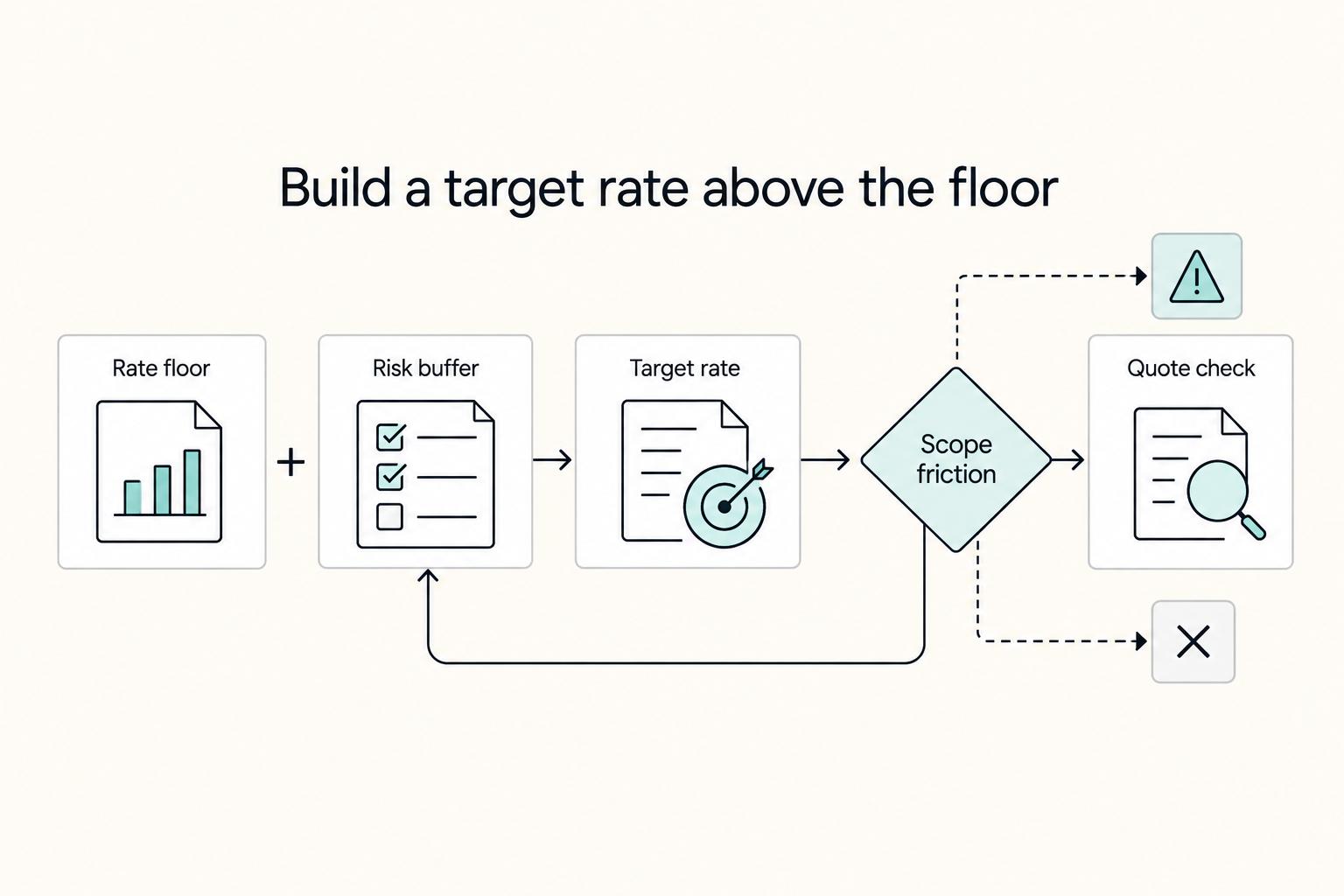
How to Calculate a Freelance Rate You Can Actually Get Paid On
A workable rate is not the neat number a calculator produces. It is the number that still works after you account for real billable capacity, non-client time, scope drift, and the gap between sending an invoice and receiving cleared cash. Start with hourly math even if you do not plan to bill hourly, then turn that number into a quote with clear `payment terms`.
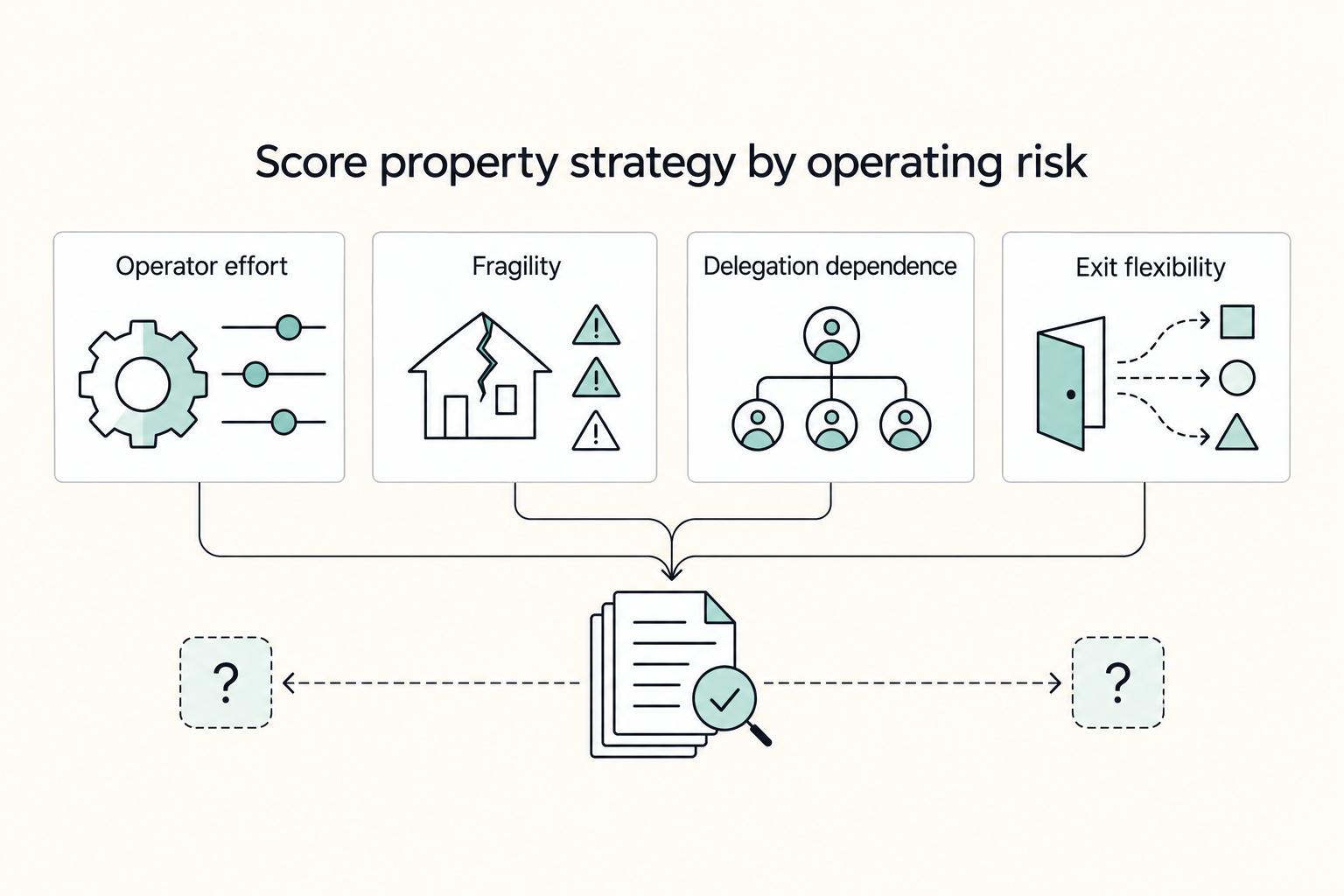
How to Invest in Real Estate as a Digital Nomad
**Run anything with money and moving parts like an operations system (cash, docs, delegation, and controls), not a "passive income" vibe.** Real life stress-tests weak spots. You change time zones, a client pays late, and something breaks at the worst moment. As the CEO of a business-of-one, your job is to build a setup that keeps working when you are not available on demand.
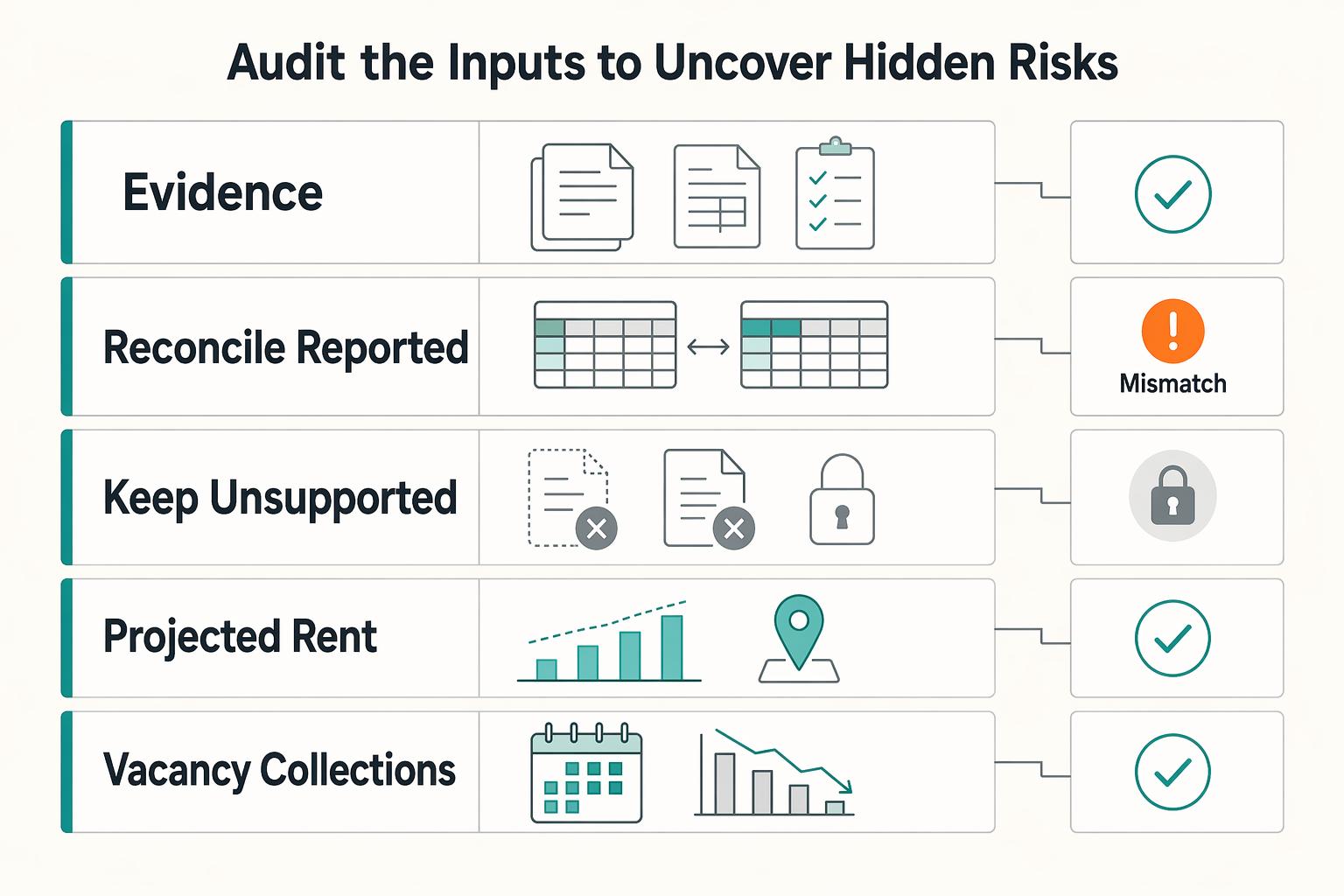
How to Calculate Cap Rate for a Rental Property
To calculate cap rate, divide **Net Operating Income (NOI)** by the property's **current market value**. That gives you an unlevered view of the asset's earning power, without mixing in loan terms or owner tax position.