
Quick Answer
Yes. For how to buy us stocks in uk, first clear your UK admin position, then open a share dealing account, complete any required declaration such as W-8BEN, compare full broker costs, and place a small test order with records kept. The article stresses doing HMRC checks early, including the 5 October notification point where Self Assessment applies, and verifying account and instrument labels before each trade so you do not enter the wrong product type.
How to buy US stocks from the UK without hidden cost surprises#
Before placing any order, handle the UK tax-admin items that can affect readiness later.
Step 1. Check your Self Assessment status early. Self Assessment is HMRC's process for telling them you need to complete a tax return. If you need to notify HMRC for the previous tax year (6 April 2024 to 5 April 2025), HMRC says you must do so by 5 October 2025. HMRC also says notifying after that date could lead to a penalty.
Step 2. Reactivate an existing account before filing, if needed. HMRC says your tax return may be delayed if you file without reactivating an existing Self Assessment account.
Step 3. Confirm your business structure before you proceed. UK guidance says your business structure can affect how you pay tax and your legal responsibilities. If you are operating as a sole trader, registration is done through Self Assessment (including when earnings go over £1,000 in a tax year). A limited company is legally separate from its owners.
Step 4. Then continue with your brokerage workflow. Once these HMRC admin points are clear for your situation, move ahead with your broker setup and first order.
Related: How to Buy US Stocks as an Australian Resident. Want a quick next step for "how to buy us stocks in uk"? Try the free invoice generator.
What to prepare before you open a share dealing account#
Prepare your records first, then start the application. The goal is a clean setup where your personal details, tax admin, and funding plan are consistent before broker onboarding begins.
Step 1. Confirm UK-resident details and make your records match. Use one consistent set of personal details across your application and your own documents (for example, legal name and current address). Check this before you apply so you are not fixing basic mismatches during onboarding.
Step 2. Get tax admin in order before broker tax forms (including W-8BEN). Keep HMRC tasks separate from broker setup, but do not leave them stale. GOV.UK says to check whether you need to send a tax return before registering, and first-time filers must register for Self Assessment before using the online filing service. HMRC also says to keep records such as bank statements or receipts, and notes that filing without reactivating an existing account may delay your return. If your residence position is unclear, review the Statutory Residence Test (SRT) first.
Step 3. Decide your funding currency before you fund the account. Pick your funding path in advance so you can compare brokers and payment methods on a like-for-like basis. A simple written choice now is better than deciding at the last click.
Step 4. Keep a one-page setup sheet beside you. Write down your target broker, funding method, and the cost checks you will confirm before placing any order. If those points are still vague, pause and finish the sheet first.
Compare brokers by total cost and execution fit#
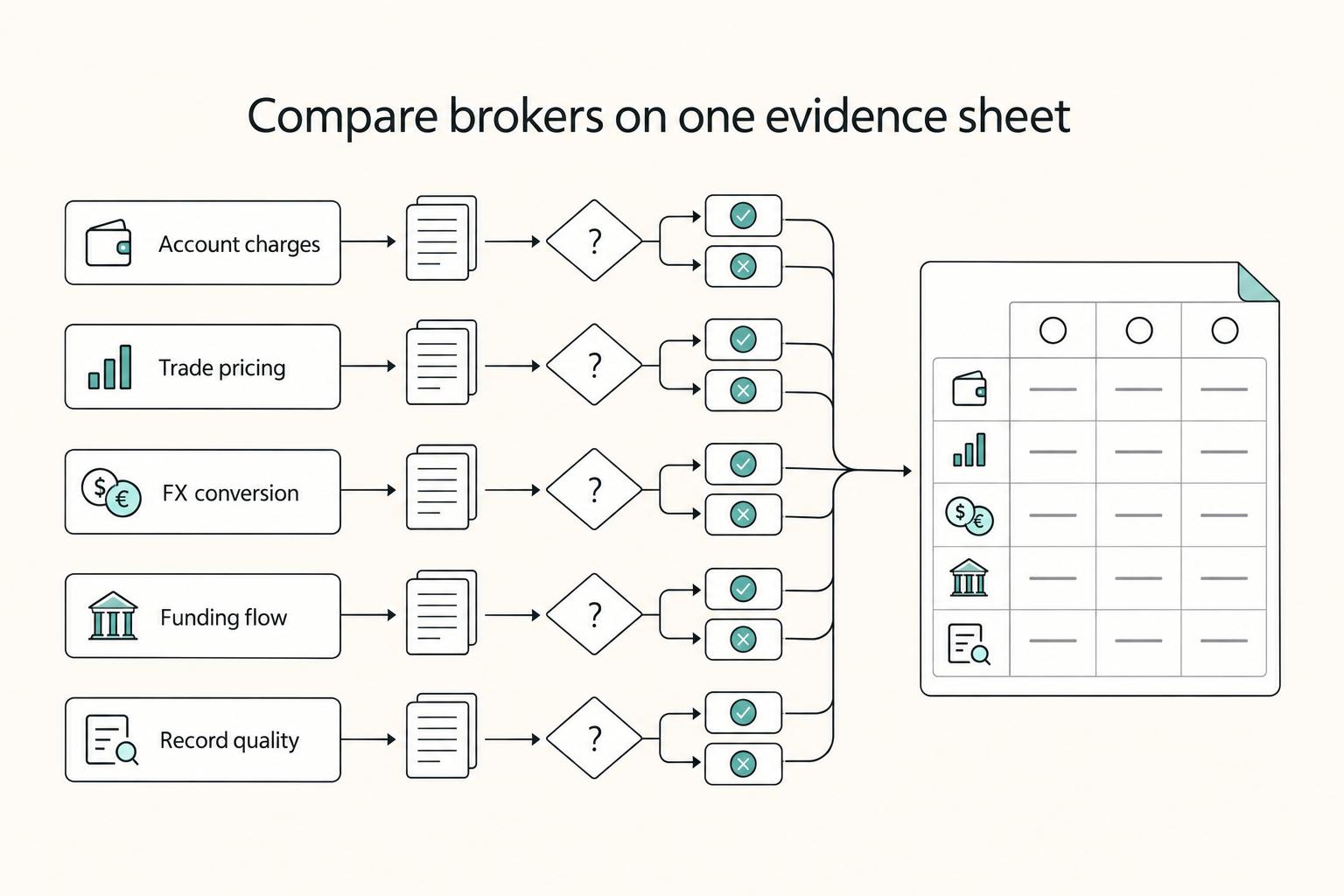
Use one like-for-like checklist for Trading 212, Interactive Brokers, and IG Group, and do not choose from a headline label alone. Your goal is to pick the broker whose costs, order flow, and cash movement you can explain clearly before you fund.
Build one comparison sheet and complete every line#
Use your planned first buy, funding currency, and one planned sale, then fill the same fields for each broker from its own pricing and help pages.
| Item to compare | What to record | Decision signal |
|---|---|---|
| Platform/account charges | Any ongoing charge tied to holding or dealing | If you cannot confirm it clearly, treat as unresolved risk |
| Trade pricing | How buy/sell costs are described | If wording is unclear, do not assume it is cheaper |
| Currency conversion | When conversion happens and how the cost is shown | Prefer setups you can track without guesswork |
| Funding and withdrawal flow | Methods, steps, and status visibility | Avoid flows that are easy to fund but unclear to withdraw |
| Records quality | What confirmations and statements actually show | Prefer clear fee/FX/cash lines you can reconcile quickly |
If you cannot complete every row from public docs in a short review, pause and verify before depositing more.
Match pricing style to how you will trade#
If you plan small, infrequent trades, simpler pricing and fewer moving parts are usually easier to manage. If you plan regular trading and tighter GBP/USD control, prioritize clearer execution and FX handling you can model in advance.
Verify reliability before scaling up#
Before you increase size, test with a small amount and confirm:
- Order confirmations are complete and readable.
- Statements let you reconcile holdings and cash without manual detective work.
- Deposits and withdrawals show clear status changes.
Keep tax admin separate from broker selection. GOV.UK says you must tell HMRC by 5 October if you need to complete a tax return for the previous year, and filing without reactivating an existing Self Assessment account may delay your return. Use those deadlines to keep records clean, not to rush broker choice.
Complete W-8BEN and account declarations correctly the first time#
Complete your broker's required US tax declaration and make your account details consistent before you fund. That keeps your first US shares purchase from being delayed by avoidable admin mismatches.
Treat the declaration as a pre-trade setup task#
Broker flows differ, so verify this directly in your own account and help docs rather than assuming it was done during signup. Check onboarding, profile, and tax/settings areas until you can clearly confirm whether any required US tax declaration is still outstanding.
Do this before funding or placing an order. The goal is simple: finish declarations first, then move cash and trade.
Run a line-by-line field check before submission#
Use this sequence before you submit:
| Field | Reference point | What to confirm |
|---|---|---|
| Legal name | account ID records | match the format used on your account ID records |
| Residency details | account profile, ID records, and declaration fields | keep your answers consistent across account profile, ID records, and declaration fields |
| Final declaration review | summary page | check the summary page slowly, confirm the account holder type is correct, and save any confirmation record |
If your residency history is unclear, reconcile your records first and use Understanding the UK's Statutory Residence Test (SRT) as background.
Confirm account readiness before first funding#
Do not treat a draft or partial submission as complete. Proceed only after your broker's own account screens or support path confirm there are no pending declaration issues for US dealing.
This section is not tax advice. If you are investing through a company or another separate structure, treat that as a separate review path. For example, the IRS Instructions for Form 5472 (12/2024) include dedicated sections titled "Who Must File" and "When and Where To File," which signals entity cases need their own handling.
Keep plain share investing separate from leveraged trading products#
If your goal is long-term ownership, only place orders that are clearly shown as a standard share purchase, and treat any leveraged product as a separate risk decision.
Check the instrument label before you check the price#
Start with the product label, account section, and order preview, then look at the chart. On many platforms, similar language can appear across different parts of the app, so confirm what you are buying before you confirm the order.
For each order, verify these three fields match your intent:
- account type
- instrument label
- order preview wording
If any one is unclear, stop and check the broker's own product description first.
Match the product to the job#
If you want to buy and hold shares, use the share-dealing route. If the platform presents something as leveraged or short-term trading, do not treat it as interchangeable with plain investing.
This is where confusion often starts: some guides use "invest," "trade," and "buy" loosely. Keep your own decision standard tighter than that wording.
Use a one-sentence risk test before you confirm#
Do not place a trade you cannot explain in one sentence, including worst-case loss. A practical check is: what am I buying, in which account, and what happens if I am wrong?
A common mistake is funding the right account, then entering through the wrong tab. Slow down, re-check the three fields above, and only proceed when they are unambiguous.
For a step-by-step walkthrough, see How to Invoice a US Client from Mexico as a Temporary Resident.
Place your first order with operational checkpoints#
Use your broker's documented order flow and treat your first trade as a verification exercise, not a speed exercise. With the approved sources for this section, detailed execution steps for US stock orders are not evidenced, so confirm each step against your platform's own help pages and the order ticket wording before you submit.
Before placing the order, make sure you can clearly identify what you are buying, which account you are using, and what total cash movement the ticket shows. After submission, keep the platform records as shown so you can reconcile the trade in your account history. If anything is unclear or the order outcome is not obvious, pause and verify in your broker's guidance before trying again.
Manage FX exposure so returns are not quietly eroded#
After your first order, the next risk to manage is currency. As a UK investor in US shares, your result has two moving parts: stock performance in USD and GBP/USD conversion back into pounds.
Separate the stock result from the currency result#
Review performance as two lines, not one. First, the share moves in dollars. Second, sterling moves against the dollar while you hold the position. So a solid USD gain can look weaker in GBP if the pound strengthens, while a weaker pound can cushion or lift your GBP result.
This is built-in dollar exposure, not a side detail. It can also change volatility: when equity-currency correlation is positive, combined volatility can rise; when it is negative, currency exposure can reduce overall volatility. Do not assume FX will always help or always hurt.
Map exactly where foreign exchange fees can hit#
Before you trade more often, identify each point where FX costs may appear in your broker flow:
| FX point | When it can happen | What to verify |
|---|---|---|
| deposit conversion | funding in GBP, then converting to USD | check the cash ledger, contract note, or statement to confirm whether you have separate GBP and USD balances or auto-conversion at each step |
| trade settlement conversion | if the platform auto-converts at buy or sell instead of letting you hold USD cash | check the cash ledger, contract note, or statement to confirm whether you have separate GBP and USD balances or auto-conversion at each step |
| withdrawal conversion | converting sale proceeds back to GBP for your UK bank account | check the cash ledger, contract note, or statement to confirm whether you have separate GBP and USD balances or auto-conversion at each step |
Then verify it in your records. Check the cash ledger, contract note, or statement to confirm whether you have separate GBP and USD balances or auto-conversion at each step. If you cannot see where conversion happened, you cannot see your true cost.
Pre-plan conversion moments before you increase trade frequency#
If your broker auto-converts whenever cash moves between GBP and USD, estimate your likely annual FX drag before increasing trade frequency. You do not need a perfect model; you need a realistic count of how often you convert.
The practical control is simple: pre-plan conversion moments and avoid unnecessary round trips. Converting to buy, converting back after selling, then repeating that cycle can stack avoidable FX cost on top of market risk.
If you want a separate tool later, formal currency hedging uses forwards to remove the impact of currency moves. But for most readers, the first operational win is to plan conversions in advance, keep one statement showing the FX entry, and cut unneeded back-and-forth moves.
Related reading: How a US photographer can license photos to a UK magazine and handle withholding tax.
Common mistakes and how to recover fast#
Most errors are fixable if you pause and verify before adding more money or placing more trades. Use this order: confirm account type, fix missing tax paperwork, then recalculate total cost.
Stop funding if you opened the wrong product#
If your account shows products like CFDs or spread betting when you intended to buy shares, pause funding and trading. Recover by moving to a true share trading account before you continue.
Check both the account label and the instrument label on the order screen. If plain share ownership is not clear, stop and confirm in the broker's own documentation first.
Complete W-8BEN if it is missing#
If W-8BEN is missing, complete it before treating your setup as finished. The form is used to notify a withholding agent about tax-residence status, so leaving it incomplete can create avoidable tax-handling confusion.
After submitting, verify your account records reflect that the form is on file before you assume withholding details are correct.
Recalculate "free" trades using full cost#
If you focused on zero-commission messaging, recalculate your all-in cost from your own records. Use your cash ledger and contract notes to include every FX conversion point in your workflow, not just the trade ticket.
The useful question is: what did the full GBP-USD-GBP round trip cost?
Validate forum shortcuts against official docs#
Forum threads can be useful prompts, but they are not your operating checklist. Confirm each action against your broker's documentation and your own account statements before acting.
Keep a small recovery pack: account type screenshot, W-8BEN record, first trade contract note, and one statement showing FX entries.
Your copy and paste checklist before every US stock purchase#
Use this as an admin checklist you repeat every time so the tax side stays routine, not reactive.
- Keep your records up to date as you trade.
HMRC says you need records (for example, bank statements or receipts) so you can fill in your tax return correctly. Do not leave this until year-end.
- Check whether Self Assessment registration applies to you.
GOV.UK says you register as a sole trader by registering for Self Assessment, including if you earn more than £1,000 in a tax year (6 April to 5 April).
- Confirm your registration setup is actually usable.
You need a National Insurance number to register for Self Assessment. If you have an older account, HMRC says you may need to reactivate your Self Assessment account before filing.
- Set your filing timeline before it becomes urgent.
HMRC says you can file online on or after 6 April following the end of the tax year. If you need to notify HMRC for the previous tax year, follow the stated deadline for that year (for example, 5 October 2025 in the cited guidance context).
- Repeat the same sequence each time.
Consistency is the point: records maintained, registration status clear, and filing readiness confirmed before this turns into a deadline problem.
Frequently Asked Questions
Can a UK resident legally buy US stocks through a UK broker?
Check broker terms and relevant UK regulatory guidance directly. Separately, if your activity means you need to file a UK tax return, HMRC says you must tell HMRC by 5 October for the previous tax year.
Do I always need a W-8BEN before buying US shares?
This guide does not state when a W-8BEN is required. Follow your broker’s onboarding steps and treat setup as complete only when any required tax forms are shown as received or accepted.
What costs should I calculate before placing my first US stock order?
Use your broker's published fee schedule and trade preview to confirm dealing, FX, and account charges before placing an order.
Is buying US shares the same thing as trading CFDs or spread betting?
Verify the exact product and account labels in your platform documentation before trading.
What is the first action to take before I choose a stock ticker?
If there is any chance you need Self Assessment, handle that early. First-time filers must register before using HMRC’s online filing service, and HMRC notes that filing without reactivating an existing account may delay your return. HMRC also says you must tell them by 5 October if you need to complete a return for the previous tax year; if you are waiting for a Unique Taxpayer Reference, do not leave that admin to January.
How do currency conversion and FX fees change my real return?
The HMRC material here does not quantify FX mechanics or broker conversion fees for US stock trading. Check your broker’s fee disclosures and statement entries so you can model the impact before and after trading.
What should I verify right after my first order is executed?
Keep complete records from your broker, and for UK tax admin remember that if Self Assessment applies, HMRC says you must tell them by 5 October for the previous tax year and pay any tax due by 31 January.
Try a related tool
Researched and edited by the Gruv editorial team. Gruv builds cross-border billing, payouts, and finance-operations software for global businesses.
Sources
- acquisition.gov/sites/default/files/current/far/pdf/FAR.pdftrusted
- dodcio.defense.gov/Portals/0/Documents/Library/(U)ZT_RA_v2.0(U)...trusted
- fema.gov/sites/default/files/2020-08/fema430.pdftrusted
- ftb.ca.gov/file/personal/residency-status/part-year-and...trusted
- ftb.ca.gov/forms/misc/1100.htmltrusted
- irs.gov/instructions/i5472trusted
- irs.gov/pub/irs-irbs/irb04-45.pdftrusted
- state.gov/releases/office-of-the-spokesperson/2025/12/...trusted
Educational content only. Not legal, tax, or financial advice.
Related Posts

Understanding the UK's Statutory Residence Test (SRT)
Treat SRT like ops, not folklore. You want a repeatable workflow you can run monthly so your tax-year answer is boring, documented, and easy to defend.

A Deep Dive into Form 5472 for Foreign-Owned US LLCs
**Treat Form 5472 as an IRS reporting workflow, not a tax guess, and you can cut avoidable penalty risk quickly.** If you run a globally mobile single-member LLC, most uncertainty comes from definitions, not effort. You can keep clean books and still miss a trigger because the IRS focuses on entity status, related parties, and reportable transactions.

The Freelance Payment Penalty: A Modeled Audit of Platform Fees, FX Spreads, and Payout Delays
The money rarely disappears through a single, easy-to-spot fee. The real loss is stacked. A marketplace takes its commission, a processor adds a charge for international cards, a bank or payment company converts the currency at a spread, a platform holds the funds before release, and a wire sheds a little to intermediaries on the way in. Each layer looks defensible on its own, but the worker feels the combined result as a smaller deposit and a later payday.