
Quick Answer
A Canadian resident can buy U.S. stocks by using a broker that supports the right account types, USD handling, and reporting, then choosing a clear currency-conversion and account-placement strategy. The article organizes the process into three repeatable parts: set up the platform correctly, manage FX and tax drag in the portfolio, and keep paperwork current, including W-8BEN status and an annual T1135 scope check for non-registered foreign holdings.
Buying U.S. stocks from Canada is straightforward only if you make it repeatable. The real friction is not the first trade. It is everything around it: broker behavior, currency conversion, withholding, account location, and the records that prove you handled each step correctly. A pile of disconnected tips does not solve that. It usually creates more second-guessing.
A better approach is to run this like the CEO of your own Business-of-One. That means using a simple operating structure instead of ad hoc decisions. This guide is built around three pillars: the Platform you use, the Portfolio you build, and the Paperwork you maintain. Get those three right, and you cut avoidable mistakes, protect your capital, and make future decisions easier to repeat.
Pillar 1: The Platform - Building Your Operational Foundation#
Start with the broker, because the wrong platform keeps charging you in time, conversion friction, and avoidable admin mistakes. If you are figuring out how to buy U.S. stocks in Canada, treat broker choice like a system decision. You want the setup that matches your account types, USD cash flow, and reporting habits.
Match the broker to your actual workflow#
Do not start with brand reputation. Start with the way you actually invest. The six checks that matter most are the account wrappers you need, whether you can hold USD, how foreign exchange is handled, how much order control you need, what fees and costs apply, and how painful year-end reporting will be.
| Illustrative platform | Verified operator details | Best if | Avoid if |
|---|---|---|---|
| Interactive Brokers Canada | Execution-only dealer, not advisory. States access to over 100 order types, algos, and tools. Says Form T5008 is available by February 28. | You want more order control and you are comfortable owning the setup and tax-document process yourself. | You want guided recommendations or a simpler interface with fewer decisions. |
| Questrade | Lists TFSA, RRSP, FHSA, Cash, and Margin accounts. States you can hold USD and avoid forced conversion on every transaction. In non-registered margin accounts, USD cash can go negative if you buy before converting. In registered accounts, negative balances are not allowed, so auto-conversion can occur. | You want common Canadian account wrappers plus dual-currency behavior. | You assume registered and non-registered USD handling works the same way. |
| Wealthsimple | States USD accounts are available for TFSA, FHSA, RRSP, and non-registered accounts. States you can deposit USD from another Canadian institution without foreign exchange fees. Notes tax documents may be available on different dates. | You want straightforward USD funding and simpler day-to-day handling. | You need advanced order tooling and have not checked feature depth first. |
A quick rule helps narrow the choice. If your main pain point is repeated currency conversion, prioritize dual-currency behavior first. If your main pain point is execution precision, prioritize order tools first.
Verify the failure points before you fund#
Canada moved to T+1 settlement on May 27, 2024, and the U.S. moved on May 28, 2024. Standard equity trades now settle one business day after trade date. If you plan to trade, convert, and withdraw on the same day, check the broker's cash-availability rules first instead of assuming settled funds.
Also confirm what protection does and does not exist. CIPF covers missing client property if a member firm becomes insolvent, with published limits such as $1 million for general accounts combined, but it does not protect you from market losses.
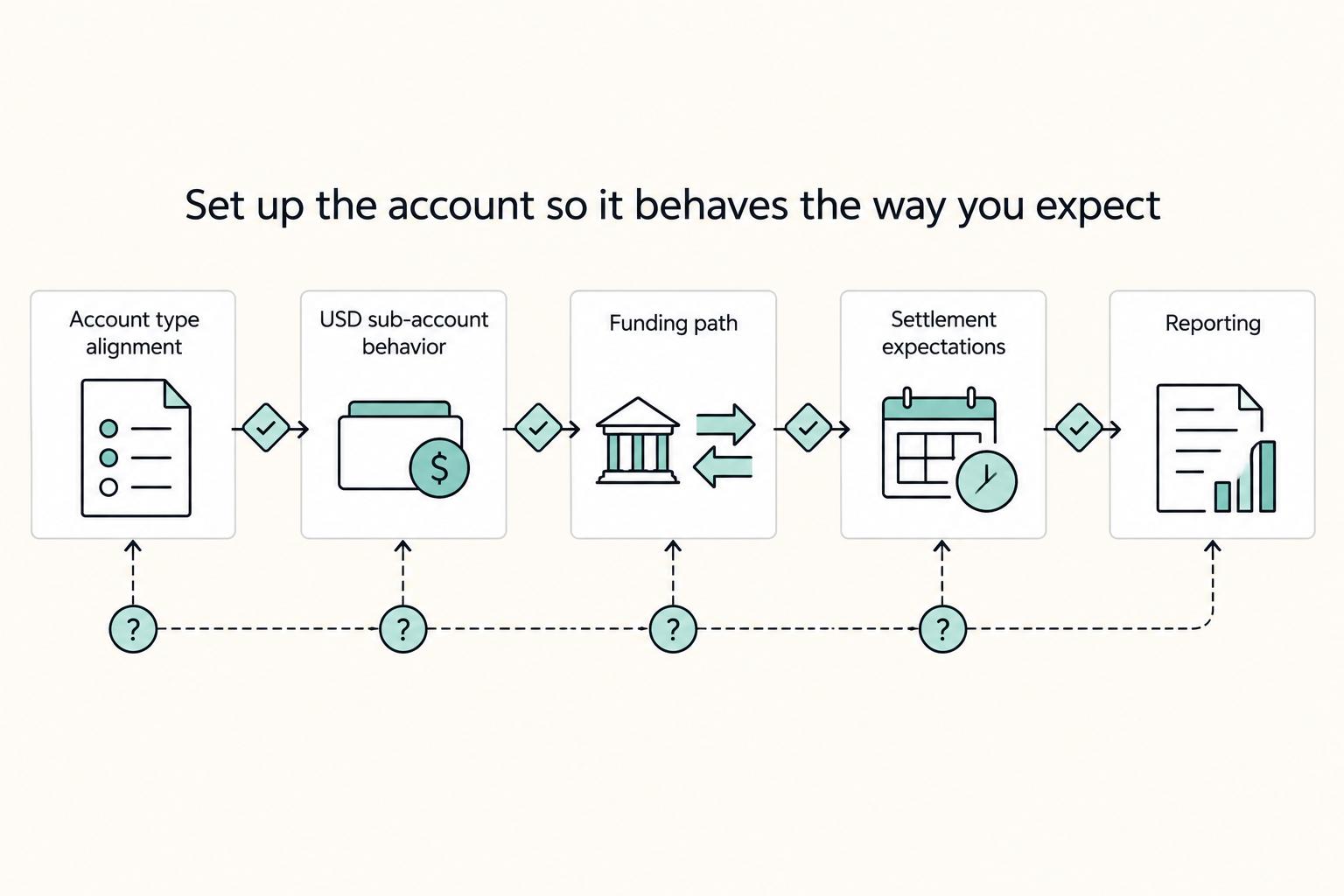
Set up the account so it behaves the way you expect#
Before you send real money, make sure the account will handle cash and reporting the way you think it will. Confirm these five items:
| Setup item | What to confirm |
|---|---|
| Account type alignment | TFSA, RRSP, FHSA, cash, or margin |
| USD sub-account behavior | USD sub-account behavior in each wrapper |
| Funding path | CAD only, or direct USD transfer from a Canadian institution |
| Settlement expectations | Under T+1 |
| Reporting | Reporting exports and tax-document timing |
Use one simple checkpoint before your first trade. You should be able to explain exactly where USD will sit, when conversion happens, and where your statements and tax slips will appear. If you cannot answer those three questions, pause and fix the setup first. For another example of building a repeatable operating routine, see How to Write a Newsletter That Your Subscribers Actually Read.
Pillar 2: The Portfolio - Managing Currency and Asset Risk#
Your portfolio outcome is driven by four choices: how much USD/CAD movement you will accept, how you convert currency, which account holds each position, and when to use a CAD-based wrapper instead of direct U.S. holdings.
- Currency risk: your CAD return changes if USD/CAD moves while you hold U.S. securities.
- Conversion spread: the bid-ask gap is an execution cost each time you convert.
- Withholding tax: tax can be deducted from U.S. dividends before cash reaches you; treaty treatment may reduce the default rate for qualifying Canadian residents.
- Account-location risk: the same U.S. security can produce different after-tax results depending on account type.
Choose your FX path#
Use urgency first, then optimize cost. If timing is tight, favor simplicity. If conversion is planned and repeatable, compare the lower-cost path carefully.
| Method | Trade size / context | Effort | Execution risk | Expected savings |
|---|---|---|---|---|
| Direct broker conversion | Small, one-off, or time-sensitive trades | Low | Low | Usually lowest process risk; confirm the current fee range with your broker before relying on it |
| Norbert's Gambit (journaling) | Planned conversions where waiting is acceptable | Medium to high | Medium | Can reduce conversion drag, but depends on fees, spread, and timing; confirm the current fee range with your broker before relying on it |
| CAD-traded exposure (CDRs, CAD-hedged ETFs) | You want U.S. exposure without handling USD directly | Low | Low to medium | Operationally simple; savings trade off against product costs and hedge tracking behavior; confirm the current cost range with your broker before relying on it |
Run Norbert's Gambit only when process fit is good#
Norbert's Gambit is a workflow, not an instant conversion shortcut. Use it only when you can tolerate settlement and processing time.
Checklist before you run it:
- Confirm your broker supports journaling in your specific account and that you are using equivalent assets.
- Place the initial trade on one listing, then submit the journal request to move to the other currency listing.
- Plan for timing: with T+1 settlement, recently purchased positions can face an added one-business-day delay before journaling can start, and processing can take multiple business days.
- Do not trade that same position while the journal request is in flight.
- Verify completion before your next step (the expected share quantity should appear on the target side).
Common failure points:
- Starting when the trade is urgent.
- Assuming journaling is immediate.
- Ignoring price and FX movement while waiting.
- Forgetting request fees or broker-specific handling.
Use it vs skip it rule:
- Use it when the conversion is planned, the amount is meaningful to you, and you can accept operational overhead.
- Skip it when execution is time-sensitive, the amount is modest, or you want the lowest process risk.
Place holdings by tax drag, then choose simplicity wrappers where needed#
Account placement is usually your highest-leverage tax decision.
| Holding profile | First account to review | Why | Confirm before acting |
|---|---|---|---|
| Dividend-heavy U.S. holdings | RRSP | RRSPs can have treaty withholding advantages compared with TFSAs | Current withholding treatment pending official tax guidance or broker verification; ensure valid W-8BEN is on file |
| Growth-focused, lower-yield U.S. holdings | TFSA or RRSP based on your plan | Lower immediate dividend drag can make placement more flexible | Confirm current withholding treatment and your contribution priorities |
| U.S. holdings in non-registered accounts | Case-by-case | Foreign tax paid may support a Canadian foreign tax credit in qualifying cases | Confirm reporting and credit treatment for your situation |
Before relying on treaty treatment, confirm your broker has a valid W-8BEN; it is generally valid through the end of the third succeeding calendar year unless circumstances change.
If you prefer less operational work, use a simplicity wrapper:
| Path | Hedging mechanics | Tracking behavior | Cost layer | Long-run fit |
|---|---|---|---|---|
| CDRs | Built-in currency hedge | Can differ from underlying due to hedge construction | Product and execution costs apply | Best when CAD-first simplicity matters most |
| CAD-hedged ETFs | Derivatives hedge USD exposure back to CAD | Hedge implementation can create tracking differences | MER plus trading costs | Best when you want broad exposure with CAD-hedged handling |
| Direct U.S. holdings | No wrapper-level hedge by default | Direct exposure to security and USD/CAD | Conversion plus trading costs | Best when you want full currency control |
If you want a deeper dive into structured decision-making, read Ho Chi Minh City Digital Nomad Guide for a 30-Day Move (2026).
Pillar 3: The Paperwork - Building Your Compliance Moat#
Your compliance system has two recurring jobs: keep a valid W-8BEN on file where U.S.-source income is paid, and run an annual T1135 scope check for non-registered foreign holdings.
File and monitor Form W-8BEN#
Give Form W-8BEN to your broker or other withholding agent before U.S.-source income is paid or credited. Do not send it to the IRS directly.
Use this operating rule across accounts:
- Confirm W-8BEN status for each broker account that can receive U.S.-source income.
- Verify in broker records (tax forms, account documents, or secure messages).
- Recheck when account facts change, not just on a calendar cycle.
Baseline validity runs through the last day of the third succeeding calendar year, unless a change in circumstances makes the form information incorrect. If a requested W-8BEN is missing, default withholding can apply at 30%.
Test whether T1135 applies#
Treat T1135 as a yearly threshold-and-scope decision. The trigger is based on cost amount (not market value) of specified foreign property.
| Situation | What to do |
|---|---|
| Property held only in an RRSP or TFSA | Exclude from T1135 reporting |
| Foreign property in a non-registered account | Include it in the review |
| Total cost amount never above $100,000 during the year | Keep your calculation and stop |
| Cost amount above $100,000 but below $250,000 throughout the year | Review whether Part A (simplified) applies |
| Assets held with a Canadian registered securities dealer or Canadian trust company | Organize records for CRA's aggregate-reporting category |
Use this checklist in order:
- If property is held only in an RRSP or TFSA, it is excluded from T1135 reporting.
- If you hold foreign property in a non-registered account, include it in the review.
- If total cost amount was never above $100,000 during the year, keep your calculation and stop.
- If cost amount was above $100,000, assess filing; if it was above $100,000 but below $250,000 throughout the year, review whether Part A (simplified) applies.
- If assets are held with a Canadian registered securities dealer or Canadian trust company, organize records for CRA's aggregate-reporting category.
Escalate to a tax review when cost amount is unclear, assets moved between institutions, or holdings sit outside your usual Canadian brokerage setup. Form T1135 is due on the same date as your income tax return; CRA lists April 30 for most individuals and June 15 for self-employed persons (or where a spouse/common-law partner carried on a business).
Run a light annual control routine#
Keep this as a repeatable control routine, not a heavy project:
- January: W-8BEN status check
Save broker confirmation, profile snapshot, and any renewal submission.
- March: T1135 scope review
Save year-end statements, trade confirmations, and your non-registered cost-basis worksheet.
- Tax filing month: filing proof archive
Save the filed return, filed T1135 (if required), and submission confirmation.
Use one evidence folder pattern each year, for example: Compliance/2026/U.S.-Investing/01-W8BEN, 02-T1135, 03-Tax-Filing. If T1135 applies, verify current CRA penalty language from official CRA source records before use.
For a step-by-step walkthrough, see How to Buy US Stocks as a UK Resident.
Critical Alert for U.S. Persons in Canada#
If you are a U.S. person for tax purposes, Canada-only guidance is not enough. For this section, that lane includes at least U.S. citizens and U.S. residents, and it can trigger U.S. reporting even when you live in Canada.
Confirm whether you are in the U.S.-person lane#
Start with a full account inventory before you trade. List each Canadian financial account, the institution, and the account type (for example: bank, brokerage, or mutual fund account). Keep this with your annual tax records, because the same account can be relevant across multiple U.S. filings.
Map institution reporting vs your own filing duties#
Your institution's FATCA reporting does not replace your personal filings. A Canadian financial institution may report U.S.-linked accounts to the IRS (for example through Form 8966), but you may still need to file your own forms.
| Item | Filed by | What the article says |
|---|---|---|
| Institution FATCA reporting (for example Form 8966) | Canadian financial institution | May report U.S.-linked accounts to the IRS, but this does not replace your personal filings |
| FBAR (FinCEN Form 114) | You | Self-reported, not filed with the IRS, and separate from your tax return; trigger is aggregate foreign financial accounts exceed $10,000 at any time in the year; due April 15 with automatic extension to October 15 |
| Form 8938 | You | Self-reported and attached to your annual U.S. tax return when your threshold is met |
- FBAR (FinCEN Form 114): Self-reported, not filed with the IRS, and separate from your tax return. Trigger: aggregate foreign financial accounts exceed $10,000 at any time in the year. Common in-scope account categories include bank, brokerage, and mutual fund accounts. Due April 15 with automatic extension to October 15.
- Form 8938: Self-reported and attached to your annual U.S. tax return when your threshold is met.
Before using Form 8938 threshold values, verify the applicable year-end and at-any-time limits for your filing status against current IRS guidance.
Do not treat FBAR and Form 8938 as substitutes. They are separate regimes, and you may need both.
Screen pooled products for PFIC filing drag before you buy#
PFIC risk is the core operational hazard in this lane. PFIC status is based on IRS passive-income or passive-asset tests, and Form 8621 can be required annually with a separate filing for each PFIC, including chain holdings.
| Asset type | U.S. tax complexity | Operational fit |
|---|---|---|
| Canadian-domiciled mutual funds or ETFs | Can be high when PFIC analysis applies; Form 8621 workload can multiply | Use only with product-level cross-border review |
| Individual U.S. stocks | PFIC-specific filing drag is typically lower than foreign pooled-product exposure | Practical when you want direct holdings and simpler product screening |
| U.S.-domiciled ETFs | Often used to limit Canadian pooled-product PFIC complexity, but product details still need verification | Practical for broad exposure if domicile is confirmed before purchase |
Use this defense-first checklist:
- Build a yearly account inventory and track highest balances.
- Screen each pooled product's domicile before purchase using issuer documents and broker security details.
- Prepare filing support early: year-end statements, transaction history, and max-balance worksheets.
- Retain proof files, especially product domicile records and your count of pooled holdings.
If you already hold Canadian pooled products, or you cannot determine PFIC exposure with confidence, escalate to cross-border tax support before your next filing cycle.
You might also find this useful: A Deep Dive into Form 5472 for Foreign-Owned US LLCs.
Conclusion: Your Framework for Confident Investing#
Once you know how to buy U.S. stocks in Canada, the real edge is repeatability. The goal is not to memorize every rule. It is to make a few decisions well, document them, and re-check official status before acting.
Step 1. Lock your Platform. Your platform is the source-check routine you use every time: where you read updates and where you confirm official status. If a page is informational, verify it against the official legal edition before you rely on it. FederalRegister.gov says users should verify against an official Federal Register edition and links to the official PDF on govinfo.gov.
Step 2. Reconfirm your Portfolio decisions. Before you treat a rule or policy change as final, confirm its current status on an official tracker. Congress.gov presents checkpoint-style bill status, and the S.1071 page shows "Became Public Law No: 119-60" (latest action listed as 12/18/2025).
Step 3. Tighten your Paperwork. Your paperwork is your evidence pack: what you checked, when you checked it, and which official artifact you used. Immediate action is required if your notes do not clearly show source, status, and date, or if you cannot quickly reproduce the verification path later.
Step 4. Run a short next-review checklist. Use it before your next funding, trade, or filing cycle.
- Confirm the source you are using is official (or verified against an official edition/PDF)
- Confirm the current status on the relevant official tracker before acting
- Confirm your records are dated, traceable, and easy to reproduce
That is the frame to keep: make decisions you can repeat, and document enough that future you does not have to guess.
We covered this in detail in How to Buy US Stocks as an Australian Resident.
Frequently Asked Questions
What happens if you miss a T1135 filing?
The article does not state the late-filing consequences. It says T1135 is due on the same date as your income tax return and advises verifying current CRA penalty language if you think filing applies.
Is it better to hold U.S. stocks in an RRSP or TFSA?
Usually, an RRSP is the first account to review for U.S. dividend-paying holdings because treaty treatment can be more favorable there than in a TFSA. For growth-focused, lower-yield holdings, TFSA or RRSP placement can be more flexible. Confirm current withholding treatment and your contribution priorities before acting.
Is Norbert's Gambit worth the effort?
Norbert's Gambit is worth considering when the conversion is planned, the amount is meaningful to you, and you can tolerate settlement and processing time. Skip it when the trade is time-sensitive, the amount is modest, or you want the lowest process risk. Make sure your broker supports journaling in that account before you start.
How do you handle buying U.S. stocks in Canada if you are a U.S. person?
If you are a U.S. person for tax purposes, Canada-only guidance is not enough. Build a full account inventory, remember institution FATCA reporting does not replace your own filing duties, and review potential FBAR, Form 8938, and PFIC issues. If you cannot determine PFIC exposure or product treatment with confidence, escalate to cross-border tax support before your next filing cycle.
What is the easiest way to reduce repeated currency conversion friction?
The easiest way is to use a broker with USD sub-account support so cash, dividends, and proceeds can remain in U.S. dollars instead of being repeatedly converted. Check how USD works in each account wrapper, because registered and non-registered accounts may handle USD differently. If repeated conversion is your main pain point, prioritize dual-currency behavior first.
How often do you need to update Form W-8BEN?
Form W-8BEN is generally valid through the end of the third succeeding calendar year unless a change in circumstances makes the information incorrect. Give it to your broker or other withholding agent before U.S.-source income is paid or credited, and recheck the status when account facts change.
Try a related tool
Researched and edited by the Gruv editorial team. Gruv builds cross-border billing, payouts, and finance-operations software for global businesses.
Sources
- acquisition.gov/sites/default/files/archives/pdf/FAC_2020-03...trusted
- congress.gov/bill/119th-congress/senate-bill/1071/text/eahtrusted
- federalregister.gov/documents/2025/11/25/2025-20907/medicare-pro...trusted
- investor.gov/introduction-investing/general-resources/new...trusted
- investor.gov/introduction-investing/investing-basics/glos...trusted
- irs.gov/instructions/iw8bentrusted
- irs.gov/businesses/corporations/basic-questions-and-...trusted
- sec.gov/compliance/risk-alerts/shortening-securities...trusted
Educational content only. Not legal, tax, or financial advice.
Related Posts

Ho Chi Minh City Digital Nomad Guide for a 30-Day Move (2026)
Ho Chi Minh City is a strong base if your priority is keeping work momentum while relocating. You get density, plenty of places to work from, and a social scene that can help you settle quickly. It is a weaker fit if your best days depend on calm streets, easy walking, and long stretches of quiet. In practice, Saigon tends to reward people who want convenience and activity more than retreat pace.

How to Write a Newsletter That Your Subscribers Actually Read
If your newsletter only goes out when you feel sharp, you do not have a writing problem. You have an operating problem. A reliable way to improve is to stop treating each issue like a fresh performance and start running the same five-part routine every time: plan, draft, quality check, publish, review.

A Deep Dive into Form 5472 for Foreign-Owned US LLCs
**Treat Form 5472 as an IRS reporting workflow, not a tax guess, and you can cut avoidable penalty risk quickly.** If you run a globally mobile single-member LLC, most uncertainty comes from definitions, not effort. You can keep clean books and still miss a trigger because the IRS focuses on entity status, related parties, and reportable transactions.