
Quick Answer
Define one specific problem you solve, prove it with concrete case material, and run a low-friction delivery process from first reply to invoice. For how to build authority as a freelancer, the article’s core move is shifting from broad self-promotion to visible evidence and operational reliability: clear onboarding, decision-based status updates, and pre-worked finance basics like document readiness (for example W-9 or W-8BEN when relevant). That combination helps clients see lower risk and stronger fit.
Many talented freelancers stay trapped in a feast-or-famine cycle because they compete on price for work that looks interchangeable. The problem usually is not talent. It is strategy. A stronger portfolio or a bigger social following can help at the edges, but neither fixes the core issue on its own.
If you want higher-value, enterprise-level clients, you need a different professional posture. Position yourself around a specific business problem, prove your work with concrete assets, and make the buying process feel low risk.
That shift does not happen by accident. It has to be built into how you position yourself, how you prove your work, and how you run the business. The Authority Pyramid is a three-tier framework for doing exactly that. Use it to move out of the crowded marketplace and build a more resilient, respected business of one.
Tier 1: Help a Stranger Understand What You Do Quickly#
At the base level, authority means a stranger can quickly understand what you do, why it matters, and why hiring you feels low risk. If someone lands on your site and still has to guess, you have a credibility problem. That can show up as price pressure and tougher negotiations.
Define your spike#
Start with a tighter position than "I work with startups" or "I do brand strategy." You need a clear spike: a specific type of client, facing a specific urgent problem, where your work leads to a business outcome they already care about. Use this checklist and write one sentence for each item:
| Positioning part | What to answer |
|---|---|
| Audience | Who exactly do you serve? |
| Urgent problem | What expensive or time-sensitive issue are they trying to fix? |
| Business outcome | What changes in the business when you solve it? |
| Disqualifiers | Which leads are not a fit, even if they can pay? |
A useful positioning sentence is specific: name who you serve, the urgent problem you solve, the business outcome, and the leads you intentionally disqualify.
A disqualifier protects your pipeline from poor-fit leads who want generic execution, tiny budgets, or work outside your expertise. If your inbound mix feels messy, tighten this before you publish more content.
Remote work has opened access to global talent, which creates more opportunity and more competition. Clear positioning helps you stand out without sounding louder.
Verification point: show your positioning line to a peer. If they cannot repeat back your audience and the business problem in under 15 seconds, it is still too broad.
Build proof assets before you chase more visibility#
Before you try to get seen by more people, make sure the right people can trust what they see. Prospects are not only buying results. They are buying confidence. If they do not know you personally, your job is to replace vague promises with proof. Start with these three assets.
Case study. Use this structure every time:
- Client context
- Starting problem
- Your diagnosis
- Key decision or intervention
- Outcome, with verified metrics when available: time saved, pipeline impact, conversion change, or cost avoided
- Constraint or tradeoff you had to manage
Do not publish invented numbers or fuzzy claims like "massive growth." If the client will not approve metrics, use a bounded version such as "reduced review cycles" or "shortened onboarding time." Say the exact figures are confidential.
Teardown. Pick a public example in your field and explain what you would change, why, and what risk you are reducing. The goal is not to sound clever. It is to show how you think.
Named method. Give your process a simple name and document 3 to 5 stages. This is not about pretending you invented a universal blueprint. It is about showing that you use a tested approach instead of making it up as you go.
A common failure mode is over-formalizing the method until it reads like a corporate template. Give buyers enough structure to feel confident, but leave room for judgment. If you try to eliminate all variation, you can remove what makes your work distinctive.
Upgrade social proof and your Digital HQ#
Specific proof beats praise. A short statement about what changed is more credible than a generic testimonial about how pleasant you were to work with.
| Weak proof statement | Authority-building proof statement |
|---|---|
| "Great to work with." | "Brought structure to a messy launch and helped us make decisions faster." |
| "Very knowledgeable." | "Diagnosed the bottleneck early and explained the tradeoffs clearly." |
| "Delivered an excellent redesign." | "Improved how prospects understood our offer and gave our team reusable messaging." |
Once you have those proof points, give them a clean home. Your site does not need a complex funnel. It needs a simple path that signals professionalism and reduces uncertainty.
Include these page blocks:
- a clear headline with your spike
- 2 to 4 proof assets
- selected client proof statements
- relevant credentials or certifications, if you have them
- a brief "how I work" section
- a direct contact path with one next step
Useful trust signals are plain and verifiable: real client names when permitted, clear service boundaries, recent examples, and a contact process that explains what happens after someone reaches out. A weak site is just a gallery. A strong Digital HQ answers three questions fast: Is this person relevant, credible, and easy to engage? If the answer is not obvious, fix that before you spend more time on personal branding or content creation.
For more on personal branding, see How to Manage Your Personal Brand as a Freelancer.
Tier 2: Transactional Authority - Building Trust in Every Interaction#
Once a prospect replies, your authority is judged by how you run the work. Your first response, onboarding flow, invoice setup, contract clarity, and update rhythm should all reduce risk for the client.
Reply with a clear next step, not a friendly blur#
In your first reply, make the next decision easy. Confirm the problem in plain language, propose one next action, and ask only for the inputs needed to prepare that step.
Use this structure in one message:
- Restate the business problem you heard.
- Propose the next call or review.
- List required pre-work and who owns each item.
- State the decision that meeting should unlock.
By the end of this exchange, both sides should know who is attending, what decision is needed, and what must be shared in advance.
Send an onboarding pack that creates clean handoffs#
Operational trust grows when ownership is explicit before kickoff. Use a simple checklist so nobody has to guess who does what:
| Onboarding item | Owner | What it covers |
|---|---|---|
| Welcome packet | you | scope recap, timeline, milestones, billing contact, file-sharing method, and proposed communication rhythm |
| Intake questionnaire | client | goals, constraints, stakeholders, existing assets, dependencies, and success criteria |
| Kickoff agenda | you | agenda sent in advance, with decisions to make in the meeting |
| Communication cadence | both | channel, update rhythm, primary contact, and change-approval path |
If key inputs or decision ownership are still unclear, resolve those before kickoff.
Clear finance and contract details before work starts#
Trust drops fast when billing and compliance are handled late. Before you send the first invoice, confirm the basics that drive treatment: whether the client is a business or consumer, where the client is located, your tax residency, and the service type.
| Weak practice | Strong practice |
|---|---|
| Invoice first, ask classification questions later | Confirm client type (B2B vs B2C), location, tax residency, and service type before invoicing |
| Use one invoice approach for all cross-border clients | For B2B setups, request needed tax details (such as a client tax ID or VAT number) and apply reverse-charge wording only as it fits local law |
| Wait for finance to request documents after payment delays | Ask early which vendor documents they need; depending on setup, that may include forms like W-9 or W-8BEN |
| Copy a reverse-charge line from a template | Use jurisdiction-appropriate wording; legal phrasing can vary |
| Assume any VAT number is enough without checks | Treat VAT validation (including tools such as VIES, where relevant) as a jurisdiction-specific step and keep records with invoice files |
Also keep one nuance in view: B2B patterns do not always apply to B2C digital services. In some cases, VAT can depend on where the customer lives.
Then pressure-test the contract in plain language. Confirm it covers scope boundaries, how changes are approved, payment milestones, acceptance criteria, and communication protocol.
Run kickoff and status updates around decisions#
A strong kickoff creates decision clarity, not just momentum. Confirm goals, stakeholders, deliverables, risks, and the next action before the meeting ends.
After kickoff, keep updates short and reusable:
- What moved since last update
- What is waiting
- Decisions needed from the client
- Blockers or risks
- Next actions with owner and date
This format signals management discipline and keeps projects moving without ambiguity.
You might also find this useful: The 'Protégé Effect': Why teaching is the best way to learn.
Tier 3: Compliance Posture, Less Hourly Dependence, and Clear Cash Rules#
At this stage, your authority depends on how you run the business under pressure, not just how well you deliver projects. Use this order: make your compliance posture legible, reduce dependence on pure hourly labor, and run cash with clear operating rules.
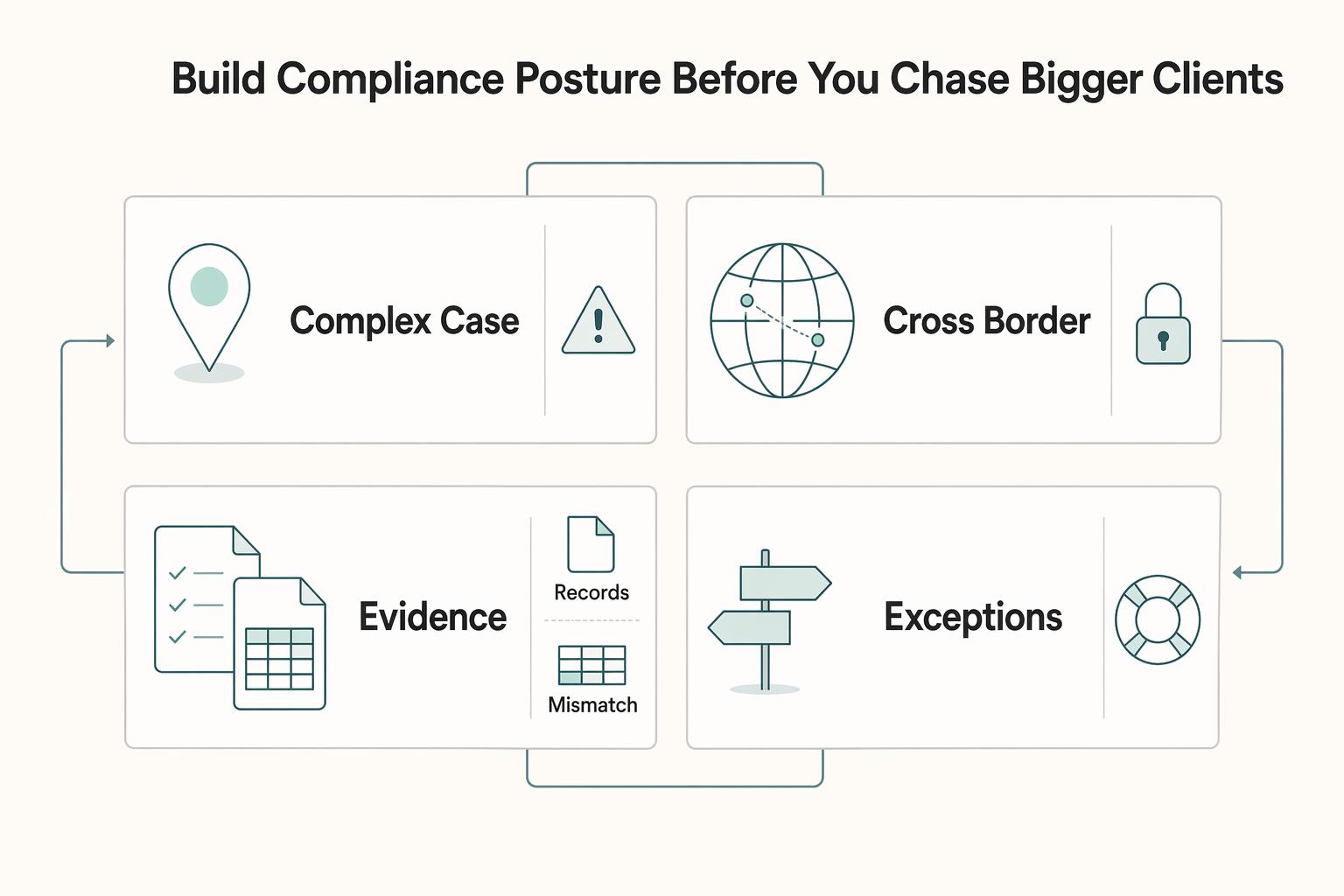
Build your compliance posture before you chase bigger clients#
Treat compliance readiness as a risk-control system. You do not need to act as your own lawyer or tax advisor, but you do need clear boundaries around what you can handle and when to escalate.
| Check | What to confirm |
|---|---|
| Entity setup | confirm your current structure still matches how you sell and deliver today |
| Cross-border scope | confirm which client types and countries you are serving now, and which ones introduce unfamiliar requirements |
| Documentation readiness | keep core business and billing documents organized so you can answer finance or procurement requests without delay |
| Escalation point | bring in a qualified advisor when a deal adds a new jurisdiction, unfamiliar tax treatment, consumer-facing obligations, or rights terms you cannot explain clearly |
Channel concentration is part of this risk check. In a longitudinal panel study of 50 Upwork freelancers across two rounds of data collection, identity was shaped by profile structure, ratings, and client feedback; the same research describes platform-level algorithmic control. If most demand still depends on one platform, treat that dependence as an explicit business risk and plan accordingly.
Shift your offer from labor-only to IP-led value#
Keep services that work, but stop relying on custom hourly delivery as your only model. A useful weekly question is: which part of your method can be reused, taught, licensed, or packaged?
| Model | Risk pattern | Margin pattern | Delivery load | Client-fit signal |
|---|---|---|---|---|
| Hourly delivery | Exposure rises when utilization falls; scope drift is common | Tied closely to your available time | High, because your direct involvement stays high | Client is primarily buying execution capacity |
| Framework or productized service | Design risk early; weaker results if the package is too rigid | Less time-bound when scoped and repeated | Medium, with repeatable steps | Client has a recurring problem and wants a defined process |
| Licensing, templates, or training | Adoption risk; requires clear IP boundaries | Least tied to your time once established | Low to medium after build | Client wants internal reuse, enablement, or rollout |
Run a monthly stress test: what breaks first if one channel weakens, one key client leaves, or delivery capacity drops?
Install a financial operating checklist#
Financial resilience is an operating habit. Run this checklist weekly:
- Keep business income and operating expenses separate from personal spending.
- Pay yourself on a fixed owner-pay workflow.
- Move a tax reserve from each payment into a separate bucket using a percentage validated for your case.
- Set a resilience reserve target in your cash plan once you have confirmed an amount that fits your expenses, payment timing, and client concentration.
Close each week with an evaluated-experience review: what went right, what went wrong, and what to change in the next cycle. That CEO rhythm keeps you from reacting late and helps you make decisions before pressure compounds.
If you want a deeper dive, read GDPR for Freelancers: A Step-by-Step Compliance Checklist for EU Clients.
Conclusion: You Are Not a Freelancer; You Are an Enterprise#
The useful shift is simple: stop presenting yourself as a general freelancer and start operating like a small, reliable business. That is how authority gets built in a way that improves client fit and gives you a stronger position when scope or price comes up.
- Build proof before you chase attention.
Make Tier 1 visible with tight case studies, focused testimonials, and educational content under your own name. A practical checkpoint is a quarterly theme structure for your niche so your proof does not drift into random posting. Verification point: a new lead should quickly understand your specific problem area and see relevant evidence. If they cannot, you are still in the generic bucket that creates weak inbound and constant outbound prospecting.
- Make trust show up in your operations.
Tier 2 is where clients decide whether your expertise feels safe to buy. Clean onboarding, clear scope, predictable updates, and usable contract and invoice details help reduce avoidable confusion. A common failure mode is looking sharp in public but messy in private: slow replies, unclear next steps, or documents that only appear after the client asks twice.
- Run your business like it has to survive change.
Tier 3 means you do not depend on a single platform, trend, or policy set. Platform fees, features, and policies can change without notice, and terms violations can lead to suspension or termination, so own your proof assets, your client relationships, and your reputation. If you publish longer-form content, check the logic before you polish the prose. That kind of manuscript-level review catches weak arguments earlier than surface edits do.
Start this week
- Pick one case study and rewrite it around one costly problem solved.
- Set one quarterly content theme and draft two posts from it.
- Tighten your onboarding email, scope language, and update cadence.
- Move your best proof asset somewhere you control.
You do not need a huge audience. You need demonstrated expertise, cleaner operations, and fewer avoidable risks. That is what a solid business looks like, and clients can feel the difference.
For a step-by-step walkthrough, see How to Find and Secure Public Speaking Gigs as a Freelancer.
Frequently Asked Questions
How do I prove my authority to a larger client?
Lead with proof assets and low-friction operations, not self-description. Share relevant case studies, strong testimonials or referrals, and a clear onboarding process that shows how you start, communicate, and deliver. You should also be ready to answer procurement or finance questions clearly, including your contract and invoicing process, and confirm tax-document requirements before sending anything.
What is the difference between influence and authority?
Influence gets attention. Authority gets trust when a project feels risky. The practical test is whether your signals make a client think "interesting" or "this person can handle it without causing problems." | Signal | More like influence | More like authority | | --- | --- | --- | | Audience response | Follows, likes, broad reach | Direct referrals and testimonials | | Content format | General posting from a brand or team account | Educational content under your own byline and name | | Client meaning | "People notice them" | "They know the work and are lower risk" | | Delivery signal | Visibility without proof of execution | On-time milestones, clear updates, revised date if something slips |
Can I build authority without a large social following?
Yes. Authority does not require fame or a massive audience. Publish useful educational content under your own name, ask happy clients for referral and testimonial proof, and make reliability visible by meeting deadlines and communicating clearly when plans change.
Why is my niche not attracting better clients?
If your positioning only names the market, you still look interchangeable with hundreds of applicants. Tighten the problem you solve, then make your proof assets show that exact problem, your method, and the result.
What tax and invoicing documents should I keep ready?
Keep the tax and invoicing documents relevant to your situation ready, plus your invoice template and a short internal note on your current process. Do not guess on country-specific rules. Verify the current requirements for your jurisdiction, entity type, and client country before sending forms or invoices, especially if the engagement is international.
What operating setup do I actually need?
Keep core assets in place: a proof-asset folder, a simple onboarding process, clear contracts, and basic finance operations. Add project milestones to your calendar, set a response standard such as within 24 hours, and state what happens if a delivery date moves. A common failure mode is scattered admin that leads to late delivery and downstream disruption to the client timeline.
Try a related tool
Researched and edited by the Gruv editorial team. Gruv builds cross-border billing, payouts, and finance-operations software for global businesses.
Sources
Includes 7 external sources outside the trusted-domain allowlist.
- par.nsf.gov/servlets/purl/10523298trusted
- bettermarketing.pub/a-relatively-stress-free-guide-to-setting-bo...external
- blog.annabyang.com/successful-freelancersexternal
- clippie.ai/blog/freelancers-use-video-build-authority-n...external
- contently.com/2025/11/05/how-to-turn-your-internal-experts...external
- indexventures.com/scaling-through-chaos/increase-your-compensa...external
- instagram.com/p/DWEjPegEkbOexternal
- instagram.com/p/DSYyvVnDnsvexternal
Educational content only. Not legal, tax, or financial advice.
Related Posts

GDPR Compliance Checklist for Freelancers Working With EU Clients
Start by separating the decisions you are actually making. For a workable **GDPR setup**, run three distinct tracks and record each one in writing before the first invoice goes out: VAT treatment, GDPR scope and role, and daily privacy operations.

How to Manage Your Personal Brand as a Freelancer
Your brand is not a mood board. Think of it as the experience people have of your work: the promise you make, the proof you can show, and the way you present yourself across client touchpoints. Get that clear first, and your fit is easier to read from profile to proposal.
The Protégé Effect for Freelancers: Teach Your Method to Build a Defensible Business
If your business only works when you personally show up, it can look stable day to day but still be hard to hand off. A sick week, an overloaded month, or a client asking for a clean record of what was agreed can surface the same issue: too much of your method lives in your head. Treat that as an operational warning, not a measured benchmark.