
Quick Answer
Start with a shared brief, agreed scope and one final approver. Review specific drafts, consolidate stakeholder feedback and record the decision after each round. Keep deposits, retainers and milestone payments on their agreed schedule, and resolve payee or tax-document exceptions through finance.
Build a freelance creative team that stays fast, compliant, and low-drama#
A freelance creative team works best when the brief is clear, feedback arrives through one decision owner, and each person has room to choose how to produce the work. Build that agreement before the first draft so review time goes into the work itself.
| Area | Ad hoc management | Controlled operating model |
|---|---|---|
| How work starts | Requests arrive loosely and get interpreted on the fly | A brief defines the assignment and its exclusions |
| How collaboration works | Every project invents its own habits | You co-create the process with the freelancer, but checkpoints stay consistent |
| What happens under pressure | Misaligned work is harder to spot early | The hiring team screens for the skills, availability and working approach the assignment needs |
-
Define the assignment before intake. State the deliverables, required skills, budget and exclusions in the brief so candidates and reviewers understand the same job.
-
Capture one shared brief. Put the objective, deliverables, owner, and deadline in one place. Outcome: everyone starts from the same plan.
-
Co-create the project process. Let the freelancer shape how they produce the work while you keep key checkpoints consistent. Figma described strong client and freelancer work as close collaboration that co-creates a custom process for each project. Outcome: autonomy stays high without losing coordination.
-
Use checkpoints to keep decisions visible. Keep a simple cadence for review and decisions across the project. Outcome: less avoidable back-and-forth when priorities shift.
-
Close each engagement cleanly. Store final files, decisions, and handoff notes together. Outcome: better continuity for the next project.
Define the work your team needs before hiring. A specialist who fits the brief and review process is usually easier to manage than a broader hire whose responsibilities keep changing. Keep the scope and budget visible when deciding whether to add another role.
For a step-by-step walkthrough, see How to Manage an Offshore Development Team Across Time Zones.
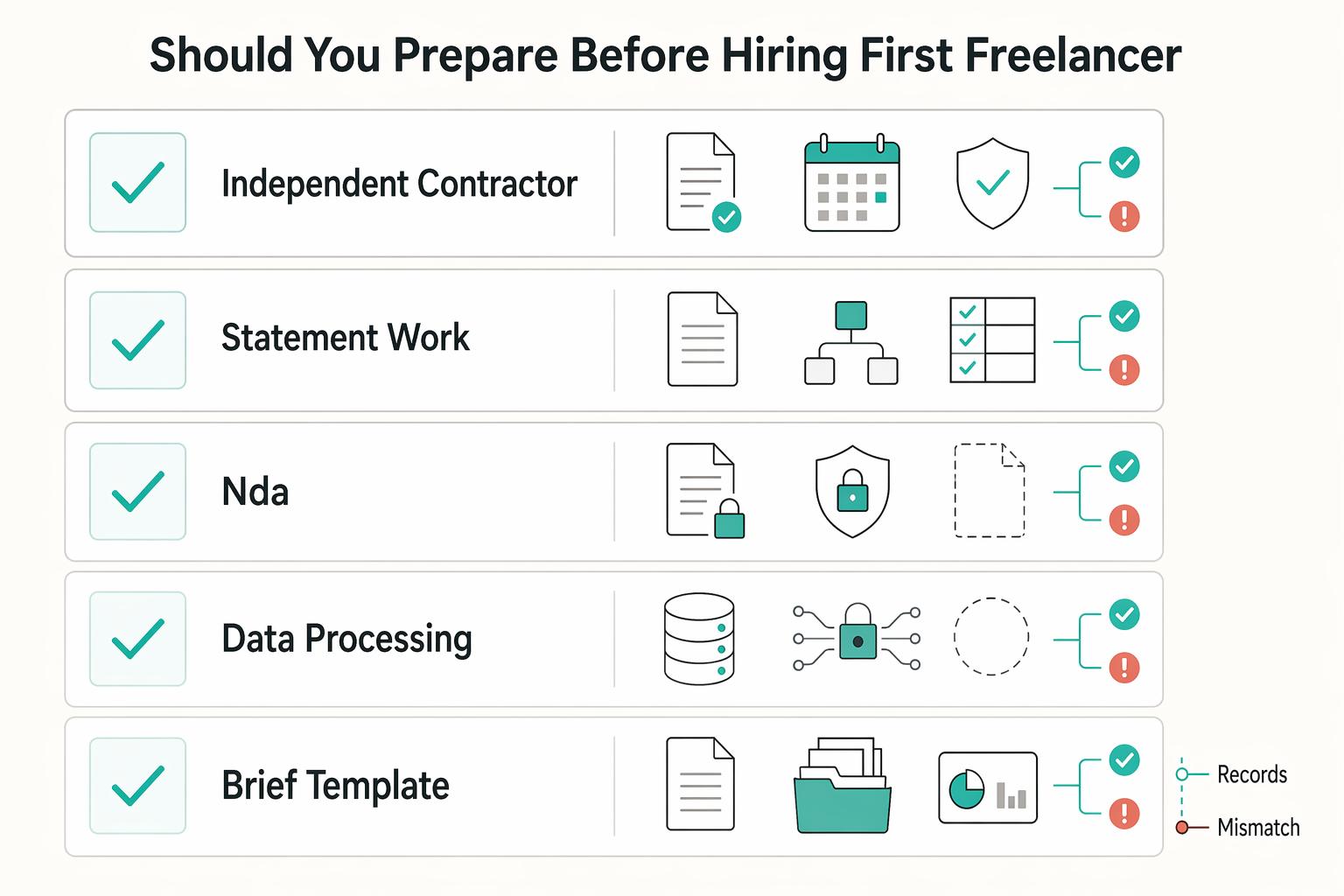
What should you prepare before hiring your first freelancer?#
Most first-freelancer issues start before hiring: unclear process turns into rework, approval drag, missing records, and payment friction.
| Document | Use in stack |
|---|---|
| Independent Contractor Agreement | Core document |
| Statement of Work | Core document |
| NDA | Add when the engagement risk requires it |
| Data-processing terms | Add when the engagement risk requires them |
Prepare a reusable brief, candidate evaluation criteria, agreement and payment-intake process before outreach. Candidates should be able to understand the job and your selection process without guessing.
| Item | Prepared before outreach | Handled after kickoff | Likely consequence if late |
|---|---|---|---|
| Brief template and named approver | Every candidate sees the same scope and decision owner | Scope gets redefined mid-project | Rework and approval delays |
| Contract packet | Terms are ready when you select a freelancer | Terms are negotiated while work is already moving | Start-stop confusion and ownership disputes |
| Tax and payment intake | Required payee and tax details are collected before first invoice | Finance chases documents after delivery | Payment delays and avoidable back-and-forth |
| One source of truth | Briefs, approvals, versions, and payout status live in one place | Decisions and files split across tools | Lost versions, unclear approvals, missed payments |
-
Set your required vs conditional document stack. Keep an Independent Contractor Agreement and Statement of Work as your default baseline, then add an NDA and data-processing terms when the engagement risk requires them. The point is consistency by risk level, not making every project heavy.
-
Match intake to worker profile and payment context. Decide upfront which tax form and compliance checks apply for this worker type, jurisdiction, and payment path, then collect them before payment setup. If requirements are unclear, pause and verify before kickoff.
-
Vet reliability and professionalism, not just creative taste. Confirm the person can deliver results and work professionally. Apply extra care to personal-network hires because a failed engagement can hurt both the project and the relationship.
-
Assign ownership and a single source of truth. Keep the approved brief, review comments, final approvals, version history, and payout status in one system. Name owners for briefing, approval, acceptance, and payment release.
-
Enforce a no-start rule. No production until scope, documents, intake, and ownership checks are complete. If worker classification is uncertain, stop and review What to Do If You've Been Misclassified as an Independent Contractor.
With this gate in place, you can start faster with less confusion on day one. For scope changes after kickoff, use How to Write a Change Order for a Freelance Project.
Step 1 set your operating model before assigning any creative work#
Define who decides what before you assign the brief. If decision rights are unclear, briefs arrive incomplete, feedback gets scattered, and final approval turns into a dispute.
Name one project lead, one final approver and the people who need to contribute. If your organization uses RACI or DACI, record those roles in the brief; smaller teams can use plain job names. The freelancer should know whose decision closes each review.
| Work tier | Day-to-day owner | Final approver | Escalation owner/path | Change authority |
|---|---|---|---|---|
| Low-risk production work | Project lead (Driver/Responsible) | Named approver in brief or SOW (Accountable/Approver) | Route scope drift, missed milestones, or conflicting feedback to one documented escalation owner in your source of truth | Project lead can approve minor changes; final approver confirms acceptance |
| Brand-critical work | Project lead coordinates execution (Driver/Responsible) | Business or creative lead is the single final approver (Accountable/Approver) | Same single path, with contract review hold where jurisdiction-specific limits must be verified | Only named final approver can authorize material changes; other stakeholders provide input |
-
Classify the assignment by risk before kickoff. Label each request as low-risk production or brand-critical, then assign the right approval level.
-
Write decision rights into the job record. Record Driver, final Approver, reviewer list, and who accepts deliverables and confirms each contractual payment trigger.
-
Publish one escalation response path. For scope drift, missed milestone, or conflicting feedback: log the trigger, pause new work on the affected asset, route to the escalation owner, then decide to revise the brief, issue a change order, or hold for contract review where jurisdiction-specific limits need verification.
-
Enforce a strict no-kickoff gate. No start until work tier, named approvers, and escalation owner are all documented.
This pairs well with our guide on A Guide to Notion for Freelance Business Management.
Step 2 onboard with contracts and control points that prevent rework#
Use one fixed onboarding sequence and treat each step as a stop/go gate. The goal is simple: no ambiguity before work starts.
| Onboarding step | Gate |
|---|---|
| Collect the onboarding packet and confirm payee/payment details | You can verify who gets paid, how they get paid, and where that record is stored |
| Send the full contract packet in one pass | Every required document is signed and saved in one source of truth |
| Align ownership, confidentiality, and scope language before any draft work | Each deliverable has one written definition of done |
| Confirm dispute and exit mechanics during onboarding | Escalation and offboarding are documented before production begins |
-
Collect the onboarding packet and confirm payee/payment details. Gather the tax form your setup requires, legal name, payment method, and billing contact. If the engagement is cross-border, plan for possible payment friction, including method changes and transfer-fee delays.
-
Send the applicable contract packet together. Issue the contractor agreement and SOW, plus confidentiality and data-processing terms where needed. Confirm the signer can access the documents and retain the completed copies.
| Applicable document | Risk if skipped |
|---|---|
| Tax form (where required) | Payment record gaps and extra finance follow-up |
| Contractor agreement | Weaker baseline for scope, fees, dispute handling, and exit terms |
| NDA (where required) | Unclear confidentiality obligations before sharing files |
| SOW | Scope drift, review friction, and preventable rework |
| Data-processing terms (where required) | Unclear handling expectations for personal data |
-
Align ownership, confidentiality, and scope language before any draft work. Make sure the contractor agreement, SOW and any applicable confidentiality terms do not conflict on ownership, usage rights, or confidentiality. In the SOW, define acceptance criteria, revision boundaries, dependency assumptions, approver roles, and the exact scope version in force.
-
Confirm dispute and exit mechanics during onboarding. Set escalation ownership, notice path, handling for unfinished files, and offboarding steps, and flag jurisdiction-specific terms for verification. Before kickoff, confirm any deposit required by the contract, the start date and exact scope version.
Hard rule: no kickoff until signatures, ownership terms, and definition-of-done criteria are complete in writing. Related reading: How Freelance Developers Use Linear to Control Scope and Billing.
How do you run weekly execution without micromanaging creatives?#
Manage outputs and decisions, not activity tracking. Once contracts and approval rights are set, keep work moving through visible artifacts instead of constant check-ins that add stress and waste time.
Freelancers usually value autonomy in how and when they work. If your process turns into nonstop messages and meetings, you often get slower execution, more tension, and higher churn risk.
| Work type | Check-in intent | Required artifact | Approval owner |
|---|---|---|---|
| High-risk brand or client-facing work | Confirm direction early and surface blockers before final polish | Approved brief, in-progress draft, decision notes | One named approver on your side |
| Standard campaign or content work | Check alignment to scope, deadline, and dependencies | Current draft or working file plus open questions | The owner of the deliverable outcome |
| Low-risk support tasks | Confirm completion and capture reusable outputs | Finished asset or completed task record | Assigned team lead or task owner |
Anchor your cadence to deliverables, not reassurance. Each review should end with a clear decision: approve, revise, or escalate.
-
Anchor every check-in to an artifact. Replace "How is it going?" with a request for the brief, draft, revision file, or approval-ready version. Start with a complete project brief so scope and expectations are explicit before production.
-
Protect ownership boundaries. You own priorities, deadlines, acceptance criteria, and final decisions. The freelancer owns method, tools, sequence, and most of the creative process.
-
Run one review loop and log decisions. Keep one primary review path, then record what changed, what did not, and who approved it. Avoid splitting final feedback across chat, email, and comments without consolidation.
-
Use a clear multi-stakeholder feedback protocol and async handoffs. Assign one consolidator to gather feedback, one decision owner to make the call, and one change log to track accepted edits. For distributed teams, each handoff should include the current artifact, owner, next reviewer, deadline, and an escalation trigger if no response arrives by your team's agreed response window recorded in the brief. For deeper distributed coordination patterns, see How to Manage a Global Team of Freelancers.
If you keep execution artifact-first and decisions visible, creatives get room to do strong work without leaving you blind. If you need adjacent workflow support, see How to Manage Multiple Freelance Projects Without Losing Your Mind and Browse Gruv tools.
How do you pay global freelancers with compliance and audit readiness?#
Pay according to the agreed schedule, including deposits, retainers and milestone payments. Match each amount to its contractual trigger, check the invoice and payee details, and resolve exceptions promptly. Final deliverable acceptance is one possible trigger, rather than a prerequisite for every payment.
| Step | Owner | Required record |
|---|---|---|
| Match payment to its agreed trigger | Project or contract owner | Deposit, retainer, milestone or acceptance record as the contract requires |
| Check contract and invoice alignment | Operations or finance owner | Signed contract or SOW plus invoice matched to agreed checkpoints and due-date terms |
| Verify classification and tax intake | Payee-setup owner (finance or operations) | Classification note plus required IRS tax document where applicable |
| Confirm payout details before release | Accounts payable or funds-release owner | Approved invoice, payout method details, release date, and remittance/confirmation record |
| Archive one complete record chain | Payables archive owner | Relevant approval or contractual trigger, contract, invoice, applicable tax-document status, exception log and payout confirmation |
Keep the contract, relevant approval or payment trigger, invoice, applicable tax-document status and confirmation linked to the payment. An internal approval delay does not itself change the agreed due date.
| Control point | Minimum standard | Failure signal | What you do next |
|---|---|---|---|
| Payment trigger | Amount and due date follow the agreed payment schedule | The required trigger is unclear or disputed | Resolve the issue against the contract and applicable payment obligations; record the decision |
| Contract and terms | Contract or SOW is in place before work starts and defines checkpoints, invoice due date, and late-fee terms | Terms exist only in chat, or invoice does not match checkpoints | Pause and reconcile to signed terms before release |
| Classification and tax file | Review worker status and applicable tax treatment | Required information is missing | Finance determines the lawful documentation, withholding and payment path; an incomplete form is not a universal payment prohibition |
| Payment setup and record chain | Invoice, payment method, payout status, and exception notes are stored together | Last-minute detail edits, name mismatch, or missing payout confirmation | Stop release, verify details, and log resolution before retry |
- Step1: Match payment to its agreed trigger.
Owner: project or contract owner. Required record: the agreed deposit, retainer, milestone or deliverable acceptance that makes this amount due.
Worker status depends on the actual relationship and applicable rules, rather than the freelancer label or a Form1099. The IRS definition focuses on the payer’s right to control how the work is performed. Record the classification review and collect only the tax documentation that applies to the payer, payee and payment.
Before release, confirm the payment’s contractual trigger, due date, payee details and applicable tax treatment. Route an unresolved documentation issue to finance early enough to determine the lawful payment and withholding path, rather than automatically withholding the whole amount.
Resolve payment exceptions promptly#
- Last-minute bank-detail change: verify it through the established contact method, independently of the change request, and retain the confirmation before using the new details.
- Provider rejection or failed check: record the reason and current transaction status. Resolve an uncertain first outcome before retrying; do not treat an internal exception approval as authority to bypass a legal restriction.
- Incomplete tax information: send the case to finance for the applicable documentation and withholding treatment. IRS backup-withholding guidance describes withholding from certain payments when required tax information is missing. Determine the applicable path rather than making every payee non-payable.
For the next layer after this payout-control checklist, read How to Manage a Global Team of Freelancers. It covers cross-time-zone operations, handoffs, and distributed coordination.
Related: How to Manage a Software Project in ClickUp with a Remote Team.
What breaks most freelance teams and how do you recover fast?#
When your freelance team starts breaking down, pause new creative work, identify the failure pattern, and reset controls in writing before you restart. The pattern is usually the same: deadlines slip, boundaries blur, and burnout pressure builds.
| Failure signal | Root cause | Immediate containment action | Proof of recovery |
|---|---|---|---|
| Deadlines keep moving, work arrives late, review windows collapse | Scope drift or no usable schedule | Freeze new requests, issue a written scope reset, rebuild the schedule with current milestones and named approvers | Every active deliverable has a due date, acceptance rule, and owner, and the next milestone lands on time |
| Messages arrive nights and weekends, people look exhausted, quality drops | Boundaries have failed and burnout pressure is building | Reduce active work in flight, confirm working hours and response expectations in writing, stop "just one more thing" asks | The team is working to a visible schedule, and deadlines are hit consistently |
| Freelancer gets conflicting feedback from multiple stakeholders | No single decision owner or no standard feedback format | Route all feedback through one approver, consolidate comments into one note, pause revisions until that note is final | The creative receives one direction set per round and can trace each change to one approver |
| Payment, compliance, or contract questions appear mid-project | Intake or agreement gaps were not closed | Put work on hold at the next handoff, complete the missing record, and mark unresolved local-rule items as pending qualified review | The file contains the updated agreement, required intake records, and release approval before work resumes |
| You cannot tell who owns final files or usage rights | IP terms were assumed, not documented | Stop external use, confirm ownership and usage terms in writing, and store the signed update with the project file | One signed document states who owns what, who can use it, and who approved final release |
- Step 1: Stop the spread before diagnosis.
Put new creative work on hold. Keep only work needed to protect the current milestone, assign one incident owner, and write the hold reason plus next decision point.
- Step 2: Reset scope with change control.
If scope is disputed, reopen the SOW or brief and publish a written reset: revised deliverables, what changed, timing or budget impact, named approver, and restart criteria. Restart only after written approval and freelancer confirmation of the updated brief.
- Step 3: Check capacity and burnout signals before pushing harder.
If people are exhausted, isolated, or overwhelmed, do not respond with more pressure. Build a schedule with active work, review dates, and boundaries, then cut or delay lower-priority asks until the plan is realistic.
- Step 4: Patch records before the next handoff.
Do not argue contract, compliance, or IP gaps while production continues. Update the project file with missing records and mark jurisdiction-specific items as pending qualified review until they are confirmed.
- Step 5: Calibrate managers so failure does not repeat.
Set one review cadence, one feedback format, and one escalation owner so your freelancers stop getting mixed direction. Once those controls are stable, use How to Manage a Global Team of Freelancers as the next operating playbook.
You know recovery is real when deadlines become consistent again and every active deliverable has one clear path from brief to approval. Related: How to Manage a Remote Team of Subcontractors.
Run a 30-day pilot in one lane, then scale or adjust#
Test the workflow on one role and a repeatable job type before extending it to the whole team. A 30-day window may work if it includes the relevant brief, review, handoff and payment stages; otherwise choose a representative project cycle.
Choose one lane and define what "complete" means#
Pick one role and one repeatable job type. Before kickoff, set three practical checklists in the project file:
- Contract stack: core agreement, scope terms, and any missing local items marked as pending qualified review.
- Payables readiness: invoice and payout setup, plus any local steps marked as pending qualified review.
- Escalation path: who decides, how changes are raised, and what triggers a stop-and-reset.
Use one simple verification check: can you quickly see the current documents, owner, payment state, and latest decision notes in one place? If not, tighten the lane before you add volume.
Test the workflow and its exceptions#
Use the agreed sequence for the chosen project: brief, kickoff, production, review, approval and handoff, with invoices and payments at their contractual milestones. Record exceptions so you can see which handoffs need improvement.
If something breaks, patch one control point instead of redesigning everything mid-sprint. That keeps your test clean and makes the final decision easier.
End the sprint with a scale-or-adjust decision#
Review the lane with evidence, not memory. Pull a small pack from the same project thread (engagement docs, approved output, invoice/payout status, and key decision trail), then choose one path:
- Scale if the lane stayed clear and repeatable.
- Adjust one control point if one stage kept failing.
- Pause expansion if risk or ownership still feels unclear.
A signed agreement helps operationally, but classification risk can still exist. If that part is unclear, use What to Do If You've Been Misclassified as an Independent Contractor before you expand.
After the sprint review, if you want help implementing it, Talk to Gruv. Need the full breakdown? Read A guide to using Notion 'Databases' for freelance project management.
Frequently Asked Questions
How do you manage freelance creatives without micromanaging?
Set the outcome, deadline, and acceptance criteria, then let the freelancer choose the method. Write the brief so scope, revision limits, and a named approver are visible before work starts. You know it is working when feedback is tied to decisions, not taste drift, and the creative does not need constant status checks to stay on track.
How often should managers check in with freelance creatives?
Match your cadence to delivery risk, not your anxiety. Write down one planning touchpoint, one blocker update path, and one output review tied to the milestone, then push routine status into async updates. It is working when live calls stay short and decision-based, and review windows stop collapsing at the end of the week.
What should be included in a freelance creative onboarding process?
Finish the controls before kickoff: contract, scope, acceptance rules, approvers, file-handoff standard, and payment setup. Keep the onboarding checklist in the project file. If you use a proposal template, tailor the process, work samples, and terms to the actual job rather than treating it as generic paperwork. You have a good start when the freelancer can answer, on day one, who approves the work, where files go, and how invoices get cleared.
How do you manage freelancers across time zones and multiple commitments?
Make every handoff self-contained so work can move without a live meeting. Write down overlap windows, response expectations, and a required update format that includes blocker, next action, and file location. It is working when a reviewer can pick up the work after your local day ends without chasing missing context.
How do you preserve creative ownership while maintaining accountability?
Let the freelancer own craft decisions and process, but keep approval rights and scope changes with your team. Record one approver, one acceptance rule set, and one feedback channel for each deliverable. If comments start coming from multiple stakeholders, stop revisions and consolidate direction first. The signal that it is working is one clear note per round and fewer circular edits.
What contracts are non-negotiable when hiring freelance creatives?
Do not look for one universal clause set, because that depends on jurisdiction and deal shape. Get the basics in writing: scope, payment terms, usage or ownership terms, revision limits, change-request handling, and stop-work triggers, then flag any jurisdiction-specific items for qualified local legal review. You are in a better position to start when you can quickly prove what was commissioned, what changes cost extra, and who can use the final files.
How do you set up compliant payout and tax-document workflows for global freelancers?
Keep the agreed payment schedule, invoice, applicable tax-document status and payment confirmation together. Assign finance to resolve documentation and withholding questions promptly, and record the resulting treatment. Deposits and retainers need their own triggers; final acceptance should not be imposed on a payment due earlier under the contract.
Try a related tool
Researched and edited by the Gruv editorial team. Gruv builds cross-border billing, payouts, and finance-operations software for global businesses.
Sources
Includes 3 external sources outside the trusted-domain allowlist.
- irs.gov/businesses/small-businesses-self-employed/in...trusted
- irs.gov/businesses/small-businesses-self-employed/ba...trusted
- figma.com/blog/in-good-company-agencies-freelancersexternal
- resources.workable.com/tutorial/how-to-hire-and-manage-freelancers-...external
- worksuite.com/resources/insights/how-to-avoid-micromanagin...external
Educational content only. Not legal, tax, or financial advice.
Related Posts

What to Do If You've Been Misclassified as an Independent Contractor
If a business calls you an independent contractor but directs your work like an employee, check the rules for the rights you need to recover. A contract label, LLC or Form 1099 does not decide every legal status. Federal wage law, federal employment taxes and state employment laws can use different tests and provide different remedies.
How to Manage a Global Freelance Team Without Compliance Gaps
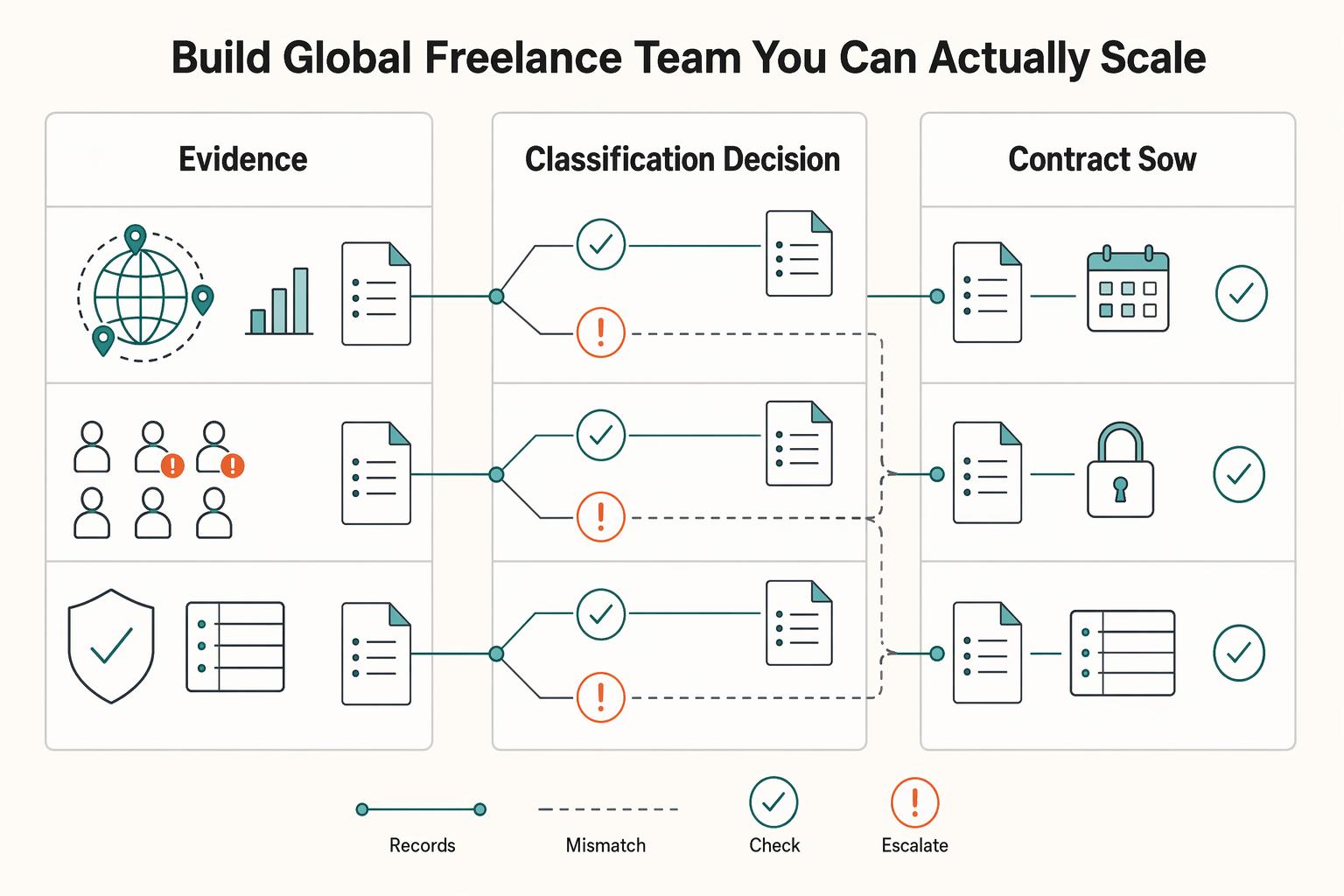
If you want to manage a global freelance team without constant cleanup, use the same intake-to-payout process for every engagement and save an artifact at each gate. Common failure points are instinct-based classification, vague scope, and payments approved in chat with no audit trail.

The Freelance Payment Penalty: A Modeled Audit of Platform Fees, FX Spreads, and Payout Delays
The money rarely disappears through a single, easy-to-spot fee. The real loss is stacked. A marketplace takes its commission, a processor adds a charge for international cards, a bank or payment company converts the currency at a spread, a platform holds the funds before release, and a wire sheds a little to intermediaries on the way in. Each layer looks defensible on its own, but the worker feels the combined result as a smaller deposit and a later payday.