
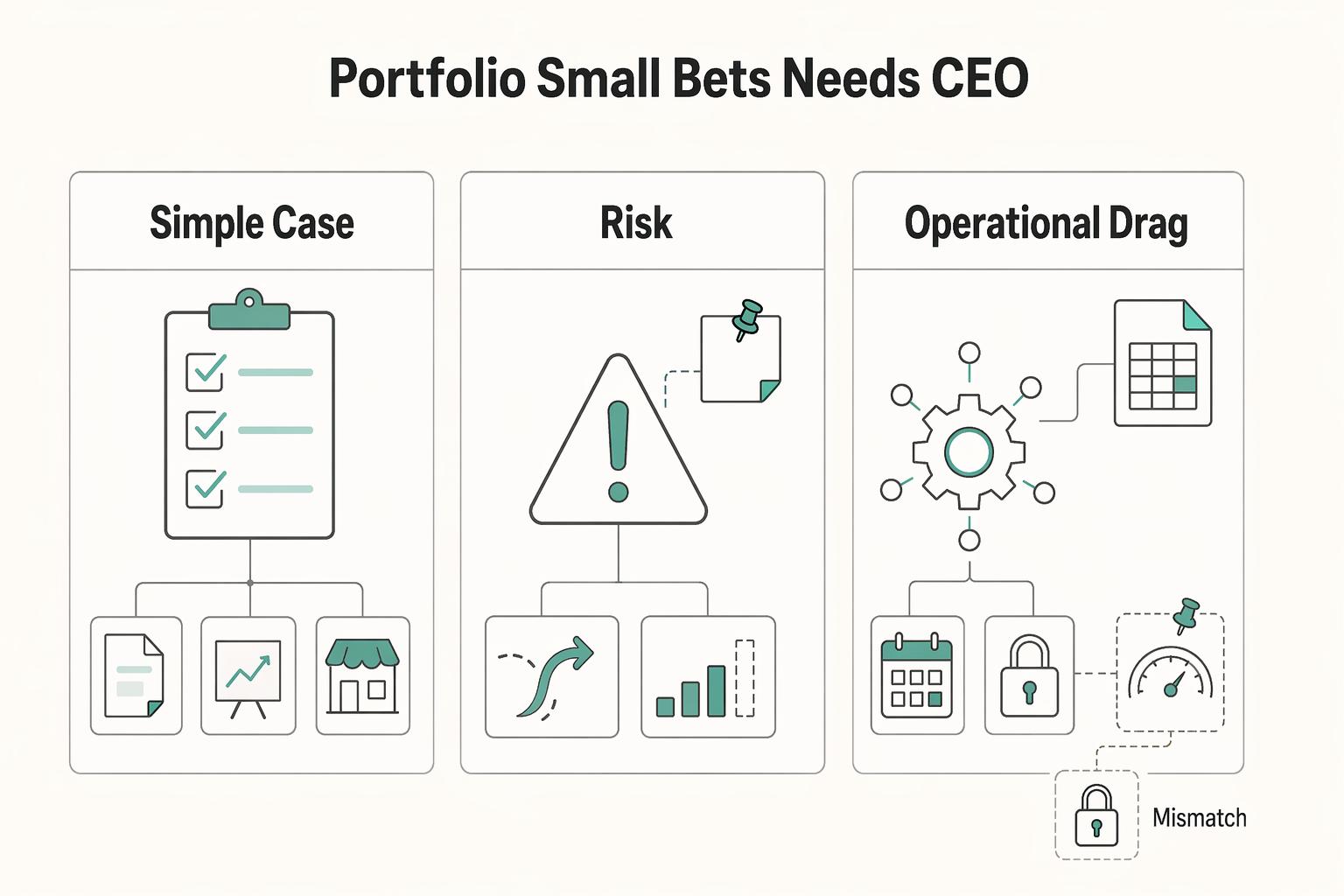
The popular "portfolio of small bets" advice is dangerously simplistic for established professionals, as it ignores their significant opportunity costs and the hidden operational complexities of launching new projects. The approach here is to productize your existing expertise, rigorously evaluate new ventures based on their true ROI, and systematically manage risks like taxes and liability. That moves income diversification from a creative gamble to a strategic asset, and builds a portfolio you can manage without chaos.
Why Your 'Portfolio of Small Bets' Needs a Risk-Managed System#
The internet is saturated with advice on building a "portfolio of small bets," often presented as a straightforward path to passive income. Launch a course, build a Shopify store, sell some digital products. While well-intentioned, this beginner-level advice dangerously ignores the realities faced by an established global professional. It’s a great idea wrapped in a framework that is simply too small for you.
Let's be direct. For someone whose billable time is worth $150 an hour or more, there is no such thing as a "small" bet. Every choice to pursue one path comes at the expense of another—a concept economists call opportunity cost. This isn't a theoretical principle; it has tangible financial weight. Investing 100 hours into a new side project isn't a casual experiment—it's a $15,000 investment of your time before you ever spend a dollar on software or marketing. That time could have been spent on billable client work, business development for your core service, or simply recharging to prevent burnout.
This is the core hesitation that most advice glosses over, but it’s where our conversation must begin. Beyond the significant opportunity cost, a portfolio of new income streams introduces a labyrinth of hidden complexities you cannot afford to ignore:
- Compliance Risks: Selling a simple e-book to customers globally can instantly create a complex web of tax obligations, from state-by-state sales tax in the U.S. to VAT MOSS requirements in the European Union.
- Liability Exposure: Co-mingling funds from a new SaaS product with your primary consulting income can expose your personal and business assets to unnecessary risk.
- Operational Drag: Juggling different payment processors, customer service channels, and accounting systems for multiple side projects creates a significant administrative burden that steals focus from high-value work.
This is not meant to discourage you, but to equip you. The goal of this guide is to deliver what others don’t: a professional framework to assess, manage, and scale a portfolio of assets. We will transform the concept of income diversification from a creative lottery into a systematic, risk-managed strategy. This is how you build a more resilient "Business-of-One" that serves your life, not the other way around.
From Income Streams to a Portfolio of Assets You Build#
This transformation begins with a fundamental identity shift. You are not a gambler placing chips on random numbers; you are the CEO of your "Business-of-One," strategically allocating capital to build a portfolio of assets. While a new freelancer's goal is immediate income diversification, your objective is entirely different. It’s about building scalable, long-term assets that methodically decouple your time from your income. This isn't about finding more hours in the day; it's about making your hours exponentially more valuable.
Each "bet" must be viewed not as a project that generates income, but as an asset you are creating. An asset has value independent of your direct labor. It can grow, be sold, and generate returns while you sleep. This is the core distinction between building a job and building a business.
| Income-Generating Activity | Asset-Creation Equivalent |
|---|---|
| Writing a client's e-book | Creating your own evergreen e-book or course |
| Building a custom analytics dashboard | Developing a niche SaaS for a specific industry |
| 1-on-1 hourly consulting calls | A paid community with a resource library |
Therefore, you must reject the generic advice to "start a blog from scratch" or "learn a new skill." Your most valuable resource is your existing, high-value expertise. Your strategy is not to learn but to leverage. The most direct path to a successful portfolio is to productize what you already possess. Identify the 20% of your service that solves 80% of your clients' problems and turn that into a standardized product, such as:
- Digital Products: Pre-built templates, frameworks, or comprehensive video courses that solve a specific, recurring client problem.
- Niche Tools: A specialized calculator, a diagnostic tool, or a simple software application that automates a task you currently perform manually for clients.
- Scalable Services: A fixed-scope, flat-rate audit or strategy session that serves as a high-value entry point for larger consulting engagements.
This CEO-driven approach fundamentally changes the goal. The high-risk, venture-backed startup model is a hunt for a single, billion-dollar unicorn. That is not our game. The "small bets" philosophy is about building resilience. It’s a deliberate strategy to create 3-4 independent income streams that protect your core business from market shocks and client volatility. This isn't about finding one idea that returns 1000x; it's about ensuring a handful of bets provide stability and optionality, reinforcing what we call the "Autonomy Premium."
| Mindset | The Gambler (Venture Model) | The CEO (Portfolio Model) |
|---|---|---|
| Primary Goal | Hunt for a single "unicorn" | Build a resilient, antifragile system |
| Risk Profile | Concentrated, high-risk, all-or-nothing bets | A series of managed, independent, low-risk bets |
| Success Metric | Exponential growth and market capture | Profitability, stability, and personal autonomy |
| Ideal Outcome | One massive success that covers all failures | 3-4 durable income streams that protect the whole |
The Opportunity Cost Test: How to Calculate the True ROI of Any 'Small Bet'#
Adopting the CEO mindset naturally leads to the next critical question: How does a CEO evaluate an opportunity? Not on gut feeling or social media hype, but with a clear-eyed calculation of its true return on investment. For a high-value professional, this ROI goes far beyond the sticker price. Your formula must be solid, treating your time as the significant capital investment it is.
We guide our clients to use the Professional's ROI Formula to assess every potential project:
(Potential Financial Upside + Acquired Skills Value) / (Direct Costs + Opportunity Cost of Time)
The financial upside and direct costs are straightforward. The two variables that demand your focus are the ones most often ignored: Acquired Skills Value and Opportunity Cost of Time. The first acknowledges that a project can be valuable even if it doesn't immediately turn a profit, so long as it equips you with skills—like mastering a marketing automation platform—that enhance your core business. The second variable, however, is the most important.
Quantifying your time is non-negotiable. Before considering a new idea, calculate its cost in billable hours. If your target rate is $150/hour and you estimate a new project will require 50 hours to launch, you are making a $7,500 investment. Framing it this way instantly clarifies the stakes and forces the question: "Is this idea truly worth a $7,500 capital injection from my business?"
This calculation also helps redefine "asymmetric upside." For a beginner, asymmetry means a product going viral. For you, the upside is strategic. A well-chosen bet can serve as a powerful lead magnet for six-figure consulting contracts, establish your authority in a lucrative sub-niche, or create a valuable piece of intellectual property that you can license or sell. The upside isn't just revenue; it's leverage. If you are still choosing which bets belong on the shortlist, The Best Ways to Diversify Your Income as a Freelancer is a useful source list before you run the ROI test.
To put this into practice, use a Pre-Mortem Framework. Imagine the project has already failed and work backward to identify the causes. Before proceeding, ensure you can answer "yes" to these questions:
- Problem-Niche Fit: Does this solve a painful, specific problem for a niche I already understand deeply?
- Path to Customers: Is there a clear, low-friction path to the first 10 customers that doesn't rely on a massive ad spend or building an audience from zero?
- Leverage, Not Learning: Does this project primarily leverage my existing expertise rather than requiring me to learn a completely new domain?
- Time-to-Value: Can I create and validate a minimum viable version of this product in under 40 hours?
If the answer to any of these is a firm "no," the opportunity cost is likely too high. Kill the idea without emotion and move on. This isn't failure; it's efficient capital allocation—the true mark of a CEO.
The Compliance Minefield: Navigating the Hidden Risks of Diversification#
Moving from a well-reasoned decision to fund a project is the mark of a CEO, but that same mindset demands you look beyond opportunity cost to the next frontier: operational risk. This is where generic "side hustle" advice fails established professionals. Launching a new product doesn't just add a revenue stream; it multiplies legal and financial complexity. Suddenly, you're not just a consultant—you're a global vendor.
The anxiety around this complexity is justified. It’s one thing to invoice a few high-ticket clients and another to manage hundreds of small transactions across the globe. As Roger Grothmann, Founder of Taxdoo, points out, many entrepreneurs are unprepared: "The core problem is that most sellers...don't understand that OSS is nothing more than a mailbox. In the end, you still have to deal directly with foreign tax authorities for every penalty fee or follow-up – in the local language and according to local laws."
This manifests in three key areas:
- The Global Sales Tax/VAT Minefield That $49 e-book you just sold to a customer in Germany? You've entered the labyrinth of European Value Added Tax (VAT). Selling digital products globally creates immediate tax obligations. In the EU, you must charge VAT at the rate of your customer's country. In the U.S., a chaotic patchwork of state-by-state regulations for digital goods creates a significant tracking burden.
- Income Segregation and Liability Shielding A core principle of risk management is containment. Co-mingling income from your portfolio with your primary consulting revenue is a critical error. It makes accounting needlessly complex and, more importantly, exposes your entire business to risks from one small part of it. This raises a strategic question: Is a separate legal entity, like an LLC, necessary? For many, the answer is yes. An LLC creates a legal shield, confining liability from a new product to that entity's assets and protecting your personal and core business finances.
- The Operational Drag of Disparate Systems Finally, consider the hidden costs of a patchwork of systems. Using different platforms for different projects quickly spirals into chaos, consuming your time with low-value administrative work.
| Activity | The Disparate Systems Nightmare | The Integrated System Solution |
|---|---|---|
| Payment Processing | Stripe for SaaS, Gumroad for an ebook, manual invoices for consulting. | A single platform handles all payments, regardless of the product. |
| Revenue Tracking | Logging into three different dashboards to get a full financial picture. | One unified dashboard shows gross revenue, fees, and net profit. |
| Tax Preparation | Manually downloading and consolidating CSVs from multiple sources. | A single, comprehensive transaction export simplifies tax filing. |
| Customer Management | Customer data is fragmented across three separate systems. | A unified view of every customer and their entire purchase history. |
For any serious diversification effort, a unified operational system isn't a luxury; it's the only sane path forward.
Your Portfolio OS: A Framework for Managing Multiple Bets Without Chaos#
A chaotic, patchwork approach to operations is a direct threat to your most valuable asset: focus. To build a resilient business, you must move from frantic operator to disciplined CEO. This requires an internal operating system—a clear framework for allocating resources and making objective decisions.
First, ruthlessly manage your time. A scattered approach leads to burnout and half-finished projects. Instead, adopt a structured allocation model:
- 80% on Your Core Business: This is your primary economic engine. Protect it at all costs.
- 15% on Your Most Promising Bet: Dedicate a focused block of time to the one project that shows the most traction or has the highest asymmetric upside.
- 5% on Pure Experimentation: This is your R&D budget. Use it to explore new ideas or test initial hypotheses for future bets.
With your time allocated, the next step is to manage your emotional investment. Many professionals falter here, becoming too attached to an idea and falling victim to the sunk cost fallacy. To counter this, adopt what entrepreneur Daniel Vassallo calls the "cattle, not pets" mindset. The premise is simple: you cannot become emotionally attached to your projects. They are assets in a portfolio, not beloved family members.
To put this into practice, establish a "kill switch" for every bet before you begin. These are clear, objective, and time-bound metrics that define success or failure. For example:
- For a new e-book: Achieve 50 pre-orders within 30 days.
- For a niche SaaS: Onboard 10 paying customers within the first 90 days.
- For a paid newsletter: Attain 250 subscribers in the first 60 days.
If a project fails to meet its predefined metric, you kill it. You don't pivot or pour more money into it. You execute the decision without emotion, freeing up your 15% allocation for a more promising bet. This disciplined approach ensures you’re always investing your limited resources where they can generate the highest return.
Frequently Asked Questions#
A systematic approach forms the bedrock of a resilient business, but it naturally surfaces critical questions about the practical details. Let’s address the most common concerns.
- What are the tax implications of a portfolio of small bets? Once your net earnings from all side projects combined exceed $400 in a year, you are generally required to report that income and pay self-employment taxes (Social Security and Medicare), which is 15.3% on top of your regular income tax. It's crucial to meticulously track all income and expenses. A common best practice is to set aside 25-30% of all freelance earnings for taxes. As your income grows, you will likely need to make quarterly estimated tax payments to avoid penalties. Consulting with a tax professional is non-negotiable.
- Is a portfolio of small bets a good strategy for established freelancers? It's an excellent strategy, arguably better suited for an established professional than for a beginner. You have three distinct advantages: existing expertise to productize, capital from your core business to fund experiments, and an audience of clients and colleagues who can become your first customers. The key is to leverage these advantages to build scalable assets that decouple your time from your income.
- How do you manage the operational overhead of multiple side projects? The goal is to standardize and systemize to minimize administrative drag. Unify your tech stack by using one payment processor and one email provider across all projects. Template everything from customer service responses to marketing emails. Finally, time-block a recurring "CEO Time" in your calendar each week to review performance against your metrics, ensuring you make strategic decisions rather than constantly reacting to operational fires.
- Do I need an LLC for my small side projects? While not legally required at the start, you should seriously consider forming an LLC as your revenue or risk increases. An LLC creates a separate legal entity, shielding your personal assets (like your house and savings) from business debts or lawsuits. This is a critical layer of protection. A common approach is to operate as a sole proprietor when a project is a small experiment. Once it generates consistent income or involves potential liabilities, forming an LLC becomes a prudent step. This is a critical decision, so a conversation with a lawyer and an accountant is essential.
Conclusion: From Creative Gamble to Strategic Asset#
This framework is designed to move you beyond simplistic advice and toward a sophisticated model built for a high-value professional. The core argument is this: a portfolio of small bets is a powerful tool for resilience, but only when you trade the mindset of a hopeful creator for the disciplined rigor of a CEO.
This shift is not about stifling creativity; it's about protecting it. The naive creator chases every new idea, invests emotionally, and ultimately burns through their most valuable resources. The professional, by contrast, builds a system. This system uses objective measures like the true ROI calculation to make unemotional decisions. It acknowledges and prepares for the complexities of global sales tax and legal liability. It transforms diversification from a source of anxiety into a known business process.
Ultimately, every tool discussed is a component of a larger machine—an intentional architecture designed to build a more resilient, adaptable, and autonomous "Business-of-One." This approach ensures your experiments are funded by a clear strategy, not just fleeting enthusiasm. It provides the clarity needed to confidently kill projects that fail to perform and to double down on those that succeed.
Stop collecting lottery tickets. Start building your operating system for a truly resilient business.
Frequently Asked Questions
What are the tax implications of a portfolio of small bets?
Once your net earnings from all side projects combined exceed $400 in a year, you are generally required to report that income and pay self-employment taxes (Social Security and Medicare), which is 15.3% on top of your regular income tax. It's crucial to meticulously track all income and expenses. A common best practice is to set aside 25-30% of all freelance earnings for taxes. As your income grows, you will likely need to make quarterly estimated tax payments to avoid penalties. Consulting with a tax professional is non-negotiable.
Is a portfolio of small bets a good strategy for established freelancers?
It's an excellent strategy, arguably better suited for an established professional than for a beginner. You have three distinct advantages: existing expertise to productize, capital from your core business to fund experiments, and an audience of clients and colleagues who can become your first customers. The key is to leverage these advantages to build scalable assets that decouple your time from your income.
How do you manage the operational overhead of multiple side projects?
The goal is to standardize and systemize to minimize administrative drag. Unify your tech stack by using one payment processor and one email provider across all projects. Template everything from customer service responses to marketing emails. Finally, time-block a recurring "CEO Time" in your calendar each week to review performance against your metrics, ensuring you make strategic decisions rather than constantly reacting to operational fires.
Do I need an LLC for my small side projects?
While not legally required at the start, you should seriously consider forming an LLC as your revenue or risk increases. An LLC creates a separate legal entity, shielding your personal assets (like your house and savings) from business debts or lawsuits. This is a critical layer of protection. A common approach is to operate as a sole proprietor when a project is a small experiment. Once it generates consistent income or involves potential liabilities, forming an LLC becomes a prudent step. This is a critical decision, so a conversation with a lawyer and an accountant is essential.
Researched and edited by the Gruv editorial team. Gruv builds cross-border billing, payouts, and finance-operations software for global businesses.
Sources
Includes 4 external sources outside the trusted-domain allowlist.
- hbs.edu/faculty/Pages/item.aspxtrusted
- sba.gov/business-guide/launch-your-business/choose-b...trusted
- vat-one-stop-shop.ec.europa.eu/index_entrusted
- dorieclark.com/entrepreneurialyouexternal
- kit.com/reports/creator-economy-2024external
- mbopartners.com/state-of-independenceexternal
- news.patreon.com/articles/state-of-createexternal
Educational content only. Not legal, tax, or financial advice.
Related Posts

GDPR Compliance Checklist for Freelancers Working With EU Clients
Start by separating the decisions you are actually making. For a workable **GDPR setup**, run three distinct tracks and record each one in writing before the first invoice goes out: VAT treatment, GDPR scope and role, and daily privacy operations.
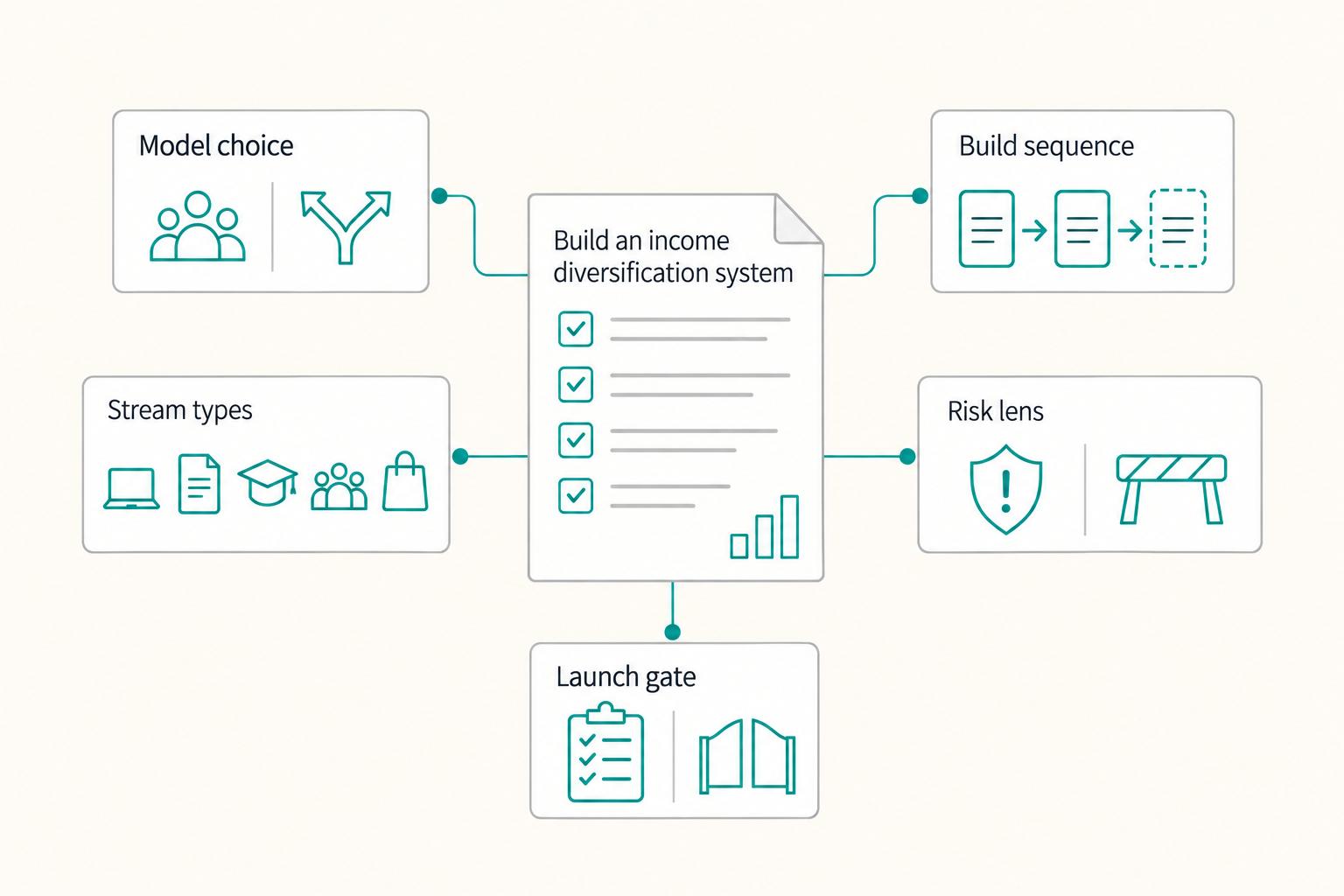
The Best Ways to Diversify Your Freelance Income: A Risk-First Framework
Most freelancers add new revenue lines reactively: a course after a slow month, an affiliate link because someone else said it works, a consulting offer because one client asked for it once. The result is usually the same: more moving parts, unclear priorities, and no real protection when one major client or platform wobbles.

The Freelance Payment Penalty: A Modeled Audit of Platform Fees, FX Spreads, and Payout Delays
The money rarely disappears through a single, easy-to-spot fee. The real loss is stacked. A marketplace takes its commission, a processor adds a charge for international cards, a bank or payment company converts the currency at a spread, a platform holds the funds before release, and a wire sheds a little to intermediaries on the way in. Each layer looks defensible on its own, but the worker feels the combined result as a smaller deposit and a later payday.