
Quick Answer
Start with one active local bank account, then add a single reporting credit line and run it with full-statement autopay. In U.S. onboarding, banks may require core identity and address details using documents such as passport information plus an SSN or ITIN, depending on the institution. Keep usage simple with one or two recurring charges, verify payments posted, and monitor Equifax, Experian, and TransUnion through AnnualCreditReport.com. After that system is stable, split personal and freelance cashflow before expanding credit.
Get banked, add one reporting credit line, then separate cashflow#
If you need to establish credit history in a new country, use a simple sequence: get banked, add one reporting credit line, then separate personal and business cashflow so your payment record stays stable.
Before you start#
Requirements vary by country, so build your checklist around the rules in your destination jurisdiction. In the U.S., account opening typically requires your name, date of birth, address, and an identification number. That may be an SSN, ITIN, or passport number with country of issuance.
| Onboarding pack item | Condition |
|---|---|
| Passport and any immigration or residency documents | Bring the documents the bank requests |
| One accepted identification number | Use the number accepted for that institution |
| Proof-of-address documents | Use the documents the bank confirms it accepts |
| Proof of income or cashflow | Bring it if requested |
| Local phone number | Provide it if required by the application flow |
Do not guess on proof-of-address rules. Confirm acceptable documents with the bank first, keep that confirmation, and check your documents against the application before you submit anything. Your name, address, and other core details should appear the same way across the form and the supporting documents.
If one document uses a shortened address, an older address format, or a different version of your name, ask the bank whether that is acceptable before you apply. That is easier than trying to rescue a paused file later.
Treat your onboarding pack like a working file, not a pile of documents. Save clean copies, keep screenshots or emails showing which documents the institution said it accepts, and note whether you are applying online or in person. Some banks handle those channels differently, so if you switch midway through, confirm the document list again instead of assuming the first answer still applies.
Step 1. Open your first local account with the least friction#
In the U.S., home-country credit usually does not transfer, so your first win is a local account you can actually use. Compare banks on newcomer onboarding clarity, not marketing.
| Question | Topic |
|---|---|
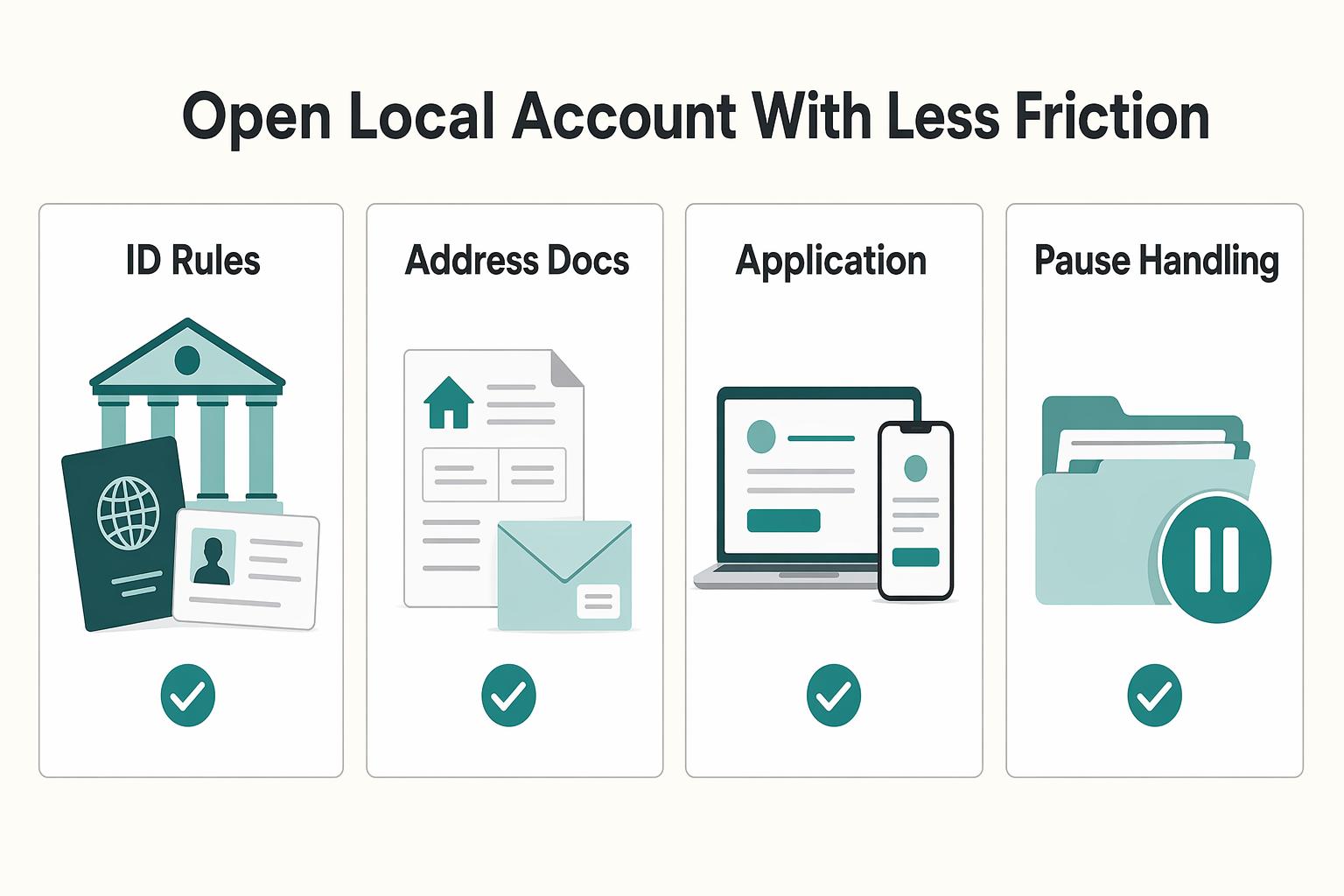
| Can I open with passport + ITIN, or passport details if I do not yet have an SSN? | ID requirements |
| Which address documents are accepted? | Accepted address documents |
| Is in-person onboarding better than online-only for my case? | Application channel |
| If my file is paused, will you specify the exact missing document or field? | Paused-file handling |
For Phase 1, "done" means your account is active and usable for recurring payments, not just "application submitted." That distinction matters because a submitted application does not help you if the bank still needs more information, identity review is still open, or the account exists but is not ready for the recurring payments you plan to use in Phase 2.
Your goal is an account you can log into, fund, and rely on for predictable payment flow. That is why newcomer onboarding clarity matters more than headline features. A bank with a smooth process, a clear document list, and staff who can tell you exactly what is missing is often more useful than one with stronger marketing but vague onboarding rules. If your case is slightly nonstandard, clarity saves time.
If you have a choice between online-only and in-person onboarding, compare them based on error recovery. Online can be efficient when your documents fit the system cleanly. In-person can be better when you need someone to review your document set, explain an address rule, or tell you what caused a hold. The right channel is the one that gets you to an active account with the fewest avoidable loops.
Once the account is open, test the basics early. Make sure the account is active for the recurring payments you intend to use, confirm the information in your profile is correct, and keep the account records organized. If anything looks off, fix it before you add a credit product. Small setup errors become bigger problems once autopay depends on that account working correctly.
Step 2. Add one reporting credit line and run it on rails#
Once your account is live, add a single credit line that reports consistently. In the U.S., a secured card is the usual starter path, but authorized-user and issuer transfer paths can also work when you are eligible.
| Path | Best eligibility signal | Speed to first score movement | Main risk | Effort |
|---|---|---|---|---|
| Secured card | You can fund the deposit and confirm the issuer reports to all three major U.S. bureaus | Commonly starts after reporting begins; first score can vary, often in the 1 to 6 month range | Some products do not report to all three bureaus | Low to medium |
| Authorized user | You have a trusted primary cardholder with strong repayment habits | Depends on issuer reporting and primary account behavior | Poor payment behavior or high balances on the primary account can hurt outcomes | Low |
| American Express Global Card Relationship | You already hold an eligible Amex account and are moving to a supported country | Can reduce setup friction, but score timing still depends on bureau reporting | Not all Amex-branded products are eligible; approval is not guaranteed | Medium |
If a secured card is your route, verify one non-negotiable point before you apply: reporting to Equifax, Experian, and TransUnion. Then keep the operating routine simple:
- put one or two small recurring bills on the card
- set autopay for the full statement balance from your checking account
- keep utilization modest relative to limit, and follow local scoring rules rather than a universal cutoff
- check before the due date and confirm autopay posted after statement close
- review your U.S. reports weekly via AnnualCreditReport.com
Payment history and amounts owed are major scoring inputs, so consistency matters more than optimization tricks. The goal is to make the account boring. You are not trying to extract rewards, test spending capacity, or run multiple experiments at once. You are trying to create a clean record of on-time use that reports predictably.
One recurring charge or two is usually enough to prove the system works. Think through the sequence before the first statement closes: the charges need to post, the statement needs to generate, and autopay needs to pull correctly from the checking account you opened in Step 1. If any part of that chain is uncertain, reduce complexity until it is reliable.
Verification matters as much as setup. After the first cycle, do not assume reporting happened the way you expected. Check the account, confirm the payment posted, and then review your reports to see whether the account appears as expected. If reporting is delayed or unclear, you want to know that before you open anything else.
The same caution applies if you qualify for an authorized-user path or a transfer path. Those routes can reduce friction, but only when you understand the reporting behavior and your level of control. If another person controls the primary account, your result depends partly on their payment and balance habits. If a transfer path exists, treat it as a route to a local reporting account, not as a promise that everything will carry over automatically.
Use a simple Phase 2 rule: if you cannot explain exactly how the account will be used, paid, and checked each month, the setup is not ready.
Step 3. Separate freelance cashflow before you expand#
Do not add more credit products until the first one is stable. For freelancers, the next control point is separating personal and business money flows. In the U.S., SBA guidance is to open a business bank account once business money starts moving.
| Benefit | How it is described |
|---|---|
| Recordkeeping | Clean separation supports recordkeeping |
| Performance monitoring | Clean separation helps you monitor business performance |
| Statement and tax prep | Clean separation makes statement and tax prep cleaner |
| Client payment setup | It can give clients a cleaner payment setup when invoices and operating expenses are not mixed with personal spending |
This is a control step, not paperwork for its own sake. The point is to make cashflow visible before you expand credit.
Only add the next product after stable repayment behavior. If your first account has aged, is reporting, and payments are consistently on time, then evaluate a second line. If cashflow is still uneven, keep autopay anchored to the account with the most reliable buffer.
For freelancers, this step often determines whether your early credit progress stays stable. Mixed cashflow makes it harder to see what money is available for personal obligations, what belongs to the business, and what timing gaps might disrupt autopay. Separate accounts do not solve every cashflow problem, but they often make problems visible sooner.
Use the split in a practical way. Route business income and business expenses through the business side, and keep personal recurring obligations tied to the account that supports your repayment routine. That can make your records easier to review if a bank asks for income or cashflow support later. It can also help you explain your activity cleanly if an institution wants to understand where funds come from and how they move.
This is also why you should wait before expanding credit. A second product can make sense after the first account is reporting normally and your payment routine is settled. But if the first setup is still new, or if freelance income is still moving unpredictably, more products usually create more moving parts, not more strength.
If you want a deeper dive, read Should Your Freelance Business Accept Credit Cards?. As you build your income dossier, keep your client billing records clean and exportable with this free invoice generator.
Conclusion: Your Financial Identity Is Your New Superpower#
Your local credit profile is a practical operating asset, not just a score. Managed well, it can reduce day-to-day money friction and give you a stronger base for freelance cashflow, expense control, and future applications.
You now have three levers to work with: documentation readiness, consistent on-time repayment, and a clean split between personal and business finances. That will not guarantee approval, but it can make your file easier for issuers and lenders to review.
- Keep repayment predictable.
Set full-balance autopay where possible, then confirm the first payment posts correctly. On-time payment behavior has the biggest effect on score outcomes, so protect this first. After your first statement cycle, verify the account is current and keep your credit use around or below 30% of your total limit. If anything in the payment flow feels manual or uncertain, simplify it before you add more moving parts.
- Review your credit file, not just application outcomes.
Use AnnualCreditReport.com to check Equifax, Experian, and TransUnion reports. Free weekly online reports are available, and regular checks help you catch errors that can hurt your score. Confirm your identity details, accounts, and payment status match your records, and keep statements and confirmations organized in case you need to dispute anything. You are not just checking for a score change. You are checking whether the file reflects reality.
- Separate business and personal money before expanding credit.
Use separate bank accounts and clean recordkeeping so your income and expenses are easy to trace. This reduces day-to-day friction, improves expense control, and can make reviews easier for banks and other counterparties. Apply for additional products only when needed, and after your profile is stable and your recent activity is easy to explain. If you are rate-shopping for the same loan type, keeping applications within a focused 14 to 45 day window may reduce the impact of multiple inquiries. If your cashflow is still settling, protect the system you already built instead of stretching it.
That is the real goal: a profile you can maintain consistently, verify quickly, and use with confidence in your new country. Related: How to Build Credit as a Freelancer.
If you want one workflow to invoice clients, track payment status, and keep payout records organized while you establish local financial credibility, see Gruv for freelancers.
Frequently Asked Questions
How should you prove income if you are self-employed and new to the country?
Use the exact requirement list from the institution handling your application, and treat any unverified checklist as provisional. Keep copies of what you submit and the requirement version/date you were given. If a legal or regulatory statement affects your next step, verify it against an official edition rather than an informational web summary.
What is the fastest way to build credit history in a new country?
Use a verify-first sequence and confirm each step before starting another. | Checkpoint | What to confirm | Verification step | | --- | --- | --- | | Institution requirements | Current eligibility and required documents | Use the institution's current requirements for your application channel | | Regulatory references | That quoted rule text is official | Verify against an official edition of the Federal Register | | Federal Register copy | That you are not relying only on the unofficial web/XML view | Use the official PDF link on govinfo from the Federal Register entry | | Guidance freshness | Whether handbook text has later updates | Check the current version/date and referenced update bulletins | When details are unclear, pause and verify before adding another application.
What documents should you bring to open a newcomer bank account?
Get the exact list from the institution and channel you will use, and avoid generic checklists when official requirements are available. Before submitting, make sure your documents match the details on your application and keep a record of the requirements you were given at that time.
Can you use your existing foreign card to build local credit, or do you need a new one?
Treat this as unconfirmed until you verify it directly with the issuer. Confirm country-by-country transfer-program eligibility and reporting outcomes with the relevant authority. If transfer details remain unclear, use the local option whose requirements and process you can verify end to end.
What mistakes slow people down most?
A major failure mode is treating informational web text as if it were the final legal record. For regulatory points, verify against an official edition; relying on the unofficial XML/web rendering alone does not provide legal or judicial notice. Another slowdown is acting on stale guidance. For example, the OCC Allowances for Credit Losses booklet notes that references to reputation risk were removed as of March 20, 2025, and it points readers to OCC Bulletin 2025-4.
Are credit-builder loans or similar products worth using?
Treat product terms, pricing, and outcome timelines as unconfirmed until you verify them in current official disclosures from the provider. Choose only options where requirements, costs, and process steps are explicit and verifiable before enrollment.
Try a related tool
Researched and edited by the Gruv editorial team. Gruv builds cross-border billing, payouts, and finance-operations software for global businesses.
Sources
- consumer.ftc.gov/consumer-alerts/2023/10/you-now-have-permane...trusted
- consumer.gov/credit/getting-credit-cardtrusted
- consumerfinance.gov/consumer-tools/credit-reports-and-scores/und...trusted
- consumerfinance.gov/ask-cfpb/what-kind-of-credit-inquiry-has-no-...trusted
- dol.gov/agencies/owcp/FECA/regs/compliance/DFECfolio...trusted
- ecfr.gov/current/title-31/subtitle-B/chapter-X/part-1...trusted
- fdic.gov/system/files/2024-05/how-to-open-a-bank-acco...trusted
- federalregister.gov/documents/2023/05/31/2023-07230/small-busine...trusted
Educational content only. Not legal, tax, or financial advice.
Related Posts
Should Your Freelance Business Accept Credit Cards?
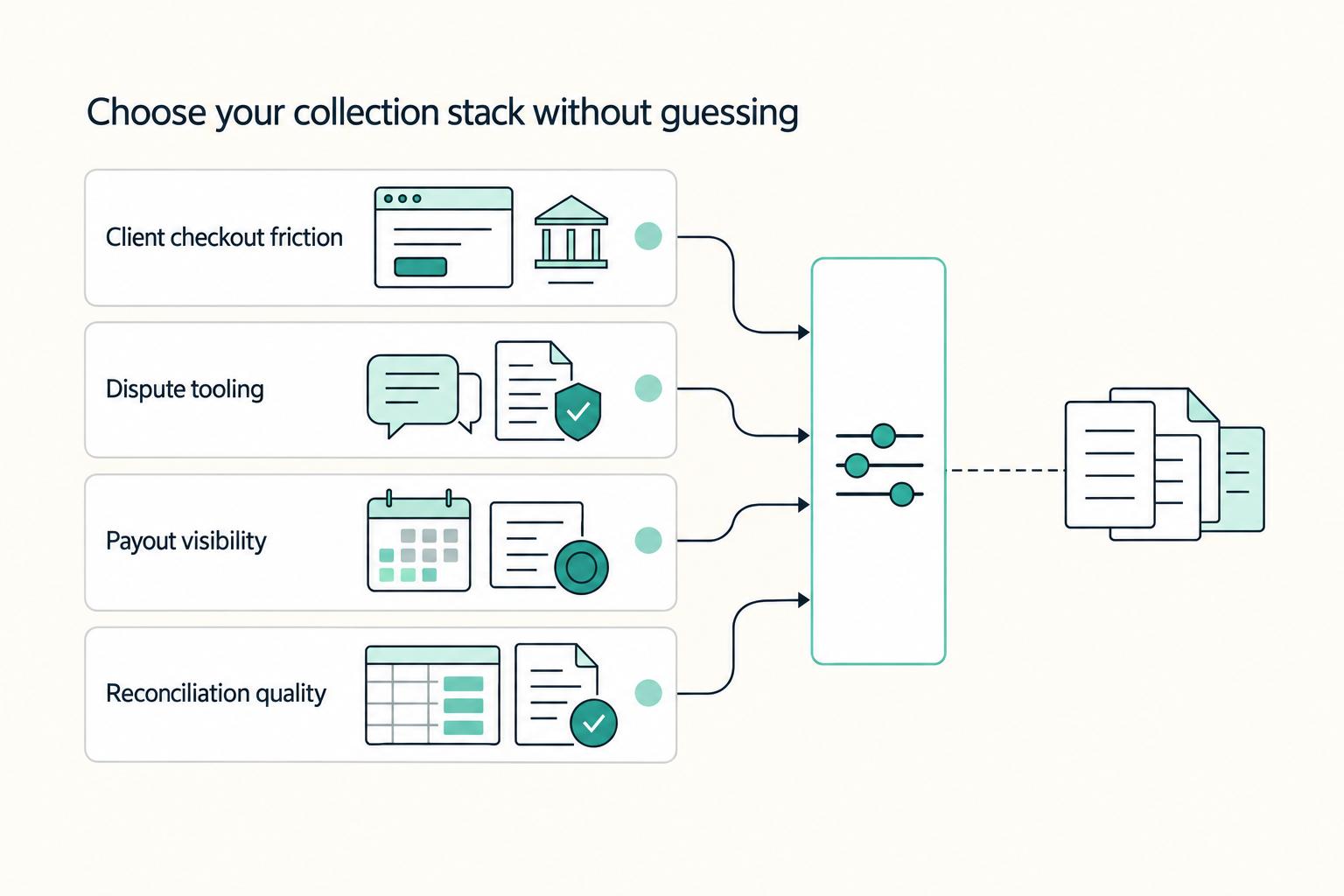
Offer card payments, but stay in control of how money reaches you. The goal is not a smoother checkout screen. It is predictable cash you can use to run the business.

How to Build Credit as a Freelancer
To build credit as a freelancer, stop relying on motivation and start running a simple, repeatable system that still works when income is uneven. You run a business-of-one, and credit is part of your operating model, not a personality test. If you've ever blamed your "money habits," you probably just lacked a workflow that turns irregular cashflow into consistent credit behavior. Start thinking like an operator: controls first, then tools.
What is a 'Financial Identity' and Why Do Nomads Need One?
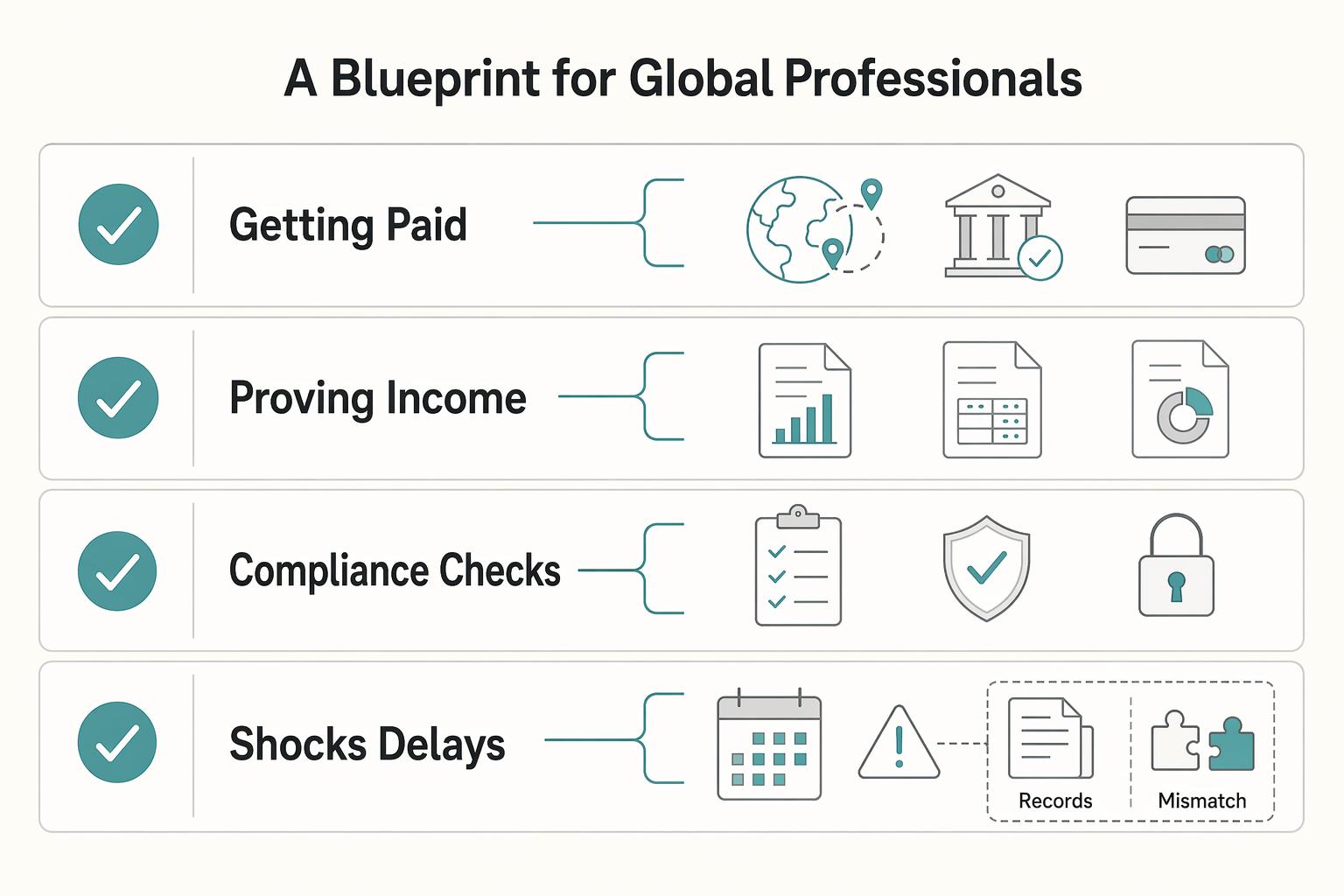
Your financial identity should function as portable proof. It can help you get paid across borders, clear reviews faster, and control risk when your life does not fit the one-address, one-employer, one-country model many institutions still assume.