
Quick Answer
Start by treating Superhost as a performance system, not a badge chase. For how to become an airbnb superhost, set controls around the metrics Airbnb checks: review quality, response behavior, cancellations, and booking history. Use a turnover SOP with dated photos, stage-based guest messages, and a clear booking acceptance rule. Then check your host dashboard on a fixed cadence so weak spots are corrected before the next quarterly assessment.
Stop Hosting. Start Managing Your Asset.#
You do not earn Superhost by chasing a badge. You earn it by running your listing like an asset, with controls, checkpoints, and fewer avoidable misses. If you're figuring out how to become an Airbnb Superhost, the first shift is not tactical. It's deciding what you're actually managing.
Airbnb is clear on two points that matter here. First, you do not apply; if you meet the program requirements on the quarterly assessment date, qualification happens automatically. Second, the criteria are built around consistent performance in positive reviews, responsiveness, and avoiding cancellations. That is why Superhost is better treated as an operating model than a status goal.
Step 1 Reframe the badge as a visible trust signal, not the job#
A Superhost badge appears on your listing and profile, so it has real customer-facing value. Airbnb also says Superhosts get more visibility, earning potential, and access to exclusive rewards. That matters, but keep it in proportion. The badge is a trust signal, not an endorsement, and it does not guarantee ranking, occupancy, or rate lift on its own.
The practical takeaway is simple. Manage for reliability first, then measure whether that trust signal improves your occupancy consistency, conversion, and pricing power in your market.
Step 2 Translate Airbnb's criteria into controls you can actually run#
The useful move here is to stop thinking in platform labels and start thinking in operating controls. Once each requirement has an owner and a business outcome, you stop hoping and start managing.
| Platform qualification area | Operational control | Primary owner | Business outcome |
|---|---|---|---|
| Positive reviews | Turnover standard, arrival-readiness check, issue-resolution routine | You plus cleaner or co-host | More consistent guest satisfaction and fewer preventable review hits |
| Responsiveness | Message coverage by hour, saved replies, escalation rule for urgent issues | You or inbox manager | Faster guest trust, fewer missed inquiries, smoother stays |
| Avoiding cancellations | Calendar discipline, maintenance buffer, backup vendor list, booking acceptance rule | You | Fewer self-inflicted disruptions and stronger reliability |
| Quarterly assessment checkpoint | Recurring host dashboard review before each assessment date | You | No surprises when Airbnb reviews performance 4 times a year |
Your verification point is the host dashboard. Airbnb explicitly points hosts there to see how they are doing on each requirement, and Airbnb checks performance 4 times a year. If you cannot open your dashboard and name your weakest area, your next assessment date, and the person responsible for fixing the gap, you are still operating reactively.
One common failure mode is focusing on guest charm while ignoring control failures. One avoidable cancellation, one slow response pattern, or one messy turnover can damage the same result you were trying to improve.
Keep a small evidence pack for yourself: dated cleaning photos, a turnover checklist, message templates, and backup contact details for maintenance and cleaning. That is not paperwork for its own sake. It is what lets you diagnose what broke before it turns into a bad review or a cancelled stay.
Step 3 Run the work in the only sequence that really holds#
Follow the work in this order. First, systemize consistently positive stay quality as your product. Then automate communication as your service layer. Last, de-risk operations so one preventable problem does not wipe out the gains from the first two.
| Order | Focus | Why it comes here |
|---|---|---|
| 1 | Systemize consistently positive stay quality | Reviews come from the stay itself |
| 2 | Automate communication | Responsiveness shapes trust before, during, and after booking |
| 3 | De-risk operations | One preventable problem does not wipe out the gains from the first two |
That sequence matters. Better messages cannot rescue a disappointing stay, and a beautiful unit still underperforms if guests cannot get timely answers or if you cancel bookings you should never have accepted. Start with the product because reviews come from the stay itself. Then tighten communication because responsiveness shapes trust before, during, and after booking. Finally, build your firewall around cancellations, handoffs, and exceptions.
Your next move is straightforward: go to Part 1 and define the repeatable quality standard for the property itself. Before you touch automation or pricing, make sure the stay can deliver the same result every time.
Related: A Guide to Getting Your First Five-Star Review on Airbnb.
Part 1: Systemize 5-Star Quality (Your Product)#
To hold a 4.8+ overall rating, you need quality to be repeatable, not improvised. Run one standard, one verification flow, and one clear sign-off before every arrival.
Step 1 Build a turnover SOP you can verify#
Your turnover process should make the unit guest-ready the same way every time. Use one checklist for cleaning, staging, and basic functionality, and run it twice: a turnover check after cleaning and a pre-arrival check before check-in. Capture dated photos as proof of completion, and assign one named person to approve the final handoff.
| Checkpoint | What to confirm |
|---|---|
| Latest photos | Recent photos are on file |
| Access and core functions | They were checked |
| Final sign-off | A specific person signed off |
Before each arrival, you should be able to quickly confirm three things: the latest photos exist, access and core functions were checked, and a specific person signed off. If ownership is unclear, small misses become review problems.
Step 2 Control inventory like an operational risk#
Treat inventory as a reliability control, not a convenience task. Split supplies and systems into critical (guest-visible if missing or failing) and nice-to-have (helpful but not stay-breaking), then manage each category intentionally.
| Turnover model | Effort from you | Consistency risk | Oversight needed |
|---|---|---|---|
| Self-managed turnover | High | Depends on your discipline and time pressure | High |
| Cleaner-managed turnover | Lower day-to-day | Depends on how clear your standards are | High upfront, then ongoing spot checks |
| Hybrid | Medium | Depends on handoff quality between you and cleaner | Medium to high |
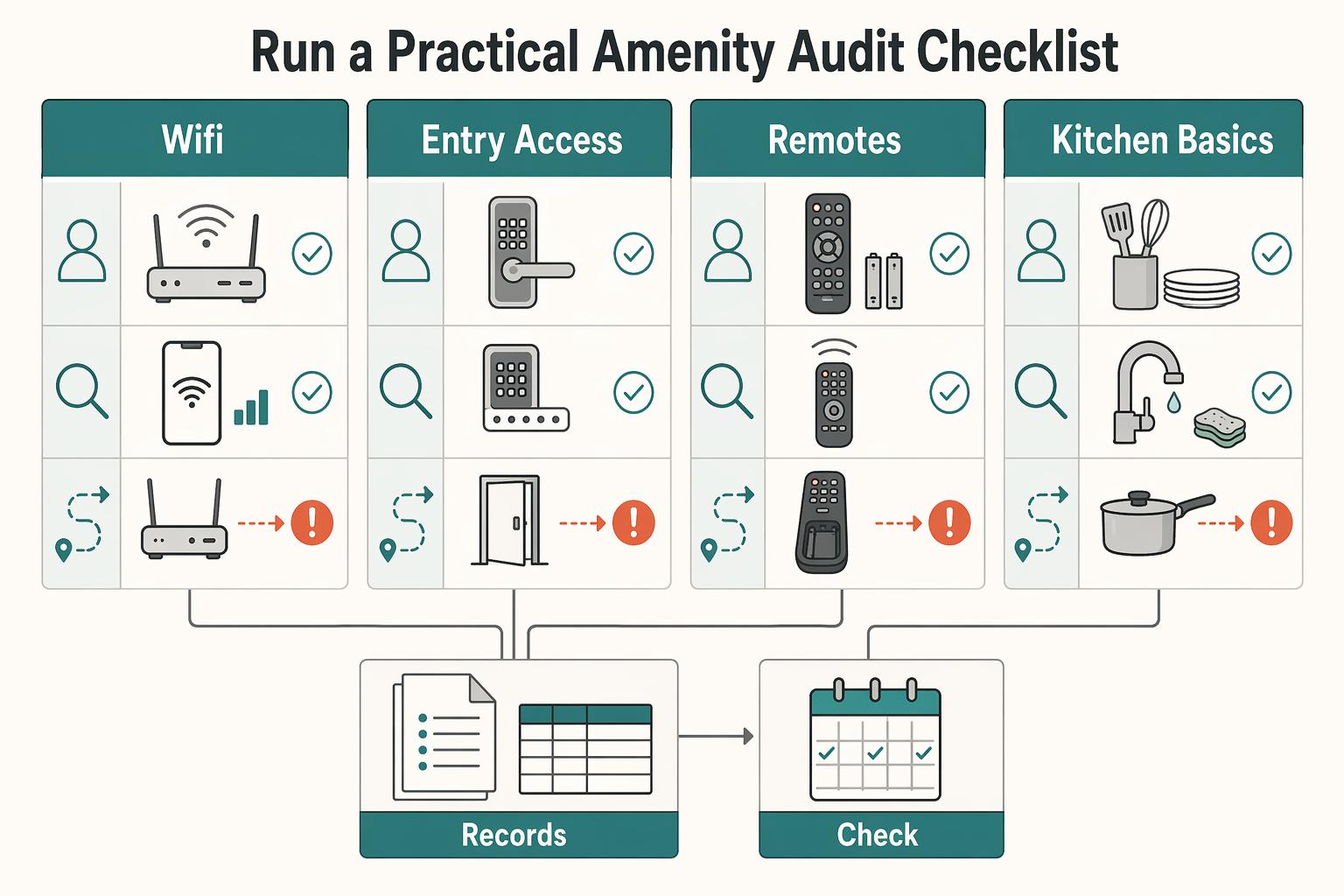
Set practical restock triggers for critical items before shortages reach guests. Check connectivity and access status during turnover, and keep a simple exception log for repeat failures so you fix root causes, not just one-off symptoms.
Step 3 Publish a digital welcome book and maintain it#
Your welcome book should reduce friction immediately. Keep it structured around four blocks: home operations, neighborhood guidance, issue escalation, and house expectations.
Set a recurring review cadence, and update the guide whenever details change, for example access instructions, connectivity details, appliance use, parking, or local recommendations. Outdated guidance erodes trust as quickly as a poor turnover.
You might also find this useful: How to Scale an Airbnb Business.
Part 2: Automate Elite Communication (Your Engine)#
Treat communication as a system: automate routine updates in Airbnb messaging, and route exceptions to a human immediately. Your non-negotiable checkpoint is simple: respond to every guest inquiry within 24 hours.
Step 1: Build one guest-journey message map. Write messages by stage so guests always know what happens next.
| Stage | What your message should do | Timing |
|---|---|---|
| Booking | Confirm reservation, thank the guest, and set the next update expectation | At booking |
| Pre-arrival | Share arrival essentials, for example entry notes and your welcome guide | Before arrival |
| Arrival | Confirm they got in and are settled | On arrival |
| In-stay | Check whether they need help before issues become public complaints | During the stay |
| Checkout | Restate checkout expectations and simple departure steps | Before checkout |
| Post-stay | Thank the guest and submit your host review promptly to encourage reciprocity | After checkout |
Quality check: each message should answer one likely question and give one clear next action.
Step 2: Use escalation rules for exceptions automation should not own. Automation handles repetition; people handle risk. Define a live-response path for each case below, with one named owner per shift:
- Late check-in
- Access failure
- Complaint
- Emergency
For each case, predefine who replies, what first action they take, and when they switch channels. Keep incident notes in the Airbnb thread and your ops log so follow-up is based on records, not memory.
Step 3: Pick the lightest setup that still gives control. Use the simplest option that prevents missed messages.
| Option | Setup effort | Day-to-day control | Integration depth | Failure handling | Best fit |
|---|---|---|---|---|---|
| Manual replies only | Low setup, high ongoing effort | High per message, low consistency at volume | None | Fully dependent on your availability | One listing, low message volume |
| Airbnb scheduled messages | Low to medium | Strong for repeatable stages | Native Airbnb messaging | Requires active monitoring if a trigger is missed | One to a few listings |
| Connected automation tool | Medium to high | High when templates and ownership are maintained | Broader workflow connections | Stronger if you assign clear human backup ownership | Growing multi-listing portfolio |
Step 4: Define access-control operations before you automate access messages. Before sending automated access instructions, decide your operating rules: code lifecycle, who can override, backup access path, identity-check step before sharing fallback access, and outage fallback if lock, power, Wi-Fi, or app fails. Keep these rules in your internal SOP, then align your templates to that SOP.
Launch-readiness checklist:
- QA templates for clarity, accuracy, and link health.
- Trigger-test each stage and confirm alerts reach the right owner.
- Check tone consistency across booking, stay, and post-stay messages.
- Assign explicit response ownership for nights, weekends, and exceptions.
That is where the gains come from: fewer communication gaps and faster recovery when something goes wrong. We covered this in detail in How to Automate Your Airbnb with Smart Home Tech.
Part 3: De-Risk Your Operations (Your Firewall)#
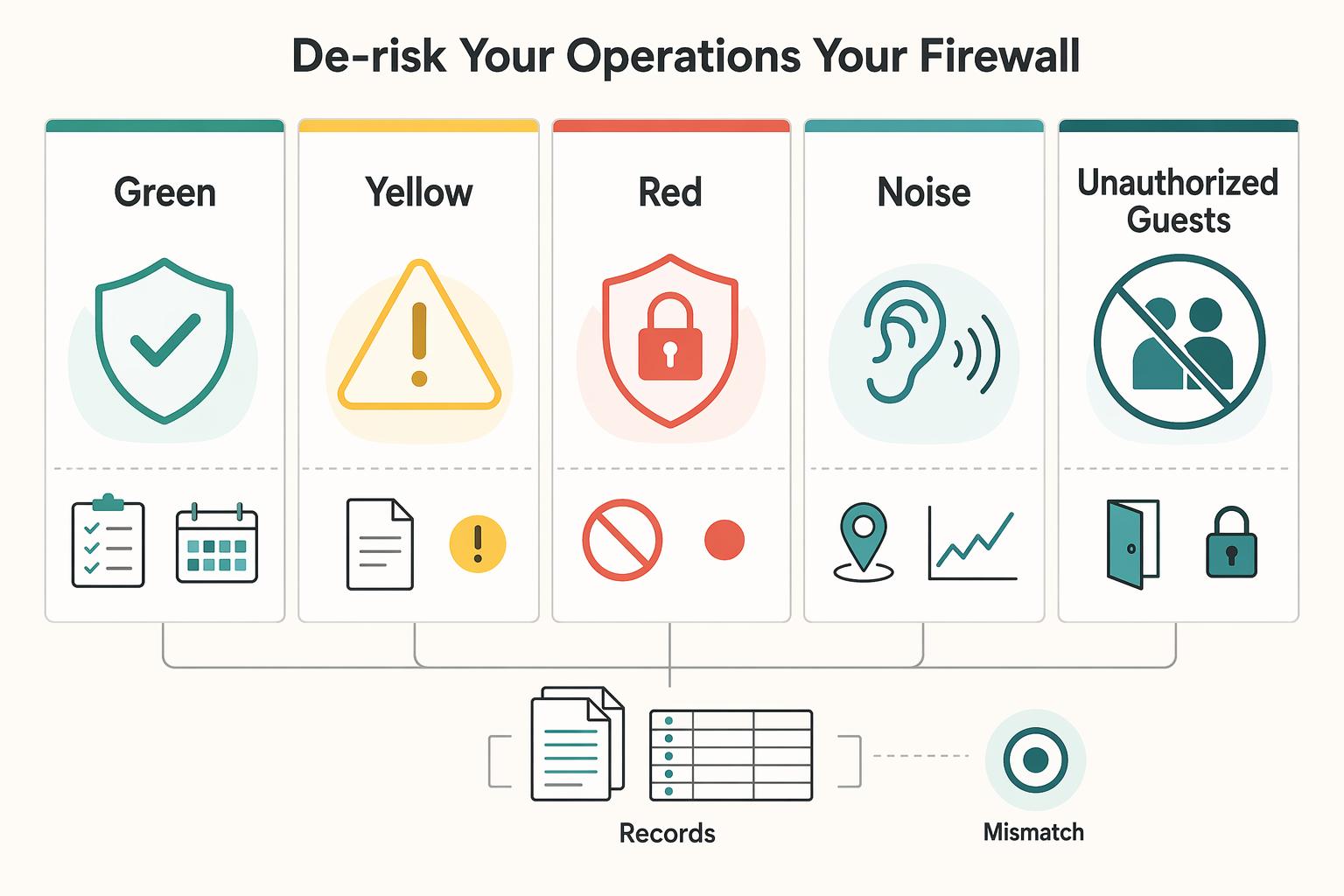
Once communication is stable, your next job is to prevent avoidable issues before they affect the stay. Think of this as your operational firewall: controls that protect your rating, revenue continuity, and property condition. In this framework, <1% Cancellation Rate is not just a platform target. It is an operational reliability signal.
| Signal | Indicators |
|---|---|
| Green | Clear trip purpose, complete answers, and alignment with your listed rules |
| Yellow | Missing context, thin profile history, or requests that may change your normal process |
| Red | Requests to break rules, contradictory reservation details, or clear conflict with your stated terms |
Step 1 Use one booking decision framework for everyone. Consistency lowers risk more than instinct. Screen for booking fit and behavior, apply the same process to every guest, and keep decisions tied to listing-related facts, not personal assumptions.
Use the green / yellow / red signals above the same way every time. When signals are mixed, ask standardized follow-up questions in-platform, pause acceptance until details are consistent, and keep your thread factual. The test is simple: another operator should be able to read the thread and understand why you accepted or declined.
Step 2 Build rule architecture across three layers. Rules are most enforceable when they are placed in the right channel, not dumped into one long block.
- Listing rules: non-negotiables that define the stay before booking (occupancy, visitors, parties, smoking, pets, parking, quiet expectations).
- Pre-arrival message: short restatement of the rules most likely to affect arrival and in-stay execution.
- In-platform documentation: any exception request, approval, or clarification captured in the Airbnb message thread.
This structure keeps expectations clear before arrival and creates a usable record if a dispute appears later.
Step 3 Predefine incident controls and evidence collection. In incidents, complete records beat fast reactions. Use a simple playbook so first actions stay calm and repeatable.
| Incident | Prevention control | Evidence to collect | First response action |
|---|---|---|---|
| Noise | Quiet expectations in listing + pre-arrival reminder | Timestamps, neighbor report, thread notes, relevant access/activity records | Message guest in-platform, state issue, request immediate correction, log time |
| Unauthorized guests | Clear occupancy and visitor policy before booking | Entry records where lawful, photos when appropriate, co-host/cleaner notes, thread history | Ask for immediate guest-count confirmation in-platform and require compliance |
| Damage | Check-in and turnover condition checks | Timestamped photos, cleaner report, estimates/receipts, message acknowledgments | Notify guest factually, document condition, keep follow-up in-platform |
| False claim | Pre-arrival QA + documented amenities/instructions | Before-check-in photos, listing screenshots, message history, access logs | Acknowledge concern, correct facts calmly, reference records |
One risk this does not solve by itself is legal separation. Rules and documentation can reduce exposure, but they do not automatically separate personal and business assets. If hosting is meaningful income, get local advice on whether an Airbnb LLC or similar structure fits your situation.
Step 4 Run a reputation workflow for negative reviews. Handle negative reviews as operations, not emotion. Start with private resolution when possible, then use a short public response aimed at future guests.
For public replies, use a factual sequence: acknowledge feedback, clarify one material point if needed, then state what changed. Example: "We updated the coffee setup and revised welcome-book instructions." That signals control, learning, and follow-through.
From Host to Asset Manager#
The practical shift is simple: stop running each stay as a one-off and run your listing as a system. You do that by defining standards, documenting repeat work, assigning ownership, and reviewing performance on a fixed cadence.
| Old approach | Managed approach |
|---|---|
| Reactive hosting after a guest complaint | Scheduled pre-arrival and post-turnover checks against written standards |
| Ad hoc messaging from memory | Documented SOPs for booking, pre-arrival, first-night check, and checkout |
| Informal rules that are hard to enforce | Clear written policies, stored evidence, and consistent escalation |
Step 1: Define your standards. Write what "ready" means for the unit, not just "clean." Include the items guests directly experience: access, bed setup, bathroom stock, Wi-Fi, temperature comfort, and visible condition.
Step 2: Document repeat work. Create short SOPs for cleaning, restocking, guest messaging, issue escalation, and checkout inspection. If tasks keep changing person to person, the process is not stable yet.
Step 3: Assign tools and owners. Decide who owns each task and where proof lives. Keep pre-arrival photos, maintenance notes, and guest messages in one place so completion and disputes are easier to handle.
Step 4: Review on Airbnb's rhythm. Airbnb checks Superhost performance 4 times a year, and you can track progress in your host dashboard. Review ratings, responsiveness, and cancellations monthly so you can correct issues before the next assessment.
Step 5: Adjust from trends, not anecdotes. Treat recurring issues as process failures to fix at the source. If you operate multiple properties, be stricter: third-party guidance warns weak performance on one property can affect your overall host profile.
Use this approach consistently and operations usually become steadier and easier to scale. Superhost status is most reliable as the result of consistent execution, not the sole target.
For a step-by-step walkthrough, see Airbnb Resolution Center: How to Document, File, and Escalate a Damage Claim.
Frequently Asked Questions
Can you lose Superhost status?
Yes. Airbnb evaluates Superhost every 3 months using the prior 12 months, and each assessment runs in a 7-day window. Track your trailing numbers, not just your last few stays. A review counts once both sides review or the 14-day window closes, so a review published after an evaluation period can count in the next assessment period.
What is the fastest way to become a Superhost?
Set up your operation before your listing goes live. The current thresholds are 10 reservations, or 3 reservations totaling at least 100 nights, plus a 90% or higher response rate, less than 1% cancellations, and a 4.8 or higher overall rating. Make sure you are the listing owner of a homes listing in good standing, since co-host activity does not count toward eligibility. Do not expect the badge the moment you hit those numbers mid-quarter; if you are still eligible at the next review, Airbnb applies it automatically with no application.
How do you automate Airbnb communication for Superhost status?
Write your repeat messages first for the moments that keep breaking your attention: booking confirmation, pre-arrival, first-night check, and checkout. Your checkpoint is simple: each message should answer one likely guest question and give one clear next action, which helps you protect the 90%+ response-rate requirement without sounding canned. Avoid long message walls and off-platform side conversations. If replies are still messy or late, go back to Part 2 and tighten the communication engine.
What is the real payoff of Superhost status?
Treat the badge as a visibility and trust signal, not a guaranteed revenue jump. Airbnb states Superhosts get added visibility and the badge shows on listings and profiles. That can help guest confidence when your price, photos, and reviews already support the booking. If your listing is underperforming, fix the stay experience first in Part 1, because the badge will not rescue weak product quality or inconsistent hosting standards.
How do you handle a host initiated cancellation without hurting your chances?
Try to prevent the cancellation before it starts, because the threshold is less than 1% and avoidable cancellations are hard to recover from later. Keep the issue in the Airbnb message thread and contact support before you cancel so there is a documented record and you can confirm current policy handling. If the real issue is poor guest fit, missing trip details, or rule friction, the fix is earlier screening from Part 3, not a last-minute cancellation.
Try a related tool
Researched and edited by the Gruv editorial team. Gruv builds cross-border billing, payouts, and finance-operations software for global businesses.
Sources
Includes 5 external sources outside the trusted-domain allowlist.
- academia.edu/74829969/A_Study_on_Supporting_Factors_of_Di...trusted
- documents.coastal.ca.gov/reports/2019/7/F2/F2-7-2019-correspondence.pdftrusted
- documents.coastal.ca.gov/reports/2022/3/W14f/W14f-3-2022-corresp2.pdftrusted
- airbnb.com/help/article/828external
- airbnb.com/help/article/829external
- airdna.co/blog/airbnb-llcexternal
- airhostsforum.com/t/assaulted-by-a-male-guest-as-a-former-supe...external
- blog.beds24.com/optimize-for-airbnbs-search-algorithmexternal
Educational content only. Not legal, tax, or financial advice.
Related Posts

Thailand's Long-Term Resident (LTR) Visa for Professionals
For a long stay in Thailand, the biggest avoidable risk is doing the right steps in the wrong order. Pick the LTR track first, build the evidence pack that matches it second, and verify live official checkpoints right before every submission or payment. That extra day of discipline usually saves far more time than it costs.
How to Get Your First Five-Star Review on Airbnb
If you want better Airbnb reviews, reduce surprises first. For many high-achievers, managing a property creates a familiar kind of anxiety: the low-grade fear that one missed detail will turn into a visible, costly problem. In a career role, that might mean a missed deadline or a flawed report. In short-term rentals, it often shows up as a negative review that sits in public and affects both reputation and revenue.

The Freelance Payment Penalty: A Modeled Audit of Platform Fees, FX Spreads, and Payout Delays
The money rarely disappears through a single, easy-to-spot fee. The real loss is stacked. A marketplace takes its commission, a processor adds a charge for international cards, a bank or payment company converts the currency at a spread, a platform holds the funds before release, and a wire sheds a little to intermediaries on the way in. Each layer looks defensible on its own, but the worker feels the combined result as a smaller deposit and a later payday.