
Quick Answer
Set your booking guardrails first, then run controlled checks. To avoid dynamic pricing travel mistakes, compare like-for-like options only, document fare terms with timestamps, and decide using your pre-set lock-or-wait rule instead of chasing perfect timing. For relocation legs, choose the option with clearer change support even when another fare looks cheaper. Apply the same discipline to attractions by locking capacity-capped entries before flexible activities.
Start with your deadlines, compare like-for-like offers, then decide when to book#
Your edge is not predicting airfare. It is using a repeatable process that starts with your deadlines, compares like-for-like offers, and tells you when to book. If you want to avoid pricing mistakes during a move, treat fares as something you manage around, not something you fully control.
Prices can move for reasons you cannot cleanly see from the outside, including timing and channel differences. Automated pricing is already part of air travel, so the practical move is to spend less time guessing why a fare changed and more time comparing the same offer under the same conditions.
| Decision point | Mission-critical leg | Flexible leg |
|---|---|---|
| Trigger | Missing it creates move risk | Missing it is inconvenient, not damaging |
| Booking priority | Protect arrival date and support | Test more dates and channels |
| What to favor | Change path, baggage, direct supportability | Lower total price if rules are acceptable |
Map your real deadline#
Write down your must-arrive-by date, acceptable arrival window, and any date you cannot miss. Then label each leg as mission-critical or flexible. That label decides how strict you are in later comparisons.
Compare only matched offers#
Check the airline site and one third-party seller, but only treat a price gap as meaningful when the rest of the offer is the same: route, date, cabin, baggage, and fare rules. Save screenshots, timestamps, and the fare-rules page. That gives you a shortlist you can trust instead of random browser noise.
Set a lock-or-wait rule#
Choose a price ceiling and a time floor before you search. If a mission-critical fare lands inside both, book it. If not, keep watching on a schedule. A cheaper headline fare is not actually cheaper if the change path is poor, support is weak, or one disruption can break your move.
If you need a simple place to keep screenshots, fare rules, and decision notes, a basic spreadsheet works. You can also keep it in Notion. For a step-by-step walkthrough, see How to Avoid 'Dynamic Currency Conversion' Scams.
Prerequisites: what to prep before you start price-checking (so your data isn't garbage)#
Set up a single "booking clean room" before you compare prices. Your goal is not to prove why a fare changed, but to keep inputs stable so your comparisons are decision-ready.
Freeze one comparison setup before you open fare tabs#
Pick one browser state, one login state, one location method, and one channel scope, then keep them fixed for the full check. If you change inputs mid-session, you cannot tell whether price movement came from the market or your setup.
The caution here is simple: the accessible research here is about hotel dynamic pricing, not flights, and cookie/incognito advice is anecdotal. Use these steps as consistency controls, not guaranteed price reducers.
| Setup variable | Allowed options | What must stay constant | What to log each time |
|---|---|---|---|
| Browser state | Regular window, incognito mode, or fresh profile | Same choice for the full check | Browser and mode |
| Login state | Logged out or logged in | Do not switch mid-check | Account/login status |
| Location method | No VPN, or one fixed VPN location | Same location for that check | VPN on/off and location |
| Channel scope | Airline direct plus one third-party seller | Compare only matched offers | Seller and channel |
Quick control check: after your first two searches, confirm browser mode, login state, and location are identical in your notes. If not, restart. Also avoid assuming a friend's device or account removes noise; app history can still affect what they see.
If you want to separate browsing from checkout, you can use a different browser for final booking. Treat that as process hygiene, not a proven discount tactic.
Write relocation constraints before you compare a single fare#
Define your non-negotiable milestones first, then your flexibility window. Label each leg:
Mission-critical: missing it creates relocation risk.Flexible: missing it is inconvenient, not damaging.
This label should drive your booking choice more than a small fare difference.
Build an evidence log and a pre-commit risk rule#
Use the same fields every time so later decisions are clean:
- Route and travel dates
- Search date and time
- Seller and channel
- Fare family
- Baggage assumptions
- Change/cancel policy summary
- Total price
- Add screenshot timestamp
Before you continue searching, set a pre-commit rule: the maximum downside you can absorb, and the maximum extra you will pay for flexibility on a mission-critical leg. You will use that rule in the lock-or-wait decision next.
We covered this in detail in How to Secure Your Devices for International Travel.
When should you book if your move has hard deadlines? (The relocation-first decision framework)#
Book based on your operational deadline, not on trying to predict a perfect price dip. Dynamic pricing is commonly framed as rationing scarce inventory with price, so as your acceptable options narrow, waiting can carry more risk even when price direction is uncertain.
Map your booking window into three zones#
Use one behavior per zone so you do not treat early flexibility and late-stage constraints the same way.
| Zone | Entry criteria | Primary action | Stop condition |
|---|---|---|---|
| Exploration | Must-arrive date is defined, and you still have meaningful date/routing flexibility | Build a matched baseline: same route, dates, fare family, baggage assumptions, and channel type | Stop broad searching once you know your normal price/terms range |
| Decision | One or more move milestones make missed or weak options costly for your plan | Shortlist only bookable options; weigh fare terms and total trip cost, not headline price alone | Stop testing when an option meets your arrival need and downside limit |
| Lock | Time remaining is tight enough that losing workable inventory could disrupt your plan | Book the strongest remaining option for certainty | Stop refreshing after purchase; move to confirmation and records |
Your primary timing signal is your must-arrive-by date and how much schedule risk you can still absorb.
Score each leg by relocation impact#
Classify each leg as mission-critical or flexible before you compare fares. Use this tie-breaker: if price and flexibility conflict, choose flexibility on mission-critical legs unless the extra cost exceeds the downside limit you set earlier. On flexible legs, stricter terms can be acceptable if savings are meaningful and failure will not cascade into the rest of your plan.
Verification check before comparing options: confirm your log matches route, travel date, baggage assumptions, fare family, channel, and timestamp. This prevents false comparisons between different products.
Handle unknowns without freezing#
- Record only observable changes: price, seller, fare family, baggage, timing, browser state, login state, and location method.
- Do not assign unverified causes.
- Track quality changes too, not just price, such as poorer timings or stricter terms.
- Commit using your deadline, downside limit, and leg criticality.
Next, apply this in the lock-or-wait threshold so you can make a final commit without second-guessing.
Step-by-step: run a controlled price-check experiment (and detect personalization without spiraling)#
Run this as a controlled experiment: isolate one variable at a time, log what changed, and stop checking once results no longer improve your booking decision. You are not trying to prove why a price moved. You are trying to get clean enough evidence to decide whether to lock or wait.
Lock the test before you start clicking#
Lock the test setup before you compare anything. If dates, fare family, baggage, or policy terms change mid-test, you are comparing different products, not price behavior.
| Variable under test | Fixed controls | Invalidates test if changed |
|---|---|---|
| Channel: airline direct vs third-party seller | Same route, travel date, passenger count, currency, fare family | Baggage, seat, policy terms, or support terms differ but are treated as the same offer |
| Browser state: normal vs incognito | Same device, browser, login state, itinerary, currency | Device, browser, or login state changes between checks |
| Location method: normal connection vs VPN | Same channel, browser state, itinerary, currency | Country site, language, checkout region, or other settings change at the same time |
Verification point: before you save a result, confirm the screenshot shows the same itinerary, fare family, inclusions, and seller context.
Log each check so your decision is auditable#
At minimum, record each check with the channel, fare family, inclusions, policy terms, timestamp, and proof. If your move depends on post-booking help, also note supportability: direct carrier support, OTA support, or an unclear handoff.
| Field | What to note |
|---|---|
| Channel | Airline direct or third-party seller |
| Fare family | Exact fare family shown |
| Inclusions | Bags, seats, and other included services |
| Policy terms | Change/cancel terms |
| Timestamp | Time checked and screenshot saved |
| Supportability | Direct carrier support, OTA support, or unclear handoff |
Treat differences as signals to evaluate, not proof of cause. Prices can update in real time from multiple inputs, and airlines have long charged different prices for the same flight. Reported channel or browser effects are useful to test, but one observed difference is not proof of personalized pricing.
Use a stop condition so checking does not become the task#
Timebox repeated checks, then stop when matched comparisons show no practical advantage. At that point, move to the lock-or-wait threshold in the next section instead of continuing refresh cycles.
Use this one-sentence decision template: "Across matched checks, the meaningful difference is [channel/browser/location or none], and I will book [option] because it gives the best total outcome for price, policy quality, and supportability for my arrival deadline."
Should you book direct or use third-party sites? (A channel decision that won't backfire later)#
Choose the channel with the most reliable change path for a relocation-critical trip. If timing risk is high, treat this as an ownership-and-recovery decision, not a headline-fare contest.
Compare channels like a support contract, not just a price#
Before you pay, confirm who takes payment, who issues the ticket, and who handles your first change request. Then compare total checkout value on like-for-like terms.
| Checkpoint | Direct airline booking | Third-party booking | Verify before payment |
|---|---|---|---|
| Seller of record | Usually the airline site | May be an OTA, agency, or another seller | Exact seller name shown at checkout |
| Ticket owner/issuer | Often clearer in airline flow | May be unclear until later screens or email | Who issues the ticket and where it is shown |
| Fare rules | Carrier terms shown with fare | Terms may be presented by the seller | Screenshot the exact change/cancel terms you accept |
| Included services | Bags/seats/extras shown in flow | Inclusions may differ on the same flight | Confirm baggage, seats, and support assumptions match |
| Total checkout reality | Fare plus ancillaries on airline path | Headline fare may change after extras | Compare final paid total, not headline fare |
Quick check: if you cannot explain why one option is cheaper in one sentence, the comparison is not clean yet.
The DOT rule "Enhancing Transparency of Airline Ancillary Service Fees" was published on 04/30/2024, but you still need to verify what your chosen checkout actually shows and save proof. If you use FederalRegister.gov for policy context, verify legal details against an official Federal Register edition.
Walk away when ownership is blurry#
If ownership is unclear before payment, treat it as a red flag for later disruption recovery.
- Extra redirects before checkout completes
- Unclear issuer or seller name
- One party takes payment but another party handles changes
- Split support responsibility between seller and operating carrier
- Confirmation language that does not name first contact clearly
Action rule: if you cannot identify booking owner and first-change contact, do not use that path for a mission-critical leg.
Build a pre-payment disruption record (audit-ready)#
Do this before you click buy so recovery is faster if plans change.
- Seller name
- Operating carrier
- Expected booking identifier fields
- First support contact path (phone/chat/email)
- Screenshots of fare rules and included services
- Policy page URL and check date
Decision template: if this leg is mission-critical and support ownership is uncertain, choose the more reliable channel over a small headline saving. Related reading: How to Build a Travel First-Aid Kit.
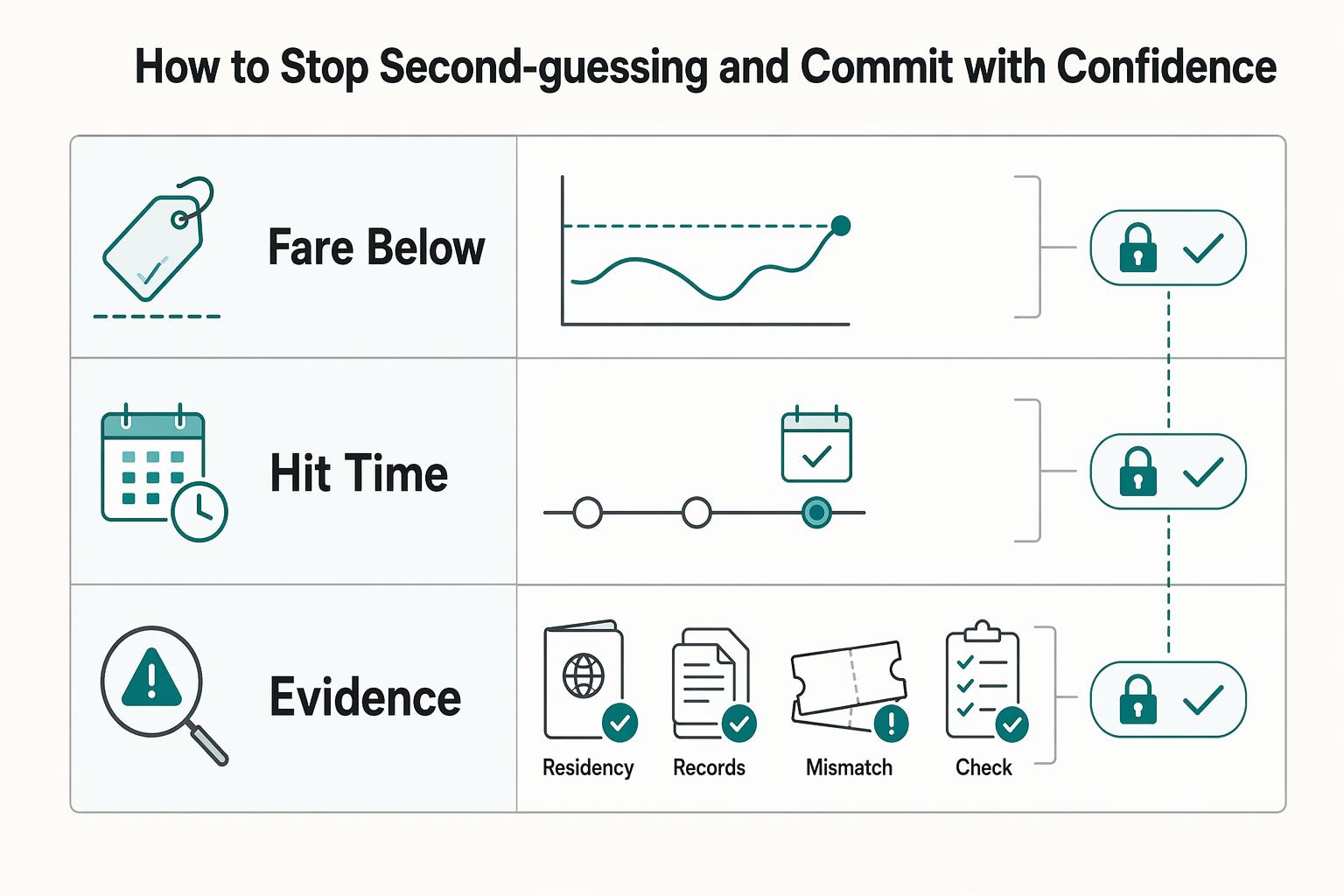
The lock-or-wait threshold: how to stop second-guessing and commit with confidence#
Once your channel is chosen, use one commitment protocol: book when either your price ceiling is met or your time floor is reached.
Step 1: Set your price ceiling. Choose one maximum all-in total for the exact trip you would actually take now, including bags, seat needs, and the fare type you need for this move. If this trip affects a housing handoff, work start, or visa-linked arrival window, do not benchmark against a stripped fare you would not book.
Your test: can you point to one saved quote and say, "If this usable trip appears at this price or lower, I book"? If not, your ceiling is still too vague.
Step 2: Set your time floor from your move plan. Your floor is the latest date you can wait before delay risk matters more than potential savings. Build it backward from your own dependencies: key pickup, end of temporary lodging, start-date obligations, and your buffer if disruption happens.
If missing your planned flight would force extra nights, rushed transfers, or a late handoff with a landlord or employer, your floor is likely closer than it feels.
| Trigger condition | Risk controlled | Required action now | Stop doing after commitment |
|---|---|---|---|
| Fare is at or below your ceiling before your floor | Budget drift from waiting for a small further drop | Book the option that matches your documented assumptions | Stop rechecking the same route for a slightly lower number |
| You hit your time floor before your target price appears | Shrinking recovery options and higher disruption risk | Book the best acceptable option in your chosen channel | Stop opening fresh comparisons across dates, airports, or sellers unless the booked trip fails |
| Dates are still unstable, but you have a documented fallback itinerary | Change-cost exposure if plans move | Pay for more changeability if that premium is acceptable | Stop treating strict terms as "fine" without a fallback you would actually use |
Step 3: Make the flexibility call explicitly. Pay for changeability when arrival timing is tied to a documented dependency and your fallback is weak. Accept stricter terms only when your fallback is real, written down, and workable for housing, work, and budget.
Step 4: Log why you locked, then close the loop. Write three lines: what changed, why you booked now, and where the evidence is stored. Save the fare-rules screenshot, checkout total, and decision date. If you used policy context, keep the official PDF or govinfo version, not only the FederalRegister.gov page, which states it is not the official legal edition. A clean record example is the 04/30/2024 DOT item, Document Number 2024-08609, Docket No. DOT-OST-2022-0109.
This is what prevents post-booking second-guessing: you did not book randomly; you booked because your threshold triggered. Related: The Best Zapier Workflows for Freelancers.
Dynamic pricing isn't just flights - how to book attractions without paying peak rates#
Treat attraction booking as an availability decision first: lock only must-do timed entries, and keep movable plans flexible until your schedule is real.
Classify the inventory and map your risk window#
Step 1: Classify each attraction from its official booking flow. For each must-do, check the official page and sort it as capacity-capped or flexible/walk-up. If you see timed entry, reservation-required wording, visible slot availability, or sold-out labels, treat it as capacity-capped. If access is broad-hour entry with no fixed slot, keep it in the flexible bucket.
| Official page signal | Bucket |
|---|---|
| Timed entry | Capacity-capped |
| Reservation-required wording | Capacity-capped |
| Visible slot availability | Capacity-capped |
| Sold-out labels | Capacity-capped |
| Broad-hour entry without a fixed slot | Flexible/walk-up |
Use one checkpoint: can you show an official page signal for your exact dates? If not, avoid assuming scarcity.
Step 2: Map risk windows from your real itinerary. Use only the dates and times you can actually make. If arrival logistics or work commitments reduce your usable windows, plan around that constraint instead of generic "peak season" advice.
Lock anchors first, then test pass math against real use#
Step 3: Split your list into anchors and flex items. Your anchors are must-do experiences with limited access and high regret if missed. Your flex items are replaceable or easy to move. Book anchors first when availability signals are already tightening, and leave flex items open.
Step 4: Choose pass vs. a la carte based on execution risk, not headline value. A pass helps only when your actual plan matches it and you can complete it without schedule friction.
| Decision point | Pass is a better fit when | A la carte is a better fit when |
|---|---|---|
| Actual-use fit | You have a tight shortlist you are likely to complete | You only need a few specific entries |
| Reservation friction | Included entries are straightforward to reserve on your dates | Reservation steps are heavy or timing is still uncertain |
| Cancellation flexibility | Pass terms remain workable if plans shift | Individual tickets have clearer refund/reschedule terms |
| Operational downside if plans change | Missing one stop does not break pass value | You want to avoid prepaying for options you may not use |
Use a bounded check routine and keep a light evidence log#
Step 5: Predefine a fixed check routine, then stop. Check each anchor at set points: when planning, after flights/lodging are confirmed, and near your booking floor. If desirable slots thin out, sold-out labels appear, or reservation constraints tighten, stop searching and book.
Step 6: Keep a simple evidence log. In one note or sheet, record slot status seen, terms snapshot, booking timestamp, and one sentence on why you booked or waited. This keeps decisions consistent and makes future trip planning faster. You might also find this useful: How to Pack Light for Long-Term Travel (One Bag Guide).
Common mistakes that trigger price spikes (and how to recover fast when things go wrong)#
Your biggest mistake is usually not a moving fare. It is changing your method mid-stream. Recover with a simple sequence: stabilize your setup, verify what changed, then decide based on supportability.
If flights move, fix attractions at the same time. Otherwise you solve one cost issue and create another through missed timed entries or wasted passes.
Stabilize#
Step 1: Freeze one controlled setup before you search again. Stop the tab spiral and run one consistent check. Use one browser session, keep incognito either on or off for the full round, and if you use a VPN, keep one location for that full test.
Hold one route assumption set across checks: same origin and arrival airports, dates, cabin, baggage, and passenger count. Then compare only two channels first: the airline site and one third-party seller.
Your checkpoint: one note or screenshot bundle with route assumptions, timestamp, and both prices from the same check window. If you cannot recreate the check, you do not have a usable signal.
Verify#
Step 2: Check timing before you guess a cause. Fares move under dynamic pricing, so treat "best day to book" as conditional, not fixed. First confirm whether your timeline still sits in a reasonable window: about 1-3 months for domestic, 2-8 months for international, and often 6-10 months for peak periods.
| Trip context | Reasonable window |
|---|---|
| Domestic | About 1-3 months |
| International | 2-8 months |
| Peak periods | Often 6-10 months |
Use a calendar or price-graph view once with the same assumptions. If nearby dates are lower and you have flexibility, that may matter more than running more browser tests. If your move date is fixed, ignore dates you cannot actually use.
Step 3: Recheck fare rules, not just total price. When prices rise, the common overreaction is buying the cheapest option with weaker terms.
| Fare approach | Change flexibility | Cancellation path | Support ownership check | Disruption impact |
|---|---|---|---|---|
| Lowest headline fare | Often most restrictive | May be limited, credit-only, or hard to use | Confirm whether airline or seller handles changes | Highest risk if dates move |
| Mid-tier changeable fare | Usually better for date changes | Often clearer than base fare | Check who owns rebooking and fees | Better fit when timing is still moving |
| Fully flexible or refundable fare | Broadest flexibility | Usually cleanest exit path | Still confirm merchant of record and support contact | Lowest disruption risk, highest upfront cost |
Ask, "What happens if my dates move after I pay?" not just "What is cheapest today?"
Decide#
Step 4: Buy for your uncertainty, then save a disruption card. If parts of your timeline are still moving, pay for more changeability on the flight and keep other pieces flexible. If the jump to the next fare family is tolerable, that premium can reduce downstream disruption.
At checkout, save five items in one place: ticket owner/merchant of record, operating carrier, all confirmation references, the support path you will use, and policy-page screenshots shown at purchase.
If you see an irrationally low fare, do not rebuild your move around it until it is ticketed and documented. Reports described 2025 as a record year for mistake airfares, including pricing glitches and partnership-pricing miscommunication.
Step 5: Rebalance flights and attractions together. After any flight change, immediately recheck timed-entry bookings and pass fit. Use official attraction pages to confirm slot availability, sold-out signals, and reservation requirements for your new window.
Rebook true anchors first, keep flexible visits flexible, and avoid reintroducing budget risk through ground logistics. Need the full breakdown? Read How to Avoid Phishing Scams When Payments and Access Are at Risk.
Conclusion: your relocation-safe booking system (copy/paste checklist)#
You are unlikely to predict a pricing engine consistently. Your job is simpler: keep your inputs controlled, verify who you are buying from, document the exact terms, and commit on your own timeline before urgency makes the decision for you.
That matters because booking risk is not just price movement. Fake travel websites and lookalike listings can closely mirror real airline branding, and a documented failure mode is discovering after payment that cancellation is impossible. Before you pay, verify the site itself, not just the fare.
| What you're booking | What changes | What you track | Your commit trigger |
|---|---|---|---|
| Cash fare | Fare, bag costs, change or cancellation costs | Same route, dates, cabin, bags, passenger count, timestamped screenshots | The total is still under your ceiling, or you have reached your time floor |
| Points booking | Points required, taxes, fees | Same itinerary, points price, cash alternative, transfer status if relevant | The redemption is acceptable for your move, and waiting adds deadline risk |
| Timed entry on the ground | Slot availability, bundled inclusions, cancellation rules | Exact date and time, policy page, confirmation terms | Availability is tightening and the slot still supports your itinerary |
- Set your deadline first.
- Write down your must-arrive date, any lease or visa milestone, and your personal booking deadline.
- Run one controlled comparison.
- Check like for like only once: same route, dates, cabin, baggage, and passenger count. - [ ] If you rerun checks, keep the search setup consistent for the whole comparison.
- Verify the seller and the policy before payment.
- Confirm the site is legitimate and not a lookalike. - [ ] Verify baggage, change, and cancellation terms before you pay.
- Save your evidence and stop rechecking.
- Store screenshots, policy pages, confirmation emails, and your one-sentence "why I booked now" note in one folder or a simple Notion page. - [ ] If the confirmation shows different terms, missing availability, or changed conditions after booking, contact support the same day with your timestamps and screenshots attached.
This pairs well with our guide on Digital Nomad Pre-Travel Checklist for Long-Stay Moves.
Frequently Asked Questions
What is dynamic pricing in travel, in plain terms?
It means the price can change based on demand, timing, location, and competitor pricing. For you, that shows up as the same flight moving between checks even when your route and dates stay the same. Treat each search as a snapshot, not a guaranteed hold.
Does dynamic pricing affect flights only?
No. You can also run into it with event tickets, ridesharing, and retail. If your move depends on both flights and timed-entry bookings, check both with the same discipline and lock the capacity-capped item first.
When are flight prices most likely to change?
They can change at any time as airlines adjust for seat availability, booking date, historical demand, seasonality, and even weather. You should not rely on a universal best day or hour to book. Instead, rerun one controlled comparison with the same assumptions and see whether the move is real.
How can I reduce exposure to dynamic pricing when booking travel (without chasing deals all day)?
Keep your checks controlled and brief. Use the same route, dates, cabin, baggage, and passenger count, then compare the airline site against one third-party seller and save screenshots with timestamps. When you buy, decide on fare rules and support ownership first, not just the lowest number.
What should I do if prices jump after I’m ready to book?
Use your lock-or-wait rule. If the fare is still under your ceiling and you are close to your time floor or must-arrive date, book the most supportable option and save the policy pages. If it blows past your ceiling and you still have time, do one clean recheck, including nearby dates if they are actually usable, then stop.
Do incognito mode, VPNs, or different browsers actually help?
They can reduce tracking signals, but they do not guarantee a lower fare. If you test with incognito/private mode, keep that setup consistent for the full comparison. Changing browser state mid-check creates false signals. A practical boundary is to browse in one browser, buy in another, and avoid drawing conclusions from one logged-in versus logged-out swing.
What should I verify before paying, especially on U.S.-related flights?
For flights to, within, and from the U.S., check the pre-purchase fee disclosures shown with fare and schedule information. Verify baggage fees for a first checked bag, second checked bag, and carry-on bag, plus the change or cancellation cost. A common failure mode is choosing a slightly lower fare and paying more later in bag or change fees.
Try a related tool
Researched and edited by the Gruv editorial team. Gruv builds cross-border billing, payouts, and finance-operations software for global businesses.
Sources
- congress.gov/114/plaws/publ94/PLAW-114publ94.htmtrusted
- copyright.gov/ai/Copyright-and-Artificial-Intelligence-Par...trusted
- cpuc.ca.gov/-/media/cpuc-website/divisions/energy-divisi...trusted
- federalregister.gov/documents/2024/04/30/2024-08609/enhancing-tr...trusted
- federalregister.gov/documents/2020/11/12/2020-24591/transparency...trusted
- hbs.edu/ris/Publication%20Files/22-050_ec28aaca-2b94...trusted
- hls.harvard.edu/today/how-delta-airlines-and-other-companies...trusted
- home.wvlegislature.gov/committee/house-financetrusted
Educational content only. Not legal, tax, or financial advice.
Related Posts

Best Travel Apps for Nomads Moving Abroad
If you are comparing travel apps for a move abroad, choose by move stage, not by feature depth. A short stack that reduces four common failures works better: booking drift, missing documents at the wrong moment, no data on arrival, and a chaotic first week.

A Guide to Notion for Freelance Business Management
If your workspace feels busy but fragile, you do not need more pages. You need one connected system. Treat your freelance business like a business-of-one and use Notion as the control layer that connects client decisions, delivery, and billing in one place.
The Best Zapier Workflows for Freelancers
If you want the best [Zapier workflows](https://zapier.com/blog/tips-for-powerful-zapier-workflows) for freelancers, stop collecting one-off automations and start treating them like operating controls. The point is not convenience. It is fewer broken handoffs, cleaner records, and less business risk as your client load grows.