
Quick Answer
Use the long tail theory for freelance niche decisions by narrowing to a buyer context where you are less substitutable, then validating demand, operational load, and repeat-work potential before scaling. Apply the three-pillar sequence: confirm commercial fit, check compliance drag, and convert recurring delivery patterns into reusable offers. A practical checkpoint is whether you can predict lead source, common objections, and intake requirements before publishing your service page.
Choose a Niche You Can Sell, Run, and Defend#
Treat your niche as an operating choice, not a branding exercise. It shapes how replaceable you are, how easy you are to buy, and what kind of delivery friction you inherit. If you want a freelance business that is easier to sell, run, and defend, niche selection is one of the first real business decisions you make.
In practice, a good niche does three things. It gives buyers a clear reason to choose you, supports repeat work, and stays manageable to deliver.
Step 1 Choose the part of the market where you are harder to swap out#
In freelance services, niche selection is simple: broader offers attract more lookalike options, while narrower offers define a clearer buyer, problem, and context. "Freelance writer" is broad. "Email copywriter for B2B software teams launching a new product line" is narrower, easier to understand, and often less interchangeable.
That matters for more than marketing. Many clients now buy from a long-tail workforce made up of smaller, more frequent freelancer transactions. Their procurement and accounts payable processes were often built for a small number of larger suppliers. If your niche serves enterprise teams, creator programs, or campaign-heavy work, that mismatch can create operational friction fast. In some environments, late payment is not a minor annoyance. It can stop work at kickoff or create public reputational damage if outside talent is unpaid.
Step 2 Compare a broad offer with a specialized one#
A niche becomes defensible when it is tied to repeatable problems and a recognizable buyer situation, not when it just sounds clever.
| Attribute | Generalist offer | Specialized offer |
|---|---|---|
| Substitutability | Many freelancers appear similar on paper | Fewer obvious substitutes because the work is tied to a specific business context |
| Pricing power | Easier for buyers to compare on hourly rate or output alone | Easier to price around the problem, urgency, and cost of getting it wrong |
| Client-fit clarity | More time spent educating mismatched leads | Prospects can self-identify faster because the offer matches their situation |
In practice, a strong niche usually shows three signals. The same problem keeps appearing. The buyer context is easy to name. Non-specialists are less credible because they do not understand the surrounding constraints. If prospects need to explain their world from scratch on every call, the niche is probably still too broad.
Step 3 Check the niche before you commit#
Before you lock in a direction, pressure-test it on four points:
- Problem repeatability: Review recent inquiries or projects. If several share the same trigger, bottleneck, or desired outcome, that is a real pattern.
- Buyer context: Can you name the type of client, team, and moment when they buy? If not, your positioning will stay fuzzy.
- Process and payment reality: Ask how onboarding, approvals, and payment timing work. If work depends on kickoff-day payment or public creator payouts, treat payment operations as part of delivery risk.
- Proof pack: Gather the materials you already have, such as call notes, redacted briefs, proposals, and case studies. If your evidence only proves "I can do good work" but not "I solve this exact problem," you are not ready to commit.
If those checks hold up, you have more than a niche idea - you have a workable business direction. From there, prioritize commercial viability first, then operational risk, then platform-building.
If you want a deeper dive, read How to Choose a Niche for Your Freelance Business.
Pillar 1: Validate Your Niche Before You Invest More#
Validate your niche before you invest more deeply. If you cannot show repeat revenue potential, realistic buyer budget, and intent-rich demand from real prospects, pause and refine.
Before you start#
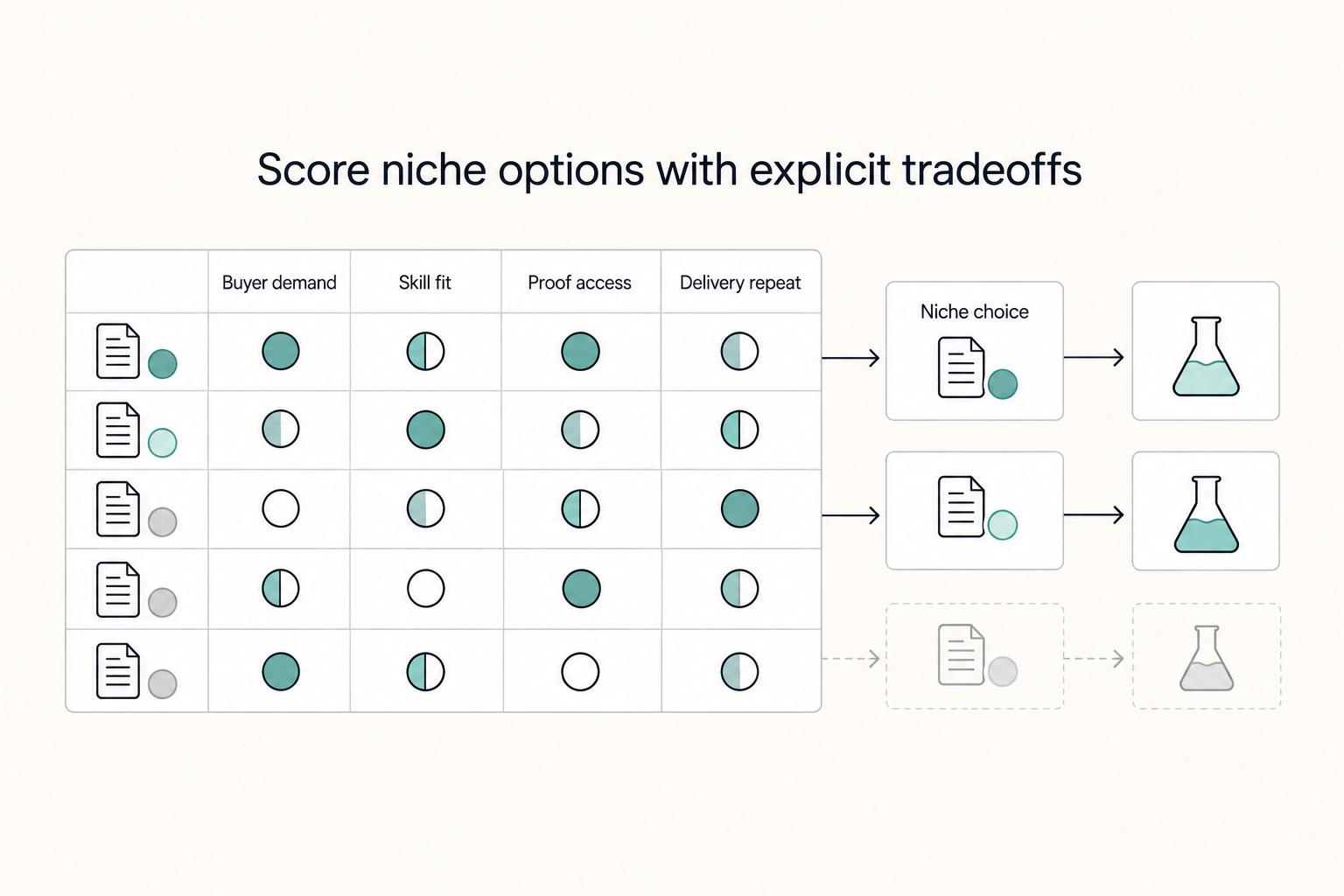
Compare two or three niche options side by side. Build a small evidence pack for each using recent proposals, invoices, discovery notes, redacted briefs, accepted and rejected pitches, and first-party query data from Google Search Console. If you do not have site data yet, use inbound emails, DMs, call notes, and AnswerThePublic phrasing.
Step 1. Gather evidence, not opinions#
Answer three questions first: will clients buy again, can they pay, and is demand likely to hold. Collect proof in four buckets:
- Repeat spend: follow-on work, retainers, add-ons, or adjacent requests from the same client
- Buyer language: exact phrases from Search Console, AnswerThePublic, and sales calls
- Budget reality: values you have already sold, pushback patterns, and signs this problem already has budget
- Operational stability: onboarding friction, approval chains, revision loops, and payment timing
If your pack is mostly inspiration, competitor screenshots, or engagement metrics, you have a hypothesis, not validation.
Step 2. Score each niche on commercial fit and stability#
Mark unknowns as TBD and note what would verify them.
| Niche option | LTV signs | Ability to pay signs | Demand durability signs | Operational stability | What still needs verification |
|---|---|---|---|---|---|
| Email copy for B2B SaaS product launches | Repeat launch cycles, upsell into onboarding or lifecycle email | Prior accepted proposals at viable rates, buyers treat launches as revenue-linked | Launches recur, messaging updates continue post-launch | Multiple reviewers and slower approvals can appear | Verify payment timing and final sign-off owner |
| Social content for local restaurants | Often one-off bursts unless bundled | Budgets can be tight and line-item compared | Demand exists but is often treated as discretionary | Fast changes, owner-led approvals, high revision risk | Verify retention length and seasonal churn |
| Your niche candidate | TBD | TBD | TBD | TBD | List the missing proof you need next |
As you score, use direct checks: Can one client buy more than once? Is this problem funded or optional? Is demand tied to recurring business moments or short-lived spikes?
Step 3. Run a signal-vs-noise check#
Do not confuse visibility with buying intent. Broad, crowded terms can underperform even when your work is strong, while long-tail phrasing usually trades lower volume for higher conversion intent.
Use one quick filter: can this niche naturally support a service page, a case study, and a comparison guide? If yes, you likely have a real buying theme. If attention mostly comes from trend spikes, vague searches, or free-advice seekers, treat it as noise.
Step 4. Decide: proceed, refine, or reject#
- Proceed if one niche shows credible repeat spend, budget evidence, intent-rich language, and manageable delivery and payment friction.
- Refine if demand is real but the niche is still broad; narrow the buyer, business moment, or deliverable until prospects can self-identify quickly.
- Reject if most fields remain TBD, demand is trend-led, or work repeatedly collapses into unstable one-offs.
Make the call now. The next pillar is compliance architecture, and it only pays off when the niche is worth keeping.
You might also find this useful: How to apply 'Game Theory' to your freelance pricing and negotiations.
Pillar 2: Architect Your Niche as a Compliance Moat#
Your niche defines your risk surface, not just your positioning. Before you commit, pressure-test each option for client geography, data flow, and industry exposure so you can see the real compliance drag before it becomes weekly non-billable work.
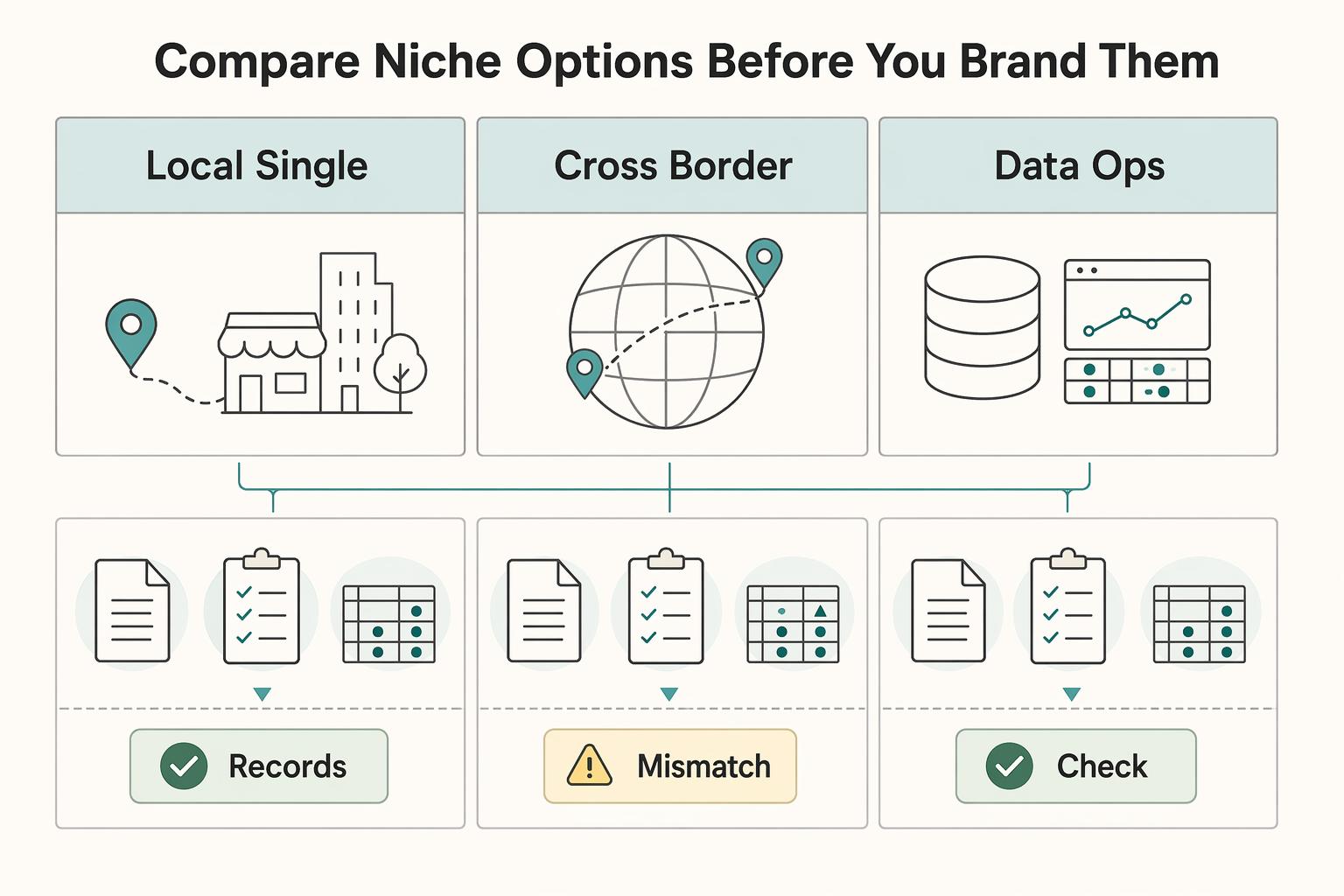
Step 1: Compare niche options before you brand them#
Use this matrix to estimate operating load, not just revenue potential.
| Niche type | Likely compliance workload | Contract complexity | Documentation needs | Specialist support likely |
|---|---|---|---|---|
| Local or single-market B2B services with limited data access | Lower to moderate | Usually lighter | Proposal, SOW, invoice trail, basic process/privacy notes | Occasional accountant or contract review |
| Cross-border enterprise work (especially creator/freelancer programs) | Moderate to high | Higher due to procurement and payment controls | Onboarding packet, tax/payment forms, approval records, payment confirmations | Legal and tax review can become recurring |
| Data/ops-heavy analytics or regulated-client workflows | High and ongoing | Higher due to liability and data-handling expectations | Data maps, access logs, reporting definitions, change logs, issue history | Legal, tax, or technical specialist review is often needed |
Quick filter: ask for a redacted contract, onboarding checklist, or procurement questionnaire early. If the process trail is unclear, assume friction is real and will show up during delivery.
Step 2: Run a compliance-drag checklist for each niche#
Score each option on four points:
- Admin effort: How much weekly process work sits outside delivery?
- Advisory cost: How often will you need paid legal, tax, or specialist input?
- Workflow friction: Where can payment, approvals, or handoffs stall work?
- Risk concentration: How exposed are you if one client, channel, or system fails?
Keep this practical. Payment failure can stop production and create reputational damage, and unstable data schemas can force repeated rework and break continuity.
Step 3: Set your escalation boundary#
Standard freelancer controls are usually enough when contracts are straightforward, payment paths are stable, and sensitive-data exposure is limited. Escalate to local legal or tax review when you see cross-border billing, unusual procurement controls, regulated data handling, or concentrated revenue risk.
Decision rule: move forward only if the niche passed Pillar 1 commercial viability and this operational-manageability check. If demand is strong but compliance drag stays high, narrow the niche further before you scale. Related: How to find your 'Blue Ocean' as a freelancer.
Pillar 3: Evolve from Niche Service to Defensible Platform#
Once your niche passes viability and compliance, your next move is to stop selling only your hours. Build four assets that compound across client cycles: a signature point of view, a repeatable method, reusable IP, and a channel strategy based on how ideal clients discover and trust specialists.
| Dimension | Service-only model | Platform model |
|---|---|---|
| Lead flow | Mostly referral spikes or outbound effort | More consistent inbound from repeated ideas, reusable assets, and referrals that reinforce each other |
| Revenue mix | Mostly custom delivery | Custom delivery plus packaged offers (for example audits, workshops, templates, advisory formats) |
| Delivery dependency | Value depends heavily on your direct time | More value sits in methods, templates, and training assets you can reuse |
| Switching risk | You are compared mainly on price and availability | Clients also buy your point of view, process, and assets, which are harder to replace |
Step 1 Build authority around one clear point of view#
Choose one sharp claim you want to be known for, then repeat it where buyers already vet providers. Treat visibility as multi-surface, not single-channel: search now includes zero-click experiences, and trust signals in one place affect performance elsewhere.
Use one home base plus two support channels. Example: your site for depth, LinkedIn for repeated proof, and partner channels for borrowed trust. Add two questions to intake notes: "Where did you first hear about me?" and "What made you trust me enough to reach out?" Discovery and trust validation are often different events.
Step 2 Productize what already repeats in your delivery#
Productization works best when you package proven patterns, not guesses. First codify your workflow from diagnosis to handoff, then extract reusable components, then package offers by buyer maturity, and only then invest in a full build.
Use this sequence:
- Document your recurring delivery steps, inputs, decisions, and outputs.
- Pull out reusable pieces (templates, checklists, onboarding docs, training modules).
- Package offers by buyer maturity (diagnostic, guided implementation, ongoing advisory/training).
- Test demand with a lighter manual version before full product build.
If you support creator or freelancer programs, operational readiness is part of the offer. Some enterprises are bringing this work in-house, while legacy procurement and AP systems still struggle with high-volume independent talent networks. Keep a reusable onboarding pack ready (scope menu, intake form, approval checklist, invoice instructions, payment checkpoints), because payment failures can disrupt kickoff work and create reputational risk.
Step 3 Rebalance your client portfolio for resilience#
Use specialization to improve portfolio quality, not just utilization. Review clients through four risk-control lenses: concentration, fit, retention, and referral quality.
Run this quarterly handoff checklist:
- Confirm which channels produced qualified conversations.
- Review revenue mix by client and by offer type.
- Log retention/churn reasons and repeated delivery friction.
- Track reusable assets created, updated, or still missing.
- Flag segments with frequent custom exceptions, weak-fit referrals, or unstable payment behavior, then narrow positioning accordingly.
This is where the long-tail niche becomes durable in practice: your niche turns into an operating asset, not only a marketing label.
If you want a step-by-step walkthrough, see How to apply the 'Jobs-to-be-Done' theory to your freelance services.
Your Niche Isn't a Tactic - It's Your Global Headquarters#
Treat your niche like your business headquarters: one decision that sets your client mix, delivery model, risk concentration, and day-to-day workflow. If your niche does not change how you scope, price, onboard, and qualify leads, it is still a tagline.
| Area | Headquarters mindset | Tagline mindset |
|---|---|---|
| Positioning | Defines a specific buyer, problem, and offer shape | Uses broad claims meant to fit everyone |
| Compliance planning | Plans for likely approvals, documentation requests, and process friction early | Reacts only after a prospect asks for exceptions |
| Pricing power | Prices around fit and specificity | Competes in a broad, vague comparison set |
| Lead quality | Attracts more specific-intent prospects | Attracts mixed-fit curiosity traffic |
| Operational predictability | Repeats intake, scoping, and delivery patterns | Rebuilds process from scratch each project |
Use the three pillars as three operating decisions:
- Pillar 1 (validate demand): Choose whether you are going horizontal (one core service for many client types) or vertical (multiple deliverables for one client type), then test with measurable inputs like search volume, competition, cost-per-click estimates, your inbox, and the phrases prospects actually use.
- Pillar 2 (design for manageable risk): Decide which client segments you will serve based on how much approval and documentation overhead your workflow can absorb without constant administrative drag.
- Pillar 3 (build defensibility): Decide what repeats often enough to standardize into a reusable offer, framework, or asset so you are not operating as a generalist yes-to-everything shop.
When you can name your likely lead source, common objections, and standard intake checks before you publish the service page, you are making a headquarters decision, not a branding tweak. Then the next step is execution: build the pipeline in How to Build a Sales Pipeline for Your Freelance Business, and if you need country/program specifics, Talk to Gruv.
Frequently Asked Questions
How do you pivot to a new niche without losing income?
Use a phased pivot, not an abrupt one. Keep legacy work paying the bills while you test the new specialization with new leads, a small offer, or a narrower service page. Track qualified inquiries and close rate over an initial test period. If the new positioning attracts curiosity but no buying intent, tighten the problem or buyer before you shut down the old work.
Is it possible for your niche to be too specific?
Yes. A niche can be too tight if demand is too thin to support consistent, relevant content and offers. Check that with evidence from Google Search Console, AnswerThePublic, and your own inbox. If the niche cannot support a service page, a case study, and a comparison guide without forcing the topic, it is probably too narrow.
How does your niche affect invoicing and compliance for international clients?
Your niche can change client mix and documentation needs, so your invoice pack and records may need to adapt. If you work across borders, do not rely on one generic template for every client. Verify current rules in both jurisdictions before adding client-specific language or tax treatment. If you handle EU client data too, pair that with your privacy checks and use GDPR for Freelancers: A Step-by-Step Compliance Checklist for EU Clients as a follow-on.
How do you build a niche that is actually defensible?
You do not need to be the only freelancer in the category. You need to be harder to replace because your expertise, method, and assets fit a specific buyer better than a generalist can. In practice, that means proving the market in Pillar 1, removing avoidable risk in Pillar 2, and turning repeated work into a point of view, reusable IP, and channel proof in Pillar 3. If prospects can explain why you are different without mentioning your personality or availability, your positioning is getting stronger.
Should you choose a niche based on passion or profitability?
Treat it as a filter stack, not a binary choice. Passion helps you stay in the work long enough to get excellent, but profitability and low-friction operations decide whether the business holds up. A niche you love but cannot sell is a hobby. A niche that pays well but creates constant compliance or delivery pain may not be durable either.
Try a related tool
Researched and edited by the Gruv editorial team. Gruv builds cross-border billing, payouts, and finance-operations software for global businesses.
Sources
Includes 7 external sources outside the trusted-domain allowlist.
- files.thesaurus.ie.edu/electives.pdftrusted
- 6figurecreative.com/case-study-the-solo-freelancer-earning-1-mil...external
- almcorp.com/blog/how-to-make-money-with-ai-updated-decem...external
- arxiv.org/pdf/2602.20946external
- arxiv.org/html/2602.20946v2external
- awai.com/glossaryexternal
- copyhackers.com/2016/11/find-your-nicheexternal
- dl.acm.org/doi/pdf/10.1145/3597503.3639111external
Educational content only. Not legal, tax, or financial advice.
Related Posts

GDPR Compliance Checklist for Freelancers Working With EU Clients
Start by separating the decisions you are actually making. For a workable **GDPR setup**, run three distinct tracks and record each one in writing before the first invoice goes out: VAT treatment, GDPR scope and role, and daily privacy operations.
How to Choose a Niche for Your Freelance Business
Choosing a freelance niche is a decision about repeatable demand and repeatable delivery, not just personal interest. Passion helps you stay consistent, but durability comes from clear positioning and work you can execute without constant reinvention.
How to Find Your Blue Ocean as a Freelancer Through Operational Clarity
For a practical **blue ocean strategy for freelancers**, start inside your own business. Your first uncontested market space is not a clever tagline. It is a client experience with fewer errors, fewer delays, and clearer proof that you did what you said you would do.