
Quick Answer
Define one client job first, then shape your offer around it. For jobs-to-be-done for freelancers, pull language from Discovery Call notes, draft a single Job Statement, and map it into a Scope of Work (SOW) with Acceptance Criteria and written Change Control. That sequence gives buyers a clearer approval path, reduces unpaid “quick extras,” and makes pricing conversations about outcome responsibility instead of tool lists.
Why most freelancers lose good clients even when they have strong skills#
Freelancers lose good clients for reasons that go beyond skill. Buyers also judge whether you understand the result they need, the constraints around it, and whether you seem reliable enough to own that result.
Losing a client is not always a verdict on your craft. Freelance work is unpredictable, and clients pull back for reasons that have little to do with performance, including budget changes or internal reorganization. But there is still a pattern you can control. When your offer reads like a list of tasks, buyers start comparing you on price and perceived risk instead of business progress.
Step 1. Read your offer and ask what changes for the client#
Look at how freelance work is often listed: by skill labels, software names, and task categories. That helps buyers search, but it does not always describe what they are actually trying to fix.
In many cases, buyers are hiring for movement under pressure. They want reporting trusted before the board meeting, leads converting without rewriting the whole site, or a product launch to happen without last-minute chaos. Skills matter, but they are not the promise. If your profile, proposal, or sales call leads with tools, you make yourself easier to swap out for someone cheaper who lists the same stack.
Use this checkpoint: read your current offer and ask, "Does this explain what changes for the client, or only what I will do?" If you mostly see deliverables, platforms, and hours, you are still selling labor.
Step 2. Define the job, the outcome, and the risk to avoid#
The bigger issue is often trust, not just positioning. Some business owners see freelancers as less reliable than firms and hesitate to trust them with important projects. You do not solve that by sounding more expert. You solve it by reducing ambiguity.
That is where JTBD becomes practical. Instead of saying, "I build dashboards" or "I write email campaigns," you define the job the client is hiring you to do, the outcome they care about, and the risk they want to avoid. That gives a buyer something concrete to approve.
A common failure mode is simple: vague promises create vague scope. That can lead to mismatched expectations, soft acceptance standards, and "quick extras" that become unpaid work. If you have ever lost momentum after a strong sales call, this may be one reason why.
Step 3. Leave with four assets, starting with the Job Statement#
The goal of this guide is to help you leave with four assets you can use right away:
- a Job Statement you can defend in a real sales conversation
- a sharper Value Proposition tied to client progress, not tools
- a safer Scope of Work (SOW) with clearer boundaries
- a practical execution checklist you can use on live deals
The Job Statement matters most. It becomes the source for your Value Proposition, your SOW, and later your Acceptance Criteria. If that statement is weak, every downstream document gets softer. If it is clear, you look more credible before price even comes up.
Related: How to Use the StoryBrand Framework for Your Freelance Website.
What to prepare before you apply JTBD to your services#
Before you apply JTBD to your services, gather four things: a narrow service/buyer focus, real client language, your current delivery documents, and clear EU boundary statements.
| Prepare | What to use | Key note |
|---|---|---|
| One service line and one buyer type | One offer and one buyer you can clearly picture | If two buyers would hire you for different reasons, split them now |
| 3 to 5 Discovery Call records | Notes, transcripts, emails, or proposal comments | Highlight outcome and risk language; keep tool terms in a separate column |
| Service Agreement, Scope of Work (SOW), and Acceptance Criteria | Review them side by side | Flag vague promises and check whether done is clear |
| EU compliance boundaries | Define what you will and will not handle before the sales process gets deep | Keep OSS, the cross-border SME scheme, and VAT Cross-border Rulings (CBR) separate |
Step 1. Pick one service line and one buyer type. Start with one offer and one buyer you can clearly picture. Avoid broad labels like "analytics for startups." If two buyers would hire you for different reasons, split them now instead of forcing one message.
Step 2. Pull 3 to 5 records from Discovery Calls and mark outcome language. Use notes, transcripts, emails, or proposal comments from real conversations. Highlight outcome and risk language, for example "faster reporting" over "Microsoft Power BI." Keep tool terms in a separate column so your Job Statement stays focused on client progress.
Step 3. Gather your Service Agreement, Scope of Work (SOW), and Acceptance Criteria. Review them side by side and flag vague promises. If "done" is unclear, approvals turn into debate and scope gets soft. Use this check: could the client approve the work without arguing about what completion means?
Step 4. Set EU compliance boundaries before you promise certainty. If you serve EU clients, define what you will and will not handle before the sales process gets deep. Keep VAT mechanisms separate: OSS, the cross-border SME scheme, and VAT Cross-border Rulings (CBR) are different paths, and the EUR 100 000 SME threshold is not universal to every setup. Keep privacy work separate and use a specific checklist such as GDPR for Freelancers: A Step-by-Step Compliance Checklist for EU Clients.
Choose one client job to own instead of marketing every skill#
Choose one client job to own, then position your skills as how you deliver it. Python, React.js, and DevOps are capabilities; your offer is stronger when it states the progress the client is buying.
Step 1. Separate capabilities from the job. Treat tool labels as inputs, not the promise. A Python service can be framed as removing a reporting bottleneck. A React.js service can be framed as getting a launch-critical flow shipped. A DevOps service can be framed as making releases stable enough for reliable handoff. If you cannot state the outcome and the risk being reduced, you are still marketing skills instead of a client job.
Step 2. Split offers when the buying trigger is different. Use this as a decision rule: if two services are hired for different "why now" reasons, split them into separate offers instead of blending them into one Value Proposition. If two leads would describe different triggers, buyers, or success checks, keep those offers separate so each one stays clear.
Step 3. Use role labels to spot demand, not to define your final offer. Freelance listings and career guides are often organized by role or skill labels. Upwork surfaces role labels such as Python developers, and roundup content is often packaged as lists like "14 Freelancer Jobs" or "32 High-paying Freelance Careers." Use that signal to find opportunities, then choose a job you can see repeatedly and verify with a clear result.
Step 4. Apply a simple three-part filter before you commit. Use this screen for each candidate offer:
- Urgent trigger: something changed, broke, launched, or now has a deadline.
- Measurable success: there is a concrete test for done.
- Buyer authority: you know who can approve scope, budget, and sign-off.
If an offer fails two of the three, reject it or rewrite it before you send a proposal.
Related reading: The Best Virtual Phone Number Services for Freelancers.
Write a Job Statement you can defend in a real sales call#
A defensible Job Statement is one you can explain clearly in a call and carry into scope without changing the job.
| Check | Question |
|---|---|
| Trigger event | What changed, broke, launched, or got a deadline? |
| Constraints | What must be true about timing, approvals, confidence, or auditability? |
| Definition of done | What will the client accept as complete? |
Step 1. Draft the statement in a format that forces context and risk#
Draft it in a format that forces context, progress, and risk:
When [situation], [buyer] needs to [progress], so they can [outcome] without [main risk].
Keep the focus on the client concern and client benefit, not your tool stack. If the statement names deliverables but not the concern it resolves, it will stay too weak for sales and scope.
Step 2. Pressure-test the statement in discovery before writing a proposal#
Pressure-test the statement in discovery before you write a proposal. Use follow-up questions to confirm:
- Trigger event: what changed, broke, launched, or got a deadline?
- Constraints: what must be true about timing, approvals, confidence, or auditability?
- Definition of done: what will the client accept as complete?
Then rewrite "done" in plain acceptance language. If success, approver, or timing keeps shifting, pause and clarify before drafting scope.
Step 3. Run a final stress test before sending the Scope of Work#
Run a final stress test before sending a Scope of Work:
- What could fail even if files are delivered?
- Who must sign off that this is done?
- What client dependency could change the promise?
If the Job Statement changes materially after these checks, it is still too broad. Tighten it first. Your freelance contract is the foundation document, the SOW defines the specific project work, and they become the reference point if disputes or miscommunication happen. Do not start work until the client agrees to the SOW and signs it.
Turn the Job Statement into an offer clients can buy confidently#
Once your Job Statement survives the sales call, make it easy to buy. A strong offer makes three things obvious fast: what the client is buying, how decisions happen during delivery, and what counts as done.
Step 1. Convert the job into a Value Proposition, then into tiers. Build the offer around the client's desired progress, not your feature list. Write a short Value Proposition in client language, then create 2-3 SOW tiers around the same outcome. Keep the core promise stable, and vary depth, speed, or support.
If one tier solves a different trigger, it is not a tier. It is a different offer. In each SOW, define clear boundaries in plain language: what is included, what is excluded, what client inputs are assumed, and who signs off.
Verification point: if a buyer cannot tell tiers apart without tool names or hours, the offer is still too vague.
Step 2. Build every SOW around three concrete elements. Translate the Job Statement into this structure:
| Element | What it should cover |
|---|---|
| Deliverables | The work products you will provide, such as a dashboard, report pack, audit memo, or implementation update |
| Decision checkpoints | Moments when the client confirms direction, data definitions, stakeholder expectations, or priority changes before work continues |
| Acceptance Criteria | Observable conditions showing the work supports the target outcome, not just that files were delivered |
This structure makes the offer easier to trust and easier to approve. If success depends on a named approver, source access, or agreed metric definitions, state those dependencies in the SOW instead of leaving them in email threads.
A practical check: read the Acceptance Criteria out loud and ask, "Could the client approve this without extra explanation?" If not, tighten it.
Step 3. Put Change Control in the Service Agreement before scope moves. Scope changes are common in client work, so treat them explicitly. State that client-requested changes to deliverables, dependencies, timeline, data sources, stakeholder group, or review rounds require written approval and may change fees or timing.
Keep the trigger visible. If a client adds a dashboard tab, another business unit, another source, or asks for faster delivery, that is a scope change. Avoid silent expansion where work starts in a meeting and the SOW never gets updated.
Verification point: if a request changes effort, risk, or approvals, send a written change note before doing the work.
Step 4. Sell decision-ready insight, not analytics output alone. For analytics work with Google Analytics or Tableau Software, do not position dashboard creation as the whole offer. Most buyers want a view they can trust and act on. Shape the SOW around an insight cadence: agreed metrics, refresh rhythm, review checkpoint, and action-focused summary.
Include one polite no-fit clause to protect outcome ownership. Example: This offer depends on timely access to agreed data sources, metric definitions, and a named reviewer. If those inputs are not available, I can help scope discovery, but I cannot take responsibility for the outcome.
Add risk controls so delivery stays professional as you grow#
Once the offer is clear, protect delivery with dated evidence and explicit triggers. If a milestone, scope change, or payment event matters, keep a written record in the project file.
Step 1. Tie every milestone to proof, not memory. For each stage, keep three artifacts together: kickoff notes, an approval log, and an Acceptance Criteria sign-off. In kickoff notes, confirm the target outcome, required inputs, named approver, and dependencies such as source access or metric definitions. In the approval log, track date, decision, approver, and next action.
The sign-off can be simple: an email reply, ticket comment, or signed PDF, as long as it maps to the Acceptance Criteria in the SOW. Verification point: if you cannot show who approved a milestone and why, your evidence is incomplete.
Step 2. Document data-handling boundaries as soon as EU personal data appears. Do not rely on a casual "I'll send a CSV" when personal data may be included. Add a short data-handling note to the SOW or Service Agreement that states:
- what data you expect to receive
- where you will store or process it
- who can access it
- how long you will keep it
- who approves handling instructions and changes
Keep it practical and explicit. If you need a deeper checklist for EU client work, use GDPR for Freelancers: A Step-by-Step Compliance Checklist for EU Clients.
Step 3. Enforce Change Control before "quick extras" become unpaid work. Silent scope creep starts small, then compounds. Your Service Agreement should state that changes to deliverables, dependencies, timeline, review rounds, or stakeholder groups require written approval and may change fees or dates.
Use this checkpoint: if a request changes effort, risk, or approvals, send a change note before doing the work. Reference the original SOW, name the requested change, and state the revised price or timeline.
Step 4. Set commercial expectations early, and keep tax records audit-ready. Confirm payment timing expectations before kickoff and repeat them in the Service Agreement. Keep one folder with the signed SOW, change notes, invoices, payout confirmations, and milestone evidence.
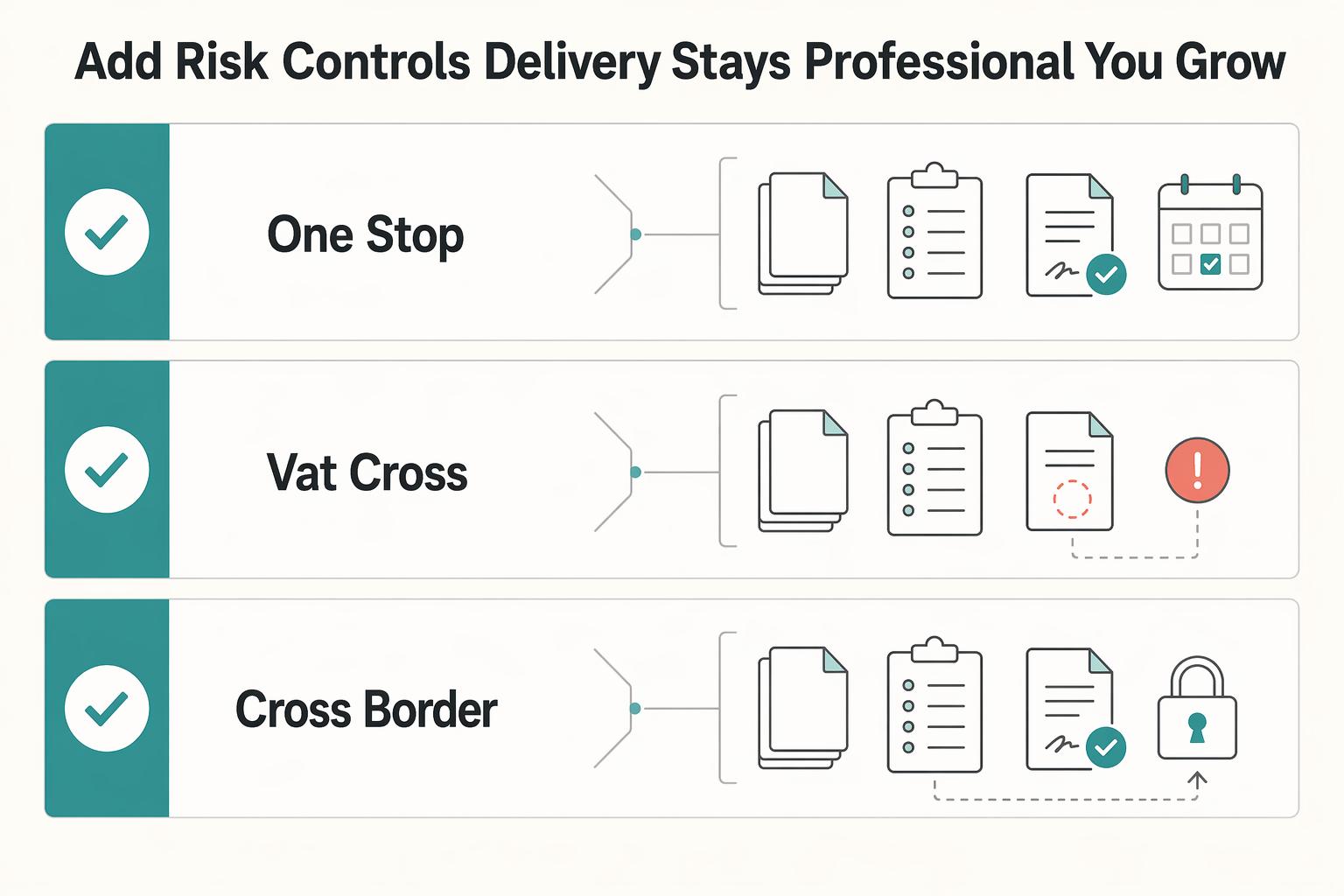
If your work includes qualifying cross-border EU supplies, handle VAT setup early:
| Topic | Practical control |
|---|---|
| One Stop Shop (OSS) | A taxable person can register in one EU Member State (the Member State of identification) for VAT declaration and payment on qualifying cross-border supplies. |
| VAT Cross-border Rulings (CBR) | If VAT treatment is unclear, taxable persons can request an advance ruling in the participating EU country where they are VAT-registered. |
| Cross-border SME scheme | Prior notification is required in the Member State of establishment, and the Union turnover cap is EUR 100 000 in the current and previous calendar year. |
Decide how to package and price without breaking your positioning#
Use this rule first: package recurring, low-variance work; use a custom proposal when the job has high variance, moving dependencies, or shared ownership risk.
Step 1. Choose format by variance, not preference. Use a productized package when inputs, buyer questions, and deliverables repeat enough to define boundaries in advance. If the work depends on unclear data, shifting stakeholders, or unresolved decisions, move to a custom proposal instead of forcing a fixed package.
A quick boundary check: if you cannot describe clear limits with "up to" language, the work is still too open for a fixed package.
Step 2. Price risk and responsibility, not the tool stack. Python, Artificial Intelligence (AI), Tableau, and similar tools are delivery methods, not the value itself. Price should reflect the responsibility you own: judgment, coordination, rework exposure, and decision-ready delivery.
Package pricing is strongest when it is not just hourly math with a new label. If uncertainty and accountability are high, your price should show that.
Step 3. Keep one red line for under-scoped requests. No proposal without a completed Discovery Call and a draft Job Statement. This protects you from pricing guesses when the client cannot yet define the job clearly.
If discovery notes still cannot produce a one-sentence Job Statement that maps to scope, pause pricing and finish discovery first.
Step 4. Keep only one adjacent offer, and only if it supports the same core job. An adjacent offer helps only when it serves the same buyer, urgency, and outcome. If it pulls you into a different trigger or success metric, it dilutes your Value Proposition and makes pricing harder to defend.
For a step-by-step walkthrough, see How to Create a Unique Selling Proposition (USP) for Your Freelance Business.
Common JTBD mistakes freelancers make and how to recover fast#
When projects get price-pressured, revised late, or stretched beyond the original brief, the problem is usually translation, not effort. Recover fast by tightening the sales-side language that sets expectations.
| Mistake | Recovery | Check |
|---|---|---|
| Confusing deliverables with outcomes | Rewrite Acceptance Criteria in business terms, not output terms | If the client can only repeat the deliverable, the outcome is still unclear |
| Broad SOW with no Change Control | Add explicit trigger points for scope, timeline, and fee changes, then name them in the SOW | If small extras keep getting absorbed without a reset, your triggers are too vague |
| Chasing every platform trend | Return to one job, one buyer, one promise | If a new offer serves a different trigger or buyer, separate it |
| Weak Discovery Call notes | Use one consistent note template: trigger event, constraints, success metric, named approver, and one no-fit condition | After the call, you should be able to draft a one-sentence Job Statement and decide whether to propose or stop |
1. Mistake: confusing deliverables with outcomes. Recovery: Rewrite Acceptance Criteria in business terms, not output terms. In JTBD, the job is the progress the client wants in a specific situation, so you should be able to say what changes after delivery. Check: If the client can only repeat the deliverable, the outcome is still unclear.
2. Mistake: broad SOW with no Change Control. Recovery: Add explicit trigger points for scope, timeline, and fee changes, then name them in the SOW. Check: If "small extras" keep getting absorbed without a reset, your triggers are too vague.
3. Mistake: chasing every platform trend. Recovery: Return to one job, one buyer, one promise. JTBD is job-first, so keep offers anchored to the same progress goal instead of adding disconnected services. Check: If a new offer serves a different trigger or buyer, separate it.
4. Mistake: weak Discovery Call notes. Recovery: Use one consistent note template: trigger event, constraints, success metric, named approver, and one no-fit condition. Check: After the call, you should be able to draft a one-sentence Job Statement and decide whether to propose or stop.
Copy and use this weekly JTBD implementation checklist#
Use this checklist as a weekly operating rhythm, not a rigid rule. The goal is to turn interview insight into clearer offers, tighter scope, and more measurable delivery.
- Pick one buyer segment and one job to own this quarter.
Define your interview goal first, then focus on one buyer context and one kind of progress they need. If your current offer mixes different triggers or outcomes, split it.
- Run three Discovery Calls and draft one Job Statement per call.
Treat three calls as a working cadence, not a universal requirement. Capture customer language you can reuse, then write one clear statement of the job after each call.
- Choose one final Job Statement and rewrite your Value Proposition around it.
Keep the framing centered on the progress the buyer is hiring for, not the artifact alone. Use real Voice of Customer wording so the message matches what qualified buyers actually search for and respond to.
- Update your Scope of Work, Acceptance Criteria, and Change Control clauses.
Translate the job into concrete delivery boundaries and clear success checks. Make sure scope changes trigger an explicit update instead of drifting into unpaid work.
- Add one no-fit rule and enforce it on new leads.
Keep it simple and operational. If a lead fails that rule, narrow the engagement or decline it.
- Ship one revised offer page and one revised proposal template.
Lead both assets with the client job, then align scope, acceptance terms, and change handling to that same promise.
- Review results after each project and tighten the Job Statement using delivery evidence.
Compare what was promised with what was actually delivered and approved. If the same mismatch repeats, refine the statement before the next proposal.
Frequently Asked Questions
What is jobs-to-be-done for freelancers in plain language?
In this context, think of it as a plain-language way to describe the client outcome you are helping with, not only the task you perform. Keep the wording simple enough that both sides can align on the project goal before scope is finalized.
How is JTBD different from selling skills like React.js or DevOps?
Skills describe how you can execute the work. The client’s project need explains why they are hiring for a specific task. In practice, you usually need both in pre-hire conversations.
How do I write a Job Statement for my service in one pass?
Keep it short and specific: name the situation, the progress the client wants, and the result you will be responsible for. If the statement is too vague to guide scope, tighten it before you send a proposal.
What should I ask in a Discovery Call to uncover the real client job?
Treat the call as a two-way interview. Freelancers may go through an interview process before being hired for a specific project or task, so prepare for a wide range of questions and ask enough clarifying questions to confirm fit on both sides.
How do I turn a Job Statement into a Scope of Work (SOW) and Service Agreement?
Convert the agreed outcome into concrete scope details. A statement of work defines all project components and is commonly treated as essential for detailed project activities and timelines. Keep project specifics in the SOW, and use the service agreement to document commercial terms clearly.
How do I know a project is a bad fit before I send a proposal?
Pause when core project details remain unclear after pre-hire discussions. Also note the risk of urgency-driven decisions: one practitioner account says revenue pressure can push freelancers toward lower-paying or less-ideal contracts.
What outcomes should I track to prove value after delivery?
Track results against the outcomes and project details you agreed up front. Tie your proof of value to what was defined in scope, rather than only whether the deliverables were sent.
Try a related tool
Researched and edited by the Gruv editorial team. Gruv builds cross-border billing, payouts, and finance-operations software for global businesses.
Sources
Includes 2 external sources outside the trusted-domain allowlist.
- kings.edu/pdf/Catalog2011-2012.pdftrusted
- sme-vat-rules.ec.europa.eu/sme-scheme/cross-border-sme-scheme_entrusted
- taxation-customs.ec.europa.eu/archives/taxable-persons/vat-cross-border-ru...trusted
- vat-one-stop-shop.ec.europa.eu/index_entrusted
- vat-one-stop-shop.ec.europa.eu/one-stop-shop_entrusted
- wp.stolaf.edu/cila/files/2020/09/Teaching-at-Its-Best.pdftrusted
- 6figurecreative.com/from-hourly-to-10k-the-package-pricing-strat...external
- agileseekers.com/blog/applying-jobs-to-be-done-jtbd-framework...external
Educational content only. Not legal, tax, or financial advice.
Related Posts

GDPR Compliance Checklist for Freelancers Working With EU Clients
Start by separating the decisions you are actually making. For a workable **GDPR setup**, run three distinct tracks and record each one in writing before the first invoice goes out: VAT treatment, GDPR scope and role, and daily privacy operations.

Digital Nomad Health Insurance Comparison for Long-Stay Moves
Use focused time now to avoid expensive mistakes later. Start with a practical `digital nomad health insurance comparison`, then map your route in [Gruv's visa planner](/tools/visa-for-digital-nomads) so we anchor policy checks to your real plan before pricing pages pull you off course.

The Freelance Payment Penalty: A Modeled Audit of Platform Fees, FX Spreads, and Payout Delays
The money rarely disappears through a single, easy-to-spot fee. The real loss is stacked. A marketplace takes its commission, a processor adds a charge for international cards, a bank or payment company converts the currency at a spread, a platform holds the funds before release, and a wire sheds a little to intermediaries on the way in. Each layer looks defensible on its own, but the worker feels the combined result as a smaller deposit and a later payday.