
Quick Answer
Start by using never split the difference for freelancers as a decision rule: don’t cut price in isolation, trade variables in writing. Run a three-phase sequence from risk discovery to shared scope design to a charter-style proposal, then push every open point into contract text before kickoff. In New York City, written-contract and payment timing rules add another reason to verify terms before sign-off.
Most freelance negotiations go off track before anyone talks about price. The real work starts in the first conversation, when you figure out whether the client can actually buy, pay, classify, brief, and legally receive your work. Miss those basics, and the project can unravel later over approvals, payment, legal terms, or scope drift.
Think of the early conversation as structured due diligence. You are not there to impress the client with instant solutions. You are there to surface hidden constraints, get the right facts on record, and decide whether the engagement is workable.
This framework gives you a repeatable way to do that in three phases: Discovery & Threat Assessment, Collaborative Solution Design, and the Control & Command Briefing.
Phase 1: Discovery & Threat Assessment - Uncovering Hidden Risks#
Run discovery like a risk audit, not a pitch. By the end of this phase, you should know whether the client can buy, pay, classify, brief, and legally receive your work, and you should have those assumptions documented before you discuss solutions.
Set the frame early#
Set the frame early so the conversation stays practical. You are assessing delivery and contract risk, not performing for the deal. A simple opener works well: "Before I recommend an approach, I want to map the operational and contract risks around this project."
Your target outcome is simple: identify the decision makers, approval path, urgency, known blockers, and the minimum conditions for success.
Pull facts in sequence#
Pull facts in sequence so you can tell the difference between a real project and a loose idea. Start with why now. Then move through approval, scope, payment, and dependencies.
Ask:
- "What changed internally that made this a priority now?"
- "How will this be approved, and who needs to sign off?"
- "What is defined in scope, and what is still assumed?"
- "How is invoicing handled for external contractors today?"
- "What teams, tools, or data access does this depend on?"
Listen for the risk signal behind each answer. "ASAP" can hide an internal deadline that has not been stated clearly. "We'll sort legal later" can mean contracting is not operationally ready. "We need full ownership" is incomplete until the transfer terms are written, specific, and signed where required.
Capture your notes in four buckets: scope, payment operations, legal ownership, delivery dependencies.
| Weak discovery behavior | Strong discovery behavior |
|---|---|
| "What do you need me to do?" | "What problem must be solved, and what could make this fail internally?" |
| "Budget is tight." | "It sounds like approval limits may be shaping scope. Is that right?" |
| "We agreed on the call." | "I'll send written assumptions so you can confirm or correct them before proposal stage." |
Surface vague or loaded points#
When something feels vague or loaded, use short scripts to surface it without making the call adversarial.
Repeat the key phrase as a prompt: "A tight deadline?" Then pause.
Label the pressure or uncertainty: "It sounds like legal needs comfort before this can move." "It seems like there's concern about relying on one external specialist."
If skepticism is obvious, use an accusation audit: "You may be wondering whether a solo consultant can handle compliance, stay responsive, and fit your internal process."
These tactics do not guarantee agreement, but they can defuse negatives early and surface unspoken concerns.
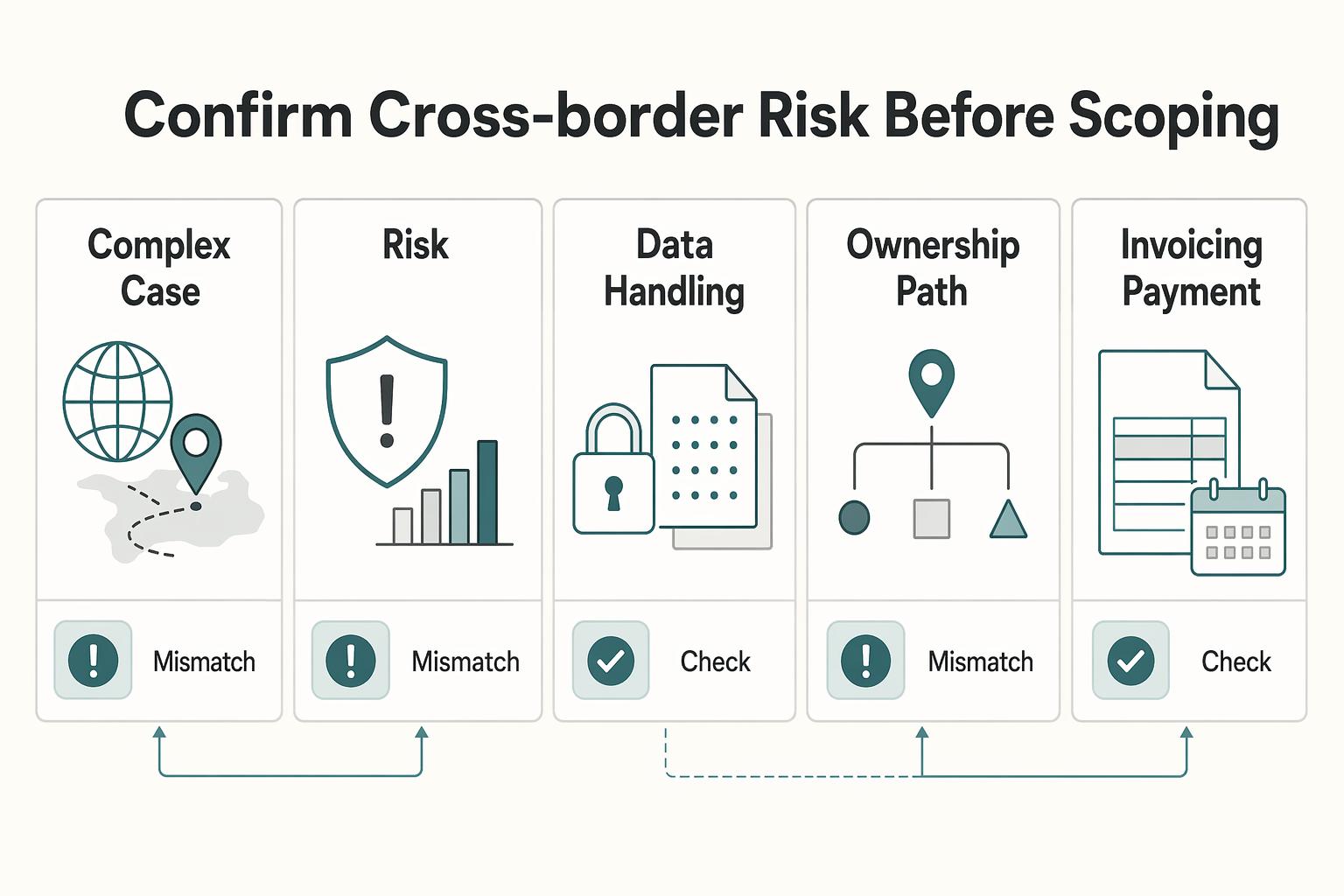
Confirm cross-border risk before scoping#
Cross-border work is where casual discovery breaks down fastest. If key compliance and operating details are still missing, do not rush into scoping.
| Area | What to confirm |
|---|---|
| Contracting party identity | Exact legal entity, country, and signer. |
| Classification risk | For U.S. engagements, review behavioral control, financial control, and relationship factors. Flag jurisdiction-specific review in [client jurisdiction] and [your jurisdiction] when needed. |
| Data handling | Who determines the purpose and means of processing? If you are a processor, controller-processor terms must be in writing, including electronic form. If data transfers cross borders, treat transfer conditions as required, not automatic. |
| IP ownership path | Define what transfers, when, and under signed written terms where required. |
| Invoicing/payment process | Confirm payer workflow, whether W-8BEN is requested by the payer/withholding agent, and for EU B2B invoicing verify rules in [client Member State] because national variation exists. |
If personal data handling is in scope, see the GDPR checklist for freelancers.
Before you move to pricing, send a short written recap and ask the client to correct it. If assumptions are not confirmed, the risk is still too high to scope confidently. Related: Confidentiality vs. NDA: What's the Difference for Freelancers?.
Phase 2: Collaborative Solution Design - Becoming a Partner, Not a Vendor#
This phase turns discovery into written operating rules. If scope boundaries, approval paths, payment mechanics, and ownership terms are not clear in writing, you still have a vendor-style arrangement, not a real working partnership.
Start condition: only move forward once your Phase 1 recap is confirmed or corrected.
Turn discovery into a shared scope rulebook#
Do not leave scope implied. Define what is in scope, what is out of scope, and who can approve expansion.
Use calibrated questions so the client helps set the rules:
- "What would count as complete from your side?"
- "Which requests are in-scope feedback, and which should trigger change review?"
- "Who approves added work if timing, budget, or ownership changes?"
Run a short alignment checkpoint where each side explains its view without interruption. Then document the decision rationale. Where possible, ground those decisions in past performance data rather than preference.
| Area | Weak vendor positioning | Partner positioning |
|---|---|---|
| Scope | "Send changes and I'll see what I can do." | "Let's separate in-scope feedback from net-new work so timing and cost stay predictable." |
| Payment | "I usually ask to be paid upfront." | "If you need reserved capacity and a fixed start, an upfront reserve can help share risk for both sides." |
| Contract risk | "I'm not comfortable with this clause." | "How can we narrow this clause to work and decisions I directly control?" |
Verification point: keep a written scope note with version date, named approver, included deliverables, excluded items, client dependencies, and acceptance trigger.
Route change requests before work expands#
Treat new requests as decisions, not favors. If work expands before anyone records the impact, you are already off plan.
A practical rule is simple: no new request enters delivery until it is captured, impact-assessed, and approved by the right person.
Use collaborative prompts:
- "It sounds valuable. How should we assess impact before it enters current delivery?"
- "Who needs to approve if this changes timeline or invoice value?"
- "Would a short change note help your team approve, defer, or drop this quickly?"
This is where you stop acting like a task-taker and start acting like a business partner. The job is not to absorb every request. It is to connect work to outcomes and approvals.
Verification point: maintain a change log. If a request has no written impact note and no named approval, treat it as unapproved.
Frame payment terms as risk-sharing#
Payment terms should match the risk each side is taking. If the client wants reserved capacity, a fast start, or phased delivery, the payment structure should reflect that.
Reusable scripts:
- Upfront reserve: "If start-date certainty matters, we can use an upfront reserve to lock delivery capacity. How would your team process that?"
- Milestone billing: "Since approvals happen in phases, milestone invoicing may help share risk more clearly. Which checkpoints are invoiceable on your side?"
- Late-payment protection: "If an invoice is delayed, what notice path, escalation contact, and work-pause protection should we set now?"
If the client wants a high level of commitment but will not agree to workable payment mechanics, reduce scope or commitment until the risk is balanced.
Negotiate liability, IP, and acceptance with clear boundaries#
This is usually where hidden risk shows up. Before you commit, close ambiguity on legal and operating responsibility.
| Area | Question |
|---|---|
| Ownership trigger | What transfers, and when? |
| License boundaries | What usage rights apply before transfer, and what stays yours, including pre-existing materials, methods, and tools? |
| Indemnity scope | Is coverage limited to your deliverables and matters within your control? |
| Acceptance criteria | What objective standard marks acceptance, and how are delayed or vague responses handled? |
| Dependency risk | Which client inputs, approvals, assets, or access are required, and who carries risk if they fail? |
In cross-border work, ownership outcomes can differ because more than one legal layer may apply. On commission-free platforms, IP negotiation happens directly between you and the client. That gives you direct control over ownership and usage terms, but also more complexity and dispute exposure if the terms are weak.
Use this as your checklist, and flag jurisdiction-specific language for review in [client jurisdiction] and [your jurisdiction].
If clauses stay broad or undefined, you are carrying risk without clear limits. Treat this section as general information and get legal review where jurisdiction-specific wording controls the outcome.
For a step-by-step walkthrough, see The 'Daily Stoic' for Freelancers: Applying Ancient Wisdom to Modern Work.
Phase 3: The Control & Command Briefing - Framing Your Final Proposal#
Once Phase 2 is confirmed in writing, send one concise proposal. It should force a real decision: approve one option as written, or reject it and identify the exact clause that needs revision.
Send a charter-style proposal, not a loose quote#
A good proposal works like a control document, not a casual estimate. Use a structure that preserves the decisions you already made:
- Objectives
- Scope boundary and exclusions
- Deliverables
- Assumptions
- Constraints and dependencies
- Acceptance criteria
- Timeline and payment logic
- Revision and communication expectations
Before sending, check it against your latest scope note and change log. If acceptance criteria, client dependencies, or exclusions are missing, fix that first.
Offer a small set of options#
Keep the option set tight so the client can choose without getting lost. A small set is usually easier to evaluate, and three simultaneous options can be a useful format when each one is clearly bounded.
| Option | Scope boundary | Client responsibilities | Revisions and changes | Risk allocation and commercial terms |
|---|---|---|---|---|
| Core | Agreed deliverables only | Provide inputs, approvals, and access on time | In-scope revisions only; net-new work requires a written change order | Narrowest risk profile and lowest commitment level |
| Expanded | Core plus additional coordination/reporting | Faster reviews and broader stakeholder availability | More revision room inside scope; new deliverables still require written change approval | Higher fee or milestone load to cover added time and dependency risk |
| Premium | Core plus reserved capacity or accelerated handling | Strict response times and a named internal owner | Priority change handling through formal change order | Higher upfront commitment tied to timeline pressure and resource reservation |
Use trade-off scripts for pushback#
Pushback is normal. The goal is not to win an argument. It is to keep the conversation tied to trade-offs you can price and deliver.
Lead with tactical empathy, then move to feasibility.
- Discount pressure: "I understand the budget pressure. Which part of scope, revision capacity, or turnaround should we reduce to match that number?"
- Timeline compression: "I understand the deadline is important. What should change on scope, approval speed, or budget to make that feasible?"
- Added work without term changes: "This sounds important. How should we document the impact before it enters delivery?"
- Unrealistic ask: "How am I supposed to do that?" then pause for problem-solving.
Treat scope expansion without matching time or budget changes as a formal change request.
Protect boundaries with a non-negotiables and levers checklist#
This final checkpoint keeps you from negotiating against yourself. Know what must stay fixed and what can move.
- Non-negotiables: written scope boundary, change-order requirement, acceptance process, payment timing, client dependencies tied to inputs/approvals.
- Flexible levers: delivery sequence, reporting cadence, meeting frequency, revision rounds, milestone shape, response windows.
If the client asks for more speed, certainty, or access, tie it to matching terms. If they want broader responsibility with the same budget and slow approvals, flag it as scope-creep risk and route it through change control.
If you want a deeper dive, read The Anchoring Effect in Freelance Negotiations.
Before you send terms, turn your negotiated scope, change rules, and approvals into one client-ready document with the SOW Generator.
Tactical Execution: Frequently Asked Questions#
When objections show up, keep the discussion tied to written scope and terms, not memory. This quick map helps you choose your next move without conceding by default.
| Client objection | Tactical objective | Suggested phrasing pattern | Fallback move | Avoid this |
|---|---|---|---|---|
| "Your price is too high." | Keep price tied to scope and service level | "It seems like budget is tight. Which scope, timeline, or support level should we adjust to match that number?" | "How am I supposed to do that without changing the work or timing?" | Cutting price first |
| "We need it faster." | Surface the real tradeoff | "It seems like speed is the priority. What should change on approvals, scope, or fee to make that feasible?" | Move timeline/commercial changes to writing before confirming | Promising faster delivery on unchanged terms |
| "Legal needs our standard terms." | Narrow broad language to controllable risk | "It seems like you want standard coverage. How can we tie this clause to the services I directly provide?" | Request exact clause redline and respond in writing | Agreeing to undefined "standard" language live |
| "Finance cannot do advance payment." | Link payment timing to start commitment | "It seems like finance has fixed process. How can we structure commitment so start capacity is reserved?" | Adjust start date/milestones in writing before work starts | Starting on verbal assurance |
What's an effective accusation audit for a high-value independent consultant?#
When the client is engaged but keeps circling around fit or internal comfort, name the concern early: "It seems like you're weighing specialist depth against continuity and process support." If they stay cautious, ask: "What would you need to see in writing to feel comfortable moving forward?"
How can I negotiate better payment terms, like an upfront payment?#
When payment timing is being treated like a preference instead of part of delivery structure, connect payment to project commitment: "It seems like your process is built around standard terms. How can we structure this so start capacity is reserved?" If they resist, trade variables instead of arguing about fairness, then confirm the revised term in writing before work starts.
How do I apply these principles to negotiate complex liability and IP clauses?#
When the clause language is broader than the work you control, aim for precision: "It seems like broad coverage is important. How can we tie this clause to the services I directly provide and manage?" If requirements are unclear, ask for exact clause language in writing and pause agreement until terms are clear.
Can mirroring and labeling really work with senior corporate clients?#
When a senior stakeholder is moving fast and speaking in shorthand, your objective is clarity without friction: label the priority with "It seems like timeline certainty matters most here." If they keep moving, use a calibrated question: "What does success need to look like on your side for this to move forward?"
What if the client insists on splitting the difference on price?#
When the conversation turns into pure haggling, trade scope, timeline, or service level instead of conceding on price alone: "I can work toward that number if we adjust scope, turnaround, or support level. Which do you want to change?" If they want the same work for less, use: "How am I supposed to do that without changing the work or the timing?"
What if I freeze up and avoid the hard part of the conversation?#
If you feel yourself avoiding the key issue, prepare one label and one calibrated question before the call, then use them as written. If the call gets messy, stop negotiating live and move to written confirmation of the exact clause, deliverable, or approval point that needs revision.
Turn Ambiguity Into Written Decisions Before Work Starts#
The pattern across all three phases is simple: turn ambiguity into written decisions before work starts. When scope, payment, acceptance, and liability are explicit, the deal is usually safer and easier to manage.
Use that as your operating rule. Do not concede out of habit when you can design a clearer agreement.
| Reactive vendor move | Architect move | Client-safe outcome |
|---|---|---|
| Cuts price to keep momentum | Trades scope, timeline, or support level | Budget aligns to defined work, not a vague promise |
| Accepts loose deliverables and verbal changes | Defines deliverables, approvals, and signed addenda for scope changes | Lower risk of scope disputes and clearer payment triggers |
| Accepts broad liability language in the call | Requests redlines and seeks liability limits tied to services you directly control | Risk allocation is clearer and reviewable |
Before proposal#
Before you price anything, make sure the work is written so both sides can see exactly what is owed for the fee. If price pressure appears, use tactical empathy, then ask which variable should change: scope, turnaround, or support. A quick check helps here: can someone outside the call read your proposal and identify the deliverables, review points, and payment triggers?
During contract review#
This is where you lock the commercial logic into actual contract text. Move every ambiguous point into writing. Reduce payment friction with upfront or installment structures, and require signed addenda for scope changes. Review indemnification, limitation of liability, and any exculpatory clause carefully. If the language covers losses outside your direct work, do not accept it "for now."
Before final sign-off#
Use the final pass to verify the current draft, not your memory of prior calls. Check the final scope, payment dates, change-order method, IP language, and latest redlines against the actual document in front of you.
| Situation | Rule |
|---|---|
| Contracts worth $800 or more | Must be in writing. |
| Agreements with the same hiring party that total $800 within a 120-day period | Must be in writing. |
| If no payment date is stated | Payment is due within 30 days after you complete the work. |
| New York State added Article 44-A through the Freelance Isn't Free Act | August 28, 2024. |
If you work in NYC, keep the local rules straight. Contracts worth $800 or more must be in writing, including agreements with the same hiring party that total $800 within a 120-day period. If no payment date is stated, payment is due within 30 days after you complete the work. New York State added Article 44-A through the Freelance Isn't Free Act on August 28, 2024. Do not assume those thresholds apply in other jurisdictions without checking.
If rate pressure is the recurring issue, read How to Calculate Your Billable Rate as a Freelancer so your number is defensible before the call. If EU client work raises data-handling risk, use GDPR for Freelancers: A Step-by-Step Compliance Checklist for EU Clients before you approve contract terms.
You might also find this useful: Crossing the Chasm for Freelancers Without Operational Chaos.
When the deal is verbally aligned, translate it into clear contract language and a cleaner redline process with the Freelance Contract Generator.
Frequently Asked Questions
What's an effective accusation audit for a high-value independent consultant?
When the client is engaged but keeps circling around fit or internal comfort, name the concern early: "It seems like you're weighing specialist depth against continuity and process support." If they stay cautious, ask: "What would you need to see in writing to feel comfortable moving forward?"
How can I negotiate better payment terms, like an upfront payment?
When payment timing is being treated like a preference instead of part of delivery structure, connect payment to project commitment: "It seems like your process is built around standard terms. How can we structure this so start capacity is reserved?" If they resist, trade variables instead of arguing about fairness, then confirm the revised term in writing before work starts.
How do I apply these principles to negotiate complex liability and IP clauses?
When the clause language is broader than the work you control, aim for precision: "It seems like broad coverage is important. How can we tie this clause to the services I directly provide and manage?" If requirements are unclear, ask for exact clause language in writing and pause agreement until terms are clear.
Can mirroring and labeling really work with senior corporate clients?
When a senior stakeholder is moving fast and speaking in shorthand, your objective is clarity without friction: label the priority with "It seems like timeline certainty matters most here." If they keep moving, use a calibrated question: "What does success need to look like on your side for this to move forward?"
What if the client insists on splitting the difference on price?
When the conversation turns into pure haggling, trade scope, timeline, or service level instead of conceding on price alone: "I can work toward that number if we adjust scope, turnaround, or support level. Which do you want to change?" If they want the same work for less, use: "How am I supposed to do that without changing the work or the timing?"
What if I freeze up and avoid the hard part of the conversation?
If you feel yourself avoiding the key issue, prepare one label and one calibrated question before the call, then use them as written. If the call gets messy, stop negotiating live and move to written confirmation of the exact clause, deliverable, or approval point that needs revision.
Try a related tool
Researched and edited by the Gruv editorial team. Gruv builds cross-border billing, payouts, and finance-operations software for global businesses.
Sources
- copyright.gov/circs/circ30.pdftrusted
- copyright.gov/title17/92chap2.htmltrusted
- dol.gov/newsroom/releases/whd/whd20240109-1trusted
- dol.ny.gov/freelance-isnt-free-acttrusted
- federalregister.gov/documents/2024/01/10/2024-00067/employee-or-...trusted
- irs.gov/taxtopics/tc762trusted
- irs.gov/forms-pubs/about-form-w-8-bentrusted
- law.cornell.edu/wex/exculpatory_clausetrusted
Educational content only. Not legal, tax, or financial advice.
Related Posts

GDPR Compliance Checklist for Freelancers Working With EU Clients
Start by separating the decisions you are actually making. For a workable **GDPR setup**, run three distinct tracks and record each one in writing before the first invoice goes out: VAT treatment, GDPR scope and role, and daily privacy operations.
How to Calculate a Freelance Rate You Can Actually Get Paid On
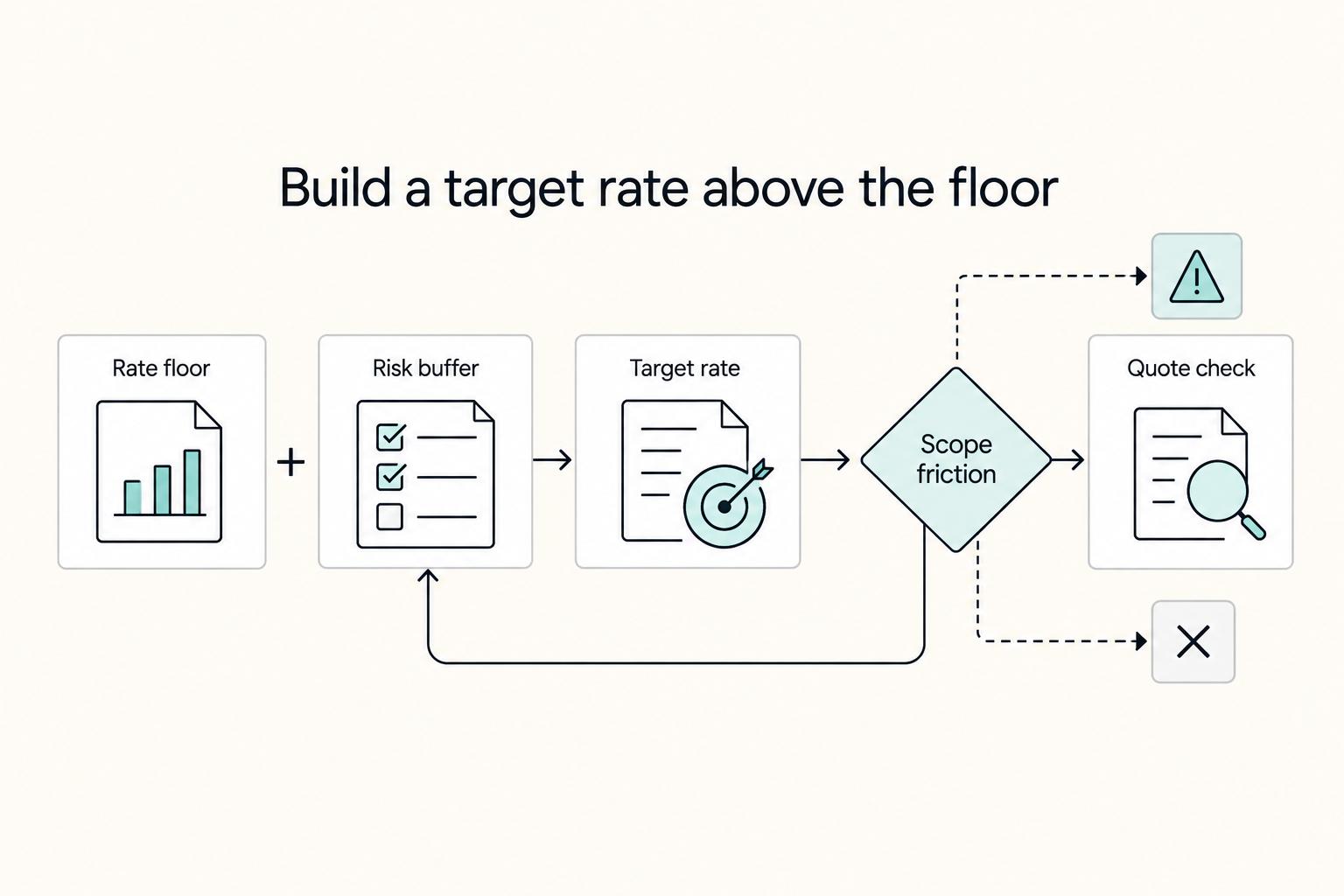
A workable rate is not the neat number a calculator produces. It is the number that still works after you account for real billable capacity, non-client time, scope drift, and the gap between sending an invoice and receiving cleared cash. Start with hourly math even if you do not plan to bill hourly, then turn that number into a quote with clear `payment terms`.

The Freelance Payment Penalty: A Modeled Audit of Platform Fees, FX Spreads, and Payout Delays
The money rarely disappears through a single, easy-to-spot fee. The real loss is stacked. A marketplace takes its commission, a processor adds a charge for international cards, a bank or payment company converts the currency at a spread, a platform holds the funds before release, and a wire sheds a little to intermediaries on the way in. Each layer looks defensible on its own, but the worker feels the combined result as a smaller deposit and a later payday.