
Quick Answer
Apply for a firpta withholding certificate only when standard withholding would materially exceed your expected U.S. tax and your supporting package is already coherent. If key facts are still shifting, use normal FIRPTA handling instead of filing a weak request. When the seller is the applicant, provide written buyer notice within the required transfer-date window. If the request is still pending at closing, withholding still happens and the funds remain in the closing arrangement until the IRS acts.
How to Apply for a Withholding Certificate to Reduce FIRPTA#
Use a firpta withholding certificate when default withholding is materially higher than your expected U.S. tax and you can support that position with a complete, consistent file. If the facts are still moving, the safer course is usually to close under standard FIRPTA handling and follow the normal reporting deadlines.
FIRPTA withholding is generally 15% of the amount realized. The IRS says it generally acts within 90 days after receiving a complete application, including all required TINs, and the regulations tie that timing to when all necessary information has actually been provided.
This process is less about filling out a form than deciding whether the economics justify the work, assembling a support pack that holds up under review, and controlling the transaction timeline so the closing team knows exactly what happens if the certificate is still pending on the disposition date.
A withholding certificate is most useful when it solves a real cash problem. It is less useful when it creates a process problem. Keep the sequence simple. First decide whether this is a certificate case at all. Then build the file, file in the right lane and give the required notice, and close the deal as if withholding still exists unless and until the IRS says otherwise.
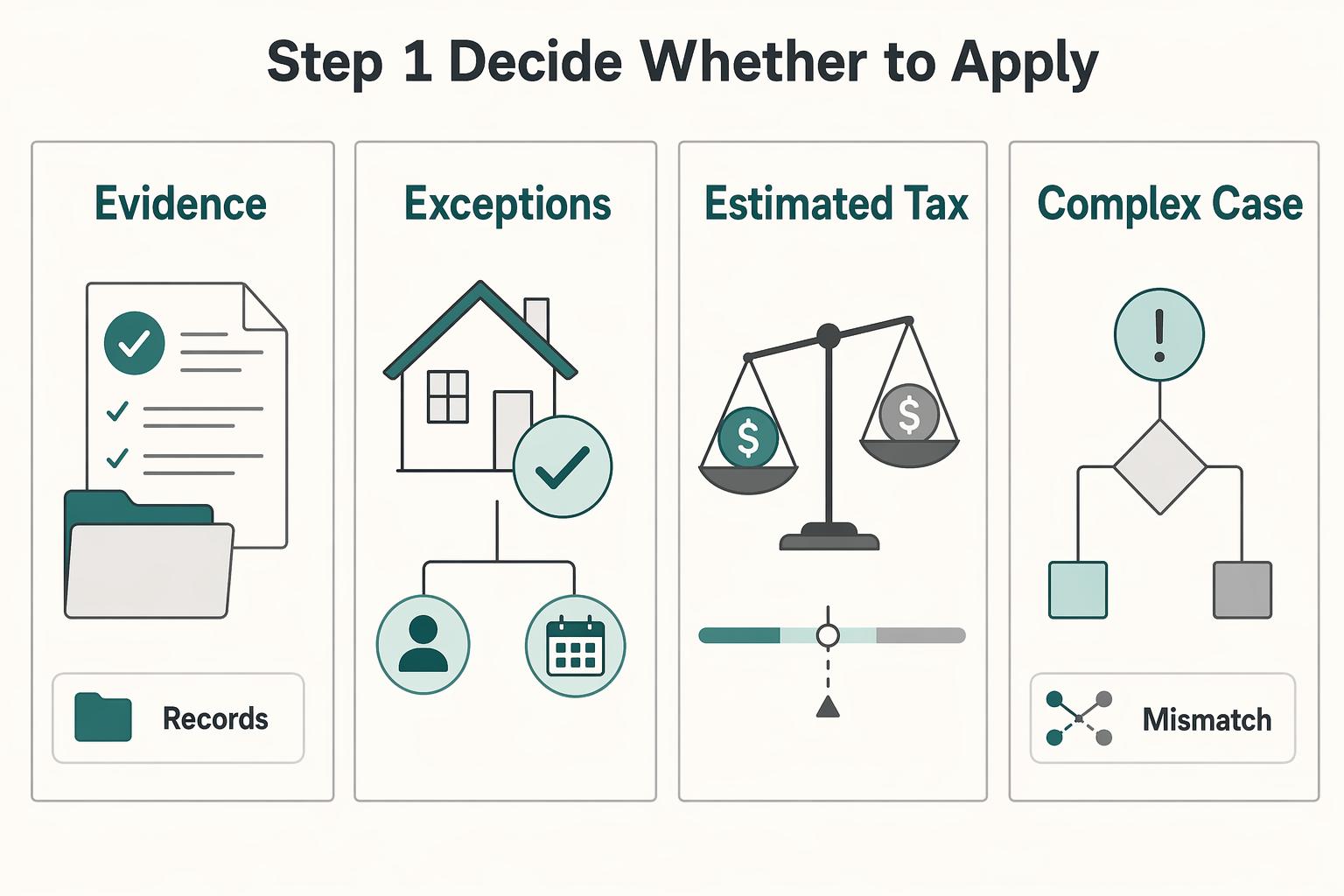
Step 1. Decide whether to apply, stand down, or escalate#
Start with materiality. If your expected U.S. tax is clearly below the default withholding, a certificate can prevent unnecessary cash from being tied up. If the gap is small, the extra process usually is not worth it.
| Situation | Action | Why |
|---|---|---|
| Expected tax is well below default withholding, and you can document the position and party details | Apply | This is the core use case for a withholding certificate |
| Buyer will use the property as a residence, amount realized is $300,000 or less, and the occupancy test is met | Stand down | Withholding may not be required if the residence exception applies |
| Estimated tax is close to default withholding | Usually stand down | Limited cash benefit for added coordination |
| Title, authority, or ownership is unclear, or an entity/trust structure is involved | Escalate to a qualified tax professional | Wrong transferor, TIN, or signer can create filing and timing risk |
Before you commit to the application path, rule out cases where you may not need it at all. If the amount realized is not more than $300,000 and the transferee or a family member will reside there for at least 50% of days used during each of the first two 12 month periods, and other residence-exception conditions are met, you may not need this process. If you want a quick baseline refresher before deciding, see What is FIRPTA Withholding on US Real Estate Sales?.
A withholding certificate isn't worth chasing just because it sounds attractive in the abstract. It's worth chasing only if it changes the economics enough to justify a controlled application process. In practice, make a simple comparison before anyone starts drafting: default withholding on one side, your expected U.S. tax on the other, and one blunt question in the middle. Can you support the lower tax position with documents that reconcile cleanly today, not after closing, not after a few internal emails, and not after someone corrects the ownership chart?
If the answer is yes, the certificate route is usually worth serious consideration. If the answer is "probably" or "we think so," you are not ready yet. A half-documented filing can create confusion for the buyer, the closing team, and anyone trying to determine whether the application was complete enough to start the IRS review clock.
A useful first cut is to sort the transaction into one of three lanes:
- Apply now when the cash benefit is meaningful and the supporting facts are stable.
- Stand down when a clear exception already removes the need for withholding or when the expected tax is so close to default withholding that the process does not buy you much.
- Escalate when the legal and tax facts are not straightforward enough for a clean filing.
That last lane matters. Ownership, authority, and transferor identity issues do not get better because you filed faster. If the file involves an entity, a trust, unusual signing authority, or any uncertainty about who the actual transferor is, assume execution mistakes carry real consequences. The same is true when support is thin or transaction terms are still being revised.
A good decision process at this stage usually looks like this:
- Confirm whether withholding is required at all or whether you are in a stand-down case.
- If withholding is in play, compare the default withholding with the expected U.S. tax.
- Ask whether the tax position is supportable with a file that is complete today.
- Ask whether party identity, TINs, and authority are already settled.
- If any core item is unstable, pause and escalate instead of pushing ahead.
That sequence keeps you from treating the certificate as a default step. It is not. It is a targeted tool for a specific problem: the default withholding is materially too high, and you can prove that before the IRS is asked to act.
Also separate an uncertain tax result from uncertain paperwork. A transaction can have a sensible certificate case but still be a bad candidate for filing this week because the paperwork is not aligned. For example, if the deal terms are still changing, if the buyer and seller details are not yet consistent across the transaction file, or if the person who will sign under penalties of perjury has not been confirmed, the issue is operational readiness.
The reverse is also true. Sometimes the paperwork is tidy, but the economics do not support the effort. If the estimated U.S. tax is close to the default withholding, the process can consume time without delivering much real benefit. In that scenario, standard handling is usually the cleaner answer.
The residence exception is a good example of why this early screen matters. If the facts fit that path, do not run a certificate process just because someone assumes FIRPTA always requires one. Verify the exception facts and avoid unnecessary application work.
When the withholding amount is meaningfully above your expected U.S. tax, the certificate can have real value. But be honest about the support burden. If the argument depends on records, those records need to be ready. If the filing depends on a particular transferor identity, that identity needs to be consistent across the deal record. If authority depends on a specific signer, authority evidence cannot be an afterthought.
A disciplined go or no-go at the outset prevents avoidable mistakes:
- filing too early with a package that is not complete,
- assuming the application changes the closing obligation, and
- discovering late in the process that the wrong party was preparing to sign.
If you are leading the transaction, keep the conversation concrete. Ask for the expected U.S. tax position in writing. Ask who the transferor is. Ask whether all required TINs are available. Ask who signs. Ask whether the deal terms attached to the application are current. If any answer is vague, you do not have a filing-ready case yet.
Go or no-go: proceed only when the cash benefit is real and the core facts are stable. Escalate early if ownership, authority, or tax support is unclear.
Step 2. Build the support file before you touch the form#
A complete file beats a fast file. Before filing Form 8288-B, make sure one reviewer can trace party identity, deal terms, tax position, and signer authority without running into contradictions.
| File item | What to confirm | Issue noted |
|---|---|---|
| Party names and TINs | Seller and buyer legal names and TINs are consistent across all documents | Missing or mismatched TINs |
| Deal documents | Current terms show what is being transferred and on what terms | Stale deal terms |
| Tax support | Records make the expected U.S. tax outcome traceable | Support is thin |
| Signer authority | Proof shows the signer is properly authorized under penalties of perjury | Signature from someone without proper authority |
Your support file should include:
- Seller and buyer legal names and TINs, consistent across all documents
- Current deal documents showing what is being transferred and on what terms
- Records supporting the expected U.S. tax outcome
- Proof that the signer is properly authorized to sign under penalties of perjury
Potential failure points include missing TINs, stale deal terms, and signatures from someone without proper authority.
Verification point: confirm that transferor and transferee names, TINs, and signer authority match across the form and attachments. Go or no-go: if the package does not reconcile cleanly, do not file yet.
This step determines whether the IRS will be dealing with a coherent application or a pile of documents that answers one question while creating two more. Your goal is not to gather some support. Your goal is to assemble a package that reads as one consistent story from the first line of the form through the last attachment.
A simple test helps. Hand the package to one internal reviewer and ask whether that person can identify, without guessing, who the parties are, what is being transferred, what tax position is being asserted, and why the signer is allowed to sign. If the reviewer has to reconcile conflicting names or wonder which version of the deal terms is current, the file is not ready.
Strong applications share four qualities:
- Consistency across every document.
- Current deal terms rather than an earlier draft that no longer matches the transaction.
- Traceable support for the expected U.S. tax outcome.
- Clear authority for whoever signs.
Start with party identity. The legal names and TINs for the seller and buyer should appear the same way everywhere they appear. A small mismatch can force reviewers to stop and ask whether the application is referring to the same party that appears in the deal file and reporting forms.
Then move to the deal terms. Build the application from the current transaction file, not from an early draft circulated before pricing changed or before the transfer structure was finalized.
The same discipline applies to the expected U.S. tax outcome. If your case depends on a lower expected tax, the file needs to show how that result was reached.
Signer authority deserves the same attention. The person signing under penalties of perjury must be properly authorized, and that authority should be evident from the file.
A practical way to build the support file is to work in this order:
- Lock the current party list.
- Verify legal names and TINs for both seller and buyer.
- Pull the current deal documents and remove outdated versions from the working set.
- Assemble the tax support for the expected U.S. outcome.
- Confirm who will sign and collect the authority support for that signer.
- Compare the form draft against the attachment set line by line before filing.
Treat single-version control as a real process requirement. FIRPTA certificate packages can fail when working documents are assembled over time and no one cleans them up before submission.
Before you touch Form 8288-B, review the file this way:
- Compare the seller's legal name everywhere it appears.
- Compare the buyer's legal name everywhere it appears.
- Confirm both TINs are present where required.
- Check that the deal documents attached are the current versions.
- Check that the expected U.S. tax support lines up with the transaction reflected in those deal documents.
- Confirm the signer's authority support matches the person who will sign.
- Read the package once from beginning to end as if you did not work on it.
That last step often catches cross-document contradictions.
Be especially cautious about "we can fix that later" items. Missing TINs and unconfirmed signer authority are not good candidates for post-filing cleanup. IRS timing guidance is tied to a complete application.
Another operational point: assign one owner for the support file, even if several people contribute documents. That person's job is to make sure the package reconciles.
The cleanest applications answer the reviewer's obvious questions before they turn into follow-up issues:
- Are the parties identified consistently?
- Are all required TINs present?
- Do the attached deal documents match the current transaction?
- Does the claimed tax result have documentary support?
- Is the signer actually authorized?
If you cannot answer yes to each one using the file itself, stop and fix the package first. Filing sooner does not compensate for filing inconsistently.
One final caution on this step. Do not let a neat-looking form trick you into believing the package is ready. A clean form attached to a weak file is still a weak filing. The strength of the application comes from the way the documents fit together, not from how quickly the form was completed.
Step 3. File in the right lane and give the required notice#
Use Form 8288-B only for certificate requests in categories (1), (2), and (3). Do not use it for categories (4), (5), and (6).
The buyer, the transferee's agent, or the seller may apply. If the transferor applies, the transferor must notify the transferee in writing on the day of or the day before transfer.
That notice matters because the buyer is generally the withholding agent and may be liable if withholding is missed. Treat it as an execution control, not an administrative detail.
Verification point: confirm who applied, the submission timing, and timely written buyer notice if the seller applied. Go or no-go: if that notice window was missed, treat it as elevated risk and default to standard handling unless your advisor confirms another path.
At this point, precision matters. Do not waste a good support file by filing in the wrong lane or mishandling the buyer notice. The operational question is straightforward: who is applying, under which route, and what has to happen around the transfer date because of that choice.
First, make sure Form 8288-B actually belongs here. The rule is narrow by design.
Next, decide who will apply. The seller, buyer, or transferee's agent can do it. That flexibility is helpful, but it also means you should choose one owner early enough that everyone else knows the filing path.
When the transferor is the applicant, the written notice to the transferee is not a side task. It is a required execution step, and the timing is tight: the notice must be given on the day of or the day before transfer. Put that timing on the closing checklist.
In practice, a clean process looks like this:
- Confirm that the application belongs in the Form 8288-B lane.
- Decide whether the applicant will be the seller, buyer, or transferee's agent.
- If the seller will apply, prepare the written notice to the buyer in advance.
- Put the notice timing on the closing calendar so it goes out on the day of or the day before transfer.
- Keep proof that the notice was sent as part of the transaction file.
- Confirm the closing team understands that the application affects timing, not the existence of withholding.
The buyer is generally the withholding agent, so the buyer needs clear visibility into what has been filed and when. If the seller applies but the buyer never gets the required written notice in the required window, you have a process failure around a party that may be liable if withholding is missed.
If you are the one coordinating the filing, ask these questions before the application goes out:
- Is this definitely a Form 8288-B case?
- Who is the applicant?
- If the seller is the applicant, when exactly will the written notice go to the buyer?
- Who is responsible for sending it?
- Where will proof of that notice live in the file?
- Has the closing team been told what this pending application changes and what it does not change?
These are operational checkpoints that keep the filing usable when the transaction reaches the closing table.
Keep the process narrow and controlled: right lane, right applicant, right notice, right timing.
Step 4. Close as if withholding still applies, because it does#
A pending application changes when funds are remitted, not whether withholding applies at disposition. If a timely Form 8288-B is pending, withholding still must occur at closing, but reporting and payment do not have to be made immediately.
| Scenario | What happens |
|---|---|
| Certificate issued before closing | Follow the approved amount |
| Timely Form 8288-B pending at closing | Withholding still occurs at closing; the withheld amount is held under the closing arrangement while the IRS decides; reporting and payment are due within 20 days after the IRS mails the certificate or denial |
| No application pending | Transferees generally file by the 20th day after disposition using Forms 8288 and 8288-A to report and pay the withheld tax |
Operationally, that usually means the withheld amount is held under the closing arrangement while the IRS decides. If a certificate is issued before closing, follow the approved amount. If not, withhold the statutory amount and make sure the hold is handled correctly.
If no application is pending, transferees generally file by the 20th day after disposition and use Forms 8288 and 8288-A to report and pay the withheld tax. If a timely application is pending, reporting and payment are due within 20 days after the IRS mails the certificate or denial.
Verification point: assign one person to track the IRS mailing date and trigger the filing and payment step. Go or no-go: if no one owns that date, you are carrying avoidable penalty risk.
This is where transaction teams can get tripped up if they confuse a pending application with a suspension of withholding. It is not. Withholding still applies at disposition while the application is pending. What changes is the timing of reporting and payment.
A clear way to manage this is to treat closing under a pending application as a two-stage process:
- Stage one: complete the disposition with withholding still recognized at closing.
- Stage two: report and pay based on the post-decision timing rules once the IRS mails the certificate or denial.
There are three basic timing scenarios to plan for:
- Certificate issued before closing.
Follow the approved amount.
- Application timely filed and still pending at closing.
Withholding still occurs at closing, and the withheld amount is held under the closing arrangement while the IRS decides. Reporting and payment are then due within 20 days after the IRS mails the certificate or denial.
- No application pending.
Transferees generally file by the 20th day after disposition and use Forms 8288 and 8288-A to report and pay the withheld tax.
This is why execution ownership matters in Step 4. Someone has to be responsible for tracking the application status and the IRS mailing date once the decision is issued.
Do not rely on informal awareness. Put one person in charge of:
- confirming whether the application was timely filed,
- confirming whether the certificate has been issued before closing,
- telling the closing team which withholding scenario applies,
- watching for the IRS mailing date, and
- triggering the reporting and payment step when that date exists.
Under a pending application, a useful internal closing checklist might read like this:
- Confirm that Form 8288-B was timely filed.
- Confirm whether a certificate was issued before closing.
- If no certificate was issued, confirm the statutory withholding amount is recognized at closing.
- Confirm how the withheld amount will be held under the closing arrangement.
- Confirm the transaction file notes that reporting and payment are delayed, not cancelled.
- Identify the person responsible for tracking the IRS mailing date.
- Pre-identify the filing and payment team so the post-mailing deadline can be met.
If no application is pending, keep the process simple and standard. The transferee generally files by the 20th day after disposition using Forms 8288 and 8288-A to report and pay the withheld tax.
If a certificate is issued before closing, follow the approved amount and make sure everyone working from the closing file sees the same approved figure.
There is also a communication point here. The buyer, generally the withholding agent, should not have to infer from scattered emails whether a certificate was issued, denied, or still pending. The transaction lead should communicate that status directly and in time for closing execution.
Execution risks here include:
- no one clearly owns the application status,
- the closing team assumes a pending filing means no withholding,
- the withheld amount is not handled correctly under the closing arrangement, or
- the IRS mailing date arrives and nobody triggers reporting and payment.
One more way to keep this clean is to separate the dates that matter:
- the disposition date,
- whether a timely Form 8288-B is pending as of closing,
- and the date the IRS mails the certificate or denial.
Different actions turn on different dates. Mixing them up is how deadline mistakes happen.
Who can apply for a withholding certificate?#
The seller, buyer, or transferee's agent can apply. In most transactions, the buyer still functions as the withholding agent at closing.
The practical takeaway is that the applicant and the withholding agent are not always the same person. That is why the filing decision cannot sit in a silo. The team handling the application and the team handling the closing need the same timeline and the same understanding of who is doing what.
If the seller applies, make the written notice to the buyer part of the execution plan, because the buyer is generally the party carrying the withholding role at closing. If the buyer or transferee's agent applies, you still want clarity in the file about who owns the application process and who owns the reporting and payment step later.
In short, who can apply is flexible. Who needs to know exactly what happened is not.
Can you file Form 8288-B without all required TINs?#
Treat missing TINs as a stop sign. The IRS timing guidance for acting within 90 days is tied to receiving a complete application, and FIRPTA reporting forms require both seller and buyer TINs.
In practice, solve the TIN issue before you treat the application as ready. Do not build a timetable around the idea that missing information can be patched in without consequence. A package with missing TINs is not the same as a complete package submitted quickly.
This is also why TIN reconciliation belongs in the support-file review, not in a last-minute filing check. If seller and buyer TINs are required, verify them early, make sure they are consistent across the file, and do not let the form move forward if they are absent or mismatched.
Does a pending Form 8288-B let the buyer skip withholding at closing?#
No. Withholding still applies at disposition while the application is pending. What changes is the reporting and payment timing, which runs from the IRS mailing of the certificate or denial.
That is the point most worth repeating to a fast-moving deal team. A pending application does not erase withholding at closing. It changes the remittance timeline. If you keep that distinction clear, the rest of the process becomes much easier to manage. Close correctly, hold the withheld amount under the closing arrangement as needed, track the IRS mailing date, and then complete reporting and payment on the correct timetable.
If you blur that distinction, you create the kind of avoidable execution risk this playbook is designed to prevent.
If you want a deeper dive, read our guide to a defensible 2026 filing plan.
Before you file, you can use the W-8 Form Generator to organize tax identity details in your workflow where relevant.
If ownership or signer authority is still unclear, use Contact Gruv to check whether a compliance-first workflow fits your cross-border payment process.
Frequently Asked Questions
Who can apply for a withholding certificate?
The seller, buyer, or transferee's agent can apply. In most transactions, the buyer still functions as the withholding agent at closing. The practical takeaway is that the applicant and the withholding agent are not always the same person. That is why the filing decision cannot sit in a silo. The team handling the application and the team handling the closing need the same timeline and the same understanding of who is doing what. If the seller applies, make the written notice to the buyer part of the execution plan, because the buyer is generally the party carrying the withholding role at closing. If the buyer or transferee's agent applies, you still want clarity in the file about who owns the application process and who owns the reporting and payment step later. In short, who can apply is flexible. Who needs to know exactly what happened is not.
Can you file Form 8288-B without all required TINs?
Treat missing TINs as a stop sign. The IRS timing guidance for acting within 90 days is tied to receiving a complete application, and FIRPTA reporting forms require both seller and buyer TINs. In practice, solve the TIN issue before you treat the application as ready. Do not build a timetable around the idea that missing information can be patched in without consequence. A package with missing TINs is not the same as a complete package submitted quickly. This is also why TIN reconciliation belongs in the support-file review, not in a last-minute filing check. If seller and buyer TINs are required, verify them early, make sure they are consistent across the file, and do not let the form move forward if they are absent or mismatched.
Does a pending Form 8288-B let the buyer skip withholding at closing?
No. Withholding still applies at disposition while the application is pending. What changes is the reporting and payment timing, which runs from the IRS mailing of the certificate or denial. That is the point most worth repeating to a fast-moving deal team. A pending application does not erase withholding at closing. It changes the remittance timeline. If you keep that distinction clear, the rest of the process becomes much easier to manage. Close correctly, hold the withheld amount under the closing arrangement as needed, track the IRS mailing date, and then complete reporting and payment on the correct timetable. If you blur that distinction, you create the kind of avoidable execution risk this playbook is designed to prevent. If you want a deeper dive, read The Ultimate Digital Nomad Tax Survival Guide for 2025. Before you file, you can use the W-8 Form Generator to organize tax identity details in your workflow where relevant. If ownership or signer authority is still unclear, use Contact Gruv to check whether a compliance-first workflow fits your cross-border payment process.
Try a related tool
Researched and edited by the Gruv editorial team. Gruv builds cross-border billing, payouts, and finance-operations software for global businesses.
Sources
Educational content only. Not legal, tax, or financial advice.
Related Posts

Digital Nomad Taxes in 2026 With a Defensible Filing Plan
With digital nomad taxes, the first move is not optimization. It is figuring out where you may be taxable, where filings may be required, and what proof supports that position.

183-Day Rule Tax Myths That Trigger Residency Filing Mistakes
If you are a mobile freelancer or consultant, start here: the "183 day rule tax" idea is not a single universal test. It is a shortcut phrase people use for different residency rules that do not ask the same question. If you mix federal and non-federal residency logic, you can create filing risk even when your travel calendar looks clean.
What Is FIRPTA Withholding on US Real Estate Sales?
Treat **FIRPTA withholding** as a pre-listing cash-flow decision, not a closing surprise. It is a required prepayment collected by the buyer, not your final U.S. tax bill. Before you reach contract stage, confirm your status, estimate exposure, and decide whether a withholding-certificate application belongs in your plan.