
Quick Answer
Yes - use atomic habits for freelancers by assigning recurring admin to fixed triggers and visible finish states. Start with one behavior you can complete and verify, then layer it through Tier 1 (focus and boundaries), Tier 2 (invoicing, close-out, client updates), and Tier 3 (compliance checks). Practical anchors in the article include keeping every open invoice tied to a next action and last contact date, plus running reviews from written records instead of memory.
What atomic habits mean for a freelance business#
Atomic habits for freelancers are small, repeatable business actions that keep key tasks from slipping when the week gets noisy. For many freelancers, the real risk is not lack of effort. It is inconsistent handling of routine business tasks, which can lead to avoidable last-minute decisions.
The fix is not to become more disciplined in the abstract. It is to stop re-deciding the same tasks over and over. This guide walks through that in three layers: first your foundation, then your operations, then the checks that keep important obligations visible.
Step 1. Identify the friction you can actually control#
A habit is a repeated behavior done regularly, often automatically. In practice, that means looking at the tasks you keep re-deciding: sending invoices, logging expenses, checking client requirements, following up on proposals. If those happen only when you remember, you are still operating reactively.
Use this checkpoint: write down the three business tasks that most often get delayed or dropped. If you cannot say when each happens, where it is tracked, and what "done" looks like, start there.
| Business area | Reactive freelancer mode | Systems-led business owner mode |
|---|---|---|
| Workload | Admin arrives in bursts and interrupts paid work | Small recurring tasks are handled on a set cadence |
| Risk exposure | Missed follow-ups, missing records, forgotten obligations | Fewer surprises because key tasks have an owner and trigger |
| Decision quality | Choices made from memory, urgency, or guilt | Choices made from visible inputs and a repeatable process |
Step 2. Work through the three tiers in order#
For this guide, the approach is organized into three layers. Tier 1, the Engine, fixes foundational routines. Tier 2, the Chassis, installs owner-level habits for delivery and operations. Tier 3, the Armor, adds strategic checks so key requirements do not get overlooked.
| Tier | Name | Purpose |
|---|---|---|
| Tier 1 | The Engine | Fixes foundational routines |
| Tier 2 | The Chassis | Installs owner-level habits for delivery and operations |
| Tier 3 | The Armor | Adds strategic checks so key requirements do not get overlooked |
If the business feels messy in several places, read straight through. If one failure mode keeps repeating, start with the tier that contains it, then come back for the rest.
Step 3. Track lagging results without chasing shortcuts#
Results are a lagging measure of habits, so do not judge this approach after one tidy week. Good habits often look boring before they look useful. Pick one baseline you can verify, such as weekly admin hours, unpaid invoice count, or proposal turnaround time, and mark the current benchmark as pending verification until the number is confirmed.
That last part matters. A goals-only approach can push you into short-term thinking and shortcuts. Your job here is simpler: build the repeatable behavior first, then judge the result after enough cycles to trust the pattern. For related guidance, see How to Manage Your Time Effectively as a Freelancer.
Tier 1: The Engine - Fortifying Your Foundational Habits#
This week, operate like the owner: decide what gets accepted, what gets scheduled, and what gets pushed back. You are not just completing tasks; you are setting boundaries and making decisions that keep work clear.
Step 1. Shift from task doer to decision owner. When a client asks for "one more thing," do not absorb it by default. Define it. A useful leadership frame is simple: managers focus on doing things right; leaders focus on doing the right thing. In freelance work, that shows up in scope, timing, and boundaries.
Before: "Sure, I can add that," then you lose a day to unplanned revisions. After: log the request (date, request, impact, recommendation), then reply with options: keep timeline and remove something else, or add the work and adjust fee or delivery date.
Verification point: by week end, you should have one visible place where change requests and decisions live.
Step 2. Make important work easier to start and easier to finish. If focus lives only in your head or inbox, idea overload can take over. Design your workflow so key work starts with less friction and ends with a clear close.
- Put one priority where you will see it.
- Pair planning with a stable cue (for example, your first work block).
- Shrink the starting line to one small first action.
- Mark completion in one trusted place.
| Area | Default behavior | Habit-designed behavior |
|---|---|---|
| Focus | Inbox or chat sets the day | One visible priority is chosen before reactive work |
| Planning | You re-decide daily | The same cue starts planning |
| Follow-through | Tasks stay vague and drift | First action is small, completion is recorded |
Use a cadence you can repeat. "1 hour a day" is concrete; vague goals are harder to run consistently.
Step 3. Treat missed habits as a reset process. A lapse often comes with a mix of excitement, excuses, and self-doubt. Plan the recovery loop in advance so one miss does not derail the week.
- Trigger: you miss the planned block.
- Fallback action: do the two-minute version today.
- Restart cue: place tomorrow's first task where you will see it first.
Run a monthly check: which habit slipped, what blocked it, and whether the cue or first step should be smaller. Aim for faster recovery, not a perfect streak.
If you want a deeper dive, read GDPR for Freelancers: A Step-by-Step Compliance Checklist for EU Clients.
Tier 2: The Chassis - Run invoicing, close-out, and client updates weekly#
To keep your business stable, run three weekly habits as repeatable systems: invoicing control, financial close-out, and scope-safe client updates.
Before you start#
Use a tiny starting action so each habit is easy to begin. A practical threshold is a first step that takes less than two minutes: open your invoice queue, pull your bank feed, or open your client-update draft.
Keep the focus narrow. You cannot optimize everything at once, so stabilize these three habits before adding more admin routines.
Step 1. Run invoicing as a compliance check, not a billing chore.#
Your goal each week is a verified, trackable invoice process, not just "invoice sent."
| Step | Overdue invoice action |
|---|---|
| 1 | Confirm receipt |
| 2 | Resend in the original email thread |
| 3 | Ask who owns payment and request an expected payment date |
| 4 | Decide whether work continues or pauses under your contract terms |
Use this flow every time:
- Verify client status from the documents and business details already on file, then log the verification date.
- Select the template that matches the client situation and jurisdiction, using unresolved notes where rules vary (for example: "Current requirement pending official or counsel verification").
- Review, send, and track the invoice until payment is complete.
For overdue invoices, use one fixed escalation sequence:
- Confirm receipt.
- Resend in the original email thread.
- Ask who owns payment and request an expected payment date.
- Decide whether work continues or pauses under your contract terms.
Verification point: every open invoice has one current status, one next action, and a last contact date.
Step 2. Close out the week before numbers get fuzzy.#
Run your close-out in the same order so your records stay usable.
- Reconcile transactions against bank activity and invoices.
- Classify cash movement (for example: revenue, owner draw, reimbursement, software cost, contractor payment, or account transfer).
- Move funds into your tax reserve account using the method you already set with current jurisdiction-specific advice.
- Flag anomalies for follow-up (duplicate charge, missing receipt, unmatched payment, unexplained transfer).
Verification point: by week-end, you can show a reconciled list, categorized movement, reserve transfer (or a pending note), and an anomaly list with named follow-ups.
Step 3. Send a weekly client update that controls scope.#
Send one written update per active client so progress and decisions are visible in one place.
Include four parts:
- Completed deliverables.
- Next commitments.
- Decisions needed from the client.
- Change requests that affect scope, fee, or timing.
Write specifics you can verify later. If new work is requested, log the request, likely impact, and your recommendation in the same update.
| Habit action | Weekly execution | Business outcome |
|---|---|---|
| Invoicing control | Verify client status, select the right template, send and track to payment | Fewer avoidable corrections, faster follow-up, cleaner records |
| Financial close-out | Reconcile, classify, reserve, and flag anomalies | Clearer cash position and fewer month-end surprises |
| Client update | Document completed work, next commitments, decisions needed, and scope-impacting requests | Less ambiguity, stronger scope control, better trust |
Rule to keep all three habits reliable: the task is done only when the record is clear enough to verify next week without relying on memory.
You might also find this useful: A Digital Detox Routine for Freelancers.
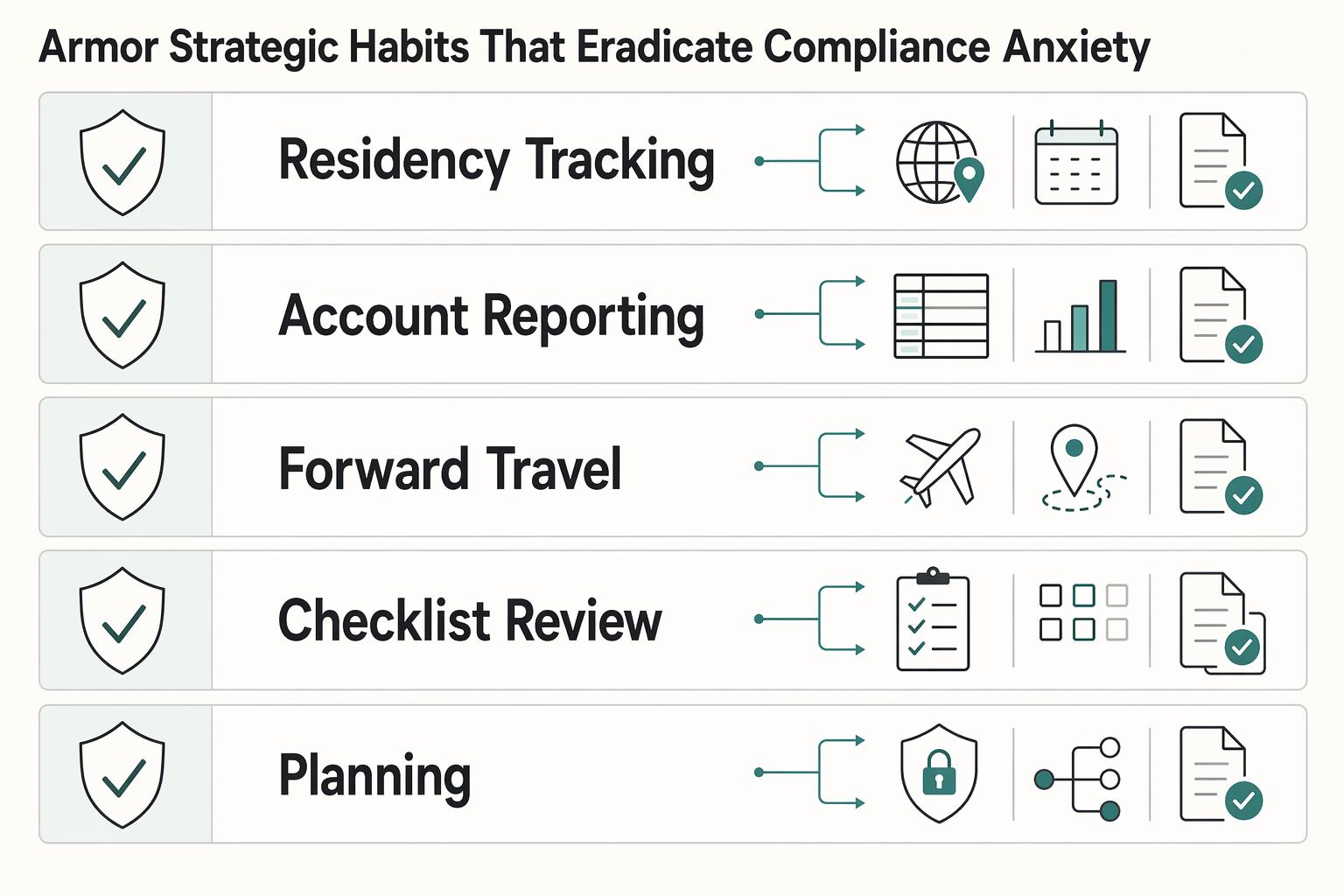
Tier 3: The Armor - Reduce compliance surprises with a current record#
At this tier, your goal is simple: reduce compliance surprises by making decisions from a current record, not memory.
| Checklist block | What it covers |
|---|---|
| Residency tracking | Update your travel log, record where you were physically present, and keep a line for each relevant jurisdiction: "Current residency test pending jurisdiction-specific verification." |
| Account and reporting monitoring | Review accounts, platforms, and entities that may create filing or disclosure obligations, and label unresolved items with "Current threshold pending tax-advisor verification" or "Current reporting rule pending official or counsel verification." |
| Forward travel review | Check upcoming trips, planned stays, and client work, then flag anything that could affect your position for follow-up. |
Step 1. Run one checklist on a fixed cadence. Keep this review practical and manual. You are not trying to resolve every legal question in one sitting, only to confirm what changed and what still needs verification.
Use three blocks in the same checklist:
- Residency tracking: update your travel log, record where you were physically present, and keep a line for each relevant jurisdiction: "Current residency test pending jurisdiction-specific verification."
- Account and reporting monitoring: review accounts, platforms, and entities that may create filing or disclosure obligations, and label unresolved items with "Current threshold pending tax-advisor verification" or "Current reporting rule pending official or counsel verification."
- Forward travel review: check upcoming trips, planned stays, and client work, then flag anything that could affect your position for follow-up.
Finish with a dated note of open questions. If the checklist is not updated, the review is not done.
Step 2. Use a repeatable what-if mini framework before you commit. When a new plan appears, run the same four steps before booking, signing, or opening anything new.
- Define the scenario: what exactly is changing.
- Map likely compliance impact: use your current notes, including open items still awaiting verification.
- Choose the safer option: prefer the path that is easier to document, reverse, or explain later.
- Log assumptions to revisit: write what must be verified, by whom, and when you will revisit it.
This keeps decisions traceable and prevents "I thought I checked that" moments later.
| Habit area | Reactive behavior | Early habit | Practical effect |
|---|---|---|---|
| Checklist review | Check only when stressed | Update one checklist on a set cadence | Fewer blind spots and less decision friction |
| What-if planning | Commit first, assess later | Compare scenarios before acting | Lower rework and reversal risk |
| Professional monitoring | Read updates and move on | Convert each update into an operational output | Less drift between what you know and what you do |
Step 3. Turn monitoring into an operational output every time. After any advisor note, official update, or industry article, create one concrete output: update the checklist, draft an advisor question, or revise a travel/tax assumption. A useful mental model is the settings-page checkpoint: nothing changes until you click "Save My Preferences." Treat your monitoring habit the same way.
For a step-by-step walkthrough, see The '7 Habits of Highly Effective People' for the Business-of-One.
Conclusion: You Are the Architect of Your Freedom#
If you take one thing from this guide, let it be this: stop managing your business from mood, memory, and urgency. The identity shift does not have to be grand or dramatic. It is moving from reacting like a solo worker wearing a lot of hats to acting like the owner who decides what gets checked, written down, and reviewed.
The three tiers are designed to support each other. Foundation habits give you a clear focus decision instead of drift. Operations habits turn that focus into visible outputs like sent invoices, filed receipts, and written client updates. Compliance habits keep important records alive so fewer things depend on memory later. Put together, this can mean fewer surprises and steadier decisions.
| Area | Reactive mode | Systems mode |
|---|---|---|
| Focus | Start the day by checking messages | Make one focus decision before you react |
| Admin | Let small tasks pile up | Finish one item to a visible state: sent, filed, or logged |
| Client work | Wait for confusion, then explain | Confirm scope in writing and send short updates early |
| Records | Trust memory until pressure hits | Update the document you actually rely on after changes |
For your first week, keep it small and concrete:
- Pick one habit. Choose one action tied to a clear finish line, not a vague intention.
- Schedule it. Put it on your calendar with a day and time.
- Track it in one place. A simple note, spreadsheet, or checklist is enough. Your checkpoint is whether you can point to a written record.
- Review it after seven days. If you skipped it because the tool was annoying or the step was fuzzy, simplify the setup before you try harder.
Do not install everything at once. Pick one habit, schedule it, track it, and review it on a repeat cadence until it feels normal. We covered this in detail in A Guide to 'Deep Work' for Freelancers.
Frequently Asked Questions
What daily habits matter most for a freelancer?
Start with small actions you can verify the same day. The most useful daily moves are usually a focus decision, one tracked business action, and one closed loop such as a filed receipt, sent follow up, or logged client note. If you cannot point to a visible output, you were probably busy without moving the business. That is Tier 1, your foundation.
How can habits improve my freelance finances?
Track leading indicators before you obsess over income. Record what you sent, what got paid, what expense was categorized, and what money you moved into a separate reserve using your own verified method. Your checkpoint is simple: your records should be clean enough that you could explain them later without relying on memory. This sits mostly in Tier 2 operations, with a Tier 3 compliance check. | Area | Common reaction | Habit based response | |---|---|---| | Finance | Check balance when stressed | Log income, categorize expenses, reserve tax money, then review what changed | | Admin | Let small tasks pile up | Finish one concrete action and mark it sent, filed, or logged | | Client communication | Reply only when a problem appears | Send brief updates early and confirm scope in writing |
What core setups should every freelance business have?
Keep three records alive: how work comes in, how work gets delivered, and what creates legal or reporting risk. The first one forces clarity on who the buyer is, because a common failure mode is building offers without a defined customer and then wondering why nothing sells. The third one should hold your travel log, account list, and any open threshold or reporting notes that still need tax-advisor or official verification. That maps across Tier 1, Tier 2, and Tier 3.
How do I use the Two Minute Rule for freelance admin?
Use a two-minute start to begin, not to avoid finishing. Open the invoice draft, label one receipt, or write the first sentence of the client email so you stop negotiating with yourself. If tiny starts continue for days without completion, treat that as a red flag. Pair the start with one finish line like “sent,” “filed,” or “logged.” That is a Tier 2 operations habit.
How do I stop feeling anxious about taxes?
Replace guessing with records you update before the pressure builds. After payments, expenses, or travel changes, update the document you actually rely on and leave clear notes for anything that still needs confirmation instead of inventing a rule from memory. If your checklist still has a threshold or reporting item marked as pending verification, treat that as an open item to resolve, not as proof you are covered. This is Tier 3 compliance.
Can habits improve client management?
Yes, if they reduce ambiguity for both sides. Confirm scope in writing, track promises you made, and send short updates before the client has to ask where things stand. Also, stop saying yes to meetings without knowing what you are walking into, because that habit quietly destroys focus and creates avoidable rework. This belongs in Tier 2 operations, supported by Tier 1 discipline.
What if I keep changing direction and never stick with one approach?
Give experiments a defined window and track the actions you took. Then make a real focus decision instead of drifting into the next idea. The tradeoff is real: you need some testing, but endless testing prevents compounding. If one offer, channel, or service is producing clean signals, double down there before adding something new. That starts in Tier 1 and protects everything built in Tier 2.
Try a related tool
Researched and edited by the Gruv editorial team. Gruv builds cross-border billing, payouts, and finance-operations software for global businesses.
Sources
Includes 1 external source outside the trusted-domain allowlist.
- acus.gov/sites/default/files/documents/Improving-Time...trusted
- extension.harvard.edu/2024-2025-extension-course-archivetrusted
- georgiasouthern.edu/research/centers/national-youth-advocacy-and...trusted
- luzerne.edu/academics/catalogs/2011-12.pdftrusted
- nrc.gov/docs/ML1724/ML17242A055.pdftrusted
- publishing.vt.edu/books/33/files/b85e4a8e-a61c-4878-955c-d5e34...trusted
- regent.edu/wp-content/uploads/2024/03/Regent-Research-R...trusted
- 6figurecreative.com/atomic-habits-for-freelancers-growing-your-s...external
Educational content only. Not legal, tax, or financial advice.
Related Posts

GDPR Compliance Checklist for Freelancers Working With EU Clients
Start by separating the decisions you are actually making. For a workable **GDPR setup**, run three distinct tracks and record each one in writing before the first invoice goes out: VAT treatment, GDPR scope and role, and daily privacy operations.
How to Manage Your Time Effectively as a Freelancer
Most freelancers struggle not because they work too few hours, but because they misallocate the hours they have—treating time as an infinite resource rather than a finite business asset with a real cost per unit. The solution is a three-layer operating system: a Time Budget Framework that commits hours to four categories before any client work is booked, a Weekly Operating Template that assigns those categories to specific calendar windows, and a monthly Admin Audit Checklist that reconciles invoicing, bookkeeping, and compliance records. Multi-client orchestration requires a WIP limit, dedicated client windows, and a capacity decision rule run before accepting new engagements. Together, these systems replace reactive decision-making with a repeatable structure that keeps delivery quality consistent, records audit-ready, and the freelance practice operationally durable.

A Digital Detox Routine for Freelancers Who Need to Stay Reachable
Use your devices as operating tools, not open doors to constant interruption. The goal is not to quit screens. It is to control when they get to interrupt your work.