
Quick Answer
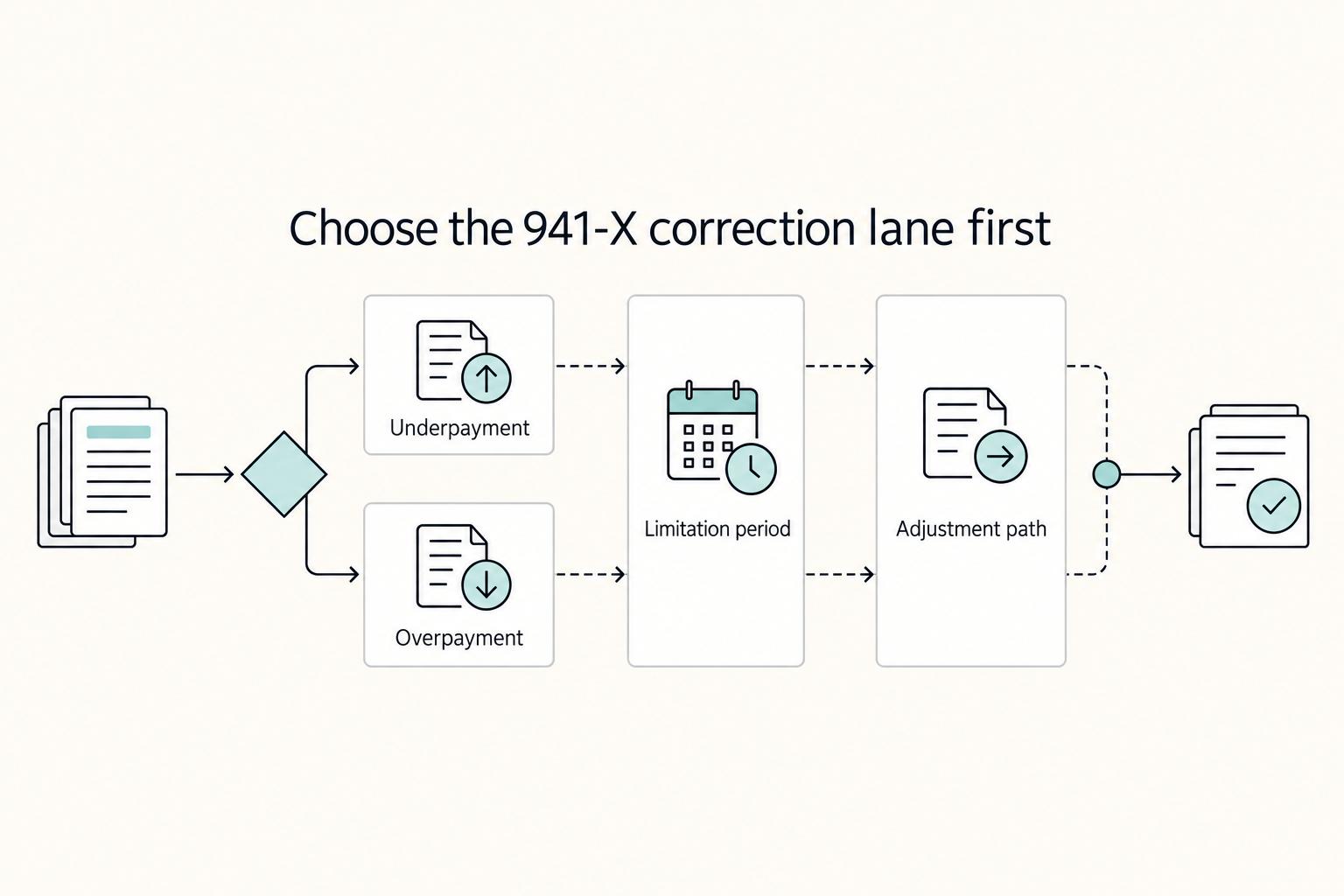
Start by freezing the quarter file and reconciling the filed Form 941, payroll reports, and deposit records before entering Form 941-X. Choose one Part 1 path first, since underreported amounts use adjustment while overpayment-only cases may use adjustment or claim based on timing. File one quarter per form, complete all pages, and keep any required W-2 or W-2c follow-through in the same correction file.
Treat Form 941-X as a Quarter-Close Correction#
Treat Form 941-X as a quarter-close correction, not a form-filling task. That framing matters because a clean amendment usually comes from process discipline, not from moving quickly through the lines. The practical sequence is straightforward. Diagnose the error, choose the Part 1 process, build the support file, submit a package that matches itself from top to bottom, and then fix the control gap that caused the error in the first place.
Form 941-X corrects a previously filed Form 941, and the IRS instructions direct filers to use the April 2025 revision for years still open under the limitation rules. Because the correction ties back to the original return line by line, the real work starts before you enter any numbers. If traceability is weak, the form usually shows it. If traceability is strong, the form is usually the easy part.
| Decision point | Fast rule | Next action |
|---|---|---|
| Error diagnosis | If you cannot state the error in one factual sentence, you are not ready to file. | Freeze the quarter file and reconcile the original Form 941, payroll reports, and deposit records in that order. |
| Part 1 path choice | Any underreported amount means adjustment. Overpayment only means adjustment or claim. In the last 90 days of the limitation period for an overpayment, use claim. | Select only one Part 1 process before calculating final corrected amounts. |
| Correction package | If any changed figure cannot be traced to a report or note, the package is incomplete. | Assemble the original return, corrected calculations, deposits, explanation, and W-2 or W-2c follow-through. |
| Submission checks | If quarter, Part 1 choice, lines, or explanation do not match, stop. | Correct mismatches, then file 1 quarter per form and complete all 5 pages. |
That table is the short version. The longer version is where most businesses either reduce risk or create a second problem while trying to solve the first.
Step 1. Diagnose the error before you touch the form#
Start with the source records, not the correction lines. If you cannot explain what went wrong in one factual sentence, keep reconciling. That sentence should be plain, narrow, and quarter-specific. It is not a place for theories or broad descriptions. It is the shortest accurate statement of what changed and why.
Freeze the quarter file. Then pull the originally filed Form 941, the payroll reports used to prepare it, and the related deposit record. Review them in that order. The goal is not just to identify that a line changed. It is to show how the original filing got there and which source item now changes that result. A good working approach is to mark:
- what was originally reported,
- what should have been reported,
- which source report supports the corrected figure,
- and what operational event created the difference.
Each changed figure should trace to a source report or reconciliation note. If you cannot trace a figure, you do not yet have a filing-ready correction package. You may have a suspicion, but not a supportable amendment.
A common failure here is fixing the visible line error while leaving the source process problem untouched. That is how a business files an amendment and then repeats the same issue in the next quarter. Another common failure is using memory to reconstruct what happened instead of using the return, payroll reports, and deposit records. Memory tends to simplify. Quarter-close errors rarely are simple.
This is also the point where you should be honest about whether the issue is actually a payroll mechanics issue. If the facts start to point to worker status rather than payroll mechanics, pause and review What to Do If You've Been Misclassified as an Independent Contractor. Form 941-X is a correction tool, but it does not change the underlying nature of the problem if the real issue is classification rather than line-by-line payroll reporting.
A practical readiness standard is simple. Another reviewer should be able to look at your quarter file and understand the error without guessing. If that cannot happen, you are still in diagnosis, not correction.
Step 2. Choose Part 1 before you do the math#
Choose the process first, because Part 1 controls treatment and the form allows only one process. This is one of the most important sequence rules in the filing. Businesses often want to compute first and choose later, but that backward approach creates avoidable mismatch between the numbers, the explanation, and the filing path. The rules are straightforward:
| Situation | Part 1 path | Key rule |
|---|---|---|
| Correcting an underpayment | Adjustment | Amounts owed must be paid by the time the IRS receives the form |
| Only an overpayment | Adjustment or claim | You may choose either process |
| Overpayment in the last 90 days of the limitation period | Claim | Claim treatment is required |
| Any underreported amount appears on the form | Adjustment | Do not use the claim box |
- If you are correcting an underpayment, use the adjustment process.
- Amounts owed must be paid by the time the IRS receives the form.
- If you have only an overpayment, you may choose adjustment or claim.
- In the last 90 days of the limitation period for an overpayment, you must use the claim process.
- If any underreported amount appears on the form, do not use the claim box.
That means you should settle the Part 1 path before building final corrected amounts. Once the path is chosen, the rest of the package should line up behind it. That includes the calculations, the explanation, the payment treatment if amounts are owed, and the file memo showing why the path was selected.
The common failure here is calculating lines first and realizing too late that the filing path no longer fits the correction. When that happens, people start revising the explanation to fit the numbers or revising the numbers to fit the chosen box. That is exactly the kind of version drift that makes a clean amendment look unreliable.
A simpler way to manage this step is to ask one question before any final calculations: Does this correction include any underreported amount? If the answer is yes, the process decision is already made. If the answer is no, you still need to consider whether the overpayment is within the last 90 days of the limitation period. That is why process selection belongs near the front of the workflow, not the end.
Step 3. Build the correction package before final entry#
Do not enter final numbers until the support and the story match. A strong correction package is not just a stack of records. It is one quarter-specific file where every major item points to the same conclusion. Keep the following together:
- the original Form 941,
- corrected wage and tax calculations,
- deposit records,
- a draft explanation,
- and evidence that you filed or will file Forms W-2 or W-2c when required.
Form 941-X includes a certification on W-2/W-2c follow-through, so treat that as a required control, not an afterthought. If your correction package is silent on employee-form follow-through when that follow-through is required, the package is not complete no matter how good the math looks.
Three hard rules also matter here:
- Use a separate Form 941-X for each corrected quarter.
- Complete all five pages.
- Do not attach it to Form 941 unless you are reclassifying workers.
Those rules sound simple, but they have practical consequences. A separate form for each quarter means your support should also stay quarter-specific. Do not let workpapers for one quarter blend into another quarter's explanation. Completing all five pages means you should not treat the form like a partial correction worksheet. And not attaching it to Form 941 in standard correction cases means you should build a filing package that stands on its own.
A common failure is version drift across the explanation, the workpapers, and the filed form. For example, the worksheet may reflect one understanding of the issue while the narrative explanation reflects another. Or the deposit record may support a number that no longer appears in the final draft. Those are not cosmetic issues. They undermine confidence in the correction.
To avoid that problem, build the package in a fixed order:
- Original return.
- Source payroll reports and deposit support.
- Corrected calculations.
- Draft explanation.
- W-2 or W-2c follow-through evidence if applicable.
- Final form review copy.
That sequence keeps the file grounded in source records first and form entry second. It also makes later review easier, whether the reviewer is internal, external, or simply a future you who needs to understand the amendment months later.
Step 4. Submit cleanly after a short mismatch check#
File only when the package and the form agree on scope, process, and narrative. Before submission, verify the quarter and year, Part 1 choice, correction lines, explanation, and signature. Then confirm how you will send it.
| Check | What to confirm |
|---|---|
| Quarter and year | The form matches the quarter and year covered by the workpapers |
| Part 1 choice | It matches the actual correction type |
| Corrected lines | They tie back to the calculations |
| Explanation | It describes the same error reflected in the numbers |
| W-2 or W-2c follow-through | Evidence is present when required |
| Filing format | It is being submitted as a separate Form 941-X for that quarter |
| Signature | It is complete |
This is not the place for a long review meeting. It is the place for a short, deliberate mismatch check. The point is to catch inconsistencies while they are still easy to fix. A practical pre-submission review should answer these questions:
- Is the quarter and year on the form the same quarter and year covered by the workpapers?
- Does the Part 1 choice match the actual correction type?
- Do the corrected lines tie back to the calculations?
- Does the explanation describe the same error reflected in the numbers?
- Is there evidence of W-2 or W-2c follow-through when required?
- Is the filing being submitted as a separate Form 941-X for that quarter?
- Is the signature complete?
If any of those items do not match, stop and correct the mismatch before filing. A fast amendment with internal contradictions is usually slower to deal with later than a careful amendment filed after one more review.
The IRS says electronic filing of some amended employment tax returns is available, but availability varies by situation and filing channel. If mailing, verify the current IRS filing address in the latest Form 941-X instructions before sending.
That point is more than logistics. It affects how you document submission. However you file, your quarter file should reflect the actual submission method used, because proof of filing belongs in the final package.
Step 5. Close the loop so the same quarter problem does not repeat#
The correction is not operationally complete until the source failure is fixed. Filing is a milestone, not the finish line. Store one final proof package that matches what was filed. Note the root cause in plain language, and add a pre-file review for the next quarter that ties payroll reports, deposits, and off-cycle items to the draft return.
That root cause note does not need to be long. It does need to be usable. If a future reviewer cannot read it and understand what failed, the note is not doing its job. "Error corrected" is not a root cause. A plain-language explanation of where the process broke down is what helps prevent a repeat.
If timing is tight, do not guess. Confirm the applicable limitation-period rules for that quarter before filing, including whether the last 90 days rule for overpayments applies. Timing pressure is a common reason businesses skip a final review, use stale assumptions, or choose a process path too late. Tight timing is exactly when a disciplined checklist matters most. For broader compliance workflow habits, see Digital Nomad Taxes in 2026 With a Defensible Filing Plan.
A practical operating model for the quarter correction#
If you want the whole process to stay controlled, treat the amendment like a short project with a defined scope. That does not mean creating more bureaucracy. It means making sure each stage has a clear close test before the next stage starts. A simple operating model looks like this:
| Stage | What you are trying to prove | What should exist before you move on |
|---|---|---|
| Diagnosis | You know exactly what changed and why | One factual sentence describing the error, plus reconciled source records |
| Process choice | You selected the correct Part 1 path | One confirmed Part 1 choice consistent with the correction type |
| Package build | The support file and the correction story match | Quarter-specific file with return, workpapers, deposits, explanation, and employee-form follow-through evidence if applicable |
| Submission review | The form matches the package | Quarter, year, Part 1 choice, lines, explanation, and signature all agree |
| Closeout | The issue is fixed operationally, not just filed | Final proof package plus root-cause note and next-quarter review step |
This model does not add new work. It organizes the work you already have to do so the filing remains coherent from start to finish.
What leaders should watch for during review#
If you are reviewing rather than preparing the correction, your role is not to re-perform every calculation. Your role is to make sure the package is logically sound. In practice, that means asking a short set of direct questions:
- Can the preparer state the error in one factual sentence?
- Is the quarter-specific file complete?
- Does the Part 1 choice fit the correction type?
- Does the explanation match the numbers?
- Is there evidence of W-2 or W-2c follow-through when required?
- Is the filing being submitted as a separate Form 941-X for that quarter?
- Has the team identified the process failure that caused the original error?
If those questions do not have clear answers, the package probably needs more work before filing.
Common ways a correctable issue turns into a messy filing#
Most Form 941-X problems do not come from missing the need for a correction. They come from poor coordination once the team starts acting. The recurring failure points already appear in the process above, but it helps to name them clearly:
- correcting the line without diagnosing the source problem,
- doing the math before choosing the Part 1 process,
- allowing the explanation and workpapers to drift apart,
- forgetting that the form is quarter-specific,
- assuming amended e-file will work because regular payroll e-file works,
- treating W-2 or W-2c follow-through as optional,
- and filing without a clean mismatch check.
None of those failure points requires a complex solution. They require sequence, ownership, and a file that can be reviewed without guesswork.
Do I need a separate Form 941-X for each quarter?#
Yes. The IRS says to use a separate Form 941-X for each quarter that needs correction. Keep each quarter file separate so the explanation, workpapers, and support stay aligned. That quarter separation is not just a form rule. It is also the easiest way to prevent mixed support, mixed narratives, and mistaken carryover from one quarter to another.
A practical way to handle this is to maintain one folder or file set per corrected quarter. Each file should contain the original Form 941 for that quarter and the corrected calculations for that quarter. It should also contain the deposit support tied to that quarter, the explanation for that quarter, and the final filed Form 941-X for that quarter. When everything is quarter-specific, review becomes easier and later questions are easier to answer.
Can I use the claim process if any part of the correction is an underpayment?#
No. If any underreported tax amount is being corrected on that form, use the adjustment process. For overpayments only, you may choose adjustment or claim, except in the last 90 days of the limitation period, when claim treatment is required.
The practical takeaway is that mixed corrections should not be treated like overpayment-only corrections. If any underreported amount appears on the form, the claim box is not the right path. That is why the process choice belongs early in the workflow. It shapes what follows.
Can I attach Form 941-X to my current Form 941?#
Usually no. The IRS says not to attach Form 941-X to Form 941 unless you are reclassifying workers. In standard correction cases, file the amendment separately and complete any required W-2 or W-2c follow-through.
That separate filing rule should also shape your internal process. Build the amendment as a standalone package that can be reviewed, submitted, and stored on its own. If you build it as if it were an attachment to current-quarter work, it becomes easier to lose the quarter-specific logic that the correction requires.
If you want a deeper dive, read How to Amend a Tax Return as a US Expat (Form 1040-X).
If you want a cleaner handoff from correction worksheet to operational follow-through, review Gruv's implementation patterns in the docs.
From Correction to Control: Your Business is Now Stronger#
Once the amendment is filed, shift from correction mode to control mode. Filing Form 941-X is the midpoint, not the finish line. The quarter is closed only when your filed version, proof package, and follow-up records all support the same result.
Treat this as a control loop with clear ownership: one owner, one action, and one close test for each step. If no one owns the next check, the amendment can sit unresolved and lose trust over time. That is how a technically filed correction still creates operational uncertainty months later.
The point of post-filing control is simple: preserve clarity. You want a file that explains what was filed, why it was filed, how it was supported, and whether the result posted the way the package says it should. If that chain breaks at any point, the quarter is not truly closed.
Step 1. Lock the filed version and filing basis#
Assign this step to whoever controls your payroll tax records. Store the exact filed Form 941-X, submission proof, and any payment or refund record in one quarter-specific folder. Keep a short note on which instructions and source records were used. The close test is simple: another reviewer can see exactly what was filed and why.
Version control is a control, not admin cleanup. IRS draft materials are not filing-ready, and forms or instructions can change before official release, so keep the exact version you relied on. Keep the Instructions for Form 941 for the specific corrected quarter in the same file so the support set is complete.
That matters because later review often fails for avoidable reasons. A reviewer finds a filed form but not the exact support set used to build it. Or the file contains multiple working drafts with no clear indication of which one was submitted. Or the instructions relied on are not stored with the file. Those issues create friction even when the underlying correction was sound.
A clean lock step means the file should clearly contain:
- the exact filed Form 941-X,
- proof of submission or mailing,
- any payment or refund record,
- the short filing-basis note,
- the source records used,
- and the instructions relied on for the corrected quarter.
Another reviewer should not need to ask which version was filed.
Step 2. Verify account posting and reconcile to your package#
Assign this step to the person responsible for tax account monitoring. Using available account records, confirm whether the correction posted, then compare the posted quarter details and amounts to your filed package. The close test is verified posting, not assumed completion.
This is an important shift in mindset. Filing is what you do. Posting is what you confirm. Those are not the same thing. If your records show that the form was filed but the quarter details or amounts do not line up with your package, the quarter still needs attention.
If quarter details, amounts, or treatment do not line up, freeze the file again and resolve the mismatch before marking it complete. Reconcile from payroll records, deposit records, and your filed amendment. Do not start by rewriting explanations or creating new assumptions. Start with the same source records that supported the original correction.
If the issue starts to look like worker-status risk instead of payroll math, pause and review What to Do If You've Been Misclassified as an Independent Contractor.
The key habit here is resisting the temptation to close the quarter just because a filing happened. The quarter closes when the filed package and the observed result can be tied together without guesswork.
Step 3. Build one final proof package, not a loose document stack#
Give one person custody of the final quarter file, whether that is you, finance, or an outside preparer. Assemble one quarter file with the original Form 941, filed Form 941-X, calculation workpapers, deposit or payment records, discovery note, final explanation, and employee-form follow-through evidence if applicable. The close test is a file that survives turnover, audit questions, or later re-review without rework.
That last phrase matters. A file that survives turnover is a real operational asset. A file that depends on the memory of the person who prepared it is not.
Your final proof package should read like a complete story of the quarter correction:
- What was originally filed.
- What changed.
- Why it changed.
- Which source records support the change.
- What was submitted.
- What follow-through was required.
- How you know the package is complete.
A loose document stack does not do that. A proof package does. The difference is organization and consistency, not volume.
| Control step | Evidence to retain | Close criteria |
|---|---|---|
| Filed version locked | Filed Form 941-X, submission confirmation or mailing proof, final filed copy | Filed copy matches the quarter and explanation in your package |
| Posting reconciled | Account posting record, reconciliation note, internal status log | Posted quarter details and amounts match filed correction, or variance is documented |
| Proof package completed | Original Form 941, corrected calculations, deposit or payment records, discovery note, employee-form follow-through if applicable | Another reviewer can follow the correction without missing support |
| Next review scheduled | Calendar invite, assigned owner, review checklist | Pre-draft review is scheduled before the next Form 941 is prepared |
| State follow-through noted | Verified state filing note or pending-verification note | File shows the state follow-through status, either completed or still pending verification |
That table is useful because it turns the quarter close into observable evidence rather than assumptions. If a row is missing evidence, the close step is not complete.
Step 4. Schedule the next pre-draft review while the issue is fresh#
Assign this step to whoever signs off on the next quarter close. Schedule a short pre-draft review before the next Form 941 is prepared, with the specific prior failure point on the agenda. The close outcome is lower repeat risk in the next quarter.
This is where the control loop becomes practical rather than theoretical. You already know where the process failed once. That gives you a direct test for the next cycle. Keep the review narrow and test the failure point directly. For example:
- If it was mapping, test mapping.
- If it was deposits, reconcile deposits to the draft before filing.
- If it was instruction or version confusion, check current final instructions and IRS Form 941-X updates before reusing old templates.
Do not use draft releases as filing authority, and do not leave timing-sensitive notes unverified.
The purpose of this pre-draft review is not to repeat the whole amendment process. It is to put a control directly over the prior failure point while the lesson is still fresh and before the next return is prepared.
State follow-through belongs in the file, even if it is not yet complete#
That last row in the control table matters because federal completion may not resolve every state requirement. If state payroll filings could be affected, add a plain-language status note instead of leaving the issue implicit: State payroll amendment requirements still need verification. For broader context, see Do I Have to Pay State Taxes While Living Abroad as a Digital Nomad?.
The practical point is not that a state amendment is always required. The practical point is that your file should show whether that question was addressed. A missing note leaves future reviewers guessing whether the issue was considered. A pending-verification note makes the status visible until verification is complete.
How to know the quarter is really closed#
A corrected quarter is operationally closed when all of the following are true:
- the exact filed Form 941-X is stored,
- submission proof is stored,
- any payment or refund record is stored,
- the filing-basis note is stored,
- the source records and quarter-specific instructions are stored,
- posting has been checked against the package,
- any mismatch has been resolved or documented,
- the proof package is complete,
- the next pre-draft review is scheduled,
- and the state follow-through note is present, whether complete or still pending verification.
If one of those items is missing, the file may be usable, but it is not fully controlled. This is why post-filing work should be assigned, not merely mentioned.
What if my posted records do not match what I filed?#
Keep the quarter open and reconcile from source records, not memory. Compare your filed form, payroll reports, deposit records, and final explanation note without overwriting the original file set. If you still cannot explain the mismatch, escalate.
Two habits matter here. First, do not overwrite the original file set. Preserve the original package and work from a controlled review process. Second, stay anchored to source records. Once people start relying on recollection instead of records, small differences become harder to resolve.
When should I escalate after filing?#
Escalate when issues span multiple quarters, records conflict, employee-form follow-through is unclear, or the facts may involve worker classification instead of payroll mechanics. You do not need a fixed timeline to escalate when you cannot tie posted results back to your package.
That standard is useful because it focuses on clarity, not delay. If you cannot explain the result using the package you built, the issue has already moved beyond routine closeout.
Does finishing the federal correction mean I am done everywhere?#
No. Federal posting may close only the federal piece. State payroll amendment requirements and deadlines should be verified separately, and your file should mark the state follow-through status as pending until that verification is complete.
That answer is short, but the file impact is important. The quarter file should show that federal completion was not treated as universal completion. Even a simple note is better than silence, because silence makes later review harder.
Turning one amendment into a stronger payroll control process#
The real gain from handling Form 941-X well is not only that the quarter gets corrected. It is that the organization becomes better at preventing the same kind of issue from recurring. That only happens if the amendment file feeds back into the next quarter's process.
A useful internal discipline is to keep one short summary with the final package covering:
- the original error,
- the root cause in plain language,
- the control added for the next quarter,
- and the owner of that next review.
That summary does not add new facts. It simply makes the control response visible. Over time, that kind of visible follow-through is what turns one corrected quarter into a stronger system.
The amendment is not just a corrective filing. It is a test of whether your payroll reporting process can detect, explain, correct, document, and learn from error without creating a second layer of confusion. When your filed version, proof package, posting review, and next-quarter control all line up, the business is not merely corrected. It is more controlled than it was before.
Related: How to Get a Transcript of Your Tax Return from the IRS.
If this amendment revealed recurring control gaps across payroll, tax, and finance, use contact to map a safer process before the next filing cycle.
Frequently Asked Questions
Do I need a separate Form 941-X for each quarter?
Yes. The IRS says to use a separate Form 941-X for each quarter that needs correction. Keep each quarter file separate so the explanation, workpapers, and support stay aligned. That quarter separation is not just a form rule. It is also the easiest way to prevent mixed support, mixed narratives, and mistaken carryover from one quarter to another. A practical way to handle this is to maintain one folder or file set per corrected quarter. Each file should contain the original Form 941 for that quarter and the corrected calculations for that quarter. It should also contain the deposit support tied to that quarter, the explanation for that quarter, and the final filed Form 941-X for that quarter. When everything is quarter-specific, review becomes easier and later questions are easier to answer.
Can I use the claim process if any part of the correction is an underpayment?
No. If any underreported tax amount is being corrected on that form, use the adjustment process. For overpayments only, you may choose adjustment or claim, except in the last 90 days of the limitation period, when claim treatment is required. The practical takeaway is that mixed corrections should not be treated like overpayment-only corrections. If any underreported amount appears on the form, the claim box is not the right path. That is why the process choice belongs early in the workflow. It shapes what follows.
Can I attach Form 941-X to my current Form 941?
Usually no. The IRS says not to attach Form 941-X to Form 941 unless you are reclassifying workers. In standard correction cases, file the amendment separately and complete any required W-2 or W-2c follow-through. That separate filing rule should also shape your internal process. Build the amendment as a standalone package that can be reviewed, submitted, and stored on its own. If you build it as if it were an attachment to current-quarter work, it becomes easier to lose the quarter-specific logic that the correction requires. If you want a deeper dive, read How to Amend a Tax Return as a US Expat (Form 1040-X). If you want a cleaner handoff from correction worksheet to operational follow-through, review Gruv's implementation patterns in the docs.
What if my posted records do not match what I filed?
Keep the quarter open and reconcile from source records, not memory. Compare your filed form, payroll reports, deposit records, and final explanation note without overwriting the original file set. If you still cannot explain the mismatch, escalate. Two habits matter here. First, do not overwrite the original file set. Preserve the original package and work from a controlled review process. Second, stay anchored to source records. Once people start relying on recollection instead of records, small differences become harder to resolve.
When should I escalate after filing?
Escalate when issues span multiple quarters, records conflict, employee-form follow-through is unclear, or the facts may involve worker classification instead of payroll mechanics. You do not need a fixed timeline to escalate when you cannot tie posted results back to your package. That standard is useful because it focuses on clarity, not delay. If you cannot explain the result using the package you built, the issue has already moved beyond routine closeout.
Does finishing the federal correction mean I am done everywhere?
No. Federal posting may close only the federal piece. State payroll amendment requirements and deadlines should be verified separately, and your file should mark the state follow-through status as pending until that verification is complete. That answer is short, but the file impact is important. The quarter file should show that federal completion was not treated as universal completion. Even a simple note is better than silence, because silence makes later review harder.
Try a related tool
Researched and edited by the Gruv editorial team. Gruv builds cross-border billing, payouts, and finance-operations software for global businesses.
Sources
Educational content only. Not legal, tax, or financial advice.
Related Posts

Digital Nomad Taxes in 2026 With a Defensible Filing Plan
With digital nomad taxes, the first move is not optimization. It is figuring out where you may be taxable, where filings may be required, and what proof supports that position.

Do I Have to Pay State Taxes While Living Abroad as a Digital Nomad?
Living abroad does not end `state income tax` exposure by itself. The first decision is practical: choose a filing position your facts can support, then build records that support the same story all year.

What to Do If You've Been Misclassified as an Independent Contractor
Treat this as a protection problem first, not a label debate. If your work was treated as an independent contractor arrangement even though the relationship functioned differently, your first goal is to protect pay, rights, and records while you choose the least risky escalation path. You can do that without making accusations on day one, which often keeps communication open while you document what happened.