
Quick Answer
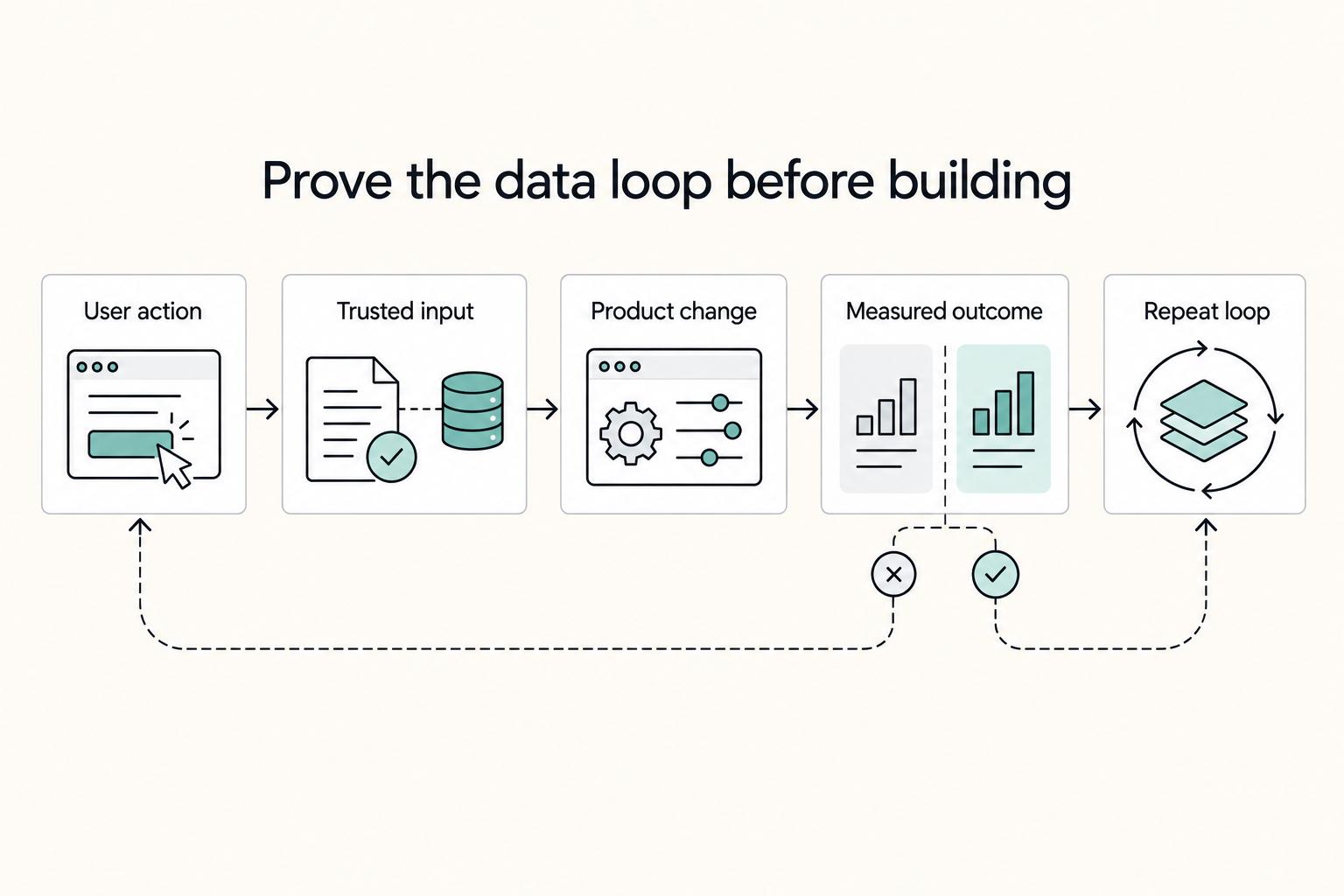
Build data network effects by shipping a repeatable loop: capture a signal, verify it, turn it into a product change, and confirm that later users benefit. In practice, moat claims are only valid when learning transfers across cohorts, not when dashboards improve. Start with one narrow decision, run an end-to-end trace test, and review each release with the continue-iterate-stop table so you scale evidence, not noise.
Start Here and Define the Win#
If you run an independent SaaS business, the goal is not to sound fluent in network theory. It is to build an advantage that gets harder to copy as you serve more customers. The practical question is simple: does growth make the product more valuable for users, or does it just make your charts busier?
Step 1. Anchor on the business goal. Write one plain sentence: "When more users do X, the product gets better for other users by Y." If you cannot finish that sentence without falling back on vague terms like "insights" or "visibility," do not claim much yet.
Step 2. Use a strict working definition. For this guide, a network effect only counts when growth in users creates more user value, not just better internal reporting. More usage alone is not enough. More stored events are not enough. If one group's activity never improves outcomes for users on the same side of the network or another side of the network, you may have analytics value, but not a clear network effect.
Use this checkpoint: name the specific product change that should improve as more users participate, then name who benefits. If the beneficiary is only your ops team, finance team, or a monthly board deck, stop and tighten the claim.
Step 3. Reject expensive data exhaust early. A common mistake is treating any pile of user data as a moat. It may not be. Data exhaust becomes a distraction when you collect broadly, report heavily, and still cannot point to a shipped product improvement another user can feel.
The red flag is simple: if the next proposed data project ends in a dashboard instead of a product change, treat it as suspect. You do not need to capture everything on day one. You need a narrow loop where more users create more value for other users.
Step 4. Commit to an execution test. The point of this guide is practical. By the end, you should be able to tell whether you have a real shared-value loop, build one deliberately if you do not, and avoid overinvesting before the evidence is there. We will stay close to checkpoints, tradeoffs, and a copy/paste checklist rather than abstract moat talk.
Before you move on, create a one-page note with three items:
- Your product outcome that should improve as usage grows
- The user group that creates the signal and the user group that receives the benefit
- One verification method you can check after release, such as better result quality, faster time to value, or improved retention-linked behavior
If you cannot fill in all three, that is already useful. It means the next job is not scale. It is definition. For related context, see The Best Analytics Platforms for SaaS Businesses.
Confirm You Are Solving the Right Problem First#
If growth is not improving outcomes for other users through product learning, you are not dealing with data network effects yet.
Name the mechanism honestly#
Separate direct peer influence from shared product learning. Peer behavior, community pull, or brand momentum can drive usage, but that is different from the product getting better through data.
Use one check: can you point to a shipped product improvement that got better because user-generated signals were learned and reused?
Run a hard transfer test#
Use a strict rule: learning from one cohort should improve the experience for another cohort. If the output stays inside internal reporting, you do not have a cross-user effect.
Keep the evidence pack small:
- the cohort creating the signal
- the cohort receiving the improved outcome
- one before/after check tied to user experience, not dashboard activity
If the result is only better ops visibility or cleaner charts, pause moat language.
Be strict with moat language#
If your edge today is distribution, brand, partnerships, or switching costs, call it that. Treat defensible-moat language as premature until shared learning is clearly improving user value across cohorts.
You might also find this useful: Network Effects for Community-Based Products as a Professional Moat.
Prepare the Inputs Before You Build#
Do not start with a model. Start by confirming your data is trustworthy and that one user action can lead to one measurable product improvement. Without that setup, you usually get more capture and reporting, but not better outcomes.
| Step | What to set up | Readiness check |
|---|---|---|
| Define the minimum evidence pack | Events you capture, data verification rules, and one baseline outcome | There is a clear chain from user action to product learning |
| Choose the smallest stack that can ship improvement | Start with rules, heuristics, or lightweight scoring | Use machine learning only when it clearly helps turn noisy signals into better product outcomes |
| Assign ownership before launch | Document who reviews output quality, approves product changes, and tracks customer perception | Ownership is clear before results are questioned |
| Run one pre-launch trace test | Trace capture, verification, product decision change, and the user-facing metric | If you cannot follow the path clearly, do not scale the loop |
Step 1. Define the minimum evidence pack. Keep it small and inspectable. Include the events you capture, the rules you use for data verification, and a baseline for the current product outcome. The goal is a clear chain from user action to product learning, not maximum data volume.
A practical pack should cover:
- an event list with clear names, trigger conditions, and the user action each event represents
- data verification rules (for example: required fields, valid values, duplicate checks, timestamp checks)
- one baseline outcome for the current experience before you ship changes
If you want data-driven decisions, identify and report data quality instead of assuming it.
Step 2. Choose the smallest stack that can ship improvement. If rules, heuristics, or lightweight scoring can improve decisions, start there. Use machine learning when it clearly helps turn noisy signals into better product outcomes. Do not force a deep learning team into day-one work when labels, event quality, or baselines are still weak.
Step 3. Assign ownership before launch. Document who reviews output quality, who approves product changes, and who tracks customer perception after release. If ownership is unclear, the loop breaks as soon as results are questioned.
Step 4. Run one pre-launch trace test. Before scaling, trace one user action end to end: capture, verification, product decision change, and user-facing metric. If you cannot follow that path clearly, you are not ready to scale the loop.
This pairs well with our guide on How to create a PCI-compliant workflow for handling credit card data.
Build the Data Loop That Creates Shared Learning#
Shared learning happens when production use directly drives better product decisions for other users, not just better reporting. Keep the loop in order: capture, verify, analyze, ship, then confirm cross-user impact.
Step 1. Instrument data capture around the decision you want to improve. Start from one product decision (for example, ranking, matching, recommendations, or fraud review), then capture only the fields that can change that decision. If a captured signal cannot be tied back to a shipped decision, it is likely data exhaust.
Step 2. Verify data before analysis. Treat verification as the gate, not cleanup. Apply required fields, duplicate checks, valid values, and timestamp checks before analysis so broken records do not become false learning.
Step 3. Analyze signals for transferability across users. Prioritize signals that can support a repeatable product change for users beyond the original cohort. If a signal cannot drive a repeatable change within one release cycle, deprioritize it.
| Signal class | What it can contribute to shared learning | Common failure mode |
|---|---|---|
| Behavior signals | Early directional patterns from real usage | High volume with weak decision relevance |
| Outcome signals | Clear evidence of success, failure, or recovery | Delayed learning if outcomes are captured late or inconsistently |
| Feedback signals | Direct context on user experience | Sparse or inconsistent input that is hard to operationalize |
Step 4. Ship a product update you can explain in plain language. Use the selected signal in a concrete change, then state what decision changed and what user-facing outcome should move. Keep training and deployment conditions aligned as closely as possible, because distribution mismatch weakens real-world performance. Synthetic or simulated interactions can help, but they only approximate real interactions.
Step 5. Monitor cross-user impact to confirm shared learning. Check whether later users who did not generate the original signal still benefit from the update. Use success, failure, and recovery outcomes as core training signals, and cut scope if those outcomes do not improve across cohorts.
For a step-by-step walkthrough, see How to Create a 'Data Room' for a Due Diligence Process.
Turn Insights Into Product Changes Without Overbuilding#
Ship the smallest change that improves user outcomes for the next cohort; if the work only improves dashboards, it is not building defensibility.
Step 1. Pick one narrow, high-value decision in your SaaS business. Skip platform-wide automation at this stage. Choose one decision where better data can change what users receive, such as ranking, matching, routing, or recommendation order. Confirm scope by naming the decision, the signal behind it, and the user-facing result you expect to improve within one release cycle.
Keep a short release record: decision changed, signal used, rule or model logic, expected user outcome, and review date. This makes it easier to see whether learning is compounding or just adding activity.
Step 2. Start with rules when signal is still thin. Use explicit rules first: thresholds, tie-breakers, exclusions, or ranking weights you can inspect and debug quickly. Add machine learning when rules stop handling the interaction complexity and the cost of manual tuning rises.
Do not go model-first to mask weak labels, missing outcomes, or inconsistent event capture. More tooling does not fix weak signal quality.
Step 3. Judge releases by user results, not internal activity. Improvements in matching, ranking, or recommendations should show up in user outcomes, not only in internal metrics. Being essential to a workflow is not the same as being hard to replace, so treat "daily use" and "defensibility" as separate tests.
Tie each release to one external outcome and one cross-user check. If users who did not generate the source signal do not benefit, pause moat claims. For more on that standard, see What is a 'Defensible Moat' for a SaaS Business?.
Step 4. Use famous patterns as design hints, not targets. Google Search can be a useful illustration of shared learning, but your market size, data volume, and feedback speed may be very different. Calibrate to your operating reality.
Richer, more granular data helps only when your organization can act on it, not just collect it. If you cannot review output quality, approve changes, and monitor cross-cohort impact, more automation will mostly create more data exhaust. We covered related implementation pitfalls in How to Automate Client Reporting with Google Data Studio and Supermetrics.
Prove the Moat Is Forming With Decision Checkpoints#
A moat is forming only if each release improves decisions in ways that compound across users and hold up under review. If you cannot show that, you have activity, not defensibility.
Treat every release as a continuation decision. AI can help extract signal from noise, but human judgment still has to approve what ships and what scales.
Track three checkpoints for every shipped change#
Use one review sheet so you can compare trends across releases, not isolated wins.
- Product improvement rate: Are shipped decision changes improving the user-facing outcome you targeted?
- Cross-user lift: Does learning from one cohort improve results for other cohorts, or only for the users who generated the data?
- Retention-linked value perception: Do customer signals indicate the product is becoming more useful in ways tied to staying, expanding, or upgrading?
Use a decision table after each review cycle#
| Decision | Signal quality | Observed lift | Diminishing returns signs | What to do next |
|---|---|---|---|---|
| Continue | Inputs are stable enough to trust, and outputs pass spot checks | Clear user-facing improvement beyond the source cohort | No clear flattening | Expand carefully into adjacent use cases |
| Iterate | Signals are noisy, delayed, or incomplete, but direction is promising | Lift appears in only one segment or one outcome | Gains are shrinking or need heavy manual tuning | Fix instrumentation, labels, or scope before adding more data or ML |
| Stop | Signals are unreliable, hard to review, or easy to game | No durable lift, or lift stays trapped with contributors | More data volume without broader benefit | Reclassify as data exhaust and redesign the loop |
Before marking "continue," run a fixed manual sample against the prior version. If the team cannot explain why outputs are better, do not scale yet.
Test the moat against replication risk#
Ask directly: if a new entrant had similar tools and capable engineers, could they catch up quickly? If yes, your edge is likely elsewhere, and the loop is not compounding enough yet.
Set a hard stop condition: if data volume keeps growing but cross-user benefit stalls, classify it as data exhaust and rework the scope.
If you want a deeper dive, read Digital Nomad Health Insurance: A Comparison of Top Providers.
Handle Tradeoffs and Constraints Early#
Treat tradeoffs as part of the operating math from the start, because early gains can hide later constraints.
| Constraint | Bounded guidance | Article example |
|---|---|---|
| Diminishing returns | Raise the evidence bar over time and require clear user-facing lift before adding more collection, labeling, or model complexity | If cross-user lift flattens, narrow scope, retire low-signal inputs, and improve signal quality |
| Limited public evidence | Do not invent precise thresholds for your market when public evidence does not provide them | Treat the 01 September 2025 paper on 7063 iOS gaming apps as one research setting, not a universal cutoff |
| Data sharing governance | Document what is shared, who can inspect raw records, and how you would explain it to a skeptical customer | Account for trust, access-control, contract, and customer-perception burden |
Assume diminishing returns will show up#
Raise your evidence bar over time. Early data often fixes obvious gaps, while later increments may produce smaller gains, so require clear user-facing lift before adding more collection, labeling, or model complexity.
Add one line to your monthly review sheet: what lift came from the latest data increment, and did it transfer beyond the source cohort? If cross-user lift flattens, narrow scope, retire low-signal inputs, and improve signal quality instead of feeding raw volume.
Keep your claims bounded when public evidence is limited#
Do not invent precise thresholds for your market when the public evidence does not provide them. A paper published on 01 September 2025 uses a dataset of 7063 iOS gaming apps; treat that as one research setting, not a universal cutoff.
Use the same caution with older academic material: if you rely on an Author's Accepted Manuscript, verify the published version before repeating precise claims.
Treat data sharing as a choice with governance cost#
Data sharing can support learning, but it also adds trust, access-control, contract, and customer-perception burden. Before sharing across accounts, partners, or product surfaces, document what is shared, who can inspect raw records, and how you would explain it to a skeptical customer.
Use outside commentary as hypothesis input, not proof. Forward-looking editorial posts and podcasts can sharpen your questions, but they do not replace your own validation of durable advantage.
Need the full breakdown? Read How to Handle a Data Breach in Your Freelance Business.
Avoid Common Failure Modes and Recover Fast#
Most failures here are scope and proof failures, not data-volume failures, so recovery starts by narrowing what you collect and what decision it must change.
| Failure area | What to check | Recovery move |
|---|---|---|
| Scope | Does the data flow map to a specific product decision and one user-visible outcome? | Pause flows that do not map and keep a short inventory with data source, owner, decision served, verification method, and keep-or-kill status |
| Proof | Does learning from one cohort improve outcomes for another cohort, not just internal visibility? | Keep moat language strict and pause data network effects claims when the benefit does not transfer |
| Execution | Did you start with the decision, constraint, and failure cost before adding machine learning? | Reverse model-first execution and add machine learning only where the outcome justifies extra monitoring and data verification |
| Trust | Are technical quality, adoption, and customer concern moving in the same direction? | Treat rising concern or weakening adoption as product risk and adjust the loop before scaling |
Step 1: Cut to one decision loop and one user-visible outcome. If a data flow does not map to a specific product decision, pause it. Keep a short inventory: data source, owner, decision served, verification method, and keep-or-kill status.
Step 2: Keep moat language strict. Treat analytics lift as useful, not automatically defensible. Use data network effects language only when learning from one cohort improves outcomes for another cohort, not just internal visibility. If you need a sharper definition of moat language, see What is a 'Defensible Moat' for a SaaS Business?.
Step 3: Reverse model-first execution. Start with the decision, constraint, and failure cost, then add machine learning only where it changes the outcome enough to justify extra monitoring and data verification.
Step 4: Track trust signals with quality and usage. If technical quality rises but adoption weakens or customer concern rises, treat that as product risk and adjust the loop before scaling.
Step 5: Run a time-boxed triage with explicit checkpoints. Use start, midpoint, and relaunch reviews to remove low-signal flows, tighten verification on the signals you keep, and relaunch only when each flow has a clear decision owner.
A practical caution: the accessible evidence here is mostly technical failure-recovery material, not direct business proof for shared-learning moats or customer-trust outcomes. One lesson still transfers: classify failures before fixing them. In the network-recovery literature, failures are grouped into three types; in this workflow, keep your categories explicit (for example, scope, proof, execution, and trust) and fix one category at a time. For related reading, see How to Network Effectively as a Remote Freelancer.
Wrap Up With a Copy Paste Execution Checklist#
Use this as an execution template to test your own claim, not as proof on its own.
- Define the claim in one sentence.
Write: "When users do X, the product gets better at Y for other users." Keep it tied to one user-facing outcome. If the later-user benefit is not clear, narrow the claim before you test it.
- Set ownership before collecting more.
Assign clear owners for data capture, data verification, and data analysis, plus one owner for the product decision. Put owners and the target metric in one short working note so accountability is visible.
- Ship one loop end to end.
Instrument, analyze, release one change, and then measure cross-user lift. Keep a brief evidence pack for that release: source signal, verification check, release date, product change, and expected metric movement.
- Run a regular moat checkpoint.
On your chosen cadence (for example, monthly), check transferability across users, retention impact, and early diminishing-returns signals. Treat this as an operating check, not a universal rule.
- Cut noise that does not improve the product.
Archive data-exhaust pipelines that are not producing user-facing gains after a fair test window. More inputs can add overhead without improving outcomes.
- Choose the next move explicitly.
If a loop shows repeatable cross-user lift, scale that loop before adding new models or sources. If lift is weak, pause and redesign the signal, verification rules, or product change instead of masking it with more machine learning.
Frequently Asked Questions
What is a data network effect in plain English?
It means usage creates information that helps the product work better for other users later. The key is shared improvement, not just more records in a database. If one customer’s activity teaches your product something that improves matching, ranking, recommendations, or another product outcome for the next customer, you may have the effect people mean by data network effects.
How is it different from a regular network effect?
A regular network effect is about participant count. The core idea is that a product or platform becomes more valuable as more buyers, sellers, or users participate. The data version is narrower. More users only matter if their usage teaches the product something that improves outcomes, not merely because the network is larger.
Why does more data fail to create a competitive advantage in many SaaS businesses?
Because collection alone does not guarantee product value. Better reporting, segmentation, or internal visibility can help operations, but those gains do not automatically transfer to better customer outcomes. One failure mode is data exhaust: you gather more events, labels, and logs, yet no shipped change improves the experience for another user.
What conditions must be true before data becomes a defensible moat?
Before you make a moat claim, you need a repeatable loop: capture a signal, verify it, turn it into a product change, and see that change help later users. You also need evidence that the learning compounds rather than resets every time a new customer arrives. The strongest public framing available here presents this as a multi-part framework, not as automatic value from data alone, and it explicitly includes both diminishing value from more data and customer perception.
How can I tell whether learning from one user is improving outcomes for other users?
Look for evidence that learning from one set of users improves outcomes for others after product updates. Use comparisons over time or controlled tests where feasible, and verify that the change appears in user-facing metrics, not only internal dashboards. Public explanations do not provide one precise, standard method for cross-user lift, so treat this as an evidence-building process rather than a fixed formula.
When should I expect diminishing returns from additional data?
You should expect them at some point, but public explanations do not give a universal threshold or timeline. One common framing explicitly lists diminishing value from additional data as part of the model. In practice, treat flattening gains as a warning sign: if volume grows while cross-user lift stalls, tighten scope before you keep collecting more.
What important details are still unknown from current public explanations?
The big gaps are operational, not conceptual. Public material does not give a numeric data threshold, a standard timeline for when returns flatten, or a precise method for proving cross-user lift across products and markets. That is why you should treat outside explanations as a filter for your own claims, then keep your moat language bounded until your own evidence is strong enough to defend.
Try a related tool
Researched and edited by the Gruv editorial team. Gruv builds cross-border billing, payouts, and finance-operations software for global businesses.
Sources
- en.wikipedia.org/wiki/Network_effecttrusted
- nces.ed.gov/fcsm/pdf/FCSM.20.04_A_Framework_for_Data_Qua...trusted
- online.hbs.edu/blog/post/network-effects-businesstrusted
- online.hbs.edu/blog/post/what-are-network-effectstrusted
- pmc.ncbi.nlm.nih.gov/articles/PMC11639101trusted
- pmc.ncbi.nlm.nih.gov/articles/PMC12071628trusted
- web.stanford.edu/~pista/MS23898manuscript.pdftrusted
- wrap.warwick.ac.uk/id/eprint/134220/1/WRAP-role-artificial-inte...trusted
Educational content only. Not legal, tax, or financial advice.
Related Posts

Digital Nomad Health Insurance Comparison for Long-Stay Moves
Use focused time now to avoid expensive mistakes later. Start with a practical `digital nomad health insurance comparison`, then map your route in [Gruv's visa planner](/tools/visa-for-digital-nomads) so we anchor policy checks to your real plan before pricing pages pull you off course.
What Is a Defensible Moat for a SaaS Business?
If you want a defensible moat for SaaS, start by treating your solo practice like an asset, not a job. That shift changes what you sell, how you deliver it, how clients experience the work, and where risk shows up.
The Best Analytics Platforms for SaaS Businesses
**Pick a SaaS analytics stack by role fit and decision ownership, not by the longest feature list.** Ad hoc dashboards drift when traffic, product, and subscription reporting split across tools, and decisions slow down.