
Quick Answer
Freelancers can deduct the business-use portion of vehicle costs by using either the standard mileage rate or the actual expense method, but they must choose one method and keep records that support it. Sole proprietors generally report deductible car expenses on Schedule C, separate business from personal driving, and watch for extra lease and method-switching rules.
Choose one IRS method, document your driving, and escalate early#
Handle your vehicle deduction like an operator. Choose one IRS method, document business driving as you go, and escalate before ambiguity turns into risk.
If you work across locations, car write-offs get messy fast. Personal and business driving blend together, rules vary by jurisdiction, and fear of getting it wrong can stall decisions. You do not need perfect tax theory. You need a repeatable system.
This playbook follows a simple sequence. Pick the right method, build records you can defend, then identify the point where a CPA or tax attorney should take over. That order keeps you moving while limiting risk.
What this framework covers#
This playbook is U.S. focused and anchored to IRS guidance, especially Tax Topic 510 and Publication 463. Use that baseline for business-driving and method decisions, then flag where rules vary by jurisdiction so your final answer may differ.
If your location changes often, pair this framework with Do I Have to Pay State Taxes While Living Abroad as a Digital Nomad? before filing.
| Decision point | Safe default | Reason |
|---|---|---|
| Method choice | Pick one method you can support with records | Defensible records beat a larger but fragile deduction |
| Mixed use driving | Track business use in real time | Clean allocation reduces rework and errors |
| Lease complexity | Escalate early if lease rules constrain method changes | IRS lease rules can lock choices for the lease period |
Adopt the operator mindset#
Picture one car handling both client visits and personal errands. You can still claim business use, but only if you separate business from personal use and support the method you chose.
Leases add extra constraints. IRS guidance states that you cannot deduct both lease costs and the standard mileage rate. If you choose standard mileage for a leased car, that method must continue for the full lease period, including renewals.
Use these operating rules:
- Choose defensibility over maximum deduction when records feel thin.
- Keep documentation simple enough to maintain every week.
- Treat uncertainty as a trigger, not a debate, and escalate early.
- Build a low-stress system you can repeat each tax year.
Build the mental model before you pick a deduction method#
Define business use first, then choose the IRS method you can support with clean records.
Here is the fast decision model you can actually run. The goal is not to debate deductions. It is to pick a method you can execute and defend.
Start with clear definitions#
The Standard mileage rate method uses a per-mile approach for business driving. For 2025, IRS guidance sets that business rate at 70 cents ($0.70) per mile. The Actual expense method uses cost allocation, so you split vehicle costs between business and personal use.
Before you calculate anything, use this quick comparison:
| Method | How it works | What you must control |
|---|---|---|
| Standard mileage rate method | Multiply business miles by the IRS rate | Accurate business mile tracking |
| Actual expense method | Track real costs and allocate business share | Consistent business-use allocation across costs |
Topic no. 510 is your anchor summary. Publication 463 is your operating reference for deductible categories, reporting, and records.
When a vehicle is used for both business and personal purposes, treat those uses separately. With mixed use, you can deduct only the business-use portion.
Use a one screen operator model#
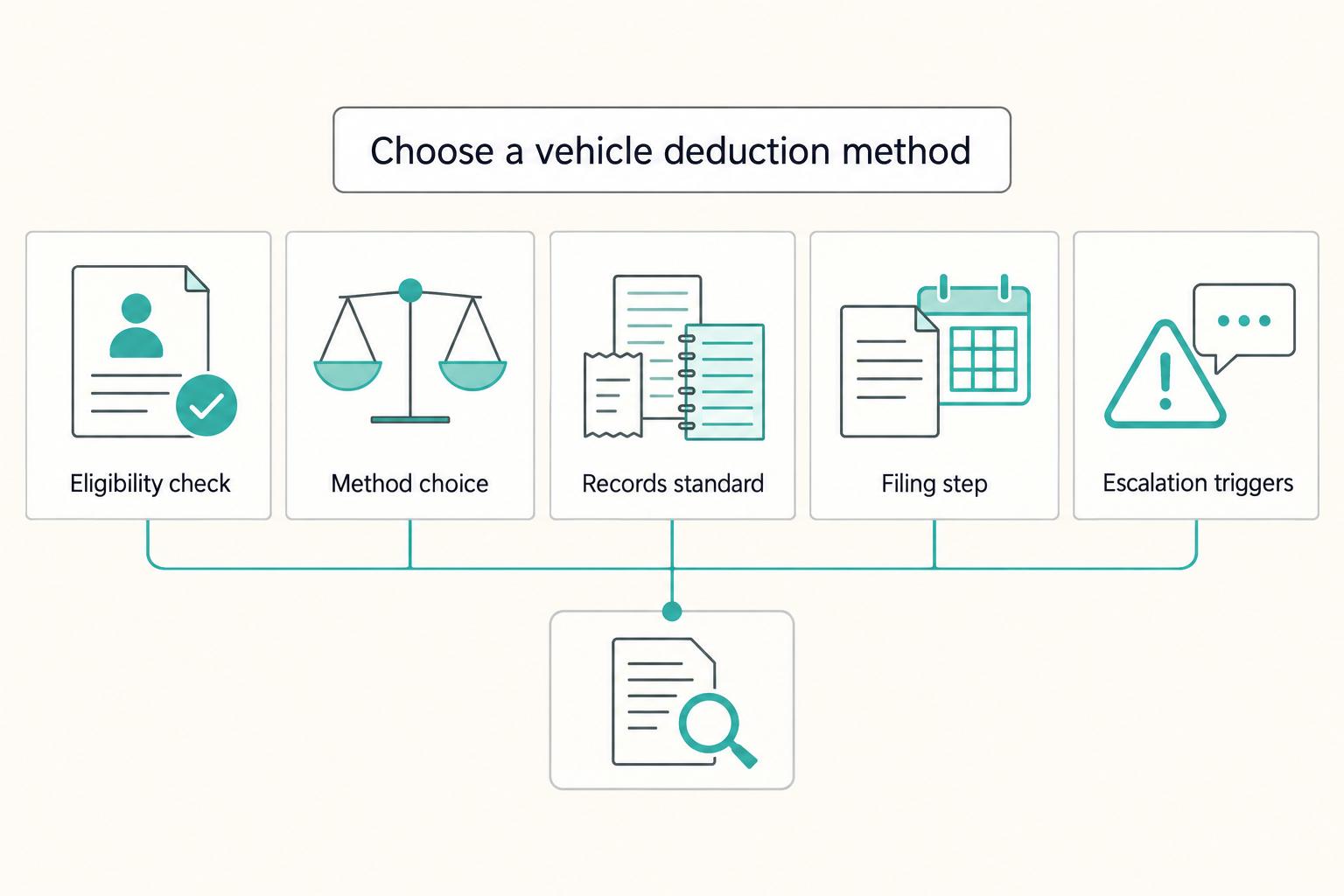
Use this one-screen checklist to stay organized:
| Checklist item | What to do |
|---|---|
| Eligibility check | Confirm you operate as self-employed for this expense decision. |
| Method choice | When eligible, run both methods once and compare outcomes before you choose. |
| Records standard | Set one documentation routine that matches your chosen method and stick to it. |
| Filing step | Route deductible car expenses through your Schedule C (Form 1040) workflow. |
| Escalation triggers | Escalate when classification, allocation, or method constraints stay unclear after one review pass. |
This is the practical goal: one method, one record system, one process you can repeat.
Do you even qualify for a vehicle expense deduction as a freelancer?#
Qualification starts with who reports the expense, and which return it belongs on.
Before you choose Standard mileage rate method or Actual expense method, confirm the return context. This prevents an expensive mistake: taking a legitimate business-driving concept and putting it on the wrong return.
Use the right filing lane first#
Schedule C (Form 1040) is the core lane for a sole proprietor who reports business income or loss. IRS guidance also places sole-proprietor automobile business-use claims in that Schedule C context. If you truly operate as a solo business, you can keep moving through this playbook.
Form 1065 and Form 1120 signal different structures. A partnership files an information return and passes profit or loss to partners. A domestic corporation files Form 1120 to report income, deductions, and tax liability. Those are different lanes, not the default sole-proprietor Schedule C lane.
| Your status | Primary return context | Practical next move |
|---|---|---|
| Sole proprietor freelancer | Schedule C (Form 1040) | Continue this framework and choose your deduction method |
| Partnership activity | Form 1065 | Confirm partnership treatment before applying sole-proprietor car rules |
| Corporation activity | Form 1120 | Follow corporate reporting workflow, not automatic Schedule C assumptions |
| Employee with unreimbursed driving costs | Limited exception categories apply | Confirm current eligibility before claiming any federal deduction |
TCJA context matters here. IRS materials state that the suspension of miscellaneous itemized deductions, including unreimbursed job expenses, runs through tax year 2025 unless lawmakers extend, amend, or repeal that rule. So do not assume employee treatment matches freelancer treatment.
If you run mixed work, keep the lanes separate. If you freelance under your own name and also share a small partnership project with a peer, track each activity under its correct filing context. Do that before you try to optimize the deduction.
When status feels fuzzy, use this safe default:
- Pause method selection.
- Confirm entity classification and filing path.
- Then choose
Standard mileage rate methodorActual expense method.
If you need a companion for mixed income setups, review How to Handle Taxes for a Side Hustle.
Should you use standard mileage or actual expenses this year?#
Pick the method you can prove with consistent records.
Once your filing lane is correct, this choice is mostly operational. The usual problem is not math. It is choosing a method your recordkeeping can sustain.
Compare the two methods like an operator#
IRS guidance gives you two options for business driving: the Standard mileage rate method and the Actual expense method. For 2025, the standard rate is 70 cents per mile for business use. If you are eligible for both, run both once before you choose.
| Decision signal | Standard mileage rate method | Actual expense method |
|---|---|---|
| Admin time | Often lower. Track business miles consistently. | Often higher. Track and allocate multiple vehicle costs. |
| Documentation quality | Works well when trip logs are strong and complete. | Works well when receipts and allocation records are complete. |
| Vehicle profile | Often simpler for steady, repeatable business driving. | Can fit cases where real operating costs justify added admin. |
| Planning style | Predictable mileage deduction workflow. | Detailed cost control workflow with more moving parts. |
Check lock in rules before you commit#
Topic no. 510 also adds method constraints.
For an owned car, you must elect standard mileage in the first year the car is available for business use if you want that path. You also cannot use Section 179 deduction or Modified Accelerated Cost Recovery System (MACRS) on that same car and still use standard mileage. For the same vehicle and year, you cannot claim both methods.
Depreciation choices also shape future flexibility. In specific switch situations, IRS rules require Straight-line depreciation over the car's remaining useful life.
If you bought a car, used it for mixed business driving, and now want to change methods, confirm your prior-year treatment before you optimize. If the depreciation history is unclear, stop and clean that up first.
Safe default when uncertain:
- Pick the method your records already support today.
- Avoid changes that depend on unclear depreciation history.
- Escalate to a CPA before filing if
Section 179 deduction,MACRS, or switching rules might apply.
What changes if your car is leased or your situation changes midstream?#
Leases can lock your method choice for the lease period, including renewals.
If you are eligible to choose between Standard mileage rate method and Actual expense method, pressure-test that choice against lease rules and operational changes during the year.
Follow the lease and switching guardrails#
Use this sequence before you change anything:
- Confirm whether the car is leased or owned.
- If leased, apply the
Lease period (including renewals) rulebefore you run new mileage deduction math. - If you choose standard mileage for a leased car, keep that method for the full lease period, including renewals.
- If you use actual expenses for a mixed-use leased car, deduct only the business-use share of lease payments.
- If you previously claimed actual expenses after 1997 for that leased car, do not move to standard mileage.
| Situation | Guardrail action | Why it matters |
|---|---|---|
| Leased car with standard mileage | Keep standard mileage through lease and renewals | IRS method lock-in applies |
| Owned car with standard mileage in first business year | You may switch later to actual expenses | Later switch requires straight-line depreciation for remaining useful life |
Car with Section 179 deduction or MACRS history | Do not use standard mileage for that car | Those choices block standard mileage eligibility |
| Five or more cars operated at the same time | Do not use standard mileage | IRS treats this as fleet context |
If you lease one car for client travel and then add another vehicle as work expands, pause and re-run your method and reporting workflow before you file.
Catch red flags before you file Schedule C#
Red flags
- Lease renewals plus a planned method switch on a leased car.
- Prior depreciation records that mention
MACRSorSection 179 deduction. - Multiple vehicles with unclear per-vehicle records.
For self-employed filing, keep the reporting step clear: report deductible car expenses on Schedule C (Profit or Loss from Business). Complete Schedule C Part IV when required. If you use more than one vehicle, attach the additional per-vehicle statement.
Escalate before filing when any of these appear:
- You cannot confirm lease history or method history.
- You plan to switch methods with unclear depreciation treatment.
- You run lease-heavy operations across multiple vehicles.
- Your records cannot cleanly separate personal and business driving.
What records make your deduction audit ready instead of audit vulnerable?#
Your deduction is only as strong as the records behind it.
At this point, you should have a method and know the guardrails. Next comes the part that makes the whole system defensible: proof that ties your business driving to what you claim. IRS rules require adequate records, or enough supporting evidence to back your statement. Publication 463 is the operating guide for what to track. During an exam, you may also have to provide additional information before a deduction is allowed.
Keep the minimum defensible record set#
Use this checklist each month, not at year end:
| Record item | What to keep |
|---|---|
| Trip log | Date, Destination, Business purpose, Start, Stop, and Miles this trip. |
| Annual mileage summary | Business-use miles plus total miles for the year. |
| Method file | Note the method you used for that vehicle and keep your records aligned to it. |
| Expense support | Keep cost records with clear business-use allocation where applicable. |
| Filing support | Vehicle-use details ready for Schedule C (Profit or Loss from Business) reporting. |
| Retention rule | Keep deduction support records for at least 3 years from filing. |
If you use one car for client visits and personal errands in the same week, log each business trip the same day. Then do one monthly mixed-use reconciliation so your file stays clean.
Rank your evidence and remove weak links#
| Evidence level | What strong records look like | Common failure |
|---|---|---|
| Trip log consistency | Complete trip fields, captured close to travel date | Rebuilt logs from memory at year end |
| Receipt completeness | Costs match your claimed deduction and period | Missing backup for key costs |
| Method reconciliation | Totals reconcile to logged business use and claimed costs | Switching logic that does not match records |
A practical warning from tax controversy attorney Diana Pelham: "poor documentation is one of the fastest ways to lose an IRS audit." Treat that as an operating rule.
Avoid these moves that weaken your file:
- Do not recreate a full year of trips without supporting detail.
- Do not mix personal and business miles without clear allocation.
- Do not keep receipts without a matching business purpose trail.
- Do not wait until filing week to test whether your records reconcile.
Safe default: document continuously and reconcile monthly. If your records and method stop matching, escalate quickly.
How do globally mobile freelancers handle state and cross border uncertainty safely?#
Apply federal vehicle rules first, confirm state treatment second, and treat cross-border reporting as its own track.
Once your method and records are aligned, the next risk is category confusion. This is where people mix mileage rules with unrelated forms and end up missing a requirement or filing the wrong thing.
Start with the federal baseline. IRS rules require business-use allocation, so if you use one vehicle for personal and business driving, you deduct only the business portion. Apply that allocation logic first before any state or cross-border overlays.
Then check your state overlay. California shows why this matters. The FTB says California generally conforms to the Internal Revenue Code, but California also keeps differences from federal law and may not adopt every federal change. So do not assume your federal treatment carries over unchanged at the state level.
| Confirm order | What you verify | Safe result |
|---|---|---|
| 1 | Federal IRS vehicle rules and business-use allocation | Your core deduction logic stays valid |
| 2 | State conformity and nonconformity rules (example: California FTB) | Your state return follows local treatment |
| 3 | Cross-border reporting obligations | You avoid category confusion and missed filings |
Keep compliance categories separate:
- FBAR means FinCEN Form 114 reporting for foreign financial accounts. It is not a vehicle deduction method.
- Form 8938 is attached to your annual tax return.
- Form 8938 does not replace FBAR. Depending on facts, you may need one or both.
- FBAR uses a $10,000 aggregate foreign account threshold, with an April 15 due date and an automatic extension to October 15.
If you move residency during the year, hold foreign accounts, and still claim U.S. vehicle costs, run the checklist in order. Pause before filing if any step conflicts.
Use this escalation checkpoint: if residency movement, foreign accounts, and deduction claims overlap in the same filing year, book a CPA or tax attorney review before you submit. If you want a tighter state decision tree next, read Do I Have to Pay State Taxes While Living Abroad as a Digital Nomad?.
Run this checklist before you file and keep your system repeatable#
Run one final control pass to verify qualification, method consistency, records, and filing alignment before you submit. Then keep the same routine each year. That is how a business-of-one keeps the car deduction low-stress and defensible.
One page filing control sheet#
| Control point | Confirm this now | If this fails, do this |
|---|---|---|
| Qualification | You are filing as a sole proprietor on Schedule C (Profit or Loss from Business) | Stop and confirm entity filing path first (for example, partnerships generally file Form 1065) |
| Method consistency | You used one method logic that matches your records (Standard mileage rate method or Actual expense method) | Reconcile method choice before filing |
| Method lock rules | Owned car: if you want later flexibility, you elected standard mileage in the first business-use year. Leased car: if you chose standard mileage, keep it for the full lease period (including renewals) | Escalate before filing if your method history conflicts |
| Records standard | You kept timely written records, allocated mixed use to business driving only, and avoided estimates | Rebuild support from contemporaneous documents before submission |
| Filing details | If you claim car and truck expenses, complete required vehicle-use disclosures (including Schedule C Part IV when applicable) | Fix disclosure gaps now |
| Depreciation flag | If you claim depreciation, complete Form 4562 Part V | Add Form 4562 review to your filing pass |
Fifteen minute pre-filing checklist#
| Time | Pre-filing check |
|---|---|
| 3 minutes | Confirm your filing path and that your activity belongs on Schedule C for this business. |
| 3 minutes | Check rate year: use the correct standard mileage rate for the tax year you are filing (for 2025 business miles, the Schedule C instruction multiplier is 0.70). |
| 3 minutes | Test method consistency against your log and expense file. |
| 3 minutes | Review Part IV vehicle-use answers and any Form 4562 trigger. |
| 3 minutes | Review escalation triggers: missing records, conflicting method history, or unclear entity treatment. |
Imagine you operate one client-facing practice and one small side offer. You can still keep this simple if you run the same control sheet before every filing cycle.
If you need help separating side-income decisions from a mileage workflow, read How to Handle Taxes for a Side Hustle. Keep it traceable, keep records close to real time, and prioritize compliant decisions over aggressive guesses.
Frequently Asked Questions
Can a freelancer deduct car expenses if the vehicle is used for both personal and business trips?
Yes. You can deduct only the substantiated business-use portion of mixed personal and business driving. Log business trips close to real time so your allocation is based on records, not estimates.
Should I choose the `Standard mileage rate method` or the `Actual expense method`?
Choose the method you can substantiate cleanly. Standard mileage works best when your trip logs are reliable, while actual expense works when you can track vehicle costs and allocate business use. For 2025, the business rate is 70 cents per mile. Beginning Jan. 1, 2026, the IRS business rate is 72.5 cents per mile.
Can I switch deduction methods in later years without creating compliance issues?
Sometimes, but switching depends on your first-year election and prior treatment. For an owned vehicle, choosing standard mileage in the first year it is available for business use preserves later flexibility. If your first-year setup or depreciation history is unclear, confirm it before you switch.
How does leasing a vehicle change my deduction options?
Leasing adds method lock-in. If you choose standard mileage for a leased vehicle, you must keep that method for the full lease period, including renewals. If you use actual expenses for a mixed-use leased car, deduct only the business-use share of lease payments.
What documentation do I need if the `IRS` reviews my deduction?
Keep adequate records that prove the expense and the business-use portion. Maintain a trip log with date, destination, business purpose, start, stop, and miles for each trip, plus annual mileage totals and method-specific support. If you claim car and truck expenses, include the required vehicle-use information on Schedule C.
When should I stop DIY and talk to a CPA or tax attorney?
Stop DIY when your records do not reconcile, your method changed midstream, lease lock-in creates uncertainty, or state and local rules conflict with your federal plan. Get professional review before filing if you rebuilt records late or feel unsure about your filing position.
Which parts of vehicle deduction rules vary by state or cross-border situation?
Your federal baseline stays the same, because IRS method rules and substantiation standards control the core deduction logic. State treatment can differ, so confirm state conformity and nonconformity rules separately before you file. Cross-border obligations should be handled as a separate compliance track from your vehicle deduction method.
Try a related tool
Researched and edited by the Gruv editorial team. Gruv builds cross-border billing, payouts, and finance-operations software for global businesses.
Sources
Educational content only. Not legal, tax, or financial advice.
Related Posts

Do I Have to Pay State Taxes While Living Abroad as a Digital Nomad?
Living abroad does not end `state income tax` exposure by itself. The first decision is practical: choose a filing position your facts can support, then build records that support the same story all year.

How to Handle Taxes for a Side Hustle
If you want less stress at filing time, use sequence instead of shortcuts. When one year includes payroll income, contractor income, and time in more than one country, the order of operations matters. This guide gives you a defensible path so you can make each decision once, document it, and avoid rebuilding the return later.
The Freelancer's Year-End Tax Prep Checklist (US Expat Edition)
Your year-end target is filing readiness. By December 31, you want a complete file for your U.S. federal return, not a last-minute chase for documents. For a globally mobile freelancer, the hard part is usually proving what happened, choosing the likely FEIE or FTC lane, and spotting the facts that need professional review.