
Quick Answer
Confirm that the provider actually holds funds under escrow terms, then agree scope, milestone amounts, acceptance criteria and dispute handling. Start each milestone only after its funding is confirmed. Track release separately from withdrawal: review periods, holds and bank transfer time can delay cash reaching your account.
Fund the milestone before starting work#
A high-value project exposes you to payment risk well before the final invoice. Escrow can reduce that risk by holding the client’s funds before work starts and releasing them under agreed conditions. It works best when the scope, acceptance rules and dispute process are clear; a funded balance alone cannot prevent every disagreement.
Run a 10-minute first pass to choose the right escrow path, then reuse the same kickoff checklist for every new client. This is triage, not a blind commitment. If any step is unclear, pause, confirm details, and move only when the funds and rules line up.
Run an initial 10-minute first pass before kickoff#
| Decision area | What to verify now | Safe default if unclear |
|---|---|---|
| Client channel | If the project runs on Upwork, confirm it is a fixed-price contract and confirm the first milestone is funded before work starts. | Keep work inside the platform flow and do not start until funding status is clear. |
| Coverage and market fit | Confirm both parties and payout routes fall inside supported regions. Escrow.com supports international transactions but also lists restricted regions. | Pause kickoff and switch provider or route before contract signature. |
| Legal and program scope | Confirm which rulebook controls the deal. Escrow regulation and licensing vary by jurisdiction, and provider terms can differ by program. | Align contract terms and escrow terms before money moves. |
| Economics | Check escrow, funding, withdrawal and currency-conversion fees, plus the cost of delays or disputes. | Choose the route with clear release triggers and predictable operations. |
A client asking you to start immediately and "fund later" is exactly when to use the system. Run the first pass, identify the unfunded step, and hold kickoff until the escrow flow shows the right status.
Reusable kickoff checklist:
- Confirm contract type, milestone definitions, and named approver.
- Confirm region support, compliance gates, and payout path.
- Confirm release triggers, dispute path, and proof you will keep.
- Confirm fallback actions if timeline or scope changes.
- Map the escrow flow step by step so the process stays routine instead of reactive.
What Is an Escrow Service for Freelancers and How Does It Actually Work?#
An escrow service protects cashflow by placing client funds with a third party and releasing them only after agreed approval steps. The kickoff screen is only the first gate. You also need a clean execution model behind it, or "payment protection" is just a label.
An escrow provider holds funds under its transaction terms and releases them when the relevant conditions are met. Escrow.com’s inspection period is agreed by the parties; acceptance can end it early. Verify that the service supports your deliverable and milestone structure before opening the transaction. Invoice payment gateways are a different product: Refrens’ terms describe invoice payment technology and do not guarantee invoice payment.
A milestone transaction is a staged release model. You break work into checkpoints, then define clear acceptance criteria for each checkpoint in your agreement. That way, both sides can verify outcomes instead of debating vague satisfaction.
Track the five escrow states#
| State | Required action |
|---|---|
| Terms agreed | Lock scope, deliverables, milestone definitions, and approval rules. |
| Funds secured | Confirm funded status before work starts. |
| Work delivered | Submit exactly what the milestone defines. |
| Acceptance recorded | Record explicit acceptance or track the provider’s automatic-release deadline and any dispute. |
| Payout released | Reconcile release status with your project records. |
Skip a state and you invite payout risk. Track all five and you can apply the same controls across every project.
Choose platform-native or standalone escrow#
| Model | Best fit | How release works | Key control check |
|---|---|---|---|
| Platform-native escrow (Upwork fixed-price) | Projects contracted on Upwork | Client funds the first milestone, or full amount when no milestones exist; funds stay in client escrow until release | Confirm funded scope and use the correct submission flow; separate release from withdrawal availability. |
| Standalone escrow, such as Escrow.com | Off-platform client relationships and custom contracts | Provider holds funds and releases on agreed acceptance steps | Confirm your contract language matches the provider's release mechanics before kickoff. |
When a client wants delivery before setup, keep the control simple: do not start until state two is complete. That keeps your workflow consistent, even when the client tries to compress the timeline. If you need an invoice while you set this up, try the free invoice generator.
Should You Use Upwork Escrow or a Standalone Escrow Service?#
Use the platform’s fixed-price flow for projects contracted on Upwork. For independently acquired clients, evaluate a standalone escrow service that supports the project and countries involved. A custom contract still needs to fit the provider’s actual release and dispute terms.
Upwork handles fixed-price funding and submission inside its platform. A standalone service can support an independent relationship, but check who holds the money, what can trigger release and how a dispute is resolved. Moving an Upwork relationship off-platform may be subject to its non-circumvention terms.
Use this decision tree before kickoff#
| Situation | Recommended path | Key check |
|---|---|---|
| Client hired you on Upwork fixed-price | Stay platform-native | Confirm funded milestones before delivery. |
| Client hired you off-platform | Evaluate standalone escrow | Align release conditions with your SOW and NDA. |
| Approval language is fuzzy or the client is new | Tighten milestone gates | Require proof-of-work acceptance and do not start until the first milestone is funded. |
If approval language is fuzzy or the client is new, tighten milestone gates before kickoff instead of relying on goodwill later.
Compare control and risk before you choose#
| Control point | Upwork fixed-price escrow | Standalone escrow |
|---|---|---|
| Contract scope | Uses Upwork fixed-price escrow instructions for release mechanics | You map contract terms directly to provider release steps |
| Release triggers | Upwork releases funds on listed release conditions, including dispute outcomes | Release follows the provider’s transaction terms, which your contract must match |
| Evidence standard | Work submission and approval run through platform workflow | Keep delivery, acceptance and dispute evidence required by the provider |
| Dispute posture | Arbitration participation can affect outcomes, and court or arbitrator orders can trigger release | Define arbitration and jurisdiction terms clearly in your off-platform contract |
| Timing edge cases | Upwork includes platform-specific timing rules for certain project types and states | Timing rules depend on provider program terms and your contract language |
| Fee signal | Varies by program and project setup | Obtain a quote covering escrow, funding, withdrawal and currency-conversion fees |
The rule stays the same in both paths: make release triggers explicit, then refuse to ship work before the money is locked into the agreed flow.
Build a Risk and Cost Scorecard Before You Pick Any Provider#
Score your escrow options on total payout reliability, not just the advertised fee. Once the channel is clear, you still need a scoring model you can run quickly. This is how you turn "risk management" into a repeatable decision.
Headline fees matter, but they are only one line item. If you only compare percentage fees, you miss the costs that actually disrupt cashflow. Look at onboarding friction, payout delays, and exception handling when something goes sideways.
Build a practical scorecard you can run quickly#
| Factor | What to test | Scoring rule |
|---|---|---|
| Total protection cost | Provider fee, admin time, failed payout handling, and delay risk from real-world anecdotes | 1 to 5, where 5 means predictable payouts and low rework burden |
| Compliance friction | Identity or business information the provider requires for this transaction | 1 to 5, where 5 means clear requirements before payments and payouts are live |
| Cross-border execution | Support for both parties, the deliverable, funding currency and withdrawal route | 1 to 5, where 5 means smooth collections and clean records |
| Tax-document readiness | Which party handles any applicable withholding and information reporting; separate this from the escrow service | 1 to 5, where 5 means no year-end scramble |
One rule keeps this honest: do not approve a provider with a low compliance or payout-reliability score, even if the fee looks cheap.
Red flags that should pause kickoff#
| Red flag | What is missing or late |
|---|---|
| KYC and KYB requirements cannot be confirmed | Information required before accounts can fully accept payments and send payouts is still unclear. |
| Verification requirements arrive late | Required identity or business information is unclear before funding. |
| Unsupported deliverable or country | The provider has not confirmed that this transaction is eligible. |
| Tax responsibilities are unclear | The payer and freelancer have not assigned any applicable documentation or reporting responsibilities. |
If onboarding stalls after signature because ownership checks or invoice format issues show up late, that is not bad luck. A gate was missing from your scorecard.
Want to sharpen the cost side of this model? Review The Silent Profit Killer: How to Stop Margin Erosion in Your Freelance Business.
Which Contract Terms Protect You Before Money Moves?#
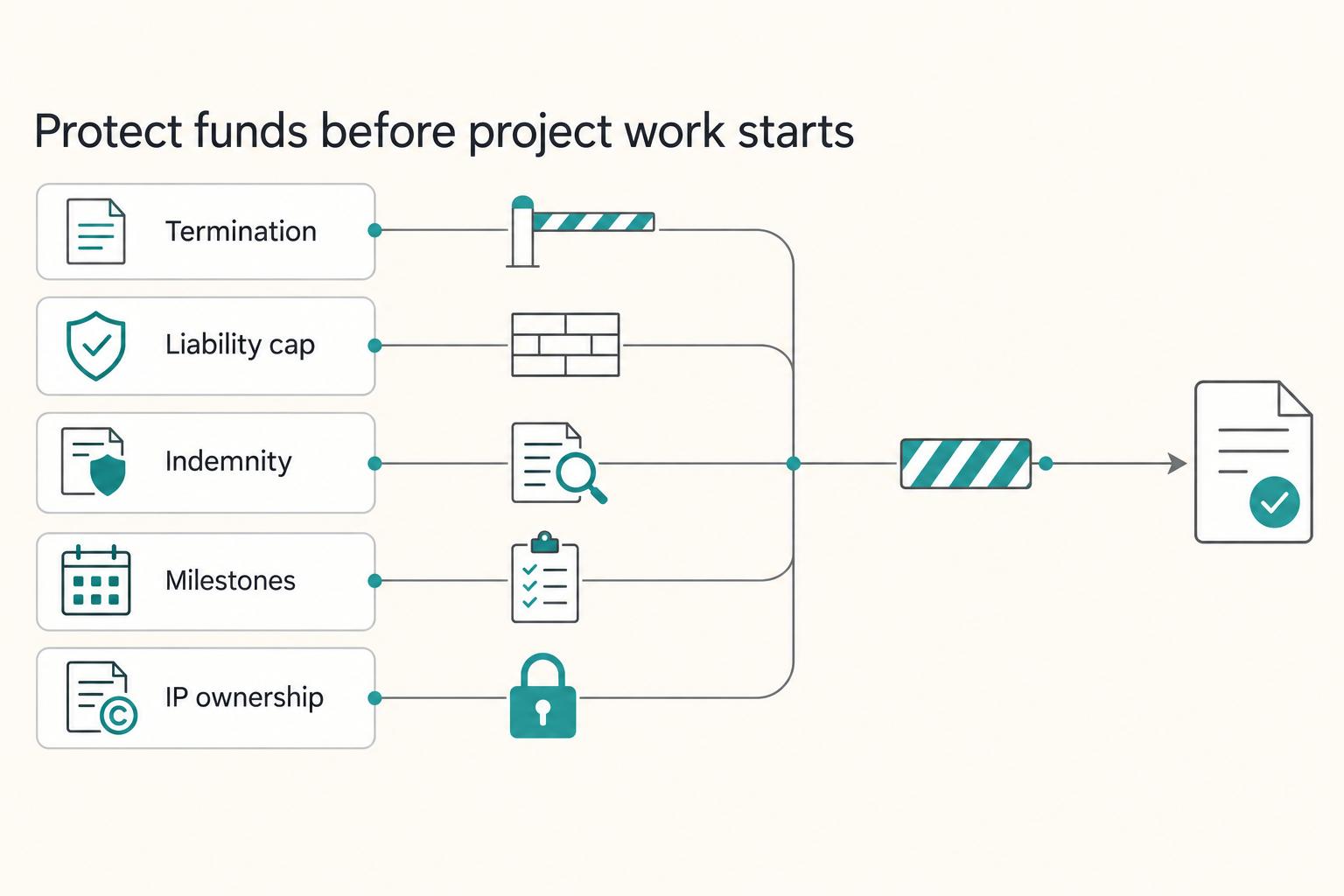
Finalize contract terms that match escrow release rules before kickoff so payment protection and dispute paths stay clear. You scored provider risk and cost. Now lock the terms that control payout, scope, and downside exposure. In escrow, these clauses are operating controls, not legal decoration.
Some platform flows require a client deposit before work begins, so your contract should mirror that sequence and your milestone logic. If your SOW says one thing and escrow release conditions say another, delays and conflict follow.
Lock the clauses that control money and ownership#
| Clause | Why it matters for risk management | Safe default to include |
|---|---|---|
| Termination | Sets when either party can end the deal and what happens to unfinished milestones | Define trigger events, notice steps, and payout treatment for in-progress work |
| Limitation of Liability | Caps exposure if claims arise and helps avoid open-ended downside | Set a clear cap structure and carve-outs you can defend |
| Indemnification | Allocates who covers specific losses when third-party claims appear | Tie indemnity to defined breach types and deliverable use |
| SOW + milestone acceptance | Converts vague approval into objective release criteria | List deliverables, evidence, reviewer, and acceptance event per milestone |
| IP ownership and assignment | Clarifies who owns output and when rights transfer | Define which rights transfer, when they transfer and what pre-existing materials remain yours |
Use confidentiality terms for protected information. If you process personal data on a client’s behalf and GDPR applies, assess whether an Article 28 processor agreement is required; the presence of personal data alone does not make every engagement a processor relationship.
For cross-border deals, state Governing Law, Jurisdiction, and Arbitration explicitly. Arbitration can produce binding outcomes, and that choice can affect whether parties pursue court litigation for the same claim. Choose the forum deliberately, then align your escrow process to it.
Use this do not start checklist#
- Escrow funding status is unclear or unfunded.
- SOW acceptance criteria do not match release conditions.
- Termination language does not define payout handling.
- A required data-processing agreement is missing.
- Governing Law, Jurisdiction, or Arbitration terms remain blank or contradictory.
Run Milestone Approvals as a Documented Release Sequence#
Run milestones through prefunding, delivery evidence, the provider’s acceptance or automatic-release process, and withdrawal reconciliation. Track the review deadline and any dispute so the release record reflects what actually happened.
A milestone transaction splits work into phases with defined deliverables and amounts. Fund the phase before work begins. Provider review periods and release rules vary: Upwork’s fixed-price flow allows up to 14 days for client review after submission, then a five-day security hold after approval or automatic release.
Define each milestone as an approvable unit#
| Milestone field in your SOW | What you set | Why it protects cashflow |
|---|---|---|
| Deliverable scope | Exact files, outputs, and success criteria | Reduces ambiguity and interpretation disputes |
| Proof artifacts | Work files, revision log, and acceptance note text | Gives objective evidence for approval decisions |
| Due date and reviewer | Specific date and named approver | Prevents handoff drift and missed signoff ownership |
| Approval event | Explicit acceptance or the provider-defined automatic-release event, with the review and dispute deadline | Aligns your contract with escrow release conditions |
| Payment amount | Fixed amount per milestone | Keeps risk management contained to one phase |
Execute release and fallback steps every time#
- Confirm the milestone is funded before you begin work.
- Deliver through the agreed channel with your full proof-of-work package.
- On Upwork fixed-price, use Submit Work for Payment so the review and protection flow triggers correctly.
- Track provider timing rules, including any review windows and security holds that affect when you can withdraw funds.
- If approval stalls or scope breaks, run the fallback path already defined in your contract. Use force majeure only for extraordinary events beyond the parties' control, as defined in your terms.
- After release, match the provider’s transaction record and actual withdrawal to the milestone, fees and net amount received.
A client asking for "one more revision" after submission is normal. Log it, update the proof package, and keep release tied to the same acceptance rule instead of renegotiating payment in chat. Keep one rule across every workflow: no funded milestone, no delivery.
How Do You Run Escrow Safely for International Clients?#
Run international escrow safely by clearing compliance gates, payout eligibility, and enforceability before signature, then execute every release with tax-ready records and exception controls. Cross-border work is not harder because clients are different. It is harder because the corridor, compliance steps, and payout path can break late if you do not clear them early.
Set the route before work starts#
Use this table before kickoff on high-value projects.
| Decision point | What to confirm early | Safe default for risk management |
|---|---|---|
| Provider coverage | Your country, the client country, and payout corridor support for this specific program | If support looks unclear, pause signature and select a supported path first |
| Compliance gates | KYC requirements tied to account profile and jurisdiction, plus AML controls | Complete onboarding before production work, then recheck requirements each contract cycle because providers update rules |
| Withdrawal route | The escrow provider’s supported withdrawal method, currency and beneficiary account | Record release and withdrawal separately; a virtual account or merchant-of-record service does not itself provide escrow |
| Timeline assumptions | Review windows, holds, and bank transfer timing for your payout method | Treat payout timing as a range, not a promise, because timing varies by country and bank |
Receiving accounts and merchant-of-record arrangements serve different purposes from escrow. Use them only where the provider supports the transaction; they do not replace an agreement that specifies who holds funds and when release is permitted.
Keep tax ops and exception handling in the same workflow#
Form W-8BEN captures foreign status for withholding and reporting context. Form W-9 provides taxpayer ID details that payers need for information reporting. In payer setups that trigger independent contractor reporting, 1099-NEC obligations can apply, while some marketplace structures shift direct payor reporting to the platform.
A provider may hold withdrawal until required tax information is supplied. Confirm which documents apply to your account before work begins, rather than assuming every escrow transaction requires the same tax profile.
Track each transaction status from funded to released, and flag holds or returns immediately. Build an audit-ready exception pack with milestone proof, acceptance records, tax form status, and payout records before you escalate any dispute. If you run marketplace projects, keep your process aligned with A Freelancer's Guide to Getting Paid on Upwork.
Confirm safely before contract signature
- Confirm provider coverage for both parties and payout eligibility in the intended corridor.
- Confirm which law, jurisdiction, and dispute forum govern enforceability for this deal.
- Confirm KYC, AML, and tax onboarding requirements that must clear before withdrawal.
- Confirm realistic timeline assumptions for review, holds, and final payout release.
If you want a deeper dive, read A Guide to Opening a Bank Account in Spain as a Foreigner.
Use the 10-Minute Framework Before Every New Client#
Run one short pre-kickoff sequence that locks route, cost, terms, and release evidence before you start work. You now have a system for provider choice, operating cost, dispute posture, and compliance gates. The advantage is consistency. You use the same gates on every engagement so you do not renegotiate basics under pressure.
Run the sequence before signature#
- Choose the route first: use the platform flow for Upwork fixed-price projects, or evaluate standalone escrow for independently acquired clients.
- Score true cost, not headline cost. Include escrow fees and your internal time for verification, approvals, and exceptions.
- Lock contract controls. Finalize SOW scope, acceptance criteria, release trigger, dispute forum, and termination terms before kickoff.
- Clear compliance gates early. Complete identity verification requirements and confirm AML controls before production starts. Tighten controls when project risk rises.
- Start only after funding. Require funded status before you deliver work.
Hypothetical scenario: a new client asks for an immediate start and promises to fund tomorrow. You run the checklist, spot an unfinished verification step, and delay kickoff. That one decision protects cashflow and helps prevent avoidable disputes.
Reuse one operating checklist for every deal#
For high-value projects, consistency beats improvisation. Track each item as pass or blocked, then escalate only when a gate fails:
- Route selected, with fallback route documented.
- Risk and cost score completed for this deal.
- Contract clauses and milestone approval language finalized.
- Applicable provider-required verification and onboarding gates cleared.
- Funds confirmed in the chosen escrow service.
- Evidence package plan ready for each milestone.
If any gate fails, pause the deal and reset to safe defaults. That's practical risk management. If you need to validate coverage, compliance gates, and operational fit in your workflow, do it before you sign the next client contract.
Frequently Asked Questions
What is an escrow service for freelancers, and what are the exact payment release steps?
Escrow uses a third party to hold funds under agreed release conditions. Agree terms, confirm funding, deliver and track the review or inspection window. Release can follow explicit acceptance, a provider-defined automatic-release event or a dispute outcome. On Upwork fixed-price, submit work against the funded milestone through the platform and track withdrawal separately.
Is Upwork escrow enough for high-value projects, or should I use a standalone provider?
Use Upwork escrow when the client relationship, contract, and delivery all stay inside Upwork and your milestone criteria stay precise. Use a standalone provider when the deal runs off-platform or when you need custom release terms tied to your own contract framework. For high-value projects, the deciding factor is whether your acceptance criteria and release mechanics are tight enough to prevent "we thought you meant..." disputes.
What fees should I evaluate beyond the advertised escrow percentage?
Compare escrow fees, funding costs, withdrawal charges and currency-conversion costs. Ask which fees apply if the deal is cancelled or disputed, who pays them and how much you receive after release. A low advertised gateway fee is not evidence of escrow protection.
How do milestone approvals reduce chargeback and non-payment risk?
Milestones turn vague approval into a documented release trigger with clear deliverables and set payment amounts. That structure can reduce ambiguity and strengthen payment protection because the work scope and approval trail are clearer. On Upwork fixed-price, funded milestones and defined dispute steps give you a clearer path when payment disagreements start.
What contract clauses should be finalized before a client deposits funds?
Finalize the SOW with objective acceptance criteria, exact deliverables, and explicit release events. Set payment timing and dispute terms before kickoff, then align those terms with your escrow workflow. Add ownership, NDA, and termination language, and get legal review where needed because clause requirements vary by jurisdiction.
What is the safest escrow workflow for international clients when compliance rules vary?
Confirm that the provider supports both parties, the service and the withdrawal route. Complete its required verification, agree the release and dispute terms, and assign any applicable tax documentation responsibilities. Keep funded status, delivery proof, acceptance and withdrawal records together.
How can I compare escrow providers without relying on marketing claims alone?
Use the same project, amount, countries and currencies for each comparison. Ask who legally holds funds, what triggers release, how inspection and disputes work, and what funding and withdrawal cost. Treat payment gateways separately unless their terms establish an escrow service.
Try a related tool
Researched and edited by the Gruv editorial team. Gruv builds cross-border billing, payouts, and finance-operations software for global businesses.
Sources
Includes 3 external sources outside the trusted-domain allowlist.
- commission.europa.eu/publications/standard-contractual-clauses-co...trusted
- irs.gov/businesses/small-businesses-self-employed/re...trusted
- irs.gov/forms-pubs/about-form-1099-nectrusted
- escrow.com/support/faqs/what-is-an-inspection-period%2C...external
- refrens.com/termsexternal
- support.upwork.com/hc/en-us/articles/211063718-How-payments-for...external
Educational content only. Not legal, tax, or financial advice.
Related Posts

Stop Freelance Profit Margin Erosion Before It Hits Cashflow
Revenue can hold steady while the business underneath it gets weaker. What comes in matters, but what you keep after the work is delivered is the clearer signal of health.

Opening a Bank Account in Spain as a Foreigner
You can open a Spanish account as a foreign resident or non-resident, but the available product depends on where you live, your documents and the account holder. Start by separating a personal account, an autónomo account in your own name and an incorporated company account. The account must support the client payments you intend to receive.

Getting Paid on Upwork Without Cashflow Surprises
Most payout surprises come from mixing three clocks: contract type, payout process steps, and withdrawal method. Keep them separate and your cashflow is much easier to predict.