

Quick Answer
Start with a program that accepts your entity, owner locations and activity, then verify the payment functions you need. Foreign ownership does not universally prevent a U.S. business-account application. Keep legal, operating and mailing addresses distinct, prepare accepted EIN and identity evidence, and confirm any unsupported-country or industry restrictions before applying.
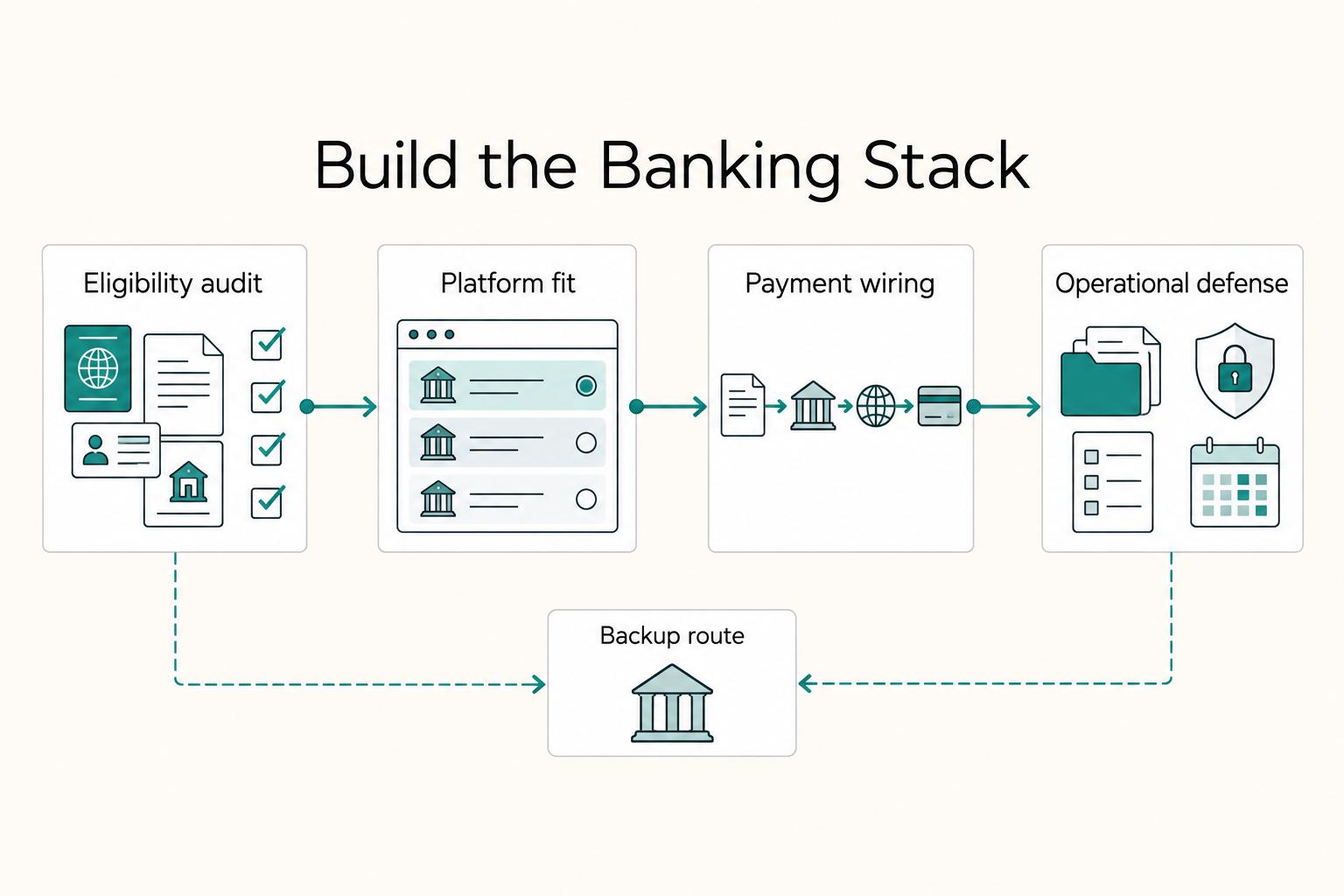
A practical way to choose your U.S. receiving setup as a foreign founder#
Foreign founders can apply for some U.S. business-account programs without being U.S. residents. Eligibility still depends on the entity, operating activity, owner countries, industry and provider policy. Start with a published route that accepts your profile, then compare the payment functions you need.
For freelancers and small teams, compare the functions you need: receiving customer payments, paying suppliers, running payroll, and keeping business money separate. An eligible business account or payment service may cover different parts of that list; choose from the requirements and limits of your actual business.
Tax residence, entity formation and account eligibility answer different questions. A U.S.-registered company with an overseas founder is not automatically approved for banking, and opening an account does not settle the founder’s tax or immigration position.
Use a simple operating rule. Keep separate notes for tax residency, entity setup, owner identity, and provider account eligibility. They can overlap, but they are not interchangeable.
Choose a route that accepts your entity and intended business receipts. A receiving service can be useful while banking is pending, but it has its own verification, permitted-use and settlement requirements. It does not bypass an unsupported country, industry or ownership profile.
Before you apply anywhere, confirm only the facts you can prove right now:
- legal entity name
- owner identity documents
- tax ID evidence, if already issued
- plain-language business activity description
Use banking terms narrowly:
- U.S. business deposit account: an account at a U.S. bank, directly or through a supported partner-bank program; distinguish it from a nonbank receiving balance.
- Non-resident banking: shorthand for onboarding where owners are not U.S. residents, not a legal status by itself.
- LLC / Corporation: common U.S. entity forms founders use.
- EIN: an IRS employer identification number. Confirm which IRS-issued evidence the provider accepts.
Do you actually need a U.S. business bank account right now#
Define the functions first: ACH credits or debits, wires, payroll funding, bill pay, cards and supported currencies. A business deposit account can cover many of these; a collection or payment service can cover a narrower need. Confirm actual eligibility and functions rather than treating “full account” and “APM” as universal product tiers.
| Need | Function to verify | Decision |
|---|---|---|
| Payroll or bill pay | Supported debits, transfers, limits and funding deadlines | Choose an eligible account/program with those functions |
| Client domestic USD instructions | Receiving details, permitted payer types and account ownership | Verify that the client accepts the route |
| Limited invoice collections | Payment acceptance and a supported withdrawal destination | A collection service can fit, with its own onboarding and costs |
For international founders, banking friction is real. Depending on the provider, onboarding may involve requests for an SSN, a U.S. address, an in-person branch visit, or some combination. If you do not yet need full U.S. money movement, it is reasonable to keep collections moving first.
When a full account earns its keep#
A U.S. business account can simplify workflows when clients or suppliers require supported domestic payment details. Compare transfer fees, FX, receiving limits and usable-funds timing for your actual invoices; domestic details alone do not guarantee fewer delays.
It also becomes more practical once you are running regular U.S. payment flows, not just collecting revenue. Workarounds that feel manageable early on often get harder to maintain once those flows become routine. Before you apply, make sure your core documentation is ready: your LLC or C-Corp setup, formation documents, and EIN.
When APMs or PaaS are enough for now#
An eligible collection service may fit a limited invoice flow while your business-account application is pending. Check that it supports your entity, owner locations, business activity and withdrawal destination. Merchant processing and an operating deposit account serve different needs.
Compare the processing fee, cross-border and conversion charges, withdrawal cost, reserves and disputed-payment exposure. Pricing for a U.S. merchant account should not be treated as pricing or eligibility for an overseas business.
Check transaction type early. PayPal treats domestic and international transactions differently, based on whether sender and receiver are in the same market.
Reassess when friction repeats. Identify the cause before changing providers. Review eligible account and payment-service options when these problems recur; a U.S. account will help only if its supported functions address the cause:
- Monthly invoice volume is rising and manual payment handling is taking meaningful time.
- Transfers fail, or payment workflows break because you cannot provide U.S. bank details.
- Payout timing delays are starting to pressure cash flow.
- You are spending more time stitching together workarounds than running the business.
Compare your setup options before you apply#
Start with the setup least likely to interrupt incoming and outgoing money. You can optimize fees later, once reliability is stable.
| Setup path | Common document/onboarding expectation | Cashflow control fit | Policy variability and known unknowns |
|---|---|---|---|
| Traditional bank | Requirements are institution-specific and must be confirmed directly before applying | Often chosen when you need a full operating setup | Approval rates, non-resident acceptance, fees, and review timelines are provider-specific and change |
Fintech providers (Mercury, Brex, Relay, Wise, Revolut, Airwallex) | Do not assume faster onboarding means easier approval; requirements and eligibility are still provider-specific | Can support day-to-day operations, but structure differs by provider | You cannot generalize approval rates, country acceptance, or fee structures across this group |
APMs/PaaS | Usually configured per platform policy; verify exact review and account requirements on the current product page | Can help collections move, but may not cover every operating need | Hold behavior, payout timing, transaction treatment, and pricing are platform-specific and frequently updated |
Mercury shows why provider structure matters. Mercury states it is a fintech company, not an FDIC-insured bank, and that banking services are provided through Choice Financial Group and Column N.A., Members FDIC. Mercury also states deposit insurance covers the failure of an insured bank.
Mercury’s pricing page, checked October 3, 2026, lists core banking at $0 per month, Plus at $29.90 per month and Pro at $299 per month. Plus lists ACH debit invoicing at $1 per transaction and Pro at $0; subscription terms and other fees still apply. Mercury Treasury is a separate product, so its balance threshold is not a bank-account eligibility requirement.
For example, a foreign founder with a U.S. LLC, overseas home office and planned U.S. clients should disclose each address in its proper field. At Mercury, an international physical operating address can be assessed; the legal-address requirement is separate. At another provider, a U.S. operating-presence requirement may make the same file unsuitable. Purchasing a mailbox does not create operations or make a prohibited address acceptable.
Before you choose a provider, run your expected invoice mix through the payment fee comparison so hidden transfer and FX costs are visible early.
Build the document pack that prevents avoidable rejection#
Once you choose a provider, the next job is to submit a packet that is easy to verify on first review. Weak files often fail early because they look inconsistent, incomplete, or hard to validate, not because of one missing page.
Banks request onboarding material because KYC checks are mandatory. Reviewers are usually trying to validate identity, sanctions or watchlist exposure, ownership context, business model, and operating countries before they assess risk.
Build your packet in two lanes#
Do not treat any single document as universally required across all providers. A better way to organize the file is required versus often requested, so you can submit cleanly first and answer follow-up quickly.
| Document | Often treated as core in first review | Often requested again in follow-up | Practical note |
|---|---|---|---|
Certificate of Formation or Certificate of Incorporation | Commonly | Commonly | Use the final filed version with the exact legal entity name. |
Operating Agreement or Corporate Bylaws | Commonly | Commonly | Keep ownership/control details readable and current. |
EIN evidence | Commonly | Commonly | Keep IRS-issued proof as a clean PDF, not only the typed EIN. |
| Owner identity docs | Commonly | Commonly | Typically a government-issued photo ID (often a passport for foreign founders); some providers may also request a U.S.-issued visa where relevant. |
If your setup is likely to receive deeper scrutiny, keep a reserve folder ready with beneficial-owner documentation and source-of-funds evidence so follow-up does not stall your application.
Use the EIN confirmation formats your provider accepts. Mercury lists CP575, Letter 147C, the IRS-returned SS-4 and, in some cases, an IRS website confirmation screenshot. An unsigned or unprocessed SS-4 application is not the same evidence. The IRS also offers an Entity transcript and a digital CP575 for eligible Business Tax Account users.
Keep the legal entity and EIN visible and legible. Do not assume every provider needs the same PDF format or that a typed EIN alone satisfies its verification process.
Run a consistency check before submission#
Before you submit, compare these fields across every uploaded file and every application screen:
- legal entity name
- entity address
- ownership percentages
- business activity wording
If those fields drift across documents, review friction rises quickly. Keep one short internal reference sheet with your final versions and verify every file against it.
Fix these red flags before you apply#
Most preventable issues show up in the basics:
- Mismatched spellings: founder or company name variations can trigger identity mismatch review.
- Stale documents: outdated governance or address records weaken confidence in the file.
- Unclear beneficial-owner disclosure: if ownership or control is hard to follow, due diligence escalates.
- Vague activity descriptions: unclear descriptions of what funds will flow through the account invite extra questions.
Handle the U.S. address question without guesswork#
Treat address and SSN requirements as institution-specific checks, not universal rules. Do not assume a physical U.S. address and a U.S. mailing address are interchangeable, and do not assume one standard applies across non-resident banking.
Mercury separates the U.S. legal address from the physical location where the team operates and from the mailing address. Its physical-address policy accepts verifiable international or residential addresses but excludes registered-agent, virtual and mail-receiving addresses for that field. Confirm the legal and mailing fields separately.
Relay’s current document page lists a physical U.S. address for the business and for beneficial owners, while accepting qualifying U.S.-registered businesses owned by non-U.S. residents with U.S. operating presence. If you operate entirely overseas, get a specific answer before paying for address services or assuming your formation address suffices.
An SSN is not universally required for every foreign-owner business program. Relay lists an SSN or passport number for beneficial owners, and Mercury accepts international passports for identity checks. Confirm the actual identity and tax fields for your entity; sole-proprietor requirements can differ.
Verify before submission#
If documentation is unclear, ask support in writing before starting the application:
- whether a
U.S. mailing addressis acceptable - whether a foreign owner without a
U.S. Social Security number (SSN)can be reviewed
Then save the reply, whether that is an email, chat export, screenshot, or PDF, along with the date and page URL. If policy interpretation changes during review, that record gives you something concrete to reference.
Choose your provider with decision criteria that match your risk#
Once address and SSN handling are confirmed in writing, choose the provider with the fewest operational unknowns. The goal is not the lowest headline fee. You want predictable onboarding, a clear escalation path, and fee behavior you can understand when something breaks.
Use a score that punishes unknowns#
Compare eligibility and published functions separately from measured service quality. A relationship-manager feature does not establish response time, payment reliability or hold frequency. Record unknowns explicitly rather than assigning numerical scores that imply observed performance.
| Route | Published starting criteria | Important limit |
|---|---|---|
| Mercury business banking | U.S.-registered entity, existing or planned U.S. operations, supported founder country and activity; international physical operating address can qualify | Fintech with partner-bank services; full application review and distinct legal/physical/mailing address rules |
| Relay business banking | Qualifying U.S.-registered business with U.S. operating presence; entity-specific documents and beneficial-owner verification | Current checklist lists physical U.S. addresses; confirm overseas-owner treatment for your actual file |
| Eligible receiving or multi-currency service | Country, business entity and activity accepted by the specific program | Local receiving details do not make every service a bank deposit account or unlock every payment function |
If payout predictability matters more than marginal monthly savings, give more weight to clear statusing and escalation than to headline pricing. If clients pay you across countries and currencies, give more weight to FX and receiving-fee clarity.
Match the provider to the failure that would hurt your business most. If interrupted payments would affect payroll, test the supported funding method and escalation process. A paid subscription tier is not evidence of uninterrupted account access or guaranteed settlement.
For cross-border receipts, compare the eligible program’s conversion, receiving and withdrawal fees for your invoice currencies. Keep collection-service features separate from deposit-account features and verify the destination route.
Before deciding, run one last verification pass:
- In Mercury, review Settings > Plan & Billing and confirm which paid features you truly need.
- Confirm disclosure of beneficial owners and the control person required by the provider, including indirect ownership.
- For any shortlist option without written policy detail, including Brex, Revolut, and Airwallex, keep scores low until support confirms current hold or return handling and fee line items in writing.
Submit your application in the right order#
The best submission order is the one that minimizes preventable mismatch. It will not guarantee approval, but it does reduce the odds that review stalls for avoidable reasons.
Finish the entity and core documents first. Set up your LLC or Corporation before starting the bank application. Have your formation documents ready, for example Articles of Organization, and keep related internal documents available if requested, such as an Operating Agreement.
Align the entity name and EIN evidence, and explain the legal, operating and mailing addresses according to the provider’s distinct fields. Address differences can be legitimate; disclose them clearly instead of forcing every document to show the same location.
Run a hard consistency check before submit#
Before clicking submit, verify every key field against your formation and EIN documents:
- Legal entity name, including punctuation and suffixes
- Entity address and any separate U.S. mailing address
- Owner names as shown on passport documents
- Ownership details across all submitted forms
- Business activity wording
Keep fields accurate and explain legitimate differences, such as a registered legal address and an overseas operating address. Consistency means a coherent file, not pretending distinct addresses are identical.
Build your follow-up packet before anyone asks#
Expect follow-up requests even after a complete submission. Keep a ready packet with formation docs, passport-based identity documents, and a one-paragraph business activity summary aligned to your invoices.
Keep that summary practical: what you sell, who pays you, how you get paid, and what a typical invoice looks like. If a bank asks for a business plan during review, you can answer quickly from material that already matches the rest of your file.
If review stalls, escalate with exact artifacts#
If review is delayed, answer the exact request with the exact document. Do not resubmit with changed facts unless you are correcting a real error.
If support asks for identity, send the requested passport file. If they ask for entity proof, send the same formation document your application fields came from. If they ask about business activity, send your summary and a representative invoice. The goal is consistency.
Set up your first 30 days to reduce holds and cashflow shocks#
Once your account is live, treat the first 30 days as a live operating test. Payout timing can vary, so make cash decisions from what you actually observe, not from ideal timelines shown on product pages or in support replies.
The month-one goal is simple: protect continuity while you learn your real settlement pattern.
Build your buffer from real payout behavior#
Set your buffer rule from the slowest realistic payout pattern you see, not the fastest one. If timing is sometimes quick and sometimes delayed, plan against the delayed case until your history is stable.
Keep a simple log from payment request to usable funds posted. Track what was requested, what was confirmed, and when cash actually became available. That gives you a practical view of working-capital pressure when conditions are uneven.
Give yourself a primary rail and a fallback. A single rail is rarely enough if continuity matters. Use one primary receiving path and one fallback path where possible. For many teams, that means a U.S. business bank account as the main route plus an alternative payment method or fintech route when it fits customer behavior.
Watch two core checkpoints: payment acceptance rates and the number of payment methods you offer. If you cannot accept the method a client needs, you may lose the transaction. That matters in cross-border sales, where cards or PayPal are not equally used in every market.
More rails add overhead, so keep the setup focused. Aim for resilience, not complexity.
Reconcile on a regular cadence while volume is still manageable#
In the first month, a regular reconciliation cadence is one of the easiest ways to catch problems early. Weekly is often enough while volume is still manageable. Compare commercial events to actual money movement, not just ending balances.
| Checkpoint | What to review | Action |
|---|---|---|
| Payment requests or invoices sent | Compare commercial events to actual money movement | Do not rely only on ending balances |
| Payment confirmations received | Match confirmations to deposits actually posted | Prioritize confirmed payments without deposits |
| Deposits actually posted | Match deposits to source records | Prioritize deposits with no clear source record |
| Exceptions | Review returns, pending payouts, failed payouts, and retries | Open a case record immediately with key references |
Prioritize mismatches: confirmed payments without deposits, deposits with no clear source record, or payouts stuck after confirmation. Open a case record immediately with the key references so escalation is faster if a hold or return needs follow-up.
If you use Gruv, connect payment confirmation to the ledger#
If you use Gruv where supported, map payment confirmations to ledger events from day one. That gives you a traceable path from commercial activity to cash movement, including held, returned, or retried transactions.
Keep records audit-ready: payment confirmation, related invoice or checkout reference, payout status history, and notes on returns or retries. Preserve event sequence instead of overwriting history so exceptions remain explainable.
Why applications fail and how to recover fast#
A decline can reflect unsupported geography or activity, an address-policy gap, unclear ownership or the provider’s risk assessment, even when an EIN is valid. Check eligibility as well as document consistency. An EIN identifies the business for tax purposes; it is not banking approval.
Ask which gap the provider can disclose and compare it with the current requirements. Correct fixable errors, but do not assume every rejection can be solved by submitting more paperwork. Some industries, jurisdictions or operating structures are unsupported.
Fix the root cause before you submit again. Do not send multiple new applications while the same inconsistency is still unresolved. If core details conflict once, that conflict often follows you into the next submission.
Before you reapply, run a line-by-line check across your LLC approval documents, EIN documentation, application draft, and owner ID documents:
- entity legal name
- business address
- beneficial owner names
- business activity wording
Use one plain business-activity description consistently across your application and your commercial records.
Use a simple rejection triage checklist#
If you get a decline, a long delay, or a vague "unable to approve" response, check these in order:
| Issue | What to confirm before resubmitting |
|---|---|
| Missing artifact | Core document categories are present: LLC approval documents, identification, LLC or business address evidence, and EIN documentation |
| Identity mismatch | Beneficial-owner details exactly match the submitted ID documents |
| Unclear business activity | The activity summary is specific and consistent across the file |
| Address-policy mismatch | Address evidence matches the provider's onboarding policy |
| Unsupported jurisdiction | The provider supports your jurisdiction |
For reapplication, use a clean evidence pack: latest LLC approval docs, EIN proof, owner identification, address evidence aligned to provider policy, and a consistent business-activity summary.
Know when to pause and use another collection route#
If the chosen provider does not support your profile, assess another eligible bank or collection service. A temporary collection route still must accept your entity and activity; it cannot cure a prohibited-use or country restriction.
Opening multiple U.S. accounts can be a useful hedge after approval, but it is not a fix for inconsistent documents. Clean the packet first, then submit one controlled reapplication.
Keep your system current as policies change#
Treat your setup as something you maintain, not a one-time approval. In non-resident banking, policies can shift, so review at a fixed cadence and again after failed payouts, major volume changes, or expansion into a new jurisdiction.
Recheck the same assumptions each time so drift is easy to spot:
- which documents the provider currently accepts
- whether it treats a U.S. mailing address differently from a physical U.S. address
- what support path exists when funds are delayed or returned
Recheck the provider’s actual address categories when your operating location or legal structure changes. Preserve dated policy and support responses, but use current requirements for the next application.
Beneficial-owner disclosure to a bank and corporate reporting to FinCEN are separate obligations. Review any applicable corporate-reporting requirement against current FinCEN guidance rather than relying on an old rule announcement; keep bank ownership records current regardless.
Keep a lightweight operations log so you can separate policy change from process failure. Track:
- date and provider
- what changed or failed
- affected artifact or assumption, for example EIN proof, address evidence, or ownership details
- remediation taken
- outcome after retest
Use that log to decide your next move. If failures mostly come from stale documents or inconsistent internal records, fix your process and stay. If the provider's written policy no longer fits your structure, address type, or jurisdiction, or payout issues repeat without a clear remediation path, start a controlled switch.
The takeaway and your next move#
Choose an eligible primary route based on the functions you need now. Keep its application, fees, account ownership and settlement records together, and define a fallback that also accepts your profile.
Build the packet from your provider’s entity-specific checklist rather than a universal list of documents for every owner. Keep formation, EIN, identity and address evidence ready for the people and roles it needs to verify.
Retain the EIN confirmation you have and verify whether the provider accepts it. Keep identity evidence for beneficial owners and control persons in the requested format, with documents current and legible.
Launch with backup rails and re-check policy when conditions change#
Do not rely on a single provider path. Keep a fallback receiving option available, and run regular operational checks so live transaction patterns stay aligned with what you submitted.
Recheck the setup after changes to ownership, operations, geography or payment volume. Provider restrictions and the legal duties of the actual entity can change independently.
Treat this as policy-driven, not guaranteed. Before major changes, re-check requirements directly and, when stakes are high, engage legal counsel and conduct further research.
If you want to implement a primary and backup payout rail with compliance gating and traceable statuses where supported, review Gruv Payouts.
Frequently Asked Questions
Can a foreign founder legally open a U.S. business bank account?
Yes, qualifying foreign-owned companies can apply through programs that accept their profile. Mercury explicitly accepts U.S.-registered companies with overseas founders, subject to operating, industry and country requirements. Approval is an individual review, not an entitlement created by incorporation or an EIN.
What documents are non-negotiable for most applications?
Use the entity-specific checklist. Common categories include filed formation records, accepted EIN evidence, owner and control-person identity, address information and a business-activity/source-of-funds explanation.
Do I need a U.S. mailing address or a physical U.S. address?
It depends on the provider and address field. Mercury distinguishes its U.S. legal address from a verifiable physical operating address, which can be international. Relay’s current checklist lists physical U.S. address requirements. Confirm your exact legal, operating, owner and mailing addresses before applying.
Can I open an account without a U.S. Social Security number (SSN)?
Some programs can review foreign owners using passport identification rather than an SSN. Confirm the provider’s fields and your entity type; a sole-proprietor route can have different requirements from a foreign-owned corporation or LLC.
Why do non-resident applications get rejected even after getting an EIN?
The EIN does not establish country, industry, address or risk eligibility. Review the provider’s criteria and any reason it can share. Fix factual or document errors, but recognize that a complete file can still fall outside the supported program.
If I only need to collect U.S. client payments, should I use APMs first?
A collection service can fit when it accepts your business and supports the receiving and withdrawal functions you need. Compare costs, holds, currencies and buyer acceptance. It still requires onboarding and is not a substitute for payroll funding, bill pay or other account functions it does not provide.
How do I compare providers like Mercury, Relay, Wise, and Revolut without guessing?
Check published eligibility and account structure first, then compare supported rails, fees, FX, export records and recovery options for your actual flow. Separate measured reliability from untested claims. Use Mercury vs Relay as a starting comparison, then verify current requirements directly.
Try a related tool
Researched and edited by the Gruv editorial team. Gruv builds cross-border billing, payouts, and finance-operations software for global businesses.
Sources
Includes 5 external sources outside the trusted-domain allowlist.
- fincen.gov/boitrusted
- irs.gov/businesses/employer-identification-numbertrusted
- mercury.com/pricingexternal
- mercury.com/legal/subscription-services-addendumexternal
- relayfi.com/hc/en-us/articles/38049251551636-Required-Do...external
- support.mercury.com/hc/en-us/articles/28770467511060-Eligibility...external
- support.mercury.com/hc/en-us/articles/28769699533588-Company-add...external
Educational content only. Not legal, tax, or financial advice.
Related Posts

Mercury vs RelayFi for Non-Resident LLC Banking
Pick the setup that keeps money moving under pressure, then worry about nicer features.
The Best Bank Accounts for US LLCs Owned by Non-Residents
**Yes, this is possible. No, it is not automatic. Approval depends on whether your profile is coherent, documented, and aligned with platform risk rules.**

The Freelance Payment Penalty: A Modeled Audit of Platform Fees, FX Spreads, and Payout Delays
The money rarely disappears through a single, easy-to-spot fee. The real loss is stacked. A marketplace takes its commission, a processor adds a charge for international cards, a bank or payment company converts the currency at a spread, a platform holds the funds before release, and a wire sheds a little to intermediaries on the way in. Each layer looks defensible on its own, but the worker feels the combined result as a smaller deposit and a later payday.