
Quick Answer
UK split year treatment can apply when your facts meet HMRC case conditions that split one tax year into a UK part and an overseas part. It is not optional once conditions are met. The safest approach is to lock your SRT result, run gate-by-gate case checks, apply overlap priority rules where needed, and file only after your evidence pack is complete and defensible.
You need a split-year decision you can defend under pressure#
You do not need guesswork here. You need a repeatable system you can run.
Treat this as a rules decision, not a tax hack. You want a position you can explain clearly if HMRC asks questions under filing pressure. This playbook gives you safe defaults so you can screen your facts faster, document your reasoning, and avoid last-minute surprises.
Under the Statutory Residence Test (SRT), your status is normally full-year UK tax residency or full-year non-UK residence. Split-year treatment is the exception. If your facts fit a qualifying case, the year splits into a UK part and an overseas part. If conditions are met, it applies automatically. You do not toggle it on or off.
Run a go or no-go triage first#
Use this sequence in one sitting. Stop if any step stays unclear.
| Checkpoint | Ask this question | Go signal | No-go action |
|---|---|---|---|
| Residency baseline | Did you complete a full SRT assessment and write down your reasoning? | You have a clear full-year SRT position with written reasoning | Pause and get review before deciding split-year treatment |
| Case fit | Do you meet all conditions for at least one split-year case? | Every condition is marked yes, with evidence | Treat as full-year position until facts improve |
| Case overlap | Could more than one case apply? | You applied priority ordering and documented why | Escalate for professional review |
| Timing confidence | Does your split point match the facts, not your preference? | Dates and events support the boundary | Assume complexity risk and escalate |
Build your evidence pack before filing#
Keep your file audit-ready from day one, especially if you are moving to the UK or leaving the UK.
| Record | What it shows |
|---|---|
| Dated movement log | Where you were and why |
| SRT worksheet | Each test and conclusion |
| Split-year case checklist | Yes, no, and uncertain items |
| Short rationale memo | Decision in plain language |
| Income mapping notes | UK part versus overseas part |
| RDR1 notes | Interpretation support where treatment feels uncertain |
Treat that table as your minimum file. These cases can be complex, and the split date may not be the date you first expect. Use conservative assumptions when facts are incomplete, then escalate early if SRT outcomes conflict, cases overlap, or your income pattern is hard to bucket.
If you need a baseline refresher before you run this triage, read Understanding the UK's Statutory Residence Test (SRT).
What is split-year treatment and when does it actually matter?#
It matters only when your facts let you split one tax year into a UK part and an overseas part under HMRC rules. If your timeline crosses borders mid-year, this is where a correct UK tax residency conclusion turns into correct return entries.
Under the Statutory Residence Test (SRT), you start with a full-year result: UK residence or non-UK residence. Split-year treatment sits inside that framework. If your conditions match a qualifying case, you apply it. It is not optional.
| Term | Practical meaning | Operator action |
|---|---|---|
| Statutory Residence Test (SRT) | Core test that sets residence status for the tax year | Lock this result first before any split-year analysis |
| split-year treatment | Rule set that can divide the year when criteria are met | Check case conditions line by line and document every yes or no |
| UK part | Period treated as resident for UK tax | Map UK-source income and relevant foreign income treatment to this period |
| Overseas part | Period treated as non-UK-resident for most purposes | Treat this as constrained, fact-dependent treatment, not a blanket exemption |
Know when this section changes outcomes#
This changes outcomes when you move in or out of the UK within one tax year and the facts might support a split. HMRC lays out eight circumstance sets, with Cases 1 to 3 for departure patterns and Cases 4 to 8 for arrival patterns. If your facts appear to fit more than one case, apply priority ordering rules instead of choosing the most favorable result.
If you leave the UK mid-year, keep some UK client work, and later return, overlaps can appear. Apply the case rules and priority ordering, then escalate if any condition stays uncertain.
Use a source hierarchy you can defend#
Start with GOV.UK manuals. Use RFIG21010 for definitions and core split-year logic, then RFIG21030 for when split-year treatment applies and how overlaps are handled. Use Low Incomes Tax Reform Group (LITRG) for plain-English sense checks, not as legal authority. If you want an SRT refresher before running cases, use Understanding the UK's Statutory Residence Test (SRT).
| Source | Use | Authority |
|---|---|---|
| RFIG21010 | Definitions and core split-year logic | GOV.UK manuals |
| RFIG21030 | When split-year treatment applies and how overlaps are handled | GOV.UK manuals |
| LITRG | Plain-English sense checks | Not legal authority |
Do you pass the five-gate triage before you do anything else?#
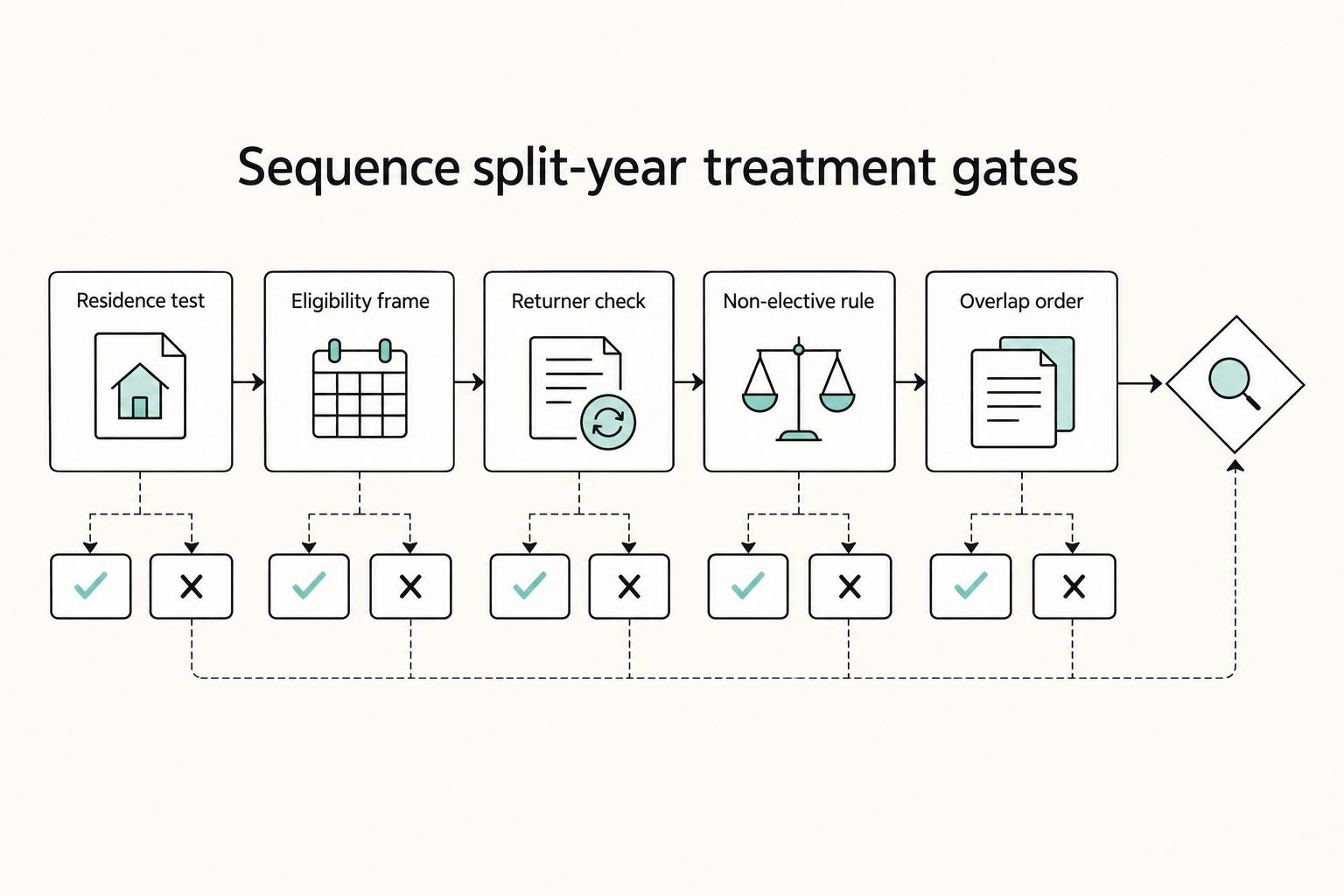
Run these five gates in order and move forward only when each one gives you a clear yes. The goal is a decision sequence you can defend if HMRC challenges your filing.
Run the gates in sequence#
Start with UK tax residency under the Statutory Residence Test (SRT). SRT has a strict order: automatic overseas tests first, then automatic UK tests, then the sufficient ties test if you still need a result.
If you meet an automatic overseas test, you are non-UK resident for that year. If you meet an automatic UK test or sufficient ties, you are UK resident.
| Gate | What you check | Go signal | No-go signal |
|---|---|---|---|
| Gate 1 | SRT sequence: automatic overseas, automatic UK, then sufficient ties if needed | You get a clear residence result | You still cannot classify status |
| Gate 2 | Eligibility frame for split-year logic | SRT classifies you as UK resident for that tax year | SRT does not classify you as UK resident |
| Gate 3 | Returner risk on GOV.UK | You lived abroad for a full tax year before returning to the UK (6 April to 5 April cycle) | You returned to the UK after less than a full tax year abroad |
| Gate 4 | Non-elective rule | You accept that if conditions are met, split-year treatment applies | You try to treat it as optional |
| Gate 5 | Overlap handling in RFIG21030 | You apply priority ordering when more than one case appears relevant | You cherry-pick the most favorable case |
Use a stop rule that protects you#
Plans change. Returning to the UK before you have lived abroad for a full tax year can fail Gate 3 and change your split-year outcome. When any gate fails, stop, document why, and escalate before filing.
Operator rule: if any gate stays unclear, treat the position as high risk and get it reviewed. This keeps split-year treatment factual, not wishful. If you need a deeper SRT refresher before Gate 1, use Understanding the UK's Statutory Residence Test (SRT).
Is split-year treatment optional and what if two cases apply?#
No, split-year treatment is not optional, and you must follow HMRC ordering rules when more than one case fits. This is where "good enough" filing instincts create avoidable risk.
Under RFIG21010, test split-year cases one by one and decide whether each case is fully met. If you meet all conditions for one case, it applies. You do not treat it as a preference toggle.
Use this operator decision tree#
| Step | What you do | If yes | If no |
|---|---|---|---|
| 1 | Check split-year case fit under RFIG21010, case by case | Mark each case pass or fail with notes | Keep reviewing remaining cases |
| 2 | Do you fully meet one case only? | Apply split-year treatment for that case | Move to overlap handling |
| 3 | Do you fully meet more than one case? | Apply RFIG21030 priority ordering | If none fit, do not apply split-year treatment |
| 4 | Is it a leaver overlap (Cases 1-3)? | Apply HMRC precedence, including Case 1 over Cases 2 and 3 | Move to arriver overlap checks |
| 5 | Is it an arriver overlap where HMRC uses split-year date ordering? | Apply the earliest split-year date rule where specified (otherwise Case 6 in those combinations) | Apply the relevant RFIG21030 ordering row and record the resulting split date |
Do not assume you can pick the best outcome#
HMRC sets eight split-year circumstance sets, split between leaver and arriver patterns. This matters when you are leaving the UK or moving to the UK and your year contains mixed signals. If overlaps appear, you do not cherry-pick the most favorable tax result. You follow the priority framework.
In leaver overlaps, HMRC gives explicit precedence such as Case 1 over Cases 2 and 3. In some arriver overlaps, priority can turn on the earliest split-year date, with a fallback rule in specific combinations. Use the ordering table as written, because one wrong assumption can shift the split date and change your filing position.
If your fact pattern looks like "left, settled, then restarted UK work," treat it as overlap risk by default. Document each plausible case, apply priority, then file the result the rules produce. If your SRT baseline still feels shaky, revisit A Deep Dive into the UK's Statutory Residence Test for Nomads.
How do moving to the UK and leaving the UK change your tax exposure?#
Split-year treatment can change exposure by splitting a qualifying tax year into an overseas part and a UK part, so your income-tax result depends on when income arises. In practice, the job is period-based income mapping.
In a qualifying split year, direction of travel changes the timeline logic. For leaving the UK, you can start in UK residence and then move into non-UK residence for the overseas part. For moving to the UK, you can start outside UK residence and then enter UK residence for the UK part. This mirrored pattern drives how you apply UK income tax across the same tax year.
| Timeline | Residence pattern in a qualifying split year | Income tax lens |
|---|---|---|
| Leaving the UK | UK part first, overseas part later | Tax the UK part as resident, then treat the overseas part as non-UK resident for most income-tax purposes |
| Moving to the UK | Overseas part first, UK part later | Treat the pre-arrival period as overseas part, then tax the UK part as resident |
Classify income in buckets before you calculate totals#
Use a strict bucket method so your return stays defensible:
| Income item | Treatment |
|---|---|
| UK-source income | Bucket by period, not by annual total |
| Foreign income | Bucket separately for the UK part and overseas part |
| Non-UK income in the overseas part | Generally outside UK income tax scope, but do not assume every item follows the same result |
Lock your bucket logic before you optimize anything.
If you move to the UK mid-year, keep offshore clients, and then start UK invoicing after arrival, do not blend periods into one annual bucket. That is how people misstate liability in both directions.
Keep adjacent regimes in scope#
Do not project income tax outcomes onto every regime. Capital Gains Tax can differ. Split-year treatment can place overseas-part gains outside charge in many situations, but non-residents can still face UK tax on some disposals, including UK land. Keep gains analysis on a separate track.
Also keep current policy context in its own lane. From 6 April 2025, remittance basis treatment for UK resident non-domiciled individuals changed, and government guidance signals a residence-based direction for non-doms and Inheritance Tax (IHT). Use this section to map exposure, then escalate edge cases before filing. For broader cross-border planning context, see the digital nomad tax guide.
What records make your position audit-ready instead of arguable?#
Build an evidence file that ties every split-year decision to dated records, return entries, and clear reasoning. If your documentation is thin, even a correct conclusion is harder to defend.
HMRC expects records that support what you state under the Statutory Residence Test (SRT). That means day counts, travel facts, and work patterns backed by contemporaneous documents. If you rely on memory later, you weaken your position.
Simple rule: if you cannot point to a document, treat that point as uncertain until you verify it.
Map records to each gate#
| Decision gate | What you need to prove | Audit-ready record set |
|---|---|---|
| Gate 1 SRT status | Your path through automatic overseas tests, automatic UK tests, then sufficient ties test | Travel schedule, tickets or boarding records, and dated UK entry and exit log |
| Gate 2 split-year eligibility | Why split-year treatment can apply in a year of UK residence | SRT worksheet plus case-condition checklist |
| Gate 3 return timing | Timing of departure and return | Timeline showing when you left the UK and when you returned |
| Gate 4 case narrative | How your facts meet the split-year case you are filing | Short decision note that records case fit and conclusion |
| Gate 5 multiple-case ambiguity | Why you filed one case when more than one seemed possible | Case comparison note with your filing rationale |
Build a safe default evidence pack#
- Keep a dated movement log and update it as events happen.
- Keep a work diary or timesheet showing your UK versus overseas work pattern.
- Flag UK workdays where you worked more than 3 hours, especially if that happens on more than 30 days.
- Complete SA109 support notes before filing, including split-year case details for box 40 and UK day count for the overseas part in box 10.
- Add RDR1 interpretation notes and mark any unresolved assumptions clearly.
- Retain records for at least 5 years after the 31 January submission deadline.
- Add supporting business records where relevant, so dates and work patterns are easier to corroborate.
If you are reconstructing travel and work history at filing time from old emails, gaps will appear. Capture evidence in real time, then escalate edge cases early. If your UK tax residency file still feels thin, review Understanding the UK's Statutory Residence Test (SRT).
Where rules vary and when should you stop and escalate?#
Treat this as a rule check, then escalate fast when facts are unclear or regimes overlap. Once you have records, the next risk is interpretation: forcing an answer when your facts do not cleanly fit a case.
Interpretation can vary by fact pattern and filing context, even when two situations look similar at first glance. HMRC gives you the framework, but you still need to apply it to your exact dates, ties, income sources, and return entries. Confirm your position against current GOV.UK guidance, then get qualified advice before submission whenever a core point stays uncertain.
Escalate when these conditions show up#
| Trigger | Why it matters | Immediate action |
|---|---|---|
| You cannot reach a clear Statutory Residence Test (SRT) result for the year | Split-year treatment only applies in a year where SRT makes you UK resident | Pause filing, rebuild day-count and ties evidence, then request technical review |
| More than one split-year treatment case appears to fit | HMRC applies priority ordering across 8 case sets, not taxpayer preference | Run case ordering logic and ask for a second professional check |
| Mixed-source income treatment remains unclear | Source-level treatment can affect how UK and overseas amounts are handled | Flag uncertain lines, use conservative assumptions, and get adviser signoff |
| You are unsure how to treat specific gains | Gains treatment needs separate analysis and may not follow income assumptions | Separate the gains analysis and escalate before final filing |
Use this safe default boundary rule#
If evidence is incomplete, choose the conservative treatment, document the assumption, and do not optimize for a favorable edge case. If you cannot evidence key facts around leaving the UK, avoid aggressive positions until a professional confirms case fit.
Keep scope tight. UK tax residency and split-year treatment do not, by themselves, settle FIG outcomes, non-dom strategy, or Inheritance Tax (IHT) exposure after the 2025 rule changes. Treat each as a separate regime with separate tests and separate advice.
Run the decision in a fixed order, then file with evidence#
Run the decision in a fixed order, then file only when each gate has evidence behind it. Start with UK tax residency, then test the split-year rules.
Classify status under the Statutory Residence Test (SRT): check automatic overseas tests first, then automatic UK tests, then the sufficient ties test if the first two do not settle status.
After that, test split-year criteria. If one case is fully met, it applies. If more than one case fits, apply HMRC priority ordering across the eight case sets.
- Classify UK residence or non-UK residence under SRT.
- Run split-year case conditions against your exact facts.
- Apply priority ordering when multiple cases appear to fit.
- Build evidence with contemporaneous records, including a work diary or timesheet (and hours) plus rationale notes.
- Prepare return support notes, including SA109 Box 3.1 when multiple cases may apply.
- Escalate unresolved issues before submission, especially where income-source treatment is unclear.
When facts stay incomplete, use a safe default. Choose the conservative treatment, document assumptions, and ask for professional review before you submit. If a third-party summary conflicts with HMRC framing, default to GOV.UK and HMRC manual logic.
If you are in filing week with a travel-heavy year and cross-border income, you can still regain control. Rebuild SRT status first. Then rerun split-year gates in order, and escalate any unresolved point instead of forcing a guess.
For fundamentals, review Understanding the UK's Statutory Residence Test (SRT). Then read HMRC split-year detail in RFIG21000 onwards before filing. If any core assumption still feels arguable, confirm it with a qualified UK tax professional before you file.
Frequently Asked Questions
What is UK split-year treatment in plain English?
UK split-year treatment lets one tax year split into a UK part and an overseas part when your facts meet HMRC criteria. Within that year, different residence treatment applies to each part. Practically, it forces you to separate what happened before and after a real move instead of blending the year into one narrative.
Do I need to be UK resident under the Statutory Residence Test (SRT) for split-year treatment to apply?
Yes. You must be UK resident for that tax year under the SRT before split-year treatment can apply. If you cannot clear that gate, split year treatment does not start. Do not begin with case selection if your SRT result is not locked.
Is split-year treatment optional or automatic once conditions are met?
It is automatic, not elective. If your facts meet a valid case, HMRC expects you to apply it, and you cannot switch it off because another result feels better. Treat uk split year treatment like a rules engine: you either meet the conditions or you do not.
Can I claim split-year treatment if I return to the UK after less than a full tax year abroad?
Sometimes yes, sometimes no, based on the specific case conditions. In some leaver cases, split-year can fail if you do not meet the following-year non-UK residence condition. If you are leaving uk and planning a quick return, test that condition early before you rely on split-year treatment.
What happens if more than one split-year case appears to apply to me?
You do not pick the most favorable case. HMRC sets priority ordering rules, and you must run that order when overlaps appear across the eight case sets. If two cases still look plausible after your first pass, treat that as a review trigger, not a judgment call you make in the final week of filing.
Does split-year treatment change how foreign income is taxed in the overseas part?
Usually, the overseas part gets non-UK-resident treatment for most purposes. That does not mean split year treatment removes UK tax from all foreign income in every situation. Keep source-by-source records, then classify each item before filing, especially if you are moving to uk mid-year.
When should I stop self-assessing and hire a UK tax professional?
Stop and escalate when your SRT result stays unclear, case overlap remains unresolved, or income sourcing crosses jurisdictions. Also escalate when the tax treatment could materially change your filing position. If you want a tighter SRT decision framework first, read Understanding the UK's Statutory Residence Test (SRT).
Try a related tool
Researched and edited by the Gruv editorial team. Gruv builds cross-border billing, payouts, and finance-operations software for global businesses.
Sources
Includes 2 external sources outside the trusted-domain allowlist.
Educational content only. Not legal, tax, or financial advice.
Related Posts

Digital Nomad Taxes in 2026 With a Defensible Filing Plan
With digital nomad taxes, the first move is not optimization. It is figuring out where you may be taxable, where filings may be required, and what proof supports that position.

Understanding the UK's Statutory Residence Test (SRT)
Treat SRT like ops, not folklore. You want a repeatable workflow you can run monthly so your tax-year answer is boring, documented, and easy to defend.

A Deep Dive into the UK's Statutory Residence Test for Nomads
If you get your residence status wrong, it is not a technical footnote. It can change whether the UK taxes only your UK income or normally taxes income from both the UK and abroad for that tax year.