
Quick Answer
Yes - this malaysia digital nomad visa can fit remote employees and independent contractors if you confirm the latest rules first and document each assumption. Build a dated dossier, validate your category, and map every income stream before filing. The article’s sequence runs from online submission through recommendation, visa step, endorsement, and pass issuance, with in-country logistics treated as a live-check item. Keep contracts, invoices, and payment records consistent so tax and operational choices stay defensible.
Decide whether to proceed, prepare, or pause on Malaysia#
Treat this as a verification-first playbook, not a travel pitch. If you cannot confirm current rules from official Malaysian sources, the best move is to pause before planning anything else.
Here, "compliance anxiety" means the worry that one bad assumption today turns into a visa, tax, or client problem later. That concern is valid. One available background source is an open-access Information Systems Journal article (Volume 34, Issue 5, pp. 1493-1535), but its case focus is Chiang Mai, Thailand. It is useful context on digital nomadism in the visitor economy, not on DE Rantau policy.
Use this guide if you want a defensible proceed, prepare, or pause decision based on dated evidence rather than a lifestyle summary without source checks. The four modules are decision lenses, and each should end with a clear outcome.
| Module | What you decide | Evidence you need | Risk it reduces |
|---|---|---|---|
| 1. Strategic fit | Proceed, prepare, or pause on Malaysia as your base | Official Malaysia sources re-verified on the date checked, plus your own assumptions documented clearly | Choosing a base on unverified assumptions |
| 2. Application dossier | Submit now or keep preparing | Requirements you can currently verify from official Malaysia sources, with matching records organized against those verified requirements | Avoidable rework from weak or outdated evidence |
| 3. Compliance | Proceed with your current structure or redesign it first | Verified current rules and your own dated compliance notes before action | Tax or legal mismatch caused by assumptions |
| 4. Operations | Whether you can run day-to-day cleanly | A dated operations checklist tied to currently verified rules and your own workflows | Operational friction and weak audit trail |
Build a dated evidence pack as you go. Save the official page, document version, screenshots, and check date. Policy details can change, so confirm live criteria from official sources before you act.
If you want a deeper dive, read the Global Digital Nomad Visa Index.
Module 1: Is the DE Rantau Pass the Right Strategic Move for Your Business?#
Proceed only after you verify live rules from official Malaysian sources and confirm the route fits how your business actually works. If either point is still unclear, keep the decision pending or compare another visa path before you build the rest of the plan.
Start with classification fit. A standard tourism framing can be a poor match for remote professionals. The cited tourism definition describes a tourist as someone staying outside their usual residence for no longer than one consecutive year. The same literature notes that digital nomads do not fit neatly into that traditional definition and are conceptualized in multiple ways, including as location-independent workers.
Fast go/no-go filter#
| Outcome | When it applies |
|---|---|
| Proceed once verified | You can verify current DE Rantau criteria today, and your work model aligns with those verified criteria. |
| Delay | Core criteria are still unclear, or your role classification is ambiguous. |
| Choose another path | Once verified, your business needs a setup this route may not fit. |
Eligibility criteria to verify from official sources#
| Decision point | Verification action |
|---|---|
| Income threshold | Capture official page + screenshot + check date |
| Role definition | Match your real deliverables line by line |
| Evidence required | Use official live checklist, not summaries |
If official criteria include multiple profiles and your work could sit in either one, do not guess. Write a plain-language description of what you deliver, who pays you, and where clients are based, then map that to the official wording.
Strategic-fit checklist (before Module 2)#
Before you move into documents, pressure-test the business basics that can break later:
- Tax residency interaction: Confirm whether your home-country position could change based on your travel and work pattern.
- Contract setup: Confirm your agreements allow cross-border delivery from Malaysia.
- Data/privacy exposure: Confirm remote access from Malaysia is permitted for the systems and data you handle.
- Client concentration risk: Stress-test whether one client or one market creates operational fragility after relocation.
Malaysia operating reality (based on current evidence limits)#
Treat this stage cautiously. Several operating details remain unconfirmed, so treat the unknowns as real until you verify them.
| Topic | What you can treat as known here | What remains unverified and must be checked |
|---|---|---|
| Location scope limits | Not confirmed | Confirm the current location scope from official sources |
| Travel friction tied to approval/status | Not confirmed | Confirm current entry and exit conditions from official sources |
| Time-zone and service-delivery fit | Depends on your client mix and delivery promises | Run a two-week schedule simulation in Malaysia time |
A January 2024 article is useful for framing the category-mismatch issue, but the page also states no full text is available and suggests requesting a copy from the author. Use it for framing, not for live rules.
If you can verify current criteria, your contracts permit cross-border work, your risk checks hold, and your delivery model still works in Malaysia time, continue to Module 2. If not, keep the go/no-go decision pending and resolve those gaps first. Related: London, UK: A Guide for Expats and Remote Workers.
Module 2: Build one coherent evidence pack before you submit#
At this stage, treat inconsistency and unverified assumptions as avoidable risks. Build one coherent evidence pack before you submit anything.
Use this section to pressure-test file quality, then confirm every required item against current official instructions before submission.
Pre-submission sequence#
Use this as a workflow template, not a confirmed policy checklist:
- Collect everything from the live rules first. Put all required files in one folder so you can review the full story at once.
- Normalize names and identifiers. Make legal name and other key identifiers consistent across files where possible.
- Check timeline consistency. Verify that supporting records align and do not contradict each other.
- Do a final file check. Open every file, confirm legibility and completeness, and use file names a reviewer can understand quickly.
Verification table (use only after live-rule check)#
| Checklist item from official instructions | Why it is requested | Review risk if weak |
|---|---|---|
| Confirm document requirement 1 from the official instructions | Confirm the stated purpose from the official instructions | Missing, unreadable, or inconsistent details |
| Confirm document requirement 2 from the official instructions | Confirm the stated purpose from the official instructions | Incomplete or contradictory supporting records |
| Confirm document requirement 3 from the official instructions | Confirm the stated purpose from the official instructions | Dates, names, or identifiers that do not align |
| Confirm document requirement 4 from the official instructions | Confirm the stated purpose from the official instructions | Stale or incomplete file where a current one is required |
| Confirm document requirement 5 from the official instructions | Confirm the stated purpose from the official instructions | Coverage/scope/date details are unclear |
| Confirm document requirement 6 from the official instructions | Confirm the stated purpose from the official instructions | Missing signature, version, or attachment |
If any third-party guide conflicts with live official instructions, follow the official instructions and record when you verified them.
Proof of work by income profile#
The key is not volume. It is traceability. This is an organization method, not a confirmed DE Rantau review rule.
| Income profile | How to organize records |
|---|---|
| Employed | Map each income-related record so names, dates, and entities stay consistent. |
| Independent contractor | Map each client record to related agreement and payment evidence. |
| Mixed income | Use one reconciliation sheet so each source is easy to trace across records and months. |
Upload quality standard#
Poor uploads can create avoidable review friction, even when the underlying records are fine.
Keep uploads legible, complete, and consistently formatted. Use a single naming convention, for example 01_DocumentType_FullName_YYYYMMDD.pdf, maintain correct page order, and avoid low-quality screenshots.
If translation is required by the live rules, pair original and translated files clearly and label them consistently with the translation requirement from official instructions. Verify the current translation requirement from official sources before you format files. Redact only unrelated sensitive details. Keep any details required by official instructions visible unless those instructions explicitly allow redaction.
Logistics decision box#
If the live process requires travel or in-person completion, plan it early instead of treating it as an afterthought.
- When it applies: only when current official instructions explicitly state your case needs it.
- Prepare in advance: keep travel documents valid, save approval records offline, and carry printed core documents.
- Confirm costs and timing before booking: Current fee and processing-window details must be verified from the official process before you pay or schedule travel.
Do not rely on recycled summaries for process-critical steps. Verify the live rule, save a copy, and date-stamp your check before you commit to travel or submission timing.
This pairs well with our guide on Japan Digital Nomad Visa: A practical overview.
Module 3: The Compliance Deep Dive: Malaysian & Home Country Tax Obligations#
Compliance problems often start when different questions get collapsed into one. Separate them first: tax residency, source of income, and reporting obligation.
Start with the three definitions that matter#
Tax residency: the rule set a country uses to decide whether you are treated as a resident taxpayer for a period. For Malaysia, verify the current official test before relying on any summary.
Source of income: the rule set used to classify where income arises for tax treatment. For planning, this is central to any foreign-sourced income position, and it should be tested against your real operating facts, not one shortcut.
Reporting obligation: filing, disclosure, and recordkeeping duties that can apply even when tax due is low or zero. "Potentially exempt" does not mean "no compliance work required."
Malaysia-side verification framework#
Do this before you move, not after money starts flowing:
- Map each income stream and label it clearly.
- Verify whether your facts support your foreign-sourced income treatment under current rules.
- Check Malaysian residency status under current rules, with dated notes.
- Confirm whether any Malaysian filing or recordkeeping duty still applies in your fact pattern.
Keep a one-page position memo with your assumptions, what you verified, and the date verified.
Home-country path for U.S. and non-U.S. applicants#
The home-country side needs the same discipline as the Malaysia side.
If you are U.S.-linked, start from a verification-first assumption: Malaysia-side treatment does not automatically remove U.S.-side filing or reporting duties. Confirm current rules against your exact facts.
If you are not U.S.-linked, run the same structure in your home system. Check residency basis, treaty considerations where relevant, dual-residency risk, and ongoing filing or reporting requirements after departure.
Foreign-sourced income operational controls#
A workable tax position depends on records that match the story you are telling.
| Control point | What to enforce | What to keep on file |
|---|---|---|
| Invoicing entity | Contracting and invoicing setup that matches your tax position | Signed agreements, invoice set, entity details (if used) |
| Payment rail | Consistent receipt path for business income | Statements with payer name, amount, and date |
| Remittance logic | Documented rationale and pattern for transfers into Malaysia, where applicable | Transfer log plus monthly notes |
| Recordkeeping | Traceable link from contract to invoice to payment to transfer | Reconciliation sheet and dated compliance notes |
A common failure mode is inconsistency: mixed personal and business flows, mismatched contracting and billing records, or transfers with no clear support.
Permanent Establishment and contractor-boundary controls#
Review Permanent Establishment risk through both contract terms and day-to-day behavior.
- Keep client agreements and your actual working practices aligned with your contractor setup.
- Avoid activities that could be interpreted as local representation without first checking the implications.
- Keep service scope and market-facing behavior consistent with your contract setup.
- Preserve operating evidence, including communications, invoices, and profile language, that matches your legal posture.
If your operating pattern changes materially, pause and re-check your position before scaling further. You might also find this useful: The Best Digital Nomad Cities in Southeast Asia.
Before you finalize your filing plan, map your travel and stay pattern in one place with the Tax Residency Tracker.
Module 4: Align banking, invoicing, and client-facing behavior in Malaysia#
Once approval is in motion, your operations should support the same story your application and tax position tell. Banking, invoicing, and client-facing behavior should line up from day one.
Choose your banking setup by use case, then verify live requirements#
Choose the simplest setup that fits your actual needs, then verify current requirements directly with the bank. Use any checklist here as a starting point, not a substitute for your specific business facts.
Before you apply or visit a branch, prepare this checklist and verify it against current bank guidance:
Current requirements: confirm what documents and onboarding steps are currently required.Setup and activation: confirm funding, activation, and ongoing account conditions.Account purpose: document whether each account is for local living costs, business flows, or both, and keep that usage consistent.
If you are protecting a foreign-sourced income tax exemption position, avoid mixed flows that blur purpose and recordkeeping.
| Option | Use case | Compliance rationale | Fee/control tradeoff | Common mistake |
|---|---|---|---|---|
| Non-local or multi-currency receiving account | Possible first receipt point for some client payments | Can help keep client receipts distinct from local spending when separation matters to your structure | May add reconciliation work | Mixing personal and business receipts without clear labels |
| Local Malaysian personal account | Daily living expenses in Malaysia | Can help separate spending from settlement activity | Convenient local payments | Routing client revenue here without clear tracking |
| Local Malaysian business account | Cases where your setup needs dedicated local business flows | Can better fit formal local operations when that fit is necessary for your facts | More admin overhead | Opening it before confirming real operating need |
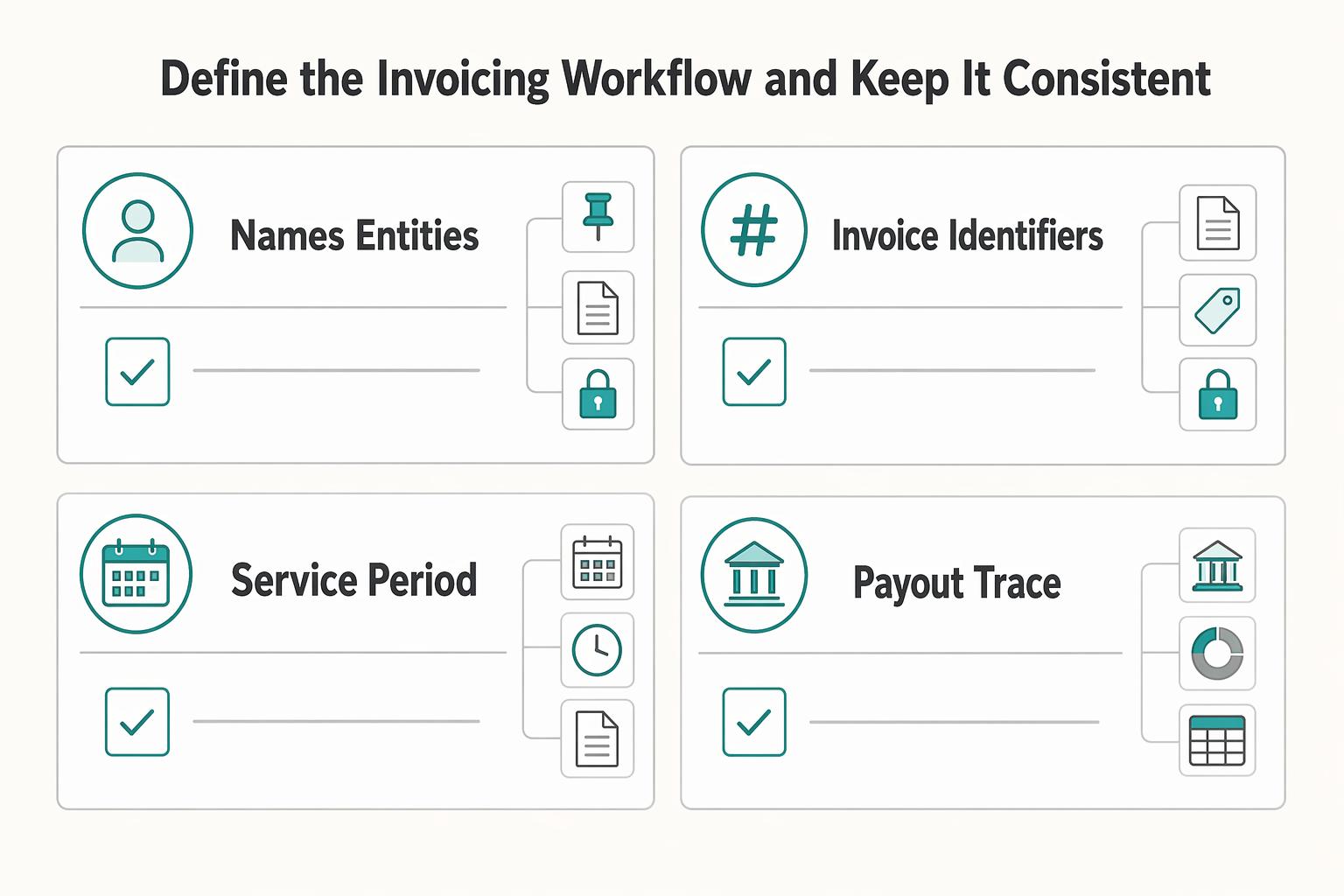
Define the invoicing workflow and keep it consistent#
Your invoice process should mirror your money flow. Use consistent working definitions in your records for billing, first payment destination, and later transfers for local expenses.
Use this invoice checklist so contract, billing, and payment records stay aligned:
- Names and entities that match the agreement
- Invoice identifiers and issue dates
- Service period and scope that match the agreement
- Payment instructions tied to your intended settlement flow
Operational test: you should be able to trace each project from signed agreement to invoice to payment to any later transfer into Malaysia quickly and cleanly.
Control PE risk through contract language and behavior#
Treat PE risk as an alignment issue. Your contract terms and daily conduct should support your independent service-provider position.
| Trigger | Control |
|---|---|
| Your authority or conduct starts to look like client representation rather than service delivery. | Keep authority limits explicit in the agreement and follow them in practice. |
| Contract language, invoicing, and communications stop telling the same operational story. | Realign scope, wording, and operating behavior before the pattern deepens. |
| Recordkeeping becomes inconsistent across agreements, invoices, and payment flows. | Reconcile records promptly and keep dated evidence of changes and decisions. |
No single clause solves this by itself. The protection is consistency across contracts, invoicing, communications, and payment records, backed by dated evidence.
We covered this in detail in Colombia Digital Nomad Visa Tax Planning Around the 183-Day Rule.
Conclusion: Execute Your Malaysian Strategy with Confidence#
By this point, you should be making a clear decision, not a hopeful guess. If this route fits your work model and your tolerance for compliance work, the advantage comes from preparation quality.
Start with fit. DE Rantau is a Professional Visit Pass (PLIK) route for qualified foreign digital nomads, and official language includes both tech and non-tech professions. The real question is whether your work is truly remote, clearly documentable, and compatible with the approved stay window you have verified from official sources.
Then complete the application in the official order: online submission, MDEC recommendation, visa or e-VISA step, passport endorsement, then pass issuance. Before you submit, make sure your core documents align on identity details and dates, and include evidence of ongoing remote work where requested.
Next, treat compliance as part of the plan from day one. IRBM frames liability year by year, and residence status is determined by facts, so your tax position depends on what actually happens during the year. If your income source, client location, or payment flow is unclear, confirm current treatment and keep contracts, invoices, and transfer records organized.
Finally, set up operations with realistic expectations. Malaysia is presented as nomad-ready, but your actual setup still needs to hold up across banking, invoicing, connectivity, housing, and dependent paperwork where relevant. Use the listed 4 to 8 weeks as a planning range, not a guarantee, and recheck current fees and dependent rules in official or platform records before paying or booking.
Your next actions are straightforward:
- Verify current DE Rantau rules with official sources, since published guidance can change.
- Finalize your document pack and resolve inconsistencies before submission.
- Confirm your tax and compliance setup, especially income-source treatment and recordkeeping.
- Launch operations only after approval steps, timing, and entry requirements are confirmed.
For a step-by-step walkthrough, see A guide to Greece's digital nomad visa.
When you are ready to operationalize invoicing and payouts with compliance controls, talk to Gruv.
Frequently Asked Questions
Who is eligible for the DE Rantau pass?
DE Rantau is positioned as a Professional Visit Pass for qualified foreign digital nomads, and the program language includes both remote employees and digital freelancers or independent contractors. It also states that both tech and non-tech talent or profession categories can apply. Confirm that your work is clearly digital and remote, then match your profile to the current official category wording before you apply.
Which professions qualify?
The official position is broad: tech and non-tech professions are both listed as eligible. In practice, you should be ready to show real remote professional work, not just a job title. If your role is borderline, prepare a clear description of how the work is performed remotely.
What income level do I need, and is that gross or net?
Current MDEC foreign-page snapshot lists annual income thresholds of >USD24,000 for tech talent/profession and >USD60,000 for non-tech talent/profession. The published wording shown here does not state whether this is gross or net, so treat that point as a live verification item before you apply. If you only qualify after deductions, treat eligibility as uncertain until you get written clarification.
What documents should you prepare first?
Do not rely on third-party summaries for the document list. Before you assemble your documents, verify the live checklist from official sources. Then make sure names, passport details, and supporting records match exactly across the file. Fix mismatches or stale proofs before submission to reduce avoidable delays.
Can you apply while already in Malaysia?
Treat this as a live-check item, not a fixed rule. General Professional Visit Pass guidance says applicants should be in their country of origin when applying, but you should confirm the process in force at the time you file. If you are already in Malaysia, verify current portal guidance first and keep a record of the answer you relied on.
How long is the Malaysia digital nomad visa valid, and can you renew it?
Current program materials describe an initial stay from 3 up to 12 months, with renewal for up to an additional 12 months. Confirm live terms before planning dates. If you expect to renew, keep your records organized from month one.
Do you pay tax in Malaysia on DE Rantau income?
Malaysia income tax scope includes income accruing in or derived from Malaysia and income received in Malaysia from outside Malaysia. For this topic, foreign income means income derived from outside Malaysia, and “received in Malaysia” includes funds brought in by cash or electronic transfer. For individuals, non-resident status is tied to staying less than 182 days in Malaysia in a year. The exemption timeline has conflicting published end-date signals, so verify the current foreign-income exemption window and conditions from official tax guidance before filing. If you may bill Malaysian clients or rely on foreign-income treatment, keep contracts, invoices, and payment trails clean and get current tax advice.
Can you bring dependents?
Program materials state the main pass holder can bring a spouse and child or children, and can also bring parent or parents for the main pass holder. Confirm current dependent definitions and relationship-proof requirements in the live portal before submission.
Try a related tool
Researched and edited by the Gruv editorial team. Gruv builds cross-border billing, payouts, and finance-operations software for global businesses.
Sources
Includes 3 external sources outside the trusted-domain allowlist.
- engage.cmap.illinois.gov/30361/widgets/106072/documents/76363trusted
- hasil.gov.my/en/individual/individual-life-cycle/income-d...trusted
- phl.hasil.gov.my/pdf/pdfam/PR6_2011.pdftrusted
- rai.malaysia.gov.my/digital-services/674d807abf56b738f6c0a469trusted
- repository.library.northeastern.edu/files/neu:bz60wp35m/fulltext.pdftrusted
- adb.org/sites/default/files/publication/1107056/acce...external
- apo-tokyo.org/wp-content/uploads/2024/07/Digital-Transform...external
- greatpyramid.com.my/exploring-the-malaysia-digital-nomad-visa-a-...external
Educational content only. Not legal, tax, or financial advice.
Related Posts

The 2026 Global Digital Nomad Visa Index for 50+ Countries
Start with legal fit, not lifestyle filters. The practical order is simple: choose a route you can actually document, then decide where you want to live. That single change cuts a lot of wasted comparison work and stops you from falling in love with places that were never a real filing option.

London, UK: A Guide for Expats and Remote Workers
Get two calls right early and the rest of the move gets easier: how you'll be in the UK, and where you'll work when conditions are less than ideal. Make those decisions before you lock dates or prepay a long stay. If you book first and sort the basics later, admin and work reliability usually collide in your first week.

The Best Digital Nomad Cities in Southeast Asia
Pick the city that can support a normal workweek, not the one that looks best across a dozen tabs. If you want one practical answer from this Southeast Asia shortlist, use these three gates in order and drop any city that fails one.