
Quick Answer
Start with a one-page Family Education Charter, then pressure-test each school on pathway fit, all-in cost, and daily logistics before you apply. For best international schools barcelona decisions, use official fee sheets, visit notes, and admissions emails instead of marketing claims. Compare IB, A-Levels, and US diploma routes against your likely university destination, then finalize with a weighted scoring method that uses only verified evidence. This turns a stressful shortlist into a defensible enrollment decision.
The Global Professional's Framework: A Project Plan for Selecting the Right International School in Barcelona#
If you are the person owning the move, the job is straightforward: build a shortlist you can defend, and avoid delays you could have caught earlier. In Barcelona, you are usually comparing four linked variables at once: curriculum pathways, admissions workflow, total cost, and whether a school still works once you map it to the neighborhood where you will actually live.
| Phase | Main check | Article example |
|---|---|---|
| Define priorities | Create a one-page family brief or At a Glance sheet | dates, cost, visa, housing, language |
| Verify fit | Check track-specific exceptions and document requests | "Language prerequisites" can be "None," while some internship placements require four semesters of university-level Spanish or equivalent |
| Compare full costs | Separate included, excluded, and optional items | $21,995 example; excursions with "no additional fees"; optional part-time internship included in program pricing |
| Validate logistics and decide | Check deadlines, visa status, and commute | April 15 and Oct. 1 deadlines; "Visa required: Yes" |
Use this guide in order: define priorities, verify fit, compare full costs, validate logistics, then decide. You do not need to predict every detail at the start. You do need the right evidence early, a clear split between hard requirements and preferences, and a way to catch deal-breakers before applications open. The concrete examples come from Barcelona higher-ed program pages and are best used as planning signals, not as K-12 school rules.
- Define priorities
Start with a one-page family brief covering age or stage, language needs, likely university geography, support needs, and commute tolerance. A useful format is an "At a Glance" sheet with five fields you can scan quickly: dates, cost, visa, housing, and language. Key differentiator: it puts your non-negotiables on paper before school marketing starts shaping the decision.
- Verify fit
Do not assume a broad match means every pathway works. Barcelona program pages show why: one listing says language prerequisites are "None," then adds that some internship placements require four semesters of university-level Spanish or equivalent. Key differentiator: this phase catches track-specific exceptions and document requests before you build a shortlist around them.
- Compare full costs
Model what is included, excluded, and optional, not just the headline number. One Barcelona program lists an estimated cost of $21,995. Another states excursions are included with "no additional fees," while an optional part-time internship is also included in program pricing. Key differentiator: you stop comparing incomplete totals. Treat these as examples of what to verify line by line, not as K-12 tuition benchmarks.
- Validate logistics and decide
Put timing and movement under the same microscope as academics. Exact dates matter. Higher-ed Barcelona pages surface deadlines like April 15 and Oct. 1, and some simply state "Visa required: Yes". Key differentiator: treat admissions and immigration as separate checks, then test your likely neighborhood-to-campus commute before making the final call.
This is the roadmap. The phase sections that follow add the evidence, checklists, and comparison tables you need to move from broad interest to a defensible shortlist. If you want a deeper dive, read Tax Guide for Digital Nomads in Thailand.
Phase 1: The Strategic Brief - Defining the Mission#
Start here: lock your non-negotiables before you compare schools. Your output for this phase is a one-page Family Education Charter that separates what must be true, what can flex, and what still needs verification.
| Check | What to ask |
|---|---|
| Language use | Which languages are used in class, parent communication, and daily school life? |
| New-student transition | How are new students supported in Spanish/Catalan transitions? |
| Family mix | What does the local/international family mix feel like in practice? |
| Teaching approach | How does the school show its teaching approach with real assessment examples? |
| Inquiry evidence | If "inquiry-based" is claimed, can they share sample tasks, rubrics, or assessment artifacts? |
- Write the charter before more school research
Draft one page in plain language first, then use school calls to verify it. Include: child age/stage, likely university destination, chance of relocating before graduation, language goals, support needs, and maximum commute.
- Compare pathways by what each school can prove now
Do not treat pathway labels as proof of fit. Ask each school for documents you can compare side by side.
| Pathway | University alignment: what to request | Transferability and relocation friction to test |
|---|---|---|
| IB | progression map, assessment calendar, transcript/report sample | written process for mid-cycle entry/exit and records transfer |
| A-Levels | subject-planning timeline, assessment plan, transcript/report sample | flexibility after subject choices and transfer process if you move |
| US diploma/AP | graduation-credit map, course/exam plan, transcript/report sample | how records and course rigor are documented for non-US transitions |
If a school cannot provide basic documentation early, treat that as a risk signal and keep validating.
- Pick destination first, then map curriculum-fit questions backward
Use this simple flow:
-
Name one primary university destination and one backup.
-
Add a charter line: "Admissions expectations to verify" (official links, required subjects, testing expectations, timeline).
-
Ask each school to show how its pathway planning maps to those requirements in writing.
-
Use a first-call checklist for culture, language, and pedagogy fit
Use this in early calls and shortlist reviews:
- Which languages are used in class, parent communication, and daily school life?
- How are new students supported in Spanish/Catalan transitions?
- What does the local/international family mix feel like in practice?
- How does the school show its teaching approach with real assessment examples?
- If "inquiry-based" is claimed, can they share sample tasks, rubrics, or assessment artifacts?
Inquiry approaches are linked with deeper understanding and engagement, but inquiry skills need varied assessment tools rather than one generic measure. In SAILS, more than 2,700 science teachers across 12 European countries participated (2012-2015), and 19 Inquiry and Assessment Units were developed. Use that as a practical checkpoint: ask for concrete evidence, not slogans.
Before Phase 2, complete this charter template:
Primary/backup university destination: ___ / ___ Possible relocation before graduation: yes/no; where ___ Curriculum evidence still needed: ___ Language goals after 2 years: ___ Support needs: ___ Commute cap: ___ minutes Culture preference: more international / more locally integrated / mixed
Finish this early. Timelines do not wait for internal alignment; for example, one Barcelona program lists an April 1, 2026 deadline, and another note shows the September 15, 2025 deadline for Spring 2026 had already passed. You might also find this useful: How to Write a Compelling Case Study.
Phase 2: Financial Due Diligence - Modeling the Total Cost of Education (TCE)#
Your next decision is financial clarity, not headline tuition. Build a multi-year Total Cost of Education (TCE) view from official school documents, then carry that normalized output into Phase 4 scoring.
- Collect only current, official fee inputs
Request the latest fee schedule from each shortlisted school and confirm what is included vs excluded in writing. Keep a freshness check in your sheet by recording document "Last Updated" and "Last Reviewed" dates when provided. If a school cannot share a current schedule or explain changes from the prior version, treat that as a verification gap.
- Normalize costs into a decision-ready comparison sheet
Separate costs by type, timing, and refundability so you can compare like-for-like across schools.
| Cost type | Line item | Timing | Refundability / billing status |
|---|---|---|---|
| One-time | Enrollment/registration | Year 1 | Refundable or non-refundable |
| One-time | Technology setup | Year 1 | Refundable or non-refundable |
| Recurring | Tuition | Annual or termly | Included or billed separately |
| Recurring | Meals | Annual or termly | Included or billed separately |
| Recurring | Transport | Annual or termly | Included or billed separately |
| Recurring | Technology | Annual or termly | Included or billed separately |
| Exam-year | External exams | Specific years | Mandatory or elective |
| Optional but common | Bus, lunch, trips, activities | Per term or annual | Optional in policy vs necessary in practice |
| Deposit/exit | Waitlist fee, acceptance deposit, withdrawal charges | Before start / on exit | Refund rules and deadlines |
- Request this admissions finance checklist (in writing)
- Latest fee schedule
- What is included and excluded
- Annual increase policy
- Billing cadence
- Sibling policy
- Withdrawal terms
- Waitlist and deposit rules
- Use the calculator as a workflow output, not a guessing tool
Run your TCE process in order: collect verified inputs, normalize assumptions across schools, run scenario cases (base, equal annual-increase assumption, early exit), then bring the final comparable TCE view into Phase 4. If your shortlist has different living or commute setups, model those as separate cases rather than blending them. For a step-by-step walkthrough, see A Guide to the Best International Schools in Lisbon.
Phase 3: On-the-Ground Reconnaissance - Seeing Beyond the Glossy Brochure#
Use one standardized field checklist for every tour, open day, and follow-up call so your Phase 4 matrix is built on comparable evidence, not memory.
| Visit record | What to note |
|---|---|
| Basics | date, visit format, who you met |
| Classrooms seen | how many classrooms you entered |
| Teaching context | whether you saw normal teaching time or a staged session |
| Scoring | 1-5 scores and one evidence note per line |
| Priority observations | one ordinary lesson, one transition period, and one common area |
| Reality check | What did I directly observe vs what was only described? |
- Set up the same scorecard before every visit
Use one sheet per school with 1-5 scores and one evidence note per line. Record: date, visit format, who you met, how many classrooms you entered, and whether you saw normal teaching time or a staged session. During the visit, prioritize one ordinary lesson, one transition period, and one common area. Right after leaving, write the missing notes while observations are still fresh. Note cue: What did I directly observe vs what was only described?
- Convert "soft data" into structured comparisons
Treat broad claims as unverified until you can match them to what you observed or to a document the school shares.
| Signal to observe | Why it matters | How to validate |
|---|---|---|
| Classroom practice | Shows how learning runs in real time, not in marketing language | Ask for a current timetable and check whether what you saw matched it |
| Student support | Shows what happens when a child needs academic, social, or transition support | Request the support pathway in writing: first contact, response steps, and follow-up flow |
| Leadership stability | Affects consistency in staffing, priorities, and execution | Ask what changed in the last 12 months and request a current leadership/org chart |
| Family communication rhythm | Affects daily predictability for working parents | Request a sample parent update, current calendar, and one real example of schedule-change communication |
- Use interview prompts to test consistency across people
Ask admissions and, where possible, a current parent contact the same questions:
- "What do new families usually find hardest in the first term?"
- "What changed most in the last year?"
- "How are urgent family issues handled during the school week?"
Then compare answers for alignment. If answers conflict, run one focused follow-up call or email on those gaps only. Note cue: Where do answers agree, and where do they diverge?
- Run a logistics decision check tied to real relocation life
Before you commit emotionally, pressure-test a normal weekday using placeholders you can verify: [door-to-door AM time], [pickup window], [after-school end time], [backup transport], [emergency pickup plan]. Ask for bus-route info (if offered), after-school schedule, and pickup/late-collection rules in writing. If the plan only works under ideal conditions, mark logistics risk clearly in your scorecard. Note cue: Can this work reliably with our actual work and housing setup?
These notes are what turn subjective impressions into usable scoring inputs for the decision matrix. Related: The Best Cities for Digital Nomads with Families.
Phase 4: The Decision Matrix - Making the Final, Confident Choice#
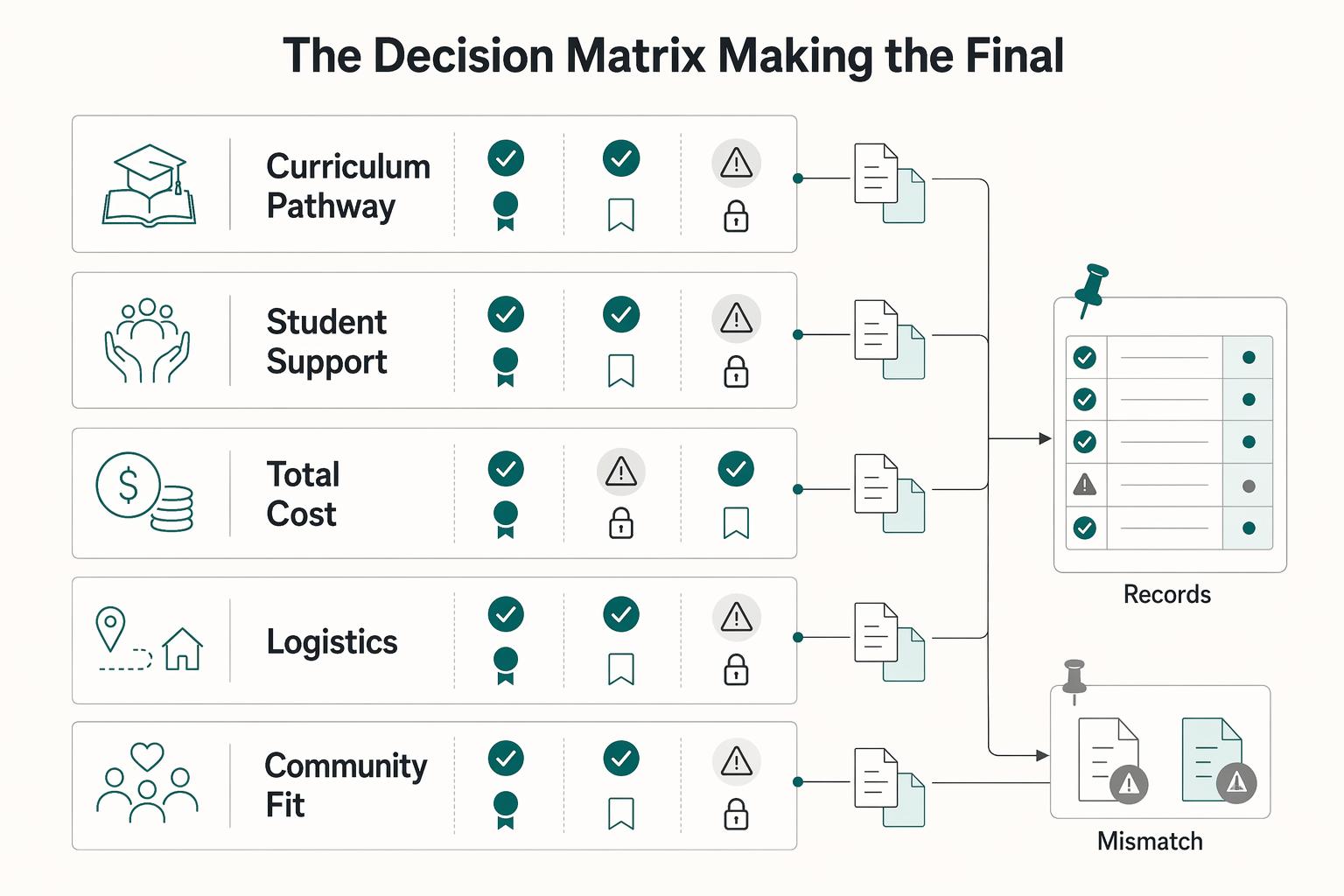
Make the final choice with one evidence-backed matrix: set criteria from your Family Education Charter, weight them, score only verified evidence, then record tradeoffs before you commit.
- Set criteria from your charter, then run a bias check
Start with your charter criteria, for example: pathway fit, student support, language environment, logistics, total cost, and community fit. Split each one into must-have or nice-to-have before scoring. Treat every must-have as pass/fail first so a strong overall score cannot hide a miss on a true non-negotiable.
- Assign weights and score only documented evidence
A decision matrix helps structure real tradeoffs, but it is decision support, not a rulebook. Use a simple scale, for example 1-5, and require one written evidence line for every score from Phases 2 and 3 (document, observation, or follow-up email). If evidence is missing, mark the item as unverified instead of guessing.
| Criterion | Must-have or nice-to-have | Weight % | School A score | Evidence used | School B score | Evidence used | Notes |
|---|---|---|---|---|---|---|---|
| Curriculum / pathway fit | [Must-have] | [ ] | [ ] | Document or visit note | [ ] | Document or visit note | [Tradeoff note] |
| [Student support] | [Must-have] | [ ] | [ ] | Support pathway or follow-up email | [ ] | Support pathway or follow-up email | [Tradeoff note] |
| [Total cost] | [Must-have or nice-to-have] | [ ] | [ ] | [Current fee schedule] | [ ] | [Current fee schedule] | Confirm current fees from each school's official fee schedule |
| [Logistics] | [Nice-to-have] | [ ] | [ ] | Route test or bus details | [ ] | Route test or bus details | Failure mode if traffic or pickup fails |
| [Community fit] | [Nice-to-have] | [ ] | [ ] | Parent or student conversation | [ ] | Parent or student conversation | [Adjustment risk] |
- Choose the top-fit school and write the tradeoffs
When totals are close, avoid fake precision. For each finalist, write: "what fits us best" and "what tradeoff we accept." If your winner depends on unverified entries, pause and close those gaps first.
- Execute admissions and waitlist actions in order
Use one execution checklist so you do not lose quality under pressure:
- Confirm first-choice status with the school.
- Prepare only the documents the school has requested.
- Submit outstanding items in a tracked file set.
- Log every interaction in writing.
- If waitlisted, send meaningful updates only and keep your backup option active until written confirmation.
- Treat enrollment as transition kickoff, not the finish line
After confirmation, request the onboarding sequence, first-week schedule, parent communication channel, and named student-support contact. Then set your family's first routine around real school operations: drop-off, pickup, backup transport, lunch, clubs, and escalation steps for missed transport or support needs. Get support handoff details in writing before day one.
We covered this in detail in The Best Health Insurance for Digital Nomad Families.
Conclusion: Executing Your Most Important Family Project#
Once you have your finalists, the job becomes execution: confirm fit, validate the evidence, choose, and move straight into enrollment. You do not need a perfect school. You need the option that gives your child continuity, fits your budget, and reduces avoidable friction in your Barcelona move.
- One-page priorities
Keep this to one page of non-negotiables: curriculum path, language reality, support needs, commute limit, and community fit. The value is practical. It stops you drifting toward a school that looks strong on paper but clashes with your family's day-to-day.
- Total cost check
Build one current cost sheet per finalist using the school's own fee document, then compare like with like. Budget discipline matters, especially because international schools are usually the highest-fee option even when they are often the strongest choice for continuity.
- On-the-ground due diligence
Visit if you can, and verify the practical details that shape daily life: class size feel, bus availability, language mix, and admissions steps. A useful cross-check is the Barcelona comparison set with 51 listed international schools and fields such as fees, class sizes, and school bus availability.
- Final decision check
Score only what you have verified, not what you assume. The real use is forcing a final choice between two good options without letting branding or stress take over.
Before you submit anything, make sure you have a clean evidence pack: current fee sheet, admissions emails, visit notes, required school records, identity documents, and the NIE and padrón if requested. If you are also considering public or concertado routes, recheck the spring application and points-system timing because that process can be complex for newcomers. Private and international schools often admit directly and may require tests or interviews.
Your next move is straightforward: confirm your shortlist, close the missing evidence, apply early, and align school follow-ups with housing and relocation timing. For most families searching Barcelona's international school market, the right decision is the one that protects continuity, matches your child, and lowers risk across the whole move.
This pairs well with our guide on The Best International Moving Companies for Digital Nomads.
Frequently Asked Questions
How should you budget for international school costs in Barcelona?
Do not compare schools on headline tuition alone. Ask each school for its current fee sheet, then build one line-by-line total that includes tuition plus any required add-ons. In your matrix, mark “Current fee range pending official verification” until you have the official document. The common mistake is comparing one school’s base price with another school’s near all-in quote.
How do you choose between IB and A-Levels?
Treat this as a fit decision, not a prestige decision. Do not assume one pathway is universally better. Schools in Barcelona can follow different curriculum models, and some schools offer more than one pathway. Before you decide, verify the actual options and subject choices in the final years, and ask how the school advises students for your likely university destination.
How should you compare two finalists such as ASB and BSB?
Do not rely on labels like “international,” “bilingual,” or “multilingual” as if they mean the same thing. Use a short comparison grid that forces you to verify curriculum path, assessment style, support model, admissions friction, and fit signals such as commute, parent communication, and whether your child looked comfortable in class. The goal is not to reward the better label. It is to surface the better day-to-day and long-term fit.
What should you prepare for admissions, and in what order?
Start with each school’s own checklist, because documents vary by school and program. In practice, you want one clean folder with identity records, recent school records, and any support documentation your child may need, all named consistently so you do not send older versions by mistake. Confirm each school’s sequence before submitting, including when to apply, when to send requested documents, and whether an assessment step is required. If you are also considering public or concertada routes, verify the official enrollment period and whether neighborhood proximity affects priority.
What language will your child actually learn in?
In many international schools, the main curriculum is taught in English, but schools are generally required to teach Spanish, Catalan, or both as additional languages. Ask four direct questions: which language is used for core subjects in your child’s year, how Spanish and Catalan are taught, what newcomer support exists, and what happens if your child arrives mid-year with limited local-language ability. If you are weighing public or concertada options too, remember that public schools follow the Catalan curriculum and teach mainly in Catalan, with Spanish integrated. For some expat families, that can be a real transition hurdle.
Try a related tool
Researched and edited by the Gruv editorial team. Gruv builds cross-border billing, payouts, and finance-operations software for global businesses.
Sources
- academia.edu/65225077/Metacognitive_Reading_Strategies_of...trusted
- cordis.europa.eu/project/id/289085/reporting/frtrusted
- cordis.europa.eu/project/id/308428/reporting/detrusted
- faa.gov/documentlibrary/media/order/cnt.pdftrusted
- frtr.gov/costperformance/pdf/remediation/principles_a...trusted
- guilford.edu/college-leadership/presidents-messagestrusted
- health.hawaii.gov/heer/files/2021/07/USEPA1992d.pdftrusted
- ntrs.nasa.gov/api/citations/20050139787/downloads/20050139...trusted
Educational content only. Not legal, tax, or financial advice.
Related Posts

Thailand Tax for Digital Nomads Without Residency Mistakes
The most expensive mistakes here happen before anyone opens a tax return. People pick a visa, assume the tax answer comes with it, then try to rebuild the year from scraps after the fact. By then, the damage is usually not one dramatic error. It is a pile of small gaps: an unverified day count, a transfer with no clear purpose note, invoices that do not line up cleanly with payments, and assumptions nobody wrote down when the facts were still fresh.
The Best Cities for Digital Nomads with Families
**Don't pick cities on vibes alone. Compare them with a simple, verification-first framework, then confirm every "yes" with a primary source before you book anything nonrefundable.** When you're moving with kids, not just traveling, you need a process that still works when you're tired, busy, and on a deadline. The operator loop is simple: assess, verify, then execute.
How to Write a Compelling Case Study
A case study should help a buyer make a decision, not just feel good about your work. Treat it as decision evidence: a detailed account of a business problem, the solution you delivered, and the results that followed. The strongest versions use client-centered proof, documented facts, and a clear [challenge-solution-results structure](https://libguides.usc.edu/writingguide/assignments/casestudy). They do not lead with praise, drift into product-centered copy, or make vague claims that sound like promotion.