
Quick Answer
Set up tds for indian freelancers as a three-part operating routine: confirm service classification and PAN details before invoice one, verify credits in Form 26AS each quarter, and reconcile Form 16A against your books before return filing. If a client deduction is missing or inconsistent, treat it as an exception and request correction evidence instead of assuming credit. This keeps cash planning steadier and reduces last-mile filing disputes.
Stage 1: Set four controls before the first payment#
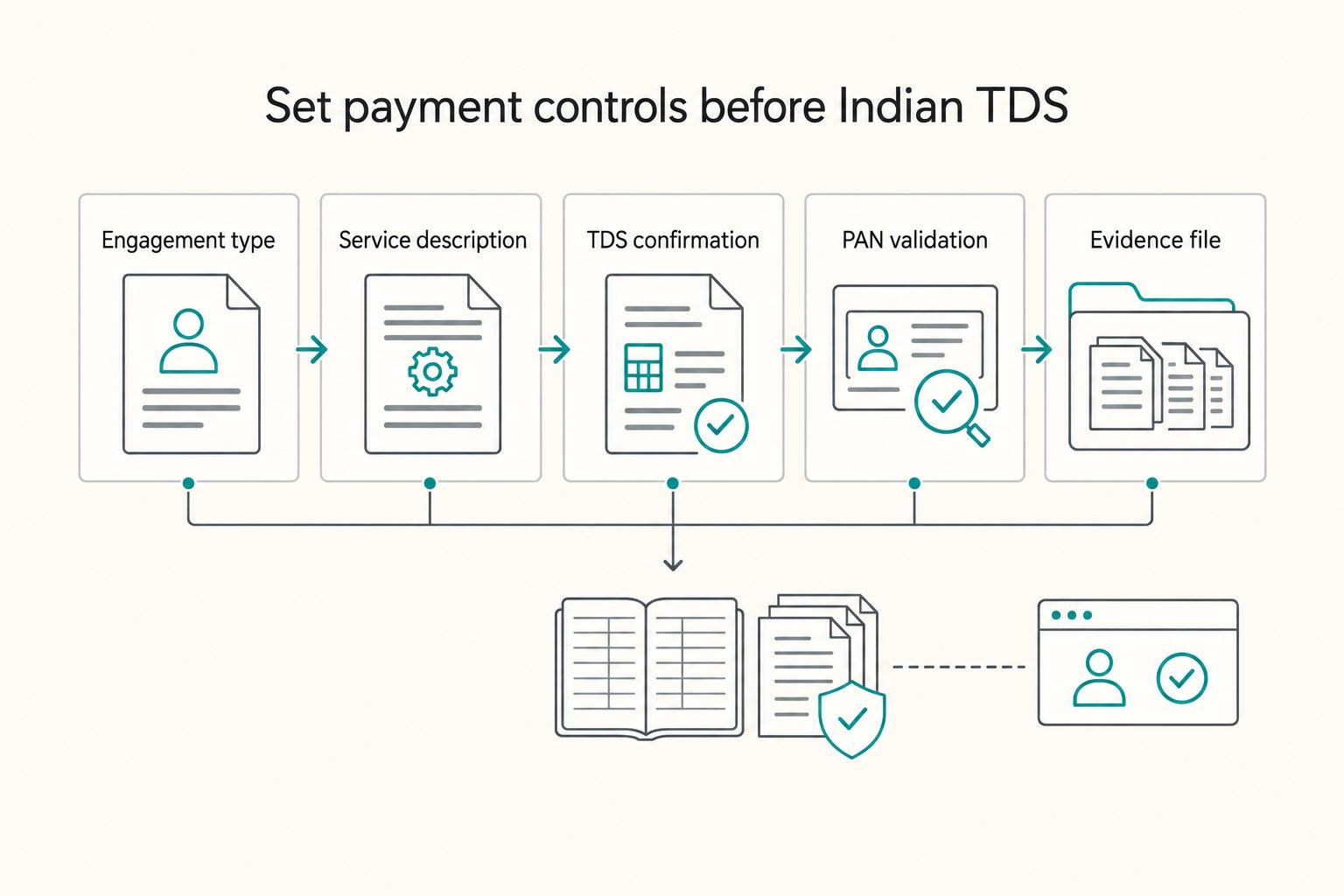
The easiest TDS problems to fix are the ones you prevent before the first payment. Set four controls early: classify the service in writing, keep contract and invoice language aligned, get written confirmation from client finance on deduction setup, and complete PAN validation as an onboarding control.
Your checklist before first payment#
Treat this as the minimum setup before invoice one. If you skip any of these, later reconciliation gets harder than it needs to be.
| Step | Action |
|---|---|
| 1 | classify the engagement type in writing with the client |
| 2 | use the same service description in the contract/SOW and invoice |
| 3 | ask finance to confirm the section they will apply, deduction timing, and TAN used for TDS compliance |
| 4 | provide PAN and get PAN validity confirmed through TRACES |
| 5 | store all proof together, including finance confirmation, contract/SOW, invoice template, PAN details, and Form 16A owner and timeline |
Start with written classification#
Do not rely on a casual invoice label. Section 194J covers resident professional and technical services. Section 194C covers payments for carrying out work, including labour supply. Both operate at the time of credit or payment, whichever is earlier. Use this decision table as a working tool, then verify current applicability and rates before finalizing.
| Your engagement | Section lane to confirm | What finance should confirm in writing | What must match in contract + invoice |
|---|---|---|---|
| Advisory, consulting, design, specialist professional input | Verify current section applicability before finalizing, often Section 194J professional services | Section selected, deduction at credit/payment, verify current rate before finalizing | Professional-services wording is consistent across SOW and invoice |
| Technical implementation or technical services | Verify current section applicability before finalizing, often Section 194J technical services | Treatment as technical services, deduction at credit/payment, verify current rate before finalizing | Technical scope and deliverables match fee line items |
| Execution-style or contractor work | Verify current section applicability before finalizing, often Section 194C | Treatment as contract work, deduction at credit/payment, verify current rate before finalizing | Contract-work wording is consistent and not mixed with advisory terms |
| Scope overlaps categories | Escalate for professional review | Written classification before first payment | Avoid vague or mixed labels |
Ask finance to confirm their setup#
Before invoice one, ask the client finance contact to confirm three things in writing. This gives you a clean record before the first deduction posts:
- which section they will apply after review
- which TAN they will use
- who will issue Form 16A and the quarterly handoff process
Keep that reply. Form 16A is a quarterly non-salary TDS certificate, and Rule 31 requires issuance within 15 days from the due date for the TDS statement under Rule 31A.
Treat PAN as a control, not a formality#
PAN errors are an avoidable failure point, so treat this as a control, not an admin step. Run a simple process: confirm, document, recheck.
- confirm: share PAN exactly as per PAN records
- document: ask the deductor to validate PAN on TRACES and confirm valid status and name match
- recheck: repeat if legal name, billing entity, or client master data changes
Section 206AA can trigger a higher-rate mechanism when PAN is not furnished, subject to stated exceptions and section-specific carve-outs, and an invalid PAN is treated as not furnished. TRACES also flags invalid PAN reporting as a short-deduction default risk for deductors.
Safe default for ambiguous scope#
If the scope is mixed, do not guess. First classify it in writing with the client, then mirror that classification in invoice language, and escalate to a tax professional when professional-services and contract-work boundaries overlap. Do not assume the invoice title alone will protect the treatment.
This matters later because ITR tax credit is restricted to what appears in Form 26AS. Related: Do I Have to Pay State Taxes While Living Abroad as a Digital Nomad?.
Stage 2: The Health Check - A Quarterly Workflow to Master Cash Flow#
Quarterly reconciliation keeps cash planning stable and filing work under control. Use one tracker, one cadence, and one owner for follow-ups so each item sits in a clear state: matched, pending credit, or disputed.
Treat this as a recurring operating step, not a year-end scramble. If you work with a bookkeeper or CA, assign roles up front. They can prepare the reconcile, but one person should own client follow-up and tracker updates.
Your quarterly operator checklist#
Keep the process simple and repeatable. The goal is not a perfect spreadsheet. The goal is to know, each quarter, which credits are verified and which still need action.
| Step | Quarterly action |
|---|---|
| 1 | Pull data on the same cadence each quarter. Download the latest statement/export you use for credit matching and open the matching invoice and payment-ledger period. Save each pull with the date. |
| 2 | Reconcile client by client. Match invoice and payment records against that statement line by line, not as a single total. |
| 3 | Tag every item with one status. Use only matched, pending credit, or disputed, and track quarterly counts and value by status. |
| 4 | Log exceptions immediately. For every non-matched item, record owner, last follow-up date, next action, and current notes. |
Client payment status workflow#
Once the quarterly pull is done, move every item into one clear status. That keeps follow-up disciplined and stops unresolved issues from disappearing into email threads.
| Status | Required action | Owner | Evidence to retain |
|---|---|---|---|
| Matched | Mark verified and include in your working tax-credit total | You or reviewer | Dated statement pull, invoice, payment proof, tracker entry |
| Pending credit | Follow up with client finance and keep out of verified-credit totals for now | You | Invoice, payment proof, follow-up messages, dated tracker note |
| Disputed | Request correction details; if unresolved by next cycle, escalate for professional review | You, then tax professional if needed | Correspondence trail, invoice/payment pack, reconciliation notes, any correction proof shared |
What to send when a credit is missing or mismatched#
Keep the message short and complete. Share the transaction details needed to identify the mismatch, for example invoice or payment references, billed amount, amount received, and a tracker snapshot. Ask the client to confirm current status and whether a correction is in progress.
Request enough proof to verify what action has been taken and what remains open. Keep replies attached to the tracker so unresolved items do not roll forward without context. If the item is still unresolved by your next quarterly pull, escalate to a tax professional.
Feed only verified credits into your tax estimate#
This is the cash-flow rule that matters most: use only matched items in your running tax estimate. Keep pending credit and disputed values in a separate exception bucket until cleared.
After that, apply any advance-tax installment planning only after you verify the latest applicable rules. That keeps your cash plan based on confirmed credits, not assumptions.
For a step-by-step walkthrough, see A Guide to Provincial Sales Tax (PST) for Canadian Freelancers. Before your next quarterly review, standardize invoice details and payment references with the Free Invoice Generator.
Stage 3: The Payoff - Reconciling TDS to Maximize Your Tax Refund#
As you get ready to file, evidence matters more than expectation. Use only credits you can verify in Form 26AS, and treat everything else as an exception queue. Run this pass client by client so your refund number is based on records, not assumptions.
Pre filing sequence#
Start by collecting the latest Form 16A for every quarter with non-salary TDS. Check that each certificate clearly maps to one Financial Year, quarter, TAN, and PAN combination. If it does not, keep it in exception status.
Then pull and save dated copies of Form 26AS and AIS. Official pages are not perfectly aligned on how they describe 26AS scope. One describes it as consolidated annual information, while AIS FAQ says 26AS on TRACES shows TDS/TCS data from AY 2023-24 onward. In practice, use 26AS as your claimable-credit base and AIS as a broader cross-check.
Next, reconcile three ways, line by line, for each client:
- Your invoice, ledger, and bank records
- Form 16A from the payer
- Form 26AS under your PAN
Match amount, date, deductor identity, and withheld tax for each entry. If Form 16A shows a deduction but 26AS does not, do not include that credit in filing totals yet.
Prepare your ITR credit figure only after this pass. Rule 37BA ties credit to deductor-furnished data plus your return claim, and portal guidance states your claim is restricted to what appears in Form 26AS.
Your action matrix#
Use this as the practical triage table before filing. It tells you what to trust, what to question, and what to fix first.
| Source document | What to verify | Common mismatch | Immediate fix path |
|---|---|---|---|
| Form 16A | FY, quarter, TAN, PAN, deductor name, TDS amount | Certificate does not map cleanly to your PAN or quarter | Ask payer finance to confirm mapping and filing status; if needed, they must file a revised TDS return |
| Form 26AS | Entry appears under your PAN at the amount you plan to claim | Certificate exists but 26AS is missing or lower | Exclude from claim total and request deductor correction filing |
| AIS | Data broadly aligns with your return prep | AIS suggests omission or timing gap | Use as a flag, then reconcile against 26AS and payer records |
| Invoice, ledger, bank proof | Gross fee, date, net receipt, withheld tax | Booked deduction differs from actual payment or deduction trail | Correct books first, then pursue payer-side tax entry correction |
A Form 16A PDF alone is not enough for filing confidence. The credit must flow through deductor filing into 26AS if you want to claim it cleanly.
If a mismatch stays open#
If an item is still open close to filing, tighten the evidence pack instead of relying on memory. Keep a dated 26AS pull, AIS pull, Form 16A, invoice, bank proof, ledger extract, and full payer correspondence for each open item. ITR filing is annexure-less, but you still need documents ready for assessment or inquiry.
Send a follow-up to payer finance covering three points, and if they use TRACES, ask whether they pulled the Justification Report to support correction filing:
- Whether they identified the mismatch
- Whether a revised or correction statement is being filed
- Expected date for corrected reflection
Escalate to a tax professional when the amount is material, facts are disputed, or the issue remains open close to filing. Given published correction time bars, move faster for older periods. Portal notices reference a 31.03.2026 deadline for specified legacy correction statements and a two-year correction window from the end of the relevant tax year under the new-act context.
Decide refund versus balance tax#
Before you file, split credits into two buckets: verified credits and assumed credits. Verified credits are in Form 26AS and matched to your books. Assumed credits are promised, certificate-only, or under correction.
Use this rule before you file:
- If
verified credits> final tax liability, expect a refund. - If
verified credits< final tax liability, pay the balance. - Do not add
assumed creditsto improve the refund number.
If you use presumptive taxation, document the computation separately and verify current-year law before finalizing. Historical reference points often used include ₹50 lakh gross-receipt eligibility, a conditional ₹75 lakh substitution, and 50% deemed profits under published 44ADA text. Do not assume those labels apply unchanged after 01.04.2026. Keep the current eligibility rule and computation basis marked as pending adviser or official-source verification in your filing notes.
If you want a deeper dive, read Digital Nomad Taxes in 2026 With a Defensible Filing Plan.
The Next Threshold: From Taxpayer to Tax Deductor#
When you start paying other freelancers, your role can change. You are no longer only protecting your own TDS credit. You may also need to handle deduction and reporting. Run a trigger check on your own business first, then keep the current deductor threshold pending adviser or official-source verification. If the verified threshold is met, your role changes from claiming TDS credit to maintaining TDS records for someone else.
Operator workflow (in order)#
Sequence matters here. The cleanest way to avoid downstream correction work is to classify the payment before release and build deduction into the payment process itself.
- Register as a deductor
Verify the live registration requirement, identifier, and portal path before the first payment that may require withholding; keep the current deductor registration step pending official verification until that check is complete.
- Classify each vendor payment before release
For resident professional or technical services, the grounded route here is Section 194J. The cited checkpoint is 10% when annual payments exceed Rs 30,000. Do not auto-apply that treatment to every payment type.
- Deduct and deposit on the live schedule
Build this into payment approval, not post-payment cleanup; keep the current rate by payment type, deposit due date, and challan/form pending adviser or official-source verification before release.
- File periodic TDS returns
Filing quality can affect whether the payee can claim credit cleanly; keep the current return form and due dates pending official verification before filing.
Common payer scenarios#
The mistake to avoid here is over-applying one section to every vendor payment. Start with the nature of the payment, then confirm the correct route.
| Payer scenario | Section route to check | Default treatment | Escalate to a tax professional when... |
|---|---|---|---|
| Resident professional/technical freelancer | Section 194J (explicitly cited) | Check annual total against Rs 30,000 and verify the current rate, cited reference uses 10% | Scope mixes services, reimbursements, software access, or non-cash consideration |
| Contract-style execution work | Do not assume 194J | Keep classification open until the correct section is verified | Before first payment if classification is unclear |
| Non-resident payee | Cross-border withholding route needs separate verification | Do not process using resident assumptions until treatment is confirmed | Treaty, residency, or place-of-service treatment is unclear |
If payment includes freebies, barter, or other non-monetary benefits, treat it as a review trigger. 2026 commentary still flags ambiguity in these cases, and provisions such as Section 194R may be relevant depending on facts.
Form 16A handoff execution#
Once deduction, deposit, and filing are handled correctly, the handoff to the contractor should be cleaner. If Form 16A applies in your case, issue it on the currently applicable schedule, and verify current timing before you build it into your process. Keep the handoff pack tight and traceable: certificate copy, payee identity fields as recorded, amount paid, tax deducted, and FY and quarter mapping used in your records.
Your quality check is simple: can the contractor reconcile your certificate to their books and tax-credit records without guesswork?
Monthly controls checklist#
If you are now deducting TDS for others, do not wait for quarter-end to discover a process gap. Keep a short monthly control set and review exceptions early.
| Control area | What to review |
|---|---|
| Onboarding records | identity and tax details collected, payment classification note, and billing profile in your records |
| Monthly reconciliation | books vs payment register vs deduction workings vs deposit proof vs filed-return data |
| Exception log | missed deduction, wrong classification, wrong amount, or correction filing tracked with owner, date, and contractor communication |
If classification is unclear, pause before payment. That is the lowest-cost control point. You might also find this useful: The Freelancer's Guide to Presumptive Taxation in India (Section 44ADA).
Set terms early, verify credits, and reconcile before filing#
The practical way to handle TDS is as a control loop, not a filing-season surprise. Set the terms early, verify credits through the year, and reconcile before you file. That is what turns a messy compliance task into something you can manage.
Stage 1 removes ambiguity upfront. Confirm payment classification and TDS handling in writing, such as a contract clause or engagement note. Keep your records aligned: signed scope, invoice number, amount, payment date, and the PAN details your client has on file. Since the Income Tax Department homepage states the Income-tax Act, 1961 stands repealed effective 01.04.2026, do not rely on old Section 194J summaries. Check current law text and portal guidance before assuming a section, threshold, or deduction logic.
Stage 2 is your operating check. Review Form 26AS as your tax-credit view, compare it with what the client says was deducted, and request Form 16A for matching. For non-salary payments, Form 16A is issued for a given financial year, quarter, TAN, and PAN, so quarter or PAN mismatches can disrupt your credit trail even when tax was deducted. Keep a follow-up trail with invoice reference, amount, date, and correction requests.
| Reactive workflow | Controlled workflow |
|---|---|
| Behavior | Waits until return filing to check TDS |
| Expected outcome | Cash-flow surprises and slower credit resolution |
| Typical failure point | Missing Form 16A, wrong quarter, PAN mismatch, stale section assumptions |
Stage 3 protects your final claim. Reconcile Form 16A against Form 26AS before entering credit in your return because ITR credit is restricted to what appears in Form 26AS. If records still differ, ask the deductor to file a revised TDS return. When records do not match or classification is unclear, pause filing assumptions and escalate to a qualified tax professional.
We covered this in detail in A Guide to Mexico's RFC Number for Foreign Freelancers.
If you want one workflow to collect client payments and keep payout records traceable, review Merchant of Record for Freelancers.
Frequently Asked Questions
What is the TDS rate for professional services for freelancers in India?
Start with classification, not the rate. If your work is being treated as resident professional or technical services, check Section 194J in the live law text before you credit the amount or release payment. Treat the current rate and threshold as pending adviser or official-source verification for the payment date, not as values to pull from memory or old summaries. Keep your evidence pack tight with the signed scope, invoice, and valid PAN record, and escalate to a tax professional if the scope mixes consulting, software access, reimbursements, or technical support.
How do I check if my client has deposited my TDS?
Check Form 26AS and AIS together. From AY 2023-24 onward, 26AS primarily shows TDS/TCS-related data, and AIS is the broader information view used for filing checks. If something is missing, go to Services > Tax Credit Mismatch in the portal workflow and review the mismatch details there. Request deduction confirmation, payment reference, and Form 16A from the client, and escalate to a tax professional if deducted amounts still do not match deductor-furnished records.
What is the difference between Section 194J and 194C for a freelancer?
The key difference is the nature of the work. Section 194J covers professional or technical services, while Section 194C covers contract work, including labour supply, and amounts covered by 194J are carved out from 194C scope. Check the signed scope, confirm the section in current law text, and keep a short classification note in your records before payment. | Comparison point | Section 194J | Section 194C | | --- | --- | --- | | Classification trigger | Professional or technical services | Carrying out work under contract, including labour supply | | Rate bucket | Confirm the current 194J rate with the tax authority or advisor | Confirm the current 194C rate with the tax authority or advisor | | Threshold rule | Confirm the current 194J threshold with the tax authority or advisor | Confirm the current 194C threshold with the tax authority or advisor | | Common misclassification consequence | Wrong or excess withholding and harder credit reconciliation | Under-withholding risk, correction filings, and possible default exposure | Escalate to a tax professional if the invoice label and the actual substance of work do not clearly match.
Do I need to deduct TDS if I hire another freelancer?
Possibly, but do not rely on old turnover cutoffs. Confirm whether you are currently a person responsible for deducting TDS and whether you need a TAN before first payment. Check current deductor guidance on the tax portal, confirm the right section for the vendor payment, and collect PAN, contract, invoice structure, and your classification note. Escalate to a tax professional if the payment includes non-cash elements, barter, or unclear reimbursements.
What should I do if TDS is deducted but not showing in Form 26AS?
Treat it as an immediate exception, because credit depends on deductor-furnished information, not just what appears on an invoice. Recheck 26AS and AIS, then send the client invoice number, amount, date, and PAN details exactly as recorded and request filed TDS details, correction status, and Form 16A if available. Escalate to a tax professional if PAN, amount, quarter, or section code still does not reconcile.
What if my PAN is missing or wrong in the client’s records?
Fix it before the next payment. Under section 206AA, missing or invalid PAN can trigger higher-rate deduction logic. Verify the PAN in the client vendor master, submit the correction in writing, and keep the confirmation email or onboarding update as evidence. Escalate to a tax professional if higher-rate deduction has already happened and quarter-level correction steps are still unresolved.
Try a related tool
Researched and edited by the Gruv editorial team. Gruv builds cross-border billing, payouts, and finance-operations software for global businesses.
Sources
Includes 3 external sources outside the trusted-domain allowlist.
- incometax.gov.in/iec/foportal/ais-faqtrusted
- incometaxindia.gov.in/_layouts/15/dit/Pages/viewer.aspxtrusted
- incometaxindia.gov.in/tax-deductortrusted
- snap.berkeley.edu/project/10053261trusted
- m.economictimes.com/wealth/save/multiple-income-sources-heres-ho...external
- oboe.com/learn/indian-tds-compliance-and-practice-1c1...external
- taxguru.in/income-tax/guide-taxation-freelancers-influe...external
Educational content only. Not legal, tax, or financial advice.
Related Posts

Digital Nomad Taxes in 2026 With a Defensible Filing Plan
With digital nomad taxes, the first move is not optimization. It is figuring out where you may be taxable, where filings may be required, and what proof supports that position.

Do I Have to Pay State Taxes While Living Abroad as a Digital Nomad?
Living abroad does not end `state income tax` exposure by itself. The first decision is practical: choose a filing position your facts can support, then build records that support the same story all year.

Section 44ADA for Freelancers in India Who Need a Defensible Filing Path
For a globally mobile freelancer, a safer tax move is the one you can defend six months later, not the one that feels fastest this week. Start with classification under `PGBP`, test whether `Section 44ADA` actually fits your facts, then file with records that support every major number you report.