
Quick Answer
For 2026, Cyprus tax residence requires more than 183 days in Cyprus, or all conditions of the 60-day rule: at least 60 Cyprus days, no more than 183 in another single state, a permanent owned/rented Cyprus home and qualifying activity or office that is not terminated during the year. Being resident elsewhere no longer itself disqualifies the 60-day route. Immigration permission, treaty residence and non-dom status require separate analysis.
Decide Whether Your Facts Support a Cyprus Residency Position#
For 2026, an individual can become Cyprus tax resident by spending more than 183 days there in the calendar year, or by meeting all conditions of the 60-day rule. Choose the route your travel, home and activity facts support. Then assess any other country’s residence and tax claims separately.
The two routes do not impose identical conditions. The more-than-183-day test is a physical-presence test; the 60-day test adds a Cyprus home and qualifying activity, plus a limit on time in another single country. A company, a visa and non-dom treatment each have separate rules. None automatically settles the other tests.
Working definitions for this guide:
- Individual tax residence: More than 183 days in Cyprus, or all conditions of the 60-day rule for the same calendar tax year.
- Non-dom: Domicile status for Special Defence Contribution (SDC), distinct from tax residence and immigration permission.
- Qualifying activity: Cyprus business/employment or an office in a Cyprus tax resident person for the 60-day test.
- Company residence: Management and control in Cyprus, or Cyprus incorporation subject to an applicable treaty override under the 2026 rule.
The roadmap is straightforward. Phase 1 is go or no-go: your day-count path, required ties, and cross-border risk check. Phase 2 is execution: residence, registrations, filings, and company evidence. Phase 3 is maintenance: keeping the position defensible each year.
| Decision | Evidence to keep | Issue to resolve |
|---|---|---|
| Residency route | Live day log and travel records; for 60-day, owned/rented permanent Cyprus home and activity records | Exactly 183 days is insufficient for the more-than 183 route; 60 alone without ties is insufficient |
| Other-country position | Its residence tests, filings and supporting timeline | Cyprus residence does not automatically end other-country residence |
| Immigration permission | Permit and permitted-work conditions | A digital-nomad permit for overseas work does not automatically allow local employment |
| Administration | Tax registration, return/payment calendar and income records | A tax number or certificate does not replace the underlying facts |
The digital-nomad scheme is for eligible non-EU/non-EEA nationals working remotely for overseas employers or clients, with stable net monthly income of at least €3,500 after taxes and contributions. It initially grants one year, renewable for up to two more. Check permitted activity before using a Cyprus employment or business role for the 60-day test; tax eligibility does not grant immigration work rights.
For the wider cross-border filing process, see digital nomad taxes. Use the Cyprus rules below for the local residence decision.
Phase 1: The Go/No-Go Strategic Assessment#
Assess the entire calendar year. Record Cyprus days, days in each other country, the home available in Cyprus and any qualifying activity. Separate the domestic Cyprus result from a possible treaty result when two countries both consider you resident.
Define the terms once#
A permanent home for the 60-day rule is an owned or rented residential property, not an immigration “permanent residence” permit. Domicile concerns SDC; incorporation concerns a company. These distinctions prevent a lease, visa or company certificate from being used as proof of a different status.
| Term | Definition | Key detail |
|---|---|---|
| Individual tax residence | Cyprus domestic residence for a tax year | More than 183 days or all 60-day conditions |
| Non-dom | Domicile classification for SDC | Separate test; 17 of 20 prior tax-resident years can cause deemed domicile |
| Company residence | Management/control or incorporation rule | 2026 incorporation subject to treaty override |
| Treaty residence | Applicable treaty allocates residence for its purposes | Test the actual treaty when domestic residence overlaps |
Pick the route you can prove, not the route you prefer#
| Decision factor | More than 183 days route | 60 day route |
|---|---|---|
| Presence | More than 183 Cyprus days in the tax year | At least 60 Cyprus days |
| Other-country days | No additional other-country-day condition in this test | Not more than 183 days in any other single state |
| Cyprus ties | No additional 60-day housing/activity conditions | Permanent owned/rented Cyprus home and qualifying business, employment or office |
| Continuity | Document actual presence | Qualifying activity/office must not be terminated during the tax year |
| Other tax residence | May still create dual residence | From 1 Jan 2026, tax residence elsewhere no longer itself disqualifies; treaty issues remain |
For example, 184 counted Cyprus days can satisfy the physical-presence route without the extra home/activity conditions of the 60-day test. A person with 61 Cyprus days and a rented home still fails the 60-day route if there is no qualifying activity or office. Exactly 183 Cyprus days does not meet the more-than-183-day test, though the 60-day route may apply if its conditions are met.
The 2026 change is settled in Law 244(I)/2025: the former requirement not to be tax resident elsewhere was removed from the 60-day definition. The other conditions remain. Do not carry an older summary or declaration into a 2026 decision without checking the applicable year.
Model outcomes as a framework, not a headline#
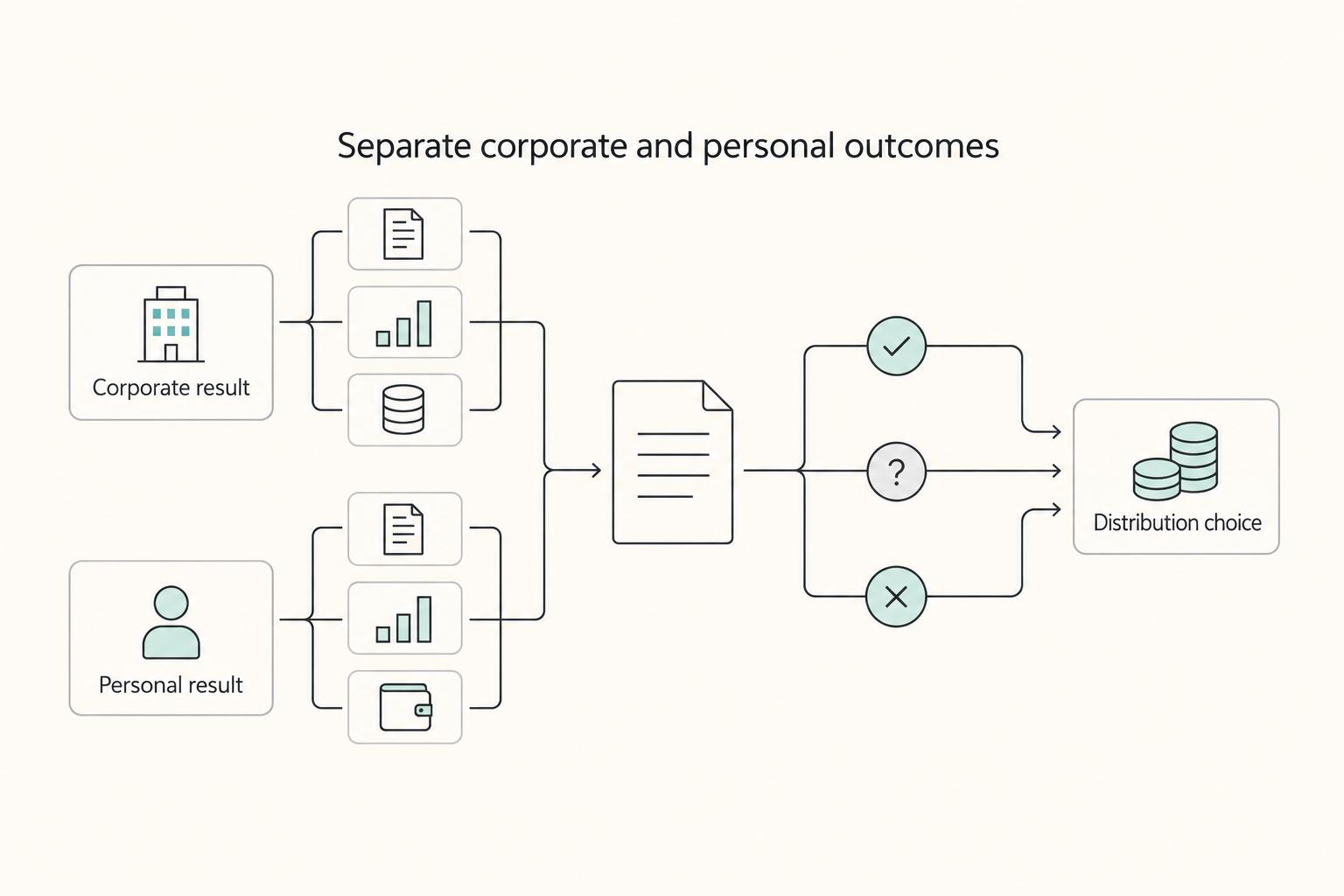
Model company profit, personal income and distributions separately. For 2026, the standard corporate rate is 15%, while personal taxable income uses progressive bands. Non-dom affects SDC on relevant passive income; it does not exempt salary, business profit or applicable healthcare contributions.
| Layer | Include | 2026 control |
|---|---|---|
| Corporate | Taxable profit after allowable expenses; salary costs; retained earnings | Standard corporate tax 15%;test company residence and any specific relief |
| Personal | Salary/self-employment income; allowable deductions; contributions | Apply personal bands and separately test employment relief/social insurance/GHS |
| Distribution | Dividends/interest, domicile history, source-country withholding | Do not equate SDC exemption with exemption from every charge |
For example, €50,000 of personal taxable income after allowable deductions gives income tax of €6,900 under the 2026 bands: €10,000 × 20% + €10,000 × 25% + €8,000 × 30%. This excludes separately applicable contributions and foreign tax. It is a taxable-income example, not a €50,000 gross-salary take-home quote.
- Corporate layer: Model profit, salary cost, retained earnings, and company residence assumptions together.
- Personal layer: Model salary, fees, and bonus together with personal tax, healthcare, and social contributions.
- Distribution layer: Treat dividends and interest separately, then overlay SDC-related non-dom treatment.
A company with €100,000 of taxable profit at the standard 15% rate has €15,000 corporate tax and €85,000 after that tax. A distribution is a separate shareholder event: assess domicile/SDC, GHS and foreign withholding before estimating personal cash received. Company formation is not an automatic route to a combined 15% tax burden.
Stop/go criteria and escalation triggers#
- Proceed with the residence analysis: Your counted days and, if needed, Cyprus home/activity evidence satisfy the chosen test.
- Resolve cross-border issues: Another country may still treat you as resident, or a treaty and credit/exemption claim affects how income is taxed.
- Do not claim an unsupported route: Fewer than 60 Cyprus days or missing 60-day conditions cannot be cured by buying a registered-office address. Meeting the more-than 183-day route remains a separate possibility.
Treaty residence often follows permanent home, centre of vital interests, habitual abode and nationality, with mutual agreement if needed. Read the actual treaty, including any modifications. HMRC describes the usual sequence; it is not a universal Cyprus treaty result. Source-country tax and reporting can remain even after treaty residence is resolved.
Keep a separate list of countries that may tax each income stream. Residence, source taxation and treaty relief are different questions; a move does not erase a prior-year return or a continuing filing duty.
The Tax Residency Tracker can help maintain a travel log. Check its counting settings against Cyprus law and retain the underlying records; a counter alone cannot establish qualifying ties or treaty residence.
Phase 2: Build the Evidence During the Tax Year#
If Phase 1 is a real go, this phase is about evidence. A defensible residency position is built by facts you can prove during the tax year, not by paperwork you assemble after year-end.
Step 1: Build the legal facts before filing#
For the 60-day route, document at least 60 Cyprus days, no more than 183 in any other single state, a permanent Cyprus home you own/rent, and qualifying Cyprus business/employment or an office in a Cyprus tax resident person. If that qualifying activity/office terminates during the year, the 60-day condition can fail for the whole year. Do not treat it as merely losing status from the termination date.
A director’s office must be in a Cyprus tax resident entity; simply incorporating a company is not proof of every individual condition. If a company fits your commercial work, retain incorporation, registered-office, directors/secretary and shareholder records together with evidence of the actual office and activity.
Under the 2026 definition, a company is Cyprus resident if managed and controlled there or incorporated there, unless an applicable double-tax treaty provides otherwise for the incorporation route. Keep real decision records, contracts and operational evidence. Foreign management can still create another-country residence or permanent-establishment issue even where Cyprus incorporation establishes domestic residence.
Step 2: Lock residence proof and travel proof early#
For the 60-day route, permanent residence means a permanent residential property in Cyprus that is owned or rented in the tax year. This is a tax-residency condition, not the same as immigration status.
Keep the lease/deed and supporting occupancy records. Cyprus counts arrival as an inside day and departure as an outside day; arriving then leaving the same day counts inside, while departing then returning the same day counts outside. Reconcile tickets with actual journeys rather than hotel nights.
An arrival on 1 March 2026 followed by departure on 1 May gives 61 Cyprus days: 31 in March and 30 in April. That can meet only the day limb of the 60-day route. If a qualifying office terminates in October, the remaining conditions still need reassessment; a 61-day trip does not guarantee residence.
Step 3: Use registrations as confirmation, not as substance#
Registrations document your position. They do not create it.
Create a TFA account and submit the Tax Register registration request online. Retain the case reference and issued TIN. The government registration guide identifies VAT application Form TD 1101 and supporting evidence of taxable activity. Where the TIN request is pending, that guide permits the REG case reference on the VAT application; it is not necessary to pretend the number has already been issued.
Keep your checklist current, especially where live portal details can change:
- Create the TFA account, select the appropriate individual Tax Register request and supply the identity/status documents requested for your circumstances.
- Attach supporting address/activity records as required, retain the submission/reference and respond to information requests.
- Keep the issued TIN and any residence-certificate application/decision separately from the underlying travel, home and activity records.
Use the current Tax Department document list for your identity and immigration category. If seeking a residence certificate, make the declaration for the correct year and legal test. Older forms can still contain pre-2026 resident-elsewhere wording; ask the Department for the applicable form rather than making a false declaration.
Step 4: Resolve other-country residence and filing duties#
A strong Cyprus file does not solve dual-residency risk by itself.
Evidence depends on the other jurisdiction: travel days, available homes, family and work ties, deregistration or departure filings where required, and any residence decision. From 2026, proving non-residence elsewhere is not a separate Cyprus 60-day condition. It remains relevant to foreign tax and treaty outcomes.
If both countries treat you as resident, obtain advice on the treaty and relief claims while maintaining due returns and payments. An unresolved residency question does not itself postpone a filing deadline.
| Task | Owner | Evidence to file | Common failure mode |
|---|---|---|---|
| Maintain a qualifying activity/office if relying on 60-day ties; use a company only if commercially appropriate | You + local corporate provider | Incorporation certificate, registered office certificate, directors and secretary certificate, shareholder certificate | Company exists on paper while management decisions happen outside Cyprus |
| Secure and maintain Cyprus home | You | Lease or ownership proof and supporting records | Lease period or named tenant details do not support the tax-year position |
| Maintain residency day evidence | You | Day log and travel records | Travel history reconstructed late, and day counts become unreliable |
| Complete tax registration workflow | You or adviser | TFA submission records, T.I.N. confirmation, current required attachments for your route | Wrong-year declarations, missing requested documents or treating a TIN as proof of residence |
| Assess other-country residence/source tax | You + relevant adviser | Its domestic tests, required filings, treaty analysis and tax credit/exemption records | Assuming Cyprus residence automatically ends foreign obligations |
Escalate a specific gap: missing qualifying activity, inconsistent travel dates, actual foreign company control or competing residence claims. Identify the affected tax year and filing action. Continue compiling the records and meeting due obligations rather than putting every tax task on hold.
A useful annual file includes travel/home/activity records, the applicable residence test, income schedules by country, tax paid abroad and the treaty or relief basis actually used.
Phase 3: Maintain the residence and filing position#
Optimization is not a one-time cleanup. It is an operating cadence. Your residency position stays defensible when you review the right controls monthly, quarterly, and annually.
Run a monthly, quarterly, annual cadence#
| Cadence | What to review | Why it matters |
|---|---|---|
| Monthly | Reconcile travel and home/activity records; record company decisions where relevant | Catch counting/continuity errors and changes in foreign exposure |
| VAT period | Review invoices, place of supply, return and payment calendar if registered | Use assigned VAT periods; do not infer the period from personal residence |
| Annually | Retest residence/domicile; estimate income tax; prepare returns and relief claims | Apply 2026 filing rules separately from prior-year returns |
Invoicing controls by client type#
The table below concerns general-rule B2B services, with a separate row for exceptions and consumers. Property-related, event and other special services require their own rule. EU invoicing guidance requires “reverse charge” where the customer is liable; use the proper VAT basis rather than treating every foreign invoice as zero-rated.
| Customer/supply | VAT analysis | Invoice treatment | Evidence |
|---|---|---|---|
| EU business: general-rule B2B service | Normally taxable where business customer is established; reverse charge where conditions met | Include reverse charge where customer liable, with required customer VAT details; not merely a 0% label | Status/establishment proof, dated VIES check where applicable, contract, invoice and payment |
| Non-EU business: general-rule B2B service | Generally outside Cyprus place of supply, subject to service-specific exceptions | Show the supported outside-scope treatment; do not call it a Cyprus exemption simply because customer abroad | Business/establishment proof, service classification, contract/invoice/payment |
| UK business: general-rule B2B service | Third-country service analysis; GB numbers are not checked through VIES | Use the supported place-of-supply basis; XI goods rules do not convert UK services into EU services | UK business evidence and transaction-specific analysis |
| Consumer or exceptional service | B2C and exceptions have different place-of-supply rules | Determine local VAT/destination/OSS duties before invoicing | Customer status, service category and location evidence |
Separate each income stream by tax layer first#
Start by identifying who earns the income, then apply the right control layer.
| Income stream | Control layer | Assessment |
|---|---|---|
| Corporate income | Company layer | Assess company residence and bookkeeping quality first |
| Salary | Individual income, payroll control | Track through PAYE withholding controls |
| Dividends | Individual passive income | Assess SDC exposure based on tax residence plus domicile status |
| Interest | Individual passive income | Assess separately from salary and trading income |
| Royalties | Company or individual, depending on structure | Classify the recipient first, then verify Cyprus and source-country treatment before invoicing or repatriation |
Apply the 2026 personal bands and corporate rate to the appropriate recipient. Specific tax incentives have their own conditions:
- Company profit: Standard corporate tax is 15% from 2026; allowable expenses and specific reliefs affect taxable profit.
- Salary/business income: Personal bands are 0% to €22,000; 20% above €22,000 to €32,000; 25% to €42,000; 30% to €72,000; 35% above €72,000. Payroll/social insurance/GHS need separate treatment.
- Dividends: Non-dom can exempt relevant dividends from SDC; domicile and profit year transitional rules matter if SDC applies. GHS and foreign withholding can remain.
- Interest: Separate passive interest from trading/business interest; SDC non-dom treatment does not make every interest-related receipt exempt business income.
- Royalties: Identify the individual/company recipient, source and actual activity. A special IP regime requires its eligibility/nexus conditions; ordinary consulting income does not become qualifying IP income by renaming it.
Compliance control framework#
The calendar below is for 2026 tax-year planning. Return type, obligation to prepare audited/reviewed accounts and any official extension determine the actual due date. Keep a separate calendar for older tax years, whose dates and portals may differ.
| Filing | Owner | Trigger | Evidence retained | Escalate when |
|---|---|---|---|---|
| VAT return/payment | You/accountant | Assigned period; generally 10th day of second month after period end | Return, invoices and receipt | Changed place of supply/status; confirm assigned period/portal |
| Provisional income tax | You/accountant | Normally 31 July and 31 December of the tax year; business starting after 30 June pays the applicable provisional tax by 31 December | Estimate, management accounts and receipts | Profit changes or business begins after 30 June |
| Individual without audited/reviewed accounts obligation | You/adviser | 2026 return/self-assessment normally 31 July 2027, subject to official extension | Return, income/relief schedules and payment | Wrong-year deadline or missing foreign income |
| Company/individual required audited or reviewed accounts | You/accountant | 2026 return and balancing self-assessment normally 31 January 2028 | Accounts, computation, return and receipt | Using old 1 August payment/15-month return rules |
Plan the non-dom horizon and its separate contributions#
Non-dom is a domicile determination, not a benefit granted by nationality alone. Track Cyprus tax-resident years: 17 of the 20 years immediately before the tax year can cause deemed domicile. Under the 2026 provisions, acquired deemed domicile persists until the required 20 non-resident years are completed; a brief move does not reset it.
The Tax Department also describes an alternative SDC method for eligible individuals without Cyprus domicile of origin who become deemed domiciled: two additional five-year periods at €250,000 per period, subject to conditions and application. This is a specific paid election, not an automatic extension for all residents.
GHS is separate from SDC. The Health Insurance Organisation lists 2.65% for income earners such as dividends/interest, 4% for self-employed remuneration and an aggregate annual contribution base cap of €180,000 per person. Non-dom alone is not a GHS exemption; contribution liability and entitlement to healthcare are also separate questions.
Conclusion: Cyprus as a Deliberate Business Strategy#
Choose the route from actual days and qualifying facts, keep the supporting records, then assess other-country obligations. A 60-day plan can preserve travel flexibility, while more than 183 days can remove the added 60-day conditions. Neither route resolves immigration, domicile or company tax by itself.
Use the 2026 rules for 2026: the resident-elsewhere disqualification was removed from the 60-day test, standard corporate tax became 15%, and personal bands now start with €22,000 at 0%. Tax Register registration is through TFA, and income returns for 2026 onward move to TFA. Older returns can still use earlier workflows.
What changes for you:
- Residence: apply the correct year test and preserve day/home/activity evidence.
- Tax layers: distinguish company profit, personal income, SDC and GHS rather than promise a single effective rate.
- Filing: from 2026, residents aged 25–70 generally must file even without income; covered income also creates obligations regardless of age, subject to applicable official exclusions.
- Accounts/calendar: the self-employed audited/reviewed-account turnover threshold rises from €70,000 to €120,000 for 2026; use the resulting return category and current deadline.
Safe default next steps:
- Validate your filing and residency position before filing, and reconcile your timeline records so they tell one coherent story.
- Align company and pay structure with that status before recurring payments begin, and keep payments fully traceable.
- Maintain an annual evidence pack for residency, pay, banking, and cross-border status records.
Ask for cross-border advice on the specific competing residence, foreign source income or company activity facts. Keep the due filing/payment calendar active while the issue is resolved.
For the next review, test one planned trip against the counting rules, one qualifying activity against its continuity requirement, and one income stream against its return and contribution obligations.
If you want a compliance-first setup to invoice clients, receive funds, and run payouts with traceable records, talk to Gruv to confirm coverage for your market.
Frequently Asked Questions
How do you choose between the 183-day rule and the 60-day rule?
The physical-presence route requires more than 183 Cyprus days in the calendar year. The 60-day route requires at least 60 Cyprus days, no more than 183 in any other single state, a permanent owned/rented Cyprus home and qualifying activity or office that is not terminated during the year. From 2026, residence elsewhere no longer itself disqualifies the 60-day route; foreign tax and treaty duties still need assessment.
What do these terms mean in plain English?
Tax residence determines the domestic tax scope for a year; treaty residence may differ for treaty purposes. Non-dom concerns domicile and SDC. A permanent Cyprus home under the 60-day test is different from permanent immigration residence. Company management/control is a separate company-residence question.
What evidence should you keep before relying on a residency position?
Keep a day log and reconcile it to your travel records throughout the year. Keep the documents that support the route you plan to use. If you are relying on the 60-day route, that includes Cyprus property evidence and proof that your Cyprus business, employment, or directorship tie continued through the year. Your position is weaker when your facts and records do not match.
When is a tax position strong enough to use on a return?
Use the legal test for the correct year and retain the facts that support it. Where a specific point is unresolved, seek advice promptly and follow the applicable filing/correction procedure. Incomplete evidence or a pending certificate does not automatically extend the deadline.
How do you show you are not still tax resident in another country?
Review that country’s actual residence and departure rules and retain any required filings. From 2026, Cyprus 60-day eligibility does not require non-residence elsewhere, but the restriction on more than 183 days in any other single country remains. Dual residence may require the applicable treaty and relief claims.
Can you assume dividends are tax-free once you become resident?
No. Non-dom can remove SDC on relevant dividends, but GHS contributions and foreign source charges may remain. Domicile history, the payer/profit year and any applicable transitional rules matter. Treat the company’s corporate tax and the shareholder’s distribution charges separately.
Can you rely on an owner-salary exemption or employment relief?
Eligible first employment in Cyprus under Article 8(23A) can qualify for 50% income-tax exemption for the starting year and 16 following years. Conditions include first employment from 1 January 2022, at least 15 consecutive prior years without Cyprus tax residence or employment there, and remuneration exceeding €55,000 under the statutory first/second 12-month tests, with annual and commencement-year rules. Self-employment fees are not automatically employment remuneration; an owner’s payslip alone does not prove eligibility. Retain evidence and apply the Tax Department’s detailed guidance.
Try a related tool
Researched and edited by the Gruv editorial team. Gruv builds cross-border billing, payouts, and finance-operations software for global businesses.
Sources
Includes 5 external sources outside the trusted-domain allowlist.
- businessincyprus.gov.cy/doing-business-in-cyprus/start-your-business...trusted
- mof.gov.cy/mof/tax/taxdep.nsf/all/5EFDC2766D87E67AC2258...trusted
- taxation-customs.ec.europa.eu/taxation/vat/vat-businesses/invoicing_entrusted
- cylaw.org/nomoi/arith/2025_1_244.pdfexternal
- gesy.org.cy/en-us/hiofinancingexternal
- gov.cy/mof-tax/en/documents/tax-residency-domicilityexternal
- gov.cy/mof-tax/documents/forologiki-dilosi-eisodima...external
- gov.uk/hmrc-internal-manuals/international-manual/i...external
Educational content only. Not legal, tax, or financial advice.
Related Posts

Digital Nomad Taxes in 2026 With a Defensible Filing Plan
With digital nomad taxes, the first move is not optimization. It is figuring out where you may be taxable, where filings may be required, and what proof supports that position.

Can Digital Nomads Claim the Home Office Deduction?
Claim the deduction only when your facts and records can carry it. With the home office deduction for digital nomads, the real decision is usually a three-way call: claim it, do not claim it, or pause and get help because your file is not ready.
Tax Residency in Ireland for Digital Nomads and Tech Contractors
Pick one status for the current year in Ireland, then document it so you can defend it. The goal is a position built on records you can prove now, not a perfect answer to every edge case.