
Quick Answer
A mini-retirement is workable for freelancers and small teams when you treat it as a controlled cashflow operation, not just time off. Use a risk-first system: pass a qualification gate, stress-test runway, harden contract and payment mechanics, set a written client comms plan, and assign escalation ownership while you are offline. If travel is involved, confirm tax and payment-provider requirements before relying on assumptions.
Take a mini-retirement without breaking your cashflow: the risk-first operating system#
Take your mini-retirement only after you install controls that keep cash collection and client expectations predictable while you go offline. You do not need more "follow your dreams" energy. You need mechanics that still work when payments slip, processes slow down, or a client situation gets messy and you cannot jump on a call to smooth it over.
Mini-retirement thinking is showing up well outside the Tim Ferriss lifestyle-design corner of the internet, at least among affluent investors. HSBC frames this as "non-linear retirement" and writes that "affluent investors are considering non-linear retirement and taking more fluid, frequent and intentional pauses across their lifetime." In the same HSBC research, 5 in 10 affluent investors intend to take a mini retirement in the future.
Translation for a business-of-one: breaks may become more normal. The operational risk does not go away. The bar for running your cashflow professionally goes up.
The cashflow risks you actually need to plan for#
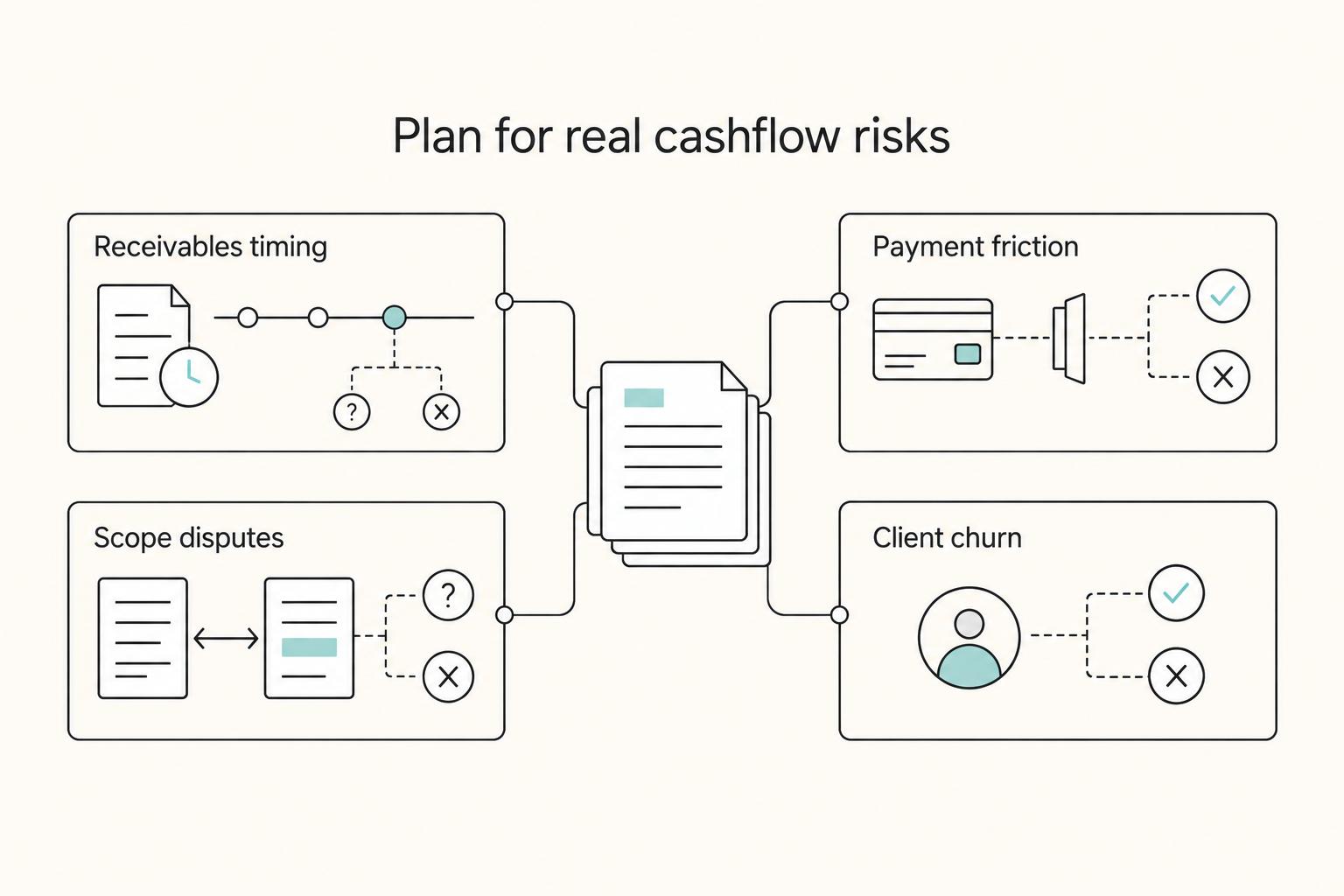
You can treat a career break like a calendar event, or you can treat it like a controlled shutdown of a revenue system. Choose the second. Here are common failure modes and the controls that prevent them.
| What breaks | What it looks like in real life | Your control (safe default) |
|---|---|---|
| Receivables timing | Invoices drift, "net-30" turns into "whenever," you return to a surprise gap | Qualification gate + stress test before you book anything non-refundable |
| Payment friction | A payout sits in review, a transfer bounces, or a processor holds funds (coverage varies by market/program) | Backup collection path + early provider verification of timing and holds |
| Scope disputes | Client delays approval, then claims non-delivery | Tight SOW + acceptance criteria + written approvals before you disappear |
| Client churn | "No response" gets interpreted as "not reliable" | Comms timeline + continuity offer that does not require daily availability |
Hypothetical scenario: you plan a mini-retirement, one client goes quiet on approvals, and another pays late. If you already locked acceptance rules and staged billing into milestones, you do not panic-text from the airport. Your system routes the problem.
The reusable pre-break control framework (what you'll leave with)#
This guide gives you a pre-break system you can reuse:
| Framework part | What it does |
|---|---|
| Qualification gate | Decide if you can safely step away, based on concentration, receivables reliability, and operational coverage. |
| Cashflow stress test | Model "earned vs collected" so you only spend cleared funds. |
| Contract and payment hardening | Convert vague terms into enforceable mechanics (scope, milestones, acceptance). |
| Revenue continuity | Keep money moving without pretending you stay fully available. |
| Re-entry plan | Come back to a pipeline, not a scramble. |
When a step depends on a provider, jurisdiction, or tax residency, default to this: coverage varies by market/program. Confirm in writing before you rely on it.
Definitions first: mini-retirement, sabbatical, and the "cashflow control loop" mental model#
For this guide, use "mini-retirement" as an operating label, then design your break around a cashflow control loop that can run without you. You now have the risk-first frame. Next you need shared terms so every checklist stays concrete, especially when you pressure-test collections, payouts, and dispute risk.
The working definitions (practical, not philosophical)#
These are working terms for this guide, not universal or legal definitions.
| Term | What it means operationally (in this guide) | What you stay responsible for |
|---|---|---|
| Mini-retirement | A self-funded, time-bounded career break where you intentionally reduce or pause delivery work without shutting down your business permanently | Collections, payout monitoring, client expectations, recordkeeping |
| Sabbatical | A more formalized leave (often employer-led). As an independent, you can do a sabbatical-style break, but you still have to self-administer the controls | Collections, compliance tasks, dispute handling, continuity coverage |
This matters because "lifestyle design" only works when the business keeps paying you predictably while you go offline. Otherwise, you just rebrand a cashflow gap.
The cashflow control loop (where mini-retirements actually fail)#
Cashflow control loop is the repeatable sequence that keeps money moving with minimal drama.
| Loop step | Operational meaning |
|---|---|
| Invoice | With clear terms and due dates. |
| Collect | Client initiates payment on an agreed rail. |
| Confirm | You verify the payment status, not just the "sent" message. |
| Hold/track | You separate cleared funds from pending funds and log it. |
| Convert (if needed) | Only when you actively choose to, with records. |
| Payout | Money reaches the account you actually use. |
| Reconcile | You match invoices, payments, fees, and payouts into audit-ready records. |
The usual cracks show up at "confirm" and "reconcile." People assume money will land, then they travel, miss a dispute window, or cannot prove delivery.
Anchor the loop to the contract documents you can rely on while you're away, especially the documents your agreement uses for a Statement of Work (SOW) and Governing Law / Jurisdiction.
Hypothetical scenario: a client claims "we never approved this milestone" while you're offline. A tight SOW with written acceptance steps lets your escalation contact point to the process, collect the next payment, and keep your payout timeline intact.
Your success metric stays simple: Can you go offline without losing control of collections, payout status, and audit-ready records? If you cannot, you do not need more inspiration. You need tighter mechanics.
Is a mini-retirement even safe for your cashflow right now? (The qualification gate)#
A mini-retirement is safest when you can plan your cashflow ahead of time instead of making decisions from fear. In practice, that means you can predict collections, contain disputes, and keep the cashflow control loop running without you. With definitions and the loop in place, you now need a go or no-go gate that blocks a vibes-based break.
Bogart Wealth puts the psychology plainly: "A solid cash flow plan helps eliminate fear and reduce emotional decision-making." They also note: "planning your cash flow ahead of time can give you peace of mind and confidence in your decision-making." Planning early, well before you step away, gives you more control and more options for handling market fluctuations and life changes. You do not need a retirement portfolio to benefit from that. You need a break plan that survives normal client chaos.
The 4-gate qualification (run it like a pre-flight checklist)#
| Gate | "Fail" signal (high risk) | Fix before you leave (safe default) |
|---|---|---|
| Client concentration | One client represents revenue you cannot miss | Get the next cycle under signed, written agreements (deliverables, acceptance, timelines), or build a continuity backup (who delivers what, who escalates). Confirm how disputes will be handled so you are not negotiating it mid-break. |
| Receivables reliability | Repeat late payers, inconsistent approvals, recurring disputes | Harden terms and proof of delivery. Tighten acceptance criteria in the contract. If needed, ask counsel about dispute-resolution language that fits your risk profile. |
| Operational coverage | Nobody owns escalations when you go offline | Name one escalation owner. Write down what they can approve (scope, refunds, client comms). Put confidentiality expectations in place for any contractors. If anyone new touches client data, confirm client-facing data-handling obligations before access changes. |
| Collections friction | One payment method equals one point of failure | Add a backup collection path (another payment method your clients can actually use, where available). Test it end-to-end while you still sit at your desk. |
Hypothetical scenario: you step away for a career break, a client questions whether a milestone counts as "done," and payment stalls. If your written agreement spells out acceptance and your escalation owner can point to the process, you keep momentum without jumping on a call.
Decision rule (the one-page test)#
If you cannot describe your break plan in one page, you are not ready. Write down the basics:
- Who pays, when they pay, and how they pay
- What happens if they do not pay (and who sends the message)
- Who can approve what while you're away
- How disputes are handled (and who owns escalation)
How much runway do you actually need before you step away? (Cashflow stress test, not guesswork)#
You need runway for real expenses plus a buffer for timing risk, and you should only count cash you can actually use. Once you have a go-or-no-go view, you shift from "Can I leave?" to "How long can I stay gone without breaking the loop?"
Build a runway model you can defend (audit-ready mindset)#
Run this like an operator. Open a spreadsheet and separate assumptions from calculations so you can see what changed when something breaks.
A simple way is to group your runway into a few categories, not a magic formula:
- Personal burn: rent, food, insurance, debt minimums, subscriptions you keep.
- Business fixed costs: software, contractors you retain, accounting, minimum tools to keep delivery and collections running.
- Timing buffer: extra room for delays, not "unexpected spending" but "expected lag."
Write down the assumptions next to each line item: what it is, how often it hits, and what account pays it. That documentation habit makes the plan easier to maintain when reality changes.
Here's the mental model that stops people from counting imaginary money: Boomer & Echo describes the "retirement consumption puzzle," where many retirees underspend in real life even when plans suggest they could spend more. It also notes people treat "guaranteed income, like a pension or government benefits" as more spendable, and summarizes research suggesting retirees are roughly twice as likely to spend money that shows up as guaranteed income than withdraw the equivalent from savings. Apply that logic here. Cash you can actually access is what feels spendable. Invoices are not.
Stress-test receivables with scenarios (not optimism)#
Do a pre-mortem: pick scenarios, then decide what you will do when they happen.
| Scenario you plan for | What breaks | Safe defaults you control before a career break |
|---|---|---|
| One late payer | Timing mismatch | Tighten acceptance criteria in the SOW. Clarify review windows and acceptance rules if your counsel approves. |
| One non-payer | Permanent cash gap | Use milestone billing. Pause work on non-payment. Cap downside with a Limitation of Liability clause where appropriate. |
| One dispute | Delays, admin load | Keep proof of delivery and written approvals. Define "done" so the client cannot relitigate scope. |
| One payout delay | Funds arrive later than expected | Don't count money you can't access yet as runway. Build your buffer assuming availability can take longer than you'd like. |
Hypothetical scenario: you take a mini-retirement, a client goes quiet during review, then claims the work "never shipped." If your SOW defines acceptance and your files show delivery and approvals, your escalation owner can enforce the process without dragging you back online.
Minimum operating reserve rule: pick a floor you will not cross while away. If cash drops below it, trigger a contingency plan you pre-write (pause travel, restart outreach, or activate delegation). Keep it boring. Boring works.
Want a quick next step? Try the free invoice generator.
Can you take a mini-retirement without losing clients? (Client segmentation + a scripted comms timeline)#
You can take a mini-retirement without losing clients if you set a clear service promise for each client, document it, and communicate it in writing before you go offline. Once your runway and reserve are clear, shift from cash math to expectation control. Clients do not need constant access. They need continuity they can trust.
Segment clients by what you'll cover, then match the paperwork you already use#
Run a quick client audit and assign each account a promise level. Keep it simple. You are answering one question: "What do I still owe them while I'm away?"
For different clients, that promise might look like light continuity coverage, a firm finish line on specific deliverables before you leave, or a clean pause until you're back. Whatever you choose, capture it in the place your client will actually look: an SOW, a short add-on, or even a written recap they explicitly confirm.
If you sell software-adjacent services, a maintenance format can be a clearer way to describe "what's covered while I'm out" than a vague "I'll be around." Reference: How to Structure a Maintenance and Support Agreement for Software.
Use a written comms cadence (and stop relying on chat memory)#
Send updates in writing on a simple cadence: an early heads-up, a reminder closer to departure, a final handoff note, and a return note. Supernova Consulting frames the operator mindset well: year-end (and breaks) offer "the perfect time to pause, zoom out, and take stock of your business itself." Treat your break the same way: planned operations, not hope.
| Message | What to include |
|---|---|
| Early heads-up | Your offline window, what stays covered, what pauses, and how to book work for after you return. |
| Closer to departure | A deliverables list, remaining approvals needed, and any upcoming invoice and payment dates (if applicable). |
| Final handoff note | Handoff contact (if any), your definition of "urgent," and where final files live. |
| Return day | Restart plan, next working session, and any re-scoping needed. |
Before you leave, get crisp on what "done" means for anything in motion, and how reviews and approvals will work while you're offline. You are preventing end-of-cycle misunderstandings.
Finally, if a teammate or contractor might touch client systems while you're away, confirm roles, permissions, and client-facing boundaries in writing. Any confidentiality or data-protection implications depend on your existing agreements and context, so handle that part carefully.
Hypothetical: you pause delivery for a month, but a client pings "quick question" that turns into a new feature request. Your written promise level tells you exactly what to do. Route it to the rebook path, not your vacation brain.
Payment-protection hardening before you leave: terms, milestones, and dispute-resistant workflows#
Harden your payment system by turning "friendly" terms into written mechanics someone else can run. With promise levels and comms set, this is the layer that helps prevent late payers, disputes, or payment-processor surprises from pulling you back online.
Turn vague terms into mechanics you can execute (inside your written agreement)#
Write terms so a third party could follow them from the agreement without context. Do not leave "we'll work it out later" gaps, especially around payment timing, approvals, and decision rights.
Use this as your rewrite checklist.
| If your agreement says (vague) | Rewrite into (mechanical) | What to confirm before you go |
|---|---|---|
| "Payment due on receipt" | A clear due-date rule tied to the invoice date (and how receipt is defined) | Who sends invoices, where they're sent, and what counts as received |
| "Upfront payment" | What triggers it, when work starts, and what happens if it doesn't arrive | Who pauses work (and how they communicate it) |
| "Billed monthly" | Billing schedule and what happens when billing overlaps your break window | Who reviews/approves invoices while you're away |
| "Net terms" | What happens if payment is late, how notices are sent, and what changes after non-payment | Who has authority to negotiate exceptions while you're gone |
If you plan to include legal or risk-allocation clauses, get them reviewed by a qualified attorney for your situation. Do not improvise legal language from memory or a template pulled from a random career break thread.
Design the workflow to prevent disputes and reduce payment reversals#
Treat disputes like process failures, not personality conflicts. Build a paper trail that matches how you deliver, then enforce it consistently.
Operate this way:
- Require written acceptance for major deliverables or phases, however you structure them. Use email, a ticket, or a signed approval note. Capture "approved" plus what exactly got approved.
- Store artifacts in one place: deliverable links, version history, meeting notes, approvals, and invoices. Make it easy to hand off if someone needs to step in.
- If you bill based on time spent, add a written cap or a written checkpoint that forces a decision before spend grows. Avoid open-ended language you cannot defend calmly.
On payment rails, reduce avoidable exposure. If you have choices in how clients pay, for example bank transfer vs card, ask your provider what changes in fees, reversal risk, and any review/hold process, and what documentation they may request to resolve issues.
Hypothetical: a client approves a deliverable in writing, then disputes the next invoice while you are on break. Your acceptance artifacts and clear scope boundaries give your delegate a clean script: point to the approval, pause work per the agreement, and route escalation through the dispute process you already defined.
Finally, set an offboarding rule you will actually enforce: if a payment is missed, work pauses automatically, and responsibility for next steps is explicit: who contacts the client, what they can offer, and what they cannot.
Revenue continuity design: keep money moving while you're offline (without pretending you're "fully available")#
Design revenue continuity around deliverables and operating windows, not around promises to "be around," so clients keep paying without expecting real-time access. With terms hardened and workflows tightened, you now need a delivery model that matches your offline reality.
Sell continuity products, then contract them like an operator#
Stop selling access to you. Sell maintenance and continuity outcomes you can fulfill asynchronously, and document them in a maintenance SOW, not a casual email. If you provide operational support, include a Limitation of Liability appropriate for your work and risk profile, and get legal review if you feel unsure.
Use this decision table to keep the offer honest.
| Model | What you promise | What you do not promise | Why it survives a mini-retirement |
|---|---|---|---|
| "Availability retainer" | "I'll be responsive" | Clear response times | Clients interpret silence as non-performance |
| Continuity retainer | Monitoring, maintenance tasks, scheduled reviews | Instant replies, same-day fixes | You anchor delivery to defined outputs and windows |
| Async deliverable bundle | A fixed set of improvements shipped on a cadence | Open-ended support | You control scope and timing |
Practical examples of continuity products:
- A monitoring and triage lane (log review, alerts routing, "next action" recommendations).
- A maintenance lane (updates, small fixes, scheduled housekeeping).
- An async advisory lane (written audits, roadmap notes, recorded walkthroughs).
Build enforceable async windows, then delegate with boundaries#
Replace vague expectations with explicit windows like "responses Tuesdays/Thursdays" or "deliverable drops every two weeks." Put the windows in the SOW, align them to acceptance and review periods, and route anything outside the window through your escalation path.
If you use a small team, delegate like a risk manager:
- Handoff scope: list exactly what your delegate can do, and cannot do.
- Access controls: give least-privilege access, time-box it, and log credentials and ownership.
- Data boundaries: use appropriate contractor confidentiality terms, and make sure client-facing data and subcontractor terms are covered if anyone else touches sensitive data.
Collections and contractor pay need the same offline-safe discipline. Treat billing and payment operations as a pre-break project: tighten payment terms, reduce exceptions, and make sure the workflow runs without you babysitting it.
Hypothetical: you ship a scheduled deliverable drop while offline, your delegate handles two routine tickets inside the agreed window, and the client stays calm because the contract matches the operating reality.
If you cannot step away because pricing traps you, fix the next cycle before you leave: Pricing a SaaS MVP Project as a Freelance Developer.
Handoff, exceptions, and re-entry: what to set up before you leave#
Build a written handoff and an exceptions system, then pre-schedule re-entry so your mini-retirement stays a planned career break. Once continuity is designed, your remaining job is to keep money, responsibilities, and decisions from falling into the cracks.
Your "away ops" package (one page plus a single source of truth)#
Don't rely on memory or chat threads. TVI MarketPro3 calls the transition moment "one of the most critical moments" in the customer journey, and notes that teams often treat the handoff like a "baton pass, quick, simple, and easily forgotten." Your job is to slow it down just enough to make it durable.
Create an away ops package with two parts:
- A one-page operating brief that clarifies ownership, decision rights, and what should be escalated, and what should not.
- A single source of truth that contains your current agreements and key reference documents, so whoever covers you can confirm obligations fast.
Then decide what you automate versus what you personally review. Use this mindset: automate predictable, low-risk steps. Manually review anything that can surprise you, and write down what counts as an exception.
Hypothetical: you step away for a mini-retirement, a client pays late, and your coverage lead follows the brief. They do not improvise. They execute the system.
Build an exceptions ladder before you leave. Do not copy someone else's day counts. Instead, define stages (friendly reminder, formal notice, pause work, escalate) that match your terms and your risk tolerance. If your contract specifies an escalation path, follow that, not emotion.
Re-entry: come back to booked work, not panic#
Pre-build your re-entry pipeline while you still feel calm. Draft outreach you can send on return, reopen your waitlist, and reserve restart weeks for delivery so you do not accept bad terms out of scarcity.
If re-entry includes relocating, review program rules early because requirements vary by program: Japan Digital Nomad Visa: A Guide.
Cross-border + compliance caveats: what changes when you travel or relocate (and how to confirm safely)#
Treat cross-border moves like a compliance change and confirm your tax position, reporting duties, and payment rails before you leave. With handoff and exceptions in place, the remaining avoidable failure mode is assuming travel changes nothing until a tax form, bank request, or client audit says otherwise.
Tax residency and FEIE: confirm, don't assume#
FEIE (Foreign Earned Income Exclusion) is a U.S. tax benefit that may let qualifying individuals exclude some foreign earned income, but the IRS ties eligibility to specific requirements. IRS guidance says you must have foreign earned income, your tax home must be in a foreign country, and you must meet a qualifying test (the Bona Fide Residence Test or the Physical Presence Test).
The Physical Presence Test is purely time-based. You meet it if you are physically present in a foreign country or countries for 330 full days during any period of 12 consecutive months (the days do not need to be consecutive). The Bona Fide Residence Test looks different. It generally requires that you qualify as a bona fide resident of a foreign country for an uninterrupted period that includes an entire tax year.
Two operator reminders:
- Even if you qualify, the IRS indicates you still file a tax return reporting the income when you claim the exclusion.
- Use the IRS Interactive Tax Assistant as a first-pass check, then validate with a tax professional using current IRS guidance.
Compliance + operations checklist before you cross a border#
Cross-border creates paperwork gravity, so plan for it.
| Area | What can change | Safe way to confirm (no guessing) |
|---|---|---|
| Financial reporting | You may trigger additional international reporting obligations depending on your facts, even when nothing feels "taxable." | Ask a tax professional for a facts-based determination. Treat it as a checklist item, not a judgment call. |
| Client tax forms | A client may request different tax paperwork based on how they treat your tax status. | Ask your client what they require, then verify with your tax advisor what you should provide. Build lead time for back-and-forth. |
| Collections and payouts | Payment providers may require verification or documentation updates that affect your ability to collect or receive payouts (coverage varies by market/program). | Message support before travel: "What documents do you require for cross-border activity, and how do I avoid interruptions?" Save the answer in your ops folder. |
| Visas | Visa programs differ materially. | Treat unofficial summaries as unverified. Check official program guidance (and start your research early). |
Hypothetical: you relocate for a career break and a client's AP team asks for different tax paperwork mid-break. If you pre-assigned documentation requests to your coverage lead and stored your tax advisor's instructions, you respond in hours, not weeks.
The mini-retirement checklist (risk-first) + your next steps#
Use a written, risk-first checklist so your plan becomes a decision you can defend. As your target date gets closer, the focus naturally shifts from general planning to practical, detailed planning, and this sequence forces clarity on money, obligations, and coverage before you disappear for a career break.
GetSmarterAboutMoney puts the planning mindset perfectly: "A retirement plan is like a map. It can help you stay on track financially." Treat this guide the same way. Your checklist is the map that shows you what breaks first (cash timing, unclear commitments, operational gaps) so you can fix it while you still have leverage.
Your four-stage checklist (use it like a map, not a manifesto)#
| Stage | Outcome you want | What you verify (practical prompts) | "Safe default" move |
|---|---|---|---|
| 1) Reality check | You know what you're optimizing for, and what you're risking | Write down the break goal, your time horizon, and what income sources continue (if any). List what must be true for the break to feel "worth it." | If you can't explain the plan and its tradeoffs on one page, delay the break. |
| 2) Run the numbers | You can fund the time away without guessing | Evaluate your current budget and write down every debt, liability, savings balance, income stream, and insurance policy you have. Stress-test the plan against a couple of "what if" scenarios. | Assume costs run higher and income runs lower than your optimistic case. |
| 3) Inventory obligations | You won't be negotiating or improvising while offline | List your active commitments and anything that could create pressure during the break (deliverables, support expectations, access needs). Identify what needs a clear decision rule vs. a real-time conversation. | Write questions for a qualified professional; don't improvise terms from the internet. |
| 4) Continuity + monitoring | Exceptions route to a human, not to you in transit | Assign an escalation owner, document where the key info lives, and define what "good enough" status checks look like while you're away. Confirm your current payment setup works the way you expect in practice. | Reduce moving parts: one primary process, one backup, both tested. |
Hypothetical: you plan a break. One client asks for "one last tweak" that changes the ask. If your decision rule and escalation owner exist in writing, you route the request to the next window or handle it as a separate, clearly scoped follow-up. You do not negotiate on the fly.
If you want a system-level upgrade, not just a one-off sabbatical, evaluate tooling that keeps your records organized and easy to review. Confirm coverage "where supported" inside your actual account before you rely on it. For continuity-friendly packaging, use a maintenance structure you can enforce: How to Structure a Maintenance and Support Agreement for Software.
Frequently Asked Questions
What is a mini-retirement, and how is it different from a sabbatical?
A mini-retirement usually means you step away from work for weeks or months to recharge, travel, or reset priorities, without waiting until age 65. People sometimes use sabbatical in a similar way, and the label can vary by context. In this mini-retirement guide, treat both as the same operational problem: you still need a plan that keeps collections, client expectations, and records under control.
How long should a mini-retirement be for a freelancer or small team?
No universal “right length” exists, so pick a duration you can fund and supervise without improvising. Start with a time box that matches your actual delivery cycle (how long projects take to finish cleanly). If you want an existence proof that longer breaks can work, Tim Ferriss wrote that his book’s stories came from experiences “between 2004 and early 2006, traveling around the world for about 18 months.”
How much money do I need before taking a mini-retirement?
Don’t anchor on a generic number. Lowrie Financial frames it simply: “Mini-retirement requires dedicated savings to cover expenses and missed retirement contributions.” Translate that into operator terms: list your personal burn, business fixed costs, and a collections timing buffer. Then only count cash you can actually use, not invoices you hope will land on time.
Can freelancers take a mini-retirement without losing clients?
Yes, when you make the service promise explicit and match it with paperwork and a comms plan. Segment clients by promise level (continuity, time-bounded delivery, or pause and restart). Put the promise in writing, name an escalation path, and give clients a clear next step while you are offline.
How do I protect cashflow while I’m on a break?
Protect cashflow by removing avoidable surprises before you leave. Use milestone billing and written acceptance, define what happens when approvals stall, and pre-write what you do on late payment (including pausing work). If you rely on any platform to collect or pay out, confirm their verification and review requirements ahead of time so you are not troubleshooting access mid-break.
What are the biggest financial and operational risks, and what mitigations actually work?
The big risks cluster into three buckets: late payment, disputes, and operational gaps (nobody monitors exceptions). Mitigations that hold up are boring and document-heavy: written scope, explicit acceptance, clean proof of delivery, and a designated owner for escalations. If you like lifestyle design thinking, keep the romance, but run it through a risk checklist first.
If I travel internationally, what tax or compliance rules might change (and how do I confirm safely)?
Cross-border changes can trigger new tax and reporting questions, so treat travel like a compliance change. Start with current guidance from the relevant tax authority (for example, the IRS if you file in the U.S.), then validate your facts with a qualified tax professional before you rely on assumptions. If your break involves relocation, pre-research country-specific requirements using official sources (and start early).
Try a related tool
Researched and edited by the Gruv editorial team. Gruv builds cross-border billing, payouts, and finance-operations software for global businesses.
Sources
Educational content only. Not legal, tax, or financial advice.
Related Posts

Japan Digital Nomad Visa 2026: Six-Month Planning Runbook
Treat this as your operating model: identify the right mission first, commit to one route, and keep dated records before you make irreversible plans. That is what keeps the rest of your timeline, paperwork, and decisions coherent.

Pricing a SaaS MVP Project as a Freelance Developer
If you want to protect margin, treat your quote as a risk decision, not a market-average guess. The headline number matters less than the assumptions and scope boundary underneath it.
How to Structure a Maintenance and Support Agreement for Software
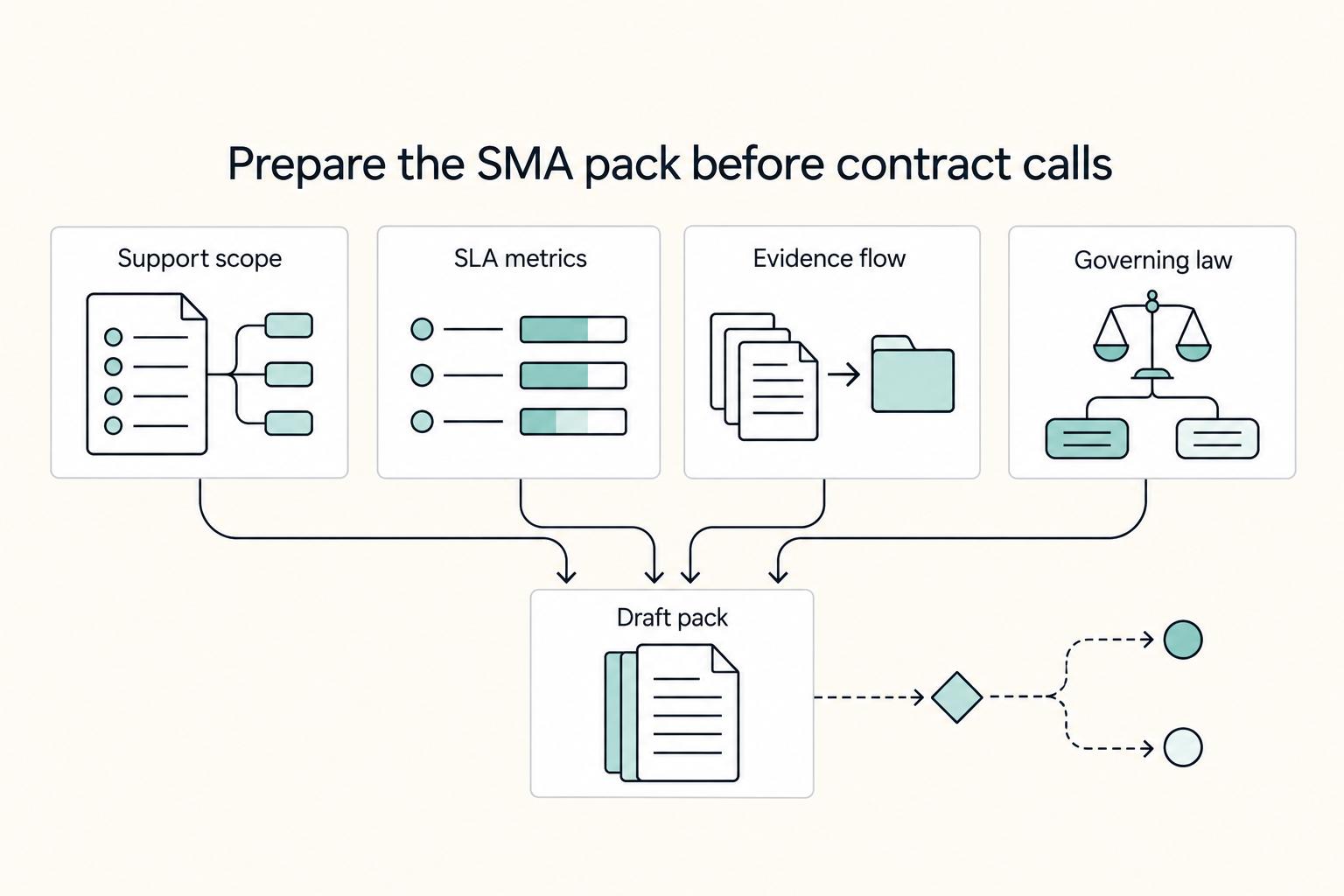
**Run every client through a clear software maintenance agreement (SMA) before support starts. Define scope, SLA commitments, payment rules, and proof requirements up front.** This is an operator workflow, not legal theater. Use it to protect delivery quality, keep maintenance profitable, and cut the argument loops that drain recurring revenue. If you work solo, this is the contract system that protects your capacity.