
Quick Answer
Spain’s non-lucrative visa is a residence route for living in Spain without gainful or professional activity, not a work permit. The safest way to apply is a consulate-aware sequence: confirm eligibility, verify your jurisdiction, prepare a complete packet, and only then book and execute the in-person submission path required by your assigned instructions. Treat fees, timelines, and thresholds as variable until locally confirmed.
Your Spain move needs an execution plan not another generic visa article#
Use a consulate-aware workflow: lock confirmed rules first, separate local unknowns, and move in sequence to reduce preventable delays in the Spain non-lucrative visa process.
If you are planning a move to Spain, the hard part is rarely the paperwork itself. It is the fragmented guidance spread across consulate pages, booking portals, and generic visa content that does not match your jurisdiction. This playbook keeps you in control by separating what is stable from what you need to verify locally, then moving in a tight sequence.
The Non-Working (Non-Lucrative) Residence Visa is a residence route to live in Spain without gainful work or professional activity. It is not a work permit. For applicants in the United States, Spanish Consular Office workflows may route submission logistics through BLS International. Where that channel is used, appointment booking and in-person submission are required for this visa category.
| Lock this as confirmed | Treat this as variable until you verify locally |
|---|---|
| Visa intent: non-working residence | Exact document nuances by consulate |
| Filing is governed by consular jurisdiction | Current local checklist wording |
| Your submission path must match your assigned post's official instructions | Whether BLS is used for your assigned post right now |
| You should not mix steps from different consulates or visa categories | Processing timing, fees, and thresholds |
Work in gates not guesswork#
Run this article like a checklist with decision points. Move gate by gate, and stop when something is still unverified:
| Gate | What to confirm |
|---|---|
| Eligibility gate | Confirm your plan fits a non-working residence route and does not rely on gainful work or professional activity |
| Jurisdiction gate | Confirm which Spanish consulate in the United States can accept your file |
| Document gate | Build one clean packet that matches that consulate, not a mixed checklist |
| Appointment gate | Book and execute the submission step only after your packet passes internal QA |
| Uncertainty gate | Log open questions and resolve each one directly with the relevant post before submission |
In practice, those gates protect you from the most common rework. First confirm fit, then confirm jurisdiction, then build one clean packet for that post, then book only after internal QA, and keep every open question on a short list until it is resolved.
Do not book a slot until you clear jurisdiction and document quality. Booking first can force a packet rebuild if your assigned post turns out to be different. Related: A Guide to Spain's Beckham Law for High-Earning Expats. If you want a quick next step, try the visa planner.
Build the right mental model before you book anything#
Use a gate-based model: confirm this is a non-working route, confirm where you file, then book only after your packet is ready.
Before you spend money or lock dates, anchor your plan to what is clearly supported. The baseline guidance here describes a non-working residence route that starts through the Spain Embassy or Consulate in your home country. Local details should be verified before you act.
The Non-working (Non-lucrative) Residence Visa is described as a residence route to live in Spain that does not allow work. That same baseline description says it also does not allow access to government healthcare or government benefits.
You apply through the Spain Embassy or Consulate in your home country. The timeline in the baseline excerpt is up to one year initially, with renewal mentioned, plus a note that permanent residency may be possible after five years. Treat that as baseline context from a July 2019 personal account and verify current rules directly with your post.
Use these terms as operational checks, not assumptions:
| Term | Practical meaning | Action before booking |
|---|---|---|
| Non-working (non-lucrative) visa | A residence route that allows stay in Spain but not work | Proceed only if your plan does not rely on working in Spain |
| Spain Embassy or Consulate filing | Filing starts through Spanish consular authorities in your home country | Confirm the current process with the relevant post before booking |
| Baseline timeline (excerpt) | Initial stay up to one year, renewal mentioned, possible permanent residency after five years | Use as planning context, then verify current requirements before taking action |
The model is simple: treat every step as a gate. If you cannot point to live official instructions for your filing post, you are not ready to move to the next step.
Are you even eligible for this visa as a remote professional?#
If your plan depends on active remote work, this non-working route is likely a mismatch, so make that call now before you spend money.
Use the eligibility gate as a hard go-or-no-go check before you pay for logistics. The goal is to avoid forcing a no-work category to support a working lifestyle, then paying for rework later.
The Non-working Residency Visa (Non-lucrative visa) is presented as a residence option with no work allowed and a passive-income profile. The Digital Nomad Visa is presented as a residence option that allows remote work.
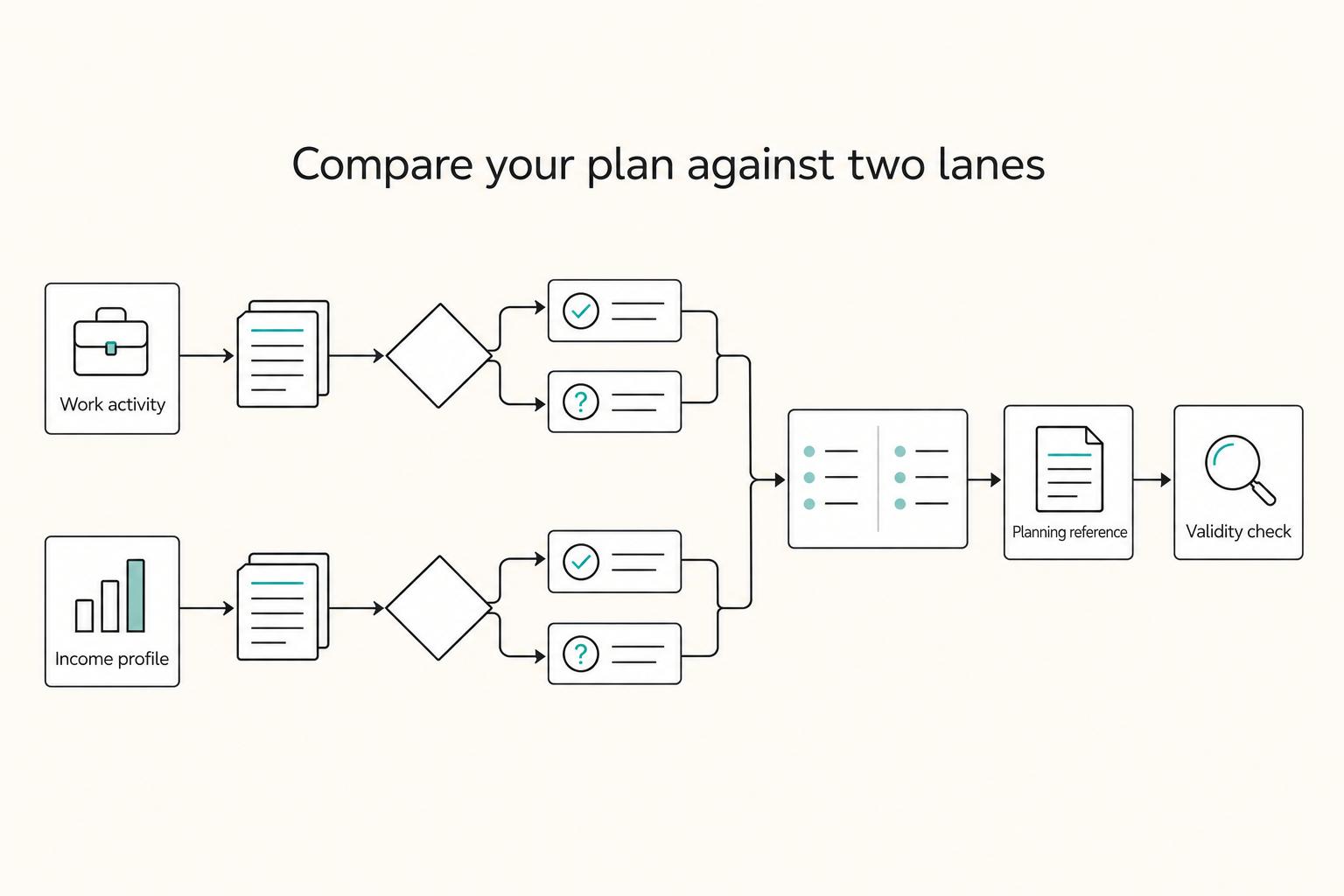
Compare your actual plan against the two lanes#
| Decision point | Non-working Residency Visa (Non-lucrative visa) | Digital Nomad Visa |
|---|---|---|
| Work activity | No work allowed | Remote work allowed |
| Income profile | Passive income only | Active remote income |
| Planning reference | €2,400/month (€28,800/year) | €2,763/month (€33,156/year) |
| Initial validity reference | 1 year | Not specified here |
Treat those income figures as planning references, not official consular thresholds. Confirm current requirements directly with the consulate that handles your case.
Run a pre-booking self-screen with your consulate#
If you are applying for Spain from abroad, run this quick test before paying for appointments or document prep:
- Write your first-year income plan and label each stream as active or passive.
- If active work funds your core expenses, pause non-lucrative planning and evaluate alternatives.
- Check the visa-purpose language on the consulate page that has jurisdiction over your case.
- Continue only when your real operating plan matches a non-working purpose.
If your day-to-day plan is ongoing client delivery after arrival, treat that as a warning sign for this route. Compare options early, including this global digital nomad visa comparison. If you want a deeper dive, read this tax guide for digital nomads in Thailand.
Which consulate should you file through and why does this gate break cases?#
Treat consular jurisdiction as a verification step, not an assumption, and pause booking until the correct filing post and channel are clearly confirmed.
| Jurisdiction check | What to do |
|---|---|
| Legal residence | Confirm your legal-residence details |
| Current consulate instructions | Check the current jurisdiction and submission instructions on the relevant consulate page |
| States or regions in planning notes | Treat that as a hypothesis to verify, not a rule |
| Submission channel | Follow only the submission channel that the consulate currently publishes |
You can lose weeks by building a perfect packet for the wrong post. The safe move is verification first, not assumption first. Jurisdiction is the acceptance gate that determines whether a consulate can take your application, and rules can vary by location and change over time.
Use this conservative loop before you book anything:
- Confirm your legal-residence details.
- Check the current jurisdiction and submission instructions on the relevant consulate page.
- If your planning notes mention specific states or regions, treat that as a hypothesis to verify, not a rule.
- Follow only the submission channel that the consulate currently publishes.
Keep the rule simple: one assigned post, one active checklist, one submission path. That discipline prevents rework and keeps the sequence clean.
What should your document pack include before you request an appointment?#
Prepare a complete, signed, consulate-aligned file for every applicant before you request an appointment.
Once jurisdiction is confirmed, work from one live checklist for your assigned post and treat it as your standard. Keep the intent consistent across the packet: this route is for residence in Spain without gainful or professional activity, and it is not a work permit.
Build the core pack every applicant must control#
Start with the anchor forms for each person, then verify formatting and completeness before you book:
- National visa application form: completed and signed by each applicant, with all sections filled.
- EX-01 (Formulario autorización de residencia temporal no lucrativa): completed and signed by each applicant, with all sections filled.
- Photo control: include one (1) recent full-face, color, passport-size photo per applicant.
- Record consistency: keep names, dates, and document references aligned across forms and supporting files.
| Pack element | Minimum standard | Failure pattern to avoid |
|---|---|---|
| Core forms | Complete and signed for each applicant | Missing signature or incomplete section |
| Supporting file set | Readable, format-consistent, consulate-ready | Mixed formats or mismatched details |
| Submission path | Matches assigned consulate instructions | Using another post's process |
Add a family unit branch before final review#
If you are filing as a family unit, split the checklist by person early so nothing gets missed at submission. Eligible dependents can include a spouse or unmarried partner, dependent children, and dependent relatives in the ascending line, where applicable.
Map this family branch to your assigned post's current checklist before booking. Do not assume family evidence rules are identical across consulates.
Run appointment readiness like an operator#
Use a final pre-book gate so your packet is appointment-ready on the first pass:
- Keep a clean, versioned folder for every upload and print step.
- If your assigned post uses a visa-center portal, mirror that sequence in your records.
- Recheck passport validity and photo specifications against the active consulate checklist.
- If a visa application center channel is enabled for your case, rehearse packet order before submission.
How do you execute the BLS step without losing weeks?#
Execute this step by following only live, jurisdiction-specific instructions you can verify in writing, and pause anything you cannot verify.
Do not assume appointment-workflow details are reliably documented, so treat gaps or unclear pages as a risk signal. For this process, execute only instructions published by your assigned authority and your current checklist.
Build a no drift runbook#
Use one tracker and lock each action to a verifiable instruction before you move forward.
- Record the exact page, timestamp, and instruction text you are relying on for each step.
- Keep one final packet version and one control sheet so nothing changes at the last minute.
- If your official instructions point to a specific booking portal, follow only that documented path.
- If a page is unavailable or unclear, stop and request written clarification before proceeding.
Plan Los Angeles and San Francisco like real operations#
City-specific center logistics are not confirmed. Use the same operational controls for both cities unless your assigned instructions explicitly say otherwise. Avoid assumptions about local timing, routes, or center rules. Focus on what you can control: travel buffer, document custody, and a day-of checklist that matches your verified instructions.
| Location | Planning approach | What this prevents |
|---|---|---|
| Los Angeles, CA | Use your verified instructions to set route, arrival buffer, and document handling plan in advance | Last-minute disruption from avoidable travel friction |
| San Francisco, CA | Use your verified instructions to set route, arrival buffer, and document handling plan in advance | Last-minute disruption from avoidable travel friction |
Route questions to the right queue fast#
When a process detail is unclear, do not guess who owns it. Send one concise question to the contact points listed in your assigned instructions, ask who owns the answer, and request written confirmation. Then execute only what is confirmed for your jurisdiction and log that decision in your tracker.
Where do rules vary and how do you confirm safely?#
Treat every unverified detail as unresolved, and submit only what your jurisdiction's official text confirms in writing.
The Non-lucrative residence visa is a route to live in Spain without gainful or professional activity, and it is not a work permit. Keep that scope fixed while you validate requirements. This guide does not confirm exact consulate-by-consulate differences, fees, timelines, or approval patterns, so you need a verification protocol.
Build a do not assume block first#
Use this block before each submission decision:
| Unverified area | How to treat it |
|---|---|
| Exact financial thresholds | Do not assume exact financial thresholds |
| Fee amounts or payment methods | Do not assume fee amounts or payment methods |
| Processing times | Do not assume processing times |
| Renewal durations or minimum-stay day counts | Do not assume renewal durations or minimum-stay day counts |
| Rejection rates or rejection patterns | Do not assume rejection rates or rejection patterns |
| Requirements from unrelated categories such as NALCAP | Do not import requirements from unrelated categories such as NALCAP |
If any of those items are missing, unclear, or conflicting across pages, treat them as unresolved rather than filling the gap yourself.
Run a variance protocol before final submission#
If your assigned jurisdiction has multiple official instructions, compare only current official pages and reconcile differences before filing.
- Open the active page for your assigned Spanish consular jurisdiction.
- Extract requirement language line by line into your tracker.
- Compare that list with your active process page only when official instructions direct you there.
- If wording conflicts or is missing, pause and request written confirmation before submission.
Use a confidence ladder for every decision#
| Confidence level | What qualifies | Action |
|---|---|---|
| High | Rule is explicit on your assigned consulate page | Execute and log |
| Medium | Process logistics are confirmed on the active official process page and do not conflict with consulate text | Execute logistics only |
| Low | Item is missing, unclear, or conflicting across pages | Pause and get direct written confirmation |
Your 30-day relocation prep checklist for a low-risk filing#
Use a four-week checklist to lock your jurisdiction, secure the required appointment path, and execute an in-person submission with an audit trail where available.
For the Non-Working (Non-Lucrative) Residence Visa, keep scope tight: this route is for living in Spain without gainful or professional activity. Build your month around confirmed rules only, and treat any missing fee, timeline, or threshold detail as unresolved until your assigned official instructions confirm it in writing.
Week 1 lock jurisdiction and build your source of truth#
- Confirm your assigned consular route first, then align every task to that route.
- Create one master folder and tracker for the visa application packet.
- Set a per-applicant checklist, because each applicant must complete and sign the visa application form.
- Add a live "unresolved items" log so open questions are visible before booking or submission.
Week 2 and week 3 harden quality and secure the slot#
| Week | Operational goal | Exit criteria |
|---|---|---|
| Week 2 | Complete packet QA and verify submission-channel details | Your packet is organized in final order, and your logistics notes match your assigned official flow |
| Week 3 | Book and rehearse appointment execution | You request the mandatory appointment via usa.blsspainglobal.com when your route directs you there, confirm slot details, and run a full submission simulation |
One control rule for these weeks: do not fill gaps with assumptions. If wording is unclear or conflicting, pause and get written confirmation before you finalize.
Week 4 submit in person and close the loop#
For routes that use BLS Visa service for Spain, week 4 is execution only. Capture receipts and reference IDs if provided, then record owner, next action, and follow-up date in a single tracker. If your route is San Francisco, confirm the listed BLS location details directly from the active official page before you travel.
Run a simple go-or-hold check before each major step#
Proceed only when your decision is checked against current official sources and your own goals.
Your advantage here is discipline, not more noise. There is no single "best" residency program for everyone, so start with what you need the program to do for you.
Use a simple go-or-hold system:
- Goal-fit check: Confirm the program matches your priorities and constraints.
- Official-source check: Verify current requirements directly with the relevant official authority before acting.
- Uncertainty check: Write down open questions and resolve them before you submit anything.
Run it strictly. If a key point is unclear, hold and verify. Program details are time-bounded and can change, so re-check before each major step. That is how you reduce preventable delays and move forward with confidence.
Frequently Asked Questions
What is Spain's non-lucrative visa in plain English?
It is a residence visa to live in Spain without gainful or professional activity. It is not a work permit. In plain terms, it supports residence without working under this visa category, for applicants who can show sufficient, guaranteed means to support themselves.
Can you work remotely or telework on Spain's non-lucrative visa?
No. This visa category does not authorize work or professional activity. If your plan depends on active work to fund your life in Spain, treat that as an eligibility failure and evaluate another route before you build a packet.
Do applications require in-person submission through BLS?
Apply through the consulate with authority over your state of permanent residence and follow that post's current instructions before you finalize an appointment plan.
Is BLS mandatory for U.S.-based applicants?
No single U.S.-wide BLS rule is supported here. You must file through the consulate with authority over your state of permanent residence and follow that post's active process. You cannot choose another consulate just because it is more convenient.
Who can be included as family members on this route?
Eligible family members can include a spouse or unmarried partner, dependent children, and dependent relatives in the ascending line when they qualify. Treat eligibility as person-specific and document each family member separately so the family-unit file does not collapse on one missing item.
Which documents are typically required to start a file?
Start with the National visa application form and the EX-01 temporary residence permit form, completed and signed by each applicant. Include one recent passport-size color photo per applicant. Then run a consistency check across names, dates, and supporting records before you request an appointment.
How does consular jurisdiction change where you apply?
Jurisdiction determines where you apply based on your state of permanent residence. You cannot apply at a different consulate just because it is more convenient. Apply through the consular authority that can accept your case, from the country where you permanently reside.
Try a related tool
Researched and edited by the Gruv editorial team. Gruv builds cross-border billing, payouts, and finance-operations software for global businesses.
Sources
Educational content only. Not legal, tax, or financial advice.
Related Posts

The 2026 Global Digital Nomad Visa Index for 50+ Countries
Start with legal fit, not lifestyle filters. The practical order is simple: choose a route you can actually document, then decide where you want to live. That single change cuts a lot of wasted comparison work and stops you from falling in love with places that were never a real filing option.

Thailand Tax for Digital Nomads Without Residency Mistakes
The most expensive mistakes here happen before anyone opens a tax return. People pick a visa, assume the tax answer comes with it, then try to rebuild the year from scraps after the fact. By then, the damage is usually not one dramatic error. It is a pile of small gaps: an unverified day count, a transfer with no clear purpose note, invoices that do not line up cleanly with payments, and assumptions nobody wrote down when the facts were still fresh.

Spain Beckham Law Decisions for Freelancers on Tight Filing Windows
Make the go or no-go call early, then test it against dated checkpoints and records you can defend. The goal is predictable compliance, not aggressive tax engineering.