
Quick Answer
Plan the F-1-D move in three steps: prove visa eligibility, choose your tax path before arrival, and complete foreigner registration early after landing. The cleanest case is a salaried foreign employee in a remote-capable role with at least one year in the industry. Verify the current gross income threshold and insurance minimum with your filing post, get written confirmation if your work is freelance or mixed, watch the 183-day tax line, and register within 90 days.
A Global Professional's Strategic Brief: De-Risking South Korea's F-1-D "Workcation" Visa#
To de-risk your move, treat this as three separate jobs: prove eligibility, choose your tax path before arrival, and complete post-arrival registration early. Most avoidable problems come from using stale 2024 figures, assuming freelancer eligibility is settled, or leaving tax and admin decisions until after you land.
That framing matters because each phase has a different failure mode. In Phase 1, the risk is a weak or inconsistent visa file. In Phase 2, the risk is creating tax exposure by drifting into resident status without a plan. In Phase 3, the risk is letting routine setup issues interfere with work once you are already in Korea. Handle them in that order and the process becomes much easier to control.
Answer first: if your timeline may approach 183 days, includes dependents, or depends on freelance income, treat this as a compliance project before you book travel. In my experience, the people who de-risk this well use a single planning stack: a visa planner, a day-count file in the tax residency tracker, and written confirmation from the filing post when category rules are unclear.
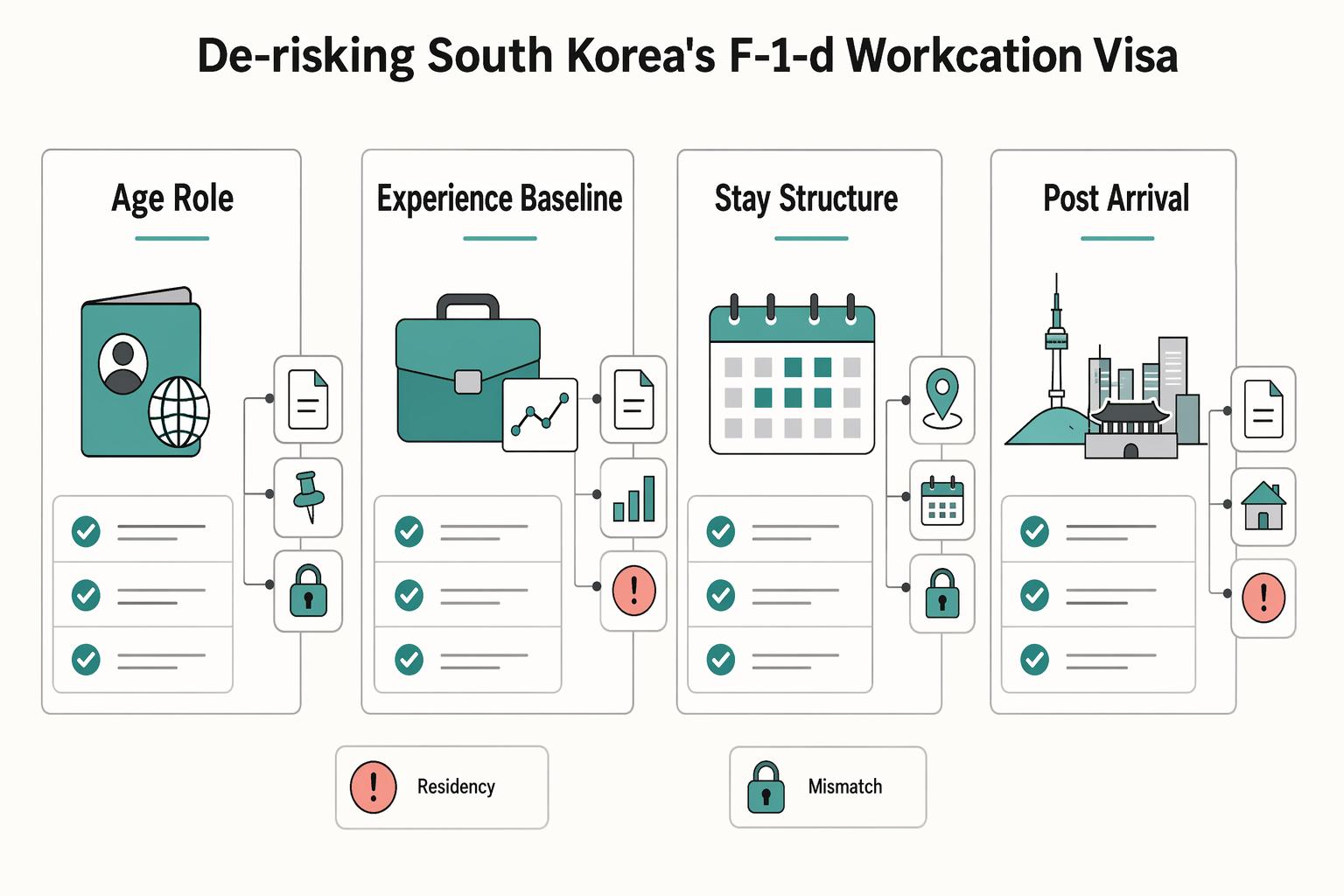
- Age and role baseline: age 18+, foreign employer, and remote-capable duties.
- Experience baseline: at least 1 year in the current industry.
- Stay structure: reported 1-year stay from arrival plus one 1-year extension (up to 2 years total).
- Post-arrival admin: foreigner registration within 90 days from entry.
Phase 1 application#
Answer first: your cleanest case is still a standard salaried employee. The strongest profile is age 18+, employed by a foreign company, able to work remotely, and with at least one year of experience in your current industry. The visa does not permit local Korean employment. The reported structure remains one year from arrival with one possible one-year extension, for a maximum of two years.
The practical reason salaried applicants have the easiest path is that the file is straightforward to verify. A reviewer can see a foreign employer, a role that can be performed remotely, an income trail, and a work history that fits the published criteria. If your case is clean, your job is not to be clever. It is to make those points easy to confirm from the documents themselves.
For income, do not rely on an old KRW figure. The benchmark is more than twice the previous year's Korean GNI, and the official FAQ says this is based on gross income before tax deductions. For a live file, verify the current threshold with your embassy or consulate before you submit.
This is worth slowing down on. Applicants often know they earn enough in general terms but submit proof that does not line up neatly with the rule being applied. If the test is tied to gross income before tax deductions, your evidence should make that visible without forcing the reviewer to infer it. If you use payroll records, bank statements, and an employer letter, those items should tell the same story rather than three slightly different stories.
Your document package needs to do four things clearly: prove foreign work, prove income, clear the background check requirement, and show private health insurance at the currently accepted level. A 2024 summary cited KRW 100 million in coverage, but for a live file you should verify the current insurance minimum because consular requirements can change. Also confirm whether your filing post wants a full policy certificate or will accept a summary letter.
Build the file around four verification steps. If any one of them is weak, the overall file feels uncertain even if you are otherwise eligible:
- Identity and employment connection: your employer letter should clearly connect you to the foreign company and your current role.
- Remote-work capability: the same letter should make it easy to see that the work can be performed remotely and that working from Korea is not inconsistent with your employment.
- Income evidence: your supporting records should show gross income in a way that matches the current threshold being used by your filing post.
- Background and insurance: these should be current, complete, and in the format the filing post accepts.
| Applicant profile | What to prove | Common failure point | Prepare in advance |
|---|---|---|---|
| Salaried employee | Foreign employer, remote-capable role, gross income above the current threshold, at least one year in the industry | Employer letter is vague about remote work or Korea; income proof does not clearly match payroll | Employer letter on letterhead, recent payroll and bank evidence, backup HR contact |
| Pure freelancer or independent contractor | Eligibility is unclear: official VISITKOREA FAQ says this category is not available to freelancers | Relying on non-official sites that say freelancers qualify | Get written confirmation from your exact filing post before making plans |
| Accompanying family member | Relationship to the principal applicant | Missing or improperly legalized relationship documents | Relationship documents ready in the format your filing post requests |
For salaried employees, the employer letter usually carries more weight than people expect because it ties together several parts of the case at once. If it is too short or too generic, you can end up with a file that technically contains the right documents but does not answer the real question: why is this person clearly eligible under this category? You want a letter that removes ambiguity, not one that merely states you are employed.
Your income proof should also be internally consistent. If payroll records show one pattern, bank deposits show another, and the employer letter uses different terminology again, the file becomes harder to read. The safer approach is to organize your documents so the reviewer can move from employer letter to recent payroll to bank evidence without guessing how they connect. Small mismatches in naming, dates, or presentation often create more friction than applicants expect.
The same principle applies to family applications. The official FAQ says accompanying family members are not required to meet visa requirements independently, but that does not mean the family side of the file is casual. It means the main focus shifts from independent eligibility to relationship proof. If those records are missing, inconsistent, or not in the requested format, the family portion can still slow the whole process.
If you are not a standard salaried employee, stop and verify early. The official tourism FAQ and some non-government explainers conflict on freelancer eligibility. Do not book flights or sign a lease until your filing post confirms your profile in writing.
That written confirmation is not a formality. It is the line between an uncertain online interpretation and a filing path you can actually rely on. If your work setup is mixed, such as partly salaried and partly independent, do not assume the salaried part will carry the rest. Ask the filing post how they want that profile treated, and keep the answer. Avoid building a life plan around a category that your exact filing location may not accept.
On timing, try to collect the hard-to-replace items first. Background documents and employer paperwork can take longer than expected, especially if one missing detail forces a second round of requests. Insurance confirmation can also create delays if the post requires more than a simple summary. Start with the documents that involve another institution, then use the waiting time to organize your income records and application forms. Meanwhile, keep your file system simple and recoverable; this is where a lightweight ops routine from How to Create a Secure Backup Strategy for Your Freelance Business can prevent last-minute document chaos.
Review your file before submission with three questions. If the answer to any of them is "not clearly," fix that before filing:
- If someone reads only the employer letter, do they immediately understand the foreign employment and remote-work point?
- If someone reads only the income evidence, can they see that the threshold is met using the current rule?
- If someone checks the background and insurance documents, are they current and in the accepted format?
Most preventable delays start as clarity problems, not eligibility problems.
Phase 2 compliance#
Short answer: choose your tax path before you move, not after. The practical split is short stay versus long stay. Under Korea's Income Tax Act, a resident is an individual with a domicile or place of residence in Korea for at least 183 days. PwC also reports an additional residence test effective for tax years beginning on or after January 1, 2026, so split-year planning should be checked rather than assumed.
| Checkpoint | Rule in play | Action |
|---|---|---|
| At least 183 days in Korea | A resident is an individual with a domicile or place of residence in Korea for at least 183 days | Choose your tax path before you move |
| Tax years beginning on or after January 1, 2026 | PwC reports an additional residence test | Check split-year planning rather than assume it |
| Shorter stay expected | Keep precise date records from day one | Track entry and exit dates, housing periods, and where your employment and pay are sourced |
| May cross 183 days or come close across two tax years | Treat this as a pre-arrival tax project | Get advice before moving |
The key mistake here is treating tax residence as something to sort out later if the stay ends up being longer than expected. That works poorly because the facts that determine your position start accumulating from day one. Once you have crossed a line or created a difficult fact pattern across tax years, you cannot fix it by becoming organized afterward.
In practice, I model this with two timelines on day one: a base case and a stretch case. We then stress-test both against the 183-day line and the year-end boundary, because those two points often drive the biggest compliance differences.
- Open a running day-count log before departure in the tax residency tracker.
- Write down a tentative extension decision month around month 8 or 9 so you do not improvise near deadlines.
- If your plan crosses a year-end, schedule tax advice before travel and keep that memo with your core file.
If you expect a shorter stay, keep precise date records from day one. Track entry and exit dates, housing periods, and where your employment and pay are sourced. If you may cross 183 days, or come close across two tax years, treat this as a pre-arrival tax project and get advice before moving.
"Keep precise date records" sounds simple, but the value is in consistency. Use one running record and update it as you go. Do not leave the reconstruction for months later, when you are trying to remember exact travel dates, short trips, address changes, or when a housing arrangement started and ended. If your stay approaches the 183-day line, those details stop being administrative trivia and become part of your tax file.
If there is any real chance that your stay could stretch, build your plan around that possibility before you leave home. That means thinking about extension timing, whether your employer is prepared for a longer Korea-based work period, and whether your existing reporting obligations at home continue in parallel. You do not need every answer in final form, but you do need to know which questions require advice before you arrive.
Your review points depend on who you are and where your obligations continue. U.S. citizens and residents should review treaty position, foreign tax credit or exclusion fit, and foreign account reporting if opening Korean accounts. Non-U.S. readers should review home-country residence rules, treaty tie-breaker issues where relevant, and any foreign asset or bank reporting that may continue after moving.
For U.S. readers, that means your Korea move is not just a Korean tax question. It is also a question of how the Korea position interacts with existing U.S. filing and reporting obligations. If you plan to open Korean bank accounts once local registration is underway, include that in the discussion early rather than treating banking as separate from tax planning.
For non-U.S. readers, the same logic applies in a different form. The real issue is usually not whether one country has rules and the other does not. It is whether both systems still have something to say about your status during the move period. That is especially true if your stay crosses a year-end, housing arrangements overlap, or your home-country ties remain strong.
Frame the tax decision around three practical questions:
- How long do you realistically expect to stay?
- What happens if the stay runs longer than planned?
- What records will you need if someone later asks how your position was determined?
That third question is the one people neglect. Keep your entry records, housing documents, employment records, and any advice or written planning notes together. If you later need to explain why you treated the stay as short-term, why you changed that view, or how you handled a period spanning two tax years, a clean file matters.
This is also where the visa timeline and the tax timeline start interacting. A one-year visa with one possible one-year extension does not by itself tell you your tax position. It does tell you that a "temporary" stay can become a much longer one without much friction if life and work are going well. If you are the sort of person who tends to extend good arrangements, plan for that tendency before the move instead of after it.
After that tax path is set, execution becomes mostly operational. The main goal is to avoid turning routine admin into a work disruption. By contrast, when teams skip this sequence, small admin delays snowball into payroll and reporting friction.
Phase 3 launch timeline#
| Stage | Key tasks | Timing notes |
|---|---|---|
| Before departure | Confirm the current income threshold and insurance minimum with your exact embassy/consulate; get the criminal record certificate apostilled; verify current entry rules | If using the e-Arrival card, submit no earlier than three days before entry; unused filings expire after 72 hours; the official K-ETA exemption notice ran through December 31, 2025 (KST) |
| Arrival week | Secure housing paperwork; keep copies of entry records; set up connectivity quickly | If local registration appointments are backlogged, book as early as possible |
| First month | Complete foreigner registration; move from temporary workarounds to stable banking, housing, and telecom arrangements as registration progresses | Complete registration well before the 90-day deadline |
- Before departure: Confirm the current income threshold and insurance minimum with your exact embassy/consulate; get the criminal record certificate apostilled; verify current entry rules instead of assuming the K-ETA exemption still applies, since the official exemption notice ran through December 31, 2025 (KST); if using the e-Arrival card, submit no earlier than three days before entry because unused filings expire after 72 hours.
- Arrival week: Secure housing paperwork, keep copies of entry records, and set up connectivity quickly so your work is not dependent on temporary internet. If local registration appointments are backlogged, book as early as possible.
- First month: Complete foreigner registration well before the 90-day deadline. Until registration is underway, banking, housing, and telecom setup can remain limited.
The simplest way to use this phase is to work backward from your first normal workday in Korea. You do not want your employer, clients, or team discovering that your internet is unstable, your housing paperwork is incomplete, or you delayed an appointment that affects routine setup. The move feels much lighter when you assume that the first days are for infrastructure, not sightseeing. Equally important, keep a clear document handoff plan so onboarding tasks do not depend on searching old inboxes or chat threads.
Before departure, your control point is the embassy or consulate. Do not generalize from another city, another country, or another applicant's experience. Your exact filing post is the one that matters for the current threshold, the insurance evidence it accepts, and any formatting preferences that are not obvious from broad summaries. This matters even more because older 2024 figures and simplified summaries can mislead applicants.
It also helps to treat critical documents as two separate sets: the original filing set and your working copies. Keep your application-side records organized before you fly, and keep digital copies accessible after you land. If you need to refer back to an insurance certificate, employer letter, or proof of background clearance while setting up life on the ground, you should not be searching through luggage or old email chains.
For entry formalities, the main risk is relying on a rule that was true for a previous trip or for another nationality. Do not assume the K-ETA exemption still applies, and verify current entry rules. The same caution applies to the e-Arrival card timing. Submitting too early does not make you more prepared if the filing expires unused after 72 hours.
During arrival week, housing paperwork becomes more important than many remote workers expect. It is not just about having a place to sleep. It also affects what you can use as supporting documentation in the next steps of setup. If your initial housing is temporary, make sure you understand what documents you will actually have in hand. Also check whether they will be enough for the practical tasks you need to complete.
Connectivity should be treated as mission-critical. Do not chase the fastest setup on day one. Focus on avoiding any gap where your ability to work depends on unstable temporary arrangements. If your work involves calls, fixed hours, or sensitive deadlines, solve for reliability first. A smooth first week is often the difference between a manageable relocation and one that starts to drain attention from your actual job.
If registration appointments are backlogged, book early and then build the rest of your first weeks around that date. Foreigner registration should be completed well before the 90-day deadline, and delays can affect banking, housing, and telecom. In practice, that means registration is not a background admin task. It is one of the main dependencies for normal life.
Use the first month to remove bottlenecks in order, because each later step often depends on the earlier one:
- Keep your entry and housing records organized.
- Complete foreigner registration well before the 90-day mark.
- Move from temporary workarounds to stable banking, housing, and telecom arrangements as registration progresses.
If you leave registration too late, you are not just increasing deadline risk. You may also be extending the period in which ordinary services remain harder to access. Finally, compare your launch checklist with your destination assumptions in our digital nomad visa index for 50+ countries before you finalize flights.
If you want a deeper dive, read The 2026 Global Digital Nomad Visa Index for 50+ Countries.
Before you lock your timeline, map your planned in-country days and travel gaps in the tax residency tracker so your visa and tax plan stay aligned.
Frequently Asked Questions
Can freelancers apply for the F-1-D visa?
Do not treat freelancer eligibility as settled. VISITKOREA's FAQ says the F-1-D visa is not available to freelancers, while some non-official sites say the opposite. Use written confirmation from your filing post before booking flights or signing a lease.
Do family members need to meet the same income test?
No. The official FAQ says accompanying family members do not need to meet visa requirements independently. You still need relationship documents in the format your filing post accepts.
When do tax risks usually start?
The first major checkpoint is the 183-day residence rule. If your stay may approach that line, or span two tax years, choose a tax path before you move and keep precise records from day one. For 2026 planning, also ask about the reported updated residence test.
How soon do I need to register after arrival?
You need to complete foreigner registration within 90 days from the date of entry. Do not wait until the end of that window, because delays can also affect banking, housing, and telecom setup.
Try a related tool
Researched and edited by the Gruv editorial team. Gruv builds cross-border billing, payouts, and finance-operations software for global businesses.
Sources
Includes 6 external sources outside the trusted-domain allowlist.
- english.visitkorea.or.kr/svc/contents/infoBscView.doexternal
- english.visitkorea.or.kr/svc/contents/infoBscView.doexternal
- junggu.seoul.kr/english/content.doexternal
- ketasouthkorea.com/f-1-d-workation-visa-digital-nomadexternal
- refworld.org/sites/default/files/2025-04/income_tax_act.pdfexternal
- taxsummaries.pwc.com/republic-of-korea/individual/residenceexternal
Educational content only. Not legal, tax, or financial advice.
Related Posts

The 2026 Global Digital Nomad Visa Index for 50+ Countries
Start with legal fit, not lifestyle filters. The practical order is simple: choose a route you can actually document, then decide where you want to live. That single change cuts a lot of wasted comparison work and stops you from falling in love with places that were never a real filing option.
Taxes in Italy for Expats and Freelancers
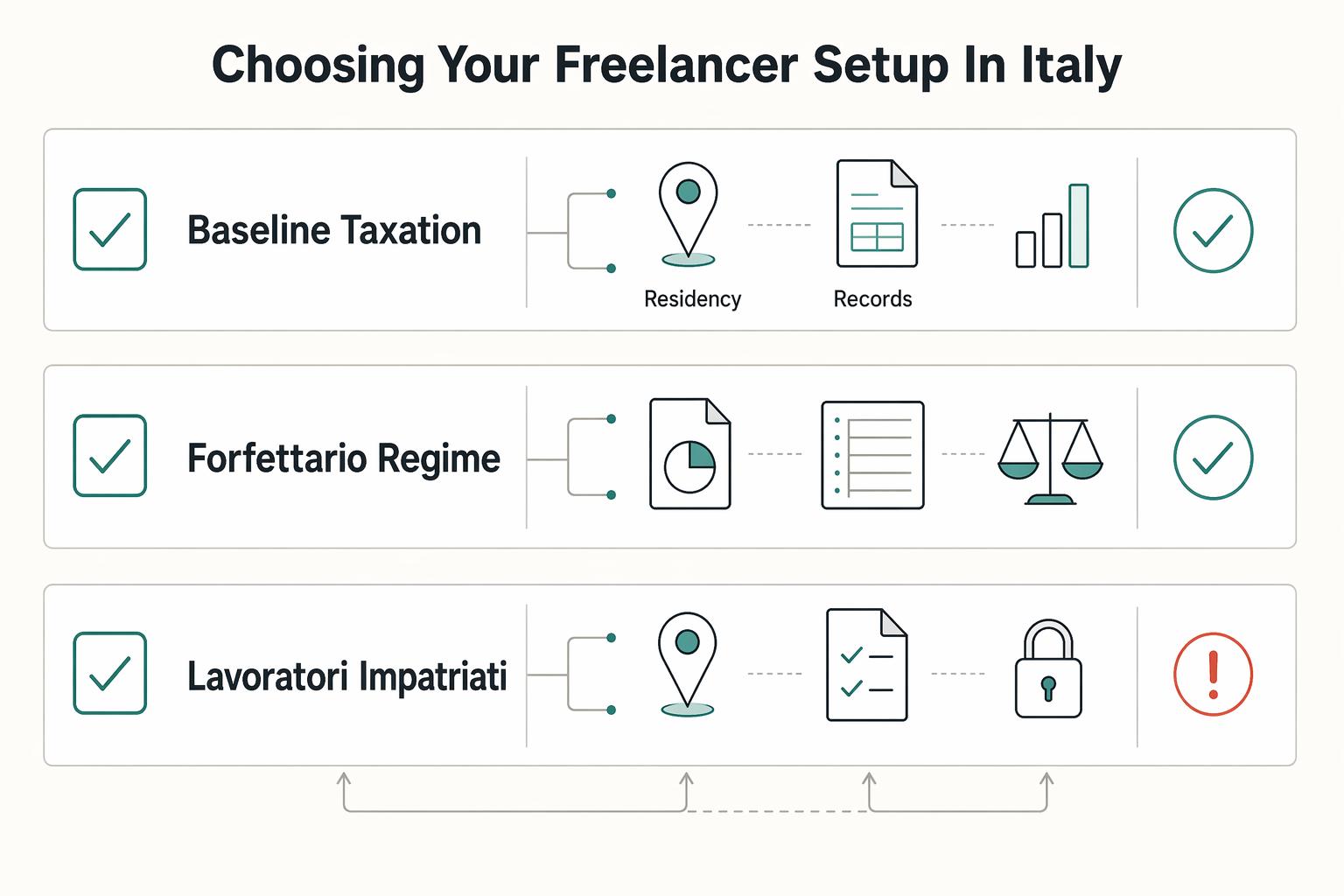
Start with one objective: make filing choices you can defend with records, not assumptions. As a freelancer or consultant, you do not need to predict every line item on day one. You need a position that stays consistent from client onboarding to invoicing to return prep. The avoidable mistake is signing work or claiming a benefit first, then trying to explain the tax result later. You are aiming for a position that holds together all year, not a best-case assumption that falls apart when forms and bank records have to match.
How to Create a Secure Backup Strategy for Your Freelance Business
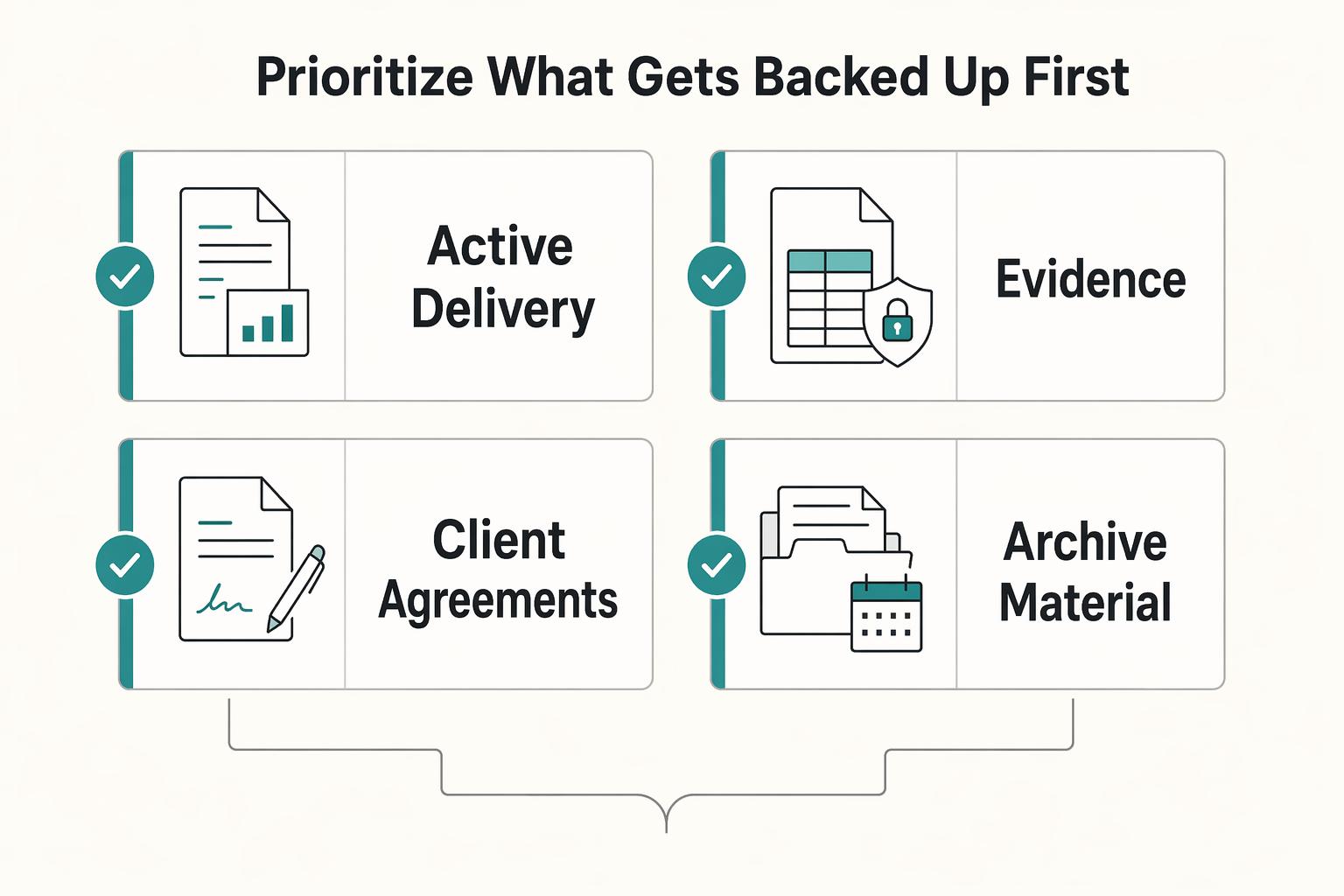
Build backup for recovery speed, not storage volume. Your setup should let you keep delivering and getting paid after equipment failure, cyberattack, human error, natural disaster, or other data-loss events. A reliable baseline matters, but the real test is whether it stays usable when stress is high and decisions need to happen fast.