
Quick Answer
The schengen 90/180 rule is a rolling short-stay limit across the Schengen Area, not a per-country allowance. The practical way to stay compliant is to keep one travel ledger, recalculate against the rolling window before each booking change, and run weekly decision gates. If your plan outgrows short-stay scope, pivot early to national procedures instead of stretching the short-stay path.
Run every movement decision through one repeatable system#
Treat Schengen short-stay limits as an operating constraint, then run every movement decision through one repeatable system. If you treat Europe travel like a chain of bookings, you create avoidable risk. Run it like operations, and you protect flexibility, reduce stress, and keep your visa compliance posture clean across the Schengen Area.
| Control | What to do | Trigger |
|---|---|---|
| Travel ledger | Keep one canonical ledger for entries, exits, and planned moves | Run it in the weekly workflow |
| Calculator workflow | Validate your status before you lock major itinerary changes | Before major itinerary changes |
| Decision gate | Choose whether to stay in Schengen short-stay mode or move to national procedures | When the plan starts to outgrow short-stay scope |
| Official guidance recheck | Recheck official guidance because checks can vary by route, port, operator, and nationality | Before each border leg |
| Owner and review day | Assign an owner and a review day so the system runs on schedule | Use one weekly review cadence |
Before you book anything, capture three inputs: your current status, your planned route, and your escalation path. Then run one weekly workflow without exceptions:
- Keep one canonical travel ledger for entries, exits, and planned moves.
- Validate your status with a calculator workflow before you lock major itinerary changes.
- Set a decision gate where you either stay in Schengen short-stay mode or move to national procedures.
- Recheck official guidance before each border leg because checks can vary by route, port, operator, and nationality.
- Assign an owner and a review day so the system runs on schedule, not on mood.
This is the core operating model for digital nomad planning in Europe. Consistency beats improvisation, especially when plans shift mid-route.
Set decision gates early, then act fast when a trigger appears. Do not assume border systems behave the same way every day in every place. One EES implementation report sets April 10 2026 as the stated full implementation deadline, and the European Commission says Member States can partially suspend EES during summer travel peaks. Build your playbook around controlled variability, not perfect uniformity.
Use a safe default: when guidance conflicts or details are unclear, take the stricter path until you verify with official channels. Document that choice in your log. If your plan starts to outgrow short-stay scope, stop optimizing short-stay limits and start national procedures immediately.
This shows up in real operator scenarios. If you rotate between two Schengen cities while running client work and coordinating housing, your playbook should tell you what to check this week. It should also tell you what can wait and exactly when to pivot your legal path. That is how you turn uncertainty into control.
Build the mental model before you book anything#
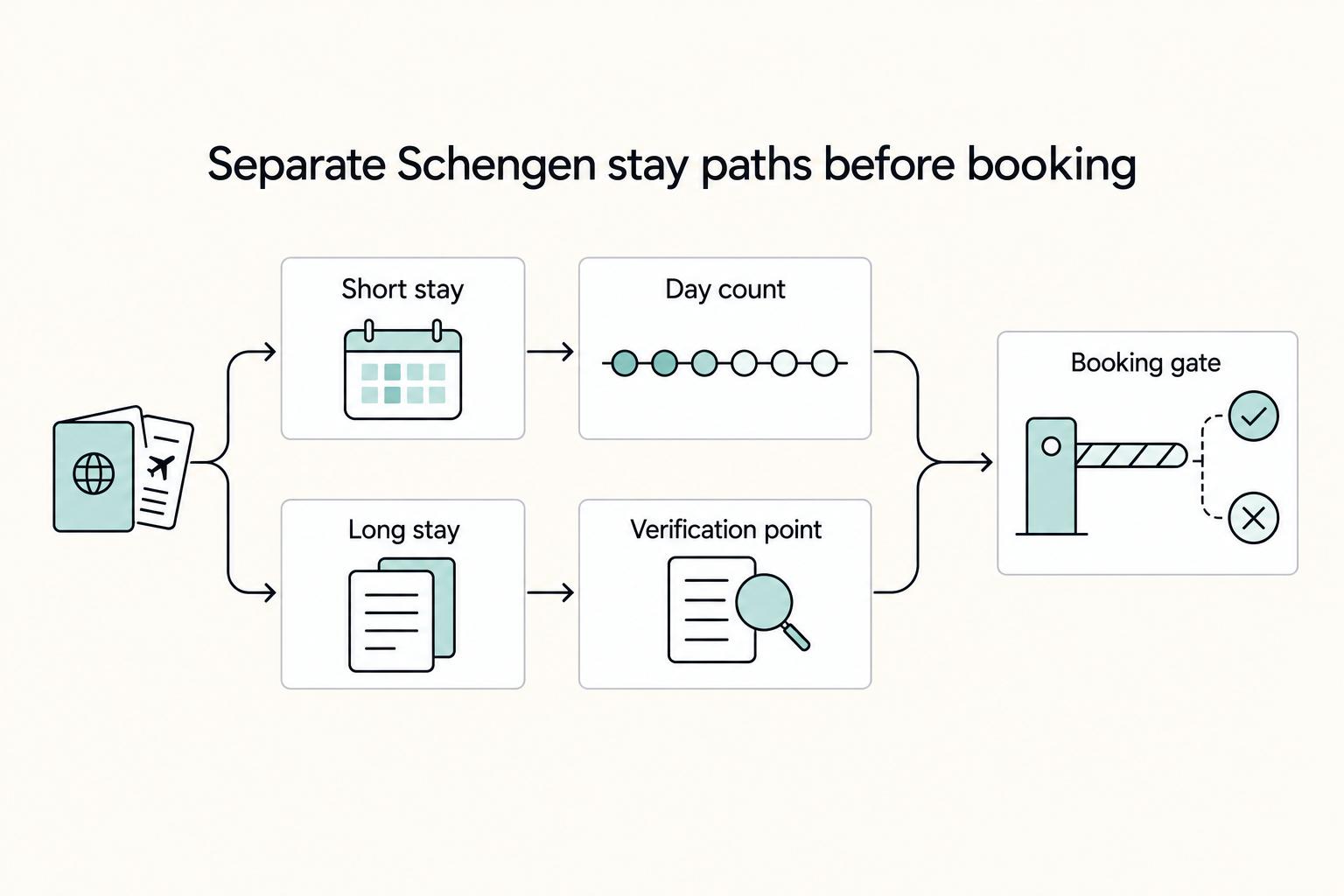
Use one decision model that separates short stay, long stay, and verification checkpoints before you commit money to travel. You set your control loop above. Now you need shared language that turns that loop into fast, repeatable calls when plans change.
Treat these as operating definitions for a short-stay workflow, then confirm edge cases with official channels for your passport and route.
- "90/180" framing is common shorthand for short-stay planning. You will often see it framed as total Schengen time staying within 90 days in a 180-day window. Use that as a practical memory aid, not as your only authority.
- Short-term visa is the short-stay permission track. A national visa center example shows a short term visa category with a maximum stay of 90 days.
- National visas are country-level long-stay routes, separate from short-term visas. The same national visa center structure separates national visas from short-term visas and lists routes such as General Student Visa and AU pair.
Use this quick panel to keep Europe travel decisions consistent and protect visa compliance.
| Control question | If answer is yes | If answer is no |
|---|---|---|
| Are you still inside short-stay scope for this trip phase? | Stay on the short-stay track and keep your day log current. | Open a national-visa workstream now. |
| Does your current plan fit your 90/180 framing budget? | Continue the itinerary with scheduled review points. | Redesign route timing before you book. |
| Do route checks or nationality rules look unclear? | Document the rule and proceed. | Pause and verify with official channels first. |
This is where most people lose time and money. A housing change shifts your travel pattern, a client moves meetings, and suddenly your plan is different.
Your model should force the same three actions every time: recheck status, recheck day budget, then decide whether to stay in short-stay mode or pivot to a country route.
Does this rule apply to your exact profile?#
Start by classifying your status first, because short-stay counting only works after you confirm you are in the short-stay lane. You have the model. Now you need a profile gate that tells you whether to run short-stay counting, follow a different legal track, or pause and verify before booking.
| Mode or record | When to use | What the article says |
|---|---|---|
| Planning mode | Before you buy travel | Run the official short-stay calculator in planning mode |
| Check mode | After changes | Confirm no overstay and see your latest valid stay date |
| Own log | Alongside calculator checks | Keep it aligned, and count entry and exit as full days in daily tracking |
Use this sequence every time you plan Europe travel:
- Check your baseline on Migration and Home Affairs pages, then anchor your decisions there.
- Confirm your status type before you count any days.
- If you travel on a short-stay visa, read the visa sticker and use the authorised stay period when it shows less than 90 days.
- Cross-check traveler-facing guidance that matches your passport and status (when relevant), then finalize decisions with official EU or national channels.
| Profile signal | What it means for your short-stay workflow | Action now |
|---|---|---|
| You travel as a short-stay visitor | You run the standard short-stay day-count discipline | Count back 180 days from each day of stay and keep total presence within 90 days |
| Your short-stay visa shows an authorised period below 90 days | Your sticker limit controls your permitted stay | Use the lower visa sticker limit in your plan |
| You hold an EU residence permit or long-stay visa | You do not run the short-stay rule for that status | Follow your permit or long-stay conditions and country rules |
| Your status looks unclear or guidance conflicts | You cannot trust a single assumption | Pause and verify through official EU or national channels before booking |
Use the official short-stay calculator in both modes. Run planning mode before you buy travel, then run check mode after changes to confirm no overstay and see your latest valid stay date. Keep your own log aligned, and count entry and exit as full days in daily tracking.
When plans change, do not skip the gate. Reclassify status first, then approve bookings. That habit protects visa compliance and removes guesswork.
How do you calculate remaining days without spreadsheet errors?#
Run one rolling 180-day calculation method every time, then verify it in a second system before you book or extend your stay. Once you know the rule applies to your profile, the risk shifts to execution. You are not estimating one trip; you are running a live compliance process for Schengen travel.
Start with your planned exit date. For each day you intend to stay, look back 180 days and total every day you spent in the Schengen Area. Log your entry and exit dates clearly so your totals stay clean.
- Keep one pooled ledger for all Schengen trips across countries.
- Track multi-entry movement in the same record under Schengen-wide counting logic.
- Enter trips in chronological order and include recent travel history before you plan the next leg.
- Treat the limit as a rolling window with no automatic reset date.
- If your look-back window already shows 90 days, stop adding Schengen time and plan time outside the Area until you return within limit.
| Checkpoint | Action | Error it prevents |
|---|---|---|
| Pre-booking | Count days from the planned exit date using the 180-day look-back | Booking a route that breaks your allowance |
| Independent validation | Recreate the same itinerary in a second Schengen day calculator | Spreadsheet formula and date-entry mistakes |
| Ongoing control | Update one canonical ledger after each entry and exit | Missing legs and double counting |
Run this process on a fixed weekly day, then rerun it after every itinerary change. If a client asks you to extend a city stay, do the two-check workflow before you confirm. That habit protects your Europe travel plan and reduces administrative consequences that can affect future travel decisions.
Run a 120-day timeline that prevents day-90 surprises#
Build your next 120 days as a rolling operations calendar, not a static itinerary, so your day count stays under control. Counting discipline is necessary, but not sufficient. You also need a timeline that forces earlier decisions, protects buffer, and keeps Europe travel stable when real life shifts.
| Block type | Use | Range |
|---|---|---|
| Schengen blocks | Time inside the Schengen Area | 14 to 90 days |
| Buffer blocks | Time outside the Schengen Area | 21 to 120 days |
| Buffer days | Unused reserve to absorb change without breaking your 90/180 rule | 5 to 10 days |
A practical model is block-based. Plan Schengen blocks for time inside the Schengen Area. Plan buffer blocks for time outside. Keep buffer days unused so you can absorb change without breaking the rule.
Treat these as safe operating ranges, not legal mandates: Schengen blocks of 14 to 90 days, buffer blocks of 21 to 120 days, and a reserve of 5 to 10 unused days.
| Timeline window | Primary objective | Required actions | Decision gate |
|---|---|---|---|
| T-120 to T-90 | Lock route constraints early | Confirm what rules apply to your passport and trip, then draft a first-pass Schengen itinerary with block and buffer design | If your draft consumes too much allowance, redesign before booking |
| T-90 to T-30 | Finalize proof and tracking system | Set up one tracking method you will actually use, and sanity-check key dates by looking back 180 days from any day you intend to be in Schengen | If your tools and log differ, pause and reconcile before you pay for changes |
| During travel | Keep one canonical record | Update entry and exit after every border event, count each day present as a full day, and remember repeated entries do not reset the rolling limit | If drift appears, trigger a route correction the same week |
| Approaching limit | Protect compliance runway | Shorten Schengen time, move to non-Schengen time, and rebuild the next block plan around your remaining allowance | If your margin gets tight, stop adding Schengen days immediately |
Assign one owner and one weekly review deadline. Use a short checklist each week:
- Recalculate remaining days for any intended Schengen date by checking the prior 180 days.
- Confirm upcoming moves still fit the rolling lookback.
- Log every border event in one place.
- Decide now whether to keep the plan or add buffer time.
When a client asks you to stay longer after you have already planned your route, this timeline gives you the next action. Recalculate, validate, then either keep the plan or pivot before risk compounds.
If you want a deeper dive, read 10 Freelance Contract Red Flags That Scream 'Run Away'.
What if your plan needs more than 90 days?#
If your plan exceeds 90 days, stop optimizing the Schengen short-stay path and switch to national procedures right away. Any plan that runs past 90 days should surface the risk early. This is the hard pivot rule.
Under EU visa policy, short stays in the Schengen Area run on the familiar 90 days in any 180-day period frame. That shared short-stay framework applies across 29 Schengen countries. Once your real plan moves past short-stay scope, you leave the short-stay lane and enter country-level processing. Act early, not at the edge.
Use this control table in your weekly review:
| If this is true | Then do this now | Why it matters |
|---|---|---|
| Your work and life plan stays within short-stay scope | Keep running your day-count tracker and short-stay workflow | You preserve compliant Europe travel flexibility |
| Your intended stay exceeds short-stay scope | Open a national procedures track in your target country immediately | Long-stay eligibility sits at country level |
| You are comparing multiple destinations | Evaluate each country separately for residence routes and digital nomad visa options where available | Requirements and approvals differ by country |
| Your itinerary includes Ireland | Treat Ireland as a separate branch and run its travel and work rules independently | Schengen counting rules do not govern that branch |
When deadlines collide, run parallel tracks instead of waiting for certainty:
- Track 1: Keep a compliant short-stay runway in the Schengen Area.
- Track 2: Prepare long-stay documents and decision steps for your chosen country.
- Assign one owner, one weekly deadline, and one decision log so you can move fast without losing control.
If you need help comparing long-stay paths quickly, use our digital nomad visa index for 50+ countries as a starting map. Then verify your final country decision with official channels.
Keep your compliance stack migration-ready#
Run one integrated compliance system that links short-stay day-count decisions with tax and document controls before you commit any move. Once you can pivot from short stay to national procedures, the next failure mode is recordkeeping. When your route changes, your documentation and reporting still need to hold up.
Store one canonical log for every mobility decision. For each entry, record the decision, the reason, and the official reference you used from current government guidance. Treat this as your operating ledger for short-stay limits and for any move beyond the short-stay lane.
Treat this as a simple control stack you can run on repeat:
| Control | What you record | When you trigger it |
|---|---|---|
| Travel ledger | Entry and exit events, remaining short-stay days (where applicable), current travel/status context | After every border event and before each booking |
| Status decision log | Stay in short-stay mode, switch to a country route, or hold | Weekly review and any scope change |
| U.S. tax control list | FATCA check, Form 8938 check, FBAR check (FinCEN Form 114) | At account changes and tax cycle milestones |
| Verify before commit rule | Final eligibility and document validation for target country program | Before deposits, filings, or relocation commitments |
Close each cycle with this operator checklist:
- Confirm your current eligibility basis for passport and status.
- Recalculate your short-stay day count (where applicable).
- Reconcile travel plans against actual border events.
- Validate document set completeness for your current track.
- Confirm which country-level path you will run next.
- Recheck FATCA and Form 8938 exposure for new accounts or assets.
- Recheck FBAR scope against FinCEN Form 114 criteria.
- Set an escalation owner and decision deadline.
- Write one contingency action if approval timing slips.
Turn policy confusion into an operating system#
Treat the Schengen short-stay rule as a weekly operating rhythm, not a one-time travel check. You now have a repeatable workflow and decision triggers that can survive route changes. The goal is one system that keeps your Schengen day count, Europe logistics, and stay-compliance notes aligned.
Build your rule set around one core fact: the Schengen Area counts as one zone, so country hopping never resets your counter. Count entry and exit days as full days, and recheck compliance using a rolling 180-day lookback. If your plan goes beyond the short-stay limit, trigger long-stay planning early instead of negotiating with day-90 pressure.
| Step | What you do | Output you keep |
|---|---|---|
| Reconcile movement | Update every border event and total days used under the short-stay rule | One current day ledger |
| Verify status | Confirm your current basis for short stay and your next decision gate | Clear go or escalate decision |
| Cross-check records | Compare your log with available border records, including EES where active | Fewer counting errors |
| Decide next action | Keep short-stay mode, shift to non-Schengen time, or start a long-stay route | Documented next step with owner |
EES is part of the verification layer, but rollout remains phased across border points. Run your own canonical log first. Then use EES as a control layer where you can access it.
If your move also involves work and payments, tie your transaction periods to your mobility timeline. Keep one folder structure, one naming rule, and one decision log so you can trace what happened when plans change.
- Define your current travel status and passport basis.
- Log planned entries and exits before booking changes.
- Review remaining days weekly, not monthly.
- Set an escalation trigger for long-stay planning.
- Pressure-test one realistic multi-entry scenario and record your decision path.
Frequently Asked Questions
What does the Schengen 90/180-day rule mean in plain language?
The Schengen 90/180 rule means you can stay up to 90 days in any 180-day period within the Schengen area. Practically, it’s a moving (rolling) 180-day reference period, so your available days depend on what you’ve already used in the most recent 180 days.
Is the 90-day limit per country or across all Schengen countries?
It applies across the full Schengen area, not per country. If you split time between multiple Schengen countries, those days pool into one total. In this short-stay framework, the associated Schengen states Iceland, Liechtenstein, Norway, and Switzerland are also covered in principle.
Can I enter and exit multiple times during the same 180-day window?
Yes, you can enter and exit multiple times as long as your total stay stays within 90 days in the relevant 180-day period. The date of entry is considered day one, so track your time in the Schengen area carefully. The operator move is simple: log every crossing immediately so re-entry decisions stay factual.
How do I calculate my remaining days step by step?
Look at the 180-day period relevant to the date you care about (for example, your planned travel dates). Add up every day you were present in the Schengen area during that 180-day period, then compare it to the 90-day limit.
What should I do if I need to stay longer than 90 days?
Stop stretching the short-stay plan and move to a country-level long-stay track. Keep your current Schengen visa or visa-waiver timeline compliant while you prepare national procedures in parallel. If you are comparing options for digital nomad europe planning, use our digital nomad visa index for 50+ countries as a shortlist, then verify final eligibility country by country.
Does this rule apply the same way to all nationalities and residents?
No. Requirements depend on the passport you travel on and your status. If you hold more than one nationality, requirements depend on the passport you choose for travel. Also, do not assume overseas territories follow the same scope as European territory rules.
How is Ireland treated when planning a broader Europe itinerary?
Treat Ireland as a separate branch from your Schengen 90/180 rule plan. Ireland is not included in this Schengen short-stay framework, so build one itinerary but run two compliance tracks.
Try a related tool
Researched and edited by the Gruv editorial team. Gruv builds cross-border billing, payouts, and finance-operations software for global businesses.
Sources
Educational content only. Not legal, tax, or financial advice.
Related Posts

The 2026 Global Digital Nomad Visa Index for 50+ Countries
Start with legal fit, not lifestyle filters. The practical order is simple: choose a route you can actually document, then decide where you want to live. That single change cuts a lot of wasted comparison work and stops you from falling in love with places that were never a real filing option.
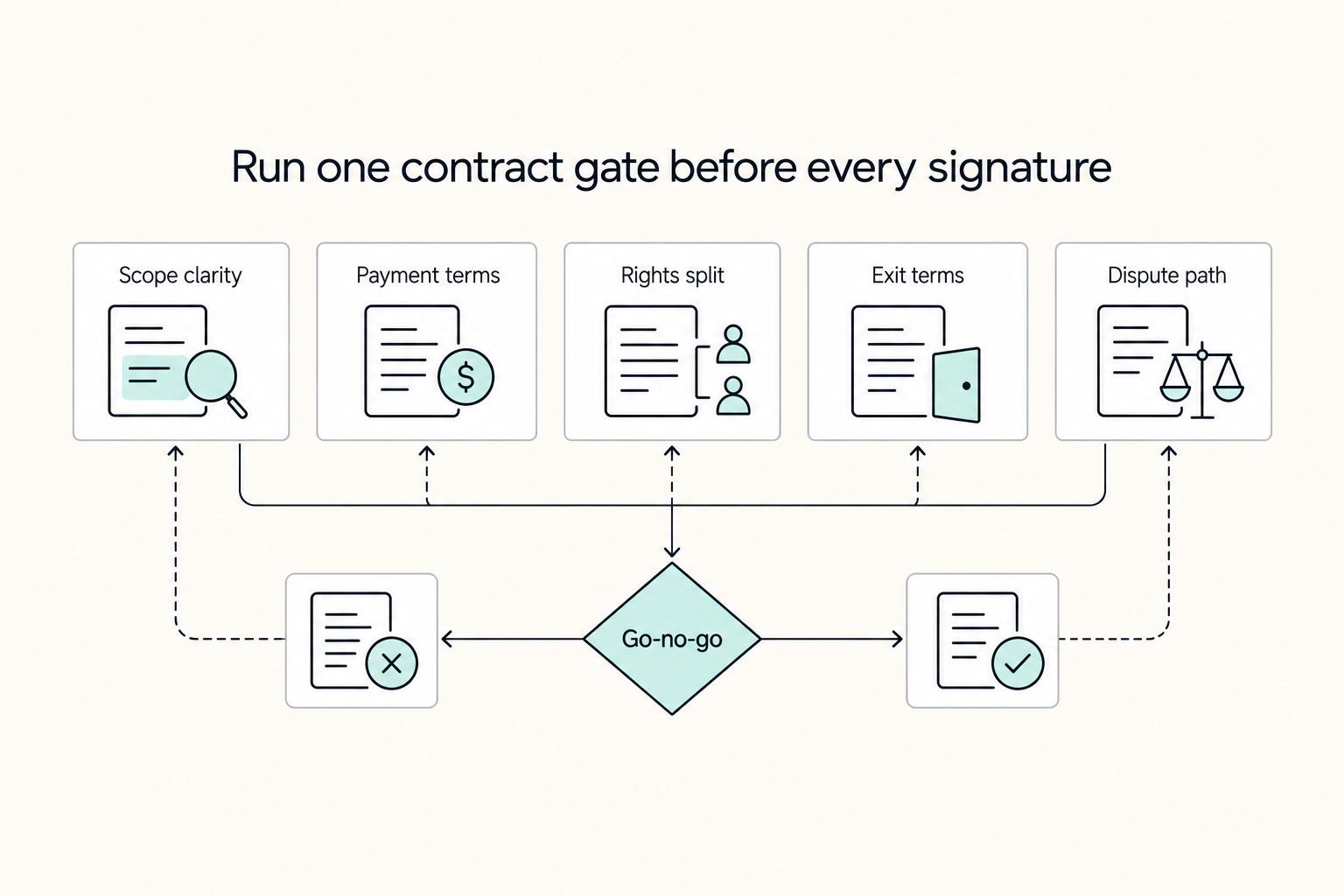
10 Freelance Contract Red Flags to Check Before Signing
Use this as a fast decision screen, not a legal theory exercise: sign the Freelance Contract, send a Contract Redline, or walk away.

The Freelance Payment Penalty: A Modeled Audit of Platform Fees, FX Spreads, and Payout Delays
The money rarely disappears through a single, easy-to-spot fee. The real loss is stacked. A marketplace takes its commission, a processor adds a charge for international cards, a bank or payment company converts the currency at a spread, a platform holds the funds before release, and a wire sheds a little to intermediaries on the way in. Each layer looks defensible on its own, but the worker feels the combined result as a smaller deposit and a later payday.