
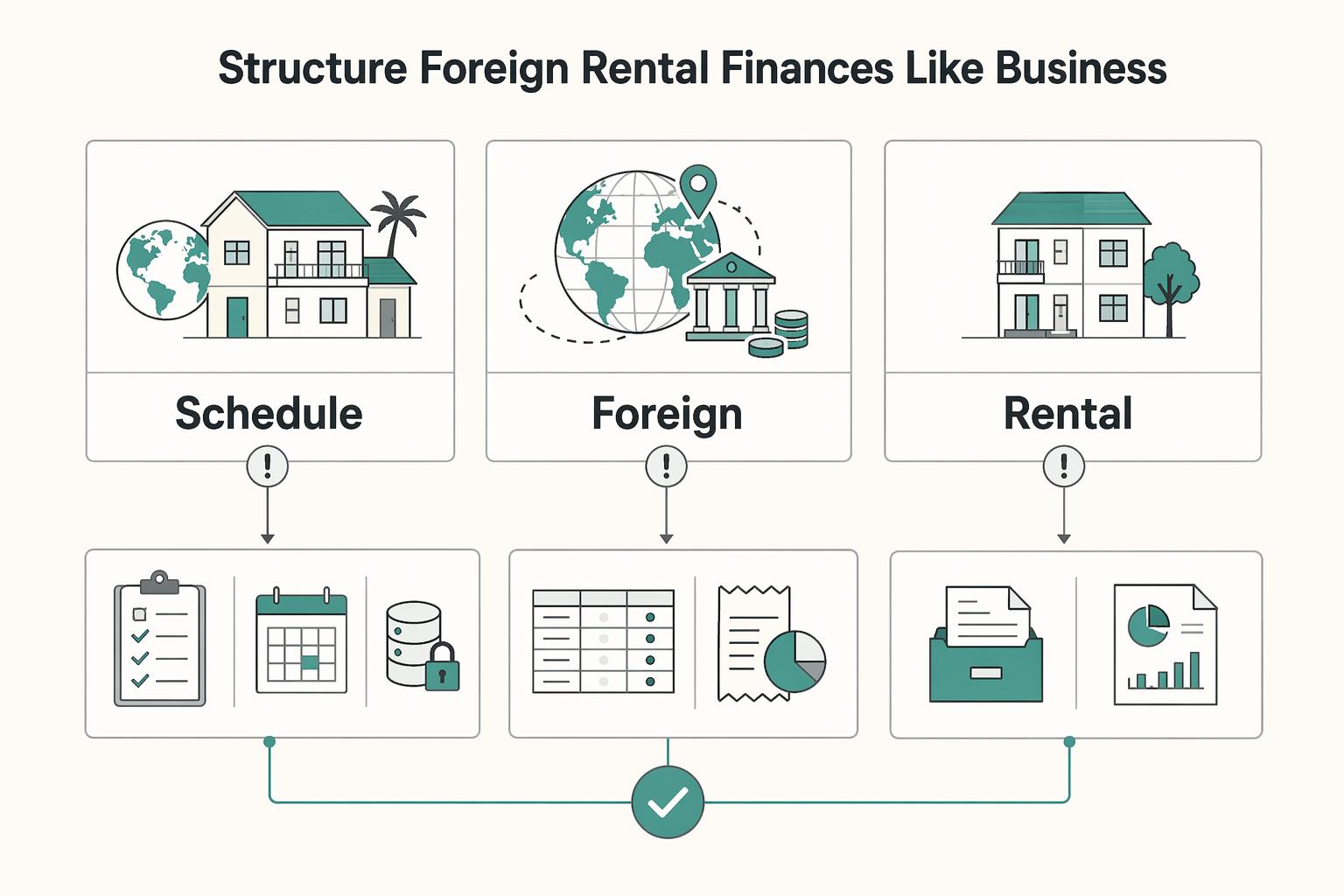
Quick Answer
Start by building a property-specific bookkeeping lane, then run monthly reconciliations, and only then file Schedule E in U.S. dollars. For schedule e foreign rental property reporting, tie rent amounts to ledgers, statements, and saved documents, treat advance rent in the year received, and keep one consistent exchange-rate method. Before submission, verify depreciation treatment for property used predominantly outside the United States and complete separate foreign-account reporting checks.
How to Structure Your Foreign Rental Finances Like a Business, Not a Hobby#
For Schedule E reporting on a foreign rental property, make three decisions in order: set up your system, run a monthly close, and verify compliance before filing. That order keeps your numbers, support, and filing positions aligned. It also cuts down the year-end scramble when bank activity, receipts, and conversion records all live in different places.
Set up the lane before money starts moving#
The best time to set this up is before the first rent payment hits. A dedicated operating lane for the property is not an IRS requirement, but it makes your records easier to support and year-end reporting cleaner.
If you own more than one rental, keep separate ledgers by property. Schedule E uses a separate column for each property and reports rental income on line 3. Even if one local bank account handles more than one property, your bookkeeping should still break out activity by property from the start. That is much easier than reconstructing it later.
Next, choose your currency method. Your U.S. return must be in U.S. dollars. IRS guidance generally points to spot-rate conversion when you receive, pay, or accrue an item, and it also accepts posted rates used consistently. What matters most is that you choose a method you can document and apply it the same way all year. If you switch approaches midyear without a clear reason and records to back it up, your file gets much harder to defend.
| Decision point | Average rate | Transaction date |
|---|---|---|
| Best fit | Recurring rent and routine expenses when you want simpler bookkeeping | Large, unusual, or timing-sensitive items, especially in volatile currency periods |
| Main tradeoff | Simpler process, less precision per transaction | Higher precision, more admin effort |
| Documentation to keep | The posted annual or periodic rate and which items it covered | The rate source tied to each receipt, payment, or accrual date |
| Safer when records are thin | Works only if applied consistently across similar items | Works better when you already have dated statements and invoices |
| Rule that matters most | Pick one method by item category and apply it consistently | Same rule: consistency is critical |
Run a short month-end close#
A short monthly close turns local-currency activity into filing-ready numbers with support attached. You do not need an elaborate process, but you do need one you will actually maintain. By the time you prepare the return, each number should tie back to a ledger entry, statement line, and document.
Keep rental inflows and outflows separate from personal spending where possible. Track activity in filing-relevant categories such as rent, advance rent, mortgage interest, real estate taxes, maintenance, utilities, insurance, and depreciation support. Save receipts and invoices when transactions happen, not at year end, and use a searchable file naming format like YYYY-MM-DD_vendor_amount_currency_property.
Then reconcile your ledger to statements each month and clear unknown items quickly. If something does not match, fix it while the transaction is still fresh instead of letting small open questions pile up into a year-end mess.
Two checks deserve special attention. First, advance rent is income in the year you receive it, even if it covers a later period. Second, keep a live evidence file with the lease, statements, invoices, local tax bills, insurance records, and notes for unusual items so every number on the return has support. When an item is unusual, leave yourself a short note at the time explaining what happened and why you classified it the way you did. That note is often more useful than trying to remember the story months later.
Verify the tax traps before filing#
Before you file, check the tax positions against the records, not just the spreadsheet totals. Confirm that each property has its own Schedule E column, that line 3 rent matches your ledger, that your U.S. dollar conversions follow your chosen method, and that advance rent was treated correctly. This is also the stage to make sure the amounts on the return still trace back to the underlying statements and document pack after any year-end adjustments.
Depreciation needs its own review. Do not assume domestic treatment carries over automatically. IRS depreciation guidance flags property used predominantly outside the United States for ADS treatment, so confirm the correct treatment for your property facts before filing. If you have not verified that yet, stop and confirm it, or use How to Calculate Depreciation on a Foreign Rental Property. This is one of the few areas where a single wrong assumption can carry through multiple years, so it is worth isolating and checking before the return goes out.
For double-tax relief, use this decision frame and keep the passive-income distinction clear from the start.
| Question | Foreign Tax Credit | Foreign Earned Income Exclusion |
|---|---|---|
| What it is built for | Reducing double taxation on foreign-source income | Excluding foreign earned income from personal services |
| Fit for rental activity | Often the relevant tool for foreign taxes tied to rental income | Not a fit for passive rental income |
| Key caution | If taxes were paid to more than one country, Form 1116 requires country-by-country separation | If you exclude foreign earned income, you cannot also claim an FTC or deduction on that same excludable income |
Once your Schedule E positions and tax-credit choices are in order, check the separate filings that often get missed. Treat that as a separate verification pass, not an afterthought once the income-tax return is done.
Related filings and when to get help#
Your Form 1040 may not cover everything. FBAR is separate from the IRS return and applies when aggregate foreign financial accounts exceed $10,000 at any time in the year. It is due April 15 with an automatic extension to October 15.
| Filing | What the section says | Thresholds or dates noted |
|---|---|---|
| Form 1040 | May not cover everything | Check separate filings as a separate verification pass |
| FBAR | Separate from the IRS return | Applies when aggregate foreign financial accounts exceed $10,000 at any time in the year; due April 15 with an automatic extension to October 15 |
| Form 8938 | Also separate; filing one does not replace the other | Thresholds depend on filing status and whether you live in or outside the U.S.; IRS comparison guidance includes $50,000/$75,000 for certain unmarried taxpayers living in the U.S. and $200,000/$300,000 for certain unmarried taxpayers living abroad |
Form 8938 is also separate, and filing one does not replace the other. Thresholds depend on filing status and whether you live in or outside the U.S. IRS comparison guidance includes $50,000/$75,000 for certain unmarried taxpayers living in the U.S. and $200,000/$300,000 for certain unmarried taxpayers living abroad. Keep the statements you used to test these filings in the same annual folder as the rest of your rental support so you can show how you reached the filing decision.
Bring in a pro when the facts stop being routine, especially in these situations:
- You used the property personally more than the greater of 14 days or 10% of rented days.
- You made major improvements and are unsure how to classify those costs for reporting.
- You sold the property, or plan to, because sale-year reporting can include Form 4797.
- You paid rental-related tax to more than one country and need a correct Form 1116 country split.
If you need related context, read 183-Day Rule Explained: Stop the Tax Myths Before They Cost You. Before you finalize your filing workflow, run a quick account check so you can confirm whether foreign-account reporting is likely in scope: Use the FBAR calculator.
Conclusion: From Tax Form to Strategic Asset#
Treat your Schedule E closeout as an operating task, not a year-end reconstruction: set the system, run the routine, then validate positions before you file.
- Set your system. Keep rental inflows and expenses clearly separated in your records so activity is traceable, and report return amounts in U.S. dollars using documented foreign-currency translations.
- Run a recurring documentation routine. Keep invoices, receipts, lender statements, tax-payment records, and improvement records so the deductions and amounts on your return are supportable.
- Validate filing positions before submission. Confirm Schedule E reporting, review any Form 1116 position, including separate country lines when taxes were paid to more than one country or territory, and run FBAR as a separate check if aggregate foreign account balances exceeded $10,000 at any point. If Form 8938 might apply, verify that separately because it does not replace FBAR.
Good default habits are simple: keep the account flow clean, keep currency translation documented, keep deduction support complete, and do not rely on assumptions when a position needs verification. If your file is organized this way, filing becomes a review process rather than a reconstruction project.
Get professional review when:
- Your facts are complex and you are not sure a filing position is supportable.
- You need depreciation treatment confirmed under ADS rules for property used predominantly outside the United States.
- You paid tax in more than one country and need Form 1116 allocation reviewed.
- Your foreign accounts may trigger FBAR or Form 8938.
- You are considering FEIE treatment for rent or any position you cannot document clearly.
If you want a deeper dive, read Digital Nomad Taxes in 2026 With a Defensible Filing Plan. If your rental setup spans multiple countries or entity layers, get a compliance-first view of your filing flow: Talk to Gruv.
Frequently Asked Questions
Is mortgage interest on a foreign rental property deductible?
Keep the loan agreement, lender statements, and clear records showing how the borrowed funds were used, then confirm the treatment with a qualified tax pro before filing. Use extra caution if you refinanced, funded improvements, or had mixed personal and rental use.
What exchange rate should I use for my tax filing?
Use a documented conversion approach and apply it consistently so each reported amount is supportable. For Form 1116, report amounts in U.S. dollars except where Part II says otherwise. Keep the rate source you used with your supporting documents.
How do I depreciate a foreign rental property?
Verify the depreciation method and recovery period for foreign residential rental property with a qualified adviser before filing, then keep your purchase documents, placed-in-service support, and improvement ledger together. Use How to Calculate Depreciation on a Foreign Rental Property as your starting point.
How do I avoid double taxation on rental income?
For rental income, do not assume FEIE applies. FEIE is for foreign earned income from personal services, while Form 1116 is filed by income category. On Form 1116, use a separate form for each income category, check only one category box on each form, and report amounts in U.S. dollars except where Part II says otherwise.
Can I use the Foreign Earned Income Exclusion for rental income?
Do not assume FEIE applies to rental income. FEIE applies only to foreign earned income, such as wages, salaries, and professional fees. To claim FEIE, you must have foreign earned income, a foreign tax home, and qualifying status (bona fide residence or physical presence, including 330 full days in 12 consecutive months for that test path). Even when income is excludable, you still report it on a U.S. return.
Do I have to file an FBAR for my rental bank account?
Verify FBAR filing thresholds separately from Schedule E using account records you can retain.
What happens if I sell my foreign rental property?
Confirm exact sale-year treatment rules (including recapture, major-improvement handling, or mixed-use allocation) with a qualified adviser. Treat the sale year as a professional-review year: assemble your purchase records, sale closing documents, improvement history, prior depreciation support, and U.S. dollar conversion records before filing.
Try a related tool
Researched and edited by the Gruv editorial team. Gruv builds cross-border billing, payouts, and finance-operations software for global businesses.
Sources
Educational content only. Not legal, tax, or financial advice.
Related Posts

Digital Nomad Taxes in 2026 With a Defensible Filing Plan
With digital nomad taxes, the first move is not optimization. It is figuring out where you may be taxable, where filings may be required, and what proof supports that position.

183-Day Rule Tax Myths That Trigger Residency Filing Mistakes
If you are a mobile freelancer or consultant, start here: the "183 day rule tax" idea is not a single universal test. It is a shortcut phrase people use for different residency rules that do not ask the same question. If you mix federal and non-federal residency logic, you can create filing risk even when your travel calendar looks clean.

How to Report Foreign Rental Income on a U.S. Tax Return
When dealing with `us tax on foreign rental income`, start conservatively: treat reportability and treatment as unresolved until primary IRS authority for your facts says otherwise.