

Quick Answer
Run a go/clarify/no-go decision before any drafting, then build the response from a live requirement tracker. For responding to an rfp, confirm deadlines, submission method, contact rules, and required attachments during intake so you do not discover blockers at the end. Keep DDQ and security questionnaire work in the same stream as the main proposal, and finish with a final gate for file completeness, evidence support, and submission confirmation.
You are not writing one more proposal you are building an RFP operating system#
If you treat every bid like a fresh writing sprint, you create avoidable risk. The better model is a repeatable flow that protects your time, surfaces compliance issues early, and leaves a useful record after submission.
A request for proposal is the buyer document. Your response is the proposal you build against that buyer-defined problem and its requirements. That distinction matters. You are not starting from a blank page. You are reading the buyer's instructions closely, deciding whether to pursue, and then answering in a controlled sequence.
Run the same flow every time#
Keep the flow simple: intake, go or no-go, controlled drafting, review, submission, then reuse capture. Intake means extracting the actual requirements before anyone starts writing. Most RFPs already tell you what must be included through scope details, expected deliverables, and explicit response instructions. Your first checkpoint is to pull those items into one working list and flag anything that could block you later.
Then make go or no-go a real gate, not a polite formality. If the fit is weak or you cannot meet key requirements, stop there. That protects capacity; it is not laziness. Teams that rush large questionnaires create delays, weaker answers, or both. Missing submission requirements can get you disqualified early.
| Emergency mode | Operating mode |
|---|---|
| Intake starts with "who can draft this fast?" | Intake starts with requirement extraction, deadlines, and submission instructions |
| Qualification happens after effort is already spent | Go or no-go analysis happens before drafting |
| Compliance questions wait until the end | Compliance and questionnaire items are surfaced early during intake |
| Submission is the finish line | Submission is followed by saved files and audit records |
Know what "done" means#
A good process should leave you with the same outputs every time.
| Output | Done means |
|---|---|
| Decision record | You can show why you bid or declined, what assumptions you made, and which deal-breakers you accepted or rejected |
| Submission-ready package | The response is complete against the buyer's instructions, reviewed, and ready to send without last-minute hunting for missing sections or attachments |
| Audit-ready trail | You save and audit responses after submission, with final files and related records preserved |
The third output matters more than many teams think. That is not overkill. Procurement guidance treats this work as part of an end-to-end lifecycle and explicitly covers record retention.
If you want this process to connect cleanly to the rest of your pipeline, hand it off from your broader client acquisition process. The point here is the operating model itself: fewer scrambles, more consistency, and better use of limited business development capacity.
The mental model that makes responding to an RFP predictable#
Treat responding to an RFP as a gated decision system, not a writing sprint. If key facts are missing, confidence is low, or a requirement could create contractual or compliance exposure, pause and resolve that point before drafting further.
That is what makes the process predictable. You are not optimizing for speed alone. You are documenting decisions, verifying claims, and slowing down on purpose when risk increases.
Use the procurement terms as decision triggers#
Use the procurement terms to trigger specific decisions. The proposal is your submitted response to the RFP. The contract is the agreement created only after award. A contractor or bidder is the vendor submitting the proposal. A responsible contractor is one that can perform the contract requirements.
| Term | Definition |
|---|---|
| Proposal | Your submitted response to the RFP |
| Contract | The agreement created only after award |
| Contractor or bidder | The vendor submitting the proposal |
| Responsible contractor | One that can perform the contract requirements |
Those definitions should trigger a real bid/no-bid pause. If you cannot demonstrate capability for the stated work, staff the initial 16-month term, support possible extensions up to three years and four months total, or keep proposal terms firm for 120 days after submission, stop and decide before drafting continues.
Send clarification requests before you draft around assumptions. If scope wording, submission instructions, required attachments, or channel rules are unclear, submit questions by the posted deadline through the required channel. In one state RFP example, questions are due December 12, 2025 at 4:00 PM (Des Moines local time), must be submitted in IMPACS, and addenda are posted there.
Run the gates with explicit ownership#
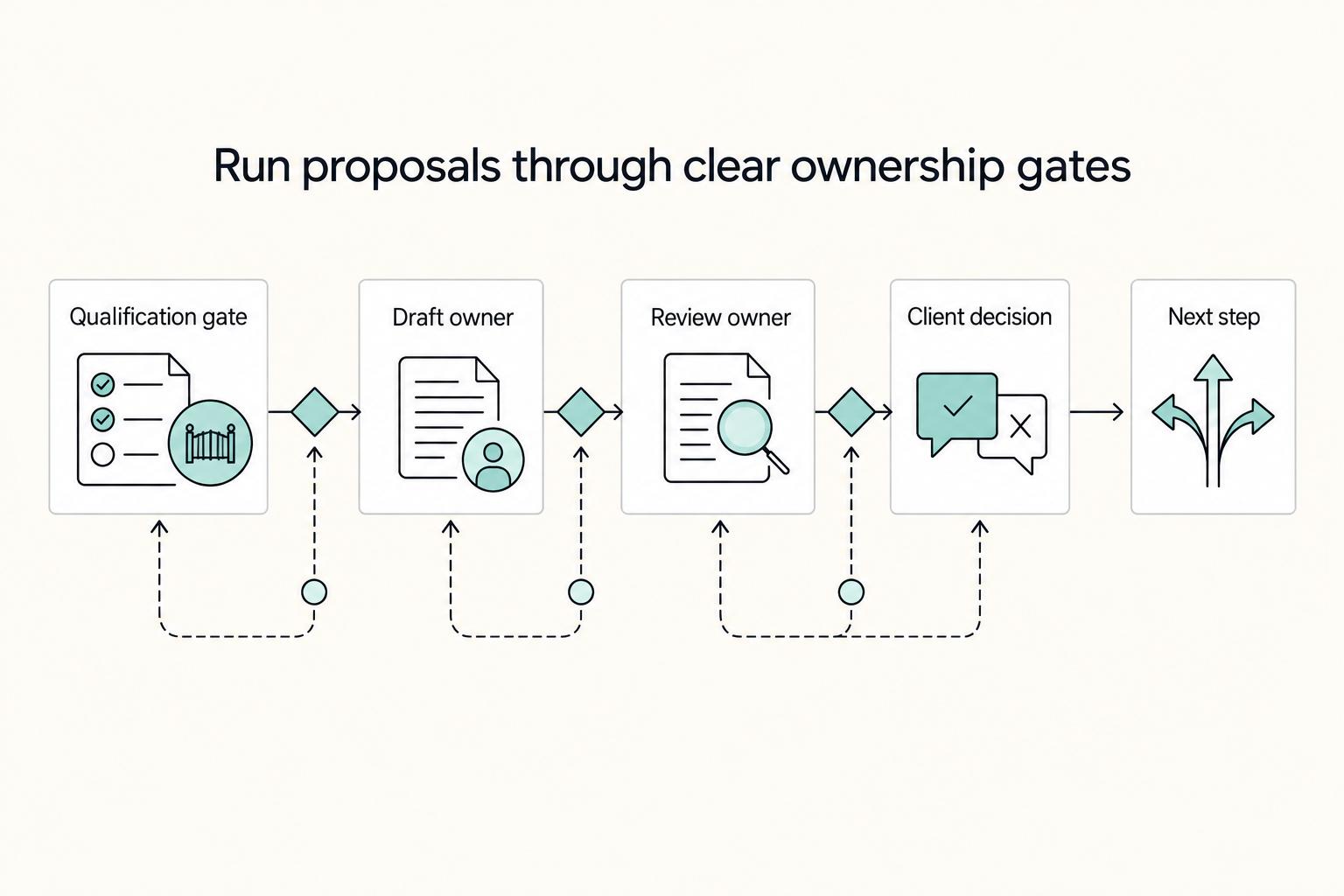
Give each gate one owner so every stage has a decision, a deliverable, and an exit check.
| Stage | Primary owner | Decision or deliverable | Exit check |
|---|---|---|---|
| Intake | Bid lead | Requirement list, deadline log, required attachments list | Submission route, dates, and attachments confirmed |
| Qualification | Sponsor or owner | Bid/no-bid decision with rationale | Fit, capacity, term, and exposure risks documented |
| Clarifications | Bid lead | Question list submitted in required channel | Questions submitted on time; addenda monitoring active |
| Draft control | Section owners | Evidence-backed draft responses | Claims align with available proof and known requirements |
| Final review and submission | Final approver | Submission-ready package | Files complete, approvals captured, portal submission verified |
Skipping gates usually creates deadline compression. That drives rework, increases risk, and consumes time late in the cycle.
Add one consistency check before final review#
Run one short alignment check across your executive summary, requirement matrix, and risk/compliance answers. Your core claims should stay consistent across all three and map to the same evidence.
If those sections conflict, fix the mismatch before submission. This single check reduces overpromising and keeps the response tied to what you can sign and deliver.
If you want a deeper dive, read How to Write a Freelance Proposal That Wins Clients.
Should you bid or walk away in 30 minutes?#
Decide go, clarify, or no-go before drafting so you protect capacity and avoid submissions you cannot complete or defend with relevant proof.
Use the gate model from the last section and run these four checks first:
| Criterion | Pass signal | Fail signal |
|---|---|---|
| Fit | The buyer's problem matches your core service and recent, directly relevant delivery | You would need to stretch into work you have not delivered or cannot staff credibly |
| Timeline and submission logistics | You can meet the deadline and follow required format, contact channel, and appendix requirements exactly | You already see deadline compression, unclear submission rules, or required files you cannot assemble in time |
| Proof readiness | You have relevant examples and supporting documents ready, or can update them quickly | Core claims rely on weak analogies, missing appendices, or evidence you cannot verify |
| Commercial viability | The pursuit justifies the time and cost you will divert from other work | The bid absorbs scarce hours with low confidence or weak strategic value |
Apply a lightweight qualification rule and act immediately:
- Go: all four areas pass. Start drafting with owners and checkpoints.
- Clarify: one or two areas depend on buyer answers. Send clarification questions first, then decide.
- No-go: you answer "no" to 3+ key questions, or one failure creates real compliance exposure. Decline and document why.
Treat red flags as operating checks, not gut feelings:
- Compliance risk: you cannot satisfy submission logistics exactly, for example required format or appendix mismatches.
- Scope ambiguity: in-scope, out-of-scope, or pricing assumptions are unclear and unresolved.
- Evidence gaps: your differentiators are not supported by directly relevant proof.
- Process quality warning: ask how many companies received the RFP; a very broad distribution, for example more than four or five, or an included incumbent can lower practical odds and should be recorded in your decision notes.
Record the rationale in your requirements traceability matrix or intake notes so your pursuit decision is defensible later.
What does a submission-ready RFP response include every time?#
A submission-ready RFP response is a complete, traceable submission set that follows the solicitation instructions exactly. Your goal is not polished prose alone. It is a package evaluators can review quickly, score confidently, and verify line by line.
Most RFPs already tell you what to include and how to submit. Use that as your build spec, then keep every document aligned so your summary, forms, and attachments do not contradict each other.
Build the package around evaluator usability#
Use a consistent core structure, but include each component only when the solicitation says so.
| Component | Usually required or context-dependent | What it needs to do |
|---|---|---|
| Cover letter | Context-dependent unless requested | Confirm intent to submit, show scope understanding, and avoid claims you cannot support elsewhere |
| Executive summary | Common, sometimes explicitly requested | Restate buyer goals, explain your approach, and map strengths to evaluation criteria |
| Response matrix | Strongly recommended even if not requested separately | Map each requirement to its answer location so completeness is easy to verify |
| Required forms and attachments | Required when listed in the solicitation | Include every named form, appendix, pricing sheet, certification, and signature item in the requested format |
| Security questionnaire or DDQ content | Context-dependent | Prepare in the same workstream when requested in parallel or when security review can affect award timing |
If security questionnaire or DDQ work is in scope, do not leave it to the end. Complete it alongside the main response so answers stay consistent across documents.
Use a response matrix that survives final review#
Treat the response matrix as your control sheet from kickoff through submission. Keep it live, not static.
At minimum, track these fields per row:
- Requirement reference from the RFP or attachment
- Answer location in your response or appendix
- Owner for that answer
- Status, for example draft, reviewed, approved
- Evidence source supporting the claim
- Open assumption or clarification need, if any
This field set is not a universal buyer requirement. It is a practical minimum to catch omissions, speed review, and prevent contradictions before submission.
Run a pre-submit quality gate#
Before you upload anything, run one deliberate completeness pass against the solicitation and its attachments.
| Check | What to verify |
|---|---|
| Traceability | Every requirement has one clear answer location, and every required file is accounted for |
| Ownership | Each answer has an owner, and final consistency is reviewed across the full set |
| Evidence linkage | Material claims are supported by current proof, not unsupported boilerplate |
| Submission readiness | File names, formats, signatures, and document count match the instructions |
Then do the mechanics checks: verify document count, confirm all required files are attached, submit on time without waiting until the last minute, and save submission confirmation. If anything is still unclear, use the buyer listed in the solicitation as your clarification channel.
Portal rules also matter. In the cited Virginia eVA workflow, uploads are limited to 80 MB (81,920 KB) per file, and a 0 KB upload triggers a warning. Treat those as workflow-specific examples, and always follow the limits in your actual solicitation.
If you want help tightening the persuasive parts after the package is under control, see How to Write a Proposal for a Six-Figure Consulting Project.
How do you run the workflow without dropping quality?#
You keep quality by giving each pass one objective and one gate. When drafting, verification, and approval blur together, buyer-scored details get missed, especially under late pressure.
Run the workflow in stages. Move on only when the current stage clears its exit check.
| Stage | Owner hat | Objective | Exit check |
|---|---|---|---|
| Draft | Writer | Produce a complete first draft mapped to extracted requirements | Mandatory requirements, deadlines, evaluation criteria, and attachment lists are captured; open items are explicitly marked for clarification before handoff |
| Review | Reviewer | Verify truth, fit, and compliance before anything is treated as final | Material claims have supporting proof; deviations from approved language are flagged; any AI-generated text is clearly surfaced for human verification |
| Final approval | Approver | Make a submit/no-submit decision on the full package | Controlled approval chain is complete; final files, signatures, and submission instructions match the solicitation |
If you are a solo operator, use RACI as hat switching. Finish one pass, then leave yourself a short handoff note before changing hats: what changed, what evidence supports claims, what assumptions are still open, and what needs buyer clarification. Review against the matrix and solicitation, not memory.
Reuse only works when it is controlled. Keep a pre-approved content library, map extracted requirements to approved blocks, and treat buyer-scored or compliance-sensitive claims as mandatory validation checkpoints. If evidence is missing, stale, or contradictory, clarify before drafting that answer.
How do you make compliance and auditability a competitive advantage?#
Compliance becomes a real advantage when every claim is tied to evidence, approval, and a clean audit trail. Because buyers score responses against a predetermined rubric, this is not admin overhead. It is how you prevent avoidable misses and give reviewers proof they can trust.
Before you lock the draft, run a matrix control check for every requirement: assign an owner, note the exact response location, attach the evidence source, mark approval status, and log unresolved assumptions. Review that matrix against the buyer's scoring criteria, not memory. If a line has no owner, no response location, or no proof, treat it as incomplete.
| Response type | Tone | Acceptable claim types | Review gate |
|---|---|---|---|
| Narrative sections (cover letter, executive summary) | Persuasive but bounded | Solution fit, relevance, and approach tied to buyer needs | Confirm each claim matches approved solution, timeline, pricing, and experience proof |
| Delivery sections (technical response, scope, timeline, pricing) | Specific and factual | What you will deliver, when, and at what price | Verify each item against the compliance matrix and latest approved source documents |
| Attestation sections (DDQ, RFI, security questionnaire) | Attestation-first, no guesswork | Verified facts only | Require linked proof, clear ownership, approved status, and no open assumptions |
Keep an evidence pack that includes the buyer requirement, final response text, version history, and proof for material claims. Acceptable proof includes approved solution details, timeline and pricing documents, team experience evidence, and approved DDQ or security questionnaire answers. Escalate anything stale, contradictory, or assumption-dependent, and exclude anything unverified.
If buyer language conflicts with your template, pause, record the assumption, route it to your policy or legal owner, revise the response, and log the approval in your audit trail. This discipline helps you avoid preventable disqualifications, speeds reviewer trust, and leaves a cleaner audit record for future bids.
How can a solo business respond faster without becoming generic?#
If you work solo, the fastest reliable rule is simple: standardize what is already verified, and rewrite what buyers will score or use to screen out bids. Reuse approved proof, process controls, and recurring verified answers. Customize anything tied to evaluation criteria, buyer priorities, scope interpretation, or non-responsive risk.
A compliant response is not automatically a responsive one. Speed improves when you stop redrafting stable material and focus your effort where buyer judgment happens.
Split your material into two layers#
Keep a base library for content that stays true across opportunities and is already approved: company background, delivery model, reporting cadence, team setup, core security/compliance responses, case evidence, standard assumptions, and verified DDQ/questionnaire answers. If you use automation, keep it on this layer only.
Build a buyer layer fresh for each bid. Before drafting, create a short customer insight brief with the buyer's goals, likely pressures, evaluation criteria, constraints, key risks, and the proof points from your base library that actually fit this RFP.
| Standardize (approved assets) | Customize each bid | Why customization affects score or risk |
|---|---|---|
| Bid intake checklist, bid/no-bid criteria, ownership notes | Your buyer insight brief and problem framing | Prevents solving the wrong problem even when your capabilities are strong |
| Approved company background, capability statements, evidence pack | Executive summary, cover letter emphasis, win themes mapped to criteria | Reviewers score relevance, not just completeness; weak alignment can lose the deal |
| Verified DDQ/questionnaire answers for recurring asks | Any response touched by buyer wording, policy terms, scope assumptions, or submission instructions | This is where copy-paste errors can create contradictions and disqualification risk |
| Compliance matrix template, submission checklist, QA workflow | Scope narrative, timeline logic, pricing rationale, objection handling | These are often buyer-scored and shape reviewer trust in your fit |
If a section is likely scored or could make the bid non-responsive when wrong, rewrite it. If it is factual and still true, reuse it from your template library.
Run the same stage sequence every time#
For a business-of-one, speed comes from order, not from drafting sooner:
- Qualify first against fit, capacity, available proof, and deadline reality.
- Create the customer insight brief from the RFP and known buyer context.
- Run a clarification checkpoint before drafting when requirements are vague, conflicting, or missing. Use the buyer Q&A path or preproposal conference when available.
- Draft buyer-scored sections first using the insight brief and evaluation criteria.
- Insert approved standard sections from your base library after tailored sections are stable.
- Run final QA with the compliance matrix, proof links, submission checklist, and, when possible, a final proofread by someone who did not draft the response.
Treat external benchmarking as optional calibration. Your primary improvement loop is internal: win/loss notes tied to specific response choices, reviewer feedback, repeated objections, and where reuse helped or hurt. For the broader operating model behind that loop, see How to Build a Client Acquisition System for Your Agency.
Set up one operating kit and one repeatable sequence this week#
You do not need a bigger process. You need one compact operating kit, one repeatable sequence, and one rule: nothing advances until it passes its checkpoint.
Build your one page operating kit#
Keep each artifact to one page so you can use it under deadline pressure. Use it to protect bid quality early and compliance late.
| Artifact | Purpose | Owner | Decision trigger |
|---|---|---|---|
| Bid record + Go/No-Go sheet | Capture deadlines, contact rule, submission method, deal breakers, and assumptions | Opportunity owner | If fit, capacity, proof, or core instructions are unclear, stop before drafting |
| Requirement tracker | Map each buyer ask to an answer, evidence, attachment, and review status | Lead writer or coordinator | If any requirement has no answer or no support, it is not submission-ready |
| Final gate checklist | Confirm latest instructions, full file set, approvals, delivery method, and timing | Final reviewer or submitter | If one item fails, pause submission until corrected |
Populate the bid record first. Record the question deadline, final deadline, and the exact contact rule from the solicitation. If the RFP says the issuing office is the sole point of contact, treat that as a hard boundary. Some packets route questions even more specifically, such as to a project manager with a consulting partner copied.
Run one sequence every time#
Run the same handoffs on every bid:
- Intake: capture rules, deadlines, submission method, and contact channel.
- Qualification: complete Go/No-Go before drafting.
- Kickoff: assign ownership for tracker, writing, evidence checks, and submission.
- Drafting: write from the tracker and evidence pack, not memory.
- Review: run requirement completeness and support checks.
- Submission: verify delivery method and timing against the latest instructions.
- Handoff: move the final tracker, assumptions, and evidence into onboarding/delivery notes.
Treat submission method as a high-risk detail. Do not assume electronic upload. One public county RFP states "No electronic submissions," requires "One (1) Original" and "One (1) Electronic Copy on Thumb Drive," and treats a proposal as timely only when Purchasing staff date/time stamp it by 1:30 pm on the due date.
If requirements change midstream, pause and escalate in order: log the change, request formal clarification through the allowed contact channel, update only affected sections, then rerun final gate checks against the latest version. Do not skip the recheck.
Use this checklist this week:
- Add the three one-page artifacts before the next opportunity reaches drafting.
- Enforce "no draft before Go/No-Go."
- Put submission method, contact rule, and deadline stamp requirement at the top of every bid record.
- After submission, move the tracker, assumptions, and evidence pack into onboarding or delivery handoff notes.
- Connect this playbook to your full pipeline in How to Build a Client Acquisition System for Your Agency.
Frequently Asked Questions
What are the first steps when responding to an RFP?
Start with intake, not drafting. Capture the hard facts first: question deadline, submission deadline, required format, and any obvious deal-breakers. Once a question deadline passes, you may lose the chance to fix missing information. Produce a one-page intake sheet or bid record before you write anything, then trigger a go or no-go review only after you have confirmed the dates, the buyer’s latest instructions, and whether key information is missing.
How do you decide whether to bid on an RFP?
Decide before you spend writing time. Qualify the opportunity against fit, capacity, available proof, and whether you can answer the packet completely without guessing through critical requirements. A practical artifact here is a bid or no-bid scorecard with a short assumptions log. If core details are missing, ask the person soliciting the proposal for clarification first, document what is still unknown, and do not move into drafting until you can clear the main compliance risks.
What should an RFP response include to be considered complete?
A response is only complete when every question in the bid response packet has an answer. Build a requirement matrix or response tracker that maps each buyer ask to where it is answered, what evidence supports it, and whether it needs final review. That matrix is your checkpoint, not your memory. Before submission, run a completeness gate that checks every requirement, every attachment, and every date-sensitive instruction against the latest version of the RFP.
How do you make your response stronger without overpromising?
Write to the buyer’s asks, not to your own sales script. Start by marking the scored or decision-critical sections, then anchor those sections in proof you can actually produce if challenged. Create a small evidence pack alongside the draft, such as case examples, delivery artifacts, policy excerpts, or other verifiable support for key claims. If a sentence sounds impressive but you cannot back it up quickly, cut it or narrow it before final review.
How can you handle the work efficiently if you are a solo operator or very small team?
You move faster by separating stable content from buyer-specific content. Reuse only what stays true across bids, then draft the buyer-facing sections fresh after you have reviewed the criteria, dates, and open questions. Your working artifacts should be a base answer library, a customer insight brief, and a live requirement tracker. Before you switch from intake to drafting, trigger a quick ownership check anyway, even if the “team” is just you, so you know who is doing qualification, writing, QA, and final submission.
How should you handle a security questionnaire versus a DDQ?
Do not assume a formal distinction unless the buyer defines one. Treat each document as its own questionnaire: read it line by line, track requests separately when scope differs, and submit clarification questions before the question deadline when terminology is unclear. Then verify each answer against your approved source material before submission.
What should you do when the buyer’s criteria are ambiguous or conflicting?
Pause and escalate early. Important information is often missing from the original RFP, and the only way to get more detail may be to ask the person soliciting the proposal. Use a simple sequence: document the assumption, submit the clarification question before the question deadline, and update your draft to match the buyer’s latest instructions. Stop the submission if the conflict still creates compliance risk. A common failure mode is drafting around the gap and discovering too late that your answer no longer fits the requirement or deadline.
How tightly should you treat deadlines?
Treat them as hard cutoffs, not suggestions. If the submission deadline is 4 pm, your internal target should be earlier, because in RFP work you can simply be too late. Put every date on the intake sheet and highlight them during review, especially the question deadline and final submission deadline. Your last gate should confirm timing, upload method, and file readiness before you hit submit, not after.
Try a related tool
Researched and edited by the Gruv editorial team. Gruv builds cross-border billing, payouts, and finance-operations software for global businesses.
Sources
- acquisition.gov/far/part-33trusted
- admin.ks.gov/media/cms/SoK_OPC_Procurement_Manual_11_3b8e...trusted
- clark.wa.gov/sites/default/files/2022-08/_RFP%20834%20Sof...trusted
- das.nebraska.gov/materiel/purchasing/6056/6056%20Z1%20Peerlac...trusted
- dgs.virginia.gov/globalassets/business-units/dps/documents/vb...trusted
- emsa.ca.gov/wp-content/uploads/sites/71/2018/04/2015-CCC...trusted
- govlab.hks.harvard.edu/wp-content/uploads/2021/02/gpl_rfp_guidebook...trusted
- humanservices.arkansas.gov/wp-content/uploads/710-19-1021_RFP_for_IVV_6...trusted
Educational content only. Not legal, tax, or financial advice.
Related Posts
How to Build a Client Acquisition System for Your Agency
Build the first version of your **agency client acquisition system** over the next month so weekly decisions replace guesswork. The point is not to collect more tactics. It is to run one repeatable acquisition process with clear checkpoints, cleaner handoffs, and fewer avoidable risks.
How to Write a Proposal for a Six-Figure Consulting Project
If you are sending a **six-figure-consulting-proposal**, treat it as an operating document, not just a polished PDF. Even indirect evidence supports a cautious rule for consulting work: clear definitions, named approvals, and written proof reduce avoidable surprises.

The Freelance Payment Penalty: A Modeled Audit of Platform Fees, FX Spreads, and Payout Delays
The money rarely disappears through a single, easy-to-spot fee. The real loss is stacked. A marketplace takes its commission, a processor adds a charge for international cards, a bank or payment company converts the currency at a spread, a platform holds the funds before release, and a wire sheds a little to intermediaries on the way in. Each layer looks defensible on its own, but the worker feels the combined result as a smaller deposit and a later payday.