
Quick Answer
Renting in Europe as a foreigner works best as a staged 90-day plan, not a rush to book the first listing. First choose your target city, confirm whether your stay is a Schengen short stay or a national long-stay procedure, and build a document pack with matching details. Do not send money until the property, signer, payment instructions, and lease all match in writing.
Renting in Europe as a Foreigner Starts With the Right Timeline#
If you're renting in Europe as a foreigner, treat the move as a staged long-term housing plan, not a booking sprint. Your first decision is not which listing looks best. It is which city you're targeting, which legal stay track applies there, and when you'll be ready to sign without guessing.
Keep the scope tight from the start. This guide is about long-term residential rentals, not holiday bookings or a two-week stopover. The usual trap is assuming there is one Europe-wide process for deposits, documents, registration, or move-in timing. There is not. Broad regional rules can tell you which stay category you are in, but the rules that block or delay a rental often sit at country, city, or municipal level.
Start with the city and the stay track#
Use a simple rule: regional rules tell you whether your stay is short or long, and local rules tell you what you must do next. For non-EU nationals, the Schengen short stay is up to 90 days in any 180-day period, while stays over 90 days move into national procedures. That alone should stop you from treating a long-stay lease like a tourist booking.
Your city choice also changes the cost side more than many people expect. EURES notes that rents in larger cities are often much higher, and gives one Finland example where Helsinki and Turku differ by almost 33%. Local restrictions can also change terms. In France, some rent controls are set in specific communes and agglomerations, not across the whole country. Before you act, verify the current requirements for the exact place you plan to rent with the relevant local authority or official city source.
Work the move in phases#
Urgency is a poor planner here. Work the move in phases, and only lock in once your documents, legal stay position, and on-the-ground checks line up.
| Phase | Your objective | Documents to finalize | Hard stop before any payment |
|---|---|---|---|
| 90 to 60 days out | Pick one target city, one backup city, and confirm your stay track | Passport copy, planned move window, visa or residency path notes, budget by city | Do not reserve a long-term place just because the listing is available |
| 60 to 30 days out | Build a clean application pack that can survive review | Proof of income or funds, ID files, current address records, translated or standardized name format across documents | If your legal name, date format, or address details do not match across files, pause and fix them |
| 30 to 7 days out | Validate the property, landlord or agent, and lease draft | Draft lease, full property address, payment instructions, inventory or condition notes if available | No transfer if the unit cannot be viewed in person or through a trusted representative |
| Final week before signing | Confirm contract and move-in readiness | Signed lease version, deposit terms, first rent amount, arrival admin checklist | Stop if the signer, bank details, unit address, or dates do not exactly match the contract |
Two checks do most of the work: make every file agree on your identity to avoid avoidable delays, and do not commit to a long-term place before you know the apartment and area actually fit. Photos can miss building access, noise, the real commute, or whether the unit shown matches the lease.
Use a strict pre-sign control list#
Before you send money or sign, run this pass/fail check:
| Check | Requirement | Stop if |
|---|---|---|
| Identity | Legal name on your ID, application, lease, and payment route matches exactly | Any legal-name detail does not match exactly |
| Property details | Property address and unit details match across the listing, draft contract, and bank instructions | Address or unit details do not match across sources |
| Viewing | You have seen the place in person, or someone you trust has | The landlord says they are abroad and cannot show the property |
| Legitimacy proof | Do not rely on a scanned ID as proof of legitimacy | A scanned ID is the main proof offered |
| Arrival requirements | You have checked local arrival requirements; Berlin gives you 14 days to register your address after moving | Local arrival requirements have not been checked |
| Early payment | Do not pay early just to "hold" a residential rental; in France no money can be demanded before the lease is signed | Money is demanded before the lease is signed |
France is a useful red-flag example here: no money can be demanded before the lease is signed, while the security deposit is tied to the lease signature itself.
If one of those points fails, wait. The goal is not to move fastest. It is to reach the signing stage with the right city, the right legal track, and no hard-to-reverse mistakes. That same logic should shape how you search in the first place. If you want a deeper dive, read Can Digital Nomads Claim the Home Office Deduction?.
Build the Right Mental Model Before You Search#
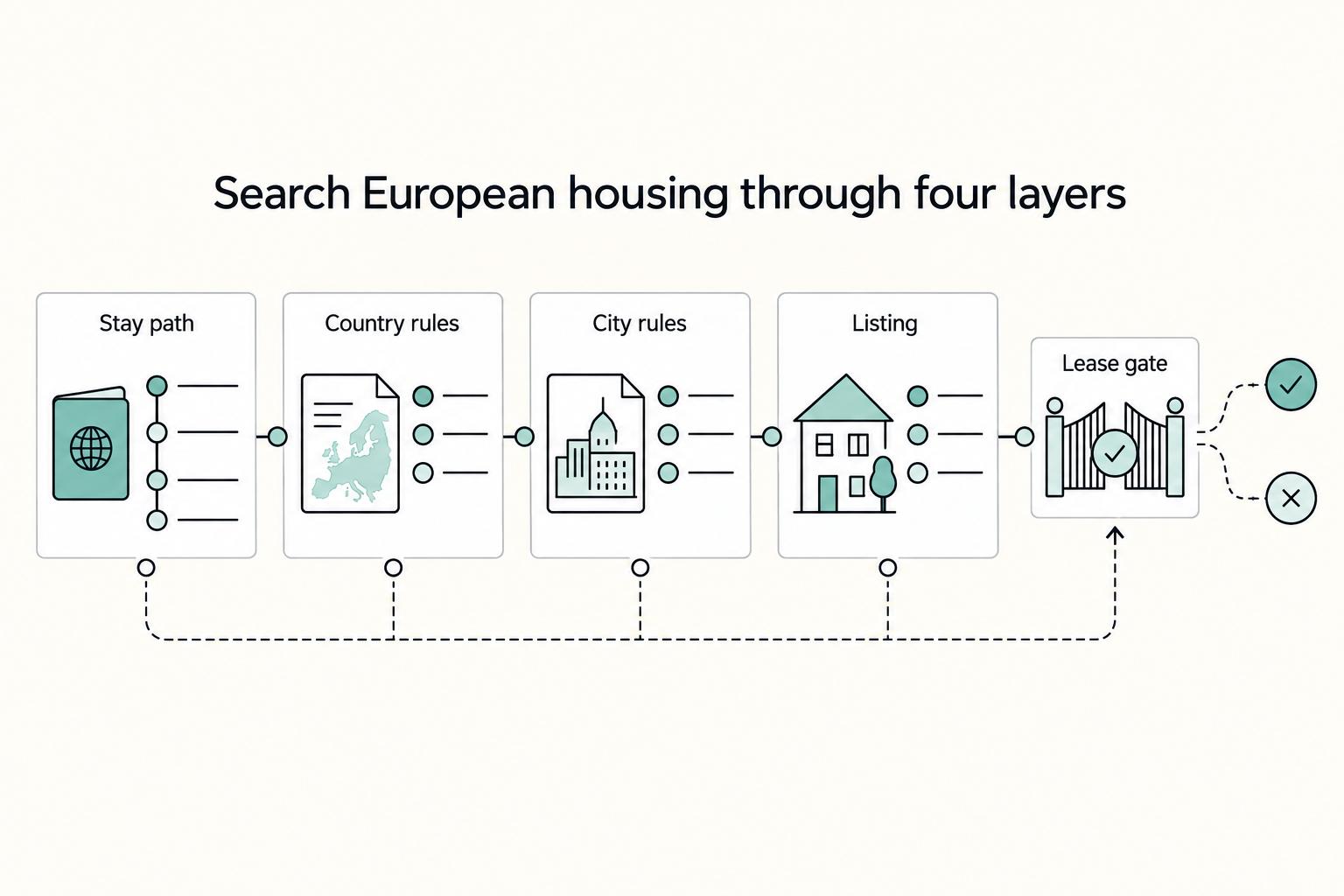
Search with a four-layer model, not a "single Europe" assumption. You are choosing a listing in a city, inside a country, under your stay path, and each layer can change what you can safely sign or pay.
A useful analogy: EU tax systems can use one central doorway, but the final conditions still depend on the Member State. Treat rental research the same way. EU-level guidance is orientation, not approval for your lease, payment flow, or renter eligibility.
| Level | Use it for orientation | Verify locally before you act |
|---|---|---|
| EU level | Official context on cross-border frameworks and institutions | Do not treat it as final on lease terms, payment timing, or eligibility |
| Country level | National stay path and baseline legal framework | Whether those rules affect your ability to sign, register, or pay on your timeline |
| City level | How the market actually operates where you will rent | How units are offered, reviewed, and finalized in that specific city |
| Listing level | The exact unit, dates, and stated terms | Address, signer identity, payment instructions, and contract-to-listing match |
One fast trust check helps: if you use EU material for orientation, confirm the page is on europa.eu. Then move to local, decision-level verification for anything that locks dates or money.
Before opening platforms, write these four lines and keep them visible:
- target city
- legal stay or status path
- must-verify terms before paying or signing
- acceptable risk level if timing slips or terms change
This filter keeps your next 90 days structured and reduces avoidable mistakes. Related: The Best Debit Cards for International Travel.
Follow a 90-Day Relocation Sequence That Reduces Delays#
Treat this as a go/no-go workflow: do not pay or sign until your stay path, document set, and lease checks line up. This is planning guidance, not legal advice, and the timing below is an operational sequence.
Run these checkpoints in order#
| Phase | Key action | Required proof | Stop condition |
|---|---|---|---|
| Day 90 to 60 | Lock a target city and backup city, then confirm your legal-stay path before lease hunting. | A written stay plan tied to your city choice. For Schengen short stays, confirm the 90 days within any 180-day period limit. If France is over 90 days, confirm your long-stay visa path in advance. | If your planned stay length does not match your legal status path, pause long-term lease applications. |
| Day 60 to 30 | Build your application pack before contacting landlords or agents. | Passport copy, identity/income documents, and known local requirements. If France is in scope, use the France Visa Wizard for the situation-based list, and keep in mind landlords are limited to an allowed document list. | If names, dates, or occupancy details conflict across documents, stop and fix the file first. |
| Arrival week | Verify property and signer identity before any transfer. | Exact address, signer identity, draft contract, and payment instructions that match the contracting party. In-person viewing is a strong fraud control where possible. | If the advertiser is unavailable to show the property, claims to be out of country, or asks for money transfer deposit methods (for example Western Union or MoneyGram), do not transfer funds. |
| First 30 days in market | Move from temporary housing to a lease only after term-by-term review. | Final contract, rent/deposit terms, start date, notice terms, and written confirmation of any local receipt or registration steps. | If listing details, contract terms, signer identity, and payment route do not align, do not sign. |
Your first decision is your stay length. If you are on a Schengen short stay, the baseline is 90 days within any 180-day period. If you plan to stay in France for more than 90 days, you must apply in advance for a long-stay visa. That difference should drive your housing path.
For France, the Visa Wizard provides a situation-based document list, and financial-means expectations vary by accommodation proof: €32.50/day with an accommodation certificate, €65/day with hotel proof, and €120/day without hotel proof. Use this as a local example, not a Europe-wide rental rule.
Choose your housing entry point by uncertainty level#
| Entry point | Flexibility | Cost tradeoff | Verify before moving forward |
|---|---|---|---|
| Short-term booking | High | Often higher monthly cost, lower commitment risk | Cancellation terms, exact address, host identity, check-in process |
| Monthly furnished temporary stay | Medium | Can cost more than a standard lease, but buys decision time | Duration rules, extension terms, deposit holder, utility setup |
| Standard residential lease | Low | Often lower monthly cost when stable, but harder to reverse | Landlord authority, contract language, deposit rules, local registration steps |
If your status, documents, or city fit is still unsettled, start flexible and delay lock-in. The most common avoidable mistake is transferring money before signer identity and payment authority are verified.
Before you commit, treat the lease as the controlling document. In France, the residential lease (bail d'habitation) defines landlord and tenant obligations and must follow mandatory information/document rules for primary-residence rentals. In Ireland, a landlord cannot request more than one month's rent as a deposit, the agreed deposit should be documented with a signed dated receipt, and private tenancies must be registered with the RTB under the Residential Tenancies Act 2004.
You might also find this useful: A Guide to Renting a Car Long-Term in Europe.
Assemble a Foreigner-Ready Document Pack Before You Apply#
Build your document pack before you apply so every request gets a fast, traceable response. You are not trying to predict every requirement up front. You are setting up a controlled workflow you can reuse without losing accuracy.
Use two packets, not one giant folder#
Use a two-tier packet to keep first contact light and formal review clean. This is an operating method, not a legal template.
| Packet | What to include | When to send |
|---|---|---|
| Quick-send packet | Short intro, target move-in window, and only the specific items requested at first screening | Initial inquiry or first reply |
| Full-review packet | Your complete review file for that listing: identity records, residency or work-status records, proof-of-income records, and any clarifying notes needed to read the file correctly | After the listing looks legitimate, the contact is responsive, and review has clearly moved beyond first screening |
Rule: send the smallest complete response for the stage you are in.
Control the files, not just the documents#
Keep file naming consistent so you can audit what happened later without guesswork. A simple pattern is YYYY-MM-DD_DocumentType_FullName_v01.pdf. When a file changes, create v02, v03, and so on instead of overwriting.
Use one tracker row per listing. Include: listing link or address, contact name, communication channel, requested item, exact filename sent, date sent, open gaps, and current status. Add one required control column: each request must map to one exact file, not a general note.
Run the same consistency check before every send:
- Identity details match across passport, residency/work-status records, and income records.
- Core details in your file do not conflict with lease-draft fields once you receive them.
- Any corrected file version is referenced in the same thread where you sent it.
If you include EU guidance in your file, treat it as official only when the page is on europa.eu.
Make payment a hard gate: no transfer until requested documents, signer identity, and written terms align in the same communication trail. If contract, identity, and payment instructions arrive from mismatched sources, pause and reconcile the record first.
For a step-by-step walkthrough, see A Guide to Renting an Apartment in Mumbai as a Foreigner.
Choose Your Housing Path Based on Risk, Not Hype#
Choose your housing lane based on how much is still uncertain, not on listing appeal. If your timing, paperwork, or city fit is still in motion, start with flexibility. If those are stable, a standard long-term lease usually lowers churn from repeated moves.
| Lane | Best when | Timeline certainty | Document readiness | Budget tolerance | Exit flexibility |
|---|---|---|---|---|---|
| Flexible arrival stay | You need a base immediately and expect details to change after arrival | Low | Partial | You are willing to trade cost certainty for lower commitment risk | High |
| Extendable temporary rental | Your move date is set, but you still need local validation before locking in | Medium | Mostly ready | You can handle moderate tradeoffs while you verify fit | Medium |
| Standard long-term lease | Your timing is fixed, your file is consistent, and the unit works in practice | High | Ready for full review | You prefer stability over optionality | Low |
Before you commit in any lane, confirm four items in one written trail: identity, payment path, exit terms, and move-in condition. The signer should match the person authorized to rent the unit, payment instructions should match that same counterparty, cancellation or notice terms should be explicit in writing, and move-in condition should be documented with dated photos/video plus a written inventory or handover note.
Most avoidable problems come from mismatches between the listing, the signer, and the money route. If someone cites an EU rule to justify a term, treat it as official only when the source is on europa.eu, then verify what it means for local housing terms before you proceed.
Switch from temporary to long-term only after local verification is complete and contract language is clear. Once signer identity, payment path, and written terms align, you can move to the long-term lane with less commitment risk.
Handle Country and City Rule Differences Without Guessing#
Treat each city as its own rule set. Do not sign or transfer money until local rules are verified for your exact case. In rental decisions, the biggest mistakes usually come from assumptions about eligibility, notice, deposits, registration steps, or payment routes that were never confirmed locally.
If someone shares an EU source, use europa.eu as an official-EU signal, then still verify local housing meaning separately. The order is: official source, applicability to your profile, process timing, then matching lease language.
Run a four-point local check#
- Find one current official local source for each high-stakes term in the draft lease (registration, deposits, notice, eligibility, payment flow).
- Confirm applicability to your profile (foreign national, lease type, stay type, booking structure).
- Confirm timing and required proof so process steps do not block move-in.
- Match the lease clause to what you verified; if wording is missing, vague, or conflicting, treat it as unresolved.
| City you are targeting | Where variation usually shows up | Verify before signing |
|---|---|---|
| Berlin | Eligibility, registration flow, notice language, deposit handling, payment route | Official local source, fit to your profile, timing requirements, lease-clause match |
| Vienna | Eligibility, registration flow, notice language, deposit handling, payment route | Same checks, but only with Vienna-specific sources and contract wording |
| Athens | Eligibility, registration flow, notice language, deposit handling, payment route | Same checks again as a separate local case |
The table is a workflow, not a template. Categories may repeat across cities, but the answer may not.
Pause before paying#
Use a hard stop if any of these are open:
- You cannot show the official source you relied on.
- You cannot confirm the rule applies to your profile.
- Timing or process steps are unclear and may delay move-in.
- Lease wording does not match what you verified.
- Signer identity, bank details, and written payment instructions do not align.
Before money moves, keep the evidence together: source link or saved page, dated written confirmation of applicability, marked lease clauses, and payment instructions tied to the same signing counterparty. Once local rule checks are complete, execution risk shifts to listing and viewing due diligence.
This pairs well with our guide on A Guide to Renting an Apartment in Berlin.
Screen Listings and Viewings Like an Operator#
Treat each listing and viewing as a Proceed or Hold decision, not a vibe check. If the unit details, signer identity, or payment path do not match in writing, hold before any transfer.
Run a pass/fail viewing sequence#
Use the same order every time so you do not get pulled by photos, urgency, or price.
| Viewing check | Proceed when | Hold when |
|---|---|---|
| Route reality | It works for your routine | The practical route does not match the listing story |
| In-unit climate | Comfort is workable in the room where you will work or sleep | Performance is unclear or only works elsewhere |
| Access constraints | Access is clear and repeatable | Access depends on unwritten workarounds |
| Live internet test | The live result is usable from your actual work spot | The answer is only a promise |
Use the table as your decision rule, then work the visit in the same order every time:
- Route reality: Walk the route you will actually use for daily life.
- In-unit climate check: Test heating or cooling in the room where you will work or sleep.
- Access constraints: Verify entry flow, floor access, keys/codes, and any building limits that affect normal arrival.
- Live internet test: Test connectivity from your actual work spot.
A clean viewing does not fix weak paperwork.
Cross-check identity, address, and payment path before any payment#
Before you pay, lay these three items side by side: listing, draft lease, and transfer instructions. The property details, signer or advertiser identity, and payee information should tell one consistent written story.
If anything shifts, pause on the mismatch until you have written clarification tied to the same counterparty requesting payment. Use this gate:
Proceed: all key fields align, or any mismatch is resolved in dated written proof.Hold: any key field is inconsistent, missing, or explained only verbally.
If someone shares an EU page for reassurance, europa.eu helps confirm it is an official EU site, but you still need a local match to your exact case and written alignment to your unit documents.
Compare shortlisted units on total commitment#
Use a compact shortlist table so you compare full commitment, not headline rent.
| Shortlist | Livability signals | Document match status | Move-in cost stack | Lock-in terms | Overall risk flag |
|---|---|---|---|---|---|
| Unit A | Route, climate, access, internet all checked | Listing, draft lease, and transfer details fully aligned | Fully itemized in writing | Clear in writing | Proceed |
| Unit B | One or more checks unclear | One unresolved mismatch | Partial or unclear itemization | Ambiguous wording | Hold |
| Unit C | Multiple checks fail | Multiple mismatches | Incomplete breakdown | Unclear exit/commitment language | Hold |
Keep an evidence pack for serious options: listing capture, viewing notes, media from visit, connectivity result, current draft lease, dated clarifications, and exact transfer instructions. Once a unit passes this screen, your main remaining risk is the contract terms.
Need the full breakdown? Read How to Get a Tax ID Number (NIF, NIE, TIN) in Europe.
Verify Every Contract Term Before You Sign#
Once a unit passes your viewing screen, the contract is your final pass/fail gate. Treat the lease agreement as the last checkpoint before any transfer, not cleanup paperwork after you decide emotionally.
Run the same grouped checks every time so you can compare drafts quickly without missing a mismatch:
- Party identity: the full legal name of the landlord, agency, or signer should match the name in messages and the name tied to payment instructions.
- Property identity: the exact address and unit identifier should match what you viewed and what the listing shows.
- Term window: confirm start date, end date (if any), minimum stay, renewal wording, and any date-based move-in conditions.
- Payment route: rent amount, due date, account holder name, IBAN/transfer destination, and listed fees should align in writing.
- Security deposit handling: confirm amount, written return trigger, and who holds it.
- Notice delivery method: confirm how notice must be sent, to whom, and when delivery is considered effective.
Use a compact comparison table for shortlisted drafts:
| Contract check | Unit A | Unit B | Unit C |
|---|---|---|---|
| Party identity | clear | unclear | mismatch |
| Property identity | clear | clear | clear |
| Term window | clear | unclear | clear |
| Payment route | clear | mismatch | unclear |
| Security deposit handling | unclear | clear | unclear |
| Notice delivery method | clear | unclear | clear |
Keep your mismatch rule strict: if contract details and payment instructions do not align in writing, move the unit to hold and request a corrected draft before proceeding. Do not resolve this by phone or informal reassurance. The signer, draft, and transfer details should match in writing on the same day.
Local variation is where avoidable mistakes happen. If a clause affects eviction triggers, renewal, early exit, deposit return conditions, or notice delivery, get plain-language clarification in writing and verify locally before signing. If someone shares an EU page for reassurance, checking for the europa.eu domain helps confirm it is official, but it still does not replace local housing verification.
After signing, keep a record pack: final signed lease, corrected drafts, ID used at signing, deposit or rent payment proofs, and dated messages that resolved unclear terms. You may lose speed, but clean terms and complete records reduce downstream dispute risk once money has moved.
Related reading: How to Negotiate a Long-Term Stay Discount on Airbnb.
Make Your Move With Fewer Surprises and Better Decisions#
Use a strict order each week: confirm status requirements, build your document pack, then clear lease and payment details. If written evidence is incomplete at any step, pause.
| Weekly step | Pass | Hold |
|---|---|---|
| Confirm status requirements | The required document and deadline are named in writing | You get vague wording or a request to pay before requirements are clear |
| Build the requested file | Your file is complete and internally consistent | Any mismatch appears across ID, application, or supporting records |
| Clear lease and payment details | One complete written version matches everywhere on the same day | The payee changes, a term remains unclear, or any required field is missing |
Use EU pages for context, not final clearance. A practical trust marker is the europa.eu domain for official EU institution pages, but EU-level guidance can still require national procedure, so your action point is local written confirmation from the party controlling your next step.
Use the same pass/hold standard each week, and track every version in a dated evidence folder (contract, payment proof, receipts, and messages). Expect delays when extra checks or investigations are needed. Final operating rule: no complete written match, no money movement.
If you want another rental workflow example, see A Guide to Renting a Condo in Bangkok. If you need product-level coverage confirmation, review Gruv tools or contact Gruv.
Frequently Asked Questions
What documents will you need to apply?
It depends on the city and country, so get the exact list from the listing contact in writing. Then confirm any residence or registration requirement on the official national or city page. If you are an EU citizen staying in another EU country for more than 3 months, local residence registration may apply. Put the unit on hold if the landlord expects status evidence but will not name it clearly.
Do visa or residence status affect approval?
Sometimes, but the answer is local. In England, landlords must check that a tenant has the right to rent before letting a property, so confirm the approval criteria with the listing contact and the relevant official source. If an agent says your status is fine but will not confirm which document they need, put the unit on hold.
How much deposit is normal?
Deposit size is a local rule check, not a Europe-wide standard. EURES notes that Greece commonly uses 2 months' rent, while France uses 1 month. England also has deposit caps of 5 weeks' rent if annual rent is below £50,000 and 6 weeks if it is £50,000 or above. Before you proceed, get the amount, who holds it, and the return conditions in writing.
How do notice and move-out rules work?
Notice and move-out rules should be verified in your country and city before you rely on the lease wording alone. In Ireland, a tenant must give a written Notice of Termination, and the notice period depends on how long the tenancy has been in place, from 28 days to 112 days in the RTB examples. If your draft lease is vague about notice method, timing, or early exit, ask the listing contact first and seek local legal advice if the clause still looks risky.
Should you start with a platform stay before signing a long-term lease?
Start with a platform stay only if it fits your total cost, timeline, and what you can verify in writing. For private accommodation bookings, keep payment and messages on the platform because moving off-platform is a known fraud risk. ECC-Net also warns against Western Union, MoneyGram, and treating bank transfer as secure just because it feels formal. Stop as soon as a host asks you to pay a different person or outside the booking channel.
Do city deadlines after move-in matter?
Yes, city deadlines after move-in can be strict. Berlin, for example, requires address registration within 14 days after move-in, so check your city's admin deadlines before you lock in dates. If your move-in plan depends on a local registration step, confirm the timing on the official city page and make sure your contract dates support it.
Try a related tool
Researched and edited by the Gruv editorial team. Gruv builds cross-border billing, payouts, and finance-operations software for global businesses.
Sources
- commission.europa.eu/strategy-and-policy/policies/justice-and-fun...trusted
- eures.europa.eu/house-hunting-eu-heres-where-start-2025-01-3...trusted
- europa.eu/youreurope/citizens/residence/documents-form...trusted
- europa.eu/youreurope/citizens/residence/documents-form...trusted
- home-affairs.ec.europa.eu/policies/schengen/visa-policy_entrusted
- home-affairs.ec.europa.eu/policies/schengen/border-crossing/short-stay...trusted
- sme-vat-rules.ec.europa.eu/sme-scheme/cross-border-sme-scheme_entrusted
- taxation-customs.ec.europa.eu/archives/taxable-persons/vat-cross-border-ru...trusted
Educational content only. Not legal, tax, or financial advice.
Related Posts

Can Digital Nomads Claim the Home Office Deduction?
Claim the deduction only when your facts and records can carry it. With the home office deduction for digital nomads, the real decision is usually a three-way call: claim it, do not claim it, or pause and get help because your file is not ready.

The Best Debit Cards for International Travel
If reliable cash access is the priority, do not evaluate this like a perks list. Treat it like continuity planning. Give one card the everyday ATM job, fund a second card for disruptions, and decide that split before you leave.

The Freelance Payment Penalty: A Modeled Audit of Platform Fees, FX Spreads, and Payout Delays
The money rarely disappears through a single, easy-to-spot fee. The real loss is stacked. A marketplace takes its commission, a processor adds a charge for international cards, a bank or payment company converts the currency at a spread, a platform holds the funds before release, and a wire sheds a little to intermediaries on the way in. Each layer looks defensible on its own, but the worker feels the combined result as a smaller deposit and a later payday.